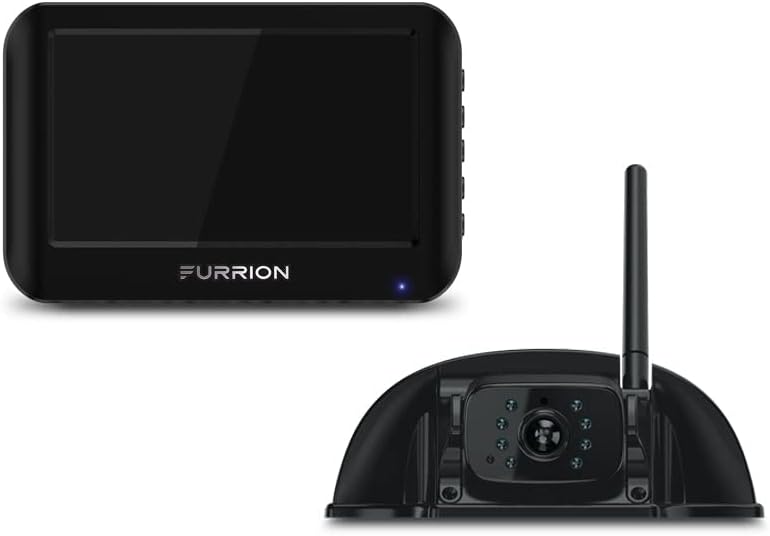
Furrion Vision S 4.3 Inch System
4.4Editor score
Compact 4.3-inch display
Motion-activated security mode
IR night vision
An RV backup camera can make reversing, campsite navigation, and lane changes feel far less stressful, especially when a large trailer hides nearby vehicles, posts, trees, or other obstacles. A useful system combines a clear rear image, dependable wireless performance, useful night vision, and a monitor that is easy to check without obstructing the forward view.
This guide compares ten RV backup camera systems based on their stated resolution, viewing angle, signal range, camera coverage, installation requirements, recording functions, and low-light performance. The list includes wireless designs, systems for factory-pre-wired RVs, dual-camera packages, and a magnetic installation that can move between vehicles.
Each review explains the system's strongest features, practical limitations, and ideal RV type. The top picks highlight the best balance of coverage, convenience, and capability, while the comparison table makes it easier to narrow the field. Prices and availability can change, so confirm current details before purchasing.
4.4Editor score

4.4Editor score

4.5Editor score
As an Amazon Associate we earn from qualifying purchases.
The comparison below covers the essential differences among all ten systems, including camera coverage, display size, image resolution, signal range, and installation style. These specifications help distinguish a compact security camera, a full rear-and-side system, and an easy magnetic setup.



The Furrion Vision S 4.3 Inch Monitor is a compact wireless rear-camera system built for RV owners who value a discreet display and straightforward parking assistance. It carries a 4.4 rating and includes one rear sharkfin camera, infrared night vision, a waterproof camera, and a wide viewing angle. Its smaller monitor takes up less dashboard space than the larger screens in this guide, which is especially useful in vehicles with crowded dashboards or multiple screens already competing for attention.
We may earn a commission when you buy through this link, at no additional cost to you.
The system's defining feature is the combination of parking guidance and security monitoring. Convenient motion sensors can wake the display, while the built-in microphone transmits audio from the camera area. That means the image does more than help you judge the distance behind the trailer; it can also let you hear movement near the rear of the vehicle. This makes the system relevant to campsites where wildlife, pedestrians, or other activity may occur around the rig after parking.
There are clear trade-offs. The single sharkfin camera provides rear coverage rather than a combination of rear and side views, so it will not replace a multi-camera system for narrow campground roads or difficult side maneuvering. The 4.3-inch screen is also less suitable if you want to compare several feeds at once. Nonetheless, for owners seeking a compact, dedicated rear view with night capability and motion-aware security features, the smaller format can be an advantage rather than a limitation.
Choose the Furrion Vision S if you already recognize the brand's pre-wired RV ecosystem, want one dependable rear camera, or prefer a small monitor that stays out of the way. It is especially well suited to RV owners who reverse with a clear rear path but still want a useful view for campsite security, wildlife awareness, and general parking assistance.
The 4.3-inch monitor is easier to position in a limited cockpit than a 7-inch display. That makes this system appealing to owners who need the rear view available without dedicating a large portion of the dashboard to it.
Motion activation and camera audio extend the system's usefulness after the RV is parked. These features can provide awareness of activity around the rear of the vehicle, which is especially relevant during overnight stops.
We may earn a commission when you buy through this link, at no additional cost to you.
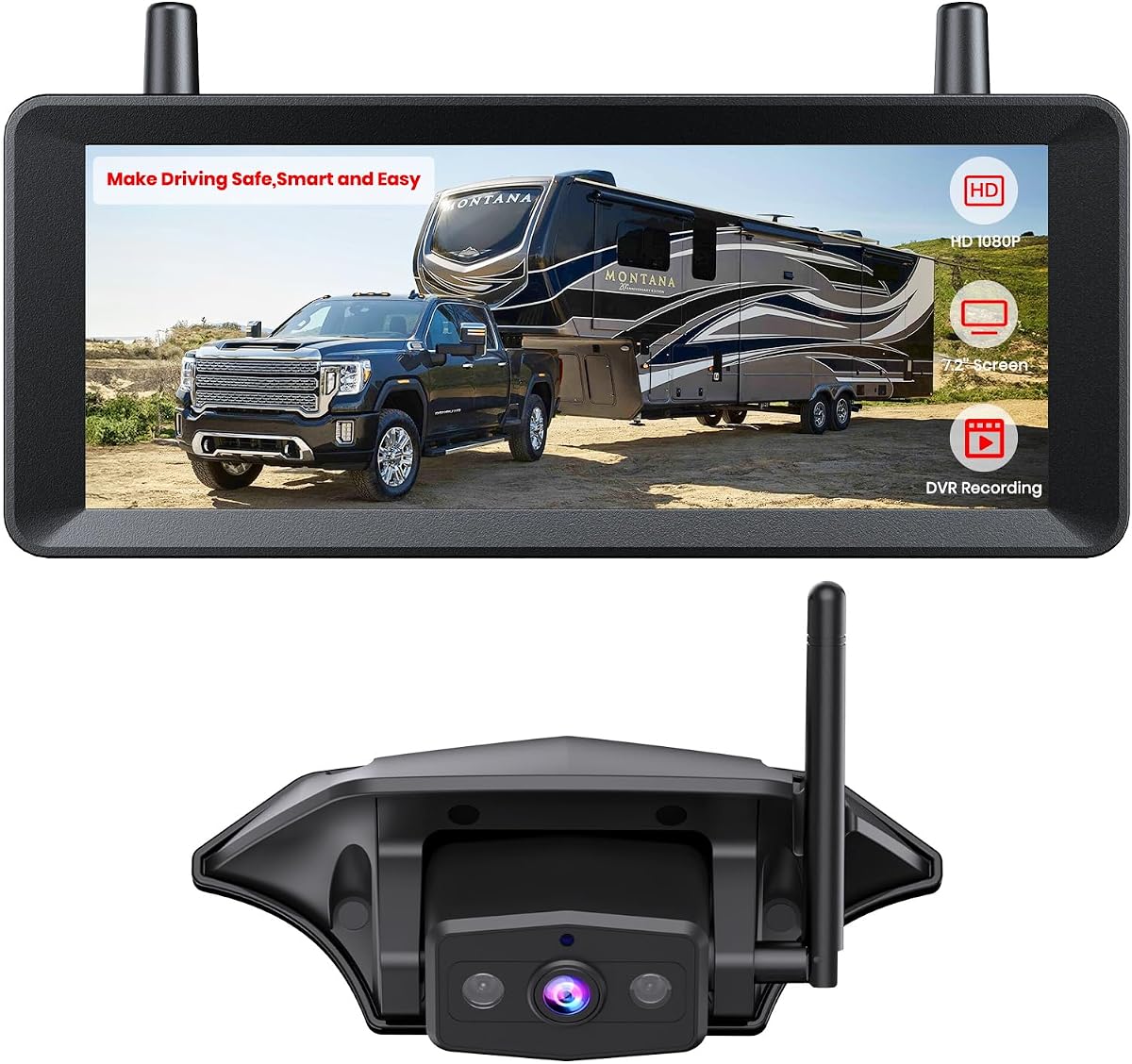
The AUTO-VOX Dual Lens System is the most versatile all-around package in this guide, earning a 4.4 rating for its combination of rear, bumper, and side visibility. Its integrated dual-lens rear camera can show a broad road view behind the RV or a closer lower view for hookups, hitch alignment, and clearance around campsite posts. Side cameras add coverage in locations that conventional tow-vehicle mirrors may not reveal.
We may earn a commission when you buy through this link, at no additional cost to you.
That combination is particularly useful because reversing situations are not all identical. A long highway lane change calls for awareness of approaching traffic, while a tight campsite demands a low view of the bumper area. Switching between the dual rear perspectives gives the driver more than one perspective without replacing the entire camera. The side views help when lining up near fences, checking the rear corners, or maneuvering through a narrow RV park.
Dual antennas on both the rear camera and monitor are designed to maintain a smoother connection across long setups. The stated testing extends to 500 feet in open areas, and the system is described as suitable for rigs longer than 60 feet. The monitor accepts USB or 12-volt power, giving owners flexibility in the tow vehicle. A built-in DVR supports loop recording with a separately sold microSD card, adding useful trip documentation and incident reference without requiring a separate display or recorder.
The trade-off is complexity compared with a single-camera system. The owner must understand which lens shows the broad rear road and which shows the lower bumper area, and the side views add more information to manage. The recording card is also not included. Even so, few options in this roundup match the flexibility of two rear perspectives plus side coverage on a single 7.2-inch HD display, making this a strong choice for long RVs and frequent campsite maneuvering.
The road-facing lens helps with traffic awareness, while the lower bumper view helps judge hookup alignment and obstacle clearance. Having both avoids choosing a single camera angle that may be useful for one part of the trip but poor for another.
Dual antennas and a stated 500-foot open-area test range make the system well suited to long rigs. The design is especially compelling for owners who need more than a basic rear view when towing or entering compact campgrounds.
We may earn a commission when you buy through this link, at no additional cost to you.
The AUTO-VOX Plug and Play system focuses on installation simplicity and expandable coverage. It holds a 4.3 rating and is designed for factory-pre-wired RVs, where installation typically takes 20 to 30 minutes without additional drilling. Its camera can also connect through included adapters to taillight power on compatible, non-pre-wired rigs, offering a more involved but still accessible alternative.
We may earn a commission when you buy through this link, at no additional cost to you.
The 7.2-inch widescreen monitor provides a high-definition view intended to make license plates, signs, curbs, posts, and trees easier to distinguish. The wide-angle lens is useful in tight campgrounds and storage spaces. Rather than stopping at one camera, the system supports up to three cameras and a three-way split screen, allowing the rear and both sides to be monitored together. That makes it a practical middle ground between a single-camera kit and a more complex multi-channel setup.
Dual antennas are engineered to support stable transmission on trailers and fifth wheels up to 60 feet. The system also brightens the image automatically when darkness arrives, combining long-range infrared night vision with automatic adjustment. A 32GB card is included for recording, which is a meaningful convenience for owners who want a visual log of trips without purchasing storage immediately. The camera and monitor still require power, so wireless does not mean completely battery operated.
The main limitation is its stated focus on rigs up to 60 feet. Owners with substantially longer combinations may prefer a system with a 500-foot open-area test range. Some installations may also require the appropriate power adapters. For a typical travel trailer or fifth wheel with factory wiring, however, this system offers an excellent balance of quick setup, recording, automatic night viewing, and expandable side coverage.
The camera is designed to use existing factory wiring and mounting locations, eliminating the need for major drilling in many installations. That makes it a practical choice for owners who want to improve visibility without rebuilding their RV's camera infrastructure.
Support for three cameras lets the owner begin with rear visibility and add side views when required. The three-way split screen turns the compact monitor into a multi-angle driving aid for narrow roads and crowded campsites.
We may earn a commission when you buy through this link, at no additional cost to you.
The Fookoo HD 1080P 7-Inch Wireless Backup Camera System is built around a relatively large IPS touchscreen, a wide 120-degree camera view, and support for as many as four cameras. Its 4.4 rating reflects a capable feature set. The display offers touch buttons, automatic brightness adjustment, and parking lines, while the camera includes six infrared lights and a photo sensor for automatic night operation.
We may earn a commission when you buy through this link, at no additional cost to you.
Its most important nuance concerns compatibility. The unit fits many Furrion pre-wired mounting locations, which can simplify installation for owners of compatible RVs, but it is not electronically compatible with the Furrion camera system itself because the technologies differ. Buyers should therefore treat the matching mount as a physical benefit, not evidence that an existing Furrion system can simply be reused. The stated 2.4GHz signal has an open-area range of up to 200 feet.
Split-screen viewing allows the monitor to expand from a single rear view to multiple camera feeds. Loop recording is available when a compatible SD card is inserted, and the camera's IP69 waterproof rating is appropriate for rain, dust, and road spray. The system also accepts DC 12 to 24 volts, making it suitable for RVs, campers, buses, vans, pickups, and farm machinery.
Installation caveats deserve attention. Some Chevrolet, GMC, and Ford circuits use pulse-width-modulated power that can cause flickering or failure without a compatible filter or adapter. Chevrolet and GMC owners may also need a seven-way power adapter. Those issues are manageable once identified, but they make careful vehicle-specific planning important. For compatible pre-wired RVs, this is a feature-rich option with an excellent display and broad expansion capacity.
The ability to add cameras and display multiple feeds makes the 7-inch monitor useful beyond a simple rear camera. It can grow into a broad vehicle-surround system for owners whose blind spots change with the campsite or road layout.
Automatic screen dimming reduces the need to manage nighttime brightness manually, while infrared illumination and the photo sensor help the camera adapt as ambient light falls. These features support both late-night arrival and routine driving after sunset.
We may earn a commission when you buy through this link, at no additional cost to you.
The Magnetic 1080P RV Camera is the most approachable option for owners who prioritize installation speed. It carries a 4.5 rating and mounts with a strong magnetic base that snaps onto a suitable metal surface. The stated setup time is one minute, with no screws, no permanent wiring, and no drilling. The camera is pre-paired with its monitor, and the package includes the mounting hardware and a USB cable.
We may earn a commission when you buy through this link, at no additional cost to you.
Image quality is centered on 1080P resolution, a 170-degree wide-angle lens, and infrared assistance in low light. The wide field is intended to reveal more of the area from bumper to bumper, which is useful for campgrounds, storage areas, and fifth-wheel maneuvering. The system also supports stable transmission over a stated 56 feet and is described as remaining effective on 40-foot trailers at highway speeds.
Its power approach is unusually convenient. A built-in solar panel charges the battery daily, while a USB-C port provides a charging option for cloudy periods. This avoids the need to connect the camera permanently to the RV's electrical system. The magnetic mount also makes it possible to move the same camera between a truck, RV, boat, or another compatible vehicle rather than installing separate hardware in each one.
The 56-foot signal is the most important limitation. It may suit shorter trailers and travel setups, but it offers less margin for very long RVs than systems tested to 300 or 500 feet in open areas. The magnetic base also requires a stable metal mounting surface and careful placement to avoid damage. Even with those constraints, the combination of a wide lens, 1080P image, solar charging, and tool-free mounting makes this an appealing high-convenience choice.
The magnetic base changes the installation process from a permanent project into a simple mounting decision. It is especially useful for renters, owners of several tow vehicles, and travelers who need occasional rather than continuous rear-camera coverage.
Daily solar charging and USB-C access provide two ways to maintain the camera's power. The design is useful for travelers who want a rear view without creating permanent wiring around the trailer.
We may earn a commission when you buy through this link, at no additional cost to you.
The AUTO-VOX Rear and Side Coverage system places rear and both side angles on one 7.2-inch HD display. Its 4.2 rating is slightly below the leaders, but the feature set is broad. Owners can use a full-screen view while traveling and switch to split views when precision backing, campsite alignment, or tight turns require more than one perspective.
We may earn a commission when you buy through this link, at no additional cost to you.
The system is intended to solve familiar RV visibility problems. Side views help when checking the rear corners or moving through an RV park where mirrors do not reveal enough of the surroundings. They also add value during lane changes with a long trailer because the driver can look more broadly at traffic behind and beside the rig. The included cameras and screen keep the installation organized around one display rather than separate monitors for each angle.
Dual antennas support a stated 500-foot transmission range in open areas, including for rigs longer than 60 feet. The 1080P image is designed to remain clear while towing and backing, while infrared night vision helps reveal animals, pedestrians, posts, and other obstacles after dark. The monitor can be powered by USB or a 12-volt car charger, offering flexibility across tow vehicles.
Recording is handled by a built-in DVR that saves to the included 32GB card. Older footage is overwritten automatically during loop recording, which provides continuous documentation without manual intervention. That feature also means the card's capacity and condition deserve routine attention. Compared with the dual-lens system in second place, this model does not offer a separate close bumper perspective, but its straightforward rear-and-side arrangement is still broad and practical for large RVs.
Showing the rear and both sides on one display reduces the need to install and switch among separate screens. This is particularly valuable around parked vehicles, tight campsite entrances, and narrow park roads.
The included 32GB card and automatic loop recording make the DVR ready to use from the start. Drivers can maintain a continuous trip log while avoiding the need to manage separate recording components.
We may earn a commission when you buy through this link, at no additional cost to you.
The Dual Camera 4-Channel Monitor combines a 7-inch 1080P display with two included cameras and room to expand to four. Its 4.4 rating makes it one of the stronger choices for owners who want more than a simple one-camera setup. Single, dual, and quad split views make it possible to tailor the screen to rear-only driving, two-camera awareness, or a complete multi-angle layout.
We may earn a commission when you buy through this link, at no additional cost to you.
Each camera uses a 150-degree wide-angle lens, automatic infrared night vision, and an IP69K waterproof housing. The housing is stated to withstand rain, dust, and splashes across a temperature range of minus 23 to 179 degrees Fahrenheit. A custom metal adapter bracket is included to match many factory-pre-mounted RV bases, which can reduce drilling and help the cameras occupy familiar exterior positions.
The dual-antenna system is stated to maintain stable HD video over a 300-foot distance. Reversing guide lines can be shifted in several directions, have their width adjusted, or be turned off completely. This flexibility is useful for different trailer alignments and driver preferences. DVR loop recording is also supported, although a compatible microSD card up to 256GB must be purchased separately.
It is important not to confuse wireless video transmission with battery operation. Both cameras and the monitor require a wired 12-volt power source, and the package is not designed to run without power. For an owner with a pre-wired RV, this limitation is less significant. The 300-foot range, included pre-wired bracket, two-camera starting point, and four-channel expansion path make this a flexible and capable choice.
The package includes two cameras, allowing immediate rear-and-side or front-and-rear monitoring without an immediate full expansion purchase. Additional cameras can be added later when the owner's parking and blind-spot needs become clearer.
Movable, width-adjustable reversing guides let the driver tune the image to the trailer and parking area. Turning the guides off entirely provides a cleaner view for drivers who prefer distance judgment over graphic overlays.
We may earn a commission when you buy through this link, at no additional cost to you.
The AUTO-VOX Rear and Side Cameras system balances broad visibility, long-range wireless performance, and a 30-minute DIY installation target. It holds a 4.3 rating and is designed for both factory-pre-wired RVs and rigs that can connect the camera to a 12-volt source. Included bracket and pigtail hardware support a faster setup when the RV already has compatible camera wiring.
We may earn a commission when you buy through this link, at no additional cost to you.
The 7.2-inch monitor can present up to three camera views in a split screen when paired with compatible side cameras. This is useful on narrow campground roads, where a single rear feed may not reveal a neighboring RV, picnic table, post, or another obstacle. During highway lane changes, the broader rear and side view gives the driver another way to assess nearby traffic before moving the tow vehicle and trailer.
A 1080P sensor and built-in infrared LEDs support low-light visibility when arriving at a dim campsite after sunset. Dual antennas are rated for transmission over a stated 500 feet, which is a useful margin for longer combinations. The cameras carry an IP69K rating intended to withstand rain, road spray, and dust during extended travel.
The built-in DVR can capture footage when a compatible SD card is inserted, but the card is not included. As with other wireless camera systems, the video link is wireless while the hardware still needs power. These are modest caveats next to the system's long-range capability and three-view display. It is a strong option for an RV owner who wants rear and side coverage, dependable highway transmission, and nighttime visibility in one package.
The split screen is valuable on narrow campground roads, while a single enlarged view provides more detail when lining up a site. The same system can therefore serve both low-speed precision work and broader highway awareness.
Dual antennas and a 500-foot stated transmission range help the monitor maintain a steady view across long RV arrangements. This is a meaningful advantage for fifth wheels and other extended combinations traveling at highway speeds.
We may earn a commission when you buy through this link, at no additional cost to you.
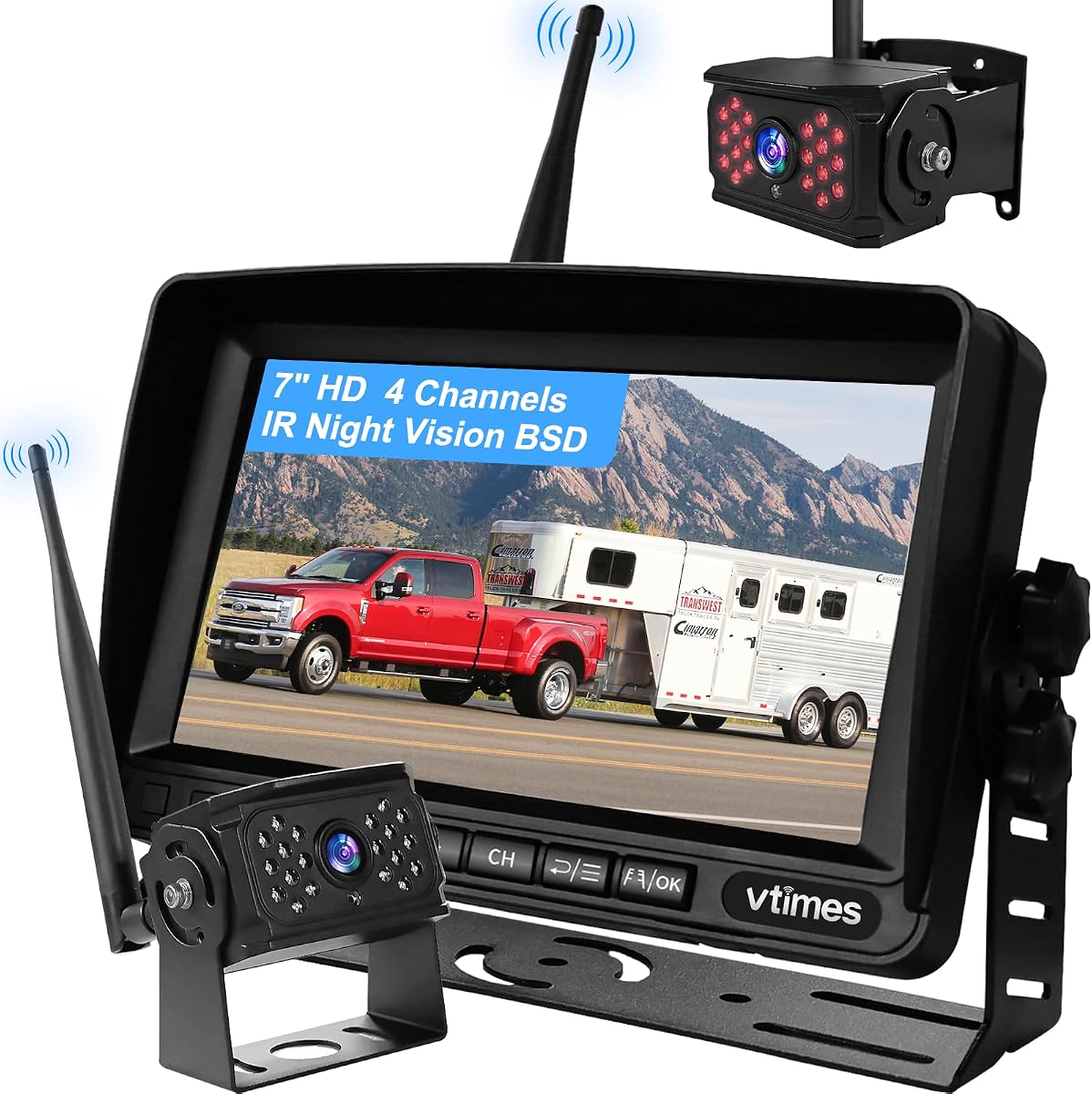
The VTimes Wireless Backup Camera system stands out for its stated 984-foot open-area transmission range and built-in blind-spot detection. It has a 4.2 rating and includes a 7-inch monitor, a camera, a cigarette-lighter monitor connection, and a pigtail for camera power. For compatible pre-installed Furrion systems, the package also provides an RV mounting bracket and pigtail wire.
We may earn a commission when you buy through this link, at no additional cost to you.
Its blind-spot detection can be turned on or off. When enabled, the system highlights a detected object or person on the display and provides an audible alert. That adds a different kind of assistance than a simple guide line, potentially helping the driver notice a hazard that is outside the normal mirror view. The camera uses a 120-degree lens, 2.4GHz frequency-modulation transmission, and a CMOS image sensor.
The all-metal camera housing is described as IP69K waterproof, shockproof, and built for severe weather. Twenty built-in infrared lights support automatic night vision, while customizable parking lines can be adjusted to match the driver's preferred reference points. The monitor also supports continuous recording and playback across four video channels, with automatic deletion of the oldest footage as storage fills.
A compatible 8GB to 128GB microSD card is required for recording and is not included. The camera also needs a wired tail-light, reversing-light, or running-light connection, so the system is not entirely installation-free. Nevertheless, the exceptional stated range, audible blind-spot warnings, and four-channel recording make this an attractive option for owners who want extended signal reach and a high degree of monitoring.
We may earn a commission when you buy through this link, at no additional cost to you.
The AUTO-VOX Plug and Play RV is a flexible three-channel system designed for factory-pre-wired campers and other RVs. It has a 4.1 rating, the lowest in this group, but offers a balanced package with 1080P imaging, infrared night vision, dual antennas, a 7.2-inch widescreen display, and a stated 500-foot test range.
We may earn a commission when you buy through this link, at no additional cost to you.
Installation is central to the design. On a compatible pre-wired RV, the included mounting bracket and pigtail simplify the process. For a non-pre-wired rig, the camera can connect to taillights, running lights, or marker lights. This makes the system more broadly applicable, although the wiring path and exact connector requirements should be checked before installation.
The monitor can expand to three cameras. Owners can add side cameras for blind spots or use additional camera positions around the RV for campsite awareness. A 1080P color chip and super infrared night vision are designed to provide a clear rear view during both daylight and darkness, including when looking for wildlife or monitoring the area around an overnight campsite.
DVR recording is supported with a compatible SD card, allowing the camera to capture nighttime activity and provide a record of the journey. The card is not included, and the super-wide lens may require drivers to adjust to its broader perspective. Overall, this system is a practical option for RV owners who want a reasonably compact monitor, three-camera flexibility, and long-range wireless performance in a system that can use existing RV wiring.
Three-camera support gives owners a practical path to rear and side monitoring without requiring a four-channel arrangement. Additional positions can also be considered for campsite security and awareness around the vehicle.
Infrared night vision supports low-light visibility, while DVR capture can preserve footage for later review. Together, these features extend the system beyond a simple parking aid into an overnight awareness tool.
We may earn a commission when you buy through this link, at no additional cost to you.
The right RV backup camera depends on rig length, factory wiring, parking environment, and whether you need rear-only visibility or a broader multi-camera system. Evaluate coverage, signal range, power requirements, recording, night performance, and installation before making a purchase.
A rear camera is the core of every system in this guide, but it may not be enough for the way you travel. Side cameras help reveal pedestrians, vehicles, posts, trees, and other obstacles near the rear corners of a trailer, particularly when mirrors cannot show the full area around a long RV. A system with three views can be especially helpful in crowded campgrounds, narrow RV parks, storage buildings, and campsites bordered by fences or picnic tables. If your main concern is highway awareness rather than tight maneuvering, a single broad rear view may be more straightforward.
Resolution influences how much fine detail remains visible, while viewing angle determines how much of the scene appears on screen. Most systems here use 1080P imaging, which can make signs, plates, curbs, posts, and tree lines easier to distinguish. Angles range from 120 degrees on the Fookoo and VTimes cameras to 170 degrees on the magnetic system. A wider lens can cover more space, but it may also make distance judgment less intuitive. Consider the parking areas you visit and the screen size you can comfortably check at a glance.
Signal range should comfortably exceed the distance between the camera and monitor in your particular RV arrangement. Stated open-area figures range from 56 feet for the magnetic system to 984 feet for the VTimes model, with several systems offering 300- or 500-foot figures. These are not guarantees of real-world performance, since walls, vehicle structure, weather, and interference can affect the link. Match the system to the length of your rig, and allow margin if you travel in varied environments or use a long fifth wheel.
A factory-pre-wired RV can make installation much easier, but compatibility must be confirmed before buying. Some products use common Furrion-style mounting locations, while the Fookoo system explicitly does not share Furrion's underlying technology. The AUTO-VOX Plug and Play system, Fookoo, and the VTimes package include relevant brackets or adapters. For a non-pre-wired vehicle, you will need a stable 12-volt power source, appropriate taillight connections, and possibly vehicle-specific adapters. Check connector type, power requirements, and physical mounting points before opening a panel or drilling into the RV exterior.
Most backup cameras transmit video wirelessly but still require power at both the camera and monitor. Several systems accept a 12-volt outlet or cigarette-lighter connection for the monitor, while cameras commonly draw power from tail, running, reversing, or marker lights. The magnetic camera is the exception, using solar charging and USB-C access for a more mobile setup. Permanent wiring offers consistent operation, whereas magnetic mounting is quicker and removable. Some vehicles use PWM power that may require a compatible filter or power adapter, so model-specific electrical research can prevent installation problems.
A camera that looks clear in daylight can still disappoint during a late campsite arrival. Most systems here use automatic infrared illumination to brighten low-light scenes, while several also adjust the monitor's brightness automatically. Infrared helps reveal objects beyond the reach of the vehicle's taillights, including people, animals, curbs, posts, and trees. Consider both the camera's infrared hardware and whether automatic controls reduce the need for manual adjustment. A large display is also helpful at night because subtle edges and depth cues may be easier to see when the image fills more of the screen.
Recording can provide a visual log of trips, campsite activity, and road incidents. Some DVR systems record automatically while powered, while others allow loop recording to be enabled after a compatible SD card is inserted. Included storage varies: the AUTO-VOX Plug and Play and Rear and Side systems include a 32GB card, while the Fookoo, VTimes, Dual Camera 4-Channel, and AUTO-VOX Rear and Side models require separate storage. Check supported card capacity, whether recording is automatic, and how the system overwrites old footage before deciding whether the added storage cost matters to you.
The monitor must be large enough to show useful detail without blocking the forward view. The 7.2-inch AUTO-VOX displays provide more room for split views than the compact 4.3-inch Furrion monitor. Several systems offer adjustable parking lines, while some include blind-spot alerts or AI-assisted human detection. These aids can support inexperienced drivers, but they should complement—not replace—direct observation. Touch controls, automatic dimming, guide-line positioning, and the ability to turn overlays off can all affect how comfortably the display fits into your driving routine.
Begin by identifying the correct power source, mounting the camera where it has a clear view behind the RV, and confirming that the monitor can reach both 12-volt and USB options if supported. Pre-wired RVs should be checked for connector compatibility before installation. On non-pre-wired rigs, follow the included guidance for tail-light, running-light, reversing-light, or dedicated power connections, and use a vehicle-specific adapter or PWM filter when required.
Pair the camera and monitor, then test the full system before relying on it in a driveway. Check the live image in daylight and darkness, adjust the parking lines if available, and confirm the angle does not hide nearby posts, vehicles, or the edge of the trailer. If the system supports multiple views, learn how to switch between full-screen and split-screen modes before entering a campground or reversing into a confined area.
Keep the camera lens clean, inspect the mount for looseness, and check the power connections periodically. Weather can affect visibility even when the camera housing is rated for outdoor exposure. Test the system periodically while parked, review the storage card when the system records, and replace it if the vehicle is not detecting it reliably. For removable systems, remove the camera when it is not needed and protect the magnetic base from scraping the vehicle's paint.
They often are, because the video signal does not need a long cable running from the camera to the monitor. However, most wireless systems still require power connections for the camera and monitor, and non-pre-wired RVs may still need tail-light or dedicated 12-volt wiring. Check your RV's existing camera provisions and electrical requirements before assuming installation will be entirely plug-and-play.
A wide angle around 150 degrees offers a useful balance of nearby clearance and broader situational awareness. Very wide lenses can show more of the bumper and rear corners, but they may make distance estimation less intuitive for some drivers. The best angle is one that clearly shows the areas around your hitch, bumper, and campsite while remaining easy to interpret from the driver's seat.
Side cameras are valuable if you regularly navigate narrow campground roads, park between close objects, or want to check traffic beside a long trailer. They are less essential for straight backing into an open space with a clear rear path. A three-camera system provides a more complete view, but added displays and cameras can also make the setup more complex to manage.
It depends on the system and its power arrangement. DVR-equipped models can record while the system is powered, and some include motion-related features, but the camera and monitor generally need a reliable power source. A fully battery-powered or solar-assisted design may support more mobile recording, while wired installations depend on the vehicle's electrical system and any parking-related power considerations.
No. A camera may fit a Furrion-style mounting position without being compatible with Furrion's underlying technology. The Fookoo system in this guide explicitly uses compatible physical mounts but does not work with the Furrion system itself. Confirm connector shape, power method, wireless compatibility, mounting dimensions, and display functions before making a purchase.
The signal should comfortably cover the distance between the camera and monitor in your specific RV. Systems here state open-area ranges from 56 to 984 feet, but real results depend on the rig's construction and environment. Long fifth wheels and trailers benefit from more margin, while a shorter trailer may work with a more compact system.
Some vehicles use PWM power signals that can interfere with a camera connected to certain taillight circuits. Depending on the RV, the solution may be a compatible vehicle power adapter or a PWM filter. If the flicker continues, verify the wiring path, grounding, and connector compatibility rather than repeatedly disconnecting the monitor.
Yes, because infrared illumination can reveal posts, people, animals, and low obstacles in darkness that may be difficult to judge from the mirrors alone. The image can look different from a daytime color view, so drivers should practice with the system before relying on it in a tight space. Automatic brightness and night-vision activation make the transition less distracting.
The AUTO-VOX Dual Lens System is the most complete option for owners who want a broad road view, a close bumper perspective, and side coverage on one 7.2-inch display. The Furrion Vision S stands out when a compact monitor, rear camera, motion activation, and audio are priorities, while the Magnetic 1080P camera wins for quick, removable installation and easy movement between vehicles.
For the remaining choices, prioritize the factors that match your actual travel pattern. Pre-wired RV owners should confirm connector and technology compatibility, long-rig owners should leave ample signal-range margin, and drivers who enter dark campgrounds should look closely at infrared performance. Multi-camera support and DVR recording are valuable when you need surrounding awareness and trip documentation rather than only a simple rear image.
Finally, confirm the current product details, included accessories, storage-card requirements, and power connections before ordering. RV layouts, wiring standards, and manufacturer packages can change, and prices and availability also fluctuate. Taking a few minutes to verify compatibility will make the installation smoother and help the selected camera provide dependable visibility for every trip.