Outlet Extender with USB-C
4.7Editor score
Six AC outlets plus USB charging
Ultra-slim 1.3-inch profile
Built-in cable organization
Compare 10 low profile outlet splitters for tight spaces, checking plug depth, outlet count, rotation, USB charging, and safety for home and travel.
A low profile outlet splitter adds usable power outlets without the deep, bulky housing that can prevent furniture from sitting close to a wall. The most useful models combine a shallow plug with side-facing receptacles, flexible cord placement, or rotating connections, making them practical for bedrooms, offices, entertainment centers, kitchens, and travel.
The ten products in this guide were compared by examining outlet quantity, measured or stated plug depth, cord length, rotation, charging options, safety features, supported plug types, and suitability for confined indoor spaces. The list includes compact tap-style extenders, short-cord models, multi-outlet adapters, and options with USB or USB-C charging.
Each numbered review explains where the product stands out, identifies any limitations, and identifies the type of user most likely to benefit from it. Ratings reflect the supplied customer feedback, while product features and intended uses are based on the available manufacturer information. Availability, configurations, and prices can change over time.
4.7Editor score

4.8Editor score

4.6Editor score
This side-by-side comparison highlights the major differences in physical profile, outlet access, charging capability, grounding, rotation, and portability so readers can match a splitter to their particular outlet and furniture-placement needs.


The TROND Flat Outlet Extender combines one of the most compact profiles in this guide with a short, flexible cord and three-sided outlet access. It carries a 4.8 customer rating, making it one of the strongest choices for users who need equipment to sit close to a wall without sacrificing access to multiple grounded receptacles.
We may earn a commission when you buy through this link, at no additional cost to you.
Its stated depth is 1.26 inches, and the included plug is designed to lie low against the wall. Outlets appear on three sides, allowing large wall adapters to connect from different directions without the crowding that often occurs with a conventional cube tap. The six-inch 14AWG cord adds just enough reach to shift the connection sideways, and the white power LED provides a quick indication that the outlet is active.
The main limitation is that the plug cannot rotate, which makes its orientation less adaptable than products with swivel or 360-degree connections. It is also specifically not designed for recessed or floor outlets. Those restrictions are understandable for a low-profile design aimed at standard indoor receptacles, but buyers with unusual outlet locations should verify fit before purchasing.
This is a strong recommendation for nightstands, sofas, bed frames, desks, kitchen counters, and travel bags. It particularly suits anyone who wants the shallowest possible connection combined with a little positioning flexibility from the short cord. For most standard indoor applications, it delivers the most balanced combination of depth, access, and portability.
The shallow housing and low-profile plug are intended to reduce the gap behind furniture. Side access is especially valuable when a sofa, dresser, or nightstand sits close to the wall and the normal direction of a bulky adapter is inconvenient.
This model does not include surge protection, which also makes it more suitable for cruise cabins and other locations where surge-protective devices may be prohibited. It should be treated strictly as an outlet extender rather than an electrical condition protector.
We may earn a commission when you buy through this link, at no additional cost to you.
The Surge Protector Outlet Extender is designed for people who want more than additional wall receptacles. It combines six grounded AC outlets, two USB-A ports, two USB-C ports, an adjustable plug, and 1800-joule surge protection in a single unit. Its 4.7 rating reflects a well-rounded approach to both power distribution and device charging.
We may earn a commission when you buy through this link, at no additional cost to you.
The body measures 5.7 by 1.9 by 1.7 inches, which is more substantial than the smallest flat adapters. Its rotating plug can turn left or right, helping it fit horizontal or vertical receptacles, while the three-sided arrangement provides space for large plugs. USB-A ports deliver up to 2.4A at 5V, and the USB-C port is rated up to 3A at 5V with automatic device detection.
Surge protection is provided through a stated 1800-joule energy-absorbing capacity and multiple protective circuit technologies. The shell is described as fire-resistant ABS, and the product is ETL certified. Buyers must still observe the 1875W and 15A total limit. As with any dense power accessory, this model is less suitable where only a very thin tap can fit behind furniture.
Choose it for a charging station, office desk, entertainment center, or a wall with several high-draw devices. It is less ideal for a tight furniture gap where its larger housing would be visible or restrictive. For anyone seeking charging convenience, plug articulation, and surge protection in one package, however, it offers excellent versatility.
The four USB ports reduce the need for separate wall chargers when phones, tablets, or other compatible devices are being replenished. The AC outlets remain available for computers, lamps, speakers, and other equipment, creating a compact multi-device hub.
The three-sided layout separates receptacles enough for larger power bricks. This makes the extender easier to use in offices and entertainment areas where several adapter-shaped plugs would otherwise block one another.
We may earn a commission when you buy through this link, at no additional cost to you.
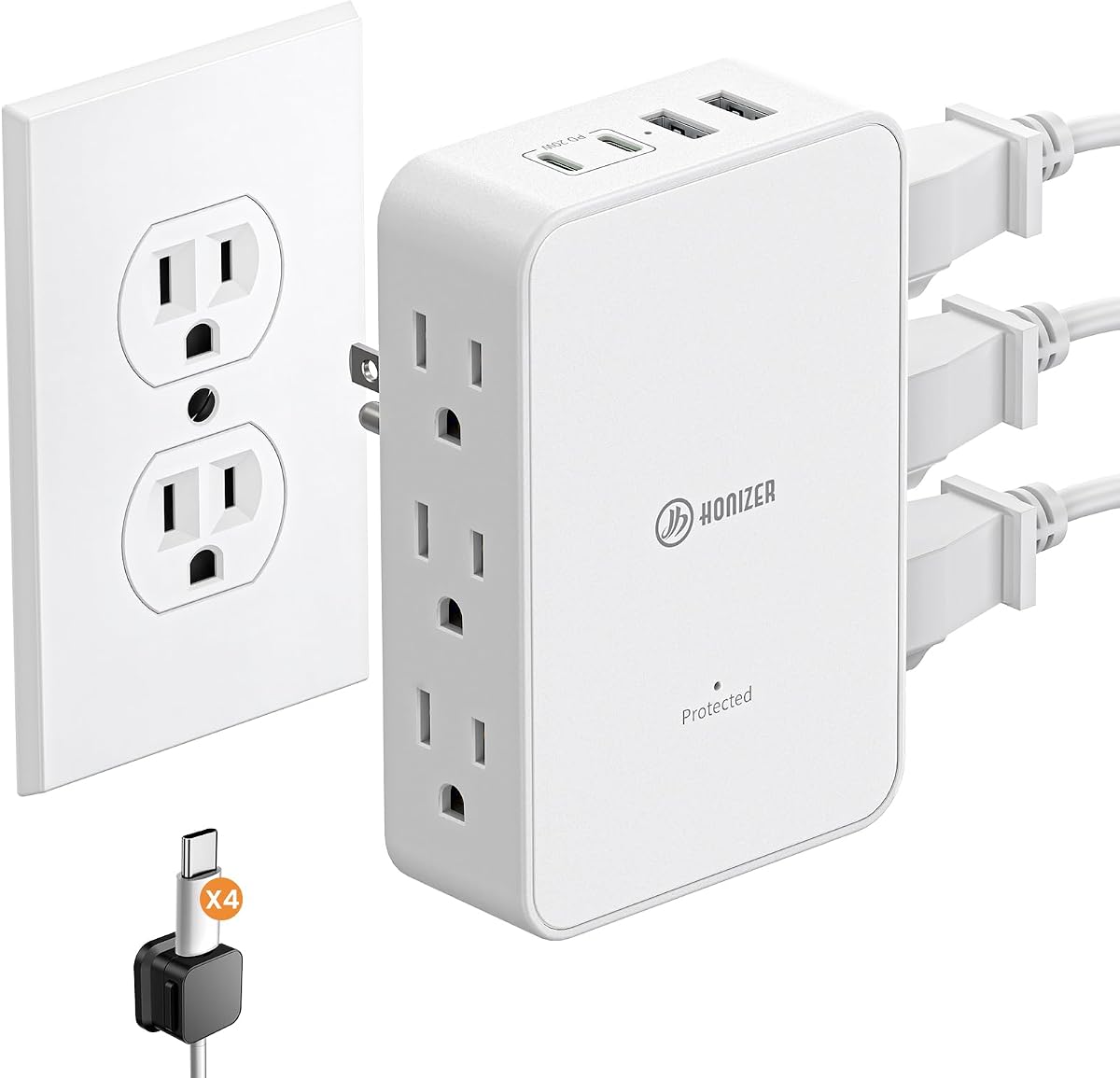
This outlet extender is an appealing all-in-one option for users who need a thin furniture-friendly profile and multiple charging options. It has a 4.7 rating and combines six AC outlets with two USB-A and two USB-C ports in a stated 1.3-inch design. The result can serve up to ten connected devices through one wall receptacle.
We may earn a commission when you buy through this link, at no additional cost to you.
Side-facing outlets help keep cords from bending sharply or disappearing behind sofas and beds. Four integrated cable clips provide a tidy way to route charging leads near entertainment centers and desks. The USB-C ports support 20W Power Delivery, while the USB-A ports are listed at up to 15W, making USB-C the faster option for compatible devices.
Safety features include a lighted power switch and an integrated 15-amp resettable circuit breaker intended to guard against overload and overcurrent. Installation requires no screws or wiring. The trade-off is that the device includes more electronics than a basic outlet tap, and its USB-A output is not as fast as its USB-C output. Users wanting the thinnest possible tap with no charging electronics may prefer a simpler model.
It is best suited to nightstands, desks, entertainment centers, offices, and kitchens where both wall plugs and USB charging are needed. The combination of low-profile construction, organized cable management, and resettable protection makes it one of the most complete picks for a modern charging setup.
Side access reduces the need to force a plug into a narrow gap at an awkward angle. Built-in clips also keep frequently used charging cables visible and organized instead of allowing them to disappear behind furniture.
The illuminated switch provides a visible on/off indicator, while the resettable breaker provides an added layer against overload. It is a useful combination for a shared charging station used regularly throughout the day.
We may earn a commission when you buy through this link, at no additional cost to you.
The NUTICT Flat Outlet Extender offers a balanced alternative for shoppers who want a slim plug and cord-based positioning without USB electronics. It has a 4.8 rating, three grounded outlets distributed on different sides, and a short 14AWG cord that helps bring power to the side of furniture.
We may earn a commission when you buy through this link, at no additional cost to you.
The multi-sided layout gives bulky plugs and adapters more room, reducing competition for the same connection point. Its six-inch cord is not intended to power a distant appliance; rather, it provides a modest amount of repositioning around a standard wall outlet. The total maximum load is 1875W at 125V and 15A.
The product does not include surge protection and is not designed for recessed, floor, or outdoor outlets. Those limitations narrow its use compared with a feature-rich charging hub, but they are reasonable for a product marketed primarily for compact indoor placement. The short cord also eliminates the cable management issues associated with a conventional extension strip.
It is a good choice for TVs, nightstands, desks, countertops, entertainment centers, dorms, and cruise cabins. Users should confirm the applicable cruise line's current policy and verify that the plug fits the target receptacle. Within that scope, it is a straightforward and highly rated way to gain three outlets without installing a full power strip.
The six-inch length is short enough to avoid excess cable while giving the outlet body enough freedom to sit beside a wall. This is especially useful when a furniture edge hides the wall connection but prevents a rigid tap from being inserted easily.
Because the extender has no surge protection, it may be used where surge-protective devices are restricted. Travelers should still check their cruise line's rules, particularly for the type and number of powered devices they intend to connect.
We may earn a commission when you buy through this link, at no additional cost to you.
The Cable Matters 3-Pack is a practical budget choice for households that need a compact outlet adapter in more than one place. Each black unit converts one grounded wall outlet into three additional AC receptacles, and the set includes three adapters for bedside tables, travel bags, offices, or other locations.
We may earn a commission when you buy through this link, at no additional cost to you.
Its 90-degree outlet arrangement is the defining feature. Large wall warts and adapter-shaped plugs can connect without extending straight outward or blocking the neighboring receptacle on a standard two-socket wall. The adapter supports both three-prong grounded cords and two-prong polarized electrical cords, broadening compatibility with common household and travel accessories.
There are two notable constraints. First, the product information states that two of these adapters cannot fit side by side on the same wall outlet. Second, the design has no cord, surge protection, or USB charging, so it remains a basic way to multiply available receptacles rather than a complete power-management hub.
It is recommended for travelers, students, office workers, and anyone who wants several simple splitters at once. Keep one in a suitcase, one in a laptop bag, and one near a frequently used outlet. At 4.6 stars, the pack is especially attractive for its convenience and useful right-angle geometry.
The three-unit format solves a common limitation of single outlet splitters. Rather than repeatedly unplugging and moving one adapter, users can keep compact units at several locations or pack them into different bags.
The right-angle arrangement redirects large adapters away from the neighboring socket. That is helpful behind entertainment equipment and desks where a straight plug would consume more of the available depth.
We may earn a commission when you buy through this link, at no additional cost to you.
The Unidapt Outlet Splitter is designed around portability and neat cord routing. This two-pack includes compact flat-tap extenders that turn one wall socket into three grounded plugs, and it carries a 4.7 rating. Each unit measures 2.5 by 1.4 by 1.18 inches, making it easy to place in luggage or carry-on storage.
We may earn a commission when you buy through this link, at no additional cost to you.
Its flat, angled arrangement lets attached cords travel sideways behind furniture and televisions rather than projecting directly into the room. That makes the splitters more practical for a living room, bedroom, office, or dorm where visual clutter and furniture clearance matter. The product supports up to 1875W at 125V and 15A.
The absence of surge protection is presented as a cruise-ship benefit, although travelers must follow the rules set by their specific cruise line. The product also has no USB ports or integrated cable, keeping it focused on basic outlet expansion. Compared with the more advanced models in this guide, its feature set is intentionally limited.
This pack suits frequent travelers, students, and anyone who wants a small secondary adapter for a hotel or guest room. It also works well for bedside charging when a shallow, cordless format is more important than faster USB charging. The included warranty and UL-listed components add confidence to an otherwise straightforward design.
The cordless body eliminates cable storage and tangling. Its small footprint also means it can remain plugged in without the extra depth associated with a conventional extension cord.
Three grounded positions can accommodate phones, laptops, lamps, and small appliances at the same time. Users should confirm that the combined draw stays within the stated 15A and 1875W limit.
We may earn a commission when you buy through this link, at no additional cost to you.
The 2 Pack 3 Way Flat Outlet Plug Extender is a compact, rotating solution for indoor outlets where a two-prong connection is appropriate. It has a 4.5 rating and uses a rotary plug design that can bend to different angles, helping attached plugs remain close to the wall.
We may earn a commission when you buy through this link, at no additional cost to you.
Three outlets allow a user to connect several items without relying on a full power strip. The rotating plug is especially useful with large adapter-shaped plugs, which can otherwise occupy too much space or interfere with adjacent receptacles. The set includes two adapters, so one can remain at home while another is packed for a trip.
Its key limitation is the two-prong wall connection, which does not provide the grounding path available on the three-prong models in this guide. The product is listed for indoor use and carries a stated maximum rating of 125VAC, 15A, and 2500W. Because the listing contains no surge protection, users should not treat it as a surge protector or use it for unsuitable high-load equipment.
It is best for travelers, dorm residents, and users with grounded-device needs who work with a compatible two-prong receptacle. The pair provides useful flexibility at a modest cost, but anyone who can use a grounded outlet should prioritize a grounded extender for broader compatibility and stronger electrical positioning.
The plug can be turned to match the socket and preserve clearance. This is valuable when a large charger projects outward or when nearby furniture leaves little room for a straight connection.
The two-pack format supports separate travel and home use. Each unit remains small enough for a laptop bag, nightstand drawer, or suitcase without adding the bulk of a full extension cord.
We may earn a commission when you buy through this link, at no additional cost to you.
The TROND Outlet Extender with 360 Rotating Plug is built for maximizing the number of devices connected to one receptacle. It converts one wall outlet into six AC sockets, carries a 4.7 rating, and uses a plug that rotates through 360 degrees for flexible positioning.
We may earn a commission when you buy through this link, at no additional cost to you.
Rotation is the main advantage over a fixed tap. The connection can point upward, downward, sideways, or at an intermediate angle, making the unit easier to fit behind furniture or near awkwardly placed receptacles. The body measures 3.17 by 1.77 by 1.75 inches, and the cordless construction eliminates the tangle and bulk of a traditional power strip.
The listed electrical rating is 1875W at 125V and 15A across all connected devices. The shell is described as fire-resistant PC, and the product is certified to FCC and RoHS requirements. Its limitation is that six outlets make it larger than the more compact three-outlet extenders, so it may not be ideal where every fraction of an inch behind furniture matters.
This model is a good fit for RV interiors, baseboard outlets, cruise cabins, travel rooms, and temporary charging stations where numerous devices need access. It has no USB ports and no surge protection, making it better understood as a high-capacity adapter than a charging hub. It also carries no cord, which supports convenient packing.
Unlike a limited swivel, the 360-degree connection can be oriented in any direction. That flexibility is especially useful around baseboards, furniture edges, and receptacles installed at unusual angles.
Six AC sockets accommodate laptops, phones, cameras, shavers, and other everyday devices. Its cordless body travels easily and can create a compact charging point in a hotel, cabin, or RV.
We may earn a commission when you buy through this link, at no additional cost to you.
The Power Cord Extension Y Splitter is a different kind of low-profile solution because it combines a 90-degree flat wall plug with a one-foot Y-shaped extension cable. It provides two output receptacles and a 4.7 rating, making it useful when devices need both clearance and a modest amount of additional reach.
We may earn a commission when you buy through this link, at no additional cost to you.
The angled plug sits against the wall rather than projecting directly outward, freeing the neighboring outlet and allowing furniture to move closer. Each output has its own power cord, which can help place a computer and monitor at different distances from the wall. The listed 16AWG SJT cable is described as UL Listed and designed to work with both three-prong grounded and two-prong cords.
Compared with a tap-style extender, this model uses more space because of its one-foot cable. It is therefore most appropriate where a small amount of reach solves a placement problem, not where the absolute shortest possible connection is required. It also provides only two outlets and does not include surge protection or USB charging.
It is a good choice for home offices, computer desks, kitchen counters, and areas with equipment positioned at slightly different distances from a receptacle. The low-profile wall plug improves the initial clearance, while the branching cable prevents a single bulky adapter from dominating the entire connection.
The wall plug angles away from the socket, while the one-foot cable provides enough distance to route equipment around a wall edge or furniture base. This is useful where a completely rigid tap cannot reach a comfortable plug-in position.
Each outlet is fed by its own section of the Y-shaped cable. Devices can therefore sit at different positions instead of being forced into one shared plug direction, which is helpful for computer and monitor arrangements.
We may earn a commission when you buy through this link, at no additional cost to you.
The Flat Plug Extension Cord stands apart with an exceptionally thin stated plug depth of 0.35 inches. It carries a 4.8 rating and uses a one-foot cord to connect three grounded outlets, offering a useful combination of shallow wall clearance and enough reach to position devices more comfortably.
We may earn a commission when you buy through this link, at no additional cost to you.
The plug can enter a top wall socket without blocking the bottom one, directly addressing a common dual-receptacle problem. The output strip provides two front-facing sockets and one rear-facing socket, giving users different connection directions for lamps, computers, gaming equipment, audiovisual components, and other household electronics.
Its maximum capacity is 1625W at 125V and 13A, which is lower than the 1875W and 15A limits stated for several competing products. The housing is described as V-0 flame-retardant PC, and the cable uses 16/3 AWG copper conductors with PVC insulation. It is intended for indoor use and does not provide surge protection.
This is a strong choice for furniture against a wall, hotel rooms, home offices, and travel. The shallow plug is the defining feature, while the short cord makes the three outlets easier to reach than a tap-style adapter. Users should verify that their connected equipment remains within the stated 13A limit.
The 0.35-inch plug is among the slimmest connections in the guide. It helps furniture sit close to the wall and avoids the loss of a neighboring outlet when a thicker adapter is inserted into a two-socket receptacle.
Two outlets face forward and one faces rearward, allowing different cord angles. This arrangement is convenient for charging stations and entertainment centers where a single outlet direction would be inconvenient.
We may earn a commission when you buy through this link, at no additional cost to you.
The most important consideration is the physical clearance available at your outlet. Beyond depth, buyers should compare outlet access, grounding, charging features, load limits, rotation, and whether a cord is helpful or simply adds clutter.
Measure the gap between the wall and the nearest piece of furniture before choosing a model. Pay attention to the entire installed configuration, including the plug, cord bend, and any large charger connected to the extender. A specification such as 0.35 inches describes the plug itself, while a 1.26- or 1.3-inch body is still relatively shallow but may require more room. Rotation can improve effective clearance, and a short cord may allow the output block to shift sideways.
Standard wall receptacles can be blocked by large power bricks, angled laptop chargers, and bulky AC adapters. A three-sided layout gives each device a different direction, while a right-angle or rotating plug changes how the extender projects from the wall. Side-facing outlets are especially helpful behind entertainment centers, desks, and sofas. Check the shape of your existing adapters before assuming a technically compatible outlet will also be physically comfortable.
A cordless tap is the smallest and simplest option, making it convenient for travel and a permanently installed extra connection. A short cord can provide better positioning when a rigid adapter cannot be inserted comfortably. A longer one-foot Y splitter can carry two outlets to devices at different distances, but it occupies more space. Select the format that solves the placement issue without creating new cable-management problems.
Most modern low-profile extenders use a three-prong grounded connection, which is generally more versatile than a two-prong model. Some products accept both grounded and polarized two-prong device cords, but the wall plug itself still determines compatibility. A grounded extender is preferable for computers, monitors, printers, kitchen equipment, and other devices with grounded cords. Never force an adapter into an outlet or use a three-to-two-prong configuration unless it is specifically designed for that purpose and all applicable safety guidance is followed.
Capacity ratings describe the maximum total load, not the amount each connected device can safely draw. Several models in this guide support 1875W at 125V and 15A, while the one-foot flat extension cord is listed at 1625W and 13A. Add up the power requirements of connected equipment and leave room below the stated limit. High-output kitchen appliances, space heaters, and other demanding equipment deserve particular caution, even when a device physically fits.
A basic outlet extender only provides additional receptacles; it does not protect electronics from power surges. Models with explicit surge protection, overcurrent controls, or a resettable circuit breaker offer added safeguards, but they tend to be larger and may be restricted on some cruise ships or in other controlled environments. Decide whether protection is important for your intended devices and location rather than assuming every compact tap provides the same level of protection.
USB and USB-C ports can reduce charger clutter and consolidate a bedside, desk, or entertainment-center setup. Compare the stated output of each port, since USB-A and USB-C may deliver different charging speeds. A 20W USB-C port is the more prominent feature in the premium organized extender, while the feature-rich surge-protector model provides two USB-A and two USB-C ports. If most devices use legacy wall plugs, adding charging electronics may add size without creating meaningful benefit.
Look for clear safety certifications, flame-resistant housing, grounding information, and stated operating limits. For cruises, extension cords and surge protectors may be prohibited under the line's current rules, so a cordless, no-surge-protection tap may be the only acceptable form. For hotels and international travel, also check the destination's plug format, voltage, and frequency rather than assuming every compact adapter works everywhere.
Begin by confirming that the wall receptacle is in good condition, compatible with the extender's plug, and positioned where the attached cords will not be pinched, stretched, or placed near heat. Plug the extender firmly into the wall outlet and position the output block before attaching high-draw equipment. If it uses a short cord, route that cord gently so it does not place twisting force on the wall plug.
Connect devices according to the stated amperage and wattage limits. Treat the rating as a combined maximum and avoid daisy-chaining the extender into another power strip. Keep liquids away from the housing, do not cover it with bedding or clothing, and avoid placing it where a vent, refrigerator, washing machine, or other heat source could create excessive ambient temperatures. For models with a breaker or surge protection, use the reset or test controls only as directed by the manufacturer.
Inspect the plug, cord, and housing periodically for cracks, discoloration, bending, heat, or looseness. Stop using the product if any component is damaged, and do not attempt to repair internal wiring. When packing for travel, wrap any cord without creating sharp bends, confirm the destination's electrical requirements, and check venue policies concerning extension cords and surge protectors.
A low profile outlet splitter usually plugs directly into a wall receptacle and provides additional grounded outlets without a long cable. A power strip typically includes a longer cord and multiple sockets distributed along it. The most compact splitters solve furniture-clearance problems, while extension strips are better when substantial distance from the wall is required.
The shallowest options in this guide are the TROND models: the fixed-plug flat extender measures 1.26 inches deep, and the one-foot extension cord uses a 0.35-inch plug. The rotating models can also save effective space by changing angle. Measure the real gap and include the size of any charger attached to the extender before making a choice.
No. Many compact splitters only provide additional outlets, including several models marketed for cruise travel. Others include explicit surge protection, overcurrent safeguards, or a resettable circuit breaker. Treat a basic splitter as a connection accessory rather than a protector, and check its product description for the specific protections included.
It is generally best to plug a wall-tap splitter directly into a wall outlet. Connecting one extender to another can create stacked adapters, awkward cord bends, and greater fire risk if the combined load is not carefully controlled. If a setup requires several connections, use a properly rated, listed power strip and avoid exceeding either product's limits.
A rotating plug changes the angle at which the entire extender enters the wall receptacle. A side-outlet design keeps the wall connection fixed but places receptacles on multiple sides of the body. Rotation is useful for unusual outlet positions, while side outlets help large device plugs fit without blocking one another.
Rules vary by cruise line, but many prohibit extension cords and surge protectors. Compact adapters with no cord and no surge protection may be accepted, while other devices may still be restricted. Check the current policy for your sailing before packing an extender, and follow any limits on the number or type of powered devices you use.
Capacity varies by model. Several options are rated at 1875W, 125V, and 15A, while the one-foot flat extension cord is listed at 1625W, 125V, and 13A. These are total combined limits across all connected devices. Add each device's wattage and confirm that the result remains below the rating.
It may work physically if the plug and wattage are compatible, but high-draw appliances can place substantial load on an outlet extender. Many manufacturers advise against using extension devices with certain kitchen appliances, particularly microwaves, heaters, and other high-power equipment. Check the appliance manual and the extender's instructions, and contact a qualified electrician if you are unsure.
The TROND Flat Outlet Extender is the strongest all-around choice for its 1.26-inch depth, three-sided access, short 14AWG cord, and 4.8 rating. The feature-rich Outlet Extender with USB-C stands out for integrated charging, cable organization, and a resettable breaker, while the Cable Matters 3-Pack offers convenient multi-location value with a right-angle design.
Your priorities should determine the winner. Choose the thinnest plug for extreme furniture clearance, prioritize rotation or side outlets for bulky chargers, select USB-C charging for a modern device hub, and verify grounding, load capacity, and travel rules before purchasing. A simple cordless tap is often best for basic outlet expansion, while a short cord is useful when a rigid connection is difficult to position.
Ratings, availability, configurations, and prices can change, so check the current listing and technical details before ordering. Confirm the outlet type, available space, connected-device requirements, and any venue restrictions. With those checks completed, a low profile outlet splitter can reclaim useful space and make charging areas cleaner without sacrificing access to power.


