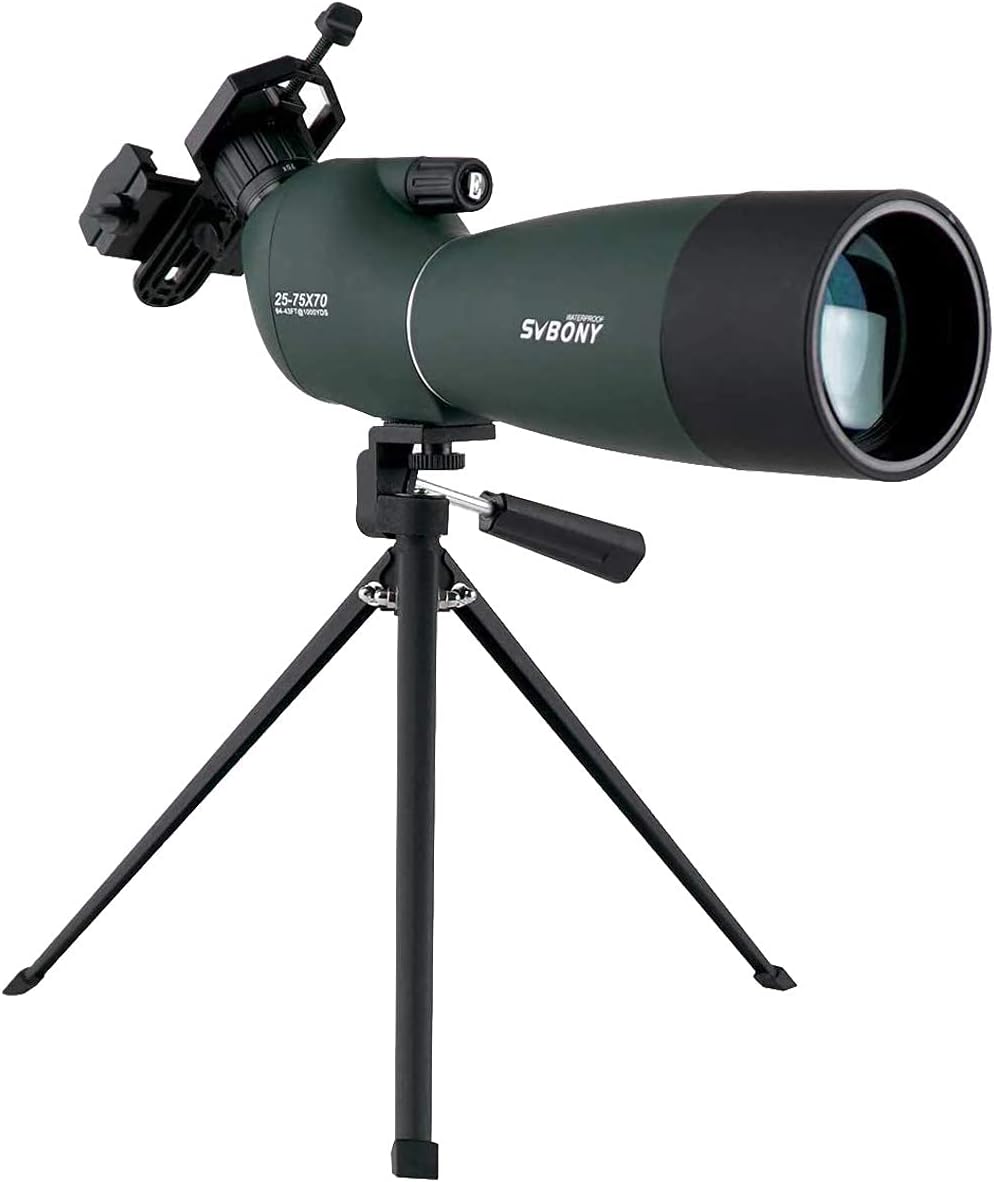
SVBONY SV28 Spotting Scope
4.4Editor score
25–75x variable magnification
70mm objective diameter
Phone adapter included
Our spotting scope for wildlife photography guide compares 10 models for magnification, light gathering, stability, weather sealing, digiscoping, and ease of
A spotting scope for wildlife photography must combine magnification, bright optics, precise focusing, and steady support. It helps photographers identify distant animals, locate behavior, frame subjects, and confirm details before committing to a longer camera lens. The right model also needs to remain comfortable and dependable during long outdoor sessions.
This guide compares ten spotting scopes using the supplied magnification ranges, objective sizes, optical systems, focusing controls, mounting options, weather protection, included accessories, and customer ratings. The list covers value-oriented kits, versatile midrange models, and premium glass options intended for serious birding, wildlife observation, and digiscoping work.
Each review explains the strongest qualities, practical limitations, and most suitable photographer. The top selections show the best balance of optical capability, portability, accessories, and specialization. Product configurations and availability can change, so readers should verify the current specifications, included items, and seller details before purchasing.
4.4Editor score

4.7Editor score

4.0Editor score
The comparison below places all ten scopes by magnification, objective size, optical design, focusing system, weather resistance, and supplied support gear, making it easier to identify the model that fits a particular wildlife-photography workflow.




The Vortex Crossfire HD 20-60×80 Angled combines a broad 20–60x zoom range, an 80mm objective, and a customer rating of 4.7. That combination makes it a strong all-purpose choice for wildlife photographers who need to scan a broad landscape and then examine a distant subject without changing equipment. Its angled eyepiece also supports a comfortable tripod-mounted working position.
We may earn a commission when you buy through this link, at no additional cost to you.
The HD optical system is described as using select glass elements to improve resolution, reduce chromatic aberration, and provide strong color fidelity, edge-to-edge sharpness, and light transmission. Anti-reflective coatings on all air-to-glass surfaces are intended to increase clarity in subdued light, while the wide field of view helps photographers acquire moving targets quickly. For digiscoping, those traits can help preserve useful detail and color rather than merely enlarging a distant silhouette.
The helical focus system provides fast and fine adjustments, a useful combination when tracking wildlife across changing distances. The scope is nitrogen purged, waterproof, and fogproof, while rubber armor improves durability and grip. Its Arca-Swiss-compatible foot is especially convenient because it can fit compatible tripod heads without requiring an additional mounting plate. One practical limitation is that the listed package does not mention a phone adapter, so photographers planning to capture images through a phone may need to confirm compatibility or purchase an adapter separately.
This is the most balanced recommendation in the guide for wildlife photographers who want a durable 80mm-class scope, flexible magnification, and convenient tripod integration. It is particularly appropriate for birding, open-country mammal observation, and general nature photography. Photographers who require a supplied phone adapter or a smaller packable body should compare those needs with the budget and lightweight alternatives, but the Crossfire remains a versatile long-term choice.
The 20x lower magnification setting provides a practical way to locate wildlife across a wide area, and the scope can then be adjusted toward 60x for closer detail. A wide field of view supports target acquisition, while the helical focus mechanism permits both rapid and incremental corrections as an animal moves.
The Arca-Swiss-compatible foot makes the scope a strong fit for many modern tripod heads and simplifies setup in the field. Pairing it with a suitable head and a separate phone or camera adapter creates a practical digiscoping station for identifying subjects and composing images.
We may earn a commission when you buy through this link, at no additional cost to you.
The SVBONY SV28 is an accessible entry point for photographers who want to locate and observe wildlife without beginning with a highly specialized premium scope. It offers 25–75x magnification, a 70mm objective, a 4.4 customer rating, and an angled viewing design. The included phone adapter and portable desktop tripod make it especially convenient for casual digiscoping and backyard or campsite observation.
We may earn a commission when you buy through this link, at no additional cost to you.
Its 70mm objective provides meaningful light-gathering capability, which can help when observing shaded subjects, distant terrain, or wildlife near dawn and dusk. The extendable sunshade helps reduce glare, and the seamless non-slip exterior is intended to maintain grip when wet. Zooming and focusing are designed to be straightforward, reducing the learning burden for a beginner who is still developing a repeatable technique for finding distant subjects.
The most significant compromise is support hardware. A desktop tripod is useful for a vehicle, picnic table, cabin, or other fixed surface, but it does not provide the height or flexible positioning of a full-size field tripod. The supplied information also does not identify the exact prism, coating, or sealing technology, so photographers who require premium low-light performance should not assume that it performs like an ED or fully multi-coated premium scope.
The SV28 is a compelling choice for beginners, families, campers, and photographers who want a complete simple kit. It can be used to find wildlife, inspect plumage, watch animal behavior, and create phone-assisted records. Buyers seeking more rigid long-session support should budget for a proper tripod, while those prioritizing the lowest possible weight may prefer a smaller 60mm model.
The scope, phone adapter, and portable desktop tripod cover the basic workflow of finding a subject, holding the view steady, and recording what is visible. This makes the package approachable for first-time users who may not yet know which specialized accessories they need.
The 70mm objective is larger than the entry-level scopes found in many general-purpose kits. It gives the SV28 a useful foundation for daylight wildlife observation and provides a more capable platform for spotting distant subjects than a very small objective.
We may earn a commission when you buy through this link, at no additional cost to you.
The Flagship 20-60×80 is a generous kit for wildlife photographers who value the 80mm objective and want accessories ready for immediate use. It has a 4.4 customer rating and a 20–60x zoom range that supports both landscape scanning and detailed observation. The BAK4 Porro prism and fully multi-coated 80mm objective form the core of its optical configuration.
We may earn a commission when you buy through this link, at no additional cost to you.
The listed field of view ranges from 82.9 to 48 feet at 1,000 yards, illustrating an important trade-off: wider views are available at the lower end of the zoom range, while higher magnification naturally narrows the visible area. A BAK4 Porro prism is intended to support light transmission, and the fully multi-coated objective contributes to a brighter, clearer image. These traits are useful for animal identification, birdwatching, and scenic wildlife photography.
Weather protection is a major strength because the scope is nitrogen filled, sealed, waterproof, and fogproof. The rubber-armored body adds grip and impact resistance, and a stretchable eyepiece shield provides added protection. The included kit is extensive: a metal tabletop tripod and mount, smartphone adapter, carrying case, lens covers, and cleaning cloth are all listed. The main limitation is that the tabletop tripod is more appropriate for stationary viewing than wildlife tracking on foot.
This scope is a strong option for photographers who want an 80mm objective, phone-based digiscoping, and a collection of useful carrying and maintenance accessories. It also suits travel, camping, archery, and general observation roles where one optic must cover several activities. For dedicated serious wildlife work, a full-size tripod and a camera adapter may be worthwhile additions, but the core scope is well equipped for identifying and observing subjects.
The combination of a BAK4 Porro prism and fully multi-coated 80mm objective is designed to support brightness and clarity. For field use, that can improve the experience when a subject is partly shaded, distant, or surrounded by a bright landscape that otherwise reduces perceived contrast.
A smartphone adapter, tabletop tripod, carrying case, protective covers, and cleaning cloth cover several practical needs at once. The included set reduces the need to purchase basic items separately, although its value depends on how often the tabletop tripod is used in the field.
We may earn a commission when you buy through this link, at no additional cost to you.
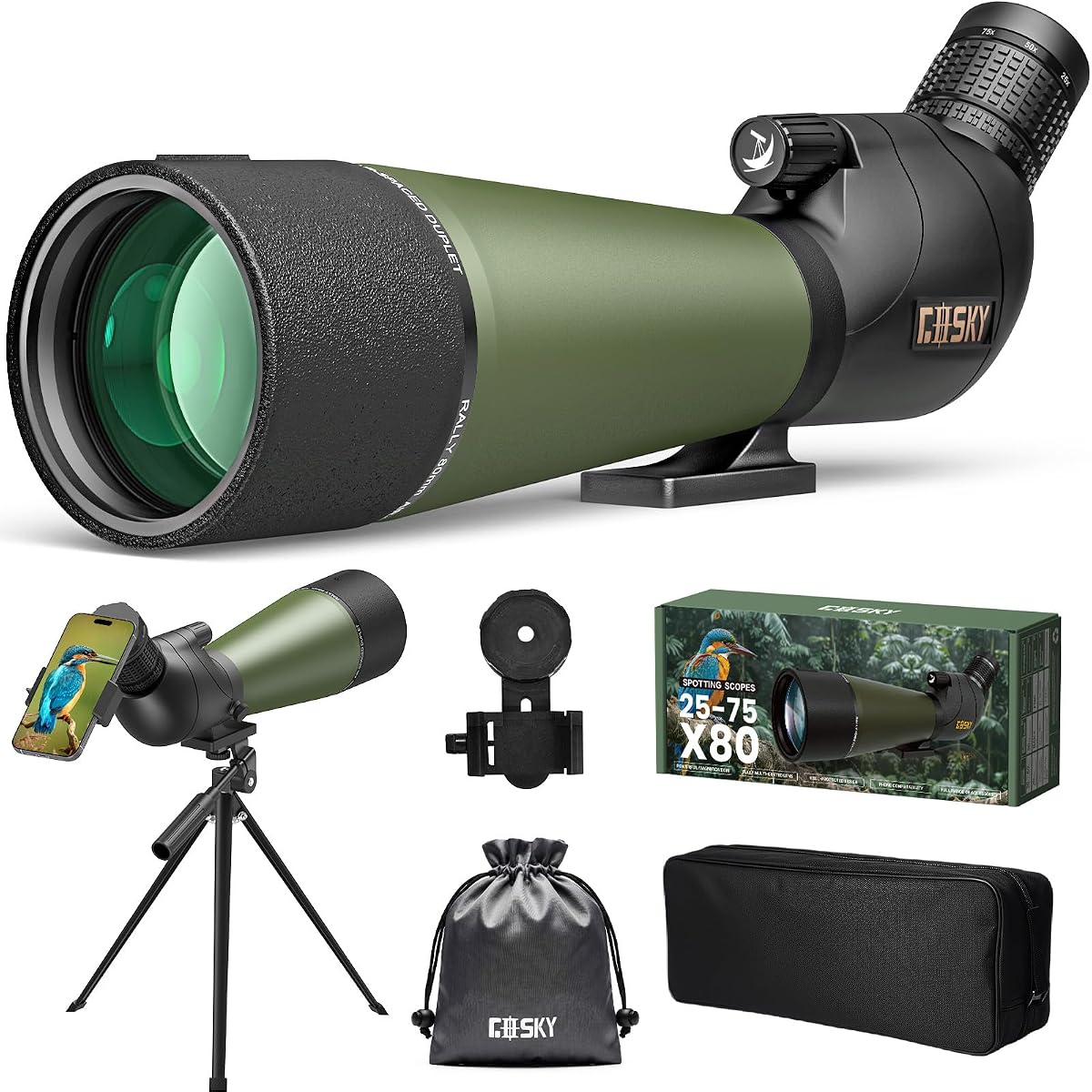
This 25-75×80 scope distinguishes itself with a full-size adjustable tripod, a 45-degree angled eyepiece, a BAK4 roof prism, and a fully multi-coated 80mm objective. Its 4.4 rating reflects a broadly favorable customer impression, while the included accessories cover tripod support, phone capture, carrying, and lens protection. It is a particularly relevant choice for wildlife photographers who expect to stand, crouch, or adjust their viewpoint in the field.
We may earn a commission when you buy through this link, at no additional cost to you.
The roof-prism configuration and multi-coated lens are intended to increase light transmission and deliver bright, clear views. The listed field of view of 123 to 63 feet at 1,000 yards gives photographers a substantial scanning area at the lower magnification setting. That wide view can be valuable for locating an animal before raising the magnification and narrowing the scene around its head, plumage, or behavior.
The tripod adjusts from 18.3 to 59.3 inches, offering much more placement flexibility than a compact desktop model. A universal phone adapter, carrying bag, cleaning cloth, and objective and eyepiece covers are included. The scope also has rubber armor, an extendable sunshade, and waterproof and fogproof construction. The main trade-off is the size and weight of carrying a full-size tripod, which can be less convenient for solo hikes on rough terrain.
This is a good match for photographers who value a complete, adaptable observation setup more than minimal carrying weight. It can be used for birding, wildlife, hiking, camping, and target observation, with the angled eyepiece reducing the need to hunch over a horizontal scope. Buyers should still confirm tripod head compatibility and consider a more specialized camera adapter if their digiscoping workflow uses a mirrorless or DSLR body.
The adjustable tripod works with the angled eyepiece to support different standing and seated positions. This flexibility is useful around uneven ground, wooded habitat, or a water edge where a fixed-height support would be awkward.
The 123-foot field of view at the low end of the zoom range provides a broad initial view. Photographers can scan an area, identify a subject, and then increase magnification to isolate fine details for recognition and image composition.
We may earn a commission when you buy through this link, at no additional cost to you.
The DiamondEdge 25-75×80 combines an 80mm objective, a relatively large 23mm eyepiece, and a rotatable body design. It carries a 4.4 customer rating and includes a tabletop tripod, lens covers, accessory pouch, carrying case, and cleaning cloth. The scope is marketed as an upgraded flagship-style option, with the rotatable construction intended to serve both birdwatching and target-oriented observation.
We may earn a commission when you buy through this link, at no additional cost to you.
BAK4 prism and fully multi-coated optics are intended to provide brightness, clarity, and color accuracy. The large objective and wide field of view give the photographer room to locate subjects, while the 25–75x zoom range permits closer inspection without requiring a second optic. Its nitrogen filling and O-ring sealing provide waterproof and fogproof protection, and the retractable sunshade helps reduce glare in direct sunlight.
A useful feature is the rotatable body, which lets the user change viewing orientation to suit different positions. The standard 1/4-20 thread also makes the scope compatible with many conventional tripods, giving buyers a straightforward path to better support. As with other desktop-tripod kits, the included support is more useful from a vehicle, table, or campsite than for continuous low-angle tracking on foot.
The DiamondEdge is well suited to wildlife photographers who want a large eyepiece, broad zoom range, and quick setup from a fixed position. It also works for target shooting, hiking breaks, and scenic observation. The package is comprehensive, but photographers planning extended standing sessions should add a full-size tripod and confirm that a suitable phone or camera adapter is available for digiscoping.
The rotatable body provides more orientation options than a fixed straight or angled design. That flexibility is useful when a subject is above or below the observer, and it also helps when changing between a vehicle setup, a tabletop, and a conventional tripod.
The listed 23mm eyepiece is larger than many comparable eyepieces. A larger design can provide a more comfortable viewing experience during extended sessions, while the 25–75x range supports both searching and detailed observation.
We may earn a commission when you buy through this link, at no additional cost to you.
The 25-75×60 Lightweight Scope is built around portability. Its listed weight is 1.5 pounds, and the package includes a 14-inch tabletop tripod and carrying bag. With 25–75x magnification, a 60mm objective, a BAK4 prism, fully multi-coated lenses, and a 4.3 customer rating, it offers a practical combination for backpackers, campers, and backyard wildlife photographers.
We may earn a commission when you buy through this link, at no additional cost to you.
The 60mm objective is smaller than the 70mm, 80mm, and 85mm objectives found elsewhere in this list, but it still provides a meaningful light-gathering design for normal outdoor observation. The BAK4 prism and fully multi-coated lenses are intended to deliver clear images and natural color. The scope also has waterproof construction, nitrogen-filled optics, and a durable non-slip body for changing outdoor conditions.
Its phone adapter and compact tripod support a simple digiscoping setup. The standard 1/4-20 thread offers additional compatibility with other tripods and mounting accessories, so a photographer can upgrade support when necessary. The main limitation is that the included tripod is only 14 inches, and the smaller objective may not offer the same low-light presentation as a larger premium glass model. Those constraints are most noticeable during dawn, dusk, deep shade, or very long observation distances.
This is a good choice for people who carry equipment over uneven trails, travel in a small vehicle, or want a simple scope for a porch, garden, or campsite. It is less compelling as the primary optic for a photographer who spends long sessions glassing in low light and values maximum light gathering. Within the lightweight category, however, it offers a generous zoom range and a useful feature set.
At a listed 1.5 pounds, the scope is designed to minimize the burden of carrying a larger optical instrument. The small tripod and carrying bag make it convenient for travel, camping, and observations from a picnic site or vehicle.
The included phone adapter and standard mounting thread make it possible to connect a compatible phone and use a more appropriate support when needed. This creates a simple starting point for recording wildlife without buying a separate phone adapter immediately.
We may earn a commission when you buy through this link, at no additional cost to you.
The 20-60×80 HD Dual Focus Scope earns its place through a large objective, a broad zoom range, and a dual-focus control system. It has a 4.5 customer rating and combines BAK4 glass with full broadband multi-coating. For wildlife photography, the ability to make coarse and fine focusing corrections separately can be valuable when a distant subject and its background sit at noticeably different focus distances.
We may earn a commission when you buy through this link, at no additional cost to you.
The 80mm objective is designed to gather light and support detailed views, while the BAK4 prism and full broadband multi-coating are intended to improve transmission. The listed field of view ranges from 86.4 to 48.2 feet at 1,000 yards. This allows broad searching at 20x before the photographer increases magnification for closer study. The scope is also described as resistant to distortion with reduced blue and purple fringing.
A detachable standard 1.25-inch eyepiece interface offers flexibility for photographers who may want to experiment with compatible eyepieces. Twist-extendable eyecups adjust eye relief, and the instructions specify unscrewing the eyecup for glasses wearers and extending it when not wearing glasses. The 45-degree angled body supports seated, standing, and crouched positions. Rubber armor, nitrogen purging, and waterproof and fogproof construction prepare it for outdoor use.
The supplied 360-degree rotating tripod and bracket allow stable viewing from multiple orientations, and a phone adapter is included. That makes the package suitable for digiscoping without requiring a separate adapter. The trade-off is that higher magnification can make small movements more disruptive, so good tripod technique remains important. Overall, this is an attractive option for photographers who value fine focusing control and an interchangeable eyepiece.
Dual focusing knobs give the photographer separate controls for bringing a subject into general focus and refining the image. That separation can make precise observation easier when zooming deeply into distant wildlife or scanning across uneven backgrounds.
The standard 1.25-inch detachable interface can appeal to photographers who want more control over their optical setup. Before changing eyepieces, the photographer should verify fit, magnification, field of view, and image quality rather than assuming every compatible eyepiece will produce the same result.
We may earn a commission when you buy through this link, at no additional cost to you.
The Maven CS2A is the specialist choice in this guide. It combines a large 85mm objective, extra-low dispersion glass, fully multi-coated optics, and a magnesium-aluminum frame. Its 26–66x range offers a slightly narrower and lower maximum magnification than many competitors, but its optical design and light-gathering capacity are aimed at photographers who value image quality over extreme zoom.
We may earn a commission when you buy through this link, at no additional cost to you.
The ED glass is intended to minimize chromatic aberration while preserving sharp, high-contrast images and accurate color. The 85mm objective is the largest listed among the scopes, making it well suited to dawn, dusk, overcast conditions, and shaded woodland. Its 60-ounce, 15-inch package is presented as a portable large-glass design, balancing the need for a substantial objective with field handling.
The waterproof and fogproof housing, protective rubber armor, and angled body make it suitable for long sessions in rain, snow, dust, and cold. Most importantly for photographers, the scope is described as compatible with standard digiscoping adapters for smartphones as well as DSLR and mirrorless cameras. That camera compatibility distinguishes it from kits centered mainly on phone adapters, although a camera adapter is not necessarily included.
This is the premium recommendation for serious wildlife photographers who need maximum light gathering, controlled color, and camera integration. It may be less suitable for someone whose priority is tracking distant subjects beyond 66x, but the 85mm objective and ED optics can provide a more refined foundation for frame assessment and image capture. Buyers should confirm adapter compatibility, tripod requirements, and their preferred camera connection before ordering.
An 85mm objective provides the strongest light-gathering foundation in this comparison. That advantage is most useful during early morning, evening, overcast, and shaded observation, when a smaller objective can make fine detail more difficult to resolve.
Compatibility with standard smartphone, DSLR, and mirrorless digiscoping adapters broadens the scope beyond visual observation. A photographer can build a more conventional camera-based workflow, provided the chosen adapter and camera arrangement are supported and properly balanced.
We may earn a commission when you buy through this link, at no additional cost to you.
The Vortex Diamondback HD 16-48×65 is optimized for wide scanning and versatile mounting. Its 16x lower limit gives it one of the broadest initial views in the group, while the 48x maximum provides enough magnification for ordinary wildlife observation. It has a 4.6 customer rating, an HD optical system, a built-in helical focus wheel, and an angled eyepiece for tripod use.
We may earn a commission when you buy through this link, at no additional cost to you.
The HD system is described as providing strong resolution, reduced chromatic aberration, outstanding color fidelity, edge-to-edge sharpness, and high light transmission. Multiple anti-reflective coatings are placed on the air-to-glass surfaces. The 65mm objective is smaller than the largest models in the list, but it provides a balanced option for photographers who need a manageable optic for field observation and general wildlife use.
Mounting flexibility is one of its strongest practical features. The scope is tripod adaptable, accepts 1/4-20 threads, and is Arca-Swiss compatible without requiring an additional plate. It can therefore move between a traditional tripod, a compatible Arca-Swiss head, or a car window mount. Argon purging, O-ring sealing, rubber armor, and Armortek lens coatings support dependable outdoor use and protection from dirt, oil, and scratches.
The Diamondback is a sensible choice for hunters, birders, and photographers who frequently scan open country. The 16x starting point makes finding distant animals easier, while 48x remains practical for details such as plumage or body posture. It is less suited to extreme long-range identification than 70x, 75x, or 80x scopes, but its mounting flexibility and HD optical system make it a highly adaptable outdoor instrument.
Beginning at 16x gives photographers a broad search view that can reduce the need to pan rapidly. Once a subject is found, the 48x upper end permits closer observation without turning to a more specialized extreme-zoom scope.
Arca-Swiss compatibility and 1/4-20 support provide flexibility across conventional tripod systems. The stated ability to work with a car window mount also makes the scope practical for mobile wildlife observation along roads and across open landscapes.
We may earn a commission when you buy through this link, at no additional cost to you.
The Swarovski Optik ATS 65 HD stands out for its 5.0 customer rating, 20–60x eyepiece, and 10-foot close-focus distance. While most wildlife photography occurs at greater distances, the close-focus capability also makes this scope useful for studying subjects that approach relatively near the observer. The angled design and 17mm eye relief support comfortable viewing during extended sessions.
We may earn a commission when you buy through this link, at no additional cost to you.
The 65mm objective is designed to gather ample light for bright, clear images in challenging conditions. The listed field of view of 118 to 66 feet at 1,000 yards provides a broad initial scene, making the scope useful for locating animals and then moving smoothly into closer inspection with its zoom range. Its wide field and focusing flexibility also suit general landscape and nature observation.
Durability is another core strength. The scope is listed as waterproof to 13 feet and nitrogen filled, helping resist moisture and internal fogging. The angled viewing design reduces the need to hunch over the eyepiece, while the eye relief and close-focus performance help maintain a comfortable working distance. The main limitation is that the supplied information does not mention a smartphone or camera adapter, and its maximum magnification is lower than many competing 70x-to-80x scopes.
The Optik ATS is well suited to wildlife photographers who value close observation, comfortable glassing, and a wide field of view alongside a strong customer rating. It can be particularly useful around a blind, hide, garden, or water edge where a subject may come closer than expected. For distant identification, it works best as a companion to a camera lens rather than as a substitute for the highest-power spotting scope.
A 10-foot close-focus distance gives the scope an extra layer of usefulness when birds or animals move relatively near the observer. It also makes the optic practical for detailed nature study without requiring extreme magnification in every situation.
The angled body, 17mm eye relief, and broad field of view are favorable for long observation sessions. Comfort is an important photographic tool because a scope that is tiring to use is less likely to be deployed consistently for tracking wildlife.
We may earn a commission when you buy through this link, at no additional cost to you.
The most useful scope is the one that combines the right field of view, magnification, light gathering, focusing control, mounting support, and weather resistance for the way you photograph. These factors determine whether a scope remains useful during long, changing field sessions.
Objective diameter is one of the most important factors for wildlife observation because it determines how much light the scope can gather. The models in this guide range from a 60mm objective to an 85mm objective. A larger objective generally provides a brighter presentation and can reveal more detail in shaded, overcast, dawn, and dusk conditions, which matters when identifying subtle plumage patterns or body markings. The 85mm Maven CS2A and the 80mm scopes provide the strongest light-gathering specifications, while the 60mm scope prioritizes portability.
Choose the largest objective that suits your mobility needs. Excellent low-light glass is less useful if the optic is too demanding to carry to the viewing location.
Magnification helps enlarge distant subjects, but higher power narrows the field of view and can make tracking animals more difficult. A model beginning around 16x or 20x offers a broad initial search area, while scopes reaching 75x or 80x can reveal finer detail once a subject is located. The Vortex Diamondback HD is especially useful for wide scanning, the Vortex Crossfire HD offers a practical 20–60x middle ground, and the Maven prioritizes 26–66x image quality over extreme power.
Think of magnification as the final step in a workflow, not the first. Find the animal at low power, center it, and then increase magnification carefully.
Glass and coating choices affect clarity, contrast, color, and light transmission. BAK4 prisms and multi-coated lenses are common throughout this guide, while the Maven CS2A adds extra-low dispersion glass intended to reduce chromatic aberration. HD systems in the Vortex scopes emphasize resolution, color fidelity, and edge-to-edge sharpness. For digiscoping, these attributes are especially useful because the camera is recording a smaller detailed area rather than a full scene viewed by the eye.
Prioritize optical clarity and color accuracy when images matter. If you mostly need casual visual observation, a BAK4 model with a suitable zoom range may be sufficient.
Wildlife rarely remains stationary, so a responsive focus control is essential. Helical focus systems offer fast and fine adjustments, while the dedicated dual-focus model separates broad focusing from precision refinement. Whatever the design, the best technique is to focus near the subject, avoid overshooting, and make small corrections as distance changes. A stable tripod reduces the effort required to keep the view composed.
Choose a focusing system that feels precise and repeatable. The ability to isolate a subject from its background matters more than an extreme maximum magnification.
A scope needs firm support to produce stable images. Some packages include compact desktop tripods, while others provide adjustable full-size tripods or rotating bases. Desktop models are useful for a vehicle, cabin, picnic table, or porch. Full-size tripods are better for walking to a blind or following a subject across open terrain. For photographs, check whether a phone adapter is included and whether the mount can accept a compatible DSLR or mirrorless camera adapter.
Match the support to the location rather than the marketing language. A feature-rich phone kit is convenient, but a proper tripod and camera adapter may matter more for serious image work.
Outdoor spotting scopes are exposed to rain, dew, dust, snow, temperature changes, and accidental knocks. Nitrogen purging or filling, O-ring sealing, waterproof construction, and fogproof design help protect the internal optics. Rubber armor improves grip and provides an additional layer of physical protection. These features are especially important when observing at dawn, during storms, or in remote areas where returning for a replacement would be inconvenient.
Treat waterproof and fogproof specifications as important protection, not permission to submerge or abuse the optic. Keep lens covers in place during transport and clean the objective after outdoor sessions.
A large objective can improve the view but may also make the scope more substantial to carry. The 25–75×60 Lightweight Scope is explicitly designed around a 1.5-pound listed weight, while the Maven balances an 85mm objective with a 60-ounce magnesium-aluminum frame. Angled eyepieces reduce neck strain and make tripod use more comfortable, and rotating bodies can accommodate different viewing positions. Carrying cases, bags, and compact tripod designs influence how easily a scope can join a field kit.
Choose a balance between optical capacity and the effort required to reach the location. The best optic is often the one you will actually carry and use.
Comfort matters during the long stationary periods typical of wildlife observation. Adjustable or extendable eyecups help position the eye correctly, especially for photographers who wear glasses. The Diamondback includes adjustable eyecups, the 20-60×80 Dual Focus model has twist-extendable eyecups, and the Swarovski lists 17mm eye relief. Angled bodies are also easier on the neck and can reduce the need to crouch awkwardly over a straight eyepiece.
If you wear glasses, check the eye-relief information and eyecup design. A comfortable scope is more likely to be used for the focused, patient observation that wildlife photography demands.
Start by stabilizing the scope on the appropriate tripod, then set the lowest magnification and widest field of view. Scan slowly across the habitat, use environmental clues such as movement, calls, or changes in vegetation, and avoid sweeping so quickly that a small animal is overlooked. Once a subject is found, center it before increasing magnification, then use a small helical adjustment or separate fine-focus control to bring it into sharp view.
For digiscoping, confirm that the phone or camera is properly supported and that the adapter does not place excessive weight on the eyepiece. Keep both eyes open when possible to retain peripheral awareness, stabilize the camera against the tripod, and use a faster shutter speed when the subject moves. Use the spotting scope to locate, identify, and compose the shot, but choose camera settings appropriate for the actual light and distance.
After use, retract the sunshade, cap the objective and eyepiece, and return the scope to its case or protective bag. Wipe the lenses with a clean, soft cloth, remove visible moisture, and avoid leaving the optic in a hot vehicle. Nitrogen purging helps prevent internal fogging, but seals can still be damaged by impacts, and external condensation should be allowed to dry before storage. If a lens appears hazy inside the scope, contact the manufacturer rather than attempting to open the sealed body.
Yes. A spotting scope can provide magnification for locating, identifying, and observing wildlife at distances where a camera lens is difficult to use. For photographs, it must be paired with a compatible phone, DSLR, or mirrorless camera adapter and a stable tripod. The resulting image is commonly called digiscoping, and its quality depends on the scope, adapter, camera, alignment, lighting, and support.
A larger objective generally gathers more light and can provide a brighter, clearer view in shade, overcast conditions, dawn, and dusk. It does not automatically make every image better, however, because a larger scope may be heavier and more expensive. Choose the objective size that matches your light conditions and how easily you can carry and support the optic.
Begin at low magnification to locate the subject, then increase power in measured steps for details. A 20x or 25x starting point is useful for scanning, while 60x, 75x, or 80x can help with fine markings on birds or distant mammals. Very high magnification makes tracking difficult and can exaggerate camera shake, so stable support remains important.
A tripod is strongly recommended because both the scope and camera need to remain steady, especially at higher magnification. A compact desktop tripod is adequate for stationary observation from a vehicle, table, or campsite. A full-size adjustable tripod provides better height, angle, and terrain flexibility for active wildlife observation and digiscoping.
Not necessarily. The phone must physically fit the adapter, and the adapter must match the scope's eyepiece size and design. Image quality can also vary with phone model, lens position, alignment, and screen glare. If a compatible adapter is included, it simplifies setup, but photographers should still confirm that the phone can be held securely without adding harmful weight to the eyepiece.
Waterproof and fogproof models are designed to withstand ordinary outdoor moisture, including rain, dew, and changing humidity. They should not be submerged unless the manufacturer specifically states that they are submersible. Even sealed scopes can be vulnerable to impacts, pressure changes, worn seals, and moisture retained inside a case, so protective handling remains important.
Both prism types redirect and align light within a spotting scope. Roof-prism models often have a compact straight-bodied form, while Porro-prism models commonly use a longer, angled shape. The choice affects size and handling, but image performance ultimately depends on the complete optical system, glass, coatings, objective, and focusing design rather than prism label alone.
Inspect it after every outing and clean it when dust, salt, fingerprints, or dried moisture are present. Use a blower or soft brush for loose debris and a clean optical cloth for the lens surface. Avoid household glass cleaner, household detergents, and rough materials, since they can damage lens coatings or leave residue that reduces image clarity.
The Vortex Crossfire HD 20-60×80 is the strongest overall recommendation because it combines a useful zoom range, an 80mm objective, HD optics, helical focusing, weather protection, and convenient Arca-Swiss mounting. The SVBONY SV28 is the best budget choice for a simple observation and phone-capture kit, while the Maven CS2A is the premium selection for photographers who prioritize an 85mm objective, ED glass, and camera digiscoping compatibility.
Before buying, prioritize the conditions in which you will actually work. A wide field of view and low starting magnification make wildlife easier to find, a larger objective helps in subdued light, and a suitable tripod reduces image shake. Confirm phone or camera adapter compatibility, check the packed dimensions against your carrying plan, and consider whether the supplied support is sufficient for the locations you visit.
Specifications, bundle contents, ratings, and availability can change over time, so verify the current listing before placing an order. The right spotting scope is the one that gives you a clear, repeatable way to find wildlife and hold it in frame, then connects smoothly to the camera system you already use.