
ANTSIR 8×21 Monocular Telescope
4.3Editor score
Genuinely pocket-sized construction
Simple one-hand focus control
FMC coated glass optics
Explore the best Monocular Pocket Scope options for compact outdoor viewing, comparing magnification, optics, portability, durability, and field of view.
A monocular pocket scope gives outdoor users a convenient way to bring distant subjects closer without carrying a full-size binocular. A useful model balances magnification, optical clarity, comfortable eye relief, compact dimensions, and dependable weather resistance while remaining easy to control with one hand.
This guide compares ten monocular pocket scopes across important considerations such as magnification, objective lens size, prism and lens coatings, field of view, focusing systems, accessories, weight, and environmental protection. The selections include general-purpose travel scopes, bird-watching models, wildlife-viewing options, and one adjustable high-powered design.
Each numbered review explains the strongest features, practical limitations, and most suitable users for that model. Ratings and specifications reflect the available product information, while availability and pricing can change, so readers should verify the current listing before making a purchase.
4.3Editor score

4.6Editor score

4.6Editor score
The table below compares all ten monocular pocket scopes by magnification, objective size, optical construction, portability, and weather protection, making it easier to identify the model that fits your preferred activities.


The Olimt 8×32 is the strongest all-around choice in this guide, combining a 4.6 rating with a balanced set of specifications. Its 8x magnification is substantial enough for wildlife and distant scenery without producing the pronounced hand shake associated with more powerful high-magnification monoculars. The 32mm objective and multi-coated extra-low-dispersion lenses also make it a credible choice for users who want more useful light gathering than a very small travel scope.
We may earn a commission when you buy through this link, at no additional cost to you.
Optical features include fully multi-coated lenses, a BAK-4 prism, and phase and dielectric coatings, all intended to support clarity, brightness, color reproduction, and reduced distortion. The listed 396-foot field of view at 1,000 yards offers a broad viewing area, which is valuable when locating animals or scanning a wide landscape. Because the magnification remains fixed at 8x, focusing is straightforward and the user can concentrate on framing rather than operating a zoom control.
The body is not the smallest model in the list, measuring 4.17 by 1.49 inches and weighing 8 ounces, but that extra size supports a more substantial optical design and metal construction. A large focus wheel should make adjustments easier to perform with one hand. The nitrogen-filled, O-ring-sealed body carries an IPX7 waterproof rating, while the metal shell adds resistance to shock and repeated outdoor handling.
This is the most practical recommendation for a traveler who wants one capable scope for birding, hunting, hiking, events, and general scenic observation. The included hand strap and pouch improve portability, and the combination of broad field of view, moderate magnification, and environmental protection avoids the compromises of a truly miniature optic. It is a particularly good fit for users who value a compact scope that still feels robust in the hand.
The main limitation is that 8 ounces is heavier than the 5.8-ounce Olimt 8×25 and the approximately 63-gram ANTSIR model. Anyone who prioritizes absolute pocketability over light gathering and rugged construction may prefer one of those alternatives. For most outdoor users, however, the Olimt 8×32 offers the most convincing balance of clarity, handling, protection, and useful magnification in this roundup.
The 396-foot field of view and fixed 8x power create a useful combination for locating birds, tracking wildlife, and scanning landscapes. Moderate magnification also makes the view easier to keep steady during handheld observation.
Its nitrogen-filled, O-ring-sealed IPX7 body and all-metal structure provide reassuring protection when rain, humidity, or accidental splashes are part of the outing. The supplied strap and pouch make it easier to carry securely.
We may earn a commission when you buy through this link, at no additional cost to you.
This 8×42 monocular earns a 4.4 rating and stands out for its unusually large objective lens and broad field of view. It is technically a compact monocular, but the 42mm front element makes it more substantial than models designed to disappear into a jacket pocket. That makes it better viewed as a compact handheld scope for users who value viewing comfort over minimal package size.
We may earn a commission when you buy through this link, at no additional cost to you.
The listing describes fully multi-coated lens elements, a large BAK-4 prism, and a green-film prism treatment intended to improve light transmission, brightness, contrast, and distortion control. At 8x magnification, the scope should suit landscape scanning, bird observation, wildlife viewing, travel, and other activities where a broad image and moderate zoom are useful. The stated 360-foot field of view at 1,000 yards gives users room to find moving subjects without constant repositioning.
Practical construction is another strength. The nitrogen-filled body is described as waterproof, fogproof, dust-proof, and shockproof, while the rubber exterior provides grip and impact protection. An adjustable twist-up eyecup accommodates users with and without glasses, and the ribbed rubber surface helps prevent slipping. A tripod connector at the base can provide steadier views during long-distance observation or wildlife watching.
The accessories are helpful for a portable scope: a hand strap reduces the chance of dropping it, while the carry case protects the optic during storage and transport. The monocular can also be used for concerts, golf, climbing, camping, and general sightseeing, although it is more specialized than a standard binocular for activities that frequently require fast switching between both eyes.
Its most obvious drawback is size. At 5.7 by 1.9 by 1.5 inches, it is the largest model here, so buyers expecting a true pocket device may find it less convenient. The stated high light transmission and low-light-oriented design are also manufacturer specifications rather than independently measured test results. Even so, this is a strong choice for someone who wants more light-gathering capacity and accessory support without moving to a 10x or adjustable-power scope.
The 42mm objective provides a noticeably larger light-gathering format than the 21mm, 25mm, and 32mm options elsewhere in the guide. That extra capacity can be useful during overcast days, dawn, or dusk when subjects are dimmer.
A ribbed rubber exterior, adjustable eyecup, and included hand strap improve comfort and control. The integrated tripod connection gives observers an easy way to stabilize the image during prolonged wildlife or scenic viewing.
We may earn a commission when you buy through this link, at no additional cost to you.
The Vortex Solo 10×25 is a compact, well-established option for travelers who want more magnification than an 8x travel scope without carrying a large model. It carries a 4.4 rating, uses fully multi-coated lenses, and is designed around a straightforward 10x magnification and 25mm objective combination. Those specifications place it between the smallest beginner scopes and the brighter models in this guide.
We may earn a commission when you buy through this link, at no additional cost to you.
Its compact proportions make it appropriate for day hikes, vacations, bird watching, and quick scenic observations. Fully multi-coated lens elements are intended to increase light transmission and resolution, producing clearer, crisper images than an otherwise comparable uncoated optic. The 10x power is useful for identifying small subjects, while the 25mm objective keeps the overall device relatively compact and light enough for routine carrying.
Durability is handled by a fully rubber-armored body that provides a non-slip grip and protects against everyday knocks. The optic is nitrogen purged and O-ring sealed for waterproof and fogproof performance. An adjustable eyecup supports comfortable viewing with or without glasses, which is important for users who may need to keep the scope at a consistent eye position.
Vortex backs the Solo with an unlimited, unconditional, lifetime VIP warranty that is transferable and covers repair or replacement for damage or defects. The stated exclusions include loss, theft, deliberate damage, and cosmetic damage that does not affect performance. That level of long-term coverage adds meaningful value for a portable optic likely to be used repeatedly over many years.
The tradeoff is that the 25mm objective gathers less light than the 32mm, 36mm, or 42mm alternatives. The fixed 10x magnification can also feel shakier than 8x during extended handheld observation. Nevertheless, the Solo is a refined, compact option for users who value a recognized warranty, familiar controls, and an easy-to-carry form more than maximum light gathering or broad framing.
At 10x, the Solo offers more subject detail than the prevalent 8x format while retaining a compact objective and body. It is a sensible middle ground for birding, sightseeing, and travel.
Nitrogen purging, O-ring seals, and full rubber armor help the optic cope with moisture, fogging, and routine impacts. The transferable lifetime warranty further reduces concern about normal wear or accidental damage.
We may earn a commission when you buy through this link, at no additional cost to you.
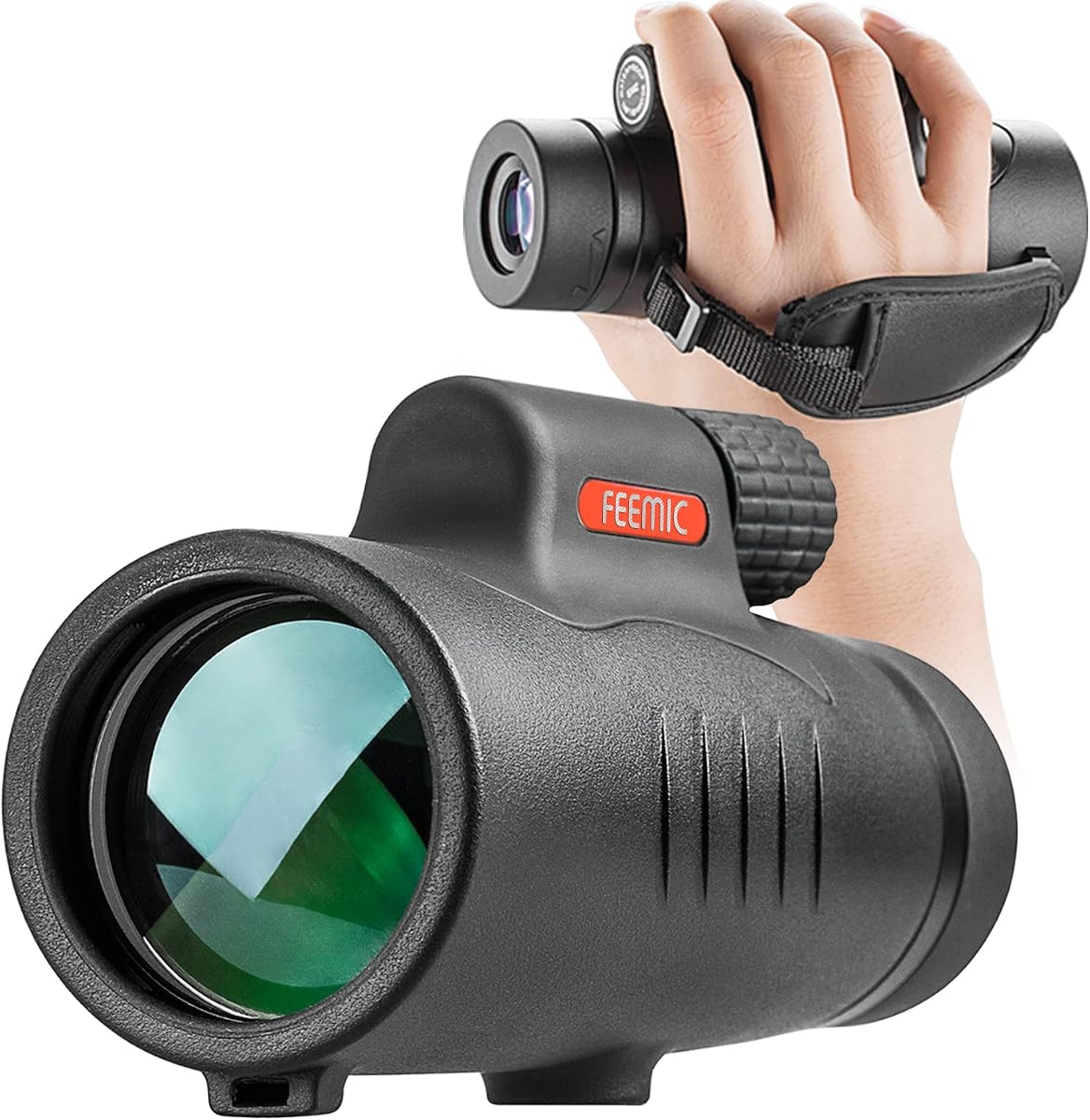
The ANTSIR 8×21 is the most genuinely pocket-oriented model in the guide, carrying a 4.3 rating and a body measuring just 9 by 3 centimeters. It weighs approximately 63 grams, so it can move comfortably between a pocket, backpack, and travel bag without becoming the dominant item in a carry-on or daypack.
We may earn a commission when you buy through this link, at no additional cost to you.
Despite its small format, it uses an actual glass optical system with an FMC green-coated lens and a roof-prism structure. The stated light transmission reaches up to 88 percent, and the listed field of view is 131 meters at 1,000 meters. Optical performance will naturally be constrained by the small 21mm objective, but the specifications suggest a capable companion for scenery, birds, sports, concerts, and casual sightseeing.
Operation is deliberately simple. A rotating focus barrel allows one-handed adjustment, while the fixed eyecup and 13mm eye relief create a conventional viewing position without multiple adjustable parts. A rubber-armored exterior supplies a secure grip, and the splash-resistant construction offers basic protection from light outdoor moisture. The product also includes a nylon pouch, wrist strap, cleaning cloth, and user manual.
This scope is a strong candidate for beginners because it avoids complicated zoom rings and offers a near-ideal balance of 8x magnification and stability. The compact body also makes it a natural choice for children under appropriate adult supervision, family travel, or anyone who wants an optical aid without committing to a full-size binocular. The accessory set reduces the need to purchase basic carrying and cleaning items separately.
The principal compromise is weather protection: splash resistance is not equivalent to the IPX7 rating of the Olimt models or the stated waterproof construction of several competitors. The 21mm objective also provides less brightness potential than a larger lens, particularly in dim conditions. Users needing maximum pocketability and uncomplicated operation will find those limitations reasonable, while serious low-light users should look to a 32mm or larger objective.
At approximately 9 by 3 centimeters and 63 grams, this model can remain in a pocket until needed. Its modest weight is especially helpful for children, hikers, and travelers who prefer to carry only the essentials.
The roof-prism design, green-coated glass lens, and stated 88 percent light transmission offer more substance than a decorative plastic viewer. The fixed 8x power and simple focus barrel keep the learning curve minimal.
We may earn a commission when you buy through this link, at no additional cost to you.
The Vortex Solo 10×36 is the premium choice in this roundup, earning a 4.6 rating while combining a bright 36mm objective with 10x magnification. It is especially relevant for wildlife observers, birders, and travelers who want a compact optic with better light-gathering potential than the smaller Solo and several other travel-focused models.
We may earn a commission when you buy through this link, at no additional cost to you.
Fully multi-coated lenses are designed to improve light transmission and resolution, supporting the clear, crisp image claimed by the manufacturer. A 36mm objective offers substantially more potential light collection than a 21mm or 25mm lens, making the Solo 10×36 better suited to shaded landscapes, overcast conditions, and lower-light observation when it is used within its normal operating limits.
The construction is similarly considered. Full rubber armor creates a durable, non-slip grip, while nitrogen purging and O-ring seals provide waterproof and fogproof protection. The adjustable eyecup is designed for comfortable use with or without glasses. Unlike the 10×25 Solo, this version includes a versatile multi-position utility clip for quick attachment to a belt, pocket, harness, or other equipment.
The lifetime VIP warranty provides a substantial ownership benefit. It is transferable and covers repair or replacement when an item becomes damaged or defective, although it does not apply to loss, theft, deliberate damage, or cosmetic damage that does not interfere with performance. That makes it especially appealing as a scope intended to remain in regular use for many years.
The trade-off is size and weight. A 36mm objective makes the Solo 10×36 less discreet than a true mini monocular, and the fixed 10x power may produce more hand shake than 8x models. It is also not as bright as the listed 42mm option, though it remains more pocket-friendly. For users who want a refined balance of optical capacity, magnification, protection, and long-term warranty coverage, this is the strongest premium recommendation.
The 36mm objective gives this Solo a meaningful advantage over the 21mm and 25mm travel scopes when light is limited. It is a good match for dawn wildlife activity, shaded forests, and overcast scenic viewing.
The multi-position utility clip keeps the scope accessible without requiring a dedicated case. Combined with rubber armor, sealed construction, and an adjustable eyecup, it is well suited to regular travel and field use.
We may earn a commission when you buy through this link, at no additional cost to you.
The Olimt 8×25 is one of the lightest and most compact choices here, with a 4.3 rating, a length of 3.81 inches, and a weight of 5.8 ounces. It fills the space between a very small travel viewer and a full-size field monocular, offering genuine 8x optical magnification in a body that should remain comfortable in a pocket or small daypack.
We may earn a commission when you buy through this link, at no additional cost to you.
Its optics use fully multi-coated extra-low-dispersion glass and a BAK-4 prism, specifications associated with clear images, color reproduction, and reduced distortion. The listed 358-foot field of view at 1,000 yards is broad for an 8x optic, making it easier to locate wildlife or scan an open landscape. A close focus distance of 0.98 feet, or 0.3 meters, adds a useful capability for examining nearby subjects.
Environmental protection is a major strength. The nitrogen-filled interior, O-ring seals, and IPX7 rating provide serious waterproof performance, including resistance to complete submersion as described in the product information. At the same time, the light 5.8-ounce weight avoids the bulk often associated with rugged metal scopes. The stated 16mm eye relief and wide-angle design are intended to produce a comfortable image, particularly for eyeglass wearers.
The listing also positions the scope for camping, backpacking, travel, sports, hunting, fishing, tactical observation, wildlife viewing, and casual stargazing. Some of those uses involve changing distances and lighting conditions, so buyers should still consider whether a fixed 8x power and 25mm objective meet their specific needs. A tripod is not included, which may matter for extended viewing.
Its main limitation is light gathering. The 25mm objective can perform well in ordinary daylight and is admirably compact, but it has less potential than the 32mm, 36mm, and 42mm models in dim conditions. It also offers no zoom, so nearby and distant subjects cannot be brought closer together with variable magnification. For travelers seeking rugged waterproof construction and true pocketability, however, it is a compelling choice.
The 3.81-inch length and 5.8-ounce weight are especially useful for walkers who want a full optical instrument rather than a lightweight viewer. It remains compact enough to carry without dominating a pocket or small bag.
A stated minimum focusing distance of 0.98 feet allows the scope to examine subjects much closer than a typical distant-scene monocular. That makes it more versatile for insects, plants, trail details, and nearby wildlife.
We may earn a commission when you buy through this link, at no additional cost to you.
The Nocs Provisions Zoom Tube 8×32 combines a 4.6 rating with a feature set tailored to bird watchers and backpackers. At 9.5 ounces, it is among the heavier models here, but its 8x magnification, 32mm objective, and 384-foot field of view create a capable general-purpose optic for trails, camps, and open landscapes.
We may earn a commission when you buy through this link, at no additional cost to you.
The optical system combines fully multi-coated lens elements with a Swiss-designed Bak4p prism. Multiple anti-reflective coatings are intended to produce a bright, crisp image with strong color clarity toward the edge of the field. The scope is also designed for smartphone photography and videography: users can align a compatible phone with the optic to capture and share what they observe.
Handling is a major strength. A central focus system keeps the control within easy reach, while the patented Rugged Wave Grip creates a secure, comfortable hold in the palm. The impact-resistant housing supports durability, and a multi-stop twist-up eyecup provides three positions for users with or without glasses. A threaded 1/4-inch-20 tripod adapter is integrated into the frame, allowing steadier viewing without a separate attachment.
Environmental resistance is rated IPX4, which the manufacturer describes as suitable for rain, fog, and snow. That rating is appropriate for ordinary outdoor conditions, although it is less comprehensive than the Olimt models with IPX7 protection. Scratch resistance and the rugged exterior further support regular field use. Nocs Provisions also includes a No-Matter-What lifetime warranty and emphasizes environmentally conscious design.
The practical limitation is size. At 9.5 ounces, this is better understood as a compact backpacker monocular than an ultra-light pocket model. Its water-resistance rating also falls short of complete waterproofing, so prolonged submersion or heavy rain should be approached cautiously. Still, for users who want a bright optic, secure grip, smartphone compatibility, and built-in tripod support, it offers an unusually complete outdoor package.
The 32mm objective and multi-coated lens elements give the Zoom Tube more light-gathering potential than mini scopes with 21mm or 25mm objectives. Its 384-foot field remains broad enough for locating birds and following wildlife across open terrain.
The three-position eyecup accommodates different users, and the central focus control is easy to reach with one hand. An integrated tripod thread adds stability for stationary birding or scenic observation.
We may earn a commission when you buy through this link, at no additional cost to you.
The 80×100 monocular is the most specialized model in the guide, carrying a 4.7 rating and offering adjustable magnification that can extend to 80x. It appeals to users who want to locate distant wildlife or scenery and are willing to accept a larger instrument in exchange for substantial optical reach.
We may earn a commission when you buy through this link, at no additional cost to you.
Its 100mm objective is far larger than the objectives on the compact scopes elsewhere in the list. The listing describes a BAK-4 prism and a dual focus wheel system for fast, precise adjustment. Because magnification is adjustable, the scope can be set at lower power for easier subject acquisition and increased when additional detail is needed, a more versatile approach than the fixed 8x and 10x designs.
Smartphone support is another distinguishing feature. A quick-positioning bracket fits a wide range of mobile phone models, allowing users to align the phone camera with the monocular for remote operation and image sharing. A tripod is also included, which is particularly valuable with this much magnification because it helps reduce the shaking that naturally accompanies long-distance handheld viewing.
The body uses robust rubber to improve grip and protect against minor bumps and scratches. Its dual focus wheels allow users to make finer adjustments than a single control might permit. Intended applications include hunting, wildlife observation, bird watching, hiking, camping, and travel, although the physical size and optical power make it less convenient for general sightseeing.
It is important to recognize that this device does not match the strict meaning of pocket scope. A 100mm objective and 80x endpoint create substantial bulk and weight, and high magnification magnifies every handshake. Digital image quality through an attached phone also depends on the phone, adapter alignment, ambient light, and camera system rather than the monocular alone. For dedicated long-distance observation with a tripod, however, it is the most powerful option here.
Adjustable power lets observers locate a subject at a lower setting and then increase magnification for closer detail. This flexibility is useful when distances and subject sizes change throughout an outing.
The included phone bracket and tripod make it easier to document distant subjects and keep the image steady. These features extend the scope beyond direct visual observation, though final phone-camera results vary by device.
We may earn a commission when you buy through this link, at no additional cost to you.
The Celestron Nature 10×25 is a travel-oriented monocular with a 4.2 rating, a 10x magnification, a bright 25mm objective, and a notably wide 5.8-degree angular field of view. It is designed for hiking, birding, travel, and wildlife viewing, where a broad scanning area can be as important as maximum magnification.
We may earn a commission when you buy through this link, at no additional cost to you.
Multi-coated optics and a BaK-4 prism are intended to enhance contrast, resolution, clarity, and color reproduction. The angular field gives users a broad view of open landscapes, making it easier to spot birds in flight or follow movement across a clearing. A 25mm objective helps keep the instrument reasonably compact while supporting reasonably bright views in normal outdoor light.
The housing is built from rubber-armored polycarbonate, a combination that offers useful impact resistance without the heft of a full metal body. The scope is described as waterproof and nitrogen purged, helping prevent fogging in rain, snow, or humid air. A twist-up eyecup helps establish a comfortable eye position for both people who wear glasses and those who do not.
Celestron supports the purchase with a limited lifetime US warranty and US-based technical support. The brand description notes that it has operated since 1960, which may appeal to buyers who prefer support from a long-established optics manufacturer. The scope is also straightforward to use, with no advertised zoom or complicated accessory system competing with the viewing experience.
Its 4.2 rating is the lowest among the ten products, although ratings alone do not reveal why individual customers were satisfied or dissatisfied. The 25mm objective is smaller than the brightest options, and fixed 10x magnification can be less stable than 8x. Even so, the wide angular field, protective construction, and established warranty make this a balanced pick for travelers who often scan broad areas rather than track one distant subject.
The stated 5.8-degree angular field is especially useful when searching wide fields, woodland clearings, and skies near the horizon. A broader view can reduce the need to repeatedly move the scope to keep a subject in frame.
Rubber-armored polycarbonate offers a practical balance of protection and portability. Nitrogen purging and waterproof construction help the optic remain usable in changing rain, snow, and humidity.
We may earn a commission when you buy through this link, at no additional cost to you.
This Nocs Provisions Zoom Tube 8×32 listing shares a 4.6 rating and the same core specifications as the earlier Nocs Provisions entry. It offers a capable combination of 8x magnification, a 32mm objective, fully multi-coated optics, a Swiss-designed Bak4p prism, and a 384-foot field of view for bird watching, backpacking, and general travel.
We may earn a commission when you buy through this link, at no additional cost to you.
Its optical coatings are designed to improve brightness, clarity, and color consistency across the field. The scope can also be aligned with a smartphone for photography or videography, allowing users to capture distant subjects and share the footage. A central focusing system provides a straightforward way to bring subjects into sharp focus without shifting the scope from the eye.
Physical handling is handled by the patented Rugged Wave Grip, which offers a secure, comfortable hold and an impact-resistant housing. The multi-stop twist-up eyecup offers three positions for glasses and non-glasses wearers. A 1/4-inch-20 threaded tripod adapter is built into the frame, which is helpful when watching wildlife or scenery for extended periods or photographing with a mounted phone.
The IPX4 rating provides water resistance for rain, fog, and snow, while the listing also describes the housing as scratch-proof. Nocs Provisions includes a No-Matter-What lifetime warranty, supporting the idea of a durable instrument intended for regular outdoor use. The brand additionally references environmentally conscious product design and participation in 1% for the Planet.
Because this listing duplicates the same model name and specifications included elsewhere in the roundup, shoppers should compare the current listing details carefully before choosing between the two entries. Both provide a 9.5-ounce, compact-but-not-ultra-mini design. The main limitation is the same for both: IPX4 protection is less comprehensive than full waterproof ratings, and the 9.5-ounce weight is less attractive to dedicated ultralight hikers.
Fully multi-coated elements and a Bak4p prism support a bright, crisp image with the listed 384-foot field. The 8x power remains stable enough for casual handheld birding and wildlife observation.
The central focus control, adjustable eyecup, secure wave grip, and integrated tripod thread address common handling needs. Smartphone alignment also adds a practical option for recording distant subjects.
We may earn a commission when you buy through this link, at no additional cost to you.
Choosing a monocular pocket scope involves balancing magnification, light gathering, image stability, portability, and environmental protection. The right model depends on whether you will mostly scan landscapes, identify birds, follow wildlife, inspect close subjects, or photograph distant scenes.
Magnification determines how much a subject appears enlarged, but more power is not automatically better. An 8x monocular is often easier to hold steady and provides a broader, more natural view, making it a sensible all-around choice for birding, hiking, and wildlife. A 10x model can reveal finer details at the cost of more visible hand movement. The adjustable 80×100 option can provide exceptional reach, but it is most effective on a tripod and is far less pocket-friendly. Beginners should generally favor 8x or 10x and learn to steady the scope against a tree, railing, or other stable surface before attempting very high magnification.
The objective lens determines how much light a monocular can gather. Larger diameters generally produce brighter images and offer more potential in shaded or overcast conditions, but they also make the scope longer and heavier. The ANTSIR 8×21 uses a very small 21mm objective for maximum portability, while 25mm options remain compact and versatile. The 32mm models offer a stronger balance for outdoor use, and the 36mm and 42mm versions prioritize brightness and conventional handling over pocket size. The 100mm objective belongs to a different class of large monocular rather than a strict pocket device. Choose the smallest lens that still provides adequate light for your usual conditions and subjects.
Lens coatings reduce reflections, improve light transmission, and help control glare and contrast. Fully multi-coated optics are generally the strongest specification to seek because several anti-reflective layers are applied to relevant lens surfaces. A BAK-4 or Bak4p prism can deliver a brighter image with better edge consistency than lower-grade prism glass. The ANTSIR, Celestron, Olimt, Vortex Solo, and Nocs Provisions models all list multi-coated lenses and BAK-4-family prisms. Specifications help identify the intended optical design, although they cannot substitute for an in-person comparison of brightness, sharpness, color, and edge distortion.
Field of view describes how much of the scene appears in the image. A wider field makes it easier to locate birds in flight, follow moving animals, and scan a landscape without constantly adjusting the scope. The Olimt 8×32 lists a 396-foot field at 1,000 yards, while the Nocs Provisions Zoom Tube and Olimt 8×25 provide 384 and 358 feet respectively. The Celestron Nature also emphasizes a wide 5.8-degree angular field. Magnification and field of view work together, so a narrower field may still be useful for identifying a stationary subject but less convenient for broad searching.
True pocket portability depends on both dimensions and weight, not just the word compact in a product title. The ANTSIR 8×21 is the smallest option at 9 by 3 centimeters and about 63 grams, while the Olimt 8×25 weighs 5.8 ounces and fits many jacket pockets. The Olimt 8×32 and Vortex Solo models remain compact but offer larger objectives. The 8×42 option is comparatively bulky, while the 80×100 model should be carried as dedicated equipment. Consider where the scope will live during an outing: a coat pocket favors minimum size, whereas a backpack or belt attachment can accommodate a more capable optic.
Waterproofing and ruggedness matter most in rain, fog, snow, and humid environments. An IPX7 designation indicates a high level of water protection for the Olimt 8×32 and Olimt 8×25. Other models are described as waterproof, water-resistant, or splash-resistant, and those terms should not be treated as equivalent. Rubber armor and impact-resistant housings help protect against drops and bumps, but neither seals nor coatings prevent physical damage. Match the stated protection to actual conditions and avoid submerging a scope unless its listing explicitly permits it.
A simple focus barrel is ideal for beginners and quick handheld use, while dual focus wheels or more elaborate controls can help make precise adjustments at long distances. An adjustable or twist-up eyecup is valuable for eyeglass wearers because it helps maintain the correct eye spacing without pressing the lens against a frame. The ANTSIR model uses a fixed eyecup with stated 13mm eye relief, the Vortex Solos include adjustable eyecups, and the Nocs Provisions Zoom Tube offers three positions. Effective focusing should be possible with one hand, and the control should not require removing the scope from the eye.
A wrist strap and pouch improve portability, while a tripod thread adds support for stationary viewing. Smartphone brackets can turn a monocular into a convenient telephoto aid, though camera quality remains dependent on the phone. The Celestron Nature emphasizes wildlife and landscape scanning, the Nocs Provisions models include smartphone use and tripod support, and the 80×100 option supplies both a phone bracket and tripod. Match accessories to the activity rather than assuming every feature will be used regularly. A clean lens cloth, protective pouch, and secure strap are generally more valuable day to day than an elaborate adapter.
Before first use, learn the focusing controls, removable eyecup positions, and any tripod connection. Hold the scope with one hand, place the eyecup comfortably against the eye, and adjust the focus while directing the view toward a distant, stable subject. Start at the lowest magnification if the model offers variable power, then increase it only after locating the subject. Avoid sudden movements, and brace the scope or use a tripod when working at high magnification.
Treat the optic more carefully than its compact size may suggest. Keep it in its pouch during travel, avoid resting the objective against hard surfaces, and do not point the lens directly at the sun or intense lasers. The rubber-armored body helps resist ordinary impacts, but it does not make the optics impact-proof. After use in rain or humid conditions, wipe the exterior dry and allow it to reach room temperature before opening or storing it in a sealed case.
Clean the lenses with a soft lens cloth or a blower designed for optics, and avoid paper towels, clothing, household cleaners, and liquid applied directly to the scope. If the scope is splash resistant rather than fully waterproof, do not submerge it or rinse it under running water. Keep replacement accessories and the warranty information in a safe place, and periodically check whether the manufacturer has issued updated care instructions or service policies.
For most users, 8x or 10x provides the best balance of detail and handheld stability. An 8x scope is easier to keep steady and generally shows a broader field, while 10x helps identify smaller birds or distant subjects. Very high magnification produces more shake and is best supported with a tripod.
A 25mm objective generally produces a smaller and lighter scope, while a 32mm objective can gather more light and suit outdoor conditions better. The 25mm option is convenient for travel and daytime viewing. The 32mm is usually more appropriate for wildlife, shaded landscapes, and longer viewing sessions.
Many models include adjustable or twist-up eyecups designed to accommodate glasses. The Vortex Solo models and Nocs Provisions Zoom Tube provide adjustable eye cups, while the ANTSIR model uses a fixed eyecup with stated eye relief. Check the product dimensions and eye-relief information to ensure the frame will not obstruct the view.
A wider field shows more of the surrounding scene, making it easier to locate a bird and follow it in flight. It is particularly helpful when searching open fields, woodland edges, or wetlands. Narrower fields are useful for inspecting a stationary subject but generally require more careful repositioning.
IPX7 represents a higher level of water protection than IPX4, including resistance to temporary immersion under the conditions defined by the rating. IPX4 protects against splashing water from any direction. Neither rating prevents damage from drops, and buyers should still follow the manufacturer's care instructions.
Many monoculars can be aligned with a smartphone camera to capture distant scenes. The Nocs Provisions Zoom Tube is designed with smartphone photography in mind, and the 80×100 model includes a bracket and tripod. Alignment can be imprecise, and final image quality also depends on the phone camera, lighting, and stability.
They are useful because multiple anti-reflective coatings can improve light transmission, contrast, and color clarity while reducing glare. The effect is most noticeable when comparing well-made scopes under similar lighting. Coatings improve light efficiency but cannot compensate for an objective lens that is too small for the intended conditions.
Binoculars are often more convenient for prolonged observation because they provide a natural two-eye image and make distance estimation easier. A monocular is lighter, narrower, and quicker to deploy, which makes it useful for travel and casual wildlife viewing. Consider whether the activity involves continuous tracking or only occasional use.
The Olimt 8×32 is the strongest all-around pick because it combines fully multi-coated optics, a broad field of view, a one-hand focus wheel, and IPX7 waterproof metal construction. The ANTSIR 8×21 is the leading budget and portability option, while the Vortex Solo 10×36 stands out as the premium choice for users who want a brighter objective, 10x magnification, and long-term warranty coverage.
Prioritize the feature your outings actually require: compact size for daily carry, a larger objective for dim conditions, a wide field for tracking birds, variable magnification for distant details, or a tripod thread for stable viewing. Magnification should be balanced against image stability, and weather-resistance ratings should match the environments where the scope will be used.
Before ordering, confirm the current listing, included accessories, warranty terms, and any changed specifications. Product availability and pricing can vary over time, so checking the live Amazon page helps ensure that the selected monocular pocket scope still meets your needs and that the included components match the product description.