
Ceptics Type A Travel Adapter
4.5Editor score
Dual North American inputs
Accepts polarized plugs
Three adapters included
Exceptionally compact design
No voltage conversion
Power Adapter for Japan from Usa guide compares ten plug adapters for outlet compatibility, USB charging, portability, safety features, and voltage needs.
A power adapter for Japan from USA should solve more than just a mismatched outlet shape. The most useful options combine a Type A plug, North American outlets, USB charging, compact construction, and clear guidance about voltage limitations for travelers carrying phones, laptops, cameras, and personal-care devices.
We compared the ten adapters in this guide by examining plug compatibility, AC outlet count, USB-C and USB-A capabilities, maximum listed wattage, portability, surge protection, and compatibility with both United States and Japanese outlets. The list includes simple adapters, multi-port travel chargers, folding designs, extension-cord models, and a universal travel kit.
Each review explains where the adapter is strongest, where compromises appear, and which traveler may prefer it. The products also differ in whether they provide surge protection, support higher-voltage USB-C charging, or include an extension cord. Product ratings and availability can change, so compare current listings and specifications before purchasing.
4.5Editor score

4.7Editor score

4.5Editor score
The comparison highlights each adapter's outlet configuration, charging options, portability, and voltage limitations so travelers can identify the model that matches their itinerary and device mix.




This TESSAN 2 Pack earns a 4.6 rating and stands out as a versatile power adapter for travelers who want to charge several device categories from a single Type A plug. It offers four AC outlets, one USB-C port, and two USB-A ports, allowing up to seven devices to be connected at once according to the product description.
We may earn a commission when you buy through this link, at no additional cost to you.
Its most useful feature is the combination of one USB-C port rated up to 20W with two USB-A ports rated up to 2.4A each. That makes the adapter suitable for phones, earbuds, and many other USB-charged accessories while preserving four AC outlets for larger electronics. The four-sided housing is also designed to avoid blocking neighboring wall outlets, a practical consideration in busy hotels and older Japanese buildings.
The trade-offs are important. It has no surge protection, and it does not transform 100-volt Japanese power into 120-volt power or vice versa. Devices must support the 100V-to-250V range listed for this adapter. Only one of the USB-C ports provides the stated 20W maximum, so travelers needing multiple high-output USB-C connections may need to reconsider.
This is a strong choice for a family, small group, or carry-on traveler who wants more than a basic plug converter. The inclusion of two adapters offers flexibility for rooms, hotels, or separate travel locations. It is less appropriate for anyone requiring surge protection, a full voltage converter, or numerous 20W USB-C ports.
Four AC outlets and three USB ports make this a convenient central charging hub. It is especially useful when a hotel room offers limited wall sockets and several travelers need to organize their cables.
The listed dimensions and weight are easy to pack, while the four-sided body helps large wall-plug chargers fit without blocking adjacent outlets. Two adapters in the pack provide useful redundancy.
We may earn a commission when you buy through this link, at no additional cost to you.
This HANYCONY Type A adapter has a 4.6 rating and focuses on a balance of compact size and useful charging options. It provides two North American AC outlets, two USB-C ports, and one USB-A port, creating five charging positions in a package listed at 2.4 ounces and 2.2 by 1.1 by 1.5 inches.
We may earn a commission when you buy through this link, at no additional cost to you.
The Type A plug is designed primarily for Japan and other countries using compatible Type A sockets. Its USB-C ports support up to 5V and 3A, while the USB-A port supports up to 5V and 2.4A. The listed combined USB output is 15.5W, and smart charging technology is intended to detect connected devices and deliver suitable output.
This is not a voltage converter, which is a meaningful limitation for hair dryers, straighteners, curlers, electric toothbrushes, and other 110V-only equipment. The product description also says it fits only partially in some outlets in Thailand and Peru. For Japan-focused travel, those caveats are understandable, but travelers combining several countries should check socket shapes carefully.
It is best for a solo traveler or couple who wants a lightweight adapter with more flexibility than a basic two-prong converter. The illuminated power indicator is also useful. Buyers should choose a different option if surge protection, foldable prongs, more AC outlets, or a short extension cord is their top priority.
Two USB-C ports and one USB-A port cover most modern phone and accessory charging needs. The small footprint is particularly attractive for carry-on bags and travelers who want to avoid packing a separate power bank.
Although the Type A design is appropriate for Japan, the product does not provide voltage conversion. Confirm that every high-wattage appliance is rated for 100V to 250V before using it.
We may earn a commission when you buy through this link, at no additional cost to you.
The HANYCONY 8-in-1 2 Pack has a 4.7 rating, making it one of the highest-rated options in this guide. Its four AC outlets, two USB-C ports, and two USB-A ports make it a well-rounded travel hub for travelers crossing between the United States and Japan.
We may earn a commission when you buy through this link, at no additional cost to you.
The AC section is listed for up to 2500 watts at 250 volts and 10 amps. USB-C outputs support up to 5V and 3A, while USB-A outputs support up to 5V and 2.4A. Smart charging technology is included to detect devices, and the four AC outlets offer enough flexibility for wall chargers without requiring a large desktop power strip.
The adapter does not convert voltage and does not include surge protection. Its USB-C charging is not described as compatible with devices that require 9V to 22V, so it is better suited to standard phone, tablet, earbud, and accessory charging than demanding laptop charging. The two-pack configuration also means users can keep one adapter in each bag or leave one at a destination.
This is an excellent recommendation for families, small groups, or anyone who wants several outlets and USB connections without carrying a separate extension cord. It is less appropriate for travelers with USB-C laptops that require high-voltage power delivery or for users who want protection against power surges.
Four North American outlets reduce the need to move chargers around a hotel room. The broad multi-port layout makes the adapter easier to use as a shared charging station.
Keeping one unit in carry-on luggage and another in a checked bag prevents a misplaced adapter from disrupting the trip. The second unit is also useful for separate rooms or travel companions.
We may earn a commission when you buy through this link, at no additional cost to you.
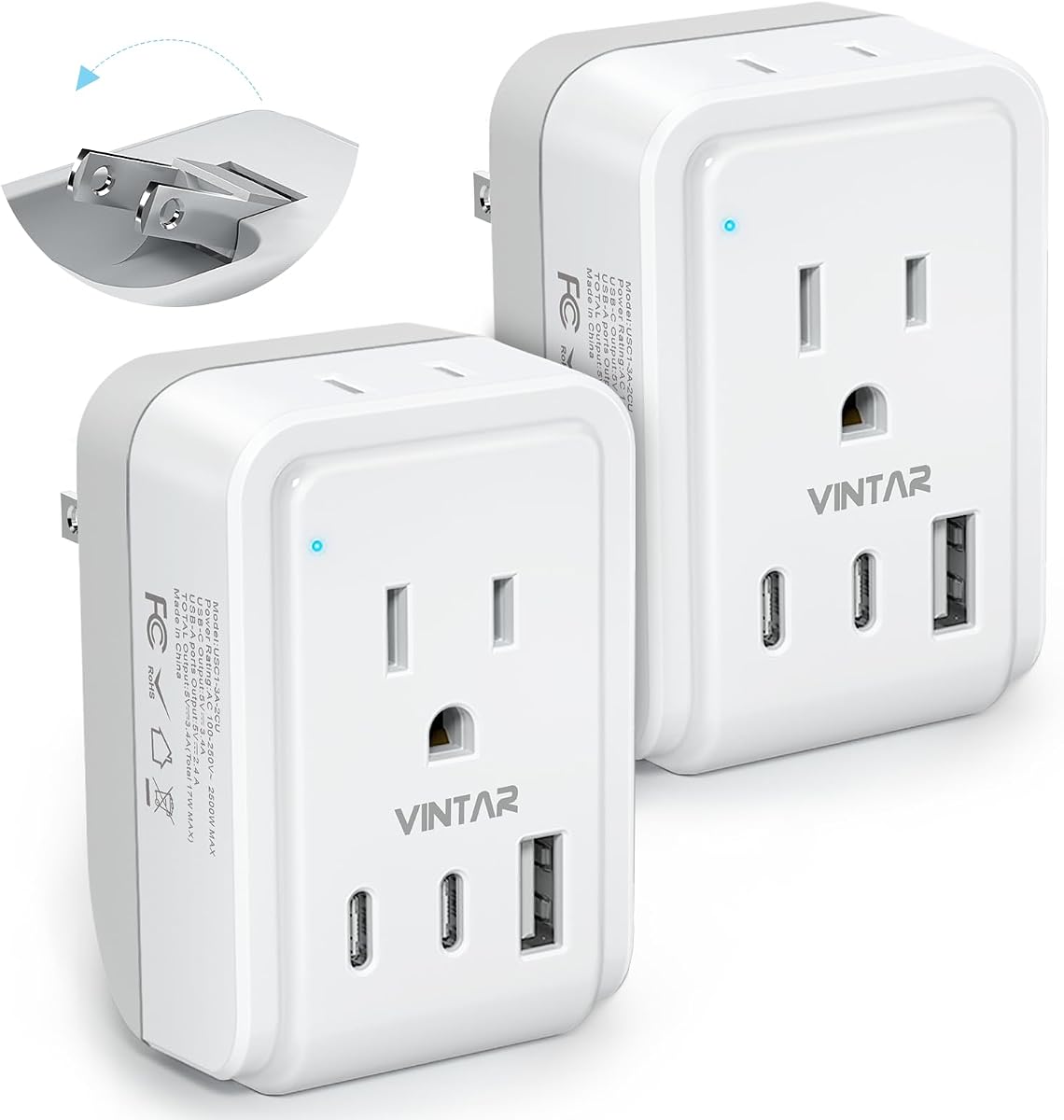
This VINTAR folding adapter combines a 4.7 rating with a design that emphasizes packability. The plug can fold by 90 degrees, reducing the chance of accidental damage to exposed prongs when the adapter is stored in luggage or a pocket.
We may earn a commission when you buy through this link, at no additional cost to you.
Its charging selection includes two USB-C ports and one USB-A port. The USB-C ports are listed at 5V and 3.4A, with a maximum output of 17W per port. This can suit phones, tablets, and other compatible accessories, but the description explicitly states that the ports are not Quick Charge 3.0 and do not support devices requiring 9V to 22V.
As with most adapters in this category, the product is not a voltage converter. It is intended for devices supporting 100V to 250V, and its lack of surge protection is an important consideration for expensive electronics. The shell is described as flame retardant with heat dissipation, while CE and FCC certification is also listed.
It is a strong fit for travelers who frequently pack cables and adapters in small carry-on bags. The two-pack provides backup and allows simultaneous use in different locations. Choose a higher-powered USB-C model or a universal surge-protected kit if you plan to charge a demanding laptop or want broader international support.
The 90-degree folding mechanism keeps the plug closer to the adapter body when stored. This is especially helpful in carry-on bags where loose metal prongs can catch on fabric or other objects.
Two USB-C connections are useful for modern accessories, but the stated 17W output and lack of high-voltage support mean this is not the right choice for every USB-C laptop.
We may earn a commission when you buy through this link, at no additional cost to you.
The Ceptics CT-6 is a straightforward Type A travel adapter with a 4.5 rating. Unlike the larger multi-port models, it concentrates on physical plug compatibility and portability, making it a sensible choice for travelers who already carry USB cables and only need a small outlet converter.
We may earn a commission when you buy through this link, at no additional cost to you.
Its grounded input accepts a three-prong North American plug, while its non-grounded output accepts polarized two-prong plugs. The Type A NEMA 1-15 design is commonly used in Japan, the Philippines, and North America. Maximum current is listed at 10 amps and maximum voltage at 250 volts, making it suitable for many ordinary travel chargers.
The adapter does not include USB ports or voltage conversion. It measures 1.6 by 1.6 by 1.9 inches and weighs 1.07 ounces, so it creates almost no packing burden. Three units are included, which allows placement in multiple bags or use by a small travel group. CE certification and RoHS compliance are listed, along with a limited lifetime warranty.
This is the best option for travelers who value simplicity and low weight over built-in charging. It works well for phone, tablet, and camera chargers that use standard North American plugs. It is not appropriate for high-wattage 110V-only appliances, and travelers needing USB ports or surge protection should choose a larger model.
The CT-6 avoids the bulk of a charging hub while still accommodating grounded and polarized plugs. It is easy to carry, distribute among travel companions, or leave in a day bag.
North American power is commonly 120V, while the adapter only changes plug shape. Use it with electronics rated for worldwide voltage and avoid 110V-only hair and grooming appliances.
We may earn a commission when you buy through this link, at no additional cost to you.
This second TESSAN option offers a 4.6 rating and differentiates itself with two USB-C ports that are each listed at up to 20W. It also includes four AC outlets and one USB-A port, producing a seven-device charging hub for a Type A outlet.
We may earn a commission when you buy through this link, at no additional cost to you.
Compared with the earlier TESSAN model in this guide, this version has two 20W USB-C ports rather than one. That arrangement is more useful for travelers carrying two modern USB-C devices or for households in which both a phone and accessory need faster charging. The USB-A port is rated up to 2.4A for devices using the older connection.
The product has no surge protection and is not a voltage converter. Personal-care appliances such as hair dryers, straighteners, and curling irons must support 100V to 250V dual voltage. Its listed dimensions are 3.15 by 2.24 by 2.25 inches, with a weight of 3.46 ounces, so it remains reasonably compact.
It is a strong selection for USB-C-heavy travelers who want two fast-output charging ports and several AC sockets. The two-pack is useful for separate travel bags or hotel rooms. It is less suitable for travelers who need laptop-class power delivery, surge protection, or automatic voltage transformation.
Two ports with listed 20W maximum output make this model better suited than many compact alternatives to modern phones, earbuds, and compatible smaller accessories.
Four AC outlets support traditional wall chargers, while USB ports handle modern cables. The four-sided design helps prevent the adapter from obstructing adjacent wall receptacles.
We may earn a commission when you buy through this link, at no additional cost to you.
This unnamed two-pack has a 4.7 rating and provides a balanced mix of AC and USB connections. Each adapter includes two North American outlets, two USB-A ports, and two USB-C ports, allowing seven devices to charge at once when the connection limits are observed.
We may earn a commission when you buy through this link, at no additional cost to you.
The AC outlets are listed at up to 1875 watts, 125 volts, and 15 amps. The four USB ports share a listed 5V and 3.1A output, with each USB-C port able to deliver up to 3A and other ports up to 2.4A. Smart technology is included to detect devices, although the product does not support USB-C charging voltages between 9V and 22V.
Its listed size is 3 by 2.4 by 1.6 inches, and the product uses a rotating or compact plug arrangement without a cord. A blue indicator shows whether the adapter is powered. The housing is described as made from 1382-degree Fahrenheit fire-resistant material, offering a reassuring construction detail even though it does not include surge protection.
It is well suited to a family or group traveling with several USB-equipped devices. The two-pack improves flexibility and provides a spare. It is less suitable for laptops requiring USB-C Power Delivery, high-end equipment that needs surge protection, or travelers seeking a compact single basic adapter.
Two ports of each USB type let travelers support newer and older devices without carrying two separate charging hubs. The shared output specification should be considered when charging several devices simultaneously.
Seven positions give a small group more charging flexibility from one wall outlet. The illuminated indicator makes it easier to confirm that the adapter is receiving power.
We may earn a commission when you buy through this link, at no additional cost to you.
The VINTAR 4-in-1 Foldable has a 4.4 rating and combines four AC outlets with two USB-C ports and one USB-A port. Its plug folds by 90 degrees, and the listed dimensions of 2.9 by 1.9 by 1.7 inches make it one of the more compact multi-port choices in the guide.
We may earn a commission when you buy through this link, at no additional cost to you.
The AC side is listed for up to 2500 watts at 250 volts and 10 amps. USB-C ports provide a maximum of 17W each, while the USB-A port supports standard USB-A charging. As with the other folding VINTAR model, the description says the USB-C ports do not support Quick Charge 3.0 or devices needing 9V to 22V, so demanding laptop charging is outside the intended use case.
It lacks surge protection and does not convert voltage. It should therefore be used with dual-voltage devices rated for 100V to 250V. CE and FCC certification, heat-dissipation and flame-retardancy details, and a 12-month warranty provide useful quality information, although its rating is lower than those of the leading multi-port alternatives.
This model is appropriate for a traveler who wants more outlets than a basic adapter, values protected folding prongs, and does not need high-wattage USB-C charging. It is a reasonable choice for phones, tablets, cameras, and compatible accessories. Travelers with laptops should select a model with explicit high-power charging support.
Four AC outlets and three USB ports provide flexibility without an extension cord. Folding the plug helps protect it and keeps the package compact during transit.
The stated 17W USB-C output and excluded high-voltage modes make this most appropriate for common accessories. Check laptop charger requirements before relying on the USB-C ports.
We may earn a commission when you buy through this link, at no additional cost to you.
This extension-cord adapter has a 4.6 rating and is the most distinctive option in the guide. It combines a three-foot cord, a rotating flat plug, four AC outlets, and five USB ports, allowing a wall outlet to reach devices positioned farther away than a direct plug adapter can accommodate.
We may earn a commission when you buy through this link, at no additional cost to you.
The Type A plug supports 100V to 250V input and a maximum output of 3750 watts, or 1875 watts at 125 volts. The USB section is listed at 5V, 3.4 amps, and 17W maximum. Its listed dimensions are 4.6 by 1.7 by 1.1 inches, while the total weight is 9 ounces, reflecting the added cable.
The cord can be helpful in rooms where furniture sits close to the wall, and the rotating plug can reach receptacles positioned at awkward angles. However, this is not a voltage converter, and it has no surge protection. Cruise operators may prohibit power strips or extension cords even when they allow ordinary plug adapters, so travelers should check the operator's rules.
It is a good fit for users who need extra reach or want to organize several devices behind furniture. It is less convenient for minimalist packing and unsuitable for travelers whose cruise line bans extension cords. A compact direct adapter is the safer choice in that scenario.
The three-foot cord gives charging cables more flexibility when a wall outlet is behind a bed, sofa, or desk. The rotating flat plug also improves access in tight locations.
The product description specifically notes that some cruise lines prohibit power strips with extension cords. Confirm current policy before bringing this model aboard.
We may earn a commission when you buy through this link, at no additional cost to you.
The Ceptics 35W Universal Travel Adapter Kit has a 4.5 rating and is the most comprehensive option here for travelers visiting Japan and other regions. It includes two United States outlets, a USB-A port, a standard USB-C port, and a 35W USB-C Power Delivery port, along with a USB-C cable and several plug attachments.
We may earn a commission when you buy through this link, at no additional cost to you.
The kit's international heads cover Type C for much of Europe, Type G for the United Kingdom, Type B for the United States, Type I for Australia and China, Type E and F for Germany and France, and Type A for Japan. A travel pouch is included, and the listed measurements are 2.7 by 1.4 by 3.7 inches with a weight below 5 ounces.
Built-in surge protection is the key advantage over most models in this guide. The 35W USB-C port can support more demanding compatible devices than the basic 5V USB-C outlets, although the exact charging protocol and cable requirements still matter. The kit remains a plug adapter rather than a voltage converter, so 110V-only devices are not supported.
It is an excellent choice for frequent international travelers who want one adaptable kit, especially when a trip includes Japan and Europe or the United Kingdom. It is less necessary for travelers going only to Japan and the United States, where a simpler Type A adapter may be lighter and easier to operate.
Six included plug heads allow the central adapter to serve trips across Europe, the United Kingdom, China, Australia, the United States, and Japan. This reduces the need to research and carry separate destination adapters.
Most compact alternatives in this guide omit surge protection. The Ceptics kit includes it alongside a 35W USB-C port, making it better suited to travelers carrying valuable electronics across multiple power systems.
We may earn a commission when you buy through this link, at no additional cost to you.
The right adapter depends on your destinations, devices, outlet needs, and tolerance for extra bulk. Pay particular attention to voltage compatibility, plug format, charging protocols, and cruise restrictions before making a selection.
Japan generally uses Type A sockets, which have two flat parallel pins. Most American plugs fit this format, but grounded three-prong plugs require an adapter that accepts them and provides an appropriate North American outlet. Products described as two-prong-to-three-prong or three-prong-to-two-prong adapters can bridge that difference, so read the orientation carefully rather than assuming every US plug will work.
Choose a model whose Type A plug is explicitly designed for Japan and the United States. If your itinerary includes Thailand, Peru, or other countries with different socket shapes, verify compatibility separately. Some Type A products fit certain round-hole outlets only partially, which can make them unreliable.
A plug adapter changes the shape of a connection but normally does not change the electrical voltage. Japanese outlets commonly supply 100V, while many American appliances are designed for 120V. Many modern phones, laptops, cameras, and chargers support 100V to 250V, but some hair dryers, straighteners, curling irons, razors, and electric toothbrushes do not.
Look for universal or dual-voltage markings on every appliance you intend to plug in. If a device accepts only 110V or 125V, choose a genuine voltage converter rather than assuming a travel adapter will make it safe. The products reviewed here are explicitly described as adapters, not voltage converters.
USB-C ports are not all equal. Basic adapters commonly provide 5V output, which is suitable for many phones, earbuds, watches, and smaller accessories. Some models in this guide list up to 20W or 35W, while the universal Ceptics kit includes Power Delivery. A higher wattage does not guarantee that every device will negotiate the desired rate.
Check the charger requirements for laptops, tablets, and newer phones. Look for an explicitly listed USB Power Delivery or compatible voltage range when your device needs more than basic 5V charging. Note that several otherwise capable adapters explicitly do not support the 9V-to-22V modes required by demanding USB-C devices.
A larger number of connections is useful for families and group travel, but it also increases size and weight. Two AC outlets may be enough for a solo traveler with a phone charger and laptop charger. Four AC outlets plus three or four USB ports can replace a small power strip in a hotel room.
Estimate your daily charging load rather than choosing only by the highest port count. Check the stated AC wattage and amperage, shared USB output, and whether the adapter can handle all connected loads simultaneously. More ports are useful only when the underlying power ratings meet your devices' needs.
The simplest Ceptics CT-6 weighs just over one ounce and accepts two kinds of North American plugs, making it excellent for minimalist packing. Larger multi-port adapters add several charging options but occupy more luggage space. Folding prongs reduce damage and bulk, while an extension cord improves reach but can be prohibited on cruise ships.
Choose based on the length and complexity of your trip. A light adapter is often preferable for a short city trip with one phone and laptop. A larger hub becomes more valuable when several people travel together, when wall sockets are scarce, or when the same unit must serve multiple destinations.
Surge protection is separate from plug conversion and is not included in most of the compact adapters reviewed. It can help guard sensitive electronics against certain voltage spikes, but it should not be confused with voltage conversion or complete protection against every electrical fault.
Travelers carrying expensive laptops, cameras, or other sensitive electronics may prefer the universal Ceptics kit because it explicitly lists built-in surge protection. When comparing other products, check certification marks, material claims, warranty coverage, and whether a travel destination or cruise operator discourages surge protectors.
A product that works perfectly in a Japanese hotel may still be restricted aboard a ship or unusable at the next destination. Some cruise lines allow compact plug adapters but prohibit extension cords or multi-outlet power strips. Countries with Type A sockets may have variations in grounding and slot dimensions that affect fit.
Check the cruise operator's current rules before departure. For a multi-country trip, identify every plug standard and voltage requirement in advance. The universal kit is advantageous in these situations because it includes several regional heads and surge protection.
A warranty provides recourse if an adapter fails or performs unexpectedly, while certifications can provide additional information about materials and electrical compliance. Several options in this guide list CE or FCC certification, RoHS compliance, fire-resistant housing, or ETL testing, though the exact marks differ between products.
Compare these details with seller support, replacement terms, and expected travel life. A longer warranty may be helpful for frequent travelers, but it should not replace careful voltage checks. Always inspect the adapter and attached devices for heat, discoloration, loose parts, or physical damage before use.
Before departure, identify the voltage and plug requirements of every device you plan to charge. Confirm that chargers are marked for 100V to 250V or another suitable worldwide range, and separately verify that laptops requiring high-wattage USB-C charging support the adapter's stated output. Pack the adapter with the original cable for each device rather than assuming a new cable will be included.
In Japan, insert the Type A plug fully into the wall outlet and connect devices to the North American AC outlets or USB ports. Do not overload the adapter beyond its listed wattage or amperage, and avoid using high-wattage heating appliances unless they explicitly support Japanese voltage. For models with folding prongs, fold them before storage but leave the plug fully extended while connected.
After use, unplug the wall adapter before removing connected devices. Keep the unit dry and away from heat, and do not place heavy objects on an extension-cord model. Inspect the housing, prongs, cable, and ports for damage. If a connector becomes loose, the shell cracks, or the unit becomes unusually warm, discontinue use and contact the seller or manufacturer.
You can use one with devices designed for worldwide or dual voltage. Japan commonly uses 100V, so your device must support that input even if its charger normally works on 120V in the United States. Check the charger's input label carefully. A plug adapter alone will not lower or raise the voltage for a 110V-only appliance.
Most US two-prong plugs fit standard Japanese Type A outlets, often with a simple physical adapter. Grounded three-prong plugs require an adapter with a grounded input and suitable North American outlets. Because socket dimensions and grounding arrangements can vary, check the product listing for explicit United States and Japan compatibility.
It depends on the laptop's charger and the adapter's output. Most laptop AC chargers accept 100V to 250V, so a Type A plug adapter can work. If the laptop charges through USB-C, you need a port and cable that support its required wattage and charging protocol. The basic 5V USB-C options in this guide are not appropriate for every laptop.
A plug adapter changes the physical plug or socket shape while leaving voltage and frequency unchanged. A voltage converter transforms electrical power so a device designed for one voltage can operate with another. The adapters in this guide are not voltage converters, with the universal travel kit explicitly retaining that limitation.
It is not always required, but it can be worthwhile when carrying expensive or sensitive equipment. Most compact Type A adapters in this guide omit surge protection. The Ceptics universal travel kit includes it, making that model more appealing for multi-country trips or travelers who want a broader layer of protection.
That depends on the cruise line's current policy. The product descriptions for corded adapters note that some operators prohibit power strips with extension cords even when ordinary plug adapters are permitted. Check the operator's website before departure and choose a compact, cordless model if the policy is uncertain.
It depends on the model and the combined power draw. Several products offer seven connection positions, while the Ceptics CT-6 offers two outlet inputs without USB ports. The listed number describes possible connections, not necessarily simultaneous maximum charging performance, so compare amperage, wattage, and USB output specifications as well.
Only if the appliance explicitly supports 100V to 250V dual voltage. Many hair and grooming appliances are designed for 110V or 125V only and will not run properly on Japan's lower voltage. For those devices, use an appropriate voltage converter or use a compatible appliance designed for the destination.
The HANYCONY 8-in-1 is the strongest all-around choice for most travelers because it combines four AC outlets, two USB-C ports, two USB-A ports, a compact body, and two adapters. The Ceptics CT-6 wins for minimalist travel, while the Ceptics 35W Universal Kit is the most complete choice for frequent international travelers who prioritize surge protection and laptop-class USB-C charging.
Prioritize voltage compatibility first, followed by the charging protocols your actual devices require. Then consider AC outlet count, portability, grounding, surge protection, and destination or cruise restrictions. A larger adapter is not automatically better if you only need to charge a phone and laptop, but compact models may be insufficient for a family or a group sharing one outlet.
Product specifications, ratings, and availability can change, so check the current listing before buying. Confirm the included plug heads, AC and USB outputs, dimensions, warranty, and current travel restrictions. With those details checked, the right power adapter can make a Japan trip more convenient without adding unnecessary equipment to your luggage.