
WGGE WG-015
4.6Editor score
Cuts 10-22 AWG solid wire
Combines stripping and crimping
High carbon alloy steel construction
Non-slip ergonomic handle
Low Voltage Wire Stripper buying guide comparing ten top tools for clean stripping, cutting, crimping, compact handling, and specialized cable work today.
A low voltage wire stripper is a small but essential tool for removing insulation cleanly from communication, control, security, audio, network, and other lightweight electrical conductors. The best results come from a tool whose gauge range, blade design, handle feel, and added functions match the wire and the installation rather than merely offering the broadest specification.
This guide compares ten wire strippers across the practical features that affect daily work: supported wire sizes, cutting and crimping capability, precision of the stripping action, self-opening or self-adjusting mechanisms, portability, and suitability for confined spaces. The selections include traditional Klein Tools models, automatic strippers, a compact multi-gauge option, and a dedicated twisted-pair radial stripper.
Each review explains where the tool is strongest, where its compromises may matter, and which electrical tasks it is best suited to handle. The top recommendations emphasize dependable specifications and useful construction details rather than assuming every electrician needs the same design. Product availability and prices can change, so confirm the current listing and requirements before purchasing.
4.6Editor score

4.8Editor score

4.4Editor score
The table below compares all ten selections by supported gauge range, major functions, construction, and best-fit work. This side-by-side view makes it easier to separate conventional stripping tools from automatic, crimping, compact, and cable-specialized designs.




The Klein Tools 11057 combines a broad small-wire range with the cutting, looping, bending, and screw-shearing functions that make it a practical all-around tool. Its 4.8 rating is the highest among the ten selections. The most important detail is its support for 20-30 AWG solid wire and 22-32 AWG stranded wire, covering many control, signal, alarm, and low-voltage conductor sizes.
We may earn a commission when you buy through this link, at no additional cost to you.
Precision-ground stripping holes encourage repeatable cuts, while the coil spring provides fast self-opening action after each squeeze. The serrated nose is intended for bending, shaping, and pulling wire, and dedicated holes support looping. Easy-to-read markings help users select the appropriate gauge more quickly, which is especially useful when moving among several conductor sizes.
The main limitation is gauge coverage. This is not a broad-range tool for heavy building wire or every conductor size encountered in residential work. Users must still match the wire to the correct marked hole and avoid forcing a conductor into a smaller opening. Its additional screw-cutting ability is useful, although a dedicated electrician's screwdriver may be preferable for extensive screw work.
It is a strong recommendation for technicians who repeatedly work with fine low-voltage conductors and want stripping, trimming, and wire shaping in one tool. For technicians who need those functions and work primarily within the stated ranges, the combination of precise holes, spring return, and readable markings makes the Klein 11057 particularly easy to recommend.
The precision-ground stripping holes are the core advantage for control and communication conductors. Match each wire to its marked gauge and work slowly, allowing the blades to cut insulation without needlessly nicking the conductor.
Cutting, looping, bending, pulling, and screw-shearing functions reduce tool switching. These extras are most valuable when a technician needs a compact secondary tool for finishing and routing small conductors.
We may earn a commission when you buy through this link, at no additional cost to you.
The Southwire Compact Wire Stripper is built around portability and clean handling of 16-26 AWG stranded cable. Its 4.7 rating reflects a well-regarded tool for technicians who need a straightforward stripper without the bulk of a full-size combination tool. The stated focus is lightweight stripping, cutting, and looping with stainless steel blades.
We may earn a commission when you buy through this link, at no additional cost to you.
Its compact format should be particularly attractive for field repairs, service calls, and technicians who carry multiple tools into tight work areas. A comfortable handle grip supports control and is intended to limit hand fatigue during repeated stripping. The spring-loaded action also allows the jaws to reopen without manually resetting the tool.
The clearest tradeoff is specialization. Its published 16-26 AWG stranded-wire focus makes it appropriate for many low-voltage communication and control applications, but it is less flexible for users who routinely alternate between solid and stranded conductors or need terminal crimping. Those tasks would require another tool.
Choose this model when small size, low weight, and reliable stranded-wire stripping matter more than maximum function count. It is a sensible carry-along option for low-voltage installers, service technicians, and repairers who value a dedicated compact instrument.
The lightweight, compact construction is the standout feature. It is easier to control in a panel, junction box, or other constrained work area than a larger multi-function stripper.
The spring-loaded design and comfortable handle grip support repeated use. For long service sessions involving many small conductors, those handling details can make the tool more pleasant to operate.
We may earn a commission when you buy through this link, at no additional cost to you.
The Klein Tools 11046 specializes in compact stripping and cutting of 16-26 AWG stranded wire. Its 4.7 rating and narrow nose make it a logical choice for technicians working inside crowded enclosures or handling fine conductors in locations where a wider tool is difficult to maneuver.
We may earn a commission when you buy through this link, at no additional cost to you.
The narrow profile improves access without making the gauge markings harder to find. Those markings appear on both sides, allowing the user to read them while the tool is positioned from either direction. Self-opening spring-loaded action helps maintain workflow, while the heavy-duty hardened steel construction is intended for durability.
Its limitations are tied directly to its focused design. The specified range centers on stranded wire, so it does not cover the broader assortment of solid and stranded sizes supported by some combination models. It also lacks a crimping function, meaning terminal work requires another tool.
For installers and maintenance technicians who regularly strip 16-26 AWG stranded cable and need direct access to tight spaces, this Klein model offers a well-balanced solution. It is less suitable as an all-in-one electrical tool but highly practical when portability and precise access are the priorities.
The compact narrow nose reaches conductors that may be difficult to approach with a broad, multi-function stripper. That makes the 11046 valuable inside control panels, junction boxes, and equipment cabinets.
Wire gauge markings on both sides reduce the need to turn the tool around. This visibility helps technicians change conductors quickly while preserving a steady working position.
We may earn a commission when you buy through this link, at no additional cost to you.
The WGGE WG-015 offers an approachable way to handle stripping, cutting, looping, and terminal crimping in an eight-inch tool. Its 4.6 rating and multi-function design make it a practical budget-oriented choice for household projects, technician kits, and routine electrical work.
We may earn a commission when you buy through this link, at no additional cost to you.
The tool is specified for 10-22 AWG solid copper wire or aluminum cable. High carbon alloy steel provides the stated material foundation for accurate stripping and repeated use. Its curved, non-slip rubber handle is designed to create a secure grip and reduce hand fatigue during the cutting and stripping action.
Its crimping capability is a major advantage over dedicated compact strippers. It accommodates both insulated and non-insulated terminals, making it useful when the goal is to avoid carrying several separate tools. The corresponding tradeoff is that the published wire range focuses on solid wire and does not offer the equally broad stranded coverage of some competing models.
This is a compelling selection for DIY users, installers, and maintenance workers who want one affordable tool for common low-voltage tasks. It is best suited to the stated 10-22 AWG solid-wire class, including 10-22 AWG terminals. Users needing fine stranded conductor work should verify compatibility or choose a model explicitly designed for it.
Stripping, cutting, looping, and crimping are combined in one eight-inch design. That consolidation is useful for technicians who want a capable secondary tool without carrying several separate implements.
The curved handle and non-slip rubber covering support controlled operation. The grip is especially relevant during repetitive crimping or stripping sessions where a slippery or poorly shaped handle can make precise work harder.
We may earn a commission when you buy through this link, at no additional cost to you.
The Klein Tools 11061 is an eight-inch self-adjusting stripper and cutter designed for 10-20 AWG solid wire, 12-22 AWG stranded wire, and sheathed cable work. Its 4.6 rating reflects a versatile design with notable control over the length of stripped conductor and support for both solid and stranded wire.
We may earn a commission when you buy through this link, at no additional cost to you.
An adjustable stopper lets the user control how much bare conductor remains, while a tensioning thumb wheel is intended to improve precision on smaller gauges. The handle incorporates a wire cutter, avoiding the need to switch tools for trimming. Grooved, dual-material grips are designed to improve comfort and control over extended use.
This model also handles 12/2 and 14/2 Romex and other nonmetallic type NM sheathed cable, as well as tasks such as removing thermostat wire jackets. That versatility is a clear strength, but the eight-inch format is less compact than dedicated strippers. Users focused only on small low-voltage conductors may find the larger tool unnecessary.
It is a good choice for technicians who alternate between individual conductors and sheathed cable, especially when repeatable core-strip length is important. It also suits users who appreciate one tool for stripping, jacket removal, and cutting. For a compact bag or a single fine-wire task, a narrower model may be easier to manage.
The adjustable stopper gives technicians control over exposed conductor length. This is useful when a connection requires a consistent amount of bare wire rather than an improvised or arbitrary strip.
Beyond individual conductors, the tool addresses NM sheathed cable and thermostat-related stripping tasks. That makes it more broadly useful for installers who move between low-voltage signal wiring and selected residential cable work.
We may earn a commission when you buy through this link, at no additional cost to you.
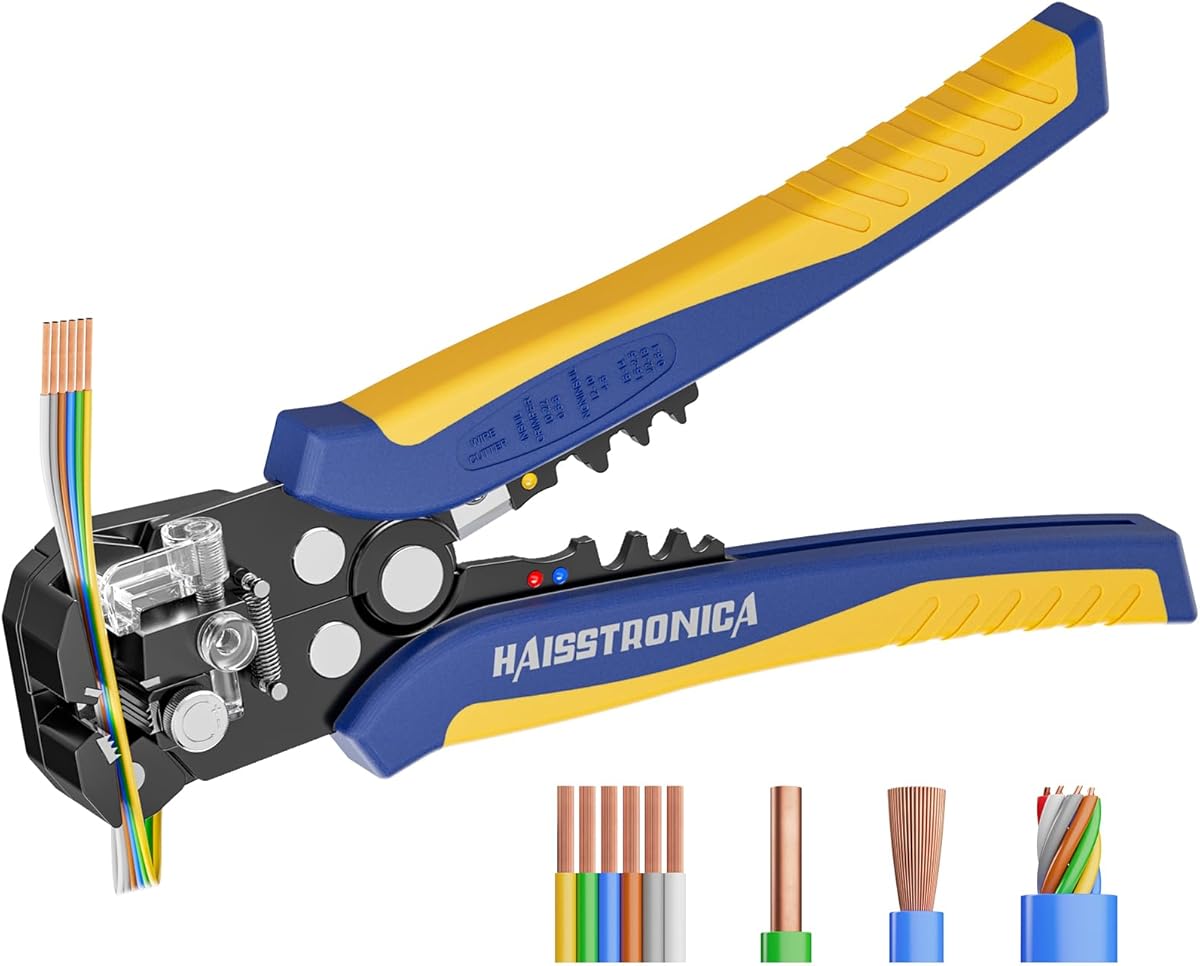
The haisstronica 3-in-1 is a self-adjusting stripper that combines wire stripping, cutting, and crimping. Its 4.6 rating and stated 10-24 AWG support make it appealing for technicians and home users who want a broad automatic tool for copper, cable, coaxial, and aluminum wire applications.
We may earn a commission when you buy through this link, at no additional cost to you.
The blades are described as heat-treated, polished, and black-oxidized alloy steel, with an emphasis on sharp, durable stripping. The self-adjusting action is intended to accommodate different conductor sizes, while the rubber handle is designed for comfortable, swift operation.
The product information presents overlapping gauge descriptions for different conductor types and materials. Users should therefore pay close attention to the applicable wire class instead of treating AWG as the only variable. The automatic action also takes more deliberate technique than a conventional fixed-hole stripper, particularly when the goal is a clean strip without damaging the core.
It is a strong option for general low-voltage maintenance where one tool must strip several sizes and perform additional cutting or crimping tasks. It is particularly suited to copper, cable, coaxial, and aluminum applications within the listed limits. Users should verify the exact conductor specification and practice on a short piece before committing to an important termination.
The self-adjusting design is intended to simplify repeated stripping across different gauges. It is valuable when a technician does not want to search for a separate fixed stripping hole for every conductor size.
Stripping, cutting, and crimping in one body simplifies common electrical tasks. The approach is practical for kits where portability and function consolidation matter more than a dedicated specialized tool.
We may earn a commission when you buy through this link, at no additional cost to you.
The VCELINK Quick Strip is a compact automatic wire stripper intended for 14-24 AWG solid or stranded wire. Its 4.5 rating reflects an approachable tool that emphasizes gentle operation, pressure adjustment, and controlled strip length, with particular suitability for speaker wire and flat ribbon cable.
We may earn a commission when you buy through this link, at no additional cost to you.
A spring in the handle allows the tool to be operated with a gentle press, automatically removing the insulation. The pressure adjustment knob helps the user tune the stripping action for wire thickness, while the length adjuster controls how much conductor is exposed. Its narrow or eagle-nose design is also intended to improve access in confined spaces.
The compact, lightweight construction makes it convenient for a drawer, technician bag, or mobile repair kit. Its trade-off is its 14-24 AWG range, which excludes heavier conductors, and its limited function set compared with crimping tools. It is primarily a stripper and cutter rather than an all-in-one termination tool.
Choose it for repeated work with small communication, audio, or similar conductors, especially when preserving the conductor core is important. The adjustment controls add useful control, though beginners should test on scrap wire and confirm that the chosen pressure and length suit the conductor before making a finished termination.
Spring-assisted operation reduces the force required to remove insulation. The pressure knob allows users to adapt the action to conductor thickness, helping support cleaner results on small wires.
The built-in length adjuster helps standardize exposed conductor length. This is useful for repeated connections where consistent prep improves workflow and reduces unnecessary bare copper.
We may earn a commission when you buy through this link, at no additional cost to you.
The Klein Tools 1019 Klein Kurve is a multi-function stripper, crimper, and cutter with a 4.7 rating. Its range includes 10-26 AWG solid and 12-28 AWG stranded wire, giving it broader conductor coverage than many tools in this guide while retaining the curved-handle format associated with the Klein Kurve line.
We may earn a commission when you buy through this link, at no additional cost to you.
The crimping section handles 10-22 AWG insulated and non-insulated terminals. It also crimps B connectors and Scotchlok IDC connectors, making it especially relevant to technicians who terminate signal, control, and communications wiring rather than merely prepare loose wire ends. A reinforced head helps reduce flex, and precision shear-type blades are designed for cleaner cutting.
The broad feature set introduces trade-offs. A tool with stripping, cutting, crimping, and screw-shearing capabilities cannot be as simple as a dedicated compact stripper, and users still need to select the correct crimper position for each connector. The screw-cutting feature is useful but does not turn it into a complete substitute for a precision screwdriver.
It is a strong recommendation for low-voltage installers and technicians who repeatedly fit terminals and IDC connectors. If those termination tasks are central to the job, the added crimping capability may be more valuable than the smallest possible footprint. Those who only strip fine wires should compare the simpler specialized options in this list.
Support for insulated and non-insulated terminals, B connectors, and Scotchlok IDC connectors makes this more than a wire-preparation tool. It is well aligned with technicians who complete connectors as part of the installation.
Separate solid and stranded ranges cover many common low-voltage conductor sizes. Matching the correct marked hole and the conductor's actual construction remains essential for clean results.
We may earn a commission when you buy through this link, at no additional cost to you.
The KNIPEX Automatic Wire Stripper is a 7.25-inch automatic tool covering 10-24 AWG wire. Its 4.4 rating is still strong, and the product data emphasizes precision-grade performance, comfort, durability, and use in shops, homes, and service fields.
We may earn a commission when you buy through this link, at no additional cost to you.
The automatic stripping principle removes much of the guesswork associated with repeatedly positioning a conductor in a fixed stripping hole. Its relatively compact 7.25-inch format should remain practical in service bags, while the stated 10-24 AWG range spans a substantial portion of the wire sizes used for controls, communications, and other low-voltage work.
The main consideration is that this model carries the highest listed cost in the group, so its advantages should justify the premium for the intended user. The supplied information also emphasizes fewer explicit secondary capabilities than the Klein, WGGE, and VCELINK selections. Buyers should not assume that it includes crimping or specialized cable-jacket cutting unless those functions are visible in the current listing.
It is best suited to professionals or serious enthusiasts who value a dedicated automatic stripping experience and work frequently within the 10-24 AWG range. For users handling larger conductors, specialized twisted-pair cable, or numerous terminal-crimping tasks, another model in this guide may deliver a better functional match.
Automatic stripping can support consistent, efficient preparation when many conductors need to be terminated. The tool is positioned as a precision-grade option for recurring professional work.
At 7.25 inches, the stripper combines a manageable size with a broad 10-24 AWG range. It can fit comfortably in a service kit without becoming one of the smallest dedicated tools in the comparison.
We may earn a commission when you buy through this link, at no additional cost to you.
The Klein Tools VDV110-261 is purpose-built for twisted-pair communication cable rather than general-purpose low-voltage conductor stripping. Its 4.7 rating and support for CAT3, CAT5/5e, and CAT6/6A make it the most specialized selection for network and communications cabling.
We may earn a commission when you buy through this link, at no additional cost to you.
Durable high-carbon steel cutting blades automatically adjust to the cable diameter. This radial stripping approach is designed to remove the outer jacket evenly while preserving the internal conductors. A finger-loop design helps with smooth rotation, which can make it easier to work around a cable without twisting it awkwardly.
An additional external blade can slit the jacket for mid-span access or open it lengthwise. That capability distinguishes this tool from ordinary wire strippers, but it also means the tool is designed around a specific cable format. It is not intended to replace a standard stripper for miscellaneous solid conductors or a crimper for connector termination.
Choose the VDV110-261 when the primary work involves installing or servicing twisted-pair cable, especially when a clean radial jacket removal matters. Network installers, structured-cabling technicians, and advanced home network hobbyists will find its specialized design more relevant than the broader general-purpose tools.
Blades that adjust to the cable diameter support an even removal around the circumference. This is useful for creating a consistent jacket opening while avoiding unnecessary disturbance to internal conductors.
The external slitting blade supports mid-span entry and lengthwise jacket opening. Those features make the stripper useful for both terminated cable preparation and installation work that begins in the middle of a run.
We may earn a commission when you buy through this link, at no additional cost to you.
The right low voltage wire stripper depends on conductor type, gauge, insulation, connection method, and working environment. Review the factors below before choosing a model, paying special attention to whether a broad feature list actually matches the tasks you regularly perform.
Start with the conductors you actually use. Some tools are specified primarily for stranded wire, while others cover both solid and stranded conductors over separate ranges. Low-voltage work may involve fine signal wires, control leads, thermostat cable, network cable, speaker wire, and larger branch-circuit conductors, and no single tool is equally optimized for every category. Compare the listed gauge limits with the wire in your project rather than assuming every conductor of a similar diameter will strip identically.
Choose a stripper whose supported solid-wire and stranded-wire ranges directly cover your most common work. Pay close attention to different ranges within the same product, because the maximum gauge for solid wire may not equal the maximum for stranded wire.
Fixed-hole strippers place the conductor in a correctly sized opening and use precision-ground blades to cut insulation. Automatic or self-adjusting tools use a different mechanism intended to accommodate wire thickness with less hole selection. Fixed holes can offer strong visual control for users who know the gauge, while automatic tools may speed repetitive work across mixed sizes. Neither approach is inherently superior; the best choice depends on the user's familiarity, the variety of wire, and the desired consistency.
Use a fixed-hole model for predictable gauge selection and automatic stripping for frequent mixed-gauge work. Test either design on a short conductor sample before making a finished connection.
The length of exposed conductor matters as much as the cleanliness of the cut. Some tools include an adjustable stopper, while others allow the wire to be positioned against a length guide. This can be particularly useful for repetitive terminal work because consistent preparation reduces the need to trim bare conductor later. It is also valuable where excess exposed copper creates a risk of contact between adjacent low-voltage circuits.
Look for an adjustable length stop if you prepare many similar connections. If the tool lacks one, learn to use the tool's reference points consistently or pair it with a careful measuring method.
A crimping function can make a wire stripper substantially more useful if you regularly terminate insulated or non-insulated terminals. Some models also support specific connector families, such as B connectors or IDC connectors. This is valuable for technicians completing signal and control connections, but it is unnecessary for users who only prepare wire ends. Extra functions also add size and create more opportunities to select the wrong crimp position.
Buy a crimping stripper when terminal completion is a routine part of the job. Match the crimper range and supported connector types to the hardware you use rather than relying on a generic crimping claim.
Not every low-voltage cable should be treated as an ordinary insulated conductor. Twisted-pair network cable has an outer jacket, internal twisted conductors, and sometimes shielding. A dedicated radial stripper removes the jacket evenly and may include an external blade for mid-span entry. General wire strippers remain useful for individual conductors after the cable jacket is opened, but they can damage internal wiring if used on the entire cable.
Choose a dedicated twisted-pair or radial stripper for structured cabling. For loose conductors or larger sheathed cable, select a tool with the correct jacket-removal method and supported construction.
A comfortable grip can reduce fatigue during repetitive stripping, while a compact profile improves access in panels and junction boxes. The tools in this guide range from narrow dedicated strippers to an eight-inch multi-function model. Ergonomic grooves, dual-material grips, curved rubber handles, and spring-assisted opening all influence handling differently. Tool size should be matched to the environment: a service technician carrying tools between locations may prioritize portability, while a technician working at a bench may favor multifunction capability.
Try the grip when possible and consider whether the tool will be carried or used in a fixed workspace. A comfortable handle is helpful, but access and task fit are more important than styling alone.
Blade material and construction influence durability, sharpness, and resistance to flex. Several selections specify hardened steel, high-carbon alloy steel, or stainless steel blades, while the Klein 1019 includes a reinforced head intended to reduce flex. Precision-ground stripping holes are another relevant feature because they help establish repeatable cutting edges. Automatic mechanisms have different internal construction requirements, so their adjustment or pressure controls also deserve attention.
Prioritize rigid construction, replaceable or maintainable cutting surfaces where applicable, and a mechanism suited to the volume of work. A sturdy tool is valuable only if its blades are suited to the conductor and kept properly adjusted.
Additional functions such as wire looping, bending, screw shearing, jacket slitting, and integrated cutting can save time when they match the job. They can also make the tool larger or more complex. A technician who installs network racks may highly value an external jacket blade, while a general installer may prefer terminal crimping. Likewise, a lightweight stripper may be ideal for mobile repair, whereas a fixed workstation may benefit from a broad multi-function tool.
Add extras only when they solve a recurring problem. Choose the simplest tool that fully covers your conductors, connections, and workspace.
Begin by identifying the conductor's material, gauge, construction, and insulation thickness. Select the stripping hole or automatic setting that corresponds to the wire, and always make a test cut on a short offcut. For a conventional stripper, insert the wire only as far as needed and avoid twisting it into the hole, because that can enlarge the cut or place the conductor against the blade edge.
For automatic tools, adjust pressure or tension according to the manufacturer's instructions, then use the length control to match the termination. Keep the tool aligned with the wire and apply a controlled squeeze. If the insulation tears or the conductor is marked, stop and reassess the gauge setting rather than forcing the cut. When stripping the outer jacket of twisted-pair or other sheathed cable, use the dedicated radial or slitting feature intended for that cable.
After use, wipe away loose insulation and debris, and store the tool dry and closed. Keep automatic mechanisms free of grit, and do not lubricate unless the manufacturer permits it. Have dull or damaged blades assessed or replaced, because a compromised cutting edge can nick conductors and create unsafe terminations. Always disconnect power when working on active wiring and use the tool only on conductors for which it is rated.
The best choice depends on the conductor sizes and tasks involved. The Klein Tools 11057 is a strong general option for fine solid and stranded wires, the Klein 1019 adds terminal and connector crimping, and the Klein VDV110-261 is specialized for twisted-pair cable. Select the model whose stated range and functions match the work rather than relying on a single universal designation.
Yes, an incorrect hole, misaligned blade, excessive force, or worn cutting edge can nick or crush the conductor. Use the gauge specified for the wire and test on scrap material first. If the tool cuts into the copper or repeatedly tears the insulation, stop and check the setting, blade condition, and whether the tool is appropriate for that conductor.
Automatic tools are convenient for repeated work across different conductor sizes because they adjust the stripping action. Manual fixed-hole tools can provide direct visual control and are familiar to many technicians. Automatic models require correct pressure and technique, while fixed-hole models require accurate gauge selection, so consider which mechanism you can use most consistently.
Coverage varies by model and conductor construction. Selections in this guide range from 10-24 AWG or 10-26 AWG capability to fine ranges extending to 32 AWG, and some specify only stranded wire. Always check both the solid and stranded limits before purchasing, particularly when your work includes multiple conductor types.
A general low voltage wire stripper is usually intended for individual conductors, not the outer jacket of twisted-pair network cable. A radial or twisted-pair stripper removes that jacket more evenly and can open the cable for access. Once the jacket is removed, a suitable wire stripper may still be needed for individual conductors.
Only if your regular work includes attaching terminals or connectors. A crimping stripper can consolidate wire preparation and termination into one tool, but a dedicated stripper may be simpler and easier to carry. Check whether the crimper supports your exact insulated terminals, non-insulated terminals, B connectors, or IDC connectors.
Use a tool with an adjustable stopper or length guide whenever possible. Otherwise, establish a repeatable measuring method and check the strip after each cut. Consistent length reduces excess bare conductor, improves termination consistency, and helps avoid the need to trim finished wires.
Remove debris after each use, keep the tool clean and dry, and avoid forcing wires into incorrect holes. Automatic mechanisms should remain free of grit, and blades should be replaced or serviced when they become dull or damaged. Store the tool closed to protect its cutting surfaces and the rest of a technician's bag.
The Klein Tools 11057 is the strongest all-around recommendation for fine conductors because it combines precise stripping with cutting, looping, bending, and screw-shearing functions. The WGGE WG-015 stands out as the budget multi-function option, while the KNIPEX Automatic Wire Stripper represents the premium choice for professionals who value an automatic workflow and precision-oriented construction.
Prioritize conductor compatibility first, followed by the stripping mechanism and the extra functions you genuinely need. Dedicated compact models are better for fine stranded wire and confined spaces, terminal crimpers are better for connector work, and the VDV110-261 is the appropriate selection for twisted-pair network cable. The most capable tool is not necessarily the best one if its range or design does not fit the job.
Finally, check the current product listing, included components, connector compatibility, and availability before buying. Ratings and specifications can change over time, and prices fluctuate as well. Comparing the current information against the conductor types and termination methods in your toolkit will help you select the most useful low voltage wire stripper with confidence.