
Sylvania 400W Plantastar HPS
4.4Editor score
400-watt growing lamp
600 μmol/s PPF
E39 mogul base
24,000-hour rated life
Hps Lights for Growing guide comparing 10 top-rated options for spectrum, wattage, ballast compatibility, coverage, dimming, controls, build quality, heat
HPS lights for growing remain important fixtures for indoor gardeners seeking intense, warm-spectrum illumination during flowering and fruiting. A useful high-pressure sodium lamp balances light output, spectral quality, electrical efficiency, compatibility, and heat management. The right choice depends heavily on the ballast, reflector, growing area, crop, ventilation, and whether you need a complete system or replacement bulb.
This guide compares ten HPS grow-light products, including complete systems, standalone bulbs, and LED alternatives that position themselves as HPS replacements. The evaluation considers stated spectrum, wattage, ballast compatibility, reflector coverage, dimming controls, electrical requirements, heat warnings, installation details, and environmental specifications. It also identifies options that may suit a different approach to indoor lighting.
Each selection highlights a different use case, from a complete dimmable setup to value-oriented bulbs and more efficient LED fixtures. Ratings reflect the supplied customer feedback, while technical details come from the product information. Current pricing and availability can change, so check the latest listing, fixture requirements, and compatibility details before purchasing.
4.4Editor score

4.0Editor score

4.7Editor score
The table below compares all ten options by type, power, output or spectrum emphasis, and installation requirements so growers can quickly identify the best fit for their setup.




The Plantmax UltraGrow is a complete 1000W eFlex HID system with a dimmable ballast, controller port, adjustable reflector, and included double-ended HPS bulb. It carries a 4.0 rating, and its strongest appeal is convenience: a grower does not need to assemble a separate lamp, socket, ballast, and reflector around an uncertain compatibility requirement.
We may earn a commission when you buy through this link, at no additional cost to you.
Its defining feature is granular control. The ballast supports 600, 750, 825, 1000, 1150, and external-control wattage settings, while the controller port allows connection to external equipment. The premium Plus Vega hammertone reflector has a three-mode adjustment intended to shape coverage, making the fixture more adaptable than a fixed basic reflector.
The trade-offs are heat and electrical intensity. A 1000W discharge lamp operates at a different energy level from the lower-wattage options in this list, and the product information does not describe a fan. It is better suited to a properly ventilated room or open rack than a small, unventilated enclosure where heat could accumulate around plants and equipment.
Choose this system when you want a ready-made 1000W installation with a bulb and adjustable reflector already included. Check the room's electrical capacity, plan ventilation, and confirm that double-ended fixture and controller arrangements fit your room. For those priorities, it is the most complete and flexible conventional HPS package in the group.
The included bulb, ballast, and adjustable reflector remove the most common compatibility problem associated with assembling a grow light from separate parts. The result is a more unified installation, subject to local electrical and environmental requirements.
Multiple wattage settings let the fixture operate below or above its nominal level, and the controller port adds a path for centralized control. These features are useful for growers who want more control over light intensity and room-wide operation.
We may earn a commission when you buy through this link, at no additional cost to you.
This two-pack of 1000W E39 HPS bulbs has a 4.4 rating and is aimed primarily at growers seeking a flowering-focused replacement lamp. Its product information emphasizes a 1950 μmol/s output figure, 136,000 lumens, and a 60% increase in red-spectrum focus, all of which support its positioning for bloom and fruiting stages.
We may earn a commission when you buy through this link, at no additional cost to you.
Compatibility is a major practical strength. The bulbs are listed for both electronic and magnetic ballasts, reducing the risk of purchasing a lamp that cannot work with the fixture already in the grow room. The two-pack also gives users a spare or supports a two-fixture arrangement, provided the electrical and ventilation setup can handle the combined load.
Unlike discharge lamps that reach output almost immediately, this product requires approximately five minutes to reach full brightness and recommends waiting at least seven minutes before striking again after use. That restart behavior matters for anyone considering frequent switching or automated short-cycle control. Its stated life of more than 24,000 hours and 90% output maintenance for 5,000 hours are also useful claims to compare when planning replacement intervals.
This is a compelling choice for growers with E39-compatible ballasts who want a two-bulb flowering package and do not need to frequently cycle the lamps. Confirm the base, wattage, ballast rating, fixture clearance, and cooling requirements before installation. It is less suitable for users who require instant-on performance or frequently dim through on-and-off control.
The listed red-spectrum emphasis makes the pair more relevant to flowering than to a broad, fixture-specific design. Growers should still evaluate total room coverage rather than assuming a bulb's output figure translates directly into uniform canopy illumination.
Support for both electronic and magnetic ballasts gives this product more flexibility than lamps restricted to one fixture type. Verify that the ballast is rated for the lamp's wattage and operating requirements before installation.
We may earn a commission when you buy through this link, at no additional cost to you.
The Eye Hortilux HX66710 is a 600W Super HPS lamp with a 4.6 rating, combining a recognized horticultural-lamp format with enhanced spectral energy. It is intended for indoor growers who already understand HPS fixture requirements and want a lamp designed to optimize the spectral balance of high-pressure sodium lighting.
We may earn a commission when you buy through this link, at no additional cost to you.
The listed benefits focus on plant-supportive spectral output rather than just raw brightness. Eye Hortilux states that the lamp provides more energy than standard HPS, while the EN specification is described as lead-free and containing less mercury than conventional HPS lamps. That makes it a practical choice for growers looking for a more refined spectrum and a product with explicit environmental characteristics.
Unlike a complete grow system, this option is only the lamp. A grower must already have, or separately acquire, a compatible ballast, socket, reflector, and appropriate environmental controls. Its 600W rating also puts it between lower-power lamps and the 1000W products featured elsewhere in this guide, giving it a useful middle ground for medium-sized rooms.
Choose the HX66710 when you want to replace an existing 600W HPS installation or build a new fixture with a higher-spectrum option. Match the lamp to its exact socket and ballast designation, and provide suitable ventilation. For growers who want turnkey equipment rather than a component, one of the complete systems in this guide will be a more convenient choice.
Enhanced spectral energy distinguishes this lamp from a basic standard-HPS model. The specification makes it easier to compare with other Super HPS options when balancing flowering performance against total power draw.
The EN lamp is described as completely lead-free and as containing less mercury than standard HPS products. Growers should still follow normal handling and disposal practices for horticultural discharge lamps.
We may earn a commission when you buy through this link, at no additional cost to you.
This 1000W HID grow-light kit is a fixture rather than a complete lighting package, and it has a 4.0 rating. It accepts compatible HPS or MH bulbs, allowing growers to select the spectrum that best matches a crop or growth stage. The included ballast, reflector, socket, and housing provide a more comprehensive foundation than a standalone bulb.
We may earn a commission when you buy through this link, at no additional cost to you.
Its adjustable ballast offers 600W, 750W, 1000W, and 1150W settings across a 120–220V input. The product information also identifies protection against short circuits, surges, ignition failure, and overheating. A controller port supports multi-deployment, while the Italian Vega aluminum reflector uses an open design intended to provide broad coverage and reduce dead spots.
The largest compromise is that no bulb is included. This makes the kit appealing to growers who already own a suitable lamp or want to choose one separately, but it also means the final performance depends on the bulb selected. Its 98% reflectivity claim improves the fixture's efficiency potential, yet actual uniformity still depends on reflector placement, room dimensions, and plant height.
The listing also emphasizes heat. It explicitly warns against unventilated enclosed use and recommends matching the kit with an inline fan for effective dissipation. Choose it when you want a flexible, controller-ready HID fixture and can select a compatible bulb separately. Ensure the electrical system, socket, reflector clearance, and ventilation are all suitable for 1000W operation.
Compatibility with HPS and MH lamps gives growers freedom to tune spectrum and output. The missing bulb should be treated as an additional required purchase, not as part of the kit's standard configuration.
The open, high-reflectivity Vega hood is intended to spread light over a broad area. Position the fixture carefully, as good reflector design cannot compensate for poor spacing or an unsuitable room size.
We may earn a commission when you buy through this link, at no additional cost to you.
The VIPARSPECTRA P4000 is a 450W full-spectrum LED grow light with a 4.7 rating. Although it is not a conventional high-pressure sodium product, it is relevant to the search because it is marketed as comparable to a traditional 1000W HPS or MH while consuming a smaller amount of power.
We may earn a commission when you buy through this link, at no additional cost to you.
The diode arrangement combines 52 red diodes at 660nm, 1,272 3000K white diodes, 632 5000K white diodes, and four 730nm infrared diodes. A built-in dimmer provides manual brightness adjustment, allowing the output to be matched to vegetative growth, flowering, and seedling stages rather than operating at one fixed level throughout the cycle.
Thermal management is handled through a fanless design and broad aluminum heat-sink surfaces. Avoiding a fan reduces mechanical noise, although the light still consumes 450W and should be positioned with appropriate clearance. Listed coverage is approximately five by four feet for vegetative growth and five by three feet for flowering, with height and brightness adjusted according to the plants' needs.
Choose the P4000 for growers seeking a full-spectrum fixture, adjustable output, and lower electrical consumption than a 1000W HPS installation. It is not the right purchase for someone specifically seeking a replaceable HPS bulb or a standard HID ballast. Evaluate coverage for the actual canopy and adjust the dimmer and mounting height rather than assuming one fixed setup is optimal.
The dimmer changes the fixture's overall brightness and makes it easier to tailor delivery to seedlings, vegetative plants, or flowers. Dimming should complement, rather than replace, proper fixture height and room coverage.
The fanless aluminum housing reduces operating noise and removes the need for a dedicated cooling fan attached directly to the light. Passive cooling still requires unobstructed airflow around the heat sinks.
We may earn a commission when you buy through this link, at no additional cost to you.
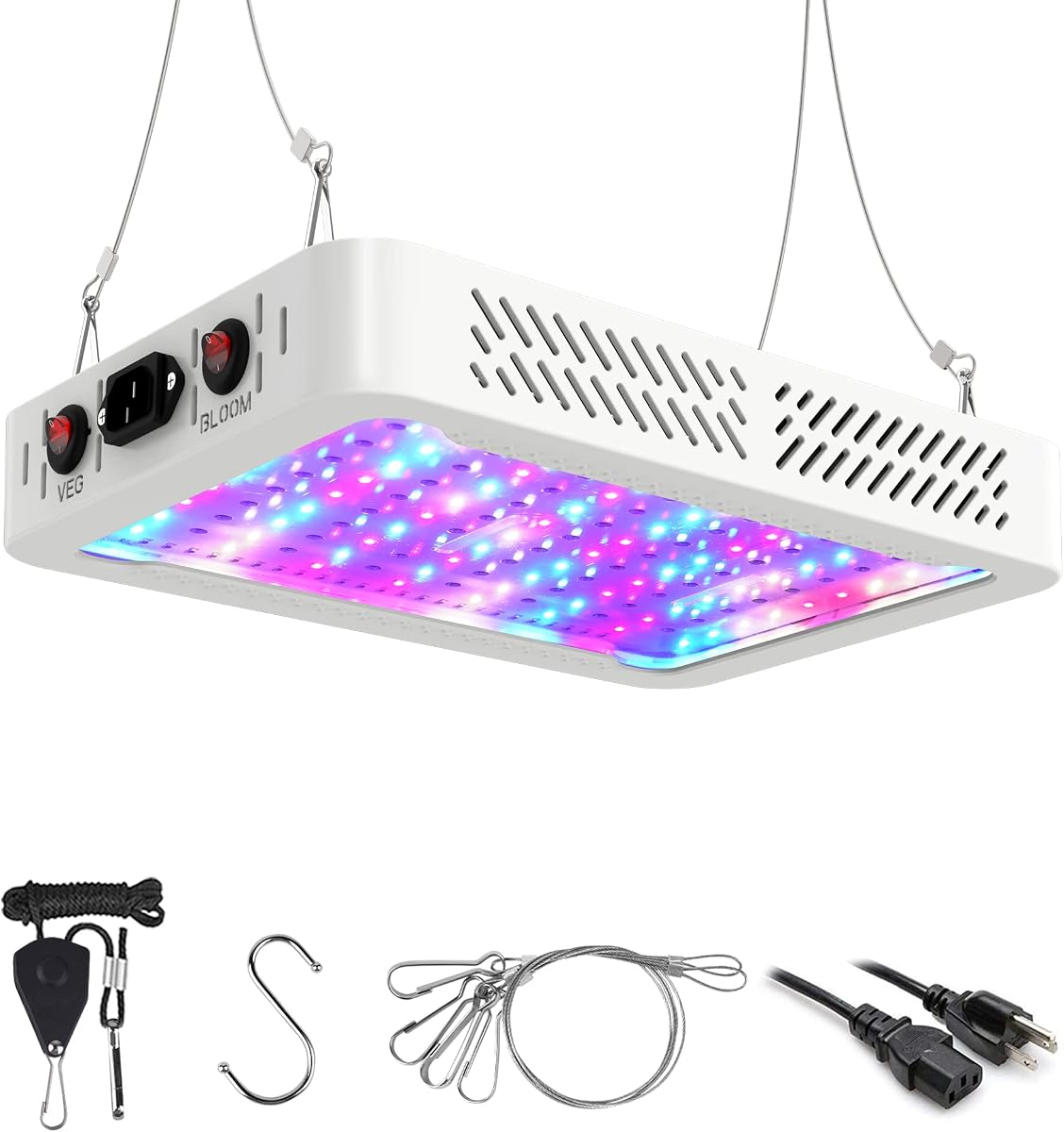
The Beelux 1000W is an LED fixture positioned as an alternative to a 1000W HPS or MH while consuming approximately 110W. It has a 4.3 rating and offers a substantially different operating profile from the discharge-lamp products in this guide, emphasizing low power consumption, simple hanging, and full-spectrum output.
We may earn a commission when you buy through this link, at no additional cost to you.
Its full-spectrum design places additional emphasis on red light, and the listing states that this can support yield increases of 30% to 50%. That claim should be understood as a manufacturer assertion rather than an independently verified result. More useful for comparison are the stated 110W consumption and suitability for a four-by-four-foot grow area.
The housing uses an optical-grade fire-resistant polycarbonate construction and an aluminum back cover. Six sides are designed to dissipate heat through convection, and the absence of a fan keeps operation quiet. A power cord, two steel ropes, and an adjustable rope provide a straightforward hanging system, while dual switches offer separate operating control.
Choose the Beelux when lower electricity use and simple installation matter more than using a true HPS discharge lamp. It may suit small indoor growing areas, seed starting, vegetables, herbs, and flowers. Do not treat the product name's 1000W as its power draw; the actual consumption is listed as 110W, and the product is an LED comparison product rather than a conventional HPS bulb.
Drawing approximately 110W makes this fixture considerably easier to operate than a 1000W HPS system. Lower power can reduce electrical and cooling demands, although actual room results still depend on coverage and fixture placement.
The included steel ropes and adjustable rope make it easier to change mounting height as plants grow. Confirm that the support structure can safely hold the fixture and that its position provides even coverage.
We may earn a commission when you buy through this link, at no additional cost to you.
The Hortilux Super HPS 1000W is a high-pressure sodium lamp with a 4.5 rating and an enhanced-spectrum design. It is intended for growers who want to improve spectral balance while retaining the output characteristics associated with a 1000W HPS source.
We may earn a commission when you buy through this link, at no additional cost to you.
The product information states that the lamp provides 25% more energy in the violet, blue, and green spectrum than standard HPS. It also discusses use alongside a Metal Ace conversion lamp to optimize spectral energy levels through different growth stages. For growers comparing standard and enhanced lamps, that extra violet-blue-green contribution is the central distinction.
The EN designation means the lamp passes stated EPA and TCLP test criteria for disposal as non-hazardous waste. This is a product-specific environmental benefit, although proper lamp handling is still important. As a standalone lamp, it does not include a fixture, ballast, socket, or reflector, and its 1000W operating level produces substantial heat.
Choose this option for a grower with compatible 1000W equipment who wants enhanced spectral output and the stated waste designation. It is less convenient for a new installation because all supporting components must be sourced separately. Match the lamp to the manufacturer's fixture and ballast specifications and plan for heat removal before switching it on.
The stated increase in violet, blue, and green energy differentiates the Super HPS from a standard lamp. That balance can make it more relevant to growers concerned with full-cycle spectrum rather than red-heavy flowering output alone.
The EN designation provides a clear environmental specification for disposal planning. It is one of the strongest documented distinctions in this product, especially for growers replacing lamps frequently.
We may earn a commission when you buy through this link, at no additional cost to you.
The Eye Hortilux Super HPS two-pack contains two enhanced-spectrum 1000W bulbs and has a 4.7 rating. It is a natural option for growers operating two fixtures who want to upgrade both lamps at the same time and prefer a documented spectrum improvement over standard HPS.
We may earn a commission when you buy through this link, at no additional cost to you.
The listing states that the lamps provide 17% more total energy and 25% more energy in the violet, blue, and green spectrum than standard HPS products. It also notes reduced mercury content compared with standard HPS lamps. These specifications make the two-pack appealing for growers comparing output quality and environmental characteristics side by side.
Its main constraint is the combined electrical and thermal load. Two 1000W discharge lamps demand more power than one and generate enough heat to require serious ventilation planning. A two-lamp pack also means the grower must already have two compatible fixtures or acquire them separately, plus a suitable ballast arrangement for each lamp.
Choose this pack when replacing lamps in a two-fixture room, balancing enhanced spectral output with the convenience of obtaining matched bulbs. Confirm base type, wattage, fixture compatibility, and adequate cooling. For a single-lamp room, a single-bulb option may be more practical, while a complete fixture may be preferable for a new installation.
Buying two bulbs together provides consistency for rooms with paired fixtures. Matching lamp models can also simplify replacement planning when one unit eventually reaches the end of its service life.
The documented increase in total and selected spectrum energy provides a clear reason to consider these over standard HPS lamps. Actual results still depend on fixture efficiency, spacing, and environmental control.
We may earn a commission when you buy through this link, at no additional cost to you.
The Eye Hortilux 1000-Watt Super HPS is a single enhanced-spectrum lamp with a 4.5 rating. It offers growers the same core spectral advantage as the two-pack version without requiring a second bulb, making it a practical replacement option for a one-fixture setup.
We may earn a commission when you buy through this link, at no additional cost to you.
The product is described as providing 25% more energy in the violet, blue, and green spectrum than standard HPS. Its listing also discusses combining the Super HPS with a Metal Ace conversion lamp to optimize spectral energy levels through all stages of plant growth, reflecting the lamp's intended use as part of a broader horticultural lighting approach.
The single-lamp format is both its main convenience and its limitation. It avoids unused inventory and fits a straightforward replacement job, but a larger flowering room may still require multiple fixtures. The lamp is made in USA, and the listed package dimensions are approximately 15.1 by 3.4 by 3.2 inches, giving installers a clearer idea of its physical footprint.
Choose this bulb when you own a compatible 1000W fixture and want a single enhanced-spectrum replacement. It is not suitable for a plug-and-play installation because the ballast, socket, reflector, and controls must already be present or purchased separately. Confirm electrical compatibility and provide adequate ventilation around the operating lamp.
One lamp is easier to match to one existing fixture and avoids carrying a second bulb that the room cannot use. It is especially useful for replacing a failed enhanced-spectrum lamp without changing the rest of the setup.
The stated violet, blue, and green energy increase gives the lamp a more balanced spectral profile than standard HPS. This makes it relevant to growers comparing full-cycle spectrum rather than only red-weighted flowering performance.
We may earn a commission when you buy through this link, at no additional cost to you.
The Sylvania Plantastar 400W is a single high-pressure sodium grow lamp with a 4.4 rating. Its lower power requirement and modest physical format make it useful for smaller installations or as a supplemental flowering light, while its 400W output still provides meaningful intensity for serious indoor grows.
We may earn a commission when you buy through this link, at no additional cost to you.
The lamp produces a stated 600 μmol/s of PPF, 50,000 lumens, and a 2100K warm spectrum. The product information says it is intended for vegetative growth, flowering, seeding, and budding across plant species. It uses an E39 mogul base and is specified for operation with an ANSI S51 ballast, which must be considered before purchase.
The 400W rating creates a more moderate heat and power load than the 1000W fixtures and lamps in this guide, although it still requires ventilation and safe handling. Its 24,000-hour stated lifetime reduces replacement frequency, and the product is backed by a five-year warranty. The warm color is characteristic of HPS and is particularly relevant during flowering.
Choose the Plantastar for a grower who wants a straightforward, moderately powered HPS lamp with a broadly stated plant-growth application and established bulb format. It is an especially accessible option when paired with the correct ANSI S51 ballast and a suitable reflector. Avoid using it with a fixture or ballast that does not match its voltage, wattage, and base requirements.
At 400W, the lamp offers a lower electrical and thermal load than 1000W HPS equipment. That can make it easier to integrate into appropriately sized rooms or combine with other fixtures.
A stated 24,000-hour life and five-year warranty support the lamp's suitability for sustained growing schedules. Its listed PPF, lumens, spectrum, and base should all be checked against the intended fixture.
We may earn a commission when you buy through this link, at no additional cost to you.
Choosing an HPS grow light requires matching the lamp or fixture to your room, crop stage, electrical capacity, and cooling plan. The most important distinctions are system completeness, spectrum, ballast compatibility, coverage, dimming, and realistic heat management.
A complete system bundles the HPS bulb, socket, ballast, reflector, and housing, reducing the need to research individual component compatibility. It is usually easier for a new grower to install, although the available wattage, reflector adjustment, and controller features are more limited. A standalone bulb offers flexibility if you already own a proven fixture, while a fixture kit lets you choose between HPS and MH lamps and is useful for growers who want to change spectrum by growth stage.
Choose a complete system for straightforward setup, a bulb for replacing existing equipment, and a fixture kit when you want customizable lamp selection. Confirm that every included component belongs to the same intended system.
HPS options in this guide range from 400W to 1000W, while the included LED alternatives draw less power. Higher wattage can support greater intensity, but it also increases heat, electrical demand, and fixture size. A 1000W setup may be excessive for a small tent or closet, whereas a 400W lamp can be more manageable. Electrical circuits, extension methods, ballast requirements, and local safety codes should be reviewed before adding high-wattage equipment.
Match lamp power to canopy dimensions and available electrical capacity. Do not assume a higher-wattage product automatically produces a better growing environment.
Traditional HPS is most strongly associated with warm, red-weighted light and is often used during flowering and fruiting. Enhanced Super HPS products claim more energy in the violet, blue, and green regions, potentially making them more versatile across a full cycle. Some of the two-pack products emphasize red spectrum and bud development, while full-spectrum LEDs provide a different spectral distribution without being true HPS lamps.
Prioritize the spectrum that matches your crop and strategy. If you rely on HPS for flowering, compare red emphasis and enhanced-spectrum claims; if you want one fixture for multiple stages, consider whether a full-spectrum LED is a more suitable fit.
Not every HPS bulb works with every ballast. The products here reference electronic and magnetic ballast compatibility, specific ANSI S51 use, and different lamp formats such as E39 and double-ended designs. Wattage, base, socket, ballast type, and voltage must all agree. A bulb that physically screws into a socket can still be unsafe or ineffective if the ballast is not rated for its operating requirements.
Check the complete system specification before ordering. Match the lamp's exact designation to the fixture manufacturer or ballast documentation rather than relying only on wattage and base shape.
A lamp's spectrum and output do not guarantee uniform illumination. Reflector shape, reflectivity, fixture spacing, room dimensions, and mounting height determine how light reaches the canopy. Adjustable reflectors can help adapt a system to different layouts, while open-design hoods aim to reduce dark areas. The included LEDs provide explicit coverage dimensions, which is useful when comparing them with traditional HPS setups for which room footprints are less explicitly stated.
Plan coverage using the entire room, not the lamp alone. Position fixtures at suitable heights, maintain separation, and use the stated coverage area as a starting point rather than an absolute guarantee.
HID and HPS systems produce heat, and several products in this category specifically warn against unventilated enclosed spaces. Even LED alternatives use heat sinks and need airflow around their housings. Temperature, humidity, and carbon dioxide levels can all affect plant performance, so a lamp should be paired with adequate room ventilation, an exhaust path, and environmental monitoring. Inline fans can improve circulation, while careful placement prevents equipment from operating in a trapped pocket of hot air.
Build cooling into the budget and layout from the beginning. Even the lower-power alternatives benefit from unobstructed airflow and deliberate room temperature management.
Dimming can reduce light intensity during seedling or vegetative stages and help fine-tune a fixture for changing canopy conditions. The Plantmax system offers multiple wattage settings and a controller port, while the 1000W HID kit includes a controller port and several power levels. The LED alternatives provide manual dimming or dual switches. Electronic control can simplify coordinated operation, but it should complement—not replace—proper fixture placement and environmental management.
Choose manual controls for simplicity or multi-fixture control for larger installations. Confirm how dimming affects output, heat, ballast behavior, and the manufacturer's recommended operating range.
Lamp life affects both long-term operating convenience and replacement planning. Products list lives ranging from 24,000 hours to more than 24,000 hours, with some adding stated output-maintenance periods. A five-year warranty is also listed for the Sylvania model. These are manufacturer specifications, not guarantees of identical real-world service duration, so lamp age, ballast quality, operating temperature, cycling frequency, and maintenance practices can affect results.
Factor replacement intervals into your setup and choose durable, supportable lamp formats. Keep compatible replacement lamps on hand if uninterrupted flowering schedules are important.
Begin by confirming that the lamp, ballast, socket, reflector, voltage, and wattage are a compatible combination. Mount the fixture on a stable, purpose-built support, keep the required clearance around the bulb and reflector, and position it according to the plant's growth stage and the light's recommended coverage. Do not energize a fixture with a loose socket, damaged cord, or obstructed cooling path.
Operate the light within the manufacturer's requirements and use the stated warmup and restart procedure where applicable. One product in this guide calls for approximately five minutes to reach full brightness and at least seven minutes before striking again. Avoid frequent short cycling, keep the reflector and bulb free of dust, and schedule replacement when output decline or physical damage makes continued use inappropriate.
Monitor the growing area rather than relying on the light alone. Use temperature and humidity monitoring, maintain adequate ventilation, and adjust fixture height as plants grow. For dimmable systems, begin with a moderate setting and increase it according to plant response, crop stage, room conditions, and manufacturer guidance. Disconnect power before cleaning, changing bulbs, or adjusting hardware.
Yes. HPS lights remain useful for indoor flowering and fruiting because they deliver strong warm-colored light with a substantial red component. Their effectiveness depends on the crop, fixture efficiency, coverage, and proper heat management. Many growers use HPS alongside a cooler-spectrum source or choose a full-spectrum LED when one fixture must serve every growth stage.
The correct ballast must match the lamp's wattage, voltage, base, and operating type. Some bulbs support both electronic and magnetic ballasts, while others are tied to a specific ANSI designation. Do not rely on the base alone, because a physically compatible bulb can still be inappropriate for the ballast. Check the lamp and fixture documentation before installation.
They can, especially in small or enclosed rooms with poor circulation. A 1000W discharge system should be paired with deliberate ventilation and an exhaust plan, and the fixture should retain manufacturer-specified clearance. Lower-wattage HPS or efficient LED alternatives may be more appropriate where heat and electrical capacity are limited.
Super HPS is designed to improve the spectral balance of standard high-pressure sodium light. Products in this guide state that enhanced lamps provide more energy in the violet, blue, and green spectrum, while ordinary HPS is more heavily weighted toward warm and red output. The improvement can make enhanced lamps more useful across a full growth cycle.
Usually not as a direct drop-in replacement because HPS and LED fixtures use different technologies, electrical systems, and optical designs. An LED fixture may replace an entire HPS setup, but it is not normally interchangeable with a standard HPS socket and ballast. Choose the lighting system as a whole and match it to the room, canopy, and power available.
There is no universal height because the correct distance depends on lamp wattage, fixture type, canopy, room conditions, and manufacturer guidance. Start with the fixture's recommended distance, monitor plant response, and adjust as plants grow. Improving reflector focus or increasing intensity can make excessive closeness damaging, so never assume every HPS fixture should hang at the same height.
Some do. The 1000W two-pack in this guide specifically recommends allowing about five minutes for full brightness and waiting at least seven minutes before striking the lamp again after use. Repeated short restarts can reduce performance and place unnecessary stress on the lamp and ballast, so follow the specific product's operating instructions.
Begin with the fixture or lamp's stated coverage, then compare that area with the actual plant canopy and available height. Consider electrical capacity, heat removal, and whether other lights will supplement or replace it. Larger rooms may need multiple fixtures, while a smaller space can be overheated by equipment sized for a much larger area.
The Plantmax UltraGrow stands out as the most complete conventional HPS system because it includes a 1000W double-ended bulb, dimmable ballast, adjustable reflector, and controller port. The Sylvania Plantastar 400W offers a more moderate-wattage entry point, while the Eye Hortilux Super HPS two-pack represents the premium spectrum-focused choice in this guide.
Prioritize compatibility before any other feature. Match wattage, ballast type, socket, voltage, and fixture design, then confirm that the room can handle both electrical demand and heat. A complete system is convenient, a standalone bulb offers replacement flexibility, and a full-spectrum LED may be a better choice for growers who prioritize lower power use and adjustable output over traditional HPS technology.
Before ordering, review the current listing for availability, manufacturer requirements, included components, and any changes to the product. Current pricing can vary, and fixtures, ballasts, reflectors, and environmental controls may need to be purchased separately. A careful compatibility check will prevent the most common and avoidable HPS installation problems.