
HiBoost Off-Road Vehicle Signal Booster
4.2Editor score
Designed for remote trails
Rugged protective construction
Folding rotating antenna mount
Compare the 10 best cell phone signal boosters for mountain areas, including home, rural, and off-road models, plus coverage, gain, antennas, and compatibility.
Mountain cabins, remote lodges, valleys, and off-road routes can leave cellular users with weak bars, unreliable calls, and frustratingly slow data. A well-chosen signal booster can improve an available outdoor signal, but the right system depends on coverage needs, antenna placement, carrier bands, and whether the installation is for a home or vehicle.
We compared the ten products in this guide by examining their stated gain, supported cellular bands, antenna arrangements, maximum coverage, FCC status, installation process, and suitability for remote terrain. The list includes multi-room home systems, directional outdoor setups, and rugged vehicle boosters, with each product evaluated according to its documented specifications.
The selections show how mountain coverage solutions differ: higher-gain multi-antenna kits suit larger properties, while vehicle-oriented systems emphasize rugged mounting and portable use. Ratings reflect the supplied customer feedback, and feature claims are limited to the available product information. As with all consumer electronics, prices and promotions can change, so check the current listing before purchasing.
4.2Editor score

4.3Editor score

4.9Editor score
This side-by-side comparison distinguishes home, multi-room, and vehicle boosters by their stated coverage, gain, supported bands, antenna configuration, and installation needs. Mountain-area buyers should start with the strength of the available outdoor signal rather than treating the listed square-foot capacity as a guaranteed result.




The HiBoost Home Office Booster is a balanced choice for a mountain cabin, remote home office, or property where usable outdoor service can reach an elevated antenna. Its 4.3 rating reflects generally favorable customer feedback, while the documented feature set makes installation easier to evaluate. The system supports 5G and 4G LTE, works with major U.S. carriers, and is designed to improve calls, data, streaming, uploads, and downloads in weak-signal areas.
We may earn a commission when you buy through this link, at no additional cost to you.
The standout feature is the combination of a color LCD and HiBoost Signal Supervisor app. Together, they provide real-time operating information and can help a user locate a stronger position for the outdoor antenna, a critical step on uneven terrain where a nearby tower may be blocked by ridges or forest. The professional directional antenna is also well suited to mountain properties because it can favor a specific cell tower while rejecting signal arriving from less useful directions.
Its stated coverage of up to 2,000 square feet is less expansive than the multi-room systems in this list, and performance depends on finding at least one usable bar at the outdoor antenna. The system also requires outdoor antenna placement and indoor distribution, so buyers in remote or electrically isolated locations should consider installation effort. Those limits make it a more focused solution for a defined living space rather than an all-purpose choice for every remote property.
This is the strongest overall recommendation for a mountain home where reliability, understandable controls, and carrier flexibility matter more than maximum floor coverage. It is particularly appealing to users who want a visual indication of signal behavior and guidance during setup. Buyers should first verify outdoor service and identify the most suitable antenna location, then use the display and app to refine the installation.
The LCD and companion app make it easier to compare signal readings at different outdoor locations. This is particularly valuable in mountain terrain, where moving an antenna a short distance can sometimes reveal a stronger or less obstructed tower.
The included directional outdoor antenna can focus reception toward a more favorable base station. It is particularly appropriate for a fixed cabin whose users need dependable service in a specific room or living area.
We may earn a commission when you buy through this link, at no additional cost to you.
This green multi-room booster combines a 4.8 rating with a 70 dB maximum-gain specification, making it an attractive option for larger mountain homes, lodges, and rural properties. It is designed to enhance voice and data across as many as 7,000 square feet when a usable signal exists outside. Two indoor antennas provide more distribution options than a single-antenna kit, while support for 5G, 4G LTE, and 3G makes it suitable for a broad mix of devices.
We may earn a commission when you buy through this link, at no additional cost to you.
Automatic Gain Control is one of the most important features for this installation category. The system can detect the incoming signal and adjust its operation, while self-oscillation elimination and anti-interference functions are intended to support stable performance. A high-quality LED screen gives users immediate feedback about operating status, and the ability to connect multiple devices suits households where several phones, tablets, or other cellular devices need coverage.
The most important limitation is also the most important rule for all boosters in this roundup: the system cannot manufacture a cellular signal where none is available. The supplied information specifically notes that current 5G deployments largely use Dynamic Spectrum Sharing on existing 4G bands, and that compatible 5G service must be present in the area. Mountain terrain can also produce sharply inconsistent readings, so the outdoor antenna needs a defensible position with at least a minimal usable signal.
This booster is best for buyers who want substantial potential indoor coverage and two internal antennas without moving outside the general-purpose home-booster category. It is especially suitable for a large home divided among several rooms. Confirm the available outdoor signal, identify the relevant carrier bands, and plan the separation between outdoor and indoor antennas before installation.
The pair of indoor antennas allows signal to be distributed through a more expansive property. Placement can be adjusted to improve service in separate rooms or focus coverage around the areas used most often.
Automatic Gain Control and self-oscillation elimination are intended to help the amplifier operate efficiently as incoming conditions change. The LED display makes the system’s current state easier for a user to observe.
We may earn a commission when you buy through this link, at no additional cost to you.
The HiBoost 5,000 Square Foot Booster has the highest customer rating among the ten products, at 4.9, and offers a balanced set of specifications for mountain homes and offices. It supports 5G and 4G LTE voice, text, and data, provides up to 65 dB of maximum gain, and lists 17 dBm as its maximum output power. Its stated indoor reach extends to 5,000 square feet under favorable outdoor conditions.
We may earn a commission when you buy through this link, at no additional cost to you.
The product information gives a useful reality-based coverage scale. A booster with one or two exterior bars may cover approximately 800 square feet, three or four bars may support about 3,000 square feet, and five bars may enable the stated maximum of 5,000 square feet. A log-periodic outdoor antenna is used to seek a stronger signal, while the indoor antenna and booster are positioned separately to help distribute coverage through the structure.
There are no application-based installation claims or color status screens listed for this model, so users who want a guided digital setup may find the HiBoost system with the LCD and app more appealing. The recommended antenna separation is about 32 feet, and power should remain off while the antennas are installed or adjusted. As with the other home systems, no result can be expected if the outdoor antenna location has no signal at all.
Despite those constraints, this is a strong budget recommendation because its rating, gain, and moderate coverage target offer a compelling balance. It suits a medium-size mountain home, home office, workshop, or agricultural property where users want broad carrier compatibility and multi-device service. It is less fitting for travelers who need a compact vehicle system or a very large lodge requiring numerous strategically placed indoor antennas.
The listed bar-based coverage estimates are more useful than a single maximum number because outdoor signal quality directly affects results. Checking several locations around the property can prevent a poor antenna position from becoming the limiting factor.
A log-periodic outdoor antenna is designed to receive cellular signals from a particular direction. Mountain users can rotate or reposition it after comparing signal readings from different sides of the building.
We may earn a commission when you buy through this link, at no additional cost to you.
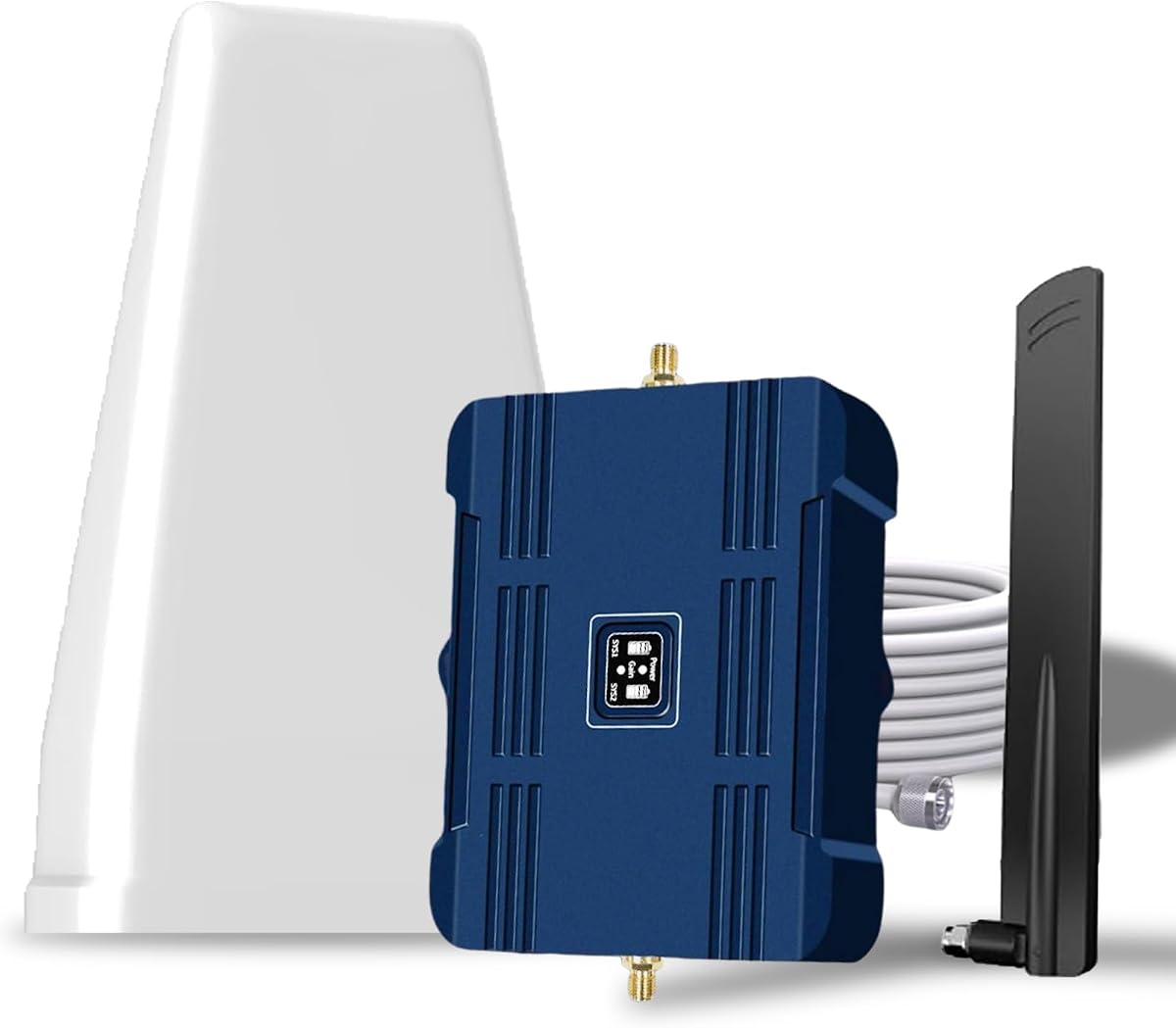
The HiBoost Off-Road Vehicle Booster is purpose-built for the most mobile side of mountain living: reaching remote trails, mountain roads, deserts, and other areas where cellular coverage can disappear. Its 4.2 rating indicates positive customer feedback, but its strongest case comes from the physical design. The system pairs 5G and 4G LTE support with a rotating, folding antenna mount and a rugged metal booster protected by a silicone cover.
We may earn a commission when you buy through this link, at no additional cost to you.
A rotating antenna mount is especially relevant on winding mountain routes because it can be adjusted to favor a tower as the vehicle changes direction. The mount folds down for garages, parking structures, and low-clearance areas, making it more practical than a permanently extended setup. The protective cover is designed to help resist bumps, scratches, and outdoor conditions, while compatibility with AT&T, Verizon, T-Mobile, and other major carriers gives travelers flexibility.
Although the system includes an app for signal detection, installation guidance, and setup, it remains a fixed vehicle installation rather than a pocket-sized hotspot. The buyer must accept the mounting, power, and cabling arrangement appropriate for the vehicle, and the product cannot create service in an area where the carrier itself offers no usable signal. Those are meaningful limitations in the most remote wilderness, where a distant tower may simply be out of range.
This is the premium choice for overlanders, hunters, field technicians, and other drivers who need service across changing terrain rather than in one building. Its rotating mount and rugged enclosure are more travel-oriented than the home systems. Buyers should check their carrier compatibility, plan a secure installation, and test basic cellular reception in the routes where they expect to travel.
The rotating mount lets a driver aim the antenna toward a more useful tower as roads and valleys change. Folding it down protects clearance when entering a garage, covered structure, or low overhang.
A metal booster body and protective silicone cover are intended to withstand bumps, scratches, and outdoor exposure. These traits suit gravel roads, equipment storage, and active travel better than a basic indoor-only kit.
We may earn a commission when you buy through this link, at no additional cost to you.
The weBoost Drive Reach Overland is designed as a three-part vehicle system comprising a booster, a tough outdoor antenna, and a versatile mounting bracket. Its 4.2 rating places it in the same customer-feedback tier as the HiBoost off-road system, while the 50 dB maximum gain and two-year warranty make its proposition distinct. It is intended for 5G and 4G LTE service across Verizon, AT&T, T-Mobile, and US Cellular.
We may earn a commission when you buy through this link, at no additional cost to you.
The rugged outdoor antenna and adaptable mounting arrangement distinguish this model from a typical home booster. Those features make sense for a truck, SUV, or dedicated off-road vehicle that encounters rocks, vibration, changing weather, and narrow routes. Rather than treating the antenna as a permanent building accessory, the package allows the user to assemble a mobile system intended to remain useful across repeated journeys.
The specified 50 dB maximum gain is lower than the 65 or 70 dB figures offered by several home systems in this guide, but gain alone does not determine the result. Antenna direction, proximity to a tower, carrier spectrum, terrain, and installation quality all influence performance. A booster may also reach regulatory limits and automatically adjust to avoid interference, so comparing only the headline gain can be misleading.
This product fits buyers who value a complete, adventure-oriented package and readily available support through an app, chat, phone, or email. It is a solid choice for a weekend off-road vehicle but less appropriate for a primary residence where extensive indoor distribution or a higher-gain stationary system is needed. Confirm the bracket fits the vehicle, plan cable routing carefully, and test carrier service before relying on the system in isolated areas.
Matching the booster with a tough outdoor antenna and versatile bracket gives the installation a more integrated design. The package is aimed at users who need the equipment to travel with the vehicle.
U.S.-based customer support through an app, chat, phone, or email can help buyers address installation questions. That support is particularly useful when the vehicle and terrain make physical adjustments inconvenient.
We may earn a commission when you buy through this link, at no additional cost to you.
The blue multi-room booster targets rural homes, offices, and other large properties with a stated indoor coverage area of up to 7,000 square feet. It provides 70 dB of maximum gain and 17 dBm of maximum output, and it is intended to support 5G, 4G LTE, voice, text, and data across multiple devices. Its two indoor panel antennas are designed to distribute coverage through three to five rooms.
We may earn a commission when you buy through this link, at no additional cost to you.
For a mountain residence with a larger footprint, panel antennas can be a sensible alternative to a single compact whip. They can be placed on opposite walls or positioned to serve separate sections of a home. The product information also provides a realistic outdoor-signal scale: one or two bars corresponds to approximately 800 square feet, three or four bars to about 3,000 square feet, and five bars to the listed maximum of 7,000 square feet.
The system uses a log-periodic outdoor antenna and recommends approximately 32 feet of separation between the outdoor and indoor antennas. Users should keep the power off during installation and adjustments. As with the similar green model, the 5G claim depends on the carrier’s use of Dynamic Spectrum Sharing in existing 4G bands, not on the booster independently creating new 5G spectrum.
This product is worth considering for a spacious mountain home where weak service affects several rooms. Its two panel antennas provide more deliberate distribution than a compact indoor antenna, while the high gain supports demanding rural installations. The trade-off is that its 4.2 rating is lower than the leading home systems, so buyers should pay close attention to compatible bands, the availability of outdoor service, and the quality of the intended antenna locations.
The two indoor panel antennas can be distributed through a home rather than relying on one concentrated signal point. Their placement is particularly relevant for properties with bedrooms, offices, or workshops that need coverage in separate areas.
The stated coverage tiers prevent a 7,000-square-foot maximum from being mistaken for a guaranteed result. A strong outdoor signal and clear line of sight to a usable tower are the foundations for reaching the upper end of that range.
We may earn a commission when you buy through this link, at no additional cost to you.
The light-blue multi-room booster pairs a 4.8 rating with a stated reach of up to 7,000 square feet. It is designed to improve cellular service in homes, offices, garages, farms, warehouses, metal buildings, and other remote spaces. With support for bands 5, 12, 13, and 17, plus 5G and 4G LTE compatibility, it offers a useful mix of lower-frequency and 5G-ready reception for supported U.S. carrier networks.
We may earn a commission when you buy through this link, at no additional cost to you.
Automatic Gain Control is the system’s primary operational feature. It detects the existing signal and adjusts amplification accordingly, reducing the need for repeated manual gain changes. The product information also notes that the booster can serve multiple devices simultaneously and that no registration or subscription is required. Its stated 65 dB maximum gain sits between the 50 dB vehicle system and the 70 dB home systems.
Band compatibility is the critical qualification. The listed bands are not identical to those supported by every other model in the roundup, and a carrier can operate different frequencies depending on location and network upgrades. The stated 5G capability also requires local 5G service, while the outdoor installation point should have at least one or two bars. A mountain home should not assume that general carrier compatibility guarantees compatibility with the nearest tower.
This booster is a strong choice for buyers who want broad room coverage, straightforward automatic operation, and no recurring fee. It is particularly useful in remote properties where low-band signals are available. Before installation, check the bands used by the local carrier, test the outdoor signal in several locations, and install the antenna where it has the clearest view of the relevant tower.
Automatic Gain Control monitors the incoming signal and adjusts the amplifier, which can make long-term use more convenient. It also helps the system adapt when conditions around the cabin change seasonally.
Bands 12, 13, and 17 are commonly associated with broad geographic coverage in the United States. Their presence may be useful where a mountain tower provides service on a lower-frequency band, although local compatibility must be verified.
We may earn a commission when you buy through this link, at no additional cost to you.
The HiBoost Hero is a home booster for cabins and rural properties that emphasizes setup assistance and antenna flexibility. It has a 4.4 rating, 65 dB of maximum gain, and a stated indoor reach of up to 3,000 square feet. Two indoor antenna choices are included: a powerful panel antenna for larger spaces and a compact whip antenna for mobile or changing needs. That combination allows the system to adapt to different layouts.
We may earn a commission when you buy through this link, at no additional cost to you.
The HiBoost app can remotely monitor the installation and assist in positioning the high-gain directional outdoor antenna. Live technical support is also offered, which is useful for users who are uncomfortable with RF installation, cable routing, or signal testing. The product information says many users complete the guided setup in about two hours, although actual time depends on the building, roof access, and outdoor antenna location.
The Hero supports bands 12, 13, 17, 5, 2/25, and 4, offering broad compatibility across major U.S. carriers. Its installation guidance is more detailed than that of many competitors, but the required outdoor antenna and cable can still be a barrier. The information also explicitly states that hotspot devices cannot be boosted, and recommends approximately one to two outdoor bars, a nearby compatible tower, and careful phone band verification.
This is a particularly useful selection for first-time booster owners who value app guidance and live support more than the largest possible square-foot figure. It works well for a medium mountain home where signal needs change by room. A technically confident buyer may still obtain more stated coverage from a 70 dB system, but the Hero’s dual indoor antenna options and hands-on setup support make it approachable.
The app helps users monitor signal behavior and find a better location for the directional outdoor antenna. Live support adds another route for resolving installation questions without relying entirely on a written manual.
The panel antenna is intended for broader interior distribution, while the compact whip can suit a smaller or changing area. Having both options allows the indoor layout to follow actual use rather than a single default arrangement.
We may earn a commission when you buy through this link, at no additional cost to you.
The 70 dB multi-room booster has a perfect 5.0 customer rating and one of the strongest specification sets in the guide. It supports 5G, 4G LTE, and 3G data for U.S. carriers and is intended to strengthen voice, text, data, and streaming across three to five rooms. Its maximum gain is 70 dB, with maximum output power listed at 17 dBm and a stated indoor coverage ceiling of 7,000 square feet.
We may earn a commission when you buy through this link, at no additional cost to you.
This system is positioned for larger rural homes and offices that need more potential reach than a compact single-room unit. The product information presents coverage in terms of exterior signal: one or two bars corresponds to about 800 square feet, three or four bars to around 3,000 square feet, and five bars to approximately 7,000 square feet. That disclosure is important because it demonstrates that the maximum figure is conditional rather than automatic.
The installation uses an outdoor log-periodic antenna, and the booster recommends placing the indoor antenna about 32 feet away. Power should remain off while antennas are installed or repositioned. The booster also notes that much current 5G service uses Dynamic Spectrum Sharing within 4G bands, so a buyer should confirm local 5G availability and the relevant carrier bands before mounting equipment.
This product is an attractive choice for a spacious mountain lodge or home where a single usable tower provides enough exterior signal to exploit the higher gain. Its high customer rating and broad stated capacity strengthen the case, though product availability and long-term review volume should still be considered. Test the outdoor signal first and arrange the antennas carefully before judging the final indoor result.
The 70 dB maximum specification gives this model considerable amplification potential. That makes it more appropriate for large homes and weak-but-present outdoor signals than for a small room with an already strong connection.
The three exterior-signal tiers help buyers set realistic goals. Even with a 7,000-square-foot ceiling, the system reaches that figure only when the outdoor location has the strongest of the listed signal levels.
We may earn a commission when you buy through this link, at no additional cost to you.
The Metarepeater MG1 offers a straightforward home signal solution with a 5,000-square-foot maximum coverage area and a smart color LCD display. Its 3.8 rating is the lowest among the ten selections, but the documented product remains relevant for mountain homes because it displays gain information across five frequency bands in real time. The display can help a user compare potential antenna positions and judge how the system is operating.
We may earn a commission when you buy through this link, at no additional cost to you.
The booster supports 5G, 4G LTE, and 3G on bands 12/17, 13, 5, 4/66, and 2/25, with compatibility listed for AT&T, Verizon, T-Mobile, Sprint, Straight Talk, U.S. Cellular, and other U.S. carriers. Multiple users and devices can be served at once. The package includes an indoor whip antenna, and the instructions are designed to allow installation without downloading an app, which may appeal to users who prefer a conventional setup.
Roof placement is a significant requirement, and the manufacturer suggests that one or two people may be needed. The system also requires an outdoor signal of at least -110 dBm at the antenna site. Its listed maximum of 100x amplification should not be interpreted as a guaranteed coverage multiplier; actual area depends heavily on outdoor strength, with approximately 400 to 1,300 square feet at one or two bars and up to 5,000 square feet under a full listed signal.
The MG1 is best for a buyer who values a detailed visual readout and a wide range of supported bands more than a large multi-antenna package. Its lower rating suggests more mixed customer experiences, so careful band and installation verification is advisable. It remains a practical option for a medium mountain home when the outdoor antenna can be mounted safely and carrier frequencies are confirmed in advance.
The color LCD shows the working state and gain across five frequency bands simultaneously. That detailed feedback can make antenna comparisons more precise than a simple light-based indicator.
The system is intended for an outdoor antenna location with at least -110 dBm of signal. Checking this requirement before buying can prevent disappointment in a remote valley where the nearest tower is too distant.
We may earn a commission when you buy through this link, at no additional cost to you.
The right mountain-area booster depends first on where you need service, how strong the carrier signal is outside, and which bands your local network uses. Installation type, antenna placement, supported devices, and system controls should then be matched to the property or vehicle.
A booster can improve a usable signal, but it cannot generate cellular service where the carrier network is unavailable. Most systems in this guide specify that at least one bar, one to two bars, or a particular decibel level should exist at the outdoor antenna. Mountain valleys can block signals even when a tower appears nearby, so test the phone or radio at several elevations and locations rather than judging from inside the building. A strong outdoor reading gives the amplifier and indoor antennas a workable foundation.
Choose a booster only after confirming that usable outdoor service exists. High gain cannot compensate for a distant tower or a fully blocked carrier signal.
Mountain living can require two different kinds of amplification. A home system normally includes a fixed outdoor antenna, a booster, and one or more indoor antennas, making it appropriate for a cabin, lodge, office, garage, or farm. A vehicle system is built around a mobile outdoor antenna, a power connection, and a mounting bracket. The HiBoost off-road model and the weBoost Drive Reach Overland are explicitly oriented toward trails and changing terrain, while the other eight products focus on fixed properties.
Match the product to the primary use rather than choosing a larger home system for travel. A vehicle kit must be securely mounted and routed for safe operation.
Square-foot claims can be misleading if they are separated from the conditions required to achieve them. Several systems list separate estimates for weak, moderate, and strong outdoor signals. Under those assumptions, coverage may expand from a few hundred square feet to the stated maximum. Multi-antenna kits can distribute a stronger signal through more rooms, but the number of antennas alone does not guarantee uniform results. Consider the building’s construction, floor plan, and the number of people who will use the system.
Treat maximum coverage as a best-case ceiling. Use the lower exterior-signal estimate to judge whether the system is realistic for your property.
A booster that supports major carriers is not necessarily compatible with every frequency those carriers use in a particular location. The supported bands vary across this guide, including combinations of 2, 4, 5, 12, 13, 17, 25, and 66. Local carrier bands can also change as networks evolve. Ask the carrier which bands serve the relevant tower and confirm them against the product’s supported list. This check is especially important for 5G service deployed through Dynamic Spectrum Sharing on existing 4G bands.
Verify local bands before ordering. Carrier-name compatibility alone does not guarantee that the nearest tower’s spectrum is supported.
The outdoor antenna receives the original cellular signal before it reaches the booster. Directional log-periodic antennas can focus toward a useful tower, while a rotating vehicle mount can be adjusted as terrain changes. Location often matters more than a small difference in nominal antenna design. Look for elevation, a clear view toward the carrier, secure mounting, and enough separation from the indoor antenna. Trees, rock walls, snow, and metal roofs can all alter reception and should be considered during placement.
Test several candidate locations and compare readings before fastening the antenna. Height and direction can matter as much as the model of antenna.
A single whip antenna may be enough for one room or a modest open-plan living area. Two panel antennas can serve a larger home more effectively, while separate indoor antennas give users control over where strong signal is distributed. The HiBoost Hero offers both panel and whip options, whereas several 7,000-square-foot systems include two panel antennas. Correctly separating outdoor and indoor antennas also reduces the potential for feedback, which is why several installation guides emphasize a substantial physical distance.
Choose the antenna arrangement according to the rooms that need service. More indoor antennas are useful only when each one is placed strategically.
Mountain installations benefit from tools that reveal how the system is performing. The HiBoost home-office model offers a color LCD and app-assisted antenna placement, the Hero provides app monitoring and live technical assistance, and the Metarepeater MG1 displays five-band gain information. A basic LED may be enough for a straightforward installation, but visible data can make it easier to distinguish a poor antenna position from a coverage problem. Automatic Gain Control is also valuable because it adapts operation to changing incoming signal.
Prioritize clear signal feedback if you are installing for the first time. It can shorten setup and make antenna adjustments more objective.
All ten products are described as FCC approved or certified, which is an important baseline for cellular amplification equipment. The supplied information also highlights three years of support and a three-year warranty for the HiBoost home-office system, three years of dedicated support for its off-road model, and a two-year warranty with U.S.-based support for weBoost. Warranty terms and support access should be checked on the current listing, particularly because the products come from different manufacturers with different policies.
Confirm certification and warranty terms before installation. Good support can be especially valuable when the outdoor antenna is on a roof or a remote hillside.
Begin with a site survey rather than installing the booster immediately. Check outdoor cellular service at multiple points around the property or vehicle, note the available bars or signal reading, and identify the direction of the carrier tower if possible. For a home system, select a high, stable outdoor antenna position that has the clearest available signal. Keep the booster powered off while mounting the antenna, connecting cables, and arranging the indoor antennas according to the manual.
Once the hardware is in place, power on the system and compare readings from the display or app. Gradually make the specified adjustments to antenna direction, height, and indoor placement rather than making several changes at once. Stop if the system indicates a problem or if you notice unusual interference. For a vehicle installation, verify that the antenna clears branches, roofs, and low structures, and that all cables and brackets remain securely fastened before travel.
Care for the system by protecting connections from moisture, avoiding unnecessary changes to factory wiring, and keeping indoor antennas properly separated from the outdoor unit. Clean dust and debris from vehicle mounts and inspect protective covers for damage after rough roads. Seasonal changes can alter outdoor reception, so periodically retest the signal and make small placement adjustments. If performance changes unexpectedly, check power, cables, and exterior signal before assuming the booster itself has failed.
No. A booster amplifies an existing cellular signal received by its outdoor antenna, and it cannot independently connect to a carrier tower that is too distant or completely blocked. Mountain terrain can make this limitation especially important because ridges and valleys may interrupt service even when a tower appears nearby. Verify usable outdoor service before buying and install the antenna where the strongest available signal can be received.
A compatible booster can improve service in a mountain area, but compatibility depends on the local carrier and the cellular bands used by the nearest tower. The products in this guide support different combinations of bands, so a broad statement such as “all carriers” does not guarantee universal local compatibility. Check the supported bands, carrier, outdoor signal, and installation environment before making a selection.
Most fixed home boosters need an outdoor antenna because walls, roofs, and lower floors can block or weaken cellular reception. The outdoor unit receives the best available carrier signal, while the indoor antenna redistributes it inside the building. A vehicle booster also needs an external antenna, but its mounting style is designed for movement and changing terrain.
The minimum varies by model, but the listed systems generally call for at least one bar, one to two bars, or a particular decibel reading at the outdoor antenna location. More outdoor signal usually permits better indoor coverage. Check several locations because a single reading may be distorted by a nearby obstruction, the building itself, or the direction of the carrier tower.
Only if your carrier offers compatible 5G service in that area and the booster supports the underlying bands. Much current 5G service uses Dynamic Spectrum Sharing within existing 4G bands, and the product information notes that new millimeter-wave enhancers are not generally authorized. Confirm with the local carrier and the booster’s supported-band list rather than relying on a broad 5G label.
A home booster is better for improving service throughout a fixed cabin, lodge, office, garage, or farm because it can use a permanent outdoor antenna and multiple indoor antennas. A vehicle booster is better for travelers because it includes a mobile antenna arrangement and vehicle-oriented mounting. If you need both, they are separate installations rather than interchangeable versions of the same product.
Not all hotspots are compatible, and the HiBoost Hero information specifically states that hotspot devices cannot be boosted. The more important issue is whether your own phone has usable service after the outdoor and indoor system is installed. Confirm device and band compatibility with the manufacturer and current carrier guidance before purchasing for a specific hotspot model.
One indoor antenna may be sufficient for a single room, while two can distribute service through a larger home or separate the signal across several rooms. The best number depends on the building layout, walls, and where users need service most. Properly positioning and separating the antennas is as important as the number included, and some products also offer panel and whip options for different areas.
The HiBoost home-office system is the most balanced overall choice because it combines broad carrier support, a directional outdoor antenna, an LCD, and app-assisted installation for a defined mountain living space. The HiBoost off-road system leads the vehicle category with a rotating, folding mount and rugged protective construction, while the HiBoost 5,000-square-foot model represents a particularly well-rated and approachable home option.
Start with the outdoor signal, supported local bands, and required installation rather than choosing solely by maximum gain or square footage. Larger homes may benefit from two indoor panel antennas, while travelers should prioritize a vehicle-specific antenna, secure mounting, and adjustable direction. Confirm that the selected product includes the necessary outdoor equipment and that the outdoor location has enough service for the system to amplify.
Finally, review the current listing for the latest specifications, warranty terms, availability, and price before purchasing. Ratings, promotions, and product configurations can change, and accurate band compatibility remains the most important technical check. With those details confirmed, a properly positioned booster can make mountain communication more dependable for calls, navigation, messaging, and online work.