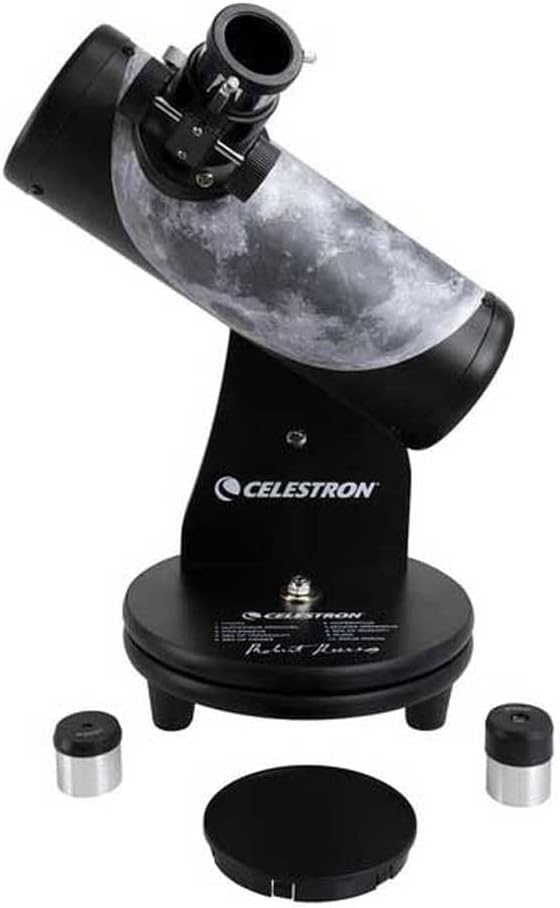
Celestron FirstScope Signature Series Moon Tabletop Dobsonian Telescope
4.3Editor score
Compact tabletop format
Simple manual operation
Celestron brand support
Dobsonian telescopes are among the most approachable instruments for exploring the night sky. Their simple altazimuth mounts, smooth manual movement, and Newtonian reflectors make it easier to point a telescope at the Moon, planets, and bright deep-sky objects. A good Dobsonian balances aperture, portability, accessories, and ease of use without overwhelming a new observer.
This guide compares ten Dobsonian telescopes using the supplied product specifications, customer ratings, optical details, mounting systems, and included accessories. The selections range from compact tabletop instruments to larger 8-inch reflectors, with options for smartphone-guided observing, traditional manual control, and computerized GoTo navigation. The final product is not a Dobsonian, so it is included as a useful comparison point for shoppers considering another telescope architecture.
Each review explains the telescope’s strongest features, practical trade-offs, and the kinds of observers it may suit. The top three picks highlight the best balance of value, guided convenience, and premium capability, while the remaining entries help identify differences in aperture, portability, mounting design, and included equipment. Product availability and prices can change, so check the current listing before purchasing.
4.3Editor score

4.4Editor score

4.3Editor score
As an Amazon Associate we earn from qualifying purchases.
The comparison below organizes each telescope by optical design, aperture, mount or navigation system, portability, and supplied accessories, making it easier to compare manual, app-assisted, and GoTo options.


The Celestron StarSense Explorer 10" is a substantial Dobsonian built around a 254mm Newtonian reflector and a smartphone-guided observing system. Its 4.4 rating reflects a balance of substantial optics and accessible navigation. The app uses sky recognition technology to analyze overhead star patterns, helping users locate stars, planets, nebulae, and other targets without relying entirely on manual star-hopping.
We may earn a commission when you buy through this link, at no additional cost to you.
The 10-inch aperture is the major attraction for observers who want brighter planetary details and a stronger showing on deep-sky objects. The supplied information highlights high-reflectivity XLT coatings, while the ultra-stable manual altazimuth base provides a stable platform for moving between targets. The telescope can be used with the app’s guided workflow or handled manually once the observer becomes more confident.
This is not the smallest or lightest telescope in the guide. Its larger optical tube and full-sized base make it less convenient for spontaneous backyard observing or carrying into a crowded observing site. The app also remains a useful aid rather than an automatic tracking system, so buyers should not expect a motorized GoTo mount.
It is best suited to beginners who want a large aperture but do not want to start with a traditional optical tube and mount combination. It also makes sense for families or educational groups because the guided interface reduces the initial learning curve. For observers who prioritize aperture and app-assisted navigation over compact portability, this is the most complete starting point in the list.
The 254mm reflector provides a meaningful step up from compact tabletop Dobsonians, while StarSense guidance helps observers find suitable targets. The combination is particularly useful for viewers who want to explore beyond the brightest objects without beginning with a fully computerized telescope.
The altazimuth Dobsonian base is designed for straightforward movement and stable viewing. Once a target is centered, the observer can adjust the telescope with small, controlled movements, which is useful for tracking planets across the sky.
We may earn a commission when you buy through this link, at no additional cost to you.
The Celestron FirstScope Signature Series Moon is a compact tabletop Dobsonian intended as an approachable entry into visual astronomy. It carries a 4.3 rating and keeps the experience intentionally straightforward. Instead of a smartphone or computerized mount, it offers a direct, traditional relationship between the observer, the telescope, and the sky.
We may earn a commission when you buy through this link, at no additional cost to you.
Its strongest advantage is practicality. A tabletop design is easy to place on a balcony, patio, or sturdy outdoor table and can be moved from one location to another with little effort. That makes it attractive for casual lunar observing, planet viewing, and anyone who wants a dedicated telescope without a large storage or transport footprint.
The trade-off is aperture. A smaller tabletop reflector will not provide the same brightness, resolution, or faint-object reach as the 6-inch, 8-inch, and 10-inch models in this guide. Observers who want to identify subtle nebulae, small galaxies, and fine planetary detail may eventually need a larger instrument.
This is a strong choice for a first telescope, a gift for a casual skywatcher, or a simple observing setup for children and adults learning together. It is less suitable for someone whose priority is the widest possible target selection or the most detailed views. For a compact first Dobsonian, its simplicity and support are the main reasons to choose it.
The FirstScope is designed to be placed on a suitable surface and used without a complex setup routine. Its compact form is ideal for quick observing sessions and keeps the total equipment footprint manageable.
The Moon is an especially forgiving first target because its brightness and surface variation are easy to see. The telescope also provides a simple introduction to locating objects and learning how a reflector behaves during use.
We may earn a commission when you buy through this link, at no additional cost to you.
The Sky-Watcher Virtuoso GTI 150P combines a 150mm aperture, 750mm focal length, and GoTo functionality in a collapsible tabletop package. Its 4.3 rating reflects a versatile design aimed at observers who want more automation than a simple manual Dobsonian without moving to a large, permanently mounted instrument.
We may earn a commission when you buy through this link, at no additional cost to you.
The f/5 optical design provides a broad, practical field of view for the Moon, planets, galaxies, and nebulae. The key convenience comes from the built-in Wi-Fi and SynScan Pro app, which supports GoTo target selection. This can be particularly useful for beginners who are still learning the sky, since it reduces the need to memorize star-hopping routes.
Freedom Find technology is a thoughtful addition for experienced users. The dual encoders allow manual control while retaining alignment, so an observer can reposition the telescope by hand without starting the alignment process again. The collapsible tube improves portability, although the setup still requires more attention than a basic tabletop model.
This is a good premium choice for a buyer who values guided observing, a manageable optical size, and the ability to switch between motorized navigation and manual handling. It is less suitable for someone who wants the simplest possible introduction or who expects fully automatic tracking without any alignment routine. The combination of portability, aperture, and GoTo capability makes it one of the most complete options here.
The Wi-Fi-equipped GoTo system offers a middle ground between a fully manual Dobsonian and a large computerized telescope. It is useful for finding targets quickly while retaining a relatively compact form factor.
The collapsible optical tube makes storage and transport more manageable than a conventional large Dobsonian. That portability is especially useful for observers who move between a home setup and darker observing locations.
We may earn a commission when you buy through this link, at no additional cost to you.
The Sky-Watcher Heritage 150 is a well-rounded tabletop Dobsonian with a 150mm aperture and fast f/5 optics. Its 4.2 rating reflects a telescope that offers a useful mix of portability, aperture, and straightforward construction. It is a common choice for observers who want more capability than a small starter scope without committing to a full-size Dobsonian.
We may earn a commission when you buy through this link, at no additional cost to you.
The 750mm focal length and f/5 ratio make it suitable for broad views of the Moon and planets, while the parabolic borosilicate primary mirror is designed to support crisp, contrast-rich images. The collapsible tube retains collimation while reducing the amount of space required for storage. Rubber feet add stability and help minimize vibration on a suitable tabletop.
Its main limitation is that the telescope relies on manual pointing. There is no app guidance or GoTo system, so new observers must learn the sky using a finder, star charts, or an external application. The 1.25-inch helical focuser is also more modest than the 2-inch focusers found on the larger models.
The Heritage 150 is a strong all-around recommendation for beginners, apartment observers, and anyone who values a capable reflector in a compact format. It is especially attractive when portability matters more than fully guided target selection. Its balance of size, optics, and construction makes it a dependable middle ground in this guide.
The 150mm aperture gathers more light than small tabletop scopes while remaining easier to move than an 8-inch Dobsonian. The fast f/5 design also supports comfortable wide-field observing sessions.
The collapsible tube is a meaningful convenience for home astronomers with limited storage. It reduces bulk without changing the fundamental manual nature of the telescope.
We may earn a commission when you buy through this link, at no additional cost to you.
The Celestron StarSense Explorer 114AZ is a compact 4.5-inch reflector that adds app-based sky recognition to a tabletop Dobsonian format. Its 4.4 rating is among the strongest in the guide, and its guided setup addresses one of the most common challenges for new observers: finding something worth looking at.
We may earn a commission when you buy through this link, at no additional cost to you.
The StarSense app analyzes the pattern of stars overhead and helps the user position the telescope. Its target list is tailored to the current time and location, which can make short observing sessions more productive. The manual altazimuth tabletop base is simple to use once the app has guided the telescope toward a target.
The 114mm aperture is the primary limitation compared with the larger 6-inch, 8-inch, and 10-inch options. It is well suited to the Moon, bright planets, and prominent deep-sky objects, but faint galaxies and small planetary details will be less impressive. A smartphone and app workflow also adds a digital dependency to a category built around direct observing.
This model is a good choice for a beginner who wants guidance but values a smaller instrument. It is also convenient for families, education programs, and observers who want a lightweight telescope that can be moved between tables or locations. If ease of finding objects is the priority, this is a more satisfying option than a comparable purely manual telescope.
StarSense guidance reduces the uncertainty of a first observing session. The app identifies the telescope’s position from recognizable sky patterns and creates a practical route to suitable targets.
The 114mm reflector offers a lighter alternative to larger app-enabled Dobsonians. It is especially convenient when the priority is quick setup and easy repositioning rather than maximum light gathering.
We may earn a commission when you buy through this link, at no additional cost to you.
The Sky-Watcher Heritage 130mm is a 5-inch tabletop Dobsonian with a 4.5 rating, the highest listed rating among the products in this guide. It emphasizes straightforward operation, an all-in-one construction, and a generous accessory package, making it appealing for beginners who want a complete setup without assembly.
We may earn a commission when you buy through this link, at no additional cost to you.
The base and optical tube are combined into a single tabletop package, and the telescope is described as fully assembled out of the box. Two 1.25-inch eyepieces and a starpointer finderscope are included, so new observers can begin with the main tools needed to locate and view objects. Radiant Aluminum Quartz coatings are also listed among its features.
Like other manual Dobsonians, it does not solve target identification automatically. The 130mm aperture provides a useful upgrade over small entry-level scopes, but it cannot match the brightness and faint-object reach of the larger 8-inch and 10-inch models. Its value is instead in the combination of accessibility, included accessories, and compact footprint.
The Heritage 130mm is a strong recommendation for first-time buyers, casual observers, and anyone who wants a traditional manual telescope that is ready to use. It is also a good fit for teaching basic observing techniques because the user remains directly involved in finding and centering targets. Its high rating and complete package make it a particularly convincing all-around beginner choice.
The no-assembly design removes one of the most common barriers for beginners. The included eyepieces and finder make it straightforward to begin observing without immediately researching a separate accessory list.
The 130mm aperture provides a meaningful step up from very small tabletop telescopes. It is appropriate for lunar detail, bright planets, and introductory deep-sky observations while retaining a manageable size.
We may earn a commission when you buy through this link, at no additional cost to you.
The Celestron StarSense Explorer LT 114AZ combines a 4.5-inch Newtonian reflector with smartphone-guided sky tours. Its 4.1 rating is solid, and the product is aimed at observers who want help locating targets while retaining a straightforward altazimuth mount.
We may earn a commission when you buy through this link, at no additional cost to you.
The StarSense application uses sky recognition to determine the telescope’s position and directs the user toward objects appropriate for the time and location. The manual altazimuth mount includes an altitude slow-motion adjustment with a sliding rod, which can make fine vertical positioning more manageable than moving the entire optical tube abruptly.
The 114mm aperture limits performance on faint targets, although the reflector is still suitable for the Moon, planets, and several brighter deep-sky favorites. The telescope does not provide motorized tracking, so the user must make small manual adjustments as objects move across the field of view. The app helps with finding objects but does not eliminate the need for patient observing.
This is a practical choice for someone who wants guided target acquisition without the size and weight of a larger Dobsonian. It is especially useful for beginners who may find traditional star-hopping challenging, while the manual mount keeps the experience more approachable than a fully computerized telescope.
The sliding altitude control provides a more gradual way to make vertical corrections. That can help when the target is close to the eyepiece’s center and large movements would otherwise be awkward.
StarSense helps the observer find and identify suitable objects, while the altazimuth mount remains mechanically straightforward. This balance suits users who want convenience but still want to learn direct telescope handling.
We may earn a commission when you buy through this link, at no additional cost to you.
The Sky-Watcher Classic 200 is a traditional 8-inch Dobsonian built around a solid optical tube and a straightforward manual base. Its 3.9 rating is the lowest in this collection, but the telescope’s specifications make it a capable choice for observers who prioritize aperture and a conventional observing experience.
We may earn a commission when you buy through this link, at no additional cost to you.
The supplied 94% reflective multi-coated borosilicate mirrors and parabolic primary mirror are designed to produce bright, detailed views, while the 2-inch Crayford-style focuser gives users a generous eye relief and more flexibility with eyepieces. Teflon bearings promote smooth azimuth movement, and the included tension-control handles help with accurate positioning. A 25mm eyepiece, 10mm eyepiece, and 9×50 finder are also included.
The trade-off is size and weight. The assembled telescope weighs 45 pounds, with the tube accounting for 20 pounds and the base for 25 pounds. That is a substantial commitment for anyone with limited storage, stairs, or a vehicle. Manual pointing also means the telescope does not automatically locate targets.
The Classic 200 is best for an observer who already understands manual telescopes and wants a large aperture for planetary and deep-sky observation. It is less suitable as a lightweight first purchase or a quick backyard grab-and-go instrument. For a dedicated setup in a stable observing location, the larger optics can deliver a rewarding observing experience.
The 8-inch mirror is considerably more capable than the smaller tabletop instruments in the guide. More light gathering helps reveal fainter galaxies, nebulae, and planetary detail under suitable conditions.
Teflon bearings and dedicated tension-control handles support controlled movement around the base. These details matter most when tracking a target or returning the telescope to a precise position.
We may earn a commission when you buy through this link, at no additional cost to you.
The Sky-Watcher Flextube 200 delivers the light-gathering capability of an 8-inch Dobsonian while using a collapsible optical tube intended to improve portability. Its 4.0 rating places it in the middle of the guide, and the telescope is a compelling option for observers who want large-aperture performance without a permanently assembled solid tube.
We may earn a commission when you buy through this link, at no additional cost to you.
The strut design allows the optical tube to collapse for transport while helping maintain collimation. The telescope includes fully multi-coated borosilicate mirrors, a 2-inch Crayford-style focuser, a 1 1/4-inch adapter, 25mm and 10mm eyepieces, and an 8×50 right-angle finder. Teflon bearings and tension-control handles support smooth, repeatable movement.
At 40 pounds fully assembled, the Flextube remains a substantial instrument, even though the collapsible tube reduces its storage footprint. It does not include motorized tracking or smartphone guidance, so beginners will still need to learn how to find targets. The right-angle finder can also require some adjustment depending on the observer’s preferred viewing position.
This telescope suits observers with a dedicated observing area who also want the flexibility to transport the instrument. It is a good middle ground between a large stationary Dobsonian and a small tabletop scope. The 8-inch aperture is the reason to choose it, while the collapsible construction helps offset the usual bulk of that size.
The collapsible tube addresses a common problem with 8-inch Dobsonians: they can be difficult to store and move. This design preserves the large optical system while reducing the space occupied when the tube is folded.
The included focuser, eyepieces, adapter, and finder cover the essential observing equipment. A user can therefore build a capable manual setup without immediately adding a separate accessory bundle.
We may earn a commission when you buy through this link, at no additional cost to you.
The Celestron NexStar 8SE is included as a comparison option because it represents a different route into automated observing. It is a fully computerized Schmidt-Cassegrain rather than a Dobsonian, and that distinction matters for shoppers deciding between a manual reflector and a motor-driven telescope.
We may earn a commission when you buy through this link, at no additional cost to you.
The NexStar+ hand control provides access to a database of more than 40,000 objects. Once aligned, the mount can automatically slew toward a selected target and track it, while SkyAlign technology helps establish alignment by centering three bright stars or planets. This removes much of the manual target-finding and tracking work associated with a standard Dobsonian.
The 8-inch aperture is capable of showing fine lunar details, Jupiter’s cloud bands, galaxies, and globular clusters in a compact format. The trade-offs are electronic complexity, power requirements, and a less mechanically simple design. It is also outside the core Dobsonian category, so buyers should compare it against the best Dobsonians only if automated tracking is worth the added complexity.
The NexStar 8SE is a compelling choice for an observer who wants a traditional manual telescope to become a guided, trackable system. It may appeal to casual users and experienced visual observers who want convenient access to a large object catalog, while a dedicated Dobsonian remains the more straightforward and often more tactile choice.
The large object database makes it easy to select targets without manually identifying them in a chart. That convenience is the telescope’s clearest advantage over a conventional manual Dobsonian.
The NexStar 8SE uses a Schmidt-Cassegrain optical design and an automated equatorial-style mount rather than a basic Dobsonian base. It is best considered when motorized tracking and computer-assisted setup are specific priorities.
We may earn a commission when you buy through this link, at no additional cost to you.
Choosing a Dobsonian is about balancing optical capability with the way you plan to observe, store, and transport the instrument. Aperture, mount design, guidance features, and physical size matter more than decorative details.
Aperture is the most important optical consideration because it determines how much light the telescope can collect. Larger mirrors generally reveal fainter galaxies, nebulae, and planetary detail, while smaller tabletop scopes are often more appropriate for the Moon and bright planets. The 114mm, 130mm, and 150mm models offer a portable middle ground, while the 8-inch and 10-inch options are better suited to dedicated visual observing.
Choose the smallest aperture that comfortably covers your target list, unless you have a reliable transport and storage plan for a larger instrument.
Tabletop Dobsonians use a compact base and are easy to place on a sturdy table or patio. Full-size Dobsonians generally use a larger base and offer more stability and conventional movement. Tabletop designs are more convenient for spontaneous sessions, while larger bases are generally easier to use for extended observing.
Consider where the telescope will live and how often you will move it before deciding between these formats.
A manual Dobsonian is direct, mechanical, and rewarding to learn, but finding faint objects takes practice. App-guided models such as the Celestron StarSense Explorer range use smartphone sky recognition to help identify the telescope’s position and locate suitable targets. They are especially helpful for first-time observers, although they still require manual tracking and do not make the telescope fully motorized.
Choose app guidance if learning the sky feels daunting; choose manual control if you prefer fewer electronic dependencies.
GoTo systems can automatically slew to a selected object and may track it continuously. The Sky-Watcher Virtuoso GTI 150P offers built-in Wi-Fi and GoTo, while the Celestron NexStar 8SE provides a larger computerized object database and automatic tracking. These systems are useful for observing sessions that involve many targets, but they require power, setup, and alignment.
Prioritize GoTo when convenience and target variety matter more than a simple, low-maintenance mechanical design.
A collapsible tube can make a larger telescope easier to store and carry without reducing its aperture. The Sky-Watcher Heritage 150, Heritage 130mm, Flextube 200, and Virtuoso GTI 150P all use designs intended to improve portability. Remember that portability includes not only the folded size but also the weight of the base, tube, and accessories.
Compare packed dimensions, assembled weight, and the number of separate pieces you will need to carry.
The supplied accessory list can materially improve the first observing experience. The Heritage 130 includes two 1.25-inch eyepieces and a starpointer finder, while the Classic 200 and Flextube 200 include larger 2-inch Crayford-style focusers and multiple eyepieces. A 2-inch focuser is a useful feature for future upgrades, but the included eyepieces determine what most users will use immediately.
Check whether the telescope includes usable eyepieces and a finder rather than assuming accessories are included.
Dobsonian mounts are valued for smooth movement and intuitive control. Stability depends on the base, the surface beneath it, and how carefully the tube is balanced. The classic models use Teflon bearings and tension-control handles, while the Celestron models emphasize an ultra-stable or smooth-tracking manual base. Tablets need to be sturdy enough to avoid vibration.
A stable surface and smooth movement matter at every aperture, especially when observing planets or fine lunar detail.
Begin by reading the telescope’s assembly and collimation instructions, then choose a stable location away from direct lights and obstacles. If the model includes a smartphone-guided system, install the required app, dock the phone as directed, and complete the sky-recognition or alignment process before selecting a target. For a manual model, use the finder or a low-power eyepiece to center the object.
Start with the Moon or a bright planet, and use the lowest-power eyepiece first to establish the field of view. Once the object is centered, switch to a higher-power eyepiece if needed and make small adjustments as Earth rotates. Keep the telescope in a position that lets you look through the eyepiece comfortably, and avoid pushing the tube sharply against its balance limits.
For care, dust the optical surfaces gently rather than wiping them aggressively, and keep the telescope protected from moisture and abrupt temperature changes. Store a collapsible or tabletop model in a dry indoor location, and check the base, fasteners, focuser, and eyepieces before each session. If collimation appears off, follow the manufacturer’s procedure rather than adjusting the mirror by guesswork.
Yes. Dobsonians are often recommended for beginners because their altazimuth mounts are intuitive and their Newtonian reflectors provide good views without complicated electronics. The simplest models are manual, so learning to locate objects takes practice. App-assisted models can make the first sessions easier by guiding the observer toward suitable targets.
A 4.5-inch to 5-inch model is often the most manageable starting point for casual observing and smaller storage spaces. A 6-inch telescope provides a useful balance of light gathering and portability. If you can store and move a larger instrument, an 8-inch or 10-inch model can deliver substantially better views of faint deep-sky objects.
Traditional Dobsonians are manually moved, so the observer must adjust the telescope as the sky moves. App-guided models help locate targets but generally still require manual tracking. GoTo models such as the Virtuoso GTI 150P can slew to targets automatically, while the NexStar 8SE provides computerized tracking but is not a traditional Dobsonian.
They are usually easier to move than full-size Dobsonians, although the total weight of the base, tube, eyepieces, and accessories still matters. Collapsible designs improve storage and transport for larger models. Always check the assembled weight and the number of parts involved before taking one to a distant observing site.
The Moon is usually the easiest target, and bright planets such as Jupiter and Saturn are also rewarding. Depending on aperture and observing conditions, a Dobsonian can show star clusters, bright nebulae, galaxies, and some fainter deep-sky objects. Light pollution, atmospheric conditions, and the telescope’s aperture all affect the result.
No. A larger aperture usually reveals more detail and faint objects, but it also adds weight, bulk, and storage demands. A smaller telescope that you will actually use is often more valuable than a larger one that remains in a closet. Choose the aperture that matches your targets, observing location, and willingness to transport the instrument.
Many Dobsonians are designed to remain reasonably collimated, especially those with collapsible tubes and stable mounts. Alignment can still shift after transport or extended use, and collimation may be necessary for the sharpest images. Follow the manual’s procedure and use a simple collimation tool if you are unsure how to proceed.
Yes, although city light pollution makes faint deep-sky objects harder to see. The Moon, bright planets, double stars, and some clusters remain enjoyable targets. A darker location will improve the experience considerably, so consider taking a portable model to a darker site when practical.
The Celestron FirstScope Signature Series Moon stands out as the most budget-friendly and compact way to begin, while the Celestron StarSense Explorer 10" is the strongest overall choice for observers who want substantial aperture and app-assisted navigation. The Sky-Watcher Virtuoso GTI 150P adds Wi-Fi GoTo functionality and a collapsible format for buyers who want more automation in a portable package.
Prioritize aperture when faint deep-sky objects matter, portability when you want to observe from different locations, and guidance when learning the sky is your biggest concern. Manual models reward practice and keep the experience straightforward; computerized models reduce setup work but introduce power, alignment, and electronic considerations. The supplied Heritage, Classic, and Flextube models offer useful alternatives across those priorities.
Before buying, check the current listing for availability, included accessories, warranty details, and any changes to the product configuration. Prices and promotions can shift over time, so the best value is the model that suits your observing habits and fits your storage and transportation needs.