
Runleader RL-HM011E Digital Hour Meter & Tachometer
4.3Editor score
Three-function digital display
IP65 water resistance
Replaceable coin-cell battery
Our Digital Tachometer for Small Engine guide compares 10 RPM and hour meters, highlighting accuracy, timing, installation, alerts, engine compatibility, and
A digital tachometer for a small engine turns operating information into an easy-to-read display, making it useful for checking RPM, accumulated run time, and scheduled maintenance. The right model can help owners tune idle speed, spot excessive revving, monitor service intervals, and keep a more reliable history of how their equipment has been used.
We compared these ten products using the information supplied for each listing, focusing on RPM range, timing functions, sensing methods, display features, power management, weather resistance, engine compatibility, installation requirements, and practical maintenance support. The list includes compact handheld gauges, bracket-mounted models, multifunction displays, and units intended for specific categories of gasoline-powered equipment.
Each review explains what the product offers, where it stands out, and which types of users may find it most useful. Ratings reflect the supplied customer feedback, while feature and specification comparisons are based on the listed product information. Product prices and availability can change, so check the current listing before making a purchase.
4.3Editor score

4.7Editor score

5.0Editor score
The table below compares all ten tachometers by their most important listed characteristics, including RPM range, timer capacity, sensing approach, power source, and practical outdoor features.




This small engine tachometer combines live RPM monitoring, total and job timers, a service countdown, maximum RPM recall, an alarm, and a clock in one compact display. Its supplied rating of 4.7 makes it a strong all-around choice for owners who want more than a basic pulse gauge, particularly when maintaining several kinds of small gasoline-powered equipment.
We may earn a commission when you buy through this link, at no additional cost to you.
The listed RPM range extends to 18,000, with stated accuracy of ±10 RPM and a 0.5-second refresh rate. Timing reaches 9,999 hours at 0.1-hour accuracy, while the service interval can be programmed from zero to 500 hours. A green backlight improves visibility in dim conditions, and the display turns red when the engine exceeds the selected RPM alarm, giving the unit a clear role in both routine maintenance and rev limiting.
Installation is more flexible than a wired panel gauge because the unit supports a spark-plug-wire clip and wireless induction sensing at an optimal distance of approximately 3–5 centimeters. The mounting bracket can attach to a suitable tubular object, and no external power connection is required. The trade-off is that users must learn the menu and configure the appropriate mode, while the bracket and long lead may take more space than a handheld unit.
This is the strongest recommendation for a user who wants a complete maintenance dashboard in a portable format. It suits lawn mowers, weed trimmers, motorcycles, snowmobiles, off-road vehicles, and other compatible gasoline engines. Those who only need a quick handheld reading can find a simpler option lower in the list, but this model offers the broadest balance of timing, alerts, and installation flexibility.
TOT, JOB, SVC, MAX RPM, and clock functions give the device a broader purpose than a simple RPM meter. Owners can preserve lifetime information, reset a task timer after work, and count down to a planned service without juggling separate instruments.
The programmable alarm changes the backlight to red when the selected threshold is exceeded. This gives the operator immediate visual notice and makes the unit especially useful for testing idle settings or preventing accidental overspeed.
We may earn a commission when you buy through this link, at no additional cost to you.
This digital chainsaw tachometer is aimed at owners who regularly work on varied gasoline engines and need a wider RPM ceiling than many conventional lawn-equipment gauges. It supports engines with one through eight cylinders, including two-stroke and four-stroke configurations, and reaches 36,000 RPM in the higher mode.
We may earn a commission when you buy through this link, at no additional cost to you.
Its multifunction display includes total time, job time, service timing, maximum RPM, RPM mode, alarm, clock, battery status, memory, automatic sleep, and reset. The backlight can remain on, switch off, or operate automatically, while a red indication appears when RPM or temperature exceeds the selected threshold. These features make it relevant to chainsaws, lawn mowers, generators, motorcycles, outboard motors, and similar machines.
The signal pickup wire uses a clip on the spark-plug wire, and the gauge automatically starts testing when the engine runs and turns its display off after the engine stops to conserve power. The replaceable battery supports continued use. A potential drawback is that the several modes and settings demand careful configuration, especially for users comparing readings from different cylinder arrangements.
This model is a good match for a multi-equipment owner who wants a portable gauge with broad compatibility, a high maximum range, and several maintenance functions. It is less suited to someone wanting a simple meter with almost no configuration, but for a general-purpose diagnostic tool, the feature set is unusually complete.
Support for one-to-eight-cylinder gasoline engines makes this tachometer useful across chainsaws, motorcycles, marine engines, ATVs, and lawn equipment. The ability to use 36,000 RPM in the higher mode also provides headroom for high-revving powersports applications.
Automatic operation reduces the need to switch the display on and off. The gauge starts testing when it detects an active engine and turns the display off when the engine stops, helping preserve the replaceable battery during intermittent use.
We may earn a commission when you buy through this link, at no additional cost to you.
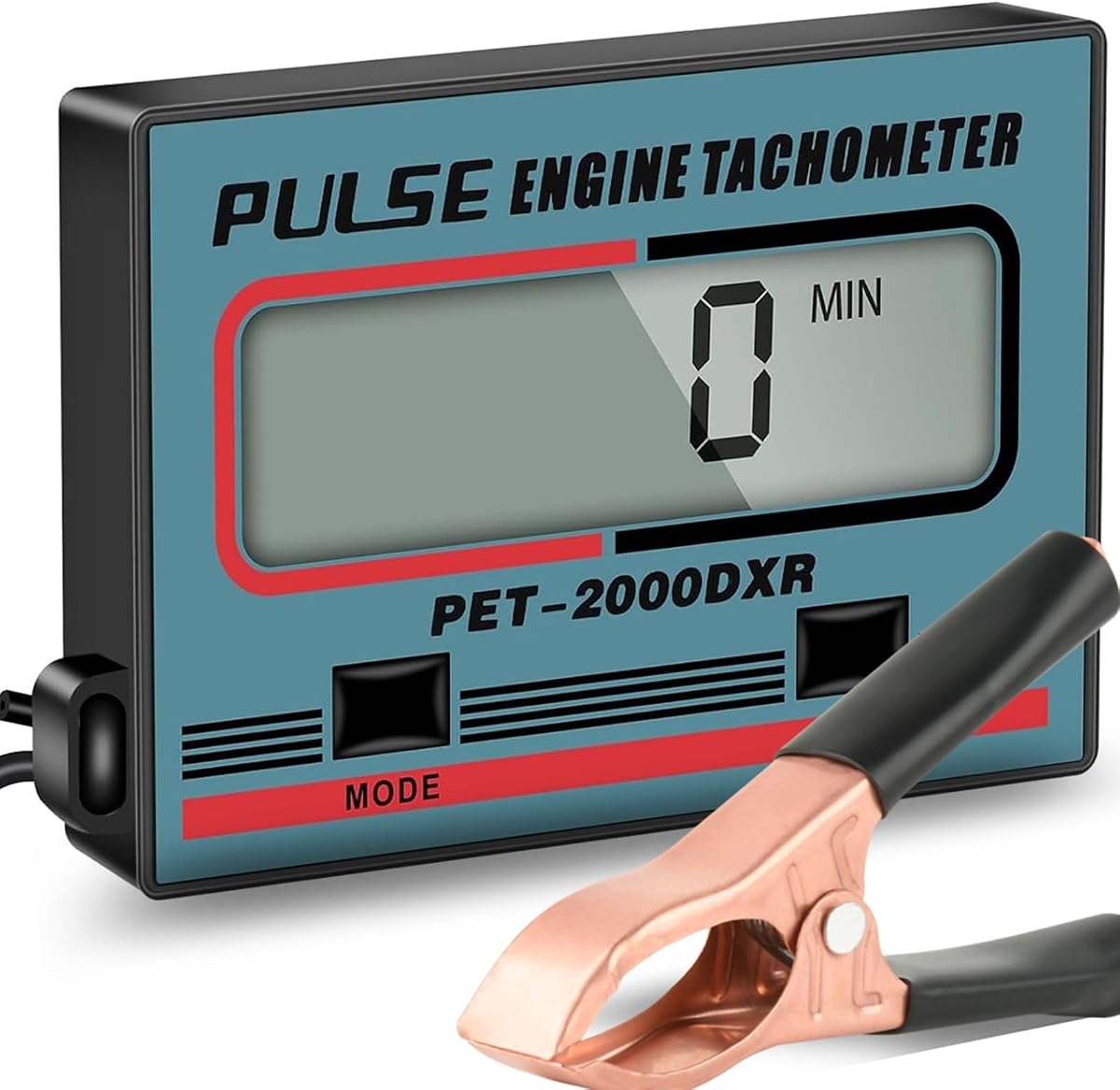
The Runleader RL-HM011E is a straightforward digital hour meter and tachometer that brings three practical functions together: RPM monitoring, total operating time, and a service timer. Its supplied rating of 4.3 and straightforward feature set make it a practical budget option for owners who want more than a disposable temporary gauge.
We may earn a commission when you buy through this link, at no additional cost to you.
The tachometer covers 0–20,000 RPM, while the hour meter extends to 99,999 hours. Service timing uses 0.1-hour accuracy, allowing custom intervals and flashing alerts when maintenance is due. The listed compatibility includes one- or two-cylinder two-stroke engines and one-, two-, or four-cylinder four-stroke gasoline engines, covering many mowers, tractors, generators, ATVs, and outboard motors.
A CR2450 coin-cell battery powers the unit, and a one-click manual shutdown prevents standby drain during seasonal storage. The IP65 enclosure is dustproof and protected against water jets, an important feature for equipment exposed to rain, grass, dust, and routine washing. It lacks the wireless sensing and alarm features highlighted on some higher-feature models, but its core functions remain focused and approachable.
Choose the RL-HM011E when reliable hour tracking, service reminders, and basic RPM monitoring matter more than elaborate displays. It is especially attractive for a lawn mower, tractor, or generator used intermittently. Users should plan for occasional battery replacement and verify the firing-pattern setup before relying on a reading for precise tuning.
The programmable service interval turns the meter into a basic maintenance reminder. Once the selected interval is reached, the display flashes, helping owners schedule inspections and oil changes without maintaining a separate paper log.
The IP65 rating means the unit is sealed against dust and protected from water jets. That makes it a sensible choice for outdoor machines where splashes, rain, grass clippings, and vibration are normal operating conditions.
We may earn a commission when you buy through this link, at no additional cost to you.
The Gexmil handheld induction tachometer is designed for quick checks around chainsaws, lawn mowers, motorcycles, generators, snowmobiles, and other gasoline-powered equipment. Its supplied rating of 4.3 reflects a practical tool for users who want live RPM information without mounting a permanent instrument.
We may earn a commission when you buy through this link, at no additional cost to you.
The listed timing range runs from one minute to 99,999 minutes with stated accuracy of 1 percent, and the gauge supports up to eight cylinders. A low-voltage design and built-in CR2450 battery support cordless use. The display activates automatically when the engine runs and switches off when the engine stops, helping conserve power without requiring a separate manual procedure.
There are several measurement approaches. The electronic wire can be fixed to the casing, a metal clip can clamp the spark-plug-wire sheath, the wire can be wound around the sheath, or the handheld unit can be held approximately 3–5 centimeters from the wire. This flexibility is useful when a machine has limited attachment points or when a temporary diagnostic reading is the main goal.
The principal trade-off is the minute-based timing format rather than a more conventional hour display. The listing also does not highlight a programmable service interval. Nevertheless, owners who primarily need a portable RPM and run-time reading will appreciate the multiple sensing options, automatic power management, and broad list of supported equipment.
The clip, wire-wrap, and close-range inductive methods let the user adapt to different engine layouts. That makes the gauge practical for temporary work on unfamiliar equipment where permanent mounting would be inconvenient.
The gauge begins measuring when the engine is active and returns to power-saving behavior when it stops. This makes intermittent diagnostics less cumbersome while helping the replaceable battery last longer between service periods.
We may earn a commission when you buy through this link, at no additional cost to you.
The Runleader RL-HM011F combines a tachometer, hour meter, and service timer in a single digital instrument. Its supplied rating of 4.3 and balanced feature set make it a sensible choice for basic engine monitoring, especially for users who primarily want an accurate operating-hours record.
We may earn a commission when you buy through this link, at no additional cost to you.
The total run time remains visible when the engine is off, can be reset, and uses 0.1-hour accuracy. The service timer counts down toward a programmed maintenance point and flashes a warning icon when that point arrives. Live RPM is also available and can be programmed for different engine firing patterns, which is helpful when the same gauge is used on more than one machine.
The replaceable CR2450 battery retains data after replacement, and the operating button can shut the unit down to prevent unnecessary drain. An IP65 waterproof rating, detailed instructions, and stated certification add confidence for regular outdoor use. Unlike several more elaborate models, this listing does not highlight a programmable RPM threshold or an advanced maximum-RPM alarm.
This model best fits lawn equipment, generators, and similar machines where service timing matters as much as a current speed reading. It is a less complex alternative to the multifunction premium tachometers, but that simplicity makes the controls and information easier to manage for a first-time user.
The hour meter keeps total run time visible after shutdown and retains it through battery replacement. This is valuable for resale preparation, maintenance scheduling, and determining how heavily a seasonal machine has been used.
The tachometer can be configured for different firing patterns, which helps one instrument serve multiple engines. Owners using it across several machines should verify the pattern before making a final judgment from the displayed RPM.
We may earn a commission when you buy through this link, at no additional cost to you.
This mini inductive pulse tachometer combines a small housing with a broad stated RPM range, minute-based timing, and a four-mode configuration system. Its supplied rating of 4.5 indicates a well-received option for owners who want a portable diagnostic gauge for chainsaws, motorcycles, marine engines, lawn mowers, and related equipment.
We may earn a commission when you buy through this link, at no additional cost to you.
The listed measurement range is 100–30,000 RPM with stated accuracy of 1 percent, while timing extends from one minute to 99,999 minutes. Modes 01, 02, and 03 apply 1×, 2×, and 4× relationships, and Mode 04 is used for reset. Importantly, the product information clarifies that Mode 02 does not automatically mean a two-stroke engine and Mode 03 does not automatically mean a four-stroke engine.
For determining the correct multiplier, the listing recommends testing the available modes at idle and selecting the one closest to the actual engine speed. The unit can either sense vibration through inductive placement or receive a signal through a copper clip on the spark-plug wire. It also turns its display off when the engine is not running and resumes testing automatically when the engine starts.
This gauge is best for users who are comfortable checking a compact display and testing modes during setup. The stated mode logic is clearer than many generic alternatives, but it still requires a deliberate installation process. It offers less integrated service-timer detail than some rivals while remaining flexible for RPM diagnostics across one-to-eight-cylinder engines.
The multiplier relationship is explicitly described, reducing ambiguity. A user can compare the displayed idle reading across the three measurement modes and select the result that best corresponds to the machine's known idle speed.
The small enclosure is easy to carry and can be mounted where vibration can be sensed. A clipped signal wire provides an alternative when vibration placement is inconvenient or less consistent.
We may earn a commission when you buy through this link, at no additional cost to you.
This wireless small engine tachometer offers an approachable combination of RPM monitoring and hour-based maintenance tracking. It is designed for gasoline equipment ranging from mowers and chainsaws to motorcycles, snowmobiles, karts, ATVs, and marine applications, with a supplied rating of 4.3.
We may earn a commission when you buy through this link, at no additional cost to you.
The core specifications include a 0–18,000 RPM range, ±10 RPM accuracy, a 0.5-second refresh rate, and timing up to 9,999 hours at 0.1-hour accuracy. The display includes TOT, JOB, SVC, MAX RPM, RPM mode, RPM alarm, clock, battery, memory, automatic sleep, and reset. The service interval defaults to 50 hours and can be adjusted from zero to 500 hours.
A bracket can secure the unit to a tubular object, while the included clip can attach to the spark-plug wire. Wireless induction sensing provides an alternative at an optimal distance of 3–5 centimeters. A green backlight supports nighttime use, and the display changes to red when the programmed RPM threshold is exceeded. The main drawback is that it lacks a more advanced water-resistance rating, so careful storage during washing may be necessary.
This is a strong choice for a user who wants cordless installation and a complete set of operating and service timers. It offers nearly the same core specification set as the leading model, making it a sensible alternative to consider when availability, construction details, or the final installation setup better suits a particular machine.
Wireless sensing lets the unit be placed near the engine without routing a permanently connected power lead. The clip remains available when a direct spark-plug-wire signal offers a more convenient installation.
Separate total, job, and service readings help distinguish lifetime use from a current task and the countdown to maintenance. The programmable service range makes the gauge useful across different schedules and machines.
We may earn a commission when you buy through this link, at no additional cost to you.
The built-in wire chainsaw tachometer is the most feature-forward product in this roundup and carries a supplied rating of 5.0. It is designed for owners who want a stable connection, extensive timing information, a high RPM ceiling, and stronger water protection than conventional portable gauges provide.
We may earn a commission when you buy through this link, at no additional cost to you.
The RPM display covers 0–36,000 RPM with stated ±10 RPM accuracy and a 0.5-second refresh rate. Its four-mode logic applies 1×, 2×, and 4× multipliers, with the mode chosen by testing at idle. Timing extends to 9,999.9 hours at 0.1-hour accuracy, and separate TOT, JOB, and SVC timers organize lifetime use, a resettable task, and a service countdown.
A 2.2-meter sensor wire is soldered directly to the board, reducing the chance of a loose detachable connection causing erratic readings under vibration. The IPX68 rating provides protection against rain, snow, and high-pressure washing. A green backlight supports low-light viewing, while a programmable red RPM alarm gives a clear overspeed warning. MAX RPM recall helps identify how far the engine was pushed during the latest run.
This premium model is recommended for dedicated equipment owners, serious maintenance users, and anyone who values a stable integrated wire and high water resistance. It is less ideal for a casual user who wants a minimal gauge, because the four modes and three timers create more setup than necessary. Even so, its supplied rating and listed construction make it a compelling premium option.
The integrated cable is soldered to the board rather than relying on a detachable plug that could loosen. This is particularly relevant on snowmobiles, motorcycles, mowers, and other machines exposed to continuous vibration.
The IPX68 rating provides stronger protection for equipment that is washed down, exposed to rain, or operated in snow. That durability makes the gauge especially practical for workshop-installed or permanently mounted monitoring.
We may earn a commission when you buy through this link, at no additional cost to you.
The BIBARAJM inductive tachometer offers a compact way to monitor RPM and accumulated run time on two-stroke or four-stroke gasoline engines. Its supplied rating of 4.3 makes it an appealing option for chainsaws, marine equipment, ATVs, motorcycles, and UTVs where a small, cordless instrument is useful.
We may earn a commission when you buy through this link, at no additional cost to you.
The listed RPM range runs from 100 to 30,000 RPM, with an hour meter that reads to 10,000 hours before automatically resetting. The gauge sleeps when the engine is inactive and wakes to display the current RPM when operation begins. When the engine is off, the total run time is shown, and the service icon supports programmable maintenance reminders.
Inductive operation allows the unit to be placed near the spark-plug wire, while the included clip offers a straightforward connection to the wire harness. The listing describes the process as safe and reliable, with the sensor positioned close enough to detect engine activity. The automatic hour reset is the main specification users should note, since it differs from gauges that retain a larger or more explicit lifetime range.
This model suits owners seeking a straightforward diagnostic and maintenance reminder without a large number of alarm controls. It is a practical pick for compact installations and occasional use. Users who need to preserve very long operating histories or require a specific ingress-protection rating should consider a model with a clearly stated larger timer capacity and formal waterproof standard.
The sleep-and-wake design keeps the main operating state simple. Current RPM appears while the engine runs, and total time remains accessible when the machine is stopped.
The service icon can be configured for maintenance intervals, making it easier to remember oil changes and inspections. This turns the compact gauge into more than a momentary speed-reading tool.
We may earn a commission when you buy through this link, at no additional cost to you.
The Timorn digital small engine tachometer provides a distinctive way to monitor two engines with one instrument. Its resettable job timer can record each engine separately, while the unresettable total time represents combined use. The supplied rating of 4.0 is the lowest in the group, but the feature set remains relevant for owners with multiple machines.
We may earn a commission when you buy through this link, at no additional cost to you.
Real-time RPM is shown across a 0–25,000 range, with selectable refresh rates of 0.5 or one second. A programmable rev-limiter setting provides a visual warning, and maximum RPM recall helps identify the highest reading from a run. The hour display reaches 6,000 hours at 0.1-hour accuracy, and a service reminder can memorize separate maintenance times for two engines.
Installation uses a contact sensor wire wrapped approximately five turns around the spark-plug wire and secured with a tie. The unit supports a broad range of two-stroke and four-stroke cylinder layouts, including engines commonly identified by GY6 and EU2000-family platform names. Its IP67 rating and replaceable battery with retained memory suit regular outdoor use.
This tachometer is most useful for an owner who alternates between two engines and wants independent job and service records. The lower supplied rating means buyers should pay particular attention to the current listing and installation instructions. Its dedicated two-engine timing, programmable rev limiter, and selectable refresh rate compensate for a more specialized feature set.
The two-engine timer arrangement is unusual among compact tachometers. It allows separate job and service tracking while retaining a combined total, reducing the need to move one gauge between machines and lose individual histories.
A programmable rev-limiter setting gives visible feedback when the engine exceeds the chosen threshold. Maximum RPM recall then helps the operator review the peak reached, which is useful during setup or when investigating a possible over-revving event.
We may earn a commission when you buy through this link, at no additional cost to you.
The most useful digital tachometer is not simply the one with the largest display or highest stated RPM range. Compatibility, sensor placement, timer behavior, alert functions, and resistance to the machine's working environment should determine which model fits your equipment and maintenance routine.
Start by checking the supported ignition arrangements and cylinder counts. Several models in this guide support one- through eight-cylinder gasoline engines, while the Timorn model lists broader arrangements, including some 12-cylinder four-stroke applications. Compatibility with a two-stroke engine does not necessarily mean the same displayed multiplier or mode will be correct for a four-stroke engine. Treat mode numbers as measurement multipliers rather than stroke labels, exactly as the product listings warn.
Inductive sensing offers the cleanest installation because it does not require cutting or connecting to the ignition wire. The sensor must still sit at the correct distance, commonly about 3–5 centimeters according to several listings. A clipped spark-plug-wire lead can provide a more direct signal, but routing and securing the wire takes planning. A wraparound contact method may suit temporary testing, although it can be less tidy for a permanent installation.
A digital tachometer with an hour meter can support several useful records: total lifetime use, a resettable job timer, and a service countdown. Listed capacity varies widely, from 6,000 and 9,999 hours to 99,999 hours, and some products use minutes instead of hours. Pay attention to whether the total timer resets at its upper limit. If you operate seasonal equipment or need long-term records, choose enough capacity and a clear display format for the way you actually track usage.
A useful range should comfortably exceed the normal operating speed of the machine without making the display unnecessarily difficult to read. Listed upper limits range from 18,000 to 36,000 RPM, while one product reaches 25,000 RPM and another offers a 30,000 RPM span. Accuracy claims also vary. Look for both the range and the stated error, then verify the correct multiplier at a known idle speed before relying on the gauge for tuning.
A service timer is valuable for oil changes and inspections, while a programmable RPM alarm is useful when preventing overspeed or maintaining a consistent operating limit. Some models also retain maximum RPM for post-run review, and several add a red backlight as a warning color. More alerts are not automatically better; choose a gauge whose controls remain understandable to the person who will use it.
An IP65 rating protects against dust and water jets, IP67 supports deeper temporary immersion under the stated conditions, and IPX68 provides stronger all-around water protection. These ratings are not interchangeable, and a listing that simply says waterproof without a standard offers less precise guidance. Consider how the gauge will be mounted, whether it will be washed with a pressure washer, and whether sunlight, vibration, rain, or snow are likely to reach the enclosure.
A replaceable coin-cell battery is common in this category, but automatic sleep, manual shutdown, low-battery indication, and memory retention affect convenience. Some units retain data after battery replacement, while others preserve readings during ordinary shutdown. A model that automatically starts when the engine runs and stops when it stops is particularly useful for intermittent diagnostics, although users should still store the gauge in a dry place during long periods of inactivity.
A compact handheld gauge is easy to carry and useful for occasional checks, while a bracket-mounted unit can remain visible during operation. A larger feature set may require more buttons, a longer learning curve, and additional space for the bracket and cable. A dual-color backlight improves readability in dim conditions, but display simplicity can matter more when the user is adjusting carburetors or checking an engine in poor light.
Before installation, identify the engine's stroke type, cylinder count, and normal idle speed. Clean the spark-plug wire, select the correct RPM mode, and mount the gauge where the display remains visible without creating a hazard around moving parts. For inductive sensing, hold the unit at the listed distance, usually 3–5 centimeters, and secure it to a stable bracket or handle.
For clipped or wrapped sensing, turn off the engine before attaching the lead. Clamp only the insulated spark-plug wire as directed, avoid damaging the conductor, and keep the cable away from hot exhaust parts and moving components. Start the engine, confirm that the display wakes automatically, and compare the idle reading with a known engine specification. If the result is obviously too high or low, test another multiplier rather than adjusting the engine first.
After confirming the reading, configure total-time, job-time, and service intervals according to the manual. Record the selected settings before service, replace the battery when the low-power indicator appears, and avoid prolonged storage in wet or extremely hot conditions. Clean the exterior with a soft damp cloth, keep the battery compartment dry, and recheck the mounting and cable after severe vibration or a major engine service.
Most models in this guide are designed for both types of gasoline engines, but the measurement mode still needs to be selected correctly. A mode labeled 02 or 03 is generally a multiplier rather than a direct stroke selector. Test the available modes at a known idle speed and choose the one that produces a realistic reading before using the gauge for tuning.
No. The products described here use replaceable internal batteries and receive the engine signal through induction or a spark-plug-wire pickup. The sensor must be installed according to the instructions, and the unit must be configured for the engine's firing pattern. A low-battery indicator is available on some models, so replacing the cell at the recommended time helps maintain reliable readings.
Induction sensing detects engine vibration or electromagnetic activity near the spark-plug wire without attaching directly to it, while clipped sensing uses a lead to capture the ignition signal. Induction is often cleaner for a permanent installation, but spacing matters. A clip may provide a more direct signal, although the wire must be routed and secured away from heat and moving components.
Yes. Most of the products include an hour meter and a programmable service countdown, while several also keep separate total and job timers. This allows an owner to record lifetime use, time spent on a particular task, and time remaining until the next service. Check whether the timer uses hours or minutes and whether the total display resets at its maximum capacity.
The supplied specifications range from a stated ±10 RPM on several models to 1 percent accuracy on another, with refresh rates of 0.5 or one second. Actual results depend on correct installation, sensing distance, firing-pattern configuration, and engine condition. Confirm the mode at a known idle speed before drawing conclusions about carburetor or idle adjustments.
Many of these gauges support multiple cylinder counts and firing patterns, making them practical for a mixed equipment fleet. The Timorn model goes further by storing separate job and service times for two engines. You should still change the configuration between machines, verify the idle reading after each change, and avoid assuming a mode used for one engine will automatically be correct for another.
IP65 is intended to protect against dust and water jets from any direction, which makes it useful for lawn mowers, tractors, generators, and other outdoor equipment. It does not provide the same level of protection as IP67 or IPX68. If the gauge will be pressure-washed or mounted in a wet location, choose a product with a stronger stated rating or protect the enclosure.
The selected mode is probably applying the wrong multiplier to the ignition signal. Several listings describe modes with 1×, 2×, and 4× relationships rather than linking mode numbers directly to engine stroke. Leave the engine idling, check the known idle speed, and test the other modes until the displayed value is closest to reality. Reset or reconfigure the gauge before using it for adjustments.
The Small Engine Tachometer, Digital Tachometer, RPM Meter and Hour Gauge is the best overall choice because it combines useful RPM accuracy, three timing modes, a programmable alarm, wireless sensing, and dependable memory in a portable format. The Runleader RL-HM011E is the best budget option for owners seeking essential hour tracking and service reminders, while the built-in-wire chainsaw tachometer is the premium choice for stronger water protection, a stable integrated lead, and extensive timing features.
Prioritize compatibility before any secondary feature. Confirm cylinder count, stroke type, normal RPM, and the correct multiplier, then consider whether you need a simple handheld reading or a mounted gauge with service alerts, maximum-RPM recall, and programmable warnings. Also account for weather exposure, battery behavior, timer units, and whether the gauge will remain attached during operation.
Ratings, availability, and product prices can change over time, so review the current listing and seller details before purchasing. Comparing the latest information against the installation requirements of your specific engine will help avoid a mismatch and ensure the chosen digital tachometer delivers the information you need.