MEYULMOL 12V 300Ah LiFePO4 Battery
4.4Editor score
App-based operating monitoring
200A integrated battery management
4S4P expansion support
Zero-degree charging cutoff
Our 12V 300Ah LiFePO4 Battery guide compares capacity, BMS protection, cycle life, monitoring, expansion, and cold-weather performance for buyers.
A 12V 300Ah LiFePO4 battery is a substantial energy-storage component for RVs, boats, solar systems, off-grid projects, and home backup installations. The right battery should deliver dependable usable capacity, protected charging, manageable weight, and enough electrical resilience for both everyday cycling and high-current demands.
We compared the ten products using the information supplied for each listing, focusing on rated capacity, energy, battery-management protection, temperature controls, monitoring options, cycle claims, physical characteristics, expansion limits, and intended applications. The guide also highlights important differences between energy-storage models and batteries designed to handle starting surges.
Each review identifies the feature that makes a model most useful for a particular installation, while noting restrictions or unresolved installation questions. Ratings reflect the supplied customer feedback and can change over time. Product pricing also fluctuates, so shoppers should confirm the current listing, warranty, and compatibility before purchasing.
4.4Editor score

4.9Editor score

4.7Editor score
This side-by-side comparison organizes the ten batteries by the factors that most affect installation decisions: usable capacity, electrical protection, remote monitoring, system scalability, and suitability for cold or high-current environments.




The MEYULMOL 12V 300Ah LiFePO4 battery combines a 300Ah rating, 3,840Wh of nominal energy, app monitoring, and a 200A BMS in one package. Its supplied rating is 4.4 out of 5. The standout feature is the balance between monitoring, protection, and expansion support, which makes it a practical choice for RV, solar, camping, off-grid, and home-backup users.
We may earn a commission when you buy through this link, at no additional cost to you.
The built-in application displays real-time capacity, voltage, current, and operating temperature for Android and iOS devices. Its intelligent BMS provides overcharge, over-discharge, overcurrent, and short-circuit protection, while a 0°C charging cutoff helps prevent lithium plating in freezing conditions. The standardized design can support 4S4P arrangements, allowing a system to grow to 48V and 1,200Ah.
The listing claims more than 5,000 deep cycles and a lifespan of up to 10 years, though real results depend on charge discipline, temperature, depth of discharge, and operating conditions. Buyers must also follow the manual for app setup and use the correct LiFePO4 charging profile. These are sensible precautions rather than unusual requirements for a battery of this class.
This is our Best Budget pick because it includes several features often associated with more elaborate installations while remaining focused on practical energy storage. It is especially suitable for an RV upgrade, modest solar bank, or mobile power system where remote status checks and eventual expansion matter. Confirm compartment dimensions, polarity, charger settings, and the required series-parallel configuration before ordering.
The application provides a useful window into battery condition without requiring a separate monitoring module. Users can review capacity, voltage, current, and temperature, making it easier to identify charging issues or unexpected loads before a deep discharge occurs.
The 4S4P architecture offers a practical path from one 12V unit to a larger 48V storage array. Expansion is particularly useful for off-grid projects whose energy requirements may increase after the initial installation.
We may earn a commission when you buy through this link, at no additional cost to you.
This 12V 300Ah lithium LiFePO4 battery earned the highest supplied customer rating in the group at 4.9 out of 5. Its intelligent dual-mode BMS allows the unit to operate as a deep-cycle energy-storage battery or enter Power Mode for high-current starting applications, making it unusually versatile for RVs, boats, and off-grid systems.
We may earn a commission when you buy through this link, at no additional cost to you.
The starting function is advertised with 1,500A of instantaneous current, while normal storage mode supports more than 5,000 cycles. A 200A BMS protects against overcharge, over-discharge, overcurrent, short circuits, and unsafe temperatures. The app tracks voltage, current, power, state of charge, and cycle count, while 4P4S expansion supports systems from 3.84kWh to as much as 61.44kWh.
The operating range is listed as -4°F to 140°F, with high- and low-temperature cutoffs protecting the battery. It supports solar, generator, and 14.6V 70A LiFePO4 charging, and the listing claims a full charge in about 4.5 hours with an 850W MPPT solar setup. Actual charging time depends on solar conditions, wiring, temperature, and the solar controller.
Our Editor's Choice is suited to buyers who want one battery to cover both house loads and engine-starting duties, subject to correct configuration. It may not be the first choice for a pure stationary bank, but its combination of monitoring, surge capability, and flexible expansion is unusually broad. Read the manual, confirm the power mode, and verify all compatible chargers before installation.
The dual-mode design is the defining feature. Normal mode prioritizes deep-cycle storage, while Power Mode is intended for brief high-current surges, reducing the need to carry a separate starter battery in space-constrained installations.
A 4.9 rating is the strongest customer-feedback figure in this comparison. While ratings remain subjective and can change, the score is a positive indicator that many buyers have found the battery capable and straightforward to use.
We may earn a commission when you buy through this link, at no additional cost to you.
The SUPER EMPOWER 12V 300Ah LiFePO4 battery is a well-documented deep-cycle option with a supplied rating of 4.7 out of 5. It provides 3,840Wh of energy and is specifically positioned for RVs, camper vans, boats, solar systems, off-grid installations, and home backup power.
We may earn a commission when you buy through this link, at no additional cost to you.
A 200A battery-management system monitors voltage, current, and temperature while guarding against overcharge, over-discharge, overcurrent, short circuits, and temperature-related risks. Its cold-weather behavior is clearly defined: charging pauses below 0°C, discharge stops at -20°C, and operation resumes above 5°C. Those thresholds help prevent charging-induced damage in cold environments.
The listing provides useful installation information, including dimensions of 15.35 by 7.59 by 9.84 inches and a weight of 58.4 pounds. That makes fit planning easier than with a listing that omits dimensions. However, users who want phone-based telemetry may prefer a model with explicit app support, and the physical weight still needs to be considered for smaller compartments.
The five-year warranty and stated technical support give this model a strong ownership-focused case, making it our Best Premium pick. It is a sensible choice for RV and marine users who value documented cold-charge limits, physical specifications, and warranty coverage. Confirm that the compartment, ventilation, wiring, and charger are suitable before purchasing.
The battery automatically suspends charging below 0°C and does not resume until the temperature is above 5°C. This is a meaningful protection for RV owners charging in winter conditions, although it can temporarily limit recharge availability.
Published dimensions and weight make it possible to check compartment fit and lifting requirements before ordering. Accurate physical information is especially valuable when replacing a dense lead-acid installation in a confined space.
We may earn a commission when you buy through this link, at no additional cost to you.
The PUPVWMHB 12V 300Ah LiFePO4 battery combines 3,840Wh of energy, Bluetooth monitoring, and a 200A BMS. It carries a supplied rating of 4.5 out of 5 and is marketed for RVs, solar systems, marine use, camping, and off-grid projects where remote battery information and scalable configurations are important.
We may earn a commission when you buy through this link, at no additional cost to you.
Its communication module reports current, voltage, temperature, and cycle count through an application. The battery also claims that cell capacity remains above 80% after 2,000 cycles, giving buyers a defined capacity-retention reference. Safety features include protection from overcharge, over-discharge, overcurrent, short circuits, and low-temperature charging.
Its standout scale claim reaches 1,200Ah and 51.2V when batteries are connected in series and parallel, with a maximum stated energy of 61.44kWh and maximum load of 40.96kW. Those figures describe a properly engineered multi-battery system rather than a single unit. Communication range, conductor sizing, balancing, and identical battery matching still require careful engineering.
This model is a good candidate for a monitored expandable installation, particularly when local Bluetooth access is sufficient. The five-year warranty adds confidence, but buyers should not interpret broad safety statements as permission to ignore manufacturer instructions. Verify charger settings, series-parallel limits, ventilation, and current ratings before integrating the battery.
Bluetooth monitoring provides convenient access to voltage, current, temperature, and cycle information near the installation. It is useful for troubleshooting and periodic checks, though it is not the same as remote monitoring over an internet connection.
Support for up to 51.2V and 1,200Ah makes the battery relevant to larger solar and home-storage projects. Achieving those totals requires matched units, appropriate cables, a correctly designed BMS, and careful commissioning.
We may earn a commission when you buy through this link, at no additional cost to you.
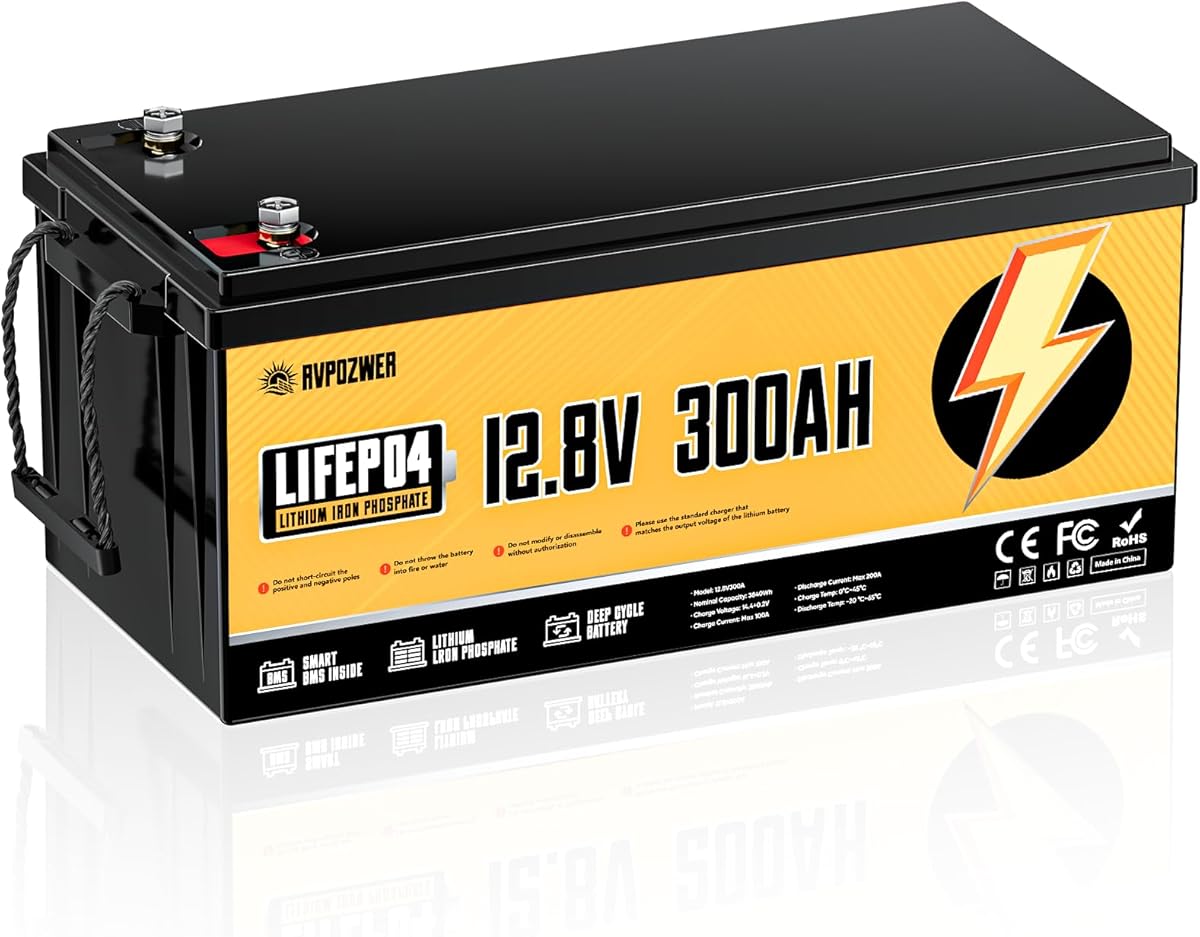
The Rvpozwer 12V 300Ah LiFePO4 battery is a 3,840Wh unit with a 200A smart BMS and Group 31-oriented dimensions. Its supplied rating is 4.0 out of 5, the lowest in this group, but its unusually specific cycle information helps buyers understand how performance relates to depth of discharge.
We may earn a commission when you buy through this link, at no additional cost to you.
The listing claims 4,000 cycles at 100% depth of discharge, 6,000 cycles at 80%, and up to 15,000 cycles at 60%. It also describes a 15-year lifespan and says the battery can operate from -20°C to 65°C. A 200A BMS protects against overcharge, over-discharge, overcurrent, overvoltage, and short circuits, providing a broad safety foundation.
Users can connect up to four batteries in series for 51.2V or in parallel for 1,200Ah. The Group 31 reference and ergonomic nylon handle are useful for RV, trolling motor, solar, boat, camper, and off-grid projects. The handle aids positioning, although a battery of this size still requires two-person handling or proper lifting equipment.
This is a worthwhile option for buyers who care most about documented cycle performance and operating temperature rather than app telemetry. The lower supplied rating deserves attention, so reviewing recent customer feedback before purchase is advisable. Confirm physical fit, charging requirements, and series-parallel compatibility with the rest of the system.
Most cycle figures are meaningful only when paired with depth of discharge. This listing provides separate numbers for 100%, 80%, and 60% depth of discharge, giving prospective owners a clearer basis for estimating service life.
The Group 31 design reference can simplify replacement planning for familiar RV or marine layouts. Buyers should still measure the compartment and confirm terminal locations, cable clearance, and mounting requirements.
We may earn a commission when you buy through this link, at no additional cost to you.
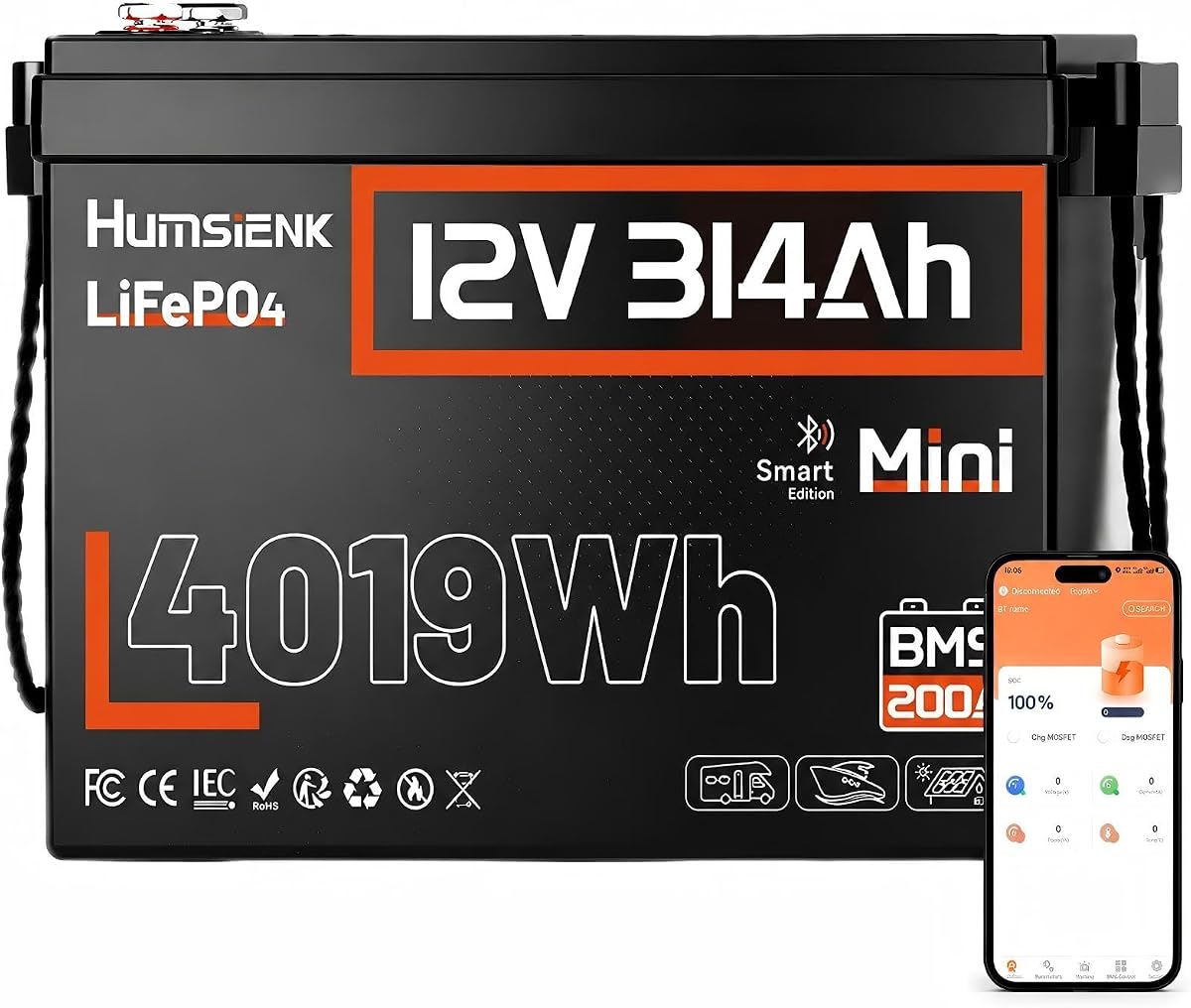
The HumsiENK 12V 314Ah battery is marketed as a compact 12V 300Ah-class alternative with a stated 314Ah capacity, 4,019Wh energy, app monitoring, and a 200A BMS. Its supplied rating is 4.4 out of 5. The combination of capacity and a relatively short 15.1-inch form factor makes it relevant to space-conscious RV and marine installations.
We may earn a commission when you buy through this link, at no additional cost to you.
The battery supports connections of up to four units in series and four in parallel, reaching 51.2V and 1,256Ah. Its internal aluminum frame is described as resistant to swelling and shock, and the listing states that the cells passed UL62133 testing. A durable ABS enclosure supports the product's positioning for mobile and outdoor use.
The app reports voltage, current, capacity, and temperature over a listed 15-meter Bluetooth range. A 200A BMS includes low- and high-temperature cutoffs, including a 158°F high-temperature charging limit. One detail deserves attention: the listing references both 4.01kWh and 4.19kWh energy figures, so buyers should determine which applies to their configuration.
This is an attractive choice when every inch of battery space matters, particularly for boats, compact RVs, or equipment cabinets. The five-year coverage and stated 24-hour customer support add value. Before ordering, verify case measurements, terminal orientation, charger settings, and the exact usable energy specification with the manufacturer.
The stated 314Ah capacity and 15.1 by 9.7 by 7.6-inch case offer an appealing density for mobile installations. Comparing actual case dimensions against the available compartment is more useful than relying on battery-category labels.
Bluetooth monitoring with a 15-meter range is convenient during installation and routine servicing. It does not replace an inverter-level display or remote telemetry system for installations that need continuous off-site visibility.
We may earn a commission when you buy through this link, at no additional cost to you.
The Vatrer Power 12V 300Ah battery combines energy storage and starting-battery functions in one 200A-BMS-equipped package. It has a supplied rating of 4.6 out of 5 and targets RVs, campers, travel trailers, boats, solar systems, and off-grid installations where conserving space is valuable.
We may earn a commission when you buy through this link, at no additional cost to you.
Automotive-grade LiFePO4 cells are used, and the listing states that charging efficiency can reach 100%. The battery claims more than 5,000 cycles and a service life eight to ten times that of a typical lead-acid battery. Its BMS guards against overcharge, over-discharge, overcurrent, and short circuits, while temperature cutoffs restrict unsafe charging conditions.
Because it contains no acid, the listing says it can be mounted in any position. That is convenient for marine and irregularly shaped compartments, although physical support, terminal access, ventilation, and manufacturer instructions remain important. The lack of app monitoring may be a drawback for users who want remote operating data, but it also reduces system complexity.
This model is most compelling when a single unit must handle both stored energy and engine starting. Users should understand the current required at startup and the BMS behavior before connecting it. Confirm that the starting function is appropriate for the engine size, review the manual, and follow the specified charging protocol.
The integrated starting function can reduce the number of batteries and cables required in an RV or boat. That simplification is attractive, provided the battery's surge capability and control logic match the starter system.
LiFePO4 chemistry eliminates the liquid electrolyte associated with conventional lead-acid batteries. The absence of acid also makes orientation flexibility more practical, though secure mounting and environmental protection still matter.
We may earn a commission when you buy through this link, at no additional cost to you.
This 12V 314Ah LiFePO4 battery stands out with an IP65 waterproof rating and a clear limitation: it is designed solely for energy storage. Its supplied rating is 4.6 out of 5, making it a strong option for marine, fishing, RV, solar, and off-grid users who need environmental resistance.
We may earn a commission when you buy through this link, at no additional cost to you.
The enhanced BMS protects against overcharging, over-discharging, low-temperature charging, overcurrent, and short circuits. It also initiates automatic balancing when voltage exceeds 14.1V, helping batteries in a bank maintain a more consistent state of charge. The listing reports cycle life exceeding 6,000 cycles at 80% depth of discharge.
At 314Ah, the battery offers greater energy density and roughly one-third the weight of a comparable lead-acid unit. However, it expressly should not be used for starting gasoline engines, golf carts, or jacks. The trolling-motor guidance also limits power to no more than 2kW, which should be checked against the motor, controller, and expected draw.
This is a good choice for protected outdoor and marine energy-storage applications where ingress resistance is valuable. It is less suitable for engine-starting duties or high surge loads. The instruction to charge and discharge the battery every six months when unused is worth considering for seasonal boats, cabins, and backup systems, as prolonged neglect can still harm a lithium battery.
The stated IP65 rating gives this model a meaningful advantage in exposed marine and outdoor installations. It should not be interpreted as immunity to every condition, so cable sealing, terminal care, and suitable enclosure design remain necessary.
Clearly excluding engine-starting uses helps buyers avoid overloading a deep-cycle design. Matching the battery to steady energy demand and staying within stated motor-power limits is safer than assuming all 300Ah batteries share the same surge capability.
We may earn a commission when you buy through this link, at no additional cost to you.
The TEMGO 12V 300Ah LiFePO4 battery combines a 4.8 supplied rating with a lightweight 54.67-pound design and Bluetooth application monitoring. It is positioned especially for marine use, RVs, campers, travel trailers, and off-grid installations where both handling and operating visibility matter.
We may earn a commission when you buy through this link, at no additional cost to you.
Its 200A BMS provides overcharge, over-discharge, overcurrent, overheating, and short-circuit protection, while a low-temperature cutoff is designed to protect trolling-motor applications in cold conditions. The case is made from 100% recycled post-consumer ABS, which distinguishes it from models that simply claim general environmental friendliness.
The battery supports a maximum 4P4S arrangement, enabling 24V, 36V, and 48V systems when correctly wired. A stated one-year service-life commitment is shorter than the warranty periods offered by several competitors, and users should read its terms carefully. The listing also notes that voltage and current readings can vary by approximately 1% to 5% under different conditions.
This model is a strong fit for marine and mobile users who prioritize low weight, app access, and a high customer rating. The manufacturer recommends using the same brand and model when connecting batteries because mixed units may become imbalanced or trigger BMS protection. Follow that guidance, use compatible wiring, and confirm the installation environment before ordering.
Built-in Bluetooth makes voltage, capacity, and other battery information accessible from a phone. This is especially useful in a boat or RV where the battery may be enclosed in a compartment away from the main controls.
At 54.67 pounds, the listed weight is lower than many 300Ah alternatives. That can simplify installation and removal, but safe lifting remains necessary because a dense battery can still cause injury if dropped.
We may earn a commission when you buy through this link, at no additional cost to you.
The Paoweric 12V 300Ah/330Ah LiFePO4 battery is a large-system option with support for up to six parallel and six series connections. It has a supplied rating of 4.4 out of 5 and targets solar systems, RVs, emergency lighting, camping, small UPS systems, fish finders, fire-safety systems, and home storage.
We may earn a commission when you buy through this link, at no additional cost to you.
Automotive-grade LiFePO4 cells are used, and the listing says properly charged and stored batteries can last more than 10 years. A 200A BMS protects against overcharge, overvoltage, over-discharge, overcurrent, and short circuits. The battery also carries a 10,000-plus cycle claim, making long-duration cycling a central selling point.
The 6S6P ceiling is unusually permissive compared with most of the field and could support a 72V nominal configuration when appropriately engineered. High-voltage systems require careful cable sizing, fusing, isolation, ventilation, and commissioning, so this capability should not be treated as permission for an improvised installation. The listing also advises against connecting batteries from different brands.
This product makes the most sense for buyers designing a large, expandable storage system with a clear load profile and technical support for high-voltage wiring. The dual 300Ah/330Ah labeling should be resolved before purchase so system calculations use the correct figure. It is less attractive for a simple installation that prioritizes remote app monitoring.
Six-series support can reduce the number of parallel strings required in some high-voltage designs. The advantage applies only when the entire battery architecture, protection equipment, inverter, and charger are designed for that operating voltage.
The stated 10-year-plus service life and 10,000-plus cycle claim make this model relevant to installations where battery replacement is difficult or expensive. Actual longevity still depends on charge discipline, operating temperature, and depth of discharge.
We may earn a commission when you buy through this link, at no additional cost to you.
A useful comparison goes beyond the 300Ah label. Capacity, usable power, protected charging, temperature behavior, physical fit, monitoring, and expansion requirements should all influence the decision.
A battery advertised as 300Ah or 314Ah provides substantial stored energy at a nominal 12V. Several listings express this as approximately 3,840Wh, while HumsiENK cites figures near 4,019Wh and also references 4.19kWh. These differences may reflect nominal versus usable energy, cell configuration, test conditions, or rounding. Calculate expected runtime by matching inverter draw, converter load, and expected duration rather than relying on a single watt-hour number.
The usable portion of rated capacity is influenced by cutoff voltage, temperature, age, discharge rate, and the depth-of-discharge pattern. A battery optimized for 60% depth of discharge may deliver more advertised cycles than one routinely taken to 100%. Review realistic appliance use, reserve requirements, and recharge time before selecting a model.
Most of the featured batteries include a 200A BMS, but the same nominal rating does not guarantee identical behavior. Protection normally covers overcharge, over-discharge, overcurrent, and short circuits, while some models add temperature monitoring, automatic balancing, or separate high-current starting modes. Check the continuous and surge requirements of the inverter, charger, and starter rather than selecting a battery solely by the 200A label.
A high-current BMS rating describes the battery's protection hardware, not a guarantee that every downstream load can safely draw 200A. Wiring, contactors, fuses, inverter ratings, and cable length determine what the complete system can deliver. For starting applications, the dual-mode models are more appropriate than batteries explicitly restricted to energy-storage service.
Low-temperature charging protection is essential for RV, marine, and off-grid users who operate in freezing conditions. The products use different thresholds and rules: the MEYULMOL has a 0°C cutoff, SUPER EMPOWER pauses charging below 0°C and resumes above 5°C, and several others also use low-temperature or high-temperature restrictions. Understand that a battery can be present and partially charged while refusing to accept a charge in cold conditions.
A heater or temperature-controlled charging area may be valuable in climates that regularly fall below freezing. Never bypass a low-temperature cutoff, and allow the battery to warm naturally before expecting full charging acceptance. Also account for summer heat, because high-temperature charge protection can limit charging in poorly ventilated compartments.
App monitoring can reveal state of charge, voltage, current, temperature, power, and cycle count, helping users identify abnormal discharge or charging behavior. MEYULMOL, the dual-mode battery, SUPER EMPOWER's product family, and several others offer app-based visibility. PUPVWMHB and TEMGO specify Bluetooth, while HumsiENK lists a 15-meter Bluetooth range. Local monitoring is convenient but does not provide continuous visibility from another location.
Decide whether near-field Bluetooth, an application with broader connectivity, or no electronic monitoring best fits the installation. Remote access can be valuable for off-grid cabins, backup systems, and infrequently used boats. Regardless of the interface, confirm that the app is available for the buyer's phone platform and that setup instructions are included.
Capacity does not guarantee a convenient installation. Measure the compartment, including terminal clearance and cable bend radius, and compare those measurements with the manufacturer's drawing rather than relying only on case length and width. SUPER EMPOWER supplies dimensions of 15.35 by 7.59 by 9.84 inches, while HumsiENK lists 15.1 by 9.7 by 7.6 inches. Rvpozwer references Group 31 dimensions, which can simplify comparison with familiar battery layouts.
Weight is especially important in an RV or boat. Listed weights range from 54.67 pounds for TEMGO to 59.5 pounds for HumsiENK, with SUPER EMPOWER listing 58.4 pounds. These figures are lighter than comparable lead-acid banks, but safe lifting and mounting remain necessary. Ensure the selected location can resist the battery's weight and allows access to terminals.
Most batteries support 4S4P configurations, allowing up to four units in series and four in parallel. Vatrer Power also cites 4S4P, while Paoweric extends the claim to 6S6P. A 4S4P bank can form a 48V nominal system with substantial aggregate capacity, but expansion affects voltage, current, communications, and charger requirements. A unit that works well alone may require different equipment once placed in a large parallel bank.
Use the same brand, model, capacity, age, and state of charge when possible. Mixed batteries can develop voltage and state-of-charge imbalance, causing the BMS to disconnect one unit or reducing usable capacity. Before expanding, check the manufacturer's maximum configuration, recommended cable size, required fusing, and any requirement for a communication bus or balancing system.
Warranty coverage varies substantially across the category. SUPER EMPOWER and PUPVWMHB list five-year coverage, HumsiENK lists five years, and Vatrer Power also describes a five-year solution, while TEMGO lists a one-year service-life commitment. Read the actual terms because exclusions, registration requirements, and shipping responsibilities can materially change the value of a long warranty.
Fast technical support and an operation manual are especially valuable when configuring multi-battery systems. Several listings explicitly direct users to read the manual and avoid touching a hot surface. Responsible sellers should also help resolve charger settings, BMS behavior, and installation questions. A clear manual and responsive support are valuable signs of a more accountable product experience.
Before installation, read the manual, verify the battery's voltage, polarity, terminal type, physical dimensions, and maximum configuration. Mount the case securely in a clean, dry, ventilated location protected from direct heat, impact, and loose objects. Use cables and fuses sized for the battery, inverter, charger, and intended maximum current rather than relying on the BMS rating alone.
Charge the battery with a charger explicitly designed for 12V LiFePO4 chemistry and configured to its specified charge voltage and current. Low-temperature cutoffs may prevent charging below freezing, and high-temperature protection may pause charging in a hot compartment. Do not bypass these functions. For solar installations, use an MPPT controller with appropriate LiFePO4 settings and size the array for the battery bank's accepted charging current.
For long-term storage, store the battery partially charged in a cool, dry location and follow the manufacturer's maintenance schedule. Some listings recommend a charge-and-discharge cycle every six months for unused batteries. Periodically inspect terminals, cables, mounting points, and the enclosure, and use app or meter readings to look for abnormal voltage, temperature, or self-discharge.
Runtime depends on the load, inverter efficiency, battery condition, and the usable portion of capacity. A nominal 300Ah battery represents about 3,840Wh, so a continuous 1kW load would theoretically draw roughly 3.84kWh over four hours before losses and reserve limits are considered. Appliance cycling, cold weather, wiring losses, and the inverter's own consumption can reduce that result.
In many RV, marine, solar, and off-grid applications, LiFePO4 can replace several lead-acid batteries while reducing weight and maintenance. The replacement must still meet the load's starting, continuous-current, and energy requirements. Do not simply connect a lithium battery to an unsuitable lead-acid charger or allow mixed batteries in a series bank without checking manufacturer guidance.
The 200A figure refers to the battery-management system's current-protection capability, not automatically to the safe continuous output of the entire installation. Inverters, chargers, cables, fuses, and connectors may have lower limits. A properly sized system uses the lowest applicable rating and remains within the battery manufacturer's current and temperature specifications.
Charging below freezing can cause lithium plating, so the batteries in this roundup use low-temperature cutoff protection. Depending on the model, charging may pause around 0°C or 32°F and resume only after the battery warms to the specified recovery temperature. Use the manufacturer's charger settings and never defeat the protection to force a cold-weather charge.
Most featured models support up to four in series and four in parallel, creating a 48V nominal bank with four units in each series string. Paoweric advertises a larger 6S6P limit. The permitted arrangement depends on the model, inverter, charger, wiring, fusing, and BMS compatibility, so confirm every component before expanding the system.
No. Vatrer Power and the dual-mode product specifically advertise starting capability, while the 314Ah deep-cycle model expressly excludes gasoline-engine starting and certain other surge uses. Even when a listing mentions starting, compare its surge rating with the engine's requirements. Use the designated starting mode and manufacturer-specified wiring for a dual-purpose battery.
Monitoring does not directly increase chemical cycle life, but it can help protect the battery by making voltage, current, temperature, and state-of-charge information easier to review. Users may identify an excessive load, charging problem, or abnormal temperature earlier. The biggest longevity gains still come from suitable charging, temperature management, and avoiding unnecessary deep discharges.
LiFePO4 batteries generally require less routine servicing than lead-acid batteries, but they still benefit from periodic inspection and correct charging. Check terminals, cables, mounting hardware, and the case, and use a meter or app to monitor operating data. For batteries stored for long periods, follow the listed maintenance interval, which may include a charge-and-discharge cycle every six months.
The MEYULMOL model stands out as the best overall value because it combines app monitoring, a 200A BMS, cold-charge protection, and 4S4P expansion. The dual-mode lithium battery earns the Editor's Choice position for its exceptional supplied rating and advertised starting capability, while SUPER EMPOWER is the premium option with detailed cold-weather behavior, clear physical specifications, and a five-year warranty.
Prioritize the features that match the actual installation. Deep-cycle-only users should examine cycle claims, temperature controls, and warranty terms; RV or marine owners who need engine starts should select a model that explicitly supports them. Bluetooth or app monitoring is useful for visibility, while physical dimensions, weight, expansion limits, and charger compatibility determine whether the battery can be installed safely.
Finally, confirm the current product listing, warranty terms, technical support, and price before ordering. Ratings and market details can change, and manufacturer instructions should always take priority over general buying advice. A properly sized, correctly charged, and safely installed 12V 300Ah LiFePO4 battery can provide a dependable foundation for mobile power, solar storage, marine use, or emergency backup.