
Donner MAMP2
4.0Editor score
Dedicated turntable phono input
Sixty watts RMS per channel
Extensive source connectivity
Discover the best amplifier for turntable in our expert guide comparing ten options for phono support, power, connectivity, features, and ease of use.
An amplifier for a turntable must do more than provide volume: it must accept the low-level signal from a cartridge, apply suitable gain, and deliver clean power to your speakers. The right choice depends on your turntable, cartridge, listening habits, room, and the other audio sources you want to connect.
We compared all ten products by examining their phono compatibility, amplifier power, input options, tone controls, connectivity, speaker compatibility, physical design, and practical features. The list covers full-size stereo receivers, compact integrated amplifiers, dedicated Class D units, and standalone phono preamplifiers for systems that already have a power amplifier.
Each pick highlights a different path into vinyl listening, from an all-in-one home receiver to a small desktop amplifier or a separate preamp. The three leading recommendations represent the strongest balance of features, usability, and listening potential, although prices, availability, and retailer listings can change over time.
4.0Editor score

4.5Editor score
4.7Editor score
The comparison below separates true turntable-ready amplifiers from preamplifiers and amplifiers that require a turntable with a built-in phono stage, making the important compatibility differences easier to identify.



The Sony STRDH190 is a conventional stereo receiver with the essentials arranged for an uncomplicated home system. It earns a 4.5 rating and stands out because its built-in phono input lets a turntable connect without an external preamp. That convenience, combined with 100 watts per channel, makes it a strong general-purpose choice for vinyl listeners.
We may earn a commission when you buy through this link, at no additional cost to you.
Its input selection is well judged for a living-room system. Four stereo RCA audio inputs cover a turntable and several analog components, while a 3.5 mm input offers another route for portable devices. Bluetooth adds wireless streaming, and the ability to connect up to four speakers gives users more placement options than a typical two-channel integrated amplifier.
The STRDH190 does not attempt to be a modern home theater hub. It lacks digital audio inputs and is centered on stereo playback, but that focus keeps its operation straightforward. A 5.25-inch-tall chassis can fit conventional AV furniture, and the included full-size headphone jack, FM radio, and remote control make it useful beyond vinyl alone.
This is the most balanced pick for someone who wants an uncomplicated receiver with genuine phono support, enough power for ordinary bookshelf speakers, and room to add other sources. It is especially attractive for a first home audio system where external components would add complexity rather than convenience.
The integrated phono stage removes the usual first obstacle for new turntable owners. Connect the tonearm's RCA leads, attach the ground wire correctly, select the phono input, and begin listening without a separate box occupying the shelf.
A/B switching allows two pairs of speakers to be connected and selected independently, or played together when the setup and amplifier configuration permit. This is useful for comparing nearfields in a listening area with surrounds in another part of the room.
We may earn a commission when you buy through this link, at no additional cost to you.
The Donner MAMP2 is an unusually broad stereo receiver for a value-oriented design. Its 4.0 rating reflects a capable feature set that includes a phono input, Bluetooth 5.3, USB, optical, coaxial, AUX, RCA, FM, and two microphone connections. The result is a central hub that can cover vinyl and many other entertainment formats.
We may earn a commission when you buy through this link, at no additional cost to you.
Its rated output is 60 watts RMS per channel, with the product's headline 600-watt peak figure representing maximum output rather than continuous power. Two channels can be controlled independently, and the stated speaker compatibility extends to groups of four to 16-ohm speakers plus a subwoofer, giving users several ways to build a system.
The MAMP2 is not limited to basic volume control. Its remote and front-panel controls cover treble, midrange, bass, echo, and talk-over functions, while the amplifier can remember input mode, volume, and EQ settings. These extras are useful for parties and presentations, although they make the unit more complex than a minimalist audiophile amplifier.
For buyers seeking a single box that handles vinyl, television audio, wireless streaming, radio, karaoke, and conventional analog components, the MAMP2 is a compelling choice. Check the input and speaker requirements carefully, particularly because it has no HDMI input and is designed around separate line-level and phono connections.
Optical and coaxial digital inputs can carry audio from compatible televisions and players, while USB supports media up to the stated 64 GB capacity. These connections turn the amplifier into a broader media center rather than a turntable-only device.
The talk-over function lowers background music for speech, and the dual microphone inputs support karaoke or hosting. Independent bass, midrange, and treble adjustments make it possible to shape different sources for a room rather than relying on a single fixed profile.
We may earn a commission when you buy through this link, at no additional cost to you.
The Nobsound NS-13G MAX combines a surprisingly substantial power specification with a body measuring only 5.1 by 4 by 1.5 inches. It has a 4.1 rating and is built around a Texas Instruments TPA3255 Class D chipset. A dedicated MM phono input makes it directly compatible with many moving-coil and moving-magnet turntable cartridges.
We may earn a commission when you buy through this link, at no additional cost to you.
Its listed 300 watts per channel is a maximum figure at 4 ohms, while the product description also emphasizes low distortion of 0.005% THD and a signal-to-noise ratio of 107 dB. A 48-volt, 5-amp adapter is included, allowing the amplifier to operate at its intended power level without requiring a separate supply.
The enclosure is CNC-milled aluminum with cooling vents and occupies little shelf space. Connectivity includes RCA, MM phono, banana speaker outputs, and a volume-synchronized 3.5 mm AUX passthrough. Bass and treble can each be adjusted by plus or minus 6 dB, although the compact controls offer less adjustment than a full-size receiver.
This model is well suited to desktop listening, small home theaters, studio-monitor use, and compact vinyl systems where shelf space matters. Its main consideration is that the headline power rating is not continuous RMS output, so buyers should also consider speaker impedance, room size, and realistic listening levels rather than selecting only by wattage.
The small aluminum body makes the amplifier easy to place beside a turntable or near active desktop speakers. Despite that footprint, the specified Class D design and 48-volt supply are intended to provide more operating headroom than a similarly small unit using a lower-voltage supply.
NE5532P preamp chips, Rubycon capacitors, and WIMA film capacitors are specified for the amplification and filtering stages. The MM input provides a convenient path for compatible turntables, while RCA and AUX connections support other sources.
We may earn a commission when you buy through this link, at no additional cost to you.
The Pyle PP999 is a dedicated phono preamplifier rather than a receiver, and that focused design makes it useful when an existing amplifier or powered speakers already have the necessary power. Its 4.3 rating reflects a straightforward device with a clear purpose: converting the turntable's phono-level signal to line level.
We may earn a commission when you buy through this link, at no additional cost to you.
The circuitry supports magnetic pickups and is specified for an input sensitivity of 3 mV at 50 kΩ. A stereo RCA input receives the turntable, while stereo RCA outputs carry the amplified line-level signal to another amplifier. A grounding post helps complete the turntable connection and reduce hum.
Noise and interference are important considerations with low-level cartridge signals, and the product uses low-noise audio operational amplifiers. The specified maximum output is 2 volts peak-to-peak at 10 kΩ. Position matters because placing the preamp close to the turntable can help reduce unwanted noise and interference.
The PP999 is a practical solution for someone who already owns capable speakers and a power amplifier but lacks a phono input. It is not a one-box answer for a new system, and it is aimed at magnetic cartridges rather than moving-coil cartridges requiring much higher gain.
Rather than adding a phono stage to a general-purpose amplifier, the PP999 performs one job in a small enclosure. The gain and filtering are designed for magnetic turntable cartridges, allowing a line-level signal to travel to a conventional amplifier.
Keeping the preamp close to the turntable can reduce the distance over which the small cartridge signal is exposed to interference. Proper grounding and quality RCA connections are equally important when installing the unit.
We may earn a commission when you buy through this link, at no additional cost to you.
The Fosi Audio MC331 is a visually distinctive integrated amplifier that combines a tube preamp, power amplifier, DAC, and headphone amplifier. It carries a 4.4 rating and appeals to listeners who want one compact component to handle analog and digital sources while adding a vintage-inspired look to a listening space.
We may earn a commission when you buy through this link, at no additional cost to you.
Maximum output is specified at 105 watts per channel into 4 ohms, enough for a range of bookshelf speakers in a domestic room. A VU meter and visible tubes reinforce the classic presentation, while the remote handles source selection, volume, bass, and treble adjustments. A pre-out and 3.5 mm headphone output add further routing options.
Bluetooth, USB, coaxial, optical, and RCA inputs make the MC331 flexible, but there is no built-in phono stage. A turntable can connect through its RCA line input only if the turntable includes its own phono preamp. Otherwise, the system needs an external phono preamplifier such as the Fosi Box X2.
This amplifier is ideal for a modern desk or living-room system that mixes vinyl with streaming, computers, optical sources, and television audio. Its replaceable tubes also let technically inclined listeners explore component changes, although those experiments should be undertaken with suitable knowledge and care.
The tube-based preamp and VU meter create a traditional visual character, while the integrated DAC avoids a separate digital-to-analog box. The result is a single component that can accept both physical media and streamed or computer-based audio.
The pre-out can feed another power stage or active setup, while the headphone output provides a convenient private listening option. These additions make the MC331 more versatile than a basic two-channel integrated amplifier.
We may earn a commission when you buy through this link, at no additional cost to you.
The Fosi Audio BT20A is a compact Class D amplifier aimed at easy deployment with passive speakers. It has a 4.5 rating, a straightforward design, and 100 watts of maximum output per channel. Its small footprint makes it suitable for a bedroom, office, garage, patio, or any shelf where full-size receiver space is unavailable.
We may earn a commission when you buy through this link, at no additional cost to you.
Bluetooth and RCA inputs cover the two most common ways to feed music into the amplifier. Bass and treble controls allow basic tonal adjustment, and a one-touch power switch keeps daily operation uncomplicated. The integrated chassis supports both practical placement and a clean visual footprint.
Vinyl compatibility depends entirely on the source. There is no phono input, so a turntable with a built-in phono stage can feed the RCA connection, while a cartridge-only turntable requires an external phono preamp. This distinction is essential and should be settled before purchase.
The BT20A is a strong option for a small speaker system centered on wireless playback or an existing line-level source. It offers straightforward power amplification without a large receiver, but buyers wanting direct turntable support should choose a phono-equipped model instead.
The compact integrated design makes the unit practical for secondary rooms and less conventional listening locations. It can support passive speaker cabinets across a home, small venue, garage, patio, or bookshelf installation.
Bluetooth offers a direct route from a phone or compatible device without a visible source component. RCA input preserves a conventional wired option, so the amplifier can serve both casual streaming and a line-level source.
We may earn a commission when you buy through this link, at no additional cost to you.
The Qlearsoul HiCore H2 is a compact Bluetooth, RCA, and AUX amplifier with a 5.0 rating. It uses a Texas Instruments TPA3255 Class D chipset and provides a rated 100 watts per channel at 4 ohms. That rating, combined with a 30-volt, 5-amp adapter, gives it enough power for compact passive speakers in many listening environments.
We may earn a commission when you buy through this link, at no additional cost to you.
Its standout feature is the anti-hijack Bluetooth behavior. Switching into RCA or AUX mode physically cuts the Bluetooth signal, which prevents another device from pairing or interrupting a wired source. In Bluetooth mode, holding the volume knob for two seconds clears the stored pairing history.
The multifunction control knob rotates for volume, short-presses to cycle input modes, and performs the pairing reset with a long press. Separate bass and treble knobs provide straightforward tone shaping. The CNC-machined aluminum enclosure uses passive side ventilation, avoiding fan noise during long sessions.
The H2 works well as a flexible source hub for a turntable with an internal phono stage, a television's line output, a computer, or a phone. A cartridge-only turntable still needs a separate preamp. The wide 24-to-51-volt input range also permits supply experimentation, although the included supply is the safest starting point.
The anti-hijack function is particularly useful in homes where several people stream music or when a wired source should not be interrupted. Physically disengaging Bluetooth in alternate input modes makes the intended source unmistakable.
The central knob consolidates volume, source selection, and pairing reset into one familiar control. Independent tone knobs remain accessible without navigating menus, making day-to-day operation direct and uncomplicated.
We may earn a commission when you buy through this link, at no additional cost to you.
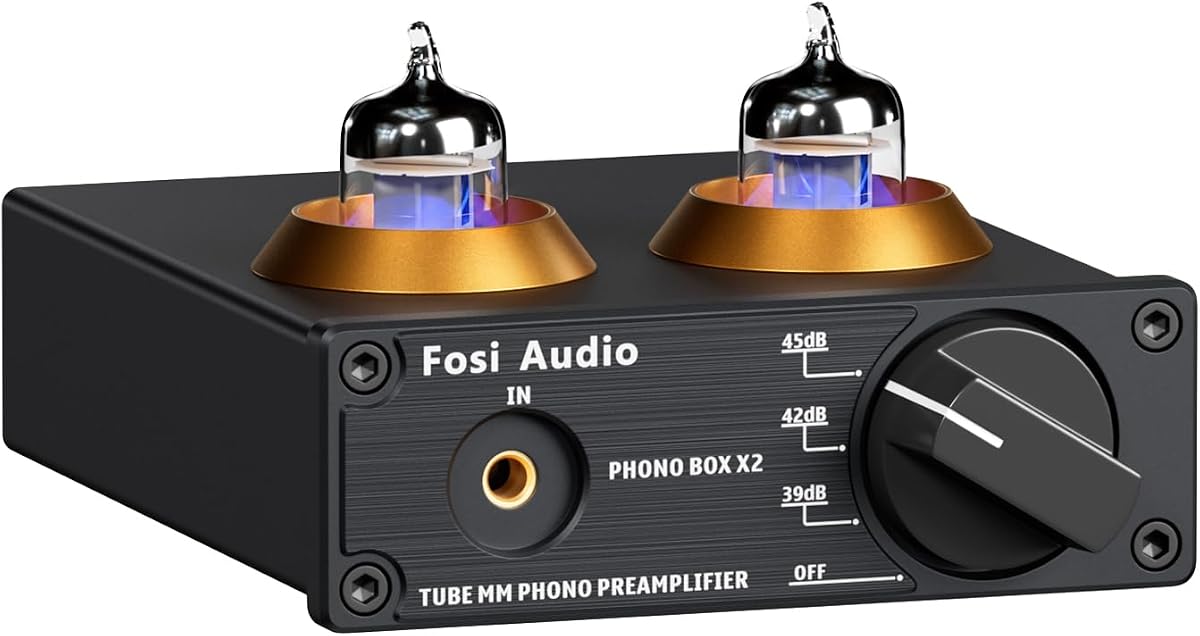
The Fosi Audio Box X2 is a tube-style phono preamplifier for moving-magnet cartridges. It holds a 4.5 rating and is designed for listeners who already have a power amplifier but want a dedicated, flexible way to bring a turntable into the system. Its compact enclosure and visible tubes give it a distinctive character.
We may earn a commission when you buy through this link, at no additional cost to you.
Three switchable gain settings provide 39, 42, or 45 dB, allowing the signal to be matched more closely to different MM cartridges and downstream equipment. The unit uses low-noise integrated circuits to convert the phono signal to line level, while a grounding post supports a secure turntable connection.
The vacuum tubes are replaceable, and the product identifies several compatible models, including 6K4, 6J1, 6J4, GE5654, 6AK5, and 66. A 3.5 mm AUX input also lets the unit function as a conventional tube preamp for line-level sources, adding flexibility beyond its primary phono role.
The box includes the preamp, two vacuum tubes, an RCA cable, power adapter, and manual. It is a good match for a separate power amplifier and careful setup, but it is not a complete solution for someone who still needs to choose speakers and a power amplifier.
The three gain positions give users a way to avoid excessive noise or insufficient signal level. Matching the preamp gain to the cartridge and downstream system is more useful than automatically selecting the loudest available setting.
Keeping phono conversion in a dedicated unit can simplify system layout and provide more control over gain. It also lets the main amplifier remain optimized for line-level sources.
We may earn a commission when you buy through this link, at no additional cost to you.
The Fosi Audio BT20A Pro is the more technically configurable version of the compact Bluetooth amplifier format. It has a 4.4 rating, a TPA3255 Class D chipset, and a headline power specification of 300 watts per channel. A 32-volt, 5-amp adapter is included to support the intended operating configuration.
We may earn a commission when you buy through this link, at no additional cost to you.
Its distinguishing feature is the ability to replace two plug-in NE5532 operational amplifiers. Compatible alternatives include LME49720HA, MUSES02, OPA2604AP, OPA2134PA, LM4562, and NJM4556AD. This gives technically experienced users a way to explore changes in the preamp section, though modification is optional rather than necessary for basic operation.
Signal-to-noise ratio is specified at 108 dB or higher, with total harmonic distortion at or below 0.005 percent. Bluetooth 5.0 supports wireless streaming, while bass and treble controls provide basic tonal shaping. Holding the volume control for five seconds removes a Bluetooth pairing, and a memory function assists with reconnection.
The BT20A Pro suits users who want more power and component-level flexibility than a basic Bluetooth amp. As with other compact units in this roundup, it lacks a phono stage, so use it with a turntable that has a built-in preamp or add a separate phono preamplifier.
Replaceable preamp modules let an owner experiment with alternative operational amplifiers while retaining the main Class D power platform. This makes the unit appealing for hobbyists who enjoy component-level customization.
The included 32-volt supply and stated peak output are intended to give the amplifier useful headroom for passive bookshelf or outdoor speakers. Room size and speaker sensitivity remain more informative than a peak-power headline when judging real-world output.
We may earn a commission when you buy through this link, at no additional cost to you.
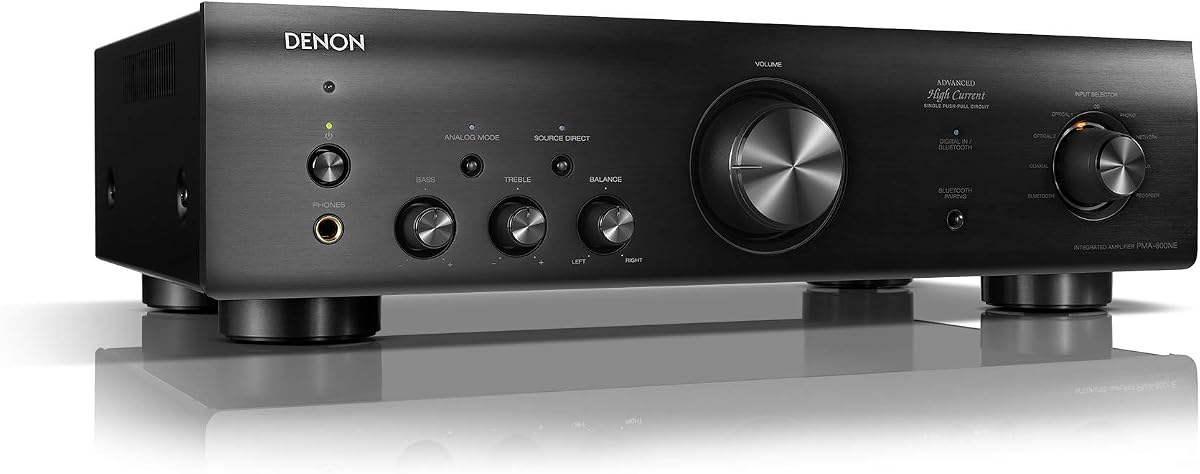
The Denon PMA-600NE is the premium-oriented choice in this group, combining a 4.7 rating with a dedicated phono input and carefully divided amplification circuitry. It is designed for listeners who want a refined two-channel system with vinyl at its center rather than a feature-packed karaoke or home-theater receiver.
We may earn a commission when you buy through this link, at no additional cost to you.
The amplifier delivers 70 watts at 4 ohms and uses Denon Advanced High Current push-pull circuitry. Its vibration-resistant enclosure is deliberately slim, allowing placement on a shelf or console without giving up the physical presence of a conventional stereo component. A large power transformer supports the stated focus on musical detail and clean output.
Connectivity includes Bluetooth, two optical inputs, one coaxial input, and a phono input. A built-in DAC broadens the digital sources it can accept, while the divided circuitry can disengage digital circuits for a more fully analog listening path. There is no USB or HDMI input, so the connection options are thoughtfully selective rather than exhaustive.
This is the strongest premium recommendation for a dedicated vinyl-and-music system. It is especially appealing to buyers who value a recognizable hi-fi component approach, a straightforward control layout, and the option to bypass digital circuitry when listening to analog sources.
The divided design allows digital circuitry to be disengaged for an undivided analog experience. Bluetooth and digital inputs remain available for broader source use without making them part of every listening path.
The high-current push-pull design is intended to balance useful driving power with low-level musical detail. At the same time, the phono stage provides a direct path for compatible turntables without requiring a separate preamp.
We may earn a commission when you buy through this link, at no additional cost to you.
The most important decision is compatibility: a turntable either includes a phono preamp and outputs a line-level signal, or it needs one built into the amplifier or added separately. After resolving that point, consider speaker power, available inputs, room size, control features, and the style of system you want to build.
A phono input applies the gain and frequency correction required by a turntable cartridge. Most turntables with a moving-magnet cartridge do not output line-level audio directly; they require either a phono-equipped amplifier or a standalone preamp. By contrast, a turntable described as having a built-in phono preamp or phono stage can usually feed a normal RCA line input, although some products also provide a separate phono-out connection.
Choose an amplifier with a built-in MM phono input when simplicity and a complete solution matter. Use a standalone preamp when your existing amplifier already performs well but lacks the required gain and filtering. Always check the turntable manual and confirm the correct input rather than relying only on the words phono on a rear panel.
Power specifications can be misleading because peak marketing figures are not the same as continuous output. Look for RMS or rated power per channel, verify the speaker impedance, and consider room size and speaker sensitivity. A small pair of efficient bookshelf speakers may sound perfectly convincing with considerably less power than a large floorstanding pair in a spacious room.
Match the amplifier to the speakers rather than chasing the largest number. Confirm that the product supports the impedance of every speaker in the system, and leave enough headroom for comfortable listening without pushing a small amplifier continuously into distortion.
Moving-magnet cartridges are the most common and generally work with standard phono inputs. Moving-coil cartridges usually produce a lower-level signal and may need a moving-coil phono stage with higher gain and capacitance adjustment. A unit intended specifically for MM cartridges should not automatically be assumed to support every moving-coil model.
Check the cartridge type before finalizing a system. If compatibility is uncertain, choose a phono preamp with selectable gain, or use a cartridge with an output level suited to the available MM stage.
Count the source components in the room rather than the total number of inputs printed on a product page. A turntable may need one RCA input pair, while a CD player, streaming device, television, and game console may require additional analog or digital connections. Optical and coaxial inputs can carry television audio, while USB and Bluetooth serve computer and mobile sources.
Prefer a clear labeling system and a remote that can control the functions you actually use. Extra inputs are useful only when they are easy to select and provide the appropriate type of signal.
A stereo amplifier should support the number of speaker pairs and subwoofer arrangement planned for the room. Some models offer A/B switching, while others support independent channels, multiple speaker groups, or a subwoofer output. Check whether all speakers can operate together safely and whether the required impedance falls within the manufacturer's stated range.
For a straightforward two-speaker setup, the differences may be negligible. For a multi-room or mixed-speaker installation, switching flexibility and correct impedance handling can be more valuable than additional tone presets.
Bass and treble controls can make it easier to balance different speakers, turntable cartridges, and room reflections. More elaborate amplifiers may add midrange, presets, or digital signal processing, which can be useful in entertainment environments but are not essential for accurate stereo playback. A neutral starting point helps reveal whether tonal adjustments are actually improving the result.
Choose controls that are easy to access and return to a known position. Too many settings can make two similarly recorded sources sound unnecessarily different.
Bluetooth is convenient for casual listening, while digital inputs can provide a direct path for compatible televisions and streamers. Features such as anti-hijack Bluetooth behavior, source memory, and a multifunction control can improve daily usability more than an extra rarely used connection. For a dedicated vinyl system, direct phono performance and clean speaker control deserve greater priority.
Select features that solve a real need in the intended room. A feature-rich device is not automatically easier to use, particularly when its controls are small or its settings are hidden in menus.
The amplifier must physically fit the shelf or cabinet and leave room for cables and ventilation. Class D units are often compact, but a power adapter can occupy as much space as the amplifier itself. Rear-panel connections should be reachable without pulling the unit forward, and speaker terminals should suit the cable gauge and connector style used in the home.
A system that is difficult to arrange is more likely to be left unused. Measure the intended location, check the depth of connectors, and allow for airflow around the chassis and power supply.
Begin by disconnecting power and identifying the correct input on both the turntable and amplifier. If the turntable lacks a built-in phono stage, use an MM-compatible phono input or connect a standalone preamp. Attach the ground wire to the designated grounding post, seat each RCA plug firmly, and avoid routing the signal cable parallel to power cords for long distances.
Set the amplifier volume low before switching it on, then choose the phono or line input corresponding to the connected source. Allow the turntable and amplifier to stabilize, raise the volume gradually, and set the cartridge tracking weight and anti-skate according to the turntable manufacturer's instructions. Use the amplifier's tone controls sparingly until the overall balance between the cartridge, speakers, and room is established.
For cleaning, switch off and unplug the amplifier, then use a soft dry cloth on its enclosure. Keep liquids away from vents, controls, and connectors, and avoid abrasive cleaners. Store the unit away from direct sunlight, excessive heat, and dust, and inspect cables periodically for loose plugs or damage. Do not open a powered unit unless you are qualified to do so.
Only if the turntable already produces a line-level signal or you add a compatible phono preamp. Most turntables with moving-magnet cartridges need an MM phono stage, while moving-coil cartridges may require more gain and compatible capacitance settings. Check both products before connecting them.
A phono input applies the gain and frequency adjustments required by a low-level cartridge signal. A normal RCA input expects a louder line-level signal and is unsuitable for a direct moving-magnet cartridge connection. Using the wrong input can produce very quiet sound or an overly bright, distorted presentation.
An external preamp is needed when the amplifier lacks a suitable phono input and the turntable does not include a built-in phono stage. It can also provide more appropriate gain or cartridge matching. If both the turntable and amplifier include compatible phono stages, an external unit is usually unnecessary.
It depends on speaker sensitivity, impedance, room size, and listening levels. Efficient bookshelf speakers can work well with a modest amplifier, while larger or less sensitive speakers may benefit from more power. Compare continuous RMS ratings with the speakers' requirements rather than choosing solely by a peak-wattage headline.
Many amplifiers can store both source types, but usually only one is active at a time. Select the turntable's phono or line input for vinyl and switch to Bluetooth for streaming. Models with physical Bluetooth disengagement in alternate modes can prevent wireless devices from interrupting a wired source.
A loose or missing ground connection is one of the most common causes. Confirm that the turntable and amplifier grounds are connected correctly, use shielded RCA cables, and keep signal cables away from power transformers and other interference sources. Persistent hum may also indicate a grounding loop, so test a different outlet or connection arrangement.
They can be connected to the same quality power strip, provided the strip and power supply meet the amplifier's requirements. Avoid cheap overloaded strips and route the turntable's RCA cables away from mains adapters. For a complex installation, a properly conditioned system can help, but it should never be used to compensate for poor grounding.
Not universally. Tube and solid-state designs can both provide enjoyable results, while the cartridge, speakers, room, and system matching matter greatly. A tube-style preamp may provide a particular tonal character, but compatibility, convenience, reliability, and available controls should be considered alongside sound preference.
The Sony STRDH190 is the most versatile overall recommendation because it combines a built-in phono stage, 100 watts per channel, Bluetooth, multiple analog inputs, and four-speaker switching in a conventional receiver format. The Donner MAMP2 stands out for value-oriented feature breadth, while the Denon PMA-600NE offers the strongest premium positioning with a refined integrated-amplifier design.
For compact systems, the Nobsound NS-13G MAX and Qlearsoul HiCore H2 provide phono-ready or source-flexible Class D options depending on the turntable. The Fosi models cover several use cases, from a tube-inspired DAC amplifier to upgradeable Bluetooth power and dedicated MM preamplifiers. Prioritize phono compatibility, continuous power, speaker fit, and usable inputs before secondary features.
Before ordering, verify the turntable's output type, cartridge specifications, speaker impedance, and the amplifier's supported connections. Retailer prices, promotions, and availability can change, so check the current listing and all included accessories at the time of purchase.
