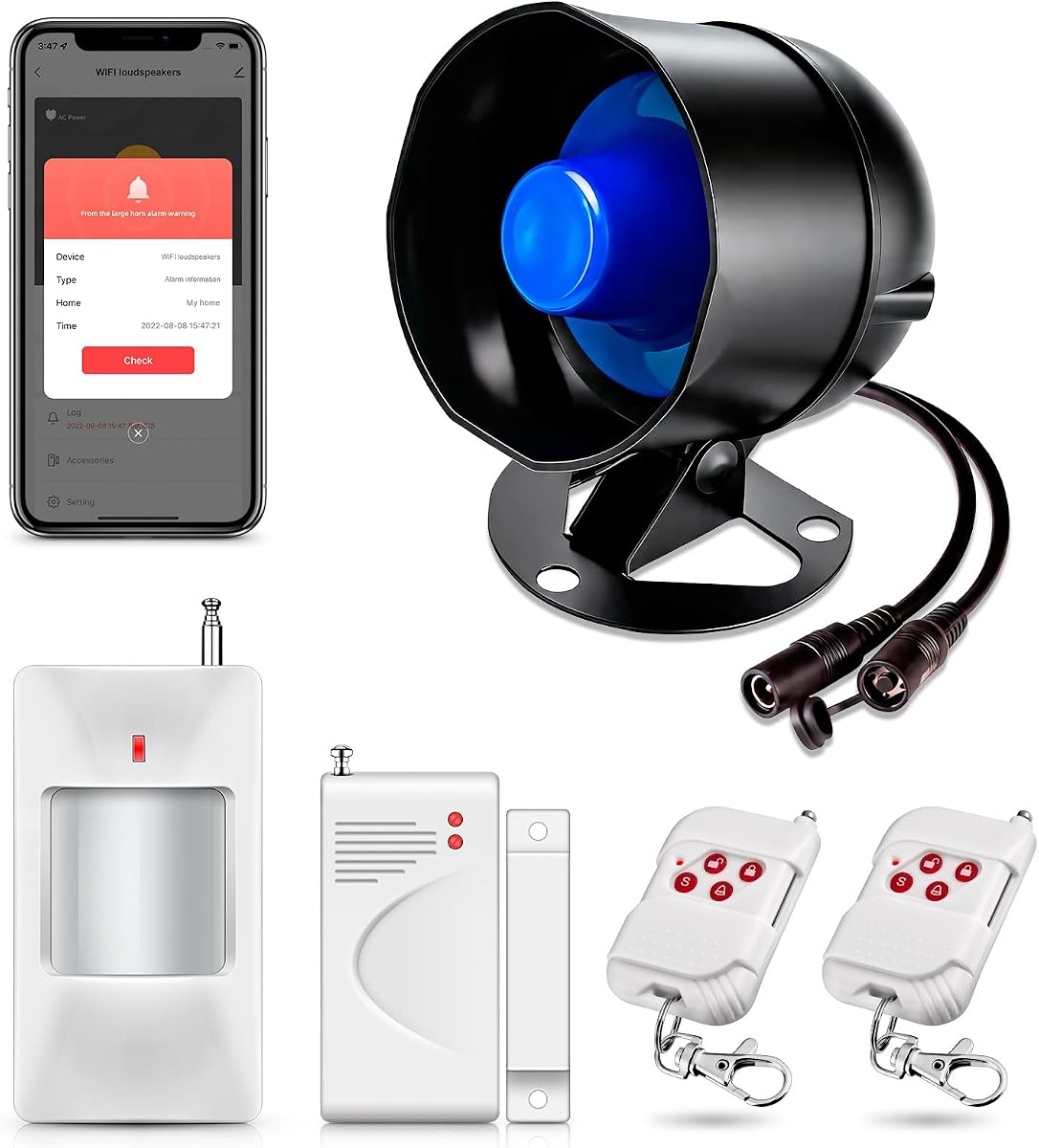
WiFi Security Alarm System Kit
4.4Editor score
Six-piece complete kit
Weatherproof siren horn
120dB alarm output
App-based arming controls
Our expert guide compares 10 alarm systems for small barns, evaluating outdoor range, weather resistance, wireless setup, alerts, and expansion.
A small barn needs an alarm system that can detect activity around doors, gates, storage areas, and open approaches without requiring complex wiring. The best systems combine useful range, dependable wireless sensors, clear notifications, and housings that can handle demanding outdoor conditions.
We compared these 10 products by examining their stated detection range, connectivity, included components, outdoor suitability, installation method, expansion options, and alarm functions. The list covers WiFi alarm kits, long-range driveway systems, weather-resistant sirens, and expandable control panels suited to small farms and outbuildings.
Each review explains where a product fits best, including practical strengths, limitations, and ideal installation scenarios. Ratings and technical details reflect the supplied product information, while features and product configurations can change. Always verify the current listing, included accessories, and compatibility before purchasing.
4.4Editor score

4.5Editor score

The comparison below highlights each system's principal hardware, alert method, outdoor capability, and expansion potential, making it easier to match a security solution to a barn's size, layout, and available power.


This WiFi alarm home security system earns a 4.5 rating and offers one of the strongest combinations of flexibility, deterrent volume, and remote control for a small barn. Its 120dB siren, door and window contacts, motion detector, and included remote controls provide a useful foundation for monitoring outbuildings, gates, and equipment storage.
We may earn a commission when you buy through this link, at no additional cost to you.
The siren hub connects to the Tuya app over 2.4GHz WiFi, allowing users to arm, disarm, adjust delays, and receive trigger notifications. The system can support up to 30 wireless detectors and 20 remote controls, so a single hub can cover a barn, nearby shed, garage, and other approaches without requiring separate installations.
The main tradeoff is that the hub must remain connected to a power outlet and dependable 2.4GHz network. It also appears designed primarily for convenient indoor placement rather than exposed outdoor use. Buyers should not place the hub where rain, dust, or livestock can reach it without suitable protection.
This is the best overall choice for a small barn owner who wants phone alerts, a loud local siren, and room to expand. It is particularly attractive when the barn has reliable WiFi and several doors or approach points that should be monitored.
Support for 30 wireless detectors makes this system practical for a property containing a barn, garage, shed, and storage building. The expansion limit also allows remotes to be shared with family members who do not use the app.
The Tuya app provides a central way to check sensor status and receive alerts when a door is opened or motion is detected. Customizable arming delays, alarm duration, and timers make it easier to accommodate normal traffic around the property.
We may earn a commission when you buy through this link, at no additional cost to you.
This six-piece WiFi security alarm kit has a 4.4 rating and delivers a balanced mix of door monitoring, motion detection, remote control, and an outdoor-capable siren. It is a practical option for a small barn where the priority is a straightforward warning system rather than a large professionally managed installation.
We may earn a commission when you buy through this link, at no additional cost to you.
The package includes one door and window sensor, one motion sensor, two remote controls, one WiFi siren horn, and one power plug. The horn is described as weatherproof, making it better suited to a barn exterior or sheltered entrance than many compact indoor kits. The 120dB output creates a strong local deterrent.
Its six-piece configuration may be modest for a property with numerous entries. The one included contact sensor and one motion sensor therefore need careful placement, while additional detectors are necessary for broader coverage. The siren also requires a nearby outlet and access to 2.4GHz WiFi.
Choose this kit for a compact barn, workshop, or garage that needs one monitored door and one motion-detection zone. It offers the best balance for buyers who want a weather-resistant siren and app control in a manageable package.
The weatherproof horn is the kit's most barn-relevant feature. It can be positioned at an entry or exterior wall where an indoor alarm would be less noticeable, provided the power connection remains protected.
Two included remotes make everyday arming and disarming easier for people who do not want to open the mobile app each time. The app adds remote status checks and trigger notifications when someone is away.
We may earn a commission when you buy through this link, at no additional cost to you.
This eight-piece WiFi door alarm system carries a 4.2 rating and focuses on protecting individual entries. With five door and window sensors, it is especially appropriate for a barn divided into multiple compartments, stalls, or storage rooms where unauthorized opening is the main concern.
We may earn a commission when you buy through this link, at no additional cost to you.
The kit combines a siren station, five contact sensors, and two remote controls. It supports up to 20 sensors and five remotes or keypads, and optional motion detectors, a wireless doorbell, and water detectors can broaden the system. Voice control through Alexa and Google Assistant adds hands-free operation.
The alarm station must remain connected to its AC adapter, although the backup battery can provide up to eight hours of emergency operation. It only works with 2.4GHz WiFi, and unlike several weather-resistant alternatives, its supplied hardware should be treated as indoor equipment unless explicitly protected.
This is a good match for a small barn with many monitored doors but limited need for extensive outdoor motion coverage. Buyers should place the five contacts on the most important openings and add motion protection if vehicles, feed areas, or large openings need supervision.
Five included door and window sensors provide unusually good entry coverage for a compact eight-piece system. This is valuable in barns where animals, equipment, or supplies are divided among several internal areas.
The eight-hour backup battery offers a safety net when the main supply is interrupted. The primary adapter connection remains essential, so placement should prioritize a protected, accessible outlet.
We may earn a commission when you buy through this link, at no additional cost to you.
This weatherproof WiFi alarm system has a 5.0 rating and stands out as one of the strongest options for outdoor approaches. Its IP65-rated 120dB siren, four motion sensors, and 26-foot detection specification are directly relevant to barns, gates, driveways, and nearby open ground.
We may earn a commission when you buy through this link, at no additional cost to you.
The sensors detect movement and trigger the siren instantly, while WiFi connectivity enables arming, disarming, and real-time alerts from a smartphone. The included remotes provide an alternative for family members who do not use the app. Peel-and-stick installation is quick and avoids running cable across a yard.
The primary limitation is that the six-piece set contains four motion sensors, two remotes, the siren, and the power plug rather than any door contacts. It is therefore better suited to detecting approaches than identifying which specific barn door was opened. Extra sensors are sold separately.
For a small barn near a driveway, gate, or open yard, this is an attractive option because it places emphasis on outdoor detection. It is also a sensible choice for users who want a weather-resistant siren and several independently positioned movement sensors.
The IP65-rated siren is designed to withstand rain, heat, and cold, making it more suitable for exposed barn surroundings than a conventional indoor hub. It still needs a protected power connection.
Four included sensors can cover a gate, driveway, side approach, and open area near the barn. Positioning them away from vegetation and moving objects may help reduce unwanted triggers.
We may earn a commission when you buy through this link, at no additional cost to you.
This long-range driveway alarm has a 4.4 rating and is built for properties where the barn sits at the end of a long drive or beyond a gate. Both the motion sensors and plug-in receiver can communicate across a stated half-mile distance, although actual performance varies with terrain.
We may earn a commission when you buy through this link, at no additional cost to you.
Each sensor detects people or vehicles from 35 to 50 feet ahead, with low and high sensitivity settings. The system is designed for outdoor use in temperatures from -30 to 150 degrees Fahrenheit, making it well matched to a wide range of climates and agricultural settings.
Unlike app-centric alarm kits, this product does not provide smartphone notifications. Its receiver sounds locally and offers 35 selectable melodies with four volume levels. That makes it dependable for audible warnings but less useful when the owner needs remote confirmation away from the property.
This is the best choice for monitoring a long driveway, field entrance, gate, pool area, or remote shed. Its two sensors can distinguish separate property zones through different melodies, and the system can expand to 32 sensors with unlimited receivers.
The stated half-mile transmission distance is the system's defining feature, making it practical for barns separated from the home by open ground, buildings, or long fenced approaches. Terrain and obstructions can affect the actual range.
Two sensitivity levels let owners choose between a narrower 35-foot zone and a wider 50-foot detection area. The sensor is also designed to reduce triggers from leaves, small animals, sunlight, wind, and temperature changes.
We may earn a commission when you buy through this link, at no additional cost to you.
This 24-piece WiFi and 4G alarm system has a 4.3 rating and offers the most elaborate alerting platform in the group. It can notify users through the Smart Life or Tuya app, telephone calls, and SMS messages, giving owners several ways to react when a barn event occurs.
We may earn a commission when you buy through this link, at no additional cost to you.
Its main unit includes a color display for system status, weather, and date, along with support for ten international languages. Door magnetic sensors and motion detectors trigger an alarm exceeding 110dB and can send notifications through the available communication channels. An emergency SOS device is included for rapid manual activation.
The system supports additional PGST accessories and custom sensor names, but it is more involved than a straightforward wireless kit. A 4G SIM card is required for cellular calling and SMS functions, and 5GHz WiFi is not supported. Owners must also understand 2.4GHz setup and control-panel programming.
This system is best for a barn or farm property that needs multiple notification routes and a broad assortment of included equipment. It is particularly appealing when a phone call is more useful than an app-only alert or when cellular backup is important.
App, phone, and SMS notifications make it easier to reach the property owner under different circumstances. The cellular function is particularly valuable where the barn is away from the home but still has usable cellular service.
Unauthorized removal of the main unit can trigger an alarm and require a security code to disarm. This feature adds an extra layer of protection for equipment that may otherwise be vulnerable to interference.
We may earn a commission when you buy through this link, at no additional cost to you.
This ten-piece WiFi security kit has a 4.6 rating and offers one of the most complete component mixes among the compact alarm systems. It combines four door and window contacts, two motion sensors, two remote controllers, a weatherproof 120dB siren, and a power plug in one coordinated package.
We may earn a commission when you buy through this link, at no additional cost to you.
That distribution of sensors makes it suitable for a barn with several entrances and at least one internal or exterior movement zone. The weatherproof horn can be positioned more appropriately for an outbuilding, while the Tuya app enables remote arming, status checks, and trigger notifications.
Capacity for up to 30 wireless detectors and 20 remote controls means the included ten pieces can form the foundation of a larger property system. The system must still share a compatible 2.4GHz WiFi network, and the siren needs a reliable outlet connection.
For owners who want meaningful coverage without assembling every component separately, this is an excellent general-purpose choice. It is especially useful when a barn has multiple doors, a nearby garage, and a need for both contact and motion detection.
Four door contacts and two motion sensors cover more entry and movement scenarios than the smaller kits. This balanced configuration reduces the need for immediate expansion if the barn has a moderate number of vulnerable points.
The hub can accept substantially more detectors and remotes than the package initially includes. That makes the kit a practical center for a small farm with several connected buildings and family members needing access.
We may earn a commission when you buy through this link, at no additional cost to you.
This expandable WiFi alarm system has a 4.5 rating and is built around a generous number of door sensors. The package includes a base station, keypad, ten door sensors, one motion detector, and two remotes, making it a strong option for a barn containing numerous individual rooms or entrances.
We may earn a commission when you buy through this link, at no additional cost to you.
Its 120dB indoor siren provides a loud local warning, while app notifications allow the owner to monitor sensor events remotely. The station has an eight-hour backup battery for outages, and installation can use adhesive pads or screws without running cable through the structure.
The system supports as many as 20 sensors and five remotes or keypads, allowing owners to add motion detectors, contact sensors, and indoor sirens as requirements grow. The main downside is that the siren is intended for indoor use, so it needs a protected location within the barn.
This is a strong recommendation for owners whose main concern is knowing when a door or window has been opened. It works particularly well when the barn has a reliable WiFi signal and multiple door sensors can provide more value than a broad outdoor motion perimeter.
Ten included door sensors are especially useful for barns with internal partitions, equipment rooms, feed storage, or numerous exterior doors. The broad contact coverage reduces the need to identify and purchase sensors separately.
A rechargeable battery keeps the alarm operating for up to eight hours when normal power is lost. This makes the base station more dependable during storms or other events that commonly affect rural properties.
We may earn a commission when you buy through this link, at no additional cost to you.
This twelve-piece WiFi alarm kit has a 5.0 rating and concentrates on broad motion detection. Eight motion sensors, two remotes, a WiFi siren, and a power plug provide enough hardware to establish several monitored zones around a barn, yard, driveway, or neighboring outbuilding.
We may earn a commission when you buy through this link, at no additional cost to you.
The weatherproof 120dB horn is a useful centerpiece for a property where an outdoor warning has practical value. The system supports up to 30 wireless detectors and 20 remotes, and app notifications provide awareness when the owner is away. Setup uses adhesive pads or screws, while the siren plugs into an outlet.
No door contacts are included, so the package cannot identify a specific opened door on its own. Motion sensors may also respond to animals, vegetation, vehicles, or other movement, making careful placement essential. The eight included sensors should be aimed at meaningful approaches rather than distributed randomly.
Choose this system when perimeter movement is the principal concern and a barn has several open approaches. It is a particularly good fit for users who want numerous wireless detection zones connected to one loud, weather-resistant alarm hub.
Eight included sensors offer a strong start for covering multiple approaches. Each can be positioned around a barn entrance, gate, path, or open side of the structure without running cable between locations.
When a sensor detects movement, the 120dB weatherproof siren sounds immediately. The combination can discourage intrusion while also notifying the owner through the app.
We may earn a commission when you buy through this link, at no additional cost to you.
The ANNKE 9-piece all-in-one system is the most feature-oriented option in this guide. It combines a control panel, four door and window sensors, a PIR camera detector, an indoor sounder, keypad, and remote keyfob in a single package designed for both residential and small-business scenarios.
We may earn a commission when you buy through this link, at no additional cost to you.
The camera detector is the key distinction. Through the ANNKE Vision app, owners can receive real-time alerts and capture snapshots to help confirm a potential threat without immediately responding to every motion event. The app also supports arming, disarming, and device-status checks.
The system supports 2.4GHz WiFi or Ethernet and includes an activate-as-needed professional monitoring capability. Installation uses snap-fit mounting without wiring or drilling, and Stay, Away, and Disarm modes accommodate different routines. Sixteen AA batteries are required but not supplied.
This is the best premium choice for a barn owner who wants visual confirmation alongside traditional contact and motion alarms. It is more advanced than the compact WiFi kits and more suitable for owners who value a camera, flexible modes, and an organized control panel.
The PIR camera detector can capture snapshots that appear in the app, helping owners judge whether detected activity is a genuine concern. This can be more useful than relying solely on a sound or a generic motion notification.
Stay, Away, and Disarm modes allow the system to reflect different security states. Owners can select settings that suit work in the barn, periods when it is empty, and times when the property should remain monitored.
We may earn a commission when you buy through this link, at no additional cost to you.
The right barn alarm should match the property's access points, outdoor exposure, communication needs, and expansion plans. Comparing detection methods, power requirements, connectivity, and installation constraints is more useful than focusing on a single headline feature.
Start by identifying where unauthorized activity is most likely to begin. A barn beside a public road may need a long-range driveway sensor, while a structure with several doors may benefit from a hub with multiple contact sensors. Motion detectors are valuable for open approaches but should be aimed at paths, gates, and entrances rather than areas with constant animal or vegetation movement.
Choose a detection area that covers likely approaches without creating unnecessary alerts. Longer range is not automatically better if it extends into a neighboring property or a frequently traveled public road.
A siren exposed near a barn entrance needs a weather-resistant housing and a protected power connection. Kits with IP65-rated sirens are better suited to outdoor placement, while conventional indoor sirens should remain inside the structure. Motion and contact sensors also need careful consideration because moisture, dust, insects, and direct sunlight can affect performance.
Verify the stated environmental rating and avoid assuming that a battery-powered outdoor sensor is fully waterproof unless the manufacturer says so.
WiFi alarm hubs generally use a 2.4GHz network, and many explicitly do not support 5GHz. Check the network available at the barn rather than only the network in the main house. A mesh node, suitable access point, or alternative long-range system may be necessary where the structure is far from the router.
Long-range driveway systems use a different architecture, communicating directly between remote sensors and a plugged-in receiver without requiring the barn to have a strong WiFi signal.
Most compact systems require the main siren or base station to remain connected to AC power. Some models include a rechargeable battery for outages, while others use the battery strictly as limited emergency support. Owners should plan around the most likely outage conditions and ensure that power adapters, extension leads, and plugs remain protected from moisture and animals.
Battery-powered remote sensors simplify placement but require regular battery checks. Low-battery warnings and an easy replacement routine are important for unattended installations.
Consider how you want to learn about activity. A local siren deters intruders, while app alerts allow remote awareness. Phone and SMS notifications can be helpful for owners who do not consistently check a mobile app, and a camera-based sensor can provide visual confirmation before anyone approaches the property.
Test notification delivery from the location where you will spend most of your time. A successful app connection at home does not guarantee that the barn hub will maintain a useful connection during an outage or extended rural signal gap.
Count the doors, gates, windows, paths, and internal compartments that matter before choosing a kit. Contact sensors are best for identifying an opened entry, while motion sensors are better for monitoring approach areas and open interior zones. A complete package with both types can reduce the need for immediate accessory purchases.
Ensure the included components are sufficient for your priority locations. Expansion capacity matters only if the hub is compatible with the additional accessories you actually intend to install.
Wireless systems are attractive for barns because they avoid wall damage and long cable runs. Adhesive pads are useful for temporary or clean installations, while screws can provide a more secure attachment to rough wood, metal, or masonry. Make sure sensors are mounted at a height and angle that matches the stated detection area.
Review the installation kit before beginning and identify where the power supply, hub, sensors, and remotes will be located. A planned layout prevents missing blind spots and unnecessary sensor movement later.
Expansion limits show whether a system can grow with additional buildings, gates, motion zones, remotes, or keypads. App ecosystems and voice-control compatibility can improve convenience, but they also create setup requirements. Confirm the supported app, network band, accessories, and voice assistant before building a plan around them.
For a small farm, it is often best to start with the essential entry points and retain unused capacity for later coverage. A well-planned foundation is more useful than owning many sensors that cannot communicate with the hub.
Begin by mapping every entrance, gate, window, equipment area, and approach that requires monitoring. Sort these locations into contact-sensor and motion-sensor zones, then place the siren where its sound will be noticeable but its electronics and power connection remain protected. Test each proposed position before adhering or screwing sensors permanently.
Connect the hub to a compatible 2.4GHz WiFi network, pair the included devices, and test remote controls, app notifications, arming modes, and every individual sensor from the app. Confirm that the system can distinguish the intended barn entrances. For long-range products, perform a walk test at different points along the driveway because terrain can change signal strength.
For ongoing care, check battery-powered sensors on a regular schedule, clean outdoor motion sensors, and inspect adhesive mounts after severe weather. Test the complete alarm periodically, verify that the hub remains connected, and update the app or firmware when recommended. If alerts become unreliable, check power, network coverage, sensor alignment, and battery status before reconfiguring the entire system.
The best choice depends on whether the priority is monitoring doors, detecting movement around an open approach, or covering a long driveway. The WiFi Alarm Home Security System is a strong all-around option, while the Half-Mile Driveway Alarm suits remote approaches and the weatherproof motion kit is useful where several outdoor zones are needed.
Only products and sensors specifically described as weather resistant or weatherproof should be placed in exposed outdoor locations. Even with a weather-resistant siren, its power connection must remain dry and protected. Indoor contact sensors should be installed inside the barn or beneath a suitable shelter.
Several included systems work only with 2.4GHz WiFi and explicitly do not support 5GHz networks. Check the product listing and your router settings before installation. If the barn has no reliable 2.4GHz coverage, consider extending the network or choosing a self-contained long-range receiver system.
The required number depends on the building's doors, gates, windows, interior compartments, and surrounding approaches. A simple barn with one main entrance may need only a few sensors, while a complex property may require contacts on every important door and motion coverage along multiple paths. Prioritize entrances and areas containing valuable equipment.
Motion-based systems can respond to animals, vehicles, branches, and other movement, especially when detection fields are aimed too broadly. Place sensors at a suitable height, use the available sensitivity adjustments, and avoid pointing them at frequently disturbed vegetation. Contact sensors are better for identifying opened doors.
A siren hub primarily provides a loud local alarm and connects wireless sensors to an app. A control panel performs similar functions but often includes a display, keypad, status controls, and more advanced modes. The ANNKE system is an example of a control-panel approach with a camera detector and monitoring capability.
Arm the system while remaining nearby, then trigger each sensor in turn and confirm that the siren sounds and the app reports the correct zone. Test remotes, verify the hub's power and network connection, and walk through the detection areas to check for blind spots. Repeat the test after moving a sensor or changing the app settings.
It depends on the value of the property, the owner's response time, and whether anyone is regularly present. Local sirens and app alerts can provide deterrence and awareness, while a system with professional monitoring is useful when prompt verification and response are important. Consider cellular backup for locations with unreliable internet.
The WiFi Alarm Home Security System is the most versatile overall choice because it combines app control, a 120dB siren, included access sensors, and substantial expansion capacity. The six-piece WiFi Security Alarm System Kit is a practical value-oriented option, while the ANNKE 9-Piece All-in-One Wireless Alarm System leads for owners who want visual confirmation and professional monitoring capability.
Before purchasing, prioritize the actual weak points of your property. Choose contact sensors for important openings, motion sensors for controlled approaches, a weather-resistant siren for exposed positions, and long-range wireless reception for a distant driveway. Reliable power, suitable WiFi coverage, and a deliberate sensor layout matter more than simply having the largest number of components.
Product configurations, included accessories, ratings, and current pricing can change, so check the live listing before ordering. Confirm outdoor ratings, network compatibility, expansion limits, batteries, and installation requirements against your barn's layout. This careful check will help you choose a system that provides useful coverage without paying for sensors the property does not need.