
Epson LABELWORKS LW-PX700 Industrial Label Maker
4.4Editor score
Labels up to 24mm wide
Five tape material options
Large print preview screen
Complete industrial label kit
We compare the best label maker for network cables, covering print quality, durability, tape compatibility, portability, connectivity, and ease of use daily.
A network-cable label maker should create clear, durable identifiers that remain readable after cables enter racks, closets, conduits, and crowded workspaces. The right machine balances print quality, compatible label materials, easy text editing, portability, and the ability to repeat labels consistently across a large installation.
We compared ten handheld and computer-connected options based on the supplied specifications, including supported cable-label formats, printing resolution, display design, durability claims, power options, barcode support, and specialized electrical-identification features. The list covers budget-friendly compact units, professional thermal-transfer models, and rugged portable printers.
Each review explains where the product fits best and where compromises may arise. The top selections include versatile all-around, professional, and portable choices, while the complete comparison covers the full range of features. Product availability and pricing can change, so check the current listing before purchasing.
4.4Editor score

4.6Editor score

4.3Editor score
The comparison highlights print resolution, label compatibility, screen or editing features, power options, and specialized network and electrical labeling capabilities across all ten products.



The Makeid P31S combines a high-resolution 300 DPI print head with unusually broad support for cable-identification materials, earning a 4.6 rating among the products examined. It supports vinyl, self-laminating wraps, PET, nylon cloth, and heat-shrink tubing, making it well suited to network rooms, data centers, electrical panels, and mixed infrastructure projects.
We may earn a commission when you buy through this link, at no additional cost to you.
Its most valuable feature for professional network labeling is the combination of a one-inch-wide print head and support for up to eight lines. That makes it possible to include source and destination information, port numbers, cable categories, barcodes, or other identifiers in a single label. Barcodes, QR codes, and bulk data imports through the app or PC software add another layer of flexibility for users managing assets across multiple locations.
The machine uses thermal-transfer technology and is specified to produce weather-resistant, oil-proof, and waterproof labels capable of withstanding harsh temperatures. It also meets ANSI and TIA/EIA-606-A labeling requirements, a meaningful advantage for installers who need consistent electrical, datacom, and IT identification. The rechargeable 2600 mAh battery is rated for up to 90 days of standby use, which is practical for extended jobsites.
This is the strongest recommendation for a technician or serious home user who needs more than a simple text printer. It may offer more capability than necessary for someone labeling only a few cables, and its advanced software and broad format support can make initial setup feel substantial. Even so, its material range, print clarity, and professional standard support make it the most versatile option in this roundup.
The 300 DPI print head is designed to produce sharp, smudge-proof text and barcodes at speeds of up to 100 labels per minute. This combination is especially useful when identifiers are small, dense, or intended to remain readable after installation.
Support for heat-shrink tubing, self-laminating wraps, PET, nylon, and vinyl lets users match the label to the environment. That flexibility reduces the need to settle for one material across a diverse network installation.
We may earn a commission when you buy through this link, at no additional cost to you.
The VolenGo H1100 is a straightforward handheld label maker with a 4.3 rating and a strong focus on readability and cable-oriented workflows. Its backlit LCD makes text entry and preview easier in dim utility rooms, network cabinets, basements, and other locations where a standard screen may be difficult to read.
We may earn a commission when you buy through this link, at no additional cost to you.
Three dedicated cable modes simplify common network-cable tasks, while 16 fonts, 100 frames, and 800 symbols provide enough variety for organized identification schemes. The included 12mm tapes are laminated and described as resistant to water, oil, abrasion, and extreme temperatures, helping labels remain intact in demanding environments.
The H1100 favors accessibility rather than advanced industrial functionality. It does not offer the eight-line output, barcode creation, or broad software-driven asset management of the Makeid P31S, and its specified 12mm tape width is narrower than the maximum widths available on some competing machines. The included materials and straightforward menus are nevertheless suitable for labeling routers, switches, patch panels, wall ports, and individual patch cords.
Choose the H1100 when you want cable-focused shortcuts, a clearly illuminated screen, and dependable laminated labels without moving into a complex professional workflow. It is an appealing option for home networks, small offices, and installers who value straightforward controls. For a large structured build with barcodes and extensive documentation, a higher-end professional model may be the better fit.
The backlit LCD provides a clear view of characters and label settings in poorly illuminated work areas. This practical feature can reduce alignment mistakes and help users move through a labeling run more confidently.
Three cable modes place common network-identification tasks close at hand. The result is a faster process than starting with a completely blank general-label screen for every cable.
We may earn a commission when you buy through this link, at no additional cost to you.
The E1000 is a 4.4-rated handheld model that combines heat-shrink tube labels with flexible laminated wire labels, making it a practical choice for installers who need more than one identification method. It supports 12mm heat-shrink tubes with a 2:1 shrink ratio and flexible labels intended for wire wraps and flags.
We may earn a commission when you buy through this link, at no additional cost to you.
The label material is described as waterproof, oil-resistant, abrasion-resistant, and resistant to fading in extreme temperatures. Three cable modes are included, and shortcut keys cover wire or cable wraps, flags, fixed-length labels, general labels, and breaker labels. A familiar computer-style QWERTY keyboard should make typing relatively direct for users accustomed to standard keyboards.
One trade-off is the power arrangement. The E1000 can run on six AAA dry cells, which are not included, or through the included USB-C cable. A screen is not mentioned in the supplied specifications, so buyers who prioritize visual preview may prefer a model with a larger display. Its label width is also centered on 12mm formats rather than the broader 24mm maximum offered by the Epson LW-PX700.
The E1000 is best suited to users who regularly work with heat-shrink identification or need a balance of wrap and flag labels. It also provides a familiar keyboard and a broad set of shortcuts. Choose it for hands-on cable work, while looking toward a screen-equipped professional model if visual confirmation, software imports, and larger labels are central to your workflow.
Heat-shrink tubes provide a close fit around a wire, while flexible laminated labels support wrap and flag configurations. Having both formats available makes the E1000 adaptable to different routing and visibility requirements.
The machine can print 20 labels at a time, and its narrower settings are intended to reduce material waste. That is useful for installers creating multiple port, cable, or equipment identifiers in one session.
We may earn a commission when you buy through this link, at no additional cost to you.
The Brother P-touch Pro PTH111 carries a 4.6 rating and offers a familiar, approachable approach to network and electrical identification. Its graphical LCD previews the label before printing, helping users catch alignment, spelling, and spacing mistakes before the label reaches the cable or panel.
We may earn a commission when you buy through this link, at no additional cost to you.
Four one-touch keys—Cable Wrap, Cable Flag, Faceplate, and Serialize—directly address common electrical-identification tasks. The machine offers three fonts and more than 300 symbols, which makes it possible to label patch panels, faceplates, serial numbers, and network infrastructure without repeatedly adjusting text formats.
It supports genuine Brother TZe tapes in 3.5mm, 6mm, 9mm, and 12mm widths, giving users multiple adhesive and style options for workshop, electrical, and general-purpose labeling. The main limitations are its two-line maximum and the need for separate purchases for six AAA batteries or an AC adapter. Some advanced users may also want barcode or computer-connected workflows that are not highlighted in the supplied specifications.
This is a particularly good match for home network organizers, facilities staff, electricians, and technicians who prefer straightforward buttons and a clear preview. The PTH111 is less suited to large data-center runs requiring extensive multi-line schedules, but for everyday cable identification its dedicated controls and broad TZe compatibility are difficult to overlook.
The graphical display shows the label as it is created, allowing users to check line breaks and character placement. This reduces waste and makes repeated labeling more consistent.
Dedicated keys for cable wraps, cable flags, faceplates, and serialized identifiers save setup time. These shortcuts reflect the kinds of labels frequently required in network closets and electrical work.
We may earn a commission when you buy through this link, at no additional cost to you.
The BRADY M210 is a handheld industrial label maker with a 4.6 rating, placing it among the strongest-rated products in this guide. Its name and format position it as a practical professional tool for facilities, electrical, and network-identification work rather than a general-purpose novelty printer.
We may earn a commission when you buy through this link, at no additional cost to you.
The supplied product information is intentionally concise and identifies the unit as the BRADY M210 handheld label maker. It does not list supported tape widths, print resolution, display dimensions, connectivity, or included accessories. As a result, the product's strongest evident qualities are its compact handheld format, industrial positioning, and favorable user rating.
Compared with the Makeid P31S, Epson LW-PX700, and DYMO Rhino models, the M210's specifications are less transparent in the available listing. Buyers should confirm their required label materials and cable formats before choosing it. It is also not possible to determine from the supplied data whether it offers barcodes, computer connectivity, or specific network-labeling modes.
The M210 remains a credible recommendation for users seeking a reputable industrial handheld model, especially if they already use compatible BRADY materials. Its 4.6 rating is encouraging, but a purchase should follow a check of label compatibility, editing features, and included accessories. Those details matter when a label maker must handle a particular network-cable standard rather than simply print identifiers.
The M210 is built around the idea that important labels should be created where the cable or equipment is located. A standalone handheld format avoids requiring a nearby computer for routine labeling tasks.
A 4.6 rating places the M210 well within the leading group in this comparison. That makes it worth considering for professional users, although the listing should be reviewed for exact media and feature requirements.
We may earn a commission when you buy through this link, at no additional cost to you.
The Epson LABELWORKS LW-PX700 is a premium industrial label maker that combines a 24mm maximum tape width with support for heat-shrink tubes, self-laminating wraps, vinyl, standard industrial tape, and specialty materials. Its 4.4 rating reflects a strong balance of professional capabilities and visual operation.
We may earn a commission when you buy through this link, at no additional cost to you.
The large print preview screen is one of the most useful features for network work. Users can inspect the complete label before committing tape, which is valuable when creating dense port schedules, equipment tags, or multi-line identifiers. Auto rewind is also included as a time-saving feature for compatible workflows.
The kit arrives with an AC adapter, a cartridge of 212VTBWPX standard industrial tape, and a guide. This makes the package more complete for immediate use than a bare printer. Its broad media support and larger width also make it suitable for tasks beyond ordinary patch-cord labels, such as rack assets and facility identification.
The LW-PX700 is the premium choice for users who value material flexibility, a large preview, and a ready-to-use package. It may be more than a casual home user needs, but for technicians and organizations handling multiple labeling systems, the wider format range is a meaningful advantage. Epson also provides a full-service lifetime warranty in the United States and Canada for eligible LABELWORKS label makers.
A maximum label width of 24mm provides space for longer names, port ranges, and richer identification details. It is a meaningful advantage when every additional character must fit without excessive wrapping.
Heat-shrink, self-laminating, vinyl, industrial, and specialty tapes are all supported. This broad range suits installations where different environments and cable constructions require different label materials.
We may earn a commission when you buy through this link, at no additional cost to you.
The Brady M211 takes a distinctly mobile approach by creating and printing labels through the Express Labels Mobile App and a phone. Its 4.3 rating and rugged kit make it an interesting choice for technicians who need to work on racks, panels, and cables away from a desk.
We may earn a commission when you buy through this link, at no additional cost to you.
The included magnetic attachment allows the printer to sit securely on a metal surface while leaving the user's hands available for routing or securing a cable. A belt clip supports hands-free transport, while the hard case protects the printer, labels, and accessories. A power brick can charge the printer, phone, or tablet, making it easier to maintain one charging setup in the field.
Durability is a major focus. The M211 is specified to resist 250-pound crushes, six-foot drops, and military-grade shocks under MIL-STD-810G. These characteristics are relevant to network rooms, construction sites, and other environments where equipment may be knocked, dropped, or compressed during transport.
The principal trade-off is dependence on a phone, tablet, and compatible mobile application rather than a fully self-contained keypad device. Users who are comfortable with mobile workflows will appreciate the editable, portable design. For large labeling batches that benefit from desktop software and fixed media controls, a computer-connected model may be more efficient.
The Express Labels Mobile App enables label creation from a phone, eliminating the need to return to a workstation for every minor correction. That is particularly helpful when troubleshooting and adding identifiers in the field.
The stated crush, drop, and military-grade shock resistance supports use beyond a protected office. The hard case adds another layer of protection when the kit is carried between job locations.
We may earn a commission when you buy through this link, at no additional cost to you.
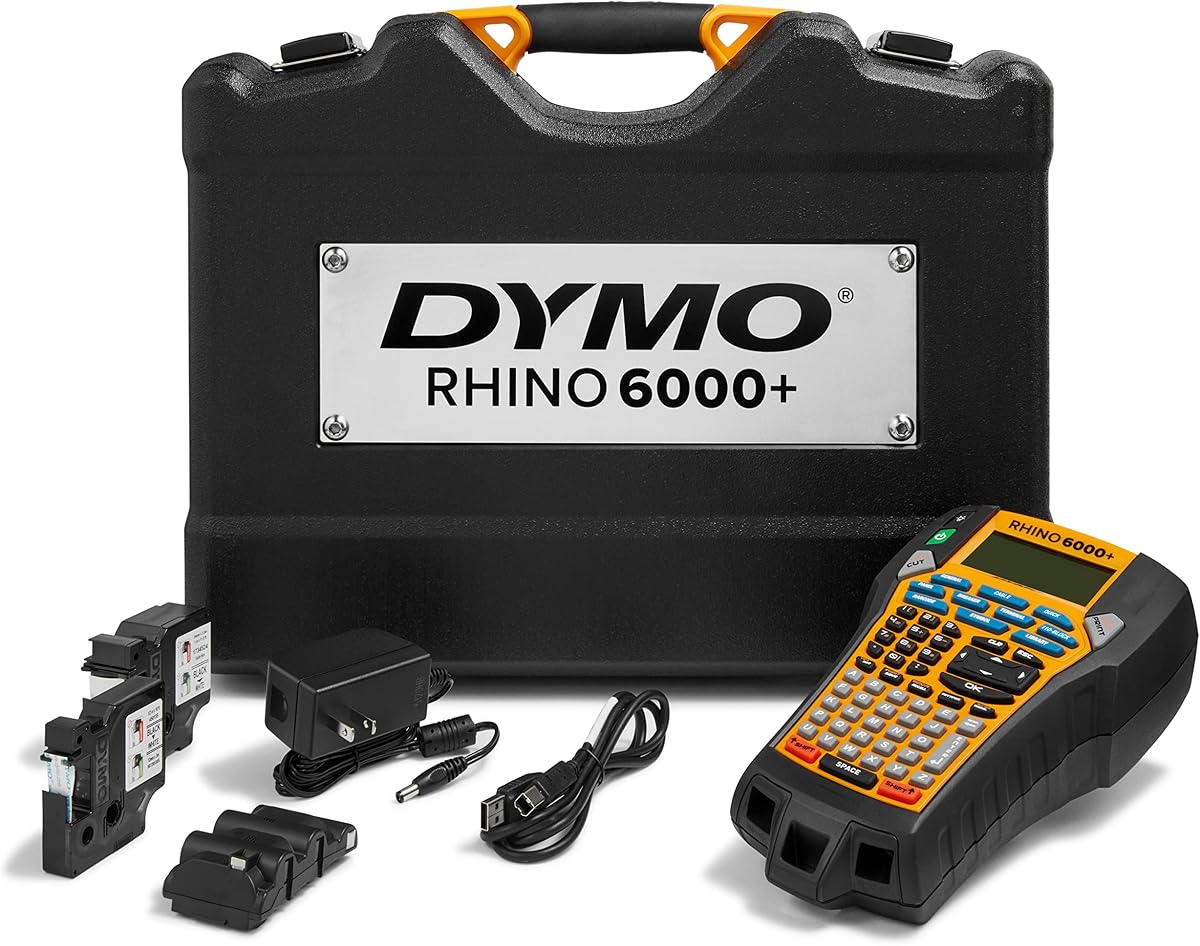
The DYMO Rhino 6000 is a computer-connected industrial label maker designed for users who need richer label layouts than a compact handheld can offer. Its 4.3 rating and support for barcodes, complex layouts, and industry standards make it especially relevant to structured network and data-center documentation.
We may earn a commission when you buy through this link, at no additional cost to you.
Labels are created and edited through DYMO ID software on a PC, providing a desktop workflow for preparing detailed cable schedules, equipment records, and standardized identifiers. One-touch Hot Keys automatically size, space, and format text, reducing repetitive adjustments while retaining the benefits of computer-based editing.
The printer meets key ANSI and TIA/EIA-606-B industry labeling standards. The kit includes a hard carry case, one vinyl tape cassette, one flexible nylon tape cassette, and a rechargeable lithium-ion battery, providing both durable label materials and a way to organize field equipment.
The Rhino 6000 is a strong recommendation for network professionals, facilities teams, and installers who want consistent desktop-based designs and barcode capability. It is less attractive for a quick, one-cable job where carrying a computer would be inconvenient. For complex documentation projects, however, the combination of software control and industrial standards support is especially valuable.
DYMO ID software supports barcodes and complex label layouts that are difficult to create efficiently on a small handheld keypad. A computer workflow also makes batch planning and correction more practical.
Support for key ANSI and TIA/EIA-606-B standards is valuable for organizations that require consistent electrical and network labeling conventions. It helps reduce ambiguity across a large infrastructure.
We may earn a commission when you buy through this link, at no additional cost to you.
The DYMO Rhino 5200 earns the highest rating in this guide at 4.8, reflecting a well-regarded approach to industrial labeling. It is designed for electrical and technical identifiers, with support for up to five lines, a backlit two-line display, and dedicated hot keys that automatically size, space, and format text.
We may earn a commission when you buy through this link, at no additional cost to you.
The built-in symbol library helps users produce consistent technical labels without repeatedly entering uncommon characters. Code 39 and Code 128 barcodes can be printed on 3/4-inch labels, which adds useful functionality for asset tracking, equipment records, and structured network documentation.
The primary advantage is efficient access to formatting controls. Hot keys reduce the number of steps required for common industrial labels, while the backlit display makes the machine easier to operate in low light. Its feature set is focused rather than expansive, and no Bluetooth or mobile-app workflow is identified in the supplied data.
The Rhino 5200 is an excellent choice for technicians who value reliable formatting, barcode support, and a straightforward industrial interface. It can be especially useful for panel schedules and labeled assets where multi-line information is necessary. Users seeking phone connectivity or extensive software imports should examine the Rhino 6000 or mobile-oriented alternatives instead.
Automatic sizing, spacing, and formatting minimize the number of manual adjustments required for each label. This helps maintain consistency when producing a long series of technical identifiers.
Code 39 and Code 128 support broadens the machine beyond simple text labels. Those formats can support inventory, equipment, and network-asset identification when paired with the appropriate system.
We may earn a commission when you buy through this link, at no additional cost to you.
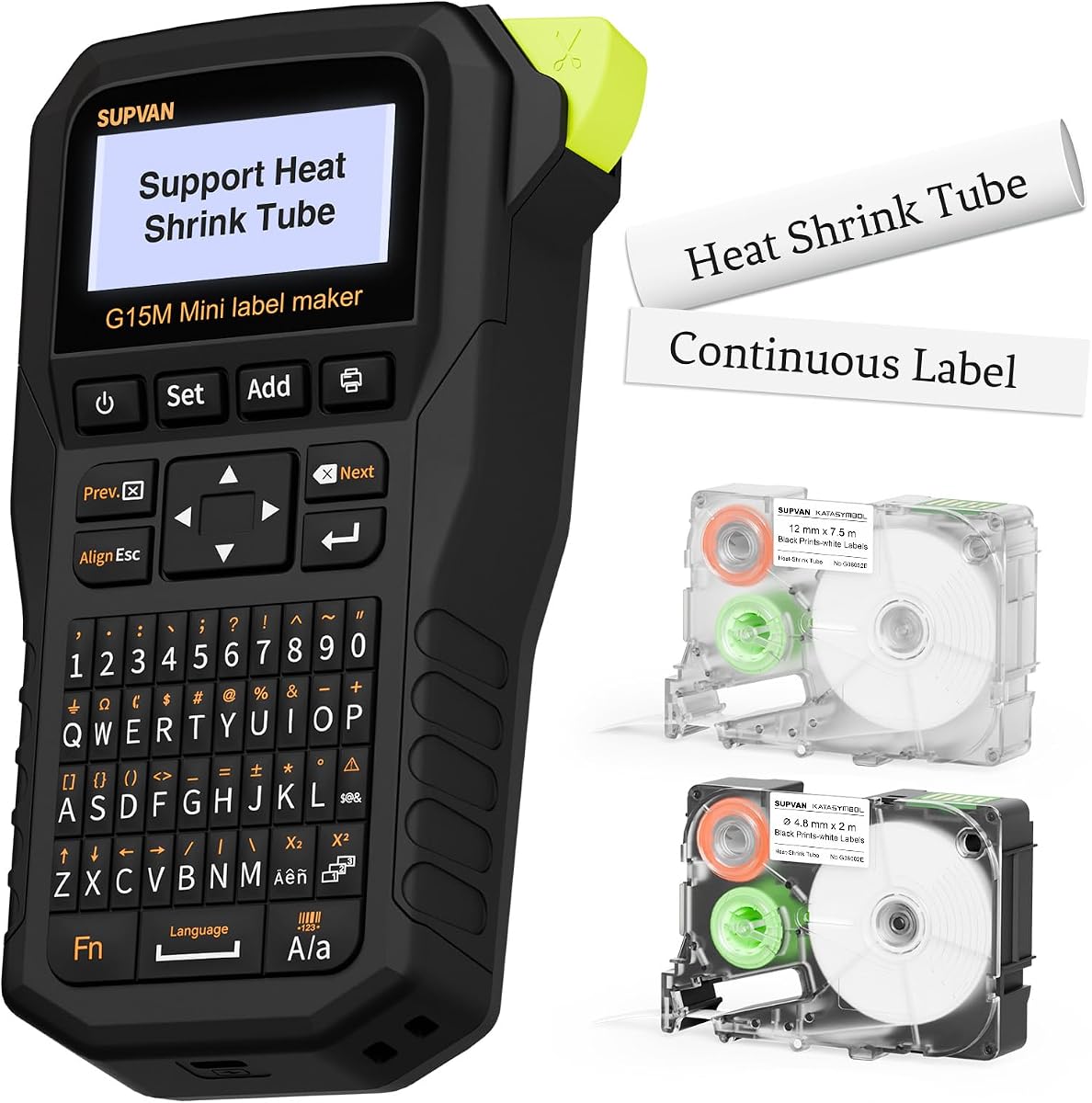
The SUPVAN G15M is a compact portable label maker with a 4.3 rating and a useful combination of heat-shrink support, rechargeable power, and customizable output. At 3.35 by 6.7 by 1.7 inches and 0.88 pounds, it is designed to fit comfortably into a tool bag or portable kit.
We may earn a commission when you buy through this link, at no additional cost to you.
Its built-in 1200 mAh battery is advertised to provide up to three months of use on a single charge. A minimum print margin of 0.19 inches is intended to reduce unused material, while thermal-transfer technology is specified to produce labels resistant to ultraviolet light, heat, and water for indoor or outdoor use.
Customization includes nine font sizes, six font styles, five frames, more than 400 icons, and color printing across as many as four lines. The machine accepts heat-shrink tubes, continuous labels, fixed-size labels, and cable labels. Its limitations include a smaller body and a focused feature set without listed barcode creation, standards certification, or computer software support.
The G15M is a good fit for a compact home network, mobile technician, or user who wants colorful, customizable identifiers without a larger industrial machine. It is particularly attractive for labeling cables on the go. For standardized data-center schedules or complex barcode systems, one of the professional models will offer a more appropriate workflow.
The compact housing and rechargeable battery support labeling away from an outlet. An advertised battery life of up to three months reduces the need for frequent charging between tasks.
The 0.19-inch margin is designed to place the printed content close to the label edge. This can conserve material during repeated runs and fit more useful information into a compact label.
We may earn a commission when you buy through this link, at no additional cost to you.
The right network-cable label maker depends on the materials, documentation standards, working environment, and labeling volume. Consider compatibility and clarity before choosing a model based only on appearance or included accessories.
Start by identifying every material your installation requires. Network cables may need heat-shrink tubes, flexible self-laminating wraps, vinyl, nylon, PET, or another specialized format, and the printer must accept the exact cartridge, roll, or tube you intend to use. The Makeid P31S supports more than 30 label sizes and several major material categories, while the Epson LW-PX700 supports heat-shrink, self-laminating, vinyl, industrial, and specialty tapes.
Match the printer to the label before considering convenience. A large screen cannot compensate for unsupported media, and a machine that handles only one narrow tape format may become limiting as the network expands.
Small port numbers, dense cable schedules, serial numbers, and barcodes require crisp output. The Makeid P31S prints at 300 DPI and is specified to produce sharp, smudge-proof text and barcodes, while most other models in the guide do not provide a stated resolution. A backlit or graphical display also helps reduce alignment errors before tape is consumed.
Prioritize readable characters over decorative fonts. For routine patch-cord labels, a clear standard font and good spacing may matter more than advanced graphics.
Purpose-built cable modes can save time in installations involving many similar labels. The E1000 and VolenGo H1100 each provide three cable modes, while the Brother PTH111 includes one-touch keys for cable wraps, cable flags, faceplates, and serialization. These shortcuts standardize spacing and reduce repetitive menu navigation.
Check whether the preferred method matches your labeling style. A technician wrapping every cable may prioritize flags, while someone documenting ports may need a visual preview and easy line editing more.
For a handful of cables, a built-in keyboard and small display may be enough. Larger projects often benefit from computer-based editing, bulk data import, and barcode or QR-code support. The Makeid P31S supports PC software, app-based work, barcodes, QR codes, and bulk imports, while the DYMO Rhino 6000 uses DYMO ID software for complex layouts and barcode generation.
Mobile workflows occupy a middle ground. The Brady M211 relies on a phone or tablet and the Express Labels Mobile App, making it convenient away from a workstation but dependent on a compatible mobile device.
Cables are often installed in conditions that expose labels to handling, moisture, oil, ultraviolet light, abrasion, or temperature changes. The G15M labels are specified to resist UV, heat, and water, while the E1000 and H1100 use laminated tapes described as resistant to several of those threats. The M211 adds physical protection through stated crush, drop, and shock resistance.
Durability must match the environment. A label that performs well in a dry office may not be suitable for a utility closet, outdoor pathway, or active industrial area.
Consider whether the machine will stay at one workstation or travel between racks and job sites. The Makeid P31S uses a rechargeable 2600 mAh battery with up to 90 days of standby time, the G15M uses a smaller 1200 mAh rechargeable battery, and the M210's supplied information does not detail its power system. The E1000 can operate with six AAA batteries or USB-C power, although those batteries are not included.
Portable does not always mean simple. A machine may be light and compact yet still require a phone, separate media cartridges, or regular charging. Assess the complete workflow rather than the dimensions alone.
A narrow 3.5mm or 6mm label may be appropriate for short IDs, but it restricts longer information. The Epson LW-PX700 supports labels up to 24mm wide, the Brother PTH111 uses tapes from 3.5mm to 12mm, and the Makeid P31S uses a one-inch print head. The P31S can also print up to eight lines, while the Rhino 5200 supports five lines.
Choose enough width and line capacity for the information you actually need. Extra capacity is useful for source-to-destination schedules, port ranges, and asset records, but it is unnecessary if every cable carries only a short name.
Organizations with formal documentation practices should investigate compliance carefully. The Makeid P31S meets ANSI and TIA/EIA-606-A requirements, and the DYMO Rhino 6000 meets key ANSI and TIA/EIA-606-B standards. The Epson LW-PX700 also comes with a full-service lifetime warranty in the United States and Canada, while the Makeid includes three years of replacement service and technical support.
Standards can simplify audits and future maintenance, but certification does not replace good label design. Keep naming conventions consistent and include enough information for another technician to understand the connection without tracing every cable.
Begin by preparing a simple naming scheme before printing. Decide whether labels should identify both ends, use source-to-destination wording, show room and rack locations, or include port numbers. Load the selected tape exactly as directed, confirm that the machine recognizes it, and use a short test label to check orientation and text size before labeling an entire bundle.
For wraps and flags, position the label according to the cable mode or template offered by the machine. Print a test after changing the text, font, spacing, or tape width, and compare the result with the preview when the model includes one. For a large run, work in small batches and move through the rack methodically, checking every label and both ends of each cable as you go.
Store the device in a dry area, keep the tape compartment protected from dust and debris, and follow the manufacturer's guidance for batteries, print heads, and charging. Use compatible media rather than forcing unsupported cartridges or tubes. Clean the exterior with a soft, dry cloth, avoid abrasive liquids, and inspect cables and labels periodically for fading, lifting, abrasion, or moisture damage.
The best type depends on the installation and documentation requirements. A basic handheld unit works well for short identifiers, while a professional thermal-transfer model is preferable for long cable schedules, barcodes, multiple media types, or standards compliance. Look for clear previews, suitable cable modes, and a print width that accommodates the information you need.
Neither format is universally better. Heat-shrink tubes provide a close fit around the cable and are useful when permanent identification is important, while wraps and flags are often easier to inspect, reposition, or replace. The best approach depends on cable diameter, routing, visibility, and how often the label may need to change.
They do not need to print barcodes for simple port or cable identifiers. Barcodes become valuable for asset management, inventory, maintenance records, and large structured installations. If your documentation system relies on scanned identifiers, choose a model with confirmed barcode and software support.
Thermal printers create images by heating a special coating, while thermal-transfer printers transfer ink from a ribbon to the label. Thermal-transfer systems are often better suited to demanding industrial materials because the printed layer can offer strong resistance to heat, moisture, oil, and abrasion. Exact durability depends on the machine, ribbon, and label combination.
Yes, many industrial and hybrid models support cables, panels, assets, and general-purpose identifiers. The Makeid P31S explicitly supports ANSI and TIA/EIA-606-A labeling, while the DYMO Rhino 6000 supports key ANSI and TIA/EIA-606-B standards. Confirm the required media and standard before purchasing.
A computer-connected model is usually better for complex layouts, bulk editing, barcodes, and consistent batch production. A handheld or mobile model is more convenient at the rack, especially when small changes must be made away from a desk. The DYMO Rhino 6000 favors desktop design, while the Brady M211 offers phone-based editing for mobile work.
A narrow label may be sufficient for a short room, rack, and port name, while a wider label helps when you need source and destination details. The Epson LW-PX700 supports up to 24mm, the Makeid P31S uses a one-inch print head, and the Brother PTH111 supports several TZe widths. Choose based on information density rather than size alone.
Create a written naming convention, identify the rack, room, panel, and port structure, and prepare a list of every cable destination. Print a few test labels in different locations and lighting conditions, then complete the run systematically. Record any exceptions and ensure both ends of each cable are identified consistently.
The Makeid P31S is the strongest all-around recommendation because it combines 300 DPI output, broad material compatibility, up to eight lines, barcode and QR-code creation, and professional standards support. The Epson LABELWORKS LW-PX700 is the premium option for users who want a large preview, 24mm labels, extensive media support, and a complete kit. The VolenGo H1100 represents a more accessible route with a backlit display and dedicated cable modes.
For a smaller or more focused task, prioritize the label material and information required rather than the largest specification list. A Brother P-touch Pro is convenient for familiar electrical shortcuts, the Brady M211 is useful for phone-based mobile labeling, and the SUPVAN G15M is compact and customizable. Professional documentation projects should give particular attention to barcode support, editing software, and ANSI or TIA compatibility.
Check the current product listing, included accessories, compatible consumables, warranty terms, and pricing before making a final decision. Label makers vary greatly in the kinds of tapes they accept and the documentation workflows they support, and the best choice is ultimately the one that matches your cable environment and naming system.