
Lowrance Eagle Fish Finder
4.3Editor score
Bright four-inch IPS display
Automatic sonar tuning
Wide 44-degree sonar coverage
Simple twist-lock installation
A cheap fishfinder can make fishing more productive by revealing water depth, fish arches, bottom contours, submerged structure, and temperature readings. The best budget model depends on where you fish, how you launch your boat, and how much detail you need. Portable sonar suits anglers with limited space, while mounted units provide larger displays and steadier readings.
We compared all 10 products using their supplied specifications, including sonar technology, display size, transducer type, portability, depth range, navigation features, and intended fishing environments. The list includes compact handheld units, kayak systems, installed fishfinders, GPS chartplotters, and wireless castable sensors. It also considers ease of setup, useful display features, and the limitations that matter most at an accessible price point.
Each review explains who the product suits, what it does well, and where its compromises appear. The top recommendations cover inexpensive portable models, a versatile mounted unit, and a more advanced premium option. Product availability and prices can change, so check the current listing and confirm that the included transducer, display, mounting hardware, and required accessories meet your needs before buying.
4.3Editor score

4.7Editor score

4.5Editor score
As an Amazon Associate we earn from qualifying purchases.
This side-by-side comparison covers every fishfinder in the guide, highlighting display format, sonar approach, portability, navigation, and practical limits so readers can match a model to their preferred fishing setup.


The Garmin STRIKER Vivid 4cv is a strong all-around choice for anglers who want more than basic depth readings. It has a 4.7 rating, the highest in this group, and combines a four-inch color screen with Garmin CHIRP traditional sonar and CHIRP ClearVü scanning sonar. That combination makes it useful for finding fish, following structure, marking productive locations, and understanding bottom contours.
We may earn a commission when you buy through this link, at no additional cost to you.
Its standout strength is the choice between conventional sonar and scanning sonar. Traditional CHIRP provides familiar arch-style information, while ClearVü is designed to create detailed representations of objects, structure, and fish. The vivid color palettes make it easier to distinguish those returns, which can be especially valuable when searching drop-offs, vegetation, rocks, brush piles, or submerged wreckage.
GPS navigation adds a larger role than a simple depth finder normally provides. Anglers can mark waypoints, create routes, and view boat speed directly on the unit. Quickdraw Contours mapping is also included, allowing users to record and store depth contours without needing a separate mapping subscription for basic custom contour use. The GT20 transducer supports both included sonar modes.
The trade-off is that this is a mounted display rather than a compact handheld, and its navigation capabilities are simpler than a full premium chartplotter. It also occupies more space than a screen-only portable unit. Even so, the combination of color scanning sonar, GPS, included transducer, mounting hardware, and mapping makes it the most versatile pick here for boaters who want meaningful capability without moving into a high-end marine electronics system.
CHIRP ClearVü scanning sonar provides detailed views of fish and underwater structure, while traditional CHIRP remains available for familiar arch readings. The vivid palettes improve visual separation and make the unit easier to interpret in changing conditions.
Built-in GPS supports waypoint marking, route creation, speed display, and Quickdraw Contours. These features help anglers return to a productive area and understand changing bottom conditions over repeated trips.
We may earn a commission when you buy through this link, at no additional cost to you.
The Lowrance Eagle Fish Finder is a practical budget choice for kayaks, small boats, and anglers who want an approachable display. Its 4.3 rating reflects a balanced feature set centered on a bright four-inch IPS screen, automatic sonar tuning, and a broad scanning beam. The portrait orientation helps it fit where a wider rectangular unit may be inconvenient.
We may earn a commission when you buy through this link, at no additional cost to you.
Visibility is one of its most important advantages. The IPS display is designed to remain clear in bright sunlight, from wide viewing angles, and while the angler wears polarized sunglasses. That makes it easier to check depth and fish returns without constantly shielding the display or changing settings just to improve visibility.
Auto-Tuning Sonar reduces setup work by automatically optimizing settings. The included 200 kHz Bullet Skimmer provides a broad 44-degree beam, offering wider coverage beneath a kayak or small boat. Fish icons, depth information, and zoom help simplify interpretation, while the absence of an audible fish alarm may be preferable to anglers who do not want unnecessary sound.
The twist-lock connector streamlines installation and removal, and the compact screen suits limited deck space. Its limitations are the absence of the richer GPS and contour features found in higher-end models, along with the need to mount it rather than carry it freely. For a straightforward fishfinder focused on clear visuals and wide sonar coverage, however, it offers a particularly useful balance.
The four-inch IPS panel is designed to remain visible in direct sunlight, from wide angles, and through polarized sunglasses. Clear readability matters when an angler must interpret a display while actively paddling, positioning a boat, or managing a line.
A 44-degree beam from the included Bullet Skimmer covers a generous area beneath the boat, while Auto-Tuning Sonar handles the initial setup. This combination reduces configuration and makes the system approachable for newer users.
We may earn a commission when you buy through this link, at no additional cost to you.
The Humminbird Helix 5 Chirp GPS G3 is the most feature-rich option in this guide. It combines a five-inch display with Dual Spectrum CHIRP sonar, an extensive basemap, premium chart compatibility, and real-time mapping. Its 4.5 rating makes it a credible choice for anglers who want a capable onboard system rather than only a simple depth display.
We may earn a commission when you buy through this link, at no additional cost to you.
Dual Spectrum CHIRP provides Wide Mode for broad coverage and Narrow Mode for detailed scanning. This flexibility helps an angler cover a lake efficiently, then zoom in on a specific target. The supplied information also highlights precise two-dimensional target separation through a Low-Q transducer, which can improve the clarity of individual fish and structure returns.
Navigation is the Helix 5's major advantage. Humminbird Basemap includes coverage for more than 10,000 lakes and the continental United States coastlines. It is also compatible with LakeMaster, CoastMaster, and Navionics charts. AutoChart Live can create maps of depth contours, bottom hardness, and vegetation, with eight hours of built-in recording time and compatibility with AutoChart Zero Line cards.
The softkey interface and physical buttons are designed for dependable operation in changing weather. This makes the unit more substantial than a basic fishfinder, and advanced mapping hardware can push the total cost higher. For anglers who regularly cover large waters, need premium chart support, or want to build custom maps, those capabilities may justify the additional investment.
Wide Mode prioritizes coverage, while Narrow Mode emphasizes detail. Choosing between the two allows anglers to scan open water efficiently and then focus more closely on fish-holding structure or promising contours.
AutoChart Live records depth contours, bottom hardness, and vegetation as the boat moves. The resulting maps can reveal how an area changes, while compatibility with premium chart providers adds flexibility for extensive waters.
We may earn a commission when you buy through this link, at no additional cost to you.
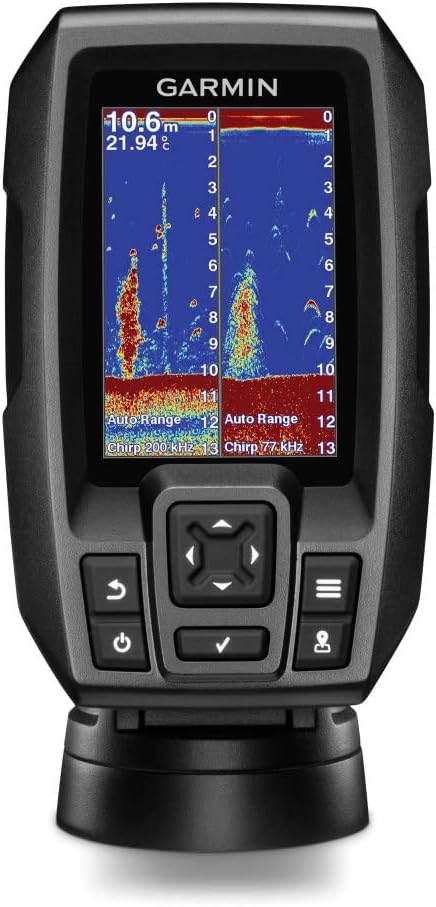
The Garmin Striker 4 is a compact but capable fishfinder with a 4.6 rating. Its three-and-a-half-inch display makes it well suited to small boats and anglers who want a straightforward GPS unit without a large screen. Despite its size, it includes CHIRP sonar, ClearVü scanning, waypoint mapping, and a built-in flasher.
We may earn a commission when you buy through this link, at no additional cost to you.
The keyed interface is easy to understand, and the supplied information emphasizes simple setup and installation. ClearVü scanning sonar is intended to create detailed representations of fish, objects, and structure, while continuous-sweep CHIRP can produce crisper arches and better target separation than a basic fixed-frequency display.
Maximum depth is rated at 1,600 feet in freshwater and 750 feet in saltwater, giving it broader vertical range than most inexpensive portable units. The IPX7 water rating also provides reassurance around rain, spray, and wet mounting locations. GPS waypoints let users mark brush piles, stumps, docks, and other promising targets.
The small display is the central compromise because it leaves less room for detailed graphics and menus. There is also no advanced mapping or premium chart support. Even so, the Striker 4 offers a rare combination of scanning sonar, GPS, a flasher, and a broad depth range in a compact package, making it a strong option for smaller rigs and ice fishing.
ClearVü scanning and CHIRP traditional sonar provide more informative returns than a basic depth-only unit. The compact screen keeps the information approachable, although the most serious anglers may prefer a larger mounted display.
Freshwater depth capability extends to 1,600 feet, with a 750-foot saltwater rating. That range makes the unit more versatile than portable products capped around 100 meters.
We may earn a commission when you buy through this link, at no additional cost to you.
The Humminbird PiranhaMAX 4 is a proven four-inch fishfinder with a 4.6 rating and a simple approach to sonar. It includes a tilt-and-swivel mounting bracket and an XNT 9 28 T transom-mount transducer, so buyers receive the core components needed for a conventional onboard installation.
We may earn a commission when you buy through this link, at no additional cost to you.
Dual Beam Sonar lets users choose between a narrow beam for detail and a wide beam for generous coverage. That choice is useful when moving across a lake and examining individual fish, structure, and contours from different distances. The broad option can help locate promising areas efficiently, while the narrow option provides a more focused view.
The tilt-and-swivel bracket makes it possible to change the viewing angle as needed, which can be helpful in bright conditions, rough water, or different mounting positions. Physical controls also tend to be intuitive for anglers who prefer navigating menus with buttons rather than relying entirely on touch input.
Its limitations are in navigation and mapping. The PiranhaMAX 4 does not offer the chart coverage, route features, or custom mapping capabilities of the Garmin STRIKER Vivid 4cv or Humminbird Helix 5. It is also a mounted rather than portable device. For anglers who mainly need dependable fish and structure detection with straightforward installation, it remains a sensible choice.
The narrow beam concentrates sonar for detail, while the wide beam covers more water. Switching between them gives users a practical way to balance target resolution against search area.
The included tilt-and-swivel mount allows rapid changes to the viewing angle. With the transom transducer also included, installation remains conventional and familiar for boat owners.
We may earn a commission when you buy through this link, at no additional cost to you.
The Venterior Handheld Fish Finder is a low-cost option for anglers who need a compact depth and fish-location readout without installing a permanent display. It has a 4.2 rating and is designed for kayaks, docks, and ice fishing. The system uses a handheld LCD and a tethered 200 kHz sonar transducer.
We may earn a commission when you buy through this link, at no additional cost to you.
Readings include water depth, approximate fish location, estimated fish size categories, and indications of short or tall weeds, sand, and rocks. The 45-degree beam provides a defined area beneath the sensor, and the detectable depth range extends from three feet to 328 feet. This makes it useful for shallower creek and pond fishing as well as deeper water.
Portability is the main attraction. A neck strap allows the display to remain accessible while the angler is busy paddling or fishing, and the unit can fit inside a tackle box when not in use. It runs on four AAA batteries, with the stated continuous-use time reaching four to five hours on new batteries. A battery-save mode can extend that interval.
It is a basic LCD system, so it cannot offer the color detail, mapping, or extensive menu structure of a mounted unit. The transducer must be kept horizontal and immersed for effective operation. Within those limits, it provides a convenient way to monitor depth and approximate fish locations from a small craft or shoreline.
The neck strap and tackle-box-friendly design make the unit easy to carry. It can be used from a moving kayak at slow speeds, from a dock, or on ice without requiring permanent mounting hardware.
Beyond depth, the display identifies broad bottom categories such as weeds, sand, and rocks. That information can help anglers interpret habitat and choose more productive fishing areas.
We may earn a commission when you buy through this link, at no additional cost to you.
The LUCKY Portable Fish Finder is designed for anglers who value simplicity and portability. It combines a one-hand-held display with a sonar transducer that can be attached to a kayak or boat hull. Its 4.1 rating places it among the more basic units here, but the straightforward feature set remains useful for depth and fish-location checks.
We may earn a commission when you buy through this link, at no additional cost to you.
The transducer detects water depth from three feet to 328 feet when fully immersed. The handheld display also identifies short and tall weeds, sand, and rocks, and allows depth units to be switched between feet and meters. A backlight improves visibility in darkness, while five sensitivity levels help accommodate clear or turbid water.
Fish and fish-school alarms provide audible and visual notifications when targets enter the sonar area. The neck strap keeps the display accessible while the angler is occupied with a paddle, rod, or other task. The unit can also work continuously for four to five hours with new batteries, and battery-save mode extends that operating period.
This is not a mapping or navigation device, and its display is far less informative than the color units in the roundup. It also relies on a basic sonar system rather than advanced scanning technology. Its appeal lies in affordability, simple operation, and the ability to work from a kayak, boat, shore, or ice in both freshwater and saltwater.
The one-handheld form and included neck strap make the unit convenient for kayaks, small boats, shorelines, and ice. It can move between fishing styles without a permanent installation.
Fish and school alarms alert the angler when targets are detected, while adjustable sensitivity and a backlight help adapt the display to different water and lighting conditions.
We may earn a commission when you buy through this link, at no additional cost to you.
The Venterior Wireless Fish Finder adds castable-sonar flexibility to the budget category. It has a 4.3 rating, a color LCD, and a wireless sensor that can be tethered and cast rather than permanently mounted to the hull. This makes it suitable for kayaks, boats, shores, lakes, rivers, seas, and ice fishing.
We may earn a commission when you buy through this link, at no additional cost to you.
The maximum distance between the sensor and handheld display is 262 feet. That generous range allows the angler to cast the probe into areas a hull-mounted transducer cannot easily reach, such as near a shoreline, around a weed edge, or beside a submerged obstacle. Holes in the sensor accept a fishing-line tether for control.
The system displays depth, water temperature, estimated fish size, fish depth, and bottom contour. A 105-degree sonar beam covers a broad area, while the stated depth range runs from 2.6 to 164 feet. Convertible measurement units, work and simulation modes, and selectable black or white screen backgrounds add practical flexibility in different weather and light.
Wireless deployment creates a possible snag risk, so anglers must manage the tether carefully. The sensor also has particular operating considerations: its display battery indicator is only accurate when the sensor is in water, and the red indicator turns off when charging is complete. Despite these points, it is a versatile option for anglers who want more reach than a fixed kayak or boat installation.
The 262-foot wireless range lets the sensor be cast toward productive areas that a permanently mounted transducer may not cover. A tether keeps the probe recoverable when it is deployed carefully.
The color display combines water depth with temperature, fish size, fish depth, and bottom contour. Selectable backgrounds help maintain readability in bright sunlight or at night.
We may earn a commission when you buy through this link, at no additional cost to you.
The DANOPLUS Portable Fish Finder is a compact wireless unit built around a 2.4-inch color LCD. It receives a 4.3 rating and provides a useful combination of fish size, depth, temperature, bottom contour, and water-surface information. Its multilingual interface supports 21 operating languages, making it versatile for a wide range of users.
We may earn a commission when you buy through this link, at no additional cost to you.
The rechargeable sonar sensor detects water to 147 feet and uses a 90-degree detection angle. It can float or be positioned near a kayak, boat, or ice-fishing area without requiring permanent installation. An illuminated sensor provides a visible attraction around the water, while the wireless connection keeps the main display in the angler's hands.
A fish alarm appears on the screen and sounds when fish enter the sensor's coverage area. The display also provides estimated size and depth information, allowing anglers to evaluate targets without reading every detail manually. The product is listed for kayak, ice, river, lake, and sea fishing, giving it broad situational flexibility.
Its depth reach is shorter than several competing portable models, and the display does not offer GPS or advanced chart functions. There is also no stated maximum wireless distance in the supplied information, so buyers should verify that range for their intended casting technique. Overall, the rechargeable design, readable color screen, and fish alarm make this an appealing compact option.
The 2.4-inch color display presents fish size, fish depth, water depth, temperature, bottom contour, and water-surface information in a compact unit suited to limited space.
The illuminated sensor can help attract fish while a built-in alarm signals movement within the detection area. These features make the probe more engaging than a basic depth-only device.
We may earn a commission when you buy through this link, at no additional cost to you.
The Wireless Sonar Radio Fish Finder is a portable dual-frequency system designed for boats, kayaks, and ice fishing. It has a 4.2 rating and pairs a wireless receiver with a rechargeable sensor. The display shows water depth, water temperature, fish size, fish depth, and bottom contour through a clear LED screen.
We may earn a commission when you buy through this link, at no additional cost to you.
A notable feature is the use of both 125 kHz sonar and 433 kHz radio frequencies. The stated purpose is to let users fine-tune sonar readings without excessive complexity. The receiver and sensor are both rechargeable, and the supplied information states that they work for about six hours, offering a practical alternative to continually replacing disposable batteries.
The sensor can be mounted on a boat or fishing rod with string, or floated in an accessible location. The display offers black and white background options for readability in bright sunlight or darkness. A two-year warranty and stated brand-support coverage add reassurance for a relatively compact electronic product.
One important limitation is that the unit will not display a fish icon when the sensor is in very shallow water below one meter, even if fish are present. It also has no advanced navigation or chart functions. Still, the rechargeable design, dual-frequency configuration, and broad data readout make it a useful option for anglers who want wireless placement without a high-end fixed installation.
The sensor may be tethered to a boat, attached to a rod with string, or floated where it can monitor an accessible area. This allows anglers to adapt the setup to moving or stationary fishing.
Using 125 kHz sonar and 433 kHz radio frequencies gives the unit two signal tools, while rechargeable receiver and sensor components help avoid routine battery replacements.
We may earn a commission when you buy through this link, at no additional cost to you.
Choosing an inexpensive fishfinder starts with the fishing platform, water depth, display visibility, and navigation needs. Comparing those factors before shopping prevents a compact novelty device from replacing a capable onboard unit or an advanced chartplotter from overwhelming a new angler.
A mounted fishfinder is generally better when the boat has a dependable power source, a stable transom location, and enough room for a dedicated display. Units such as the Garmin STRIKER Vivid 4cv and Humminbird PiranhaMAX 4 are designed to remain attached to the craft, providing steadier operation and larger, more informative screens. Their included mounts and transducers simplify setup, but installation requires attention to cable routing, power connections, and transducer placement.
Portable sonar is better for kayaks, inflatable boats, shore fishing, and anglers who share one device among different crafts. Handheld and wireless systems can be carried in a tackle box, worn with a neck strap, or cast into areas the boat cannot reach. They trade some screen size, stability, and battery convenience for flexibility. Choose a portable model if mobility is more important than navigation and detailed sonar presentation.
Basic depth finders use sonar returns to show depth and may estimate fish size, but advanced systems add scanning beams, CHIRP frequency sweeps, narrow and wide modes, or higher target separation. A narrow beam concentrates energy for detailed views of individual targets, while a wide beam covers more area. CHIRP and ClearVü scanning can improve the clarity and separation of fish arches and structure, although they do not make interpretation effortless.
Match beam width to your activity. A broad beam is useful for moving across open water and quickly scanning a large area. A narrower beam helps when inspecting a specific drop-off, weed edge, or cluster of structure. The Lowrance Eagle's 44-degree beam and the Venterior wireless unit's 105-degree beam illustrate how portable and mounted products can take very different coverage approaches.
The display is the angler's connection to the sonar, so size and legibility matter. A four-inch screen is a practical starting point for a mounted unit, while five inches offers more room for menus, contours, and navigation data. The IPS screen in the Lowrance Eagle is designed to remain visible in bright sunlight, from wide viewing angles, and through polarized sunglasses. Color-capable displays can also make fish and structure easier to distinguish.
Portable screens offer less space, so prioritize high contrast, backlighting, and selectable backgrounds. The wireless models in this guide use black or white backgrounds to remain readable in sunlight and darkness. Bigger is not automatically better, however. A large display on a cramped kayak may be less convenient than a smaller unit, and an overly complex interface can discourage frequent use.
Choose a depth range that comfortably covers the water you expect to fish. Many inexpensive portable systems reach about 100 meters, which is sufficient for many lakes and rivers. Mounted units such as the Garmin Striker 4 support considerably greater freshwater and saltwater depths. The stated maximum is useful for deep lakes, reservoirs, and offshore fishing, but ordinary anglers should also consider how clearly the unit performs near their most common fishing depths.
Freshwater and saltwater suitability are separate considerations. Verify that the product is intended for the relevant water type and that its transducer can be mounted or immersed correctly. Saltwater environments can be more demanding on electronics, while shallow and turbid water may require different sensitivity settings or sonar behavior. Do not rely on a maximum-depth figure alone to judge real-world performance.
GPS waypoints are valuable even without a large chartplotter because anglers can mark a productive drop, brush pile, rock, or weed edge and return to it later. The Garmin Striker 4 and STRIKER Vivid 4cv include GPS tools, with the latter also supporting routes, speed display, and Quickdraw Contours. These features help turn a sonar display into a system for finding and remembering productive water.
More advanced mapping changes the scope of the product. The Humminbird Helix 5 Chirp GPS G3 includes broad basemap coverage, compatibility with premium charts, and AutoChart Live for recording depth contours, bottom hardness, and vegetation. If you regularly travel across large or unfamiliar waters, a dedicated chartplotter may offer more value than a basic fishfinder with only a depth display.
Boat-mounted units generally draw power from the vessel, making uninterrupted operation straightforward. Portable models must balance battery life against readability and wireless range. The Venterior handheld uses four AAA batteries and is stated to run for four to five hours on new batteries, while the LUCKY model has a similar stated duration and can extend operation with battery-save mode. Rechargeable wireless units offer another approach.
Consider how long a fishing trip lasts and whether you can recharge before heading out. The DANOPLUS and dual-frequency wireless product use rechargeable components, while the Venterior castable system also identifies its sensor as rechargeable. Carry spare batteries for an AAA-powered unit, protect any exposed receiver from moisture, and verify charging and runtime information for the specific package before relying on it for an all-day outing.
The transducer is the part of the system that interacts with the water, and its placement can determine how useful the display is. The PiranhaMAX 4 includes a transom-mount transducer, while the Garmin mounted models include their respective transducers. A broad-beam skimmer can suit smaller boats and kayaks, whereas a transom design may require more attention to water flow and hull placement.
Wireless sonar avoids permanent drilling but introduces tether management. The Venterior wireless sensor can be cast on a line, while the dual-frequency system can be floated or mounted with string. Neither approach is maintenance-free: a cast probe can snag, and a floating sensor can drift. Read the included installation details, confirm that all parts are present, and choose a setup that matches the angler's boating speed and fishing locations.
Fish icons and size estimates are convenient, but they should be treated as guidance rather than perfect identification. They depend on sonar reflections, sensor position, water conditions, and the unit's processing. Bottom data can be equally valuable: portable models identify broad categories such as weeds, sand, and rocks, while advanced chartplotters can create maps of depth contours, bottom hardness, and vegetation.
Choose a system based on the decisions you want to make with the information. If you mainly need to know whether water is deep enough and locate fish, a portable depth finder may be sufficient. If you want to identify structure, record habitat, navigate between spots, and build a detailed picture of a lake, a color scanning unit or GPS chartplotter provides a more useful foundation.
Begin with the display and power supply rather than immediately launching into every menu option. Charge the receiver and sensor fully for a wireless model, install fresh batteries for an AAA-powered handheld, or connect a mounted unit to a correctly fused boat power source. Read the included instructions, mount the transducer in the recommended position, and confirm that the display receives a depth reading before leaving shore.
Give the sonar time to acquire and stabilize. For portable systems, toss or lower the transducer fully into the water and keep it horizontal as directed. For a boat installation, drive at a slow enough speed to avoid turbulence and confirm that the mount remains secure. Adjust sensitivity gradually, use zoom to inspect individual targets, and avoid repeatedly changing settings while the display is still stabilizing.
Protect the electronics and wiring from impact, spray, direct heat, and tangled lines. Rinse a removable transducer with fresh water after salt or mud exposure, dry connectors before storage, and keep a portable receiver in a protected case. Inspect wireless sensor tethers, charging contacts, mounting brackets, and power cables before each trip, and avoid using a unit in water beyond its stated rating or intended environment.
A well-matched budget fishfinder can provide useful depth, fish-location, and structure information for everyday fishing. Accuracy depends on the transducer, installation, boat speed, water conditions, and the quality of the sonar signal. Basic portable units are especially useful for comparing depths and spotting likely targets, while premium mounted systems provide better separation and more detailed readings.
Kayak anglers generally benefit from a compact display, a lightweight transducer, and a secure mounting arrangement. The Lowrance Eagle suits a permanent kayak setup, while the handheld and wireless products allow the display to be removed easily. Choose based on available space, whether you paddle continuously, and whether you need to cast the sensor beyond the hull.
A standard fishfinder primarily shows sonar information such as depth, fish arches, and bottom structure. GPS adds the ability to mark and return to locations, create routes, and record speed. It is particularly useful when you find structure that you want to revisit, although a simple depth finder may be enough for short trips or anglers who do not navigate between marked spots.
Several products in this guide are specifically suitable for ice fishing, including the Venterior handheld, LUCKY portable model, and wireless sonar systems. The transducer must be placed in the water beneath the ice, and the display should be kept dry and protected from condensation. Confirm that the cable or wireless sensor can reach the fishing hole without being pinched.
A narrow beam concentrates sonar energy into a smaller area, providing more detailed target separation and helping an angler inspect individual fish or structure. A wide beam covers more water, making it better for rapid searches and locating general areas. Many fishfinders let the user switch between both, which balances coverage and detail.
Color can make fish, vegetation, rocks, and other structure easier to distinguish, especially in mounted systems with larger displays. Monochrome units are simpler and often more affordable, but they may require closer attention to interpret the sonar image. A color unit is advantageous for complex structure, while a monochrome display can still provide useful depth and bottom information.
Wireless sonar can inspect areas beyond the hull and avoids permanent installation, making it flexible for kayaks, shore fishing, and ice. A transom transducer is steadier while the boat moves and avoids tether snag risks, but it only covers the area beneath or beside the boat. The better option depends on launch method, fishing speed, and whether casting the sensor is important to your technique.
Rinse the transducer and exposed connectors with fresh water after each saltwater outing, and dry them completely before storage. Keep seals clean and avoid charging or connecting accessories when ports are wet. Check brackets, cables, sensor tethers, and mounting hardware for corrosion or movement, and follow the manufacturer's cleaning instructions for the display.
The Garmin STRIKER Vivid 4cv is the strongest all-around recommendation because it combines color CHIRP ClearVü scanning, traditional sonar, GPS, waypoints, and Quickdraw Contours in a practical four-inch unit. The Lowrance Eagle is the best budget choice for a permanent small-boat or kayak installation, while the Humminbird Helix 5 Chirp GPS G3 is the premium pick for anglers who need detailed sonar and advanced mapping.
Prioritize the setup that matches how you fish. Choose a portable handheld or wireless model when flexibility, simple transport, and access to unmounted water matter most. Choose a mounted color unit when you want clearer structure identification, GPS waypoints, and stable readings while the boat is moving. Pay particular attention to depth range, transducer coverage, power requirements, and display visibility in direct sunlight.
Product availability and prices can change, so review the current listing before purchasing. Confirm the exact display size, included transducer, mounting hardware, sensor range, battery requirements, and warranty terms. Choosing the right cheap fishfinder is ultimately about obtaining dependable information for your most common fishing environment without paying for features you will never use.