
Polar H10 Heart Rate Monitor Chest Strap
4.1Editor score
Bluetooth and ANT+ connectivity
Fully waterproof construction
Internal workout memory
Replaceable button-cell battery
This Heart Rate Monitor for Pickleball guide compares 10 chest straps and armbands for accuracy, connectivity, comfort, battery life, and training insights.
A useful heart rate monitor for pickleball helps players understand exertion, pace recovery, and recognize whether a match is truly improving cardiovascular fitness. The right device should deliver dependable readings, connect to your preferred watch or app, remain comfortable through repeated rallies, and tolerate sweat, rain, and demanding court sessions.
We compared ten heart rate monitors using the specifications and compatibility information supplied for each product. The guide covers chest straps and armbands, considering accuracy claims, wireless protocols, battery life, water resistance, fit, supported devices, and practical features such as heart rate variability, zone alerts, and activity recording.
Each numbered review explains the monitor's strongest qualities, limitations, and best fit for pickleball players. Ratings and product details reflect the supplied listings, while availability and pricing can change; readers should verify the current offer, device compatibility, and included accessories before purchasing.
4.1Editor score

4.5Editor score

4.2Editor score
The comparison highlights the monitor format, wireless connections, battery approach, water resistance, and standout training functions of all ten options, helping pickleball players identify the most suitable device for their watch, app, budget, and playing schedule.


The Polar H10 is a chest-strap heart rate monitor rated 4.1 by the supplied listing. It is positioned as a precision-focused option for athletes, with Polar describing it as the most accurate sensor in the company's history. For pickleball, that emphasis on dependable readings is meaningful during fast transitions, repeated rallies, and sessions played in different conditions.
We may earn a commission when you buy through this link, at no additional cost to you.
Its strongest technical advantage is broad wireless flexibility. The H10 supports Bluetooth, ANT+, and 5 kHz, and it can maintain two Bluetooth connections or use Bluetooth and ANT+ simultaneously. Internal memory adds another useful layer because readings can be recorded during a workout and reviewed later, even if the player is not carrying a watch.
The trade-off is the replaceable CR2025 button-cell battery. Players who dislike coin cells may prefer a rechargeable monitor, and they must use the specified battery size because other batteries can damage or malfunction the sensor. Despite that inconvenience, the H10 remains attractive for anyone seeking an established, precise, and unusually versatile chest strap.
Choose the Polar H10 if you alternate among compatible watches, cycling computers, fitness equipment, and apps, or if you want offline workout capture. It is especially appropriate for dedicated pickleball players who value measurement confidence and connection breadth over a rechargeable design.
A chest sensor can provide a direct heartbeat signal without the movement artifacts that sometimes affect optical devices. The Polar H10's accuracy positioning makes it a compelling choice for interval-style pickleball matches where recovery and intensity changes matter.
Bluetooth, ANT+, and 5 kHz support give the H10 unusual flexibility. Simultaneous connections can also help users move between compatible devices without repeatedly replacing the sensor.
We may earn a commission when you buy through this link, at no additional cost to you.
The Garmin HRM 200 carries a 4.3 rating and is a straightforward chest strap for players already invested in compatible Garmin equipment. It transmits real-time heart rate and heart-rate-variability data to compatible Garmin smartwatches, cycling computers, fitness equipment, and apps, making it a practical choice for structured fitness tracking.
We may earn a commission when you buy through this link, at no additional cost to you.
Its defining convenience is battery life. The replaceable battery can last up to one year, removing routine charging from the equation. A three ATM water rating adds confidence for sweaty sessions and wet courts, while the machine-washable strap simplifies hygiene after frequent use.
This is a more focused design than the Garmin HRM 600. It does not advertise standalone workout recording, extensive running dynamics, or long-term onboard storage. Players who want only a reliable feed into an existing Garmin watch or app may find that restraint beneficial rather than limiting.
The Garmin HRM 200 suits recreational and serious pickleball players who want simple hardware and long intervals between battery changes. Pick it up when your priority is dependable Garmin connectivity, low maintenance, and a chest strap that can handle regular training.
A battery rated for up to one year is ideal for players who train casually or rotate among several devices. It eliminates the need to recharge before every practice and makes the monitor easier to keep ready.
The washable strap and three ATM rating suit frequent use. Two available sizes also make it easier to find a stable, comfortable fit across different body types.
We may earn a commission when you buy through this link, at no additional cost to you.
The Garmin HRM 600 has the highest listed rating in the group at 4.5 and offers the broadest feature set. It sends real-time heart rate and HRV data to compatible Garmin watches, cycling computers, fitness equipment, and apps, while also supporting advanced running metrics when paired with a suitable Garmin smartwatch.
We may earn a commission when you buy through this link, at no additional cost to you.
Standalone recording is the standout feature for pickleball. During activities where a watch is inconvenient, including team sports, the monitor can record a workout and sync heart rate, calories, speed, distance, and other data to Garmin Connect. This makes it possible to capture useful work without wearing a watch on the court.
The rechargeable battery lasts up to two months, providing an excellent balance between maintenance and runtime. The monitor also tracks daily steps, heart rate, and calories, handles indoor pace and distance for compatible watches, and stores heart rate during swimming. Some features still depend on compatible hardware, and the device requires periodic charging.
The Garmin HRM 600 is the strongest all-around recommendation for players who want more than a live heart rate stream. It particularly suits Garmin users, dedicated athletes, and anyone who wants a heart rate monitor that can record a pickleball session without relying on a wrist device.
Standalone recording reduces friction before matches and practices. The monitor can save a workout and sync it later, which is useful when carrying a watch is inconvenient or when a player wants focused recovery data.
HRV, running dynamics, daily activity, pace, distance, and swim heart rate make this more than a basic strap. The breadth is particularly helpful for athletes who train across several sports rather than playing pickleball exclusively.
We may earn a commission when you buy through this link, at no additional cost to you.
The COOSPO H808S is rated 4.0 and provides a broad set of connections at an accessible tier. It uses Bluetooth 4.0 and ANT+, allowing it to work with sports watches, bike computers, and numerous fitness platforms, including Peloton, Strava, Wahoo Fitness, Polar Beat, Zwift, and Runtastic.
We may earn a commission when you buy through this link, at no additional cost to you.
Its listed accuracy claim of plus or minus one beat per minute makes it a credible option for interval monitoring. The integrated LED and ringtone make connection status easier to understand, while the replaceable battery is advertised for 300 hours of use. That maintenance profile works well for frequent court sessions.
The strap itself requires attention. The manufacturer recommends replacing it every six months or after approximately 300 washes, and the electrodes should be moistened before use. It should also be disconnected after exercise. Those upkeep requirements are reasonable but make it less convenient than a permanently rechargeable unit.
The H808S is a good match for budget-conscious pickleball players who use mixed brands of watches or apps. Choose it when dual-mode connectivity and long runtime matter more than standalone recording or advanced biometric features.
ANT+ and Bluetooth support reduce the risk of choosing an incompatible sensor. That flexibility is useful for players who switch between a smartwatch, bike computer, and phone-based fitness service.
The LED indicator and audible reminder help users determine whether the sensor is connected. This avoids unnecessary troubleshooting when setting up a new device or beginning a new workout.
We may earn a commission when you buy through this link, at no additional cost to you.
The COOSPO H6 is rated 4.2 and combines a long replaceable-battery life with one of the broadest compatibility lists in this guide. Bluetooth and ANT+ allow it to serve sports watches, bike computers, gym equipment, and many popular fitness apps, making it an adaptable choice for multi-sport pickleball players.
We may earn a commission when you buy through this link, at no additional cost to you.
The strap is listed as accurate to plus or minus one beat per minute, and its IP67 construction supports rainy-day training and heavy sweat exposure. It can work directly with equipment from brands such as Peloton, Concept2, NordicTrack, Bowflex, iFIT, and Echelon as well as services including Strava, Wahoo Fitness, Zwift, and DDP Yoga.
It is not intended for swimming or soaking, and users should separate the sensor from the strap after workouts. Dry conditions may require extra moisture on the electrode area. These instructions are important because poor contact can reduce signal quality, even when the hardware itself is functioning correctly.
The COOSPO H6 is our best budget pick for players who want useful features without paying for a premium ecosystem device. It is especially attractive if your fitness life extends beyond pickleball and you want one strap to work across watches, apps, bikes, and cardio equipment.
Compatibility with popular connected equipment gives the H6 more value than a single-purpose sensor. Players can move between pickleball drills, cycling, running, and cardio sessions without changing devices.
Moistening the plastic electrode zones helps establish a stable signal. Users in dry environments should remember this step rather than interpreting a weak connection as a failed monitor.
We may earn a commission when you buy through this link, at no additional cost to you.
The POWR LABS chest strap is rated 4.0 and emphasizes comfort, compatibility, and long battery life. Its seamless fabric is designed to reduce chafing and slipping during long sessions, while an adjustment range from 24 to 61 inches helps create a secure fit for different users.
We may earn a commission when you buy through this link, at no additional cost to you.
Dual ANT+ and Bluetooth connections allow it to sync with cycling computers, smartwatches, and major fitness ecosystems including Garmin, Wahoo, Polar, Peloton, and hundreds of fitness apps. The listing also states that it can track heart rate, heart rate variability, and calories when used with compatible applications.
Its replaceable battery is advertised for more than 400 hours, which reduces charging concerns. IPX7 sweatproofing is also suitable for rain, demanding workouts, and swimming beneath a wetsuit. The accuracy figure is a manufacturer claim, and the product does not advertise the advanced standalone storage found in the Garmin HRM 600.
POWR LABS is a practical choice for players who dislike restrictive or chafing straps and want extensive app support. It works well for regular practices and doubles leagues where a durable, low-maintenance sensor is needed more than elaborate workout capture.
The soft, seamless fabric and broad adjustment range address two common chest-strap complaints. A stable fit is particularly valuable during sudden lateral movements on a pickleball court.
A replaceable battery rated beyond 400 hours makes long-term scheduling simple. Players can keep the monitor ready for several weeks or months without relying on a charging cable.
We may earn a commission when you buy through this link, at no additional cost to you.
The GEOID HS500 is rated 4.2 and stands out for its stated 800-hour battery life. With a CR2032 battery, low-energy design, and fast wake-up time, it is built for players who want a chest strap that remains ready without frequent replacement or charging.
We may earn a commission when you buy through this link, at no additional cost to you.
ANT+ and Bluetooth connectivity cover a wide range of equipment and apps. Listed compatibility includes Wahoo, IGPSPORT, Bryton, Zwift, Strava, Kinomap, TrainerRoad, Rouvy, Nike Run Club, and other platforms. As with many straps, users are instructed to connect through the relevant app rather than directly through phone Bluetooth.
The HS500 uses updated hardware and algorithms intended to reduce interference from movement and perspiration. Its IP67 rating supports wet-weather use, although swimming is not recommended. It also lacks advertised onboard workout storage, so the monitor is primarily a live or app-assisted tracking device.
The GEOID HS500 is a compelling pick for players who value battery endurance and broad app access. It suits infrequent athletes, traveling competitors, and anyone who prefers replacing a standard coin cell over managing a rechargeable device.
The listed 800-hour runtime is the strongest battery figure in this group. It is particularly useful for players who do not want to charge or replace batteries on a tight schedule.
A flashing LED confirms heart rate and connection status. The light gives quick feedback during setup and can prevent missed recording sessions caused by an unnoticed pairing issue.
We may earn a commission when you buy through this link, at no additional cost to you.
The COROS Heart Rate Monitor is rated 4.2 and offers an armband alternative for players who dislike wearing a chest strap. Its soft, breathable fabric lays flat around the arm, while a textured surface and adjustable buckle help it remain in position during movement.
We may earn a commission when you buy through this link, at no additional cost to you.
Automatic wear detection is a particularly useful feature. The monitor powers on and off according to whether it is being worn and can automatically connect to paired devices when a workout begins. It can also maintain simultaneous connections with up to three devices, including sports watches, indoor trainers, bike computers, phones, apps, treadmills, and rowers.
Its main limitation is Bluetooth-only operation, meaning it is not compatible with ANT+. The product is intended for sports and activities rather than daily heart rate tracking, and it must be recharged. A single charge provides 38 hours of full operation or 80 days of standby, with a two-hour magnetic recharge time.
The COROS monitor is best for players who prioritize comfort and automatic workflows over radio versatility. It is a good match for COROS watches, connected indoor equipment, and users willing to accept Bluetooth-only compatibility for the sake of an easy-to-wear armband.
The flat, breathable band can feel less restrictive during casual matches and practices. It also removes the need to moisten electrodes or manage a chest belt.
Wear detection simplifies the beginning and end of sessions. Automatic connection to paired devices reduces setup time when the player wants to move quickly from warmup to match.
We may earn a commission when you buy through this link, at no additional cost to you.
The COOSPO HW9 is rated 4.0 and is an optical armband with several features aimed specifically at interval training. Its five-color LED display shows the current heart rate zone, allowing a pickleball player to check intensity without looking at a watch or phone.
We may earn a commission when you buy through this link, at no additional cost to you.
The app allows the user to customize maximum heart rate, and the band can vibrate when heart rate exceeds the selected threshold. It also supports heart rate variability, calorie tracking, and Bluetooth 5.0 with ANT+. Two simultaneous Bluetooth connections are supported, and compatibility extends to more than 200 listed apps.
Its rechargeable battery lasts up to 35 hours and uses a magnetic charger. Because this is optical technology rather than a chest sensor, readings may be more susceptible to movement and arm-position effects. It is also an armband, so the fit and placement matter more than with a chest strap.
The HW9 is well suited to players who want audible or visible intensity guidance without a chest strap. It is particularly useful for interval drills, coached sessions, and players who use both ANT+ and Bluetooth equipment. Users who need the most direct signal should compare it carefully with chest-based alternatives.
The color-coded zone light and vibration alert make it easy to stay within a target range. This can be useful during drills when checking a watch would interrupt the flow of play.
Custom maximum-heart-rate settings let users define their own reference point. The app-based customization is more adaptable than relying only on a default zone model.
We may earn a commission when you buy through this link, at no additional cost to you.
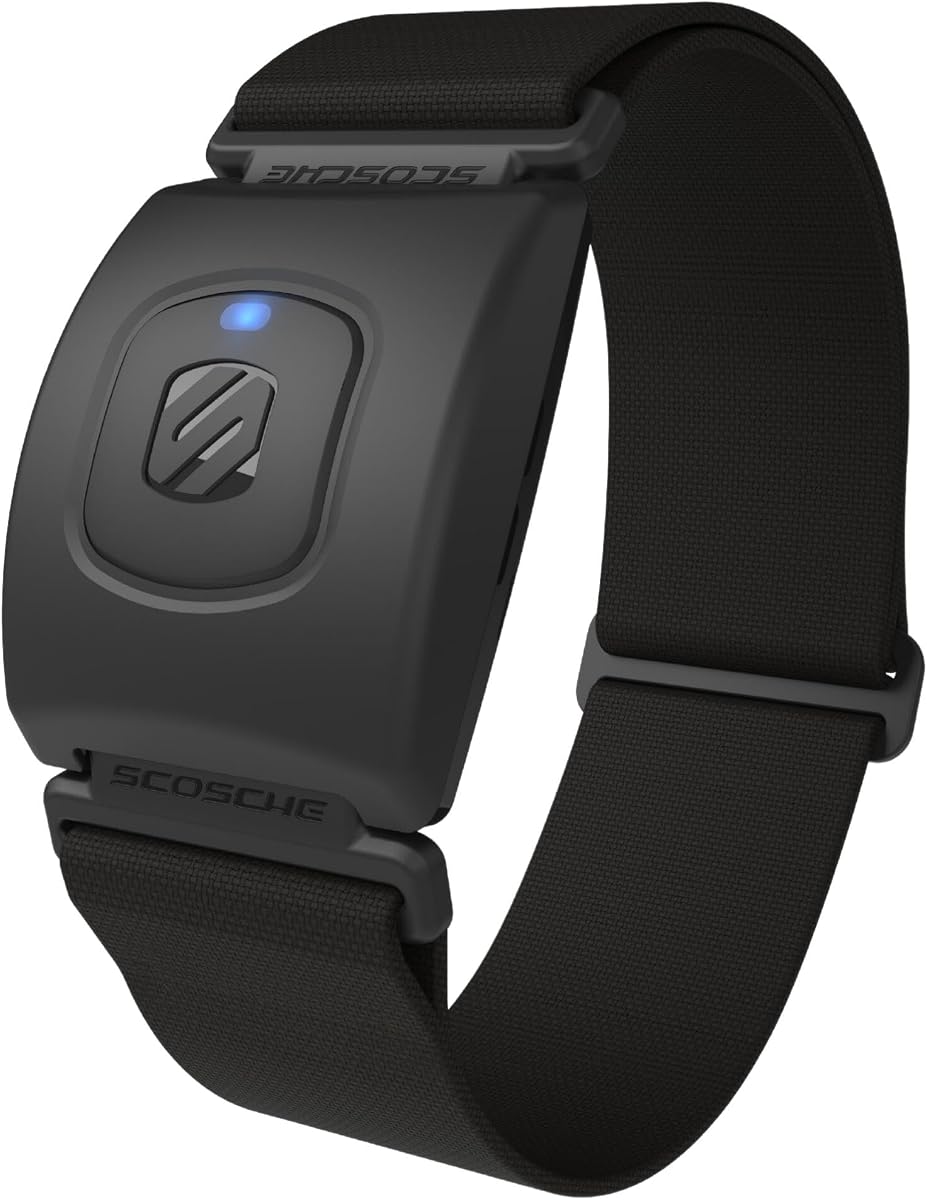
The Scosche Rhythm is rated 4.1 and is an optical armband designed for running, gym workouts, and indoor or outdoor cycling. It can be placed on the forearm, bicep, or tricep, offering more flexibility than a conventional upper-arm placement while avoiding a chest strap.
We may earn a commission when you buy through this link, at no additional cost to you.
Its HRV mode captures RR interval data and can stream that information to apps such as HRV4Training, Morpheus Training, and Welltory. This adds value for players who want to examine recovery, training response, sleep-related trends, or daily stress rather than only real-time heart rate.
Bluetooth and ANT+ support make it compatible with sports watches, connected equipment, Strava, Peloton, Wahoo, and other platforms. The lightweight, breathable band is rated IP68 for sweat and rain resistance, while the 24-hour continuous battery is shorter than the runtimes of many replaceable-battery straps.
The Scosche Rhythm is a strong choice for players who want both live exercise data and recovery-oriented HRV information without wearing a chest strap. It is also a sensible alternative for athletes who find chest straps uncomfortable, as long as they establish a secure, consistent sensor position.
RR interval streaming adds a more detailed recovery layer to standard heart rate tracking. It can help players connect intense pickleball sessions with subsequent training readiness when used with a compatible analysis app.
The adjustable band can sit on the forearm, bicep, or tricep, allowing players to find a comfortable and stable location. Consistent placement is essential for consistent optical readings.
We may earn a commission when you buy through this link, at no additional cost to you.
The best heart rate monitor for pickleball should combine a stable signal, comfortable fit, dependable connections, and enough endurance for regular play. The right balance of format, battery life, and data features depends on your watch, preferred apps, training habits, and tolerance for wearing different types of sensors.
A chest strap generally sits closest to the heart and is a common choice for players who want consistent readings during running, lateral movement, and repeated high-intensity rallies. It can be less comfortable in hot weather, may slip if fitted poorly, and usually requires moistening the electrodes before a session. An armband is easier to put on, often feels more casual, and avoids the chest entirely, but its optical signal can be affected by placement, arm movement, blood flow, and ambient conditions.
Choose a chest strap when measurement consistency and the broadest device support are the main priorities. Choose an armband when comfort, automatic wear detection, quick setup, and freedom of movement matter more than obtaining the most direct heart signal.
Wireless compatibility determines which watches, computers, equipment, and apps can receive the monitor's data. Bluetooth is common for phones, apps, fitness machines, and modern wearables, while ANT+ remains important for many dedicated sports watches and bike computers. Dual-mode sensors offer more flexibility, but the receiving device and app must still support the correct protocol. Some products also support multiple simultaneous connections, which can streamline transitions between a watch and another compatible device.
Check the exact watch, cycling computer, indoor trainer, and app you plan to use before purchasing. Dual-mode support is a useful safeguard, while Bluetooth-only armbands are best for players already committed to a compatible ecosystem.
Accuracy matters because a misleading reading can produce flawed zone and recovery conclusions. Chest straps are generally favored for direct beat detection, while optical armbands can still provide useful data when fitted correctly. Manufacturer accuracy claims are not the same as an independent laboratory test, so players should consider fit, electrode contact, motion, and device compatibility alongside the stated specification. A consistent reading is often more valuable than a theoretical claim that cannot be reproduced in normal conditions.
Prioritize a stable signal in the movements you actually perform. For rapid side-to-side play, use the recommended fit, keep chest electrodes adequately moistened, and place an optical armband where it remains secure without twisting.
Battery strategy influences how consistently a monitor will be ready for practice. Replaceable coin cells offer long uninterrupted runtimes and avoid cables, with some products advertising hundreds or even hundreds of thousands of hours under stated usage conditions. Rechargeable monitors are more convenient in the sense that many provide a full month or more of active use per charge, but they must be recharged and may need a compatible power source. Standalone sensors that record without a watch can also reduce dependence on another device's battery.
Choose a replaceable-battery model for low-maintenance training and travel. Choose a rechargeable model when quick recharging, onboard recording, or a more integrated device experience matters more. Always use the specified battery type and follow charging guidance.
Pickleball is played both indoors and outdoors, so sweat resistance matters even when rain is unlikely. A monitor with a suitable water rating can provide more confidence during humid sessions, wet courts, and competitive matches. The ratings are not interchangeable, and a product intended for rain or sweat may not be safe for swimming. The Polar H10 is described as fully waterproof, while several other options use IP67, IP68, or a three ATM rating. Some armbands also need protection from deep water even when their rating sounds impressive.
Match the rating to the environment rather than treating every water-resistance number as permission for every activity. For outdoor players, sweat and rain resistance are the key requirements; swimmers should follow the product-specific instructions.
A secure monitor produces a better experience and can improve signal consistency. Chest straps should fit snugly without restricting breathing, remain centered, and avoid riding up during quick stops and starts. Some use soft seamless fabric, while others offer silicone electrode areas and adjustable buckles. Armbands need enough tension to remain stable but should not create excessive pressure. Consider heat, sweat, skin sensitivity, and whether the device will conflict with clothing or protective equipment.
Try the available sizes or use the adjustment range to find a snug fit. For a chest strap, pay special attention to electrode contact. For an armband, establish one placement and use it consistently for cleaner workout-to-workout comparisons.
Basic real-time heart rate is useful, but some monitors also provide heart rate variability, calorie estimates, running dynamics, daily activity tracking, swim data, and heart rate zone guidance. These extras can help a pickleball athlete understand workload and recovery, although their usefulness depends on software support and the ability to export data. Standalone workout recording is especially valuable for court sessions because it allows the strap to capture a match without requiring a smartwatch. Zone lights and vibration alerts are convenient for interval drills.
Prioritize features you will use rather than selecting on feature count alone. HRV and recovery tracking can benefit serious training, while live zone prompts may be more useful for a player focused on match intensity and conditioning.
The receiving app determines how heart rate, calories, zones, and recovery information are displayed and stored. A long compatibility list is useful, but it should be treated as a starting point rather than a guarantee that every function works identically in every platform. Some products are optimized for their own ecosystem, while third-party sensors may pair with many apps but offer fewer advanced fields. Players who rely on a particular service should verify the monitor's protocol, work with the app, and confirm that required metrics such as HRV are exposed.
Use the app first, not the phone's raw Bluetooth menu, when the manufacturer instructs you to do so. This simple step can prevent pairing errors and ensure that the data reaches the correct training platform.
Begin by pairing the monitor through the app associated with your sports watch, bike computer, fitness equipment, or training service. Wear the chest strap before initiating pairing when the manufacturer requires it, and make sure the device is sufficiently charged or fitted with a fresh specified battery. For a chest strap, clean and lightly moisten the plastic electrode areas, fasten the buckle around the upper chest, and check that the sensor remains centered and snug. For an armband, place it in the recommended position and adjust the tension without restricting circulation.
Begin a short warm-up after connecting, then confirm that the device displays a live heart rate and that the app is recording the workout. During practice or a match, adjust the strap or band if it shifts, but avoid making frequent changes that may interrupt the signal. Use zone alerts, vibration prompts, or onboard recording according on your training priorities. If readings appear irregular, check device connections and sensor contact before assuming the product is faulty.
After the session, disconnect the sensor from the app when instructed, remove it, and dry the band or chest strap before storage. Do not soak models that are only intended for sweat or rain resistance. Clean compatible, machine-washable straps according to the manufacturer's directions, and replace chest straps when their contact surfaces become worn or the manufacturer recommends replacement. Keep coin-cell batteries on hand for replaceable-battery models and recharge cable-free devices before they are needed.
Chest straps are usually preferred when consistent readings are the priority because they detect the heartbeat more directly. Armbands are often more comfortable, easier to put on, and better for casual play, but optical accuracy can be affected by movement, fit, and placement. Players who train intensely or compare zones over time may favor a chest strap, while casual players may find an armband sufficient.
It depends on the monitor's wireless protocols and the specific device or app. Garmin products are designed for compatible Garmin smartwatches, cycling computers, equipment, and apps. Some third-party straps use Bluetooth and ANT+, but the receiving app may not support every metric. Verify the product's compatibility list and test pairing with the exact app before your first match.
Most chest straps stream data to a paired watch, computer, or app and do not independently record sessions. The Garmin HRM 600 is the notable exception in this list because it can record a workout and later sync heart rate and other metrics to Garmin Connect. Other devices may require a compatible watch during play, so check for standalone storage if that feature is important.
Moisten the plastic electrode areas, fasten the strap snugly below the chest, and ensure the sensor remains centered during movement. A poor fit, dry electrodes, sweat interference, and an unstable connection can all affect readings. If values seem erratic, reconnect through the relevant app and compare the reading with another trusted source before relying on it for training decisions.
Several options are designed to tolerate sweat, rain, or water exposure, including models with IP67, IP68, three ATM, or fully waterproof descriptions. However, those ratings do not make every model appropriate for swimming or soaking. Check the specific limitations, avoid submerging a monitor unless allowed, and dry the sensor and strap thoroughly after wet play.
Bluetooth is sufficient if your watch or training app uses Bluetooth and supports the monitor's data. It may not be enough if you also use ANT+-only bike computers, older sports watches, or compatible equipment that expects a different radio. The COROS Heart Rate Monitor is Bluetooth-only, while most chest straps in this guide support both protocols.
Replacement depends on wear, hygiene, and the manufacturer's guidance. The COOSPO H808S listing specifically recommends replacing the strap every six months or after roughly 300 washes, while other models may have different instructions. Replace it sooner if the electrodes become excessively worn, the fabric loses elasticity, or the sensor no longer maintains a secure and reliable contact.
Yes, when it is used to guide sensible training rather than treated as a medical diagnosis. Live heart rate, zone prompts, and recovery information can help players understand match intensity, balance hard sessions with recovery, and build aerobic capacity over time. Chest straps or well-fitted armbands can make those trends easier to observe, especially when the same device and app are used consistently.
The Garmin HRM 600 is the most complete option in this guide, combining real-time and HRV data, standalone recording, extensive training features, and a rechargeable battery lasting up to two months. The Polar H10 stands out for accuracy, broad wireless options, internal memory, and full waterproofing, while the COOSPO H6 delivers a practical budget mix of dual-mode connectivity and extensive app support.
For players already committed to Garmin, the HRM 200 is a simple, durable choice with a long replaceable-battery life. Those preferring an armband should consider the COROS model for automatic wear detection, the COOSPO HW9 for visible zone alerts, or the Scosche Rhythm for RR interval and HRV streaming. Verify protocol support, fit, battery needs, and receiving-app compatibility before buying.
Product listings, ratings, availability, and pricing can change, so check the current offer and full manufacturer instructions before making a final purchase. Choose a monitor that fits your watch or app, feels comfortable enough for repeated play, and provides the level of accuracy and recovery information that matches your training goals.