
FTTH Cold Connection Assembly Kit
4.5Editor score
Twelve-piece practical configuration
FC-6S single-fiber cleaver
Multi-wavelength optical power meter
Compatible VFL connector design
Our Fiber Optic Cable Repair Kit guide compares ten field-ready kits for testing, cleaning, stripping, cleaving, termination, portability, and value.
A fiber optic cable repair kit should make field service faster, cleaner, and more predictable. The right combination of testing, stripping, cleaving, cleaning, and termination tools can help technicians diagnose faults, prepare cables, and complete cold-connection repairs without assembling tools one at a time.
We compared all ten products using the supplied specifications, focusing on included equipment, supported fiber tasks, test capabilities, connector compatibility, storage, and suitability for FTTH, network, and maintenance work. The list includes comprehensive tool bags, focused termination kits, and one mechanical-splice option for rapid repairs.
Each review explains what the product is best equipped to handle, along with important limitations to consider before buying. Ratings reflect the supplied customer feedback, while specifications and features come from the product information. Product availability and prices can change, so check the current listing before making a final decision.
4.5Editor score

3.7Editor score

4.3Editor score
The following comparison highlights each kit's core functions, connector support, measurement capabilities, and intended field applications. It is designed to help readers distinguish full termination systems, economical maintenance sets, cleaner-focused tools, and quick mechanical repair connectors.


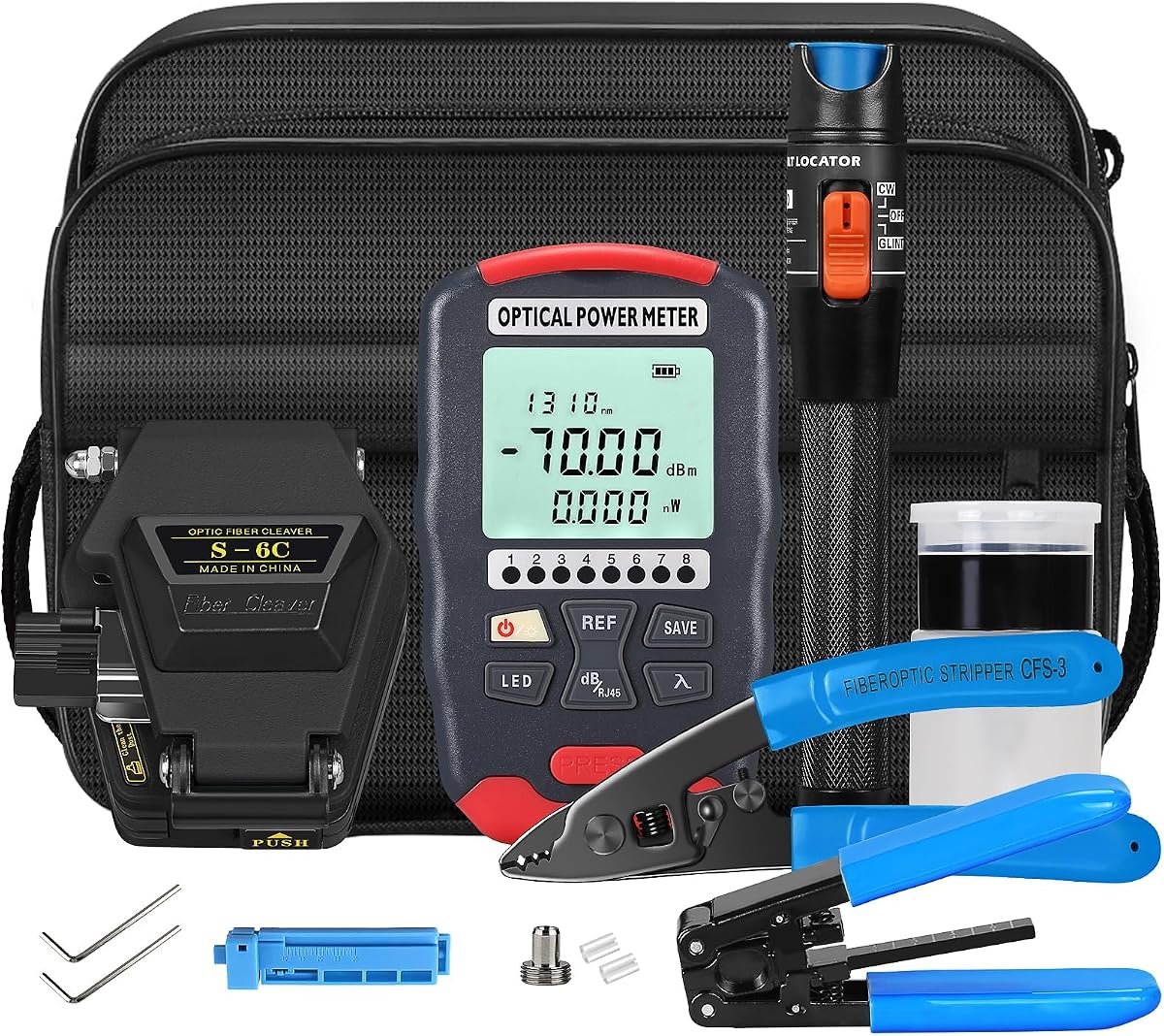
The FiberShack 12-piece kit is the broadest all-in-one option in this guide, combining a visual fault locator, optical power meter, FC-6S cleaver, three-hole stripper, Kevlar scissors, cleaning supplies, adapters, and ten SC/APC quick connectors. Its supplied customer rating is 3.7, but the product information supports a practical combination of tools for both diagnosis and cold-connection repair.
We may earn a commission when you buy through this link, at no additional cost to you.
Its standout strength is workflow coverage. The VFL and meter support fault finding and signal checks, while the cleaver, stripper, wipes, and connectors cover the preparation and assembly stages. A swiveling VFL head is designed to help maintain readings, and the included FC and SC adapters broaden compatibility with commonly used terminated fiber.
There are important trade-offs. The 3.7 rating is the lowest among the rated kits in this comparison, and the product information does not list the same range of supported wavelengths offered by several alternatives. Buyers who need a detailed specification for complex certification work may therefore want to compare the meter more carefully before committing.
Despite those limitations, this is a compelling choice for technicians who want one organized kit that spans cable inspection, preparation, cleaning, and reconnection. It is particularly relevant for FTTH repair and installation work where a compact collection of connectors, test tools, and preparation tools can reduce missing-equipment delays. For broad task coverage, it is our Editor's Choice.
Instead of separating diagnosis, stripping, cleaving, cleaning, and termination supplies, this package brings the core workflow into a single ripstop-nylon bag. That organization can be especially useful for mobile technicians moving between homes, buildings, or outdoor service locations.
The inclusion of ten SC/APC quick connectors gives the kit more direct repair utility than a collection containing only general-purpose fiber tools. It is a meaningful advantage when the job involves reconnecting a damaged drop rather than merely inspecting a link.
We may earn a commission when you buy through this link, at no additional cost to you.
This FTTH cold-connection kit is one of the strongest balanced choices in the guide, with a 4.5 supplied customer rating and an extensive set of field tools. It includes a visual fault locator, optical power meter, FC-6S cleaver, adapters, stripper, dust-free paper, and a carrying bag for common FTTH assembly tasks.
We may earn a commission when you buy through this link, at no additional cost to you.
The measuring capabilities are particularly useful. The optical power meter covers a stated range of minus 70 to plus 10 dBm and supports 850, 980, 1300, 1310, 1490, 1550, and 1625 nanometer wavelengths. The VFL uses a 2.5 mm universal connector arrangement compatible with ST, SC, and FC interfaces in circular and square forms.
The cleaver is designed for 250 to 900 micron coated single fibers and allows the adapter to be changed between mass and single-fiber cleaving. That flexibility makes it more broadly useful than a basic fixed-position cleaver, although it does not include every specialized preparation tool found in the most elaborate kits.
This is a good match for FTTH technicians, installers, and maintainers who need a capable general repair set without moving to a larger specialized system. Its combination of rating, measurement range, connector support, and manageable size makes it our Best Budget pick, provided cold-connection work is the intended application.
A wide measurement range and seven listed wavelengths let technicians perform more than a simple on-off continuity check. The VFL also supports both single-mode and multi-mode cable testing, helping users identify breaks and poor connections before making a termination.
The removable FC-6S adapter supports both mass and single-fiber cleaving for 250 to 900 micron coated fibers. This makes the kit practical for technicians who switch between different FTTH preparation routines.
We may earn a commission when you buy through this link, at no additional cost to you.
The 9-in-1 Fiber Optic Tool Kit is a polished, field-oriented package with a 4.3 supplied rating. It combines an FC-6S cleaver, optical power meter, visual fault locator, strippers, and other accessories in a shockproof zipper case, covering the basic stages of fiber splicing, testing, and maintenance.
We may earn a commission when you buy through this link, at no additional cost to you.
The product information emphasizes wear-resistant tools with ergonomic handles, which is useful for technicians working repeatedly in confined or outdoor environments. Its stated power-meter range of minus 70 to plus 10 dBm aligns with the needs of common field troubleshooting, while the VFL and meter provide complementary ways to inspect a link.
Compared with smaller 6C or 9-piece kits, this product focuses on a refined working case and an integrated tool presentation. However, its meter specifications are less detailed than those of the dedicated termination-and-cleaning kit, and the listing does not state a broad wavelength list or measurement-error figure.
It is best suited to professionals who want a professional-looking, portable termination package for FTTH construction, telecom maintenance, data-center cabling, and network installation. Among the three highest-ranked products, it provides the strongest emphasis on durable field organization, earning our Best Premium designation.
Wear-resistant construction and ergonomic handles reflect the demands of regular service work. The shockproof zipper bag also helps prevent small components from scattering while a technician is moving between sites.
The combination of VFL, meter, cleaver, and strippers allows a technician to move from fault detection into fiber preparation. That continuity makes the kit more suitable for complete service visits than a collection of testing devices alone.
We may earn a commission when you buy through this link, at no additional cost to you.
The 11-in-1 Termination Kit offers a broad FTTH assembly package and carries a 4.3 supplied rating. Its inventory includes an optical power meter, fiber optic cutter, stripping pliers, fixed-length device, clamp, FC-to-LC adapter, and a black handbag, giving technicians several useful accessories in one purchase.
We may earn a commission when you buy through this link, at no additional cost to you.
The cleaver's three-in-one holder supports 0.25 mm, 0.9 mm, and 3.0 mm fibers, which helps cover common preparation needs. The kit also includes both a three-hole fiber stripper and an FTTH drop-cable stripper, with rubber-coated handles intended to improve grip during repetitive work.
The optical meter has a stated minus 70 to plus 10 dBm range, a 2.5 mm universal interface, LED illumination, a backlight, a ten-minute automatic shutdown, and user self-calibration. Those features improve field usability, although the supplied information does not enumerate supported wavelengths or precision.
This kit is a sensible option for FTTH assemblers who need more than a meter and cleaver. It offers the richest piece count among the conventional tool bags here, but buyers seeking detailed optical-meter data may prefer the more fully documented cleaning and termination kit in position seven.
A three-position cleaver holder accommodates 0.25 mm, 0.9 mm, and 3.0 mm fiber. This versatility helps technicians keep more cable types within reach without carrying several separate cleaver fixtures.
The inclusion of a dedicated drop-cable stripper alongside the standard three-hole stripper reflects the needs of FTTH installation. A fixed-length device and clamp further support repeatable preparation work.
We may earn a commission when you buy through this link, at no additional cost to you.
The X5 Cold Welding Termination Kit is a compact FTTH set with a 4.0 supplied rating. It includes an X5 optical fiber cleaver, D7 optical power meter, stripping pliers, cleaning bottle, cleaning paper, a two-in-one fixed-length device, an FC-to-LC adapter, and a carrying bag.
We may earn a commission when you buy through this link, at no additional cost to you.
The X5 cleaver accepts bare fiber, pigtail, and other cable types with single-fiber sizes of 0.25, 0.9, and 3.0 mm. Its integrated fiber scrap collection box helps contain debris, while its compact construction supports mobile termination work. The optical meter and FC-to-LC adapter cover the core test and connection functions.
A notable convenience is the meter's three-in-one operation, which combines optical power measurement, RJ45 network testing, and LED illumination. That can save carrying a separate network tester, although users should remember that the meter requires two AAA batteries, which are not included.
This kit suits technicians who regularly perform both fiber and copper network checks and want one compact bag. It may be less attractive for users whose work requires extensive cleaning supplies, multiple connector types, or a meter with a documented wavelength list.
Combining optical measurement, RJ45 testing, and an LED light reduces the number of separate devices needed for mixed service work. The approach is especially convenient for field technicians who cover both fiber and conventional network connections.
The X5 cleaver is designed to be lightweight and portable, and its scrap collection box helps organize small fiber fragments. It supports several common fiber sizes, making it flexible for common FTTH termination routines.
We may earn a commission when you buy through this link, at no additional cost to you.
The FiberShack Fiber Optic Coupler Kit is a specialized alternative with the highest supplied customer rating in the guide at 4.7. Instead of providing a broad collection of tools, it focuses on 26 fiber adapters: eight ST, eight LC, five SC, and five SC/APC couplers.
We may earn a commission when you buy through this link, at no additional cost to you.
The press-and-click couplers are intended to join two cables for extension or create a temporary connection. Their variety makes the set useful for technicians who service buildings with mixed connector standards or need a compact supply of common inline adapters. The hard plastic snap-lock case provides organized, protected storage.
The product description states that the adapters are precision machined to help preserve fiber quality and minimize signal loss. It also positions the set as a complement to splicing or termination kits, making it best understood as an accessory package rather than a standalone repair station.
Choose this kit if your priority is having many common adapters on hand for extension, reconnection, or temporary coupling. It is not the right primary purchase for a technician who needs a cleaver, stripper, VFL, and optical power meter in one field bag.
ST, LC, SC, and SC/APC formats cover many common building and FTTH connection types. Keeping several types together can prevent a minor connector mismatch from interrupting a service call.
This set does not replace a termination or diagnostic kit. It complements one by adding a ready supply of couplers for cable extension and field connection tasks, all protected inside a durable snap-lock case.
We may earn a commission when you buy through this link, at no additional cost to you.
The Termination and Cleaning Kit is the most technically detailed option in this guide, with a 4.2 supplied rating. Its optical power meter supports ten wavelengths from 850 through 1650 nanometers, offers a minus 70 dBm to plus 10 dBm range, and lists measurement error below plus or minus 0.2 dB.
We may earn a commission when you buy through this link, at no additional cost to you.
The VFL is compatible with SC, FC, LC, and ST interfaces in circular and square connector shapes. Cleaning support includes 1.25 mm and 2.5 mm cleaner pens, a cleaning box, a cleaning core, liquid dispenser, swabs, and wipes for a wide range of ferrule formats, including LC, MU, SC, FC, ST, MTP, MPO, D4, and DIN.
The three-in-one cleaver supports 0.25 mm bare fiber and 0.9 mm pigtails, has 16 cutting positions, and uses a listed cutting angle of about 0.5 degree. The supplied information also gives an estimated cutting life of about 36,000 uses, which helps distinguish this package from less documented alternatives.
This is a strong pick for experienced technicians who value documented measurement details and a serious cleaning workflow. It is particularly appropriate where contamination can undermine termination quality. New users may find the number of tools and specifications more than they need, but for professional fiber work the detail is a major advantage.
Ten listed wavelengths, a broad dBm range, and a stated error below plus or minus 0.2 dB make this package attractive for users who compare instruments carefully. It also supports simultaneous linear mW and nonlinear dBm display according to the product information.
The broad cleaner assortment supports numerous connector types and both 1.25 mm and 2.5 mm formats. For high-quality terminations, removing dust and residue from ferrule end faces can be as important as achieving a clean fiber cut.
We may earn a commission when you buy through this link, at no additional cost to you.
The Fiber Optic Quick Connector is a five-pack of mechanical splices rather than a conventional tool bag. Its defining benefit is speed: because no fusion splicer is required, it is designed to restore FTTH drops, repair broken CCTV lines, or address emergency network outages in minutes.
We may earn a commission when you buy through this link, at no additional cost to you.
The listed insertion loss is no more than 0.3 dB, and the precision alignment accommodates 0.25 and 0.9 mm round bare fiber. The connectors are described as compatible with common single-mode and multi-mode fibers, which helps reduce field mismatch problems when the correct fiber type has been identified.
Environmental durability is another advantage. The listed operating range of minus 40 to 80 degrees Celsius suits outdoor cabinets, aerial closures, and other uncontrolled spaces. Its five-unit pack also offers a manageable number of connectors for immediate deployment rather than a large bulk inventory.
No customer rating is supplied for this product, so the selection should be based on its documented specifications and repair use case. It is best for technicians who need a fast mechanical restoration method and already own the necessary preparation tools. It does not replace a comprehensive repair kit.
A mechanical connection avoids the setup and operating requirements of a fusion splicer. That makes the five-pack useful for urgent work where restoring service quickly matters more than maintaining a large collection of general tools.
The stated temperature tolerance and protective housing suit outdoor closures and cabinets. These environmental details are particularly relevant for FTTH and CCTV infrastructure exposed to conditions beyond a climate-controlled workspace.
We may earn a commission when you buy through this link, at no additional cost to you.
The 6C Cold Connection Kit is a compact 10-in-1 FTTH termination package with a 4.1 supplied rating. It includes a D7 optical power meter, fiber cutting knife, stripper pliers, FC-to-LC adapter, RJ45 network-testing capability, and other accessories for fiber installation and cold connections.
We may earn a commission when you buy through this link, at no additional cost to you.
The cleaver uses a removable single-fiber adapter, allowing technicians to alternate its operating configuration as needed. The product information describes simple operation for removing or installing that adapter, which can reduce setup time when a technician changes between preparation methods.
Its lightweight, compact design is particularly attractive for mobile work and technicians who need to carry tools through homes, risers, or service cabinets. Optical measurement and RJ45 testing are combined, allowing a single instrument to serve both fiber-oriented and broader network service tasks.
This kit makes sense for installers who regularly perform cold connections and want a compact all-in-one bag. It has less documented cleaning coverage and no explicit wavelength list, so a technician conducting detailed optical certification should examine the alternative with more comprehensive meter and cleaner specifications.
The emphasis on lightweight, compact construction makes the kit easier to transport than a larger general-purpose set. That can be valuable for service calls where tools must be carried through confined spaces or between several nearby locations.
RJ45 network testing broadens the kit beyond optical work. It is a useful feature for FTTH technicians who also troubleshoot the Ethernet equipment connected at the customer premises.
We may earn a commission when you buy through this link, at no additional cost to you.
The S-6C Fiber Tool Kit is a streamlined 9-in-1 maintenance set with a 4.1 supplied rating. It combines the S-6C cleaver, D7 optical power meter, a fiber testing pen, wire stripper, peel pliers, and other accessories for fiber installation, maintenance, and troubleshooting.
We may earn a commission when you buy through this link, at no additional cost to you.
The meter's stated range is minus 70 to plus 10 dBm, with support from 850 to 1650 nanometers. A universal adapter accommodates SC, FC, and ST connectors, while the fiber testing pen is intended to help identify fractures, tight bends, and questionable connections quickly.
Two stripping tools cover different preparation tasks. One is described for removing 900-micron coatings, while the other handles 2 to 3 mm tightly buffered fibers and armored cable. That range makes the kit more versatile for field cable preparation than a set containing only a single stripper.
The supplied listing does not describe a large cleaning collection, multiple quick connectors, or a detailed accuracy figure, so this is a better streamlined maintenance choice than a full termination-and-cleaning station. It is well suited to technicians who need dependable fiber testing and preparation in a portable nine-piece bag.
Support across 850 to 1650 nanometers gives the meter broad applicability for common fiber work. The stated minus 70 to plus 10 dBm range also allows users to evaluate a wide span of optical signal levels.
Separate tools for 900-micron coatings and 2 to 3 mm buffered or armored fibers simplify preparation across different cable constructions. This is especially helpful for technicians who handle both indoor and outdoor-style access cables.
We may earn a commission when you buy through this link, at no additional cost to you.
The right kit depends on the repairs you perform, the connector systems you encounter, and the level of testing required. Review task coverage, measurement details, compatibility, and storage before choosing a package.
A full termination kit is the most versatile choice because it combines preparation, testing, cleaning, and connection tools. A focused coupler set is better when the goal is simply extending or joining prepared cables, while a mechanical splice pack is designed for rapid restoration without a fusion splicer. Consider whether your usual work is installation, maintenance, emergency repair, or CCTV connectivity.
A visual fault locator helps reveal breaks, bends, and poor connections, while an optical power meter quantifies signal strength. Look for a stated dBm range, supported wavelengths, connector interfaces, and whether the meter includes a VFL or separate LED tester. The most documented option here supports ten wavelengths and states an error below plus or minus 0.2 dB.
A cleaver should support the fiber diameters and cable styles you actually prepare. Look for 0.25, 0.9, and 3.0 mm compatibility, bare-fiber or pigtail support, and a collection box for fragments. Stripping tools should be appropriate for coatings, tight buffers, and armored or drop cables, with comfortable grips for repeated work.
The tools must be compatible with the connectors used on the links you service. Common interfaces include SC, FC, LC, and ST, with square and circular forms sometimes treated differently by VFL probes. An FC-to-LC adapter can bridge differences, but it does not automatically guarantee compatibility with every connector, cleaning tool, or adapter type.
A quality termination depends on clean fiber and clean connector end faces. Some kits include wipes, liquid dispensers, swabs, cleaner pens, and cassettes for numerous ferrule formats, while others provide only basic cleaning paper. Mechanical cold connections may also require connectors, adapters, or splice hardware that should be chosen for the specific fiber and enclosure.
Field technicians benefit from organized cases that protect tools and make missing accessories obvious. Ripstop nylon, shockproof zipper bags, and hard snap-lock cases each offer different levels of protection. Weight and compactness matter when carrying a full kit to residential, outdoor, or elevated work locations.
A testing pen can quickly indicate a likely break or bend, but an optical power meter provides quantitative loss information. If your work includes troubleshooting, link maintenance, or acceptance checks, prioritize a documented meter range, wavelength list, interface type, and accuracy. If the work is limited to simple visual fault detection, a smaller kit may be sufficient.
RJ45 testing can be valuable when a fiber job also involves conventional network equipment, while batteries, adapters, and replacement connectors can affect long-term use. Confirm whether batteries are included, which adapters come in the bag, and whether your workflow requires quick connectors or cleaning cartridges that are not part of the package.
Begin with a visual inspection of the cable, connectors, bend points, and nearby hardware. Identify the likely fault area and note the connector type before opening any kit. Use the VFL to check for visible light at appropriate points, while keeping active fiber work away from eyes and ensuring any powered source is handled according to local safety procedures.
Prepare the repair area and remove the dust and coating carefully. Use the appropriate stripper for the cable jacket, buffer, or coating, then clean the exposed fiber with suitable wipes or tools. Inspect the strand for damage, place it in the correct cleaver position, and make one controlled cut. Avoid bending, twisting, or touching the prepared end face unnecessarily.
After the cable is prepared, complete the appropriate mechanical, cold, or connector-based termination. Reconnect the fiber, inspect both connector end faces, and clean again if contamination is visible. Use the optical power meter to compare readings with expectations, document the results, and return each tool to its designated place in the case after cleaning and inspection.
A complete kit should normally include a visual fault locator, optical power meter, fiber cleaver, appropriate strippers, cleaning supplies, and a carrying case. Depending on the work, it may also include FC-to-LC adapters, quick connectors, mechanical splices, Kevlar scissors, or cleaning tools for specific connector formats. The ideal inventory matches the cable types and connections you regularly service.
Not always. Mechanical splices and cold-connection products can restore some links without a fusion splicer, making them useful for rapid service restoration. A fusion splice may still be preferred for certain permanent links because it can create a very precise joint. The appropriate method depends on the cable, connector, enclosure, and the service standard involved.
A visual fault locator shows where light appears or stops, helping locate breaks, bends, and faulty connections. An optical power meter quantifies optical signal level in dBm or mW. Using both provides a stronger workflow: the VFL helps locate the physical fault, while the meter confirms signal presence and helps assess connection quality.
A broadly useful cleaver should support 0.25 mm bare fiber, 0.9 mm pigtail or buffered fiber, and sometimes 3.0 mm cable. The kits in this guide vary, so verify the supported sizes against the fibers you prepare. Using the wrong fixture can produce an unsuitable cut and compromise the termination.
No, they are different connector systems with different physical interfaces and mating adapters. Some tools include a universal test adapter or an FC-to-LC adapter, but that does not mean every connector type works directly with every tool. Check the stated interface and obtain the correct adapter or connector before beginning a test or repair.
Dust, fingerprints, and residue on a ferrule or prepared fiber can scatter light and increase loss. Even a mechanically sound connection can perform poorly if its end face is contaminated. Cleaning pens, wipes, swabs, and cleaning paper help reduce the risk of transferring contamination during the final connection.
The FTTH Cold Connection Assembly Kit and the 9-in-1 Fiber Optic Tool Kit both cover diagnosis, preparation, and termination in portable formats. The first offers more detailed wavelength and connector information, while the second emphasizes durable field tools and organized storage. A technician performing detailed optical measurements may also consider the more extensively documented cleaning and termination kit.
Check the fiber sizes, connector interfaces, meter range, supported wavelengths, and included cleaning tools against your normal work. Also verify whether batteries, adapters, quick connectors, or mechanical splices are included. Finally, review the current product listing, customer feedback, and included pieces because accessories and availability can change.
The FiberShack 12-piece kit stands out for broad repair coverage, combining diagnostics, preparation, cleaning, and ten SC/APC quick connectors in a rugged bag. The FTTH Cold Connection Assembly Kit offers the strongest budget-oriented balance, while the 9-in-1 Fiber Optic Tool Kit provides a particularly polished portable package for field-oriented work.
Your priorities should depend on the job. Choose a comprehensive termination kit for routine installation, a detailed meter-and-cleaning system for precision work, a coupler collection for extensions, or mechanical quick connectors for urgent restoration. Confirm fiber diameter, connector format, test range, and missing consumables before purchasing.
Finally, check the current listing and product details before ordering. Customer ratings, included accessories, and prices can change over time, so the live Amazon page is the best source for current availability. Choose the kit that matches the repairs you actually perform rather than relying only on the number of included pieces.