WiFi Security Alarm System Kit
4.4Editor score
120dB wireless siren
Tuya app control
Door and motion sensors
Our Shed Alarm System guide compares ten wireless kits for loud sirens, WiFi alerts, weather resistance, easy installation, and reliable outbuilding security.
A shed alarm system can protect tools, lawn equipment, bicycles, and stored possessions while also discouraging entry at garages, workshops, gates, and other vulnerable outbuildings. The most useful systems combine dependable detection, an attention-grabbing siren, wireless installation, and simple controls that make arming the property part of a routine.
This guide compares ten alarm systems and single-sensor options using their stated detection methods, alarm output, connectivity, weather resistance, expansion options, controls, installation requirements, and included accessories. It covers WiFi-enabled kits, standalone motion alarms, door and window sensors, and compact systems designed for travel, rentals, homes, garages, and sheds.
The selections show that the best choice depends on the space being protected rather than on one universal feature set. Compact alarms suit a single doorway, while multi-sensor kits cover a larger property and support remote alerts. Ratings and specifications can change over time, so readers should confirm current product details and availability before purchasing.
4.4Editor score

5.0Editor score
5.0Editor score
The comparison below highlights the detection, connectivity, output, and coverage differences among ten alarm options for sheds, garages, homes, rentals, vehicles, and temporary accommodations.


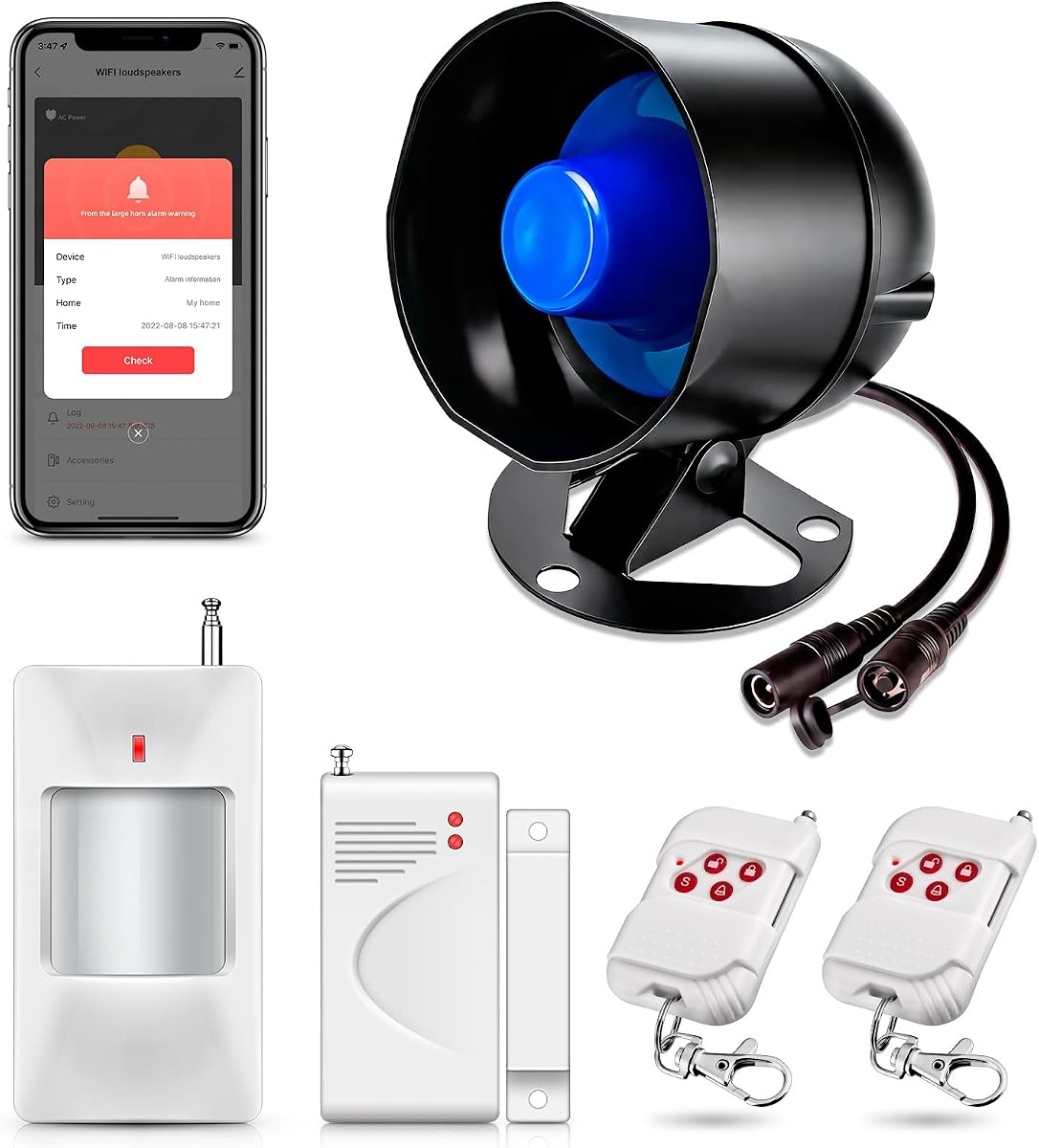
This six-piece WiFi alarm system offers an effective mix of entry detection, motion sensing, a 120dB siren, and app-based control. Its 4.4 rating reflects a solid balance of useful features for homeowners and shed owners who want more than a simple standalone contact alarm. The kit includes a door or window sensor, a motion sensor, two remotes, a WiFi speaker, and a power plug.
We may earn a commission when you buy through this link, at no additional cost to you.
The strongest feature is its flexibility. The hub connects through 2.4GHz WiFi and works with the Tuya app, allowing users to arm or disarm the system, receive trigger notifications, view sensor status, adjust alarm duration, and configure arming and disarming delays. The 120dB speaker is designed to produce an immediate warning, while the included detectors can be mounted with adhesive pads or screws.
This configuration is especially practical for a shed attached to a larger property because it does not need cable runs between the hub and sensors. Expansion support for as many as 30 wireless detectors and 20 remotes offers additional flexibility, although compatibility with another KERUI-style hub should be confirmed before purchase. The main compromises are dependence on compatible WiFi, a plug-powered siren, and a learning curve when naming and pairing multiple accessories.
The kit is best for buyers who want app control and a mixture of contact and motion detection without beginning with a large collection of sensors. It is particularly appropriate for a garage, workshop, storage shed, apartment, hotel, or small shop. Anyone wanting the strongest balance of coverage, control, and expansion in this roundup should start here.
The Tuya app turns the siren into more than a local alarm. Users can manage arming states, check whether monitored doors remain closed, customize timing, and receive phone notifications when a sensor is triggered.
Support for up to 30 wireless detectors makes the kit suitable for gradual expansion. A buyer can begin with the included sensors and add contact or motion units as additional doors, approaches, and outbuildings require monitoring.
We may earn a commission when you buy through this link, at no additional cost to you.
This SetD system combines a 120dB WiFi siren with four motion sensors, two remote controllers, and a power plug. It carries a 5.0 rating and is among the most complete configurations for monitoring a shed, garage, driveway, gate, or several approaches around a property. The focus is broad motion coverage rather than a mixture of door and motion detectors.
We may earn a commission when you buy through this link, at no additional cost to you.
Each sensor has a stated detection range of up to 26 feet, allowing the units to cover entrances, open areas, and exterior approaches. The siren is IP65-rated for resistance to dust and weather, making it better suited to damp or exposed locations than an indoor-only hub. Users can connect the system to home WiFi, arm or disarm it from a smartphone, receive real-time alerts, and give remotes to family members who do not use the app.
Its main limitation is that the package focuses on motion detection rather than including contact sensors for individual doors and windows. Expansion is still possible with compatible additional sensors, which are sold separately, so buyers should consider the cost and availability of future accessories when planning a large installation. The siren also needs an outlet, and WiFi-dependent features require a suitable 2.4GHz network.
This is a strong pick for a property with several exposed approaches or a larger shed area where motion is the main concern. It is less suited to a single doorway that would be better served by a contact alarm, but its four-sensor bundle and weather-resistant hub offer excellent coverage for sheds, garages, driveways, and outbuildings.
The IP65-rated speaker is a meaningful advantage for a shed alarm installed near an exterior door, gate, or garage opening. Its stated resistance to rain, heat, and cold suits locations where indoor-only equipment would be less practical.
Four motion sensors can cover separate approaches around a property. Strategic placement near the shed entrance, driveway, gate, and another vulnerable access point can produce broader protection than a single contact sensor.
We may earn a commission when you buy through this link, at no additional cost to you.
This standalone motion alarm is built for a single detection zone rather than a complete networked home. Its 4.0 rating reflects a straightforward product with a 125dB siren, strobe light, remote control, and stated infrared coverage of 16 to 26 feet. It can protect a shed entrance, garage, driveway, staircase, office, store, or other area where portable detection is useful.
We may earn a commission when you buy through this link, at no additional cost to you.
Installation is quick because the package includes adhesive film and screws. The unit supports two power arrangements, including three AAA batteries or a USB connection, so it can remain operational during an outage if batteries are installed. Two operating modes add flexibility: alarm mode acts as a security warning, while doorbell mode offers a gentler chime. The remote also includes a panic function.
The tradeoff is that this is not presented as a WiFi system with app notifications or broad smart-home integration. Its remote-control distance reaches 328 feet in an open area, but that figure does not guarantee performance through dense walls or across a complicated property. It also offers a one-year warranty rather than the multi-year coverage listed for some competing products.
Choose this option for a renter, traveler, camper, or shed owner who wants a compact alarm that can move between locations. It is also a sensible first layer of protection near a single high-risk entrance. Users who need remote phone alerts, multiple coordinated zones, or centralized control should choose a WiFi kit instead.
Alarm mode provides a loud deterrent, while doorbell mode offers a gentler notification for everyday movement. This makes the detector more adaptable than a strictly one-purpose alarm, particularly in occupied or frequently accessed spaces.
The ability to run from AAA batteries or USB power provides useful flexibility. It also means a temporary battery outage does not necessarily disable the alarm, provided the batteries have been installed correctly.
We may earn a commission when you buy through this link, at no additional cost to you.
This WiFi home security system is designed for users who want a single hub to coordinate motion sensors, door sensors, and other compatible wireless detectors. It has a 4.4 rating and a 120dB siren that can serve a shed, garage, home, apartment, or small commercial space. App-based control and trigger notifications distinguish it from simple local alarms.
We may earn a commission when you buy through this link, at no additional cost to you.
The siren hub connects to the Tuya app through 2.4GHz WiFi. Users can arm or disarm the system, configure delays and alarm duration, use timers, and check sensor states from their phones. Detectors can be positioned with adhesive pads or screws, avoiding the need to run wiring through walls. Compatibility with KERUI-style hubs and support for as many as 30 wireless detectors make the system attractive for a growing network.
The package description does not present the exact number of included sensors as clearly as some competing listings, so buyers should inspect the current box contents before ordering. As with the other WiFi systems in this guide, the hub depends on a compatible network, and the siren must remain connected to an outlet. These considerations make careful setup more important than for a fully self-contained battery alarm.
This is a good match for a garage or property where several entry types need to be monitored together. It is particularly suitable when phone access to the alarm status is important but running many individual alarms is inconvenient. The system offers strong expansion potential and is best for buyers who want a unified smart approach.
One app can show the status of connected doors and windows and provide alerts when a trigger occurs. Central management is convenient for a garage, detached workshop, and main house that otherwise require separate alarms.
Capacity for up to 30 wireless detectors supports a gradual build-out. Buyers should confirm that the sensors they intend to add are compatible with the hub before making future purchases.
We may earn a commission when you buy through this link, at no additional cost to you.
This system offers a balanced combination of a 120dB siren, motion detection, door or window contacts, remotes, and WiFi app management. Its 4.5 rating is among the stronger results in this roundup, while the absence of a stated indoor or outdoor restriction makes it a flexible option for a shed, garage, home, or shop.
We may earn a commission when you buy through this link, at no additional cost to you.
The siren hub integrates with the Tuya app over 2.4GHz WiFi. Users can arm and disarm the system, receive alerts when the included detectors trigger, check whether doors or windows are open, and adjust delays, timers, and alarm duration. Two remote controllers provide a convenient option for household members who do not want to use a smartphone for every arming action.
Installation is designed around wireless sensors that can be attached with adhesive pads or screws. This avoids wall damage and makes the system more attractive for rentals or temporary installations. The principal constraints are the same as those affecting other WiFi hubs: a compatible 2.4GHz network is needed, the siren requires a plug, and users must follow the pairing process carefully when adding accessories.
This kit is best for buyers who want a balanced detector package rather than either a single contact alarm or a large motion-only array. It works particularly well when a shed has both a vulnerable door and a wider approach area. For those needs, its mix of sensors, app control, and 120dB output is difficult to overlook.
Combining motion and contact sensors lets users monitor both an opening and the area around it. That balance is often more practical for a shed than relying exclusively on movement detection.
Configurable delays, duration, and timers can help the system fit different routines. These controls are valuable for properties where immediate alerts might otherwise create unnecessary alerts during normal entry.
We may earn a commission when you buy through this link, at no additional cost to you.
This compact contact alarm is designed for one door or window, with an IP66 housing, 113dB output, a remote control, and selectable alarm or doorbell modes. Its 4.1 rating reflects a specialized product that focuses on reliable opening detection rather than WiFi connectivity or whole-property coverage.
We may earn a commission when you buy through this link, at no additional cost to you.
The adjustable magnetic sensor accommodates gaps of up to 40 millimeters, which is useful for uneven frames, gates, garage doors, or sliding glass doors where a conventional contact sensor may not trigger reliably. Peel-and-stick mounting works on wood, metal, or glass, and the product is specified for operation from minus 40 to 70 degrees Celsius.
Its limitations are equally clear. It is a single-main-unit solution, so protecting a shed with several vulnerable openings requires multiple alarms or a larger kit. It has no stated smartphone integration, and the product information explicitly notes that it is not UL 2017 compliant. Users with a formal certification requirement should confirm whether that standard applies to their installation.
This alarm is best for a single shed door, RV or camper entry, apartment entrance, garage gate, or storage cabinet where a compact local warning is enough. It is especially useful when weather exposure makes an indoor-only contact alarm less suitable. Buyers seeking remote phone alerts or coordinated zones should choose one of the WiFi systems instead.
The alarm activates when the magnetic contact separates. Its wider gap tolerance reduces the chance that a loose or unevenly aligned door frame will prevent the sensor from responding.
Alarm mode supplies a loud anti-theft warning, while doorbell mode provides a gentler sound for routine monitoring. The included remote makes mode changes convenient without opening the main unit.
We may earn a commission when you buy through this link, at no additional cost to you.
This ten-piece system includes four door or window sensors, two motion sensors, two remotes, a WiFi siren, and a power plug. Its 4.0 rating makes it a practical choice for a shed complex, garage, home, hotel, or shop where both specific openings and broader approaches need to be watched.
We may earn a commission when you buy through this link, at no additional cost to you.
The 120dB siren provides a strong local deterrent, while the Tuya app supports arming, disarming, custom timing, and trigger notifications. Sensor status can be checked remotely, and the kit can expand to as many as 30 wireless detectors. Adhesive pads or screws provide mounting flexibility without running cables from the hub to each sensor.
The product does not state an IP rating for the siren in the supplied information, so it should not be assumed to have the same level of outdoor weather resistance as a system with a specific IP65 or IP66 designation. Users planning to place the hub in an exposed location should protect it from direct weather or install it in a sheltered position. App stability and notification delivery also depend on the local 2.4GHz network.
This kit is a strong option for a property with multiple shed doors, a detached garage, and a nearby access point. Its six included sensors offer meaningful coverage without requiring every accessory to be added separately. It is best for buyers who value a combination of contact and motion detection more than maximum single-sensor range.
Four contact sensors and two motion detectors can cover different vulnerabilities without relying on one detection method. This mix is practical for outbuildings with multiple entrances and an exposed perimeter.
Checking door status and receiving alert messages through the app helps owners verify an alarm event remotely. That convenience is especially helpful when the shed is away from the main living area.
We may earn a commission when you buy through this link, at no additional cost to you.
The TECKNET three-pack provides a straightforward way to monitor three doors, windows, cabinets, drawers, or gates. Its 4.6 rating is among the highest in the roundup, and the set is particularly useful for travelers, renters, families, and anyone seeking portable entry warnings without installing a networked hub.
We may earn a commission when you buy through this link, at no additional cost to you.
Each unit offers a two-in-one alarm and chime function with three volume levels. The magnetic sensor triggers when the separation exceeds 0.78 inches, while the LED gives a visual indication. Installation uses the attached sticker, with the sensor positioned close to the indicated arrow side for reliable operation. The mini size also makes each alarm easy to carry in a backpack.
Unlike the WiFi systems, these alarms do not provide stated smartphone notifications, remote arming, or coordinated zone management. They are local contact devices intended to make a sound when an entry point is opened. The product listing also specifies a 36-month warranty for registered units, providing a longer stated support period than several standalone alternatives.
This three-pack is best for securing several temporary or secondary openings, such as hotel doors, caravan entries, shed doors, apartment entrances, and storage cabinets. It is less appropriate for a property that needs broad motion awareness. For those needs, a multi-sensor WiFi system offers a more complete solution.
The adhesive installation and compact size make this set practical for temporary use. It does not require permanent modification of doors, windows, or frames, which benefits travelers and apartment residents.
Three separate alarms provide broader coverage than a single contact unit. They can be placed on a shed door, hotel room door, and travel storage area without requiring a shared hub.
We may earn a commission when you buy through this link, at no additional cost to you.
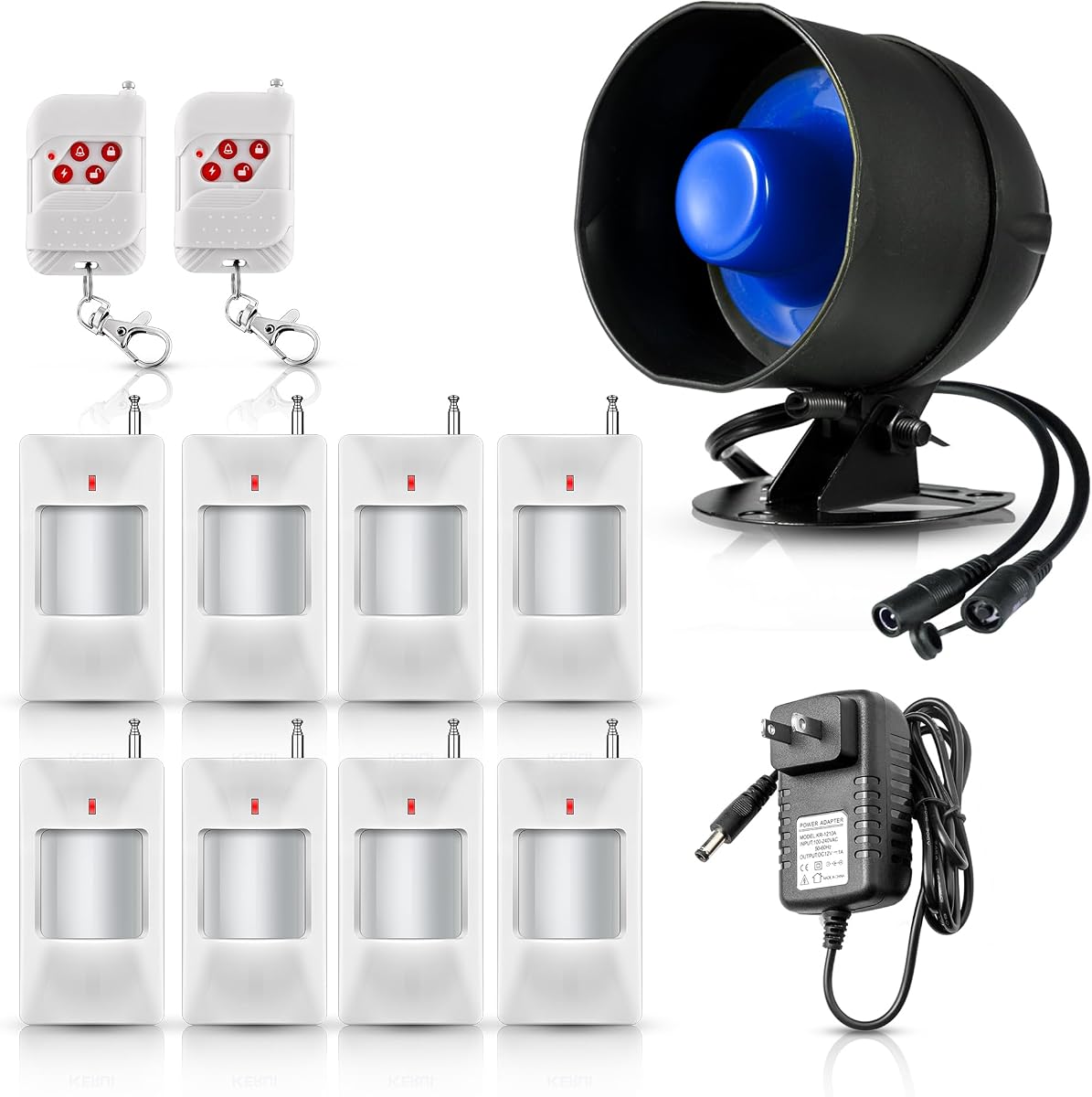
This 12-piece configuration is the most extensive included motion-sensor package in the roundup, combining eight motion detectors, two remotes, a WiFi siren, and a power plug. Its 5.0 rating and broad detector count make it a strong choice for a large property with several approaches to sheds, garages, gates, driveways, or workshops.
We may earn a commission when you buy through this link, at no additional cost to you.
The 120dB siren operates through the Tuya app on a 2.4GHz WiFi network. Owners can arm or disarm the system, receive notifications, adjust arming and disarming delays, set alarm duration, and use timers. The system supports up to 30 wireless detectors and 20 remote controls, offering substantial room for expansion beyond the eight included sensors.
The included sensors are motion detectors rather than door contacts, so coverage depends on detecting movement. Placement matters: a sensor should face an approach with a clear field of view and should not be positioned where normal activity creates frequent alerts. The hub is plug-powered and must be connected to a suitable WiFi source, and the product does not provide a specific IP rating in the supplied information despite describing the siren as weatherproof.
This kit is best for buyers who want extensive, centralized coverage across a larger property and can position eight sensors effectively. It is less suitable for a single shed door where a contact alarm would be more precise. For a multi-zone outdoor layout, however, it offers the most substantial included sensor array in the guide.
Eight included sensors can be distributed around a property to monitor separate approaches. This is particularly valuable when the shed is only one part of a larger garage, workshop, and storage area.
Programmable delays, duration, and timers help owners align alerts with daily routines. These controls also allow different parts of a property to be monitored without using several unrelated systems.
We may earn a commission when you buy through this link, at no additional cost to you.
This compact keypad alarm is designed for a single door or window and offers three operating modes: chime, instant, and delay. Its 3.3 rating is the lowest in this roundup, so it requires more careful consideration than the higher-rated WiFi kits and modern contact alarms. Its strengths lie in local control, wireless placement, and support for several operating behaviors.
We may earn a commission when you buy through this link, at no additional cost to you.
A magnetic contact triggers the system when the separation reaches at least one centimeter. Chime mode produces a repeated ding-dong sound, instant mode sounds an approximately 30-second siren, and delay mode provides a roughly 10-second warning before the siren. The password-protected keypad controls arming, disarming, and silencing.
The product is powered by three AA batteries, which are not included, and the listing recommends it for professional users. Its described operating instructions are dense and somewhat difficult for a first-time user to interpret. The unit measures 13.3 by 8 by 3.5 centimeters, and the listing allows a small manufacturing tolerance for those dimensions.
This alarm is best for a buyer who wants keypad-based local control without WiFi, phone notifications, or a large sensor network. It can suit a shed, garage, caravan, or window where a single magnetic contact is the priority. The mode flexibility helps, but careful setup and the need to supply batteries make it less convenient than several higher-rated alternatives.
Chime, instant, and delay modes cover entry warnings, immediate deterrence, and a short exit allowance. This flexibility is useful for properties where different openings or routines require different responses.
The keypad and magnetic contact do not require a smart-home network. That makes the system approachable for travel units and remote locations, although it also means it lacks the app visibility offered by connected kits.
We may earn a commission when you buy through this link, at no additional cost to you.
The right shed alarm depends on the openings, surrounding area, power access, and monitoring style that matter most. Comparing detection range, sound output, connectivity, weather resistance, and setup requirements prevents a purchase that is technically powerful but unsuitable for the location.
Contact alarms are best for a specific door, window, gate, or cabinet because they trigger when the magnetic parts separate. Motion sensors are better for open approaches, driveways, and areas where an intruder may enter without opening a monitored contact. A mixed kit provides the most adaptable coverage when a shed has both a vulnerable entrance and a wider approach. Consider what triggers an actual intrusion and choose that detection style first.
Coverage is determined by both detection range and placement. A stated 16–26-foot sensing range does not guarantee reliable detection through obstacles or across an entire property. Walk the intended area, identify sight lines, and note where people, vehicles, vegetation, or animals could move. Large properties may benefit from several sensors, while a single close-range detector can adequately cover a compact storage shed.
The products in this guide use outputs ranging from 113dB to 125dB, and several also include a strobe or gentle chime mode. Louder output can improve warning and deterrence, but placement also affects how much sound reaches the relevant area. A chimes-only mode can be useful for routine supervision, while an alarm mode is better for active intrusion deterrence. Check whether a mode can be changed easily.
Local alarms are simple, portable, and do not depend on a network. WiFi systems add smartphone arming, status checks, and trigger notifications, but require a compatible 2.4GHz network and careful pairing. Decide whether being able to check the shed from elsewhere is essential. If remote awareness is not important, a contact or standalone motion alarm can be less complicated and more portable.
A shed alarm may be installed near an exterior opening, yet not every unit has the same environmental protection. The IP66 contact alarm is specifically rated for dust and heavy rain, and the IP65 siren system is described as weatherproof. Other systems use the word weatherproof without providing a specific rating in the supplied information. Compare the stated standards and use a sheltered housing or location when necessary.
Some alarms are fully portable and run from AAA batteries, while WiFi hubs usually require an outlet and wireless sensors avoid hardwiring. Battery power supports remote and temporary installations but needs regular maintenance. Plug-powered sirens are convenient for a permanent shed and can offer louder output, though an outage may affect operation. Peel-and-stick mounting is convenient, but screws can provide greater security in exposed or high-impact areas.
A system that supports many detectors can grow as new gates, windows, and outbuildings are added. However, a stated capacity does not guarantee that every branded accessory will work together. Several kits mention compatibility with KERUI-style hubs, while the SetD system requires additional compatible sensors sold separately. Confirm the hub type, pairing process, and accessory compatibility before building a multi-zone system.
Remotes make arming and disarming faster for household members, children, or seniors who may not want to use a smartphone. Multiple remotes are especially useful in a home, hotel, or shared workshop, but every additional controller is another device that may need storage or battery care. Select a kit with enough remotes for regular users, while keeping a keypad or app as a backup method when available.
Begin by identifying every vulnerable opening and approach, then test each sensor before securing it permanently. Clean the mounting surface, position contact sensors according to the arrow or alignment instructions, and aim motion sensors across the expected path rather than directly at a wall. Pair the hub, sensors, and remotes, then perform a full arm-and-trigger test from outside the shed.
For a WiFi system, connect the siren to the appropriate 2.4GHz network, complete the app setup, and confirm that every sensor appears with the expected name and status. Set arming delays, alarm duration, and timers according to the way the property is used. For local alarms, choose the appropriate mode, fit the required batteries, and verify that both the audible and visual warning function as intended.
Test the system periodically and inspect sensors, adhesive pads, batteries, weather seals, and the siren outlet. Replace batteries before they fail, tighten loose fittings, and remove dirt or moisture that could interfere with the sensors. Recalibrate or reposition a motion unit if vegetation, stored objects, or changing shadows lead to unwanted activation. Keep the app, remotes, and installation instructions available for future troubleshooting.
A contact alarm is usually best when the main concern is one specific shed door, while a motion alarm works better for an open approach or driveway. A WiFi kit is ideal when the shed needs phone notifications, multiple sensors, and remote arming. The ideal choice depends on the number of openings, the area around the building, and whether the alarm must operate outdoors.
Local contact alarms, keypad alarms, and standalone motion sensors can operate without internet connectivity. WiFi systems need a compatible 2.4GHz network for app control and remote notifications, although their local siren operation may still be available after setup. Confirm the manual and current product details before relying on a connected alarm during an internet outage.
The systems reviewed range from 113dB to 125dB, with most WiFi sirens producing 120dB. Loudness alone does not guarantee that every person nearby will hear the alarm because walls, distance, and outdoor conditions affect sound. Placement near a vulnerable entrance and adding a second detection zone generally produces a more useful result than relying on output alone.
Yes, if the sensors are compatible with the hub and the system has enough wireless capacity. Several kits support as many as 30 detectors and 20 remotes, making them suitable for gradual expansion. Buyers should confirm compatibility, practical wireless range, and network coverage before installing sensors in distant buildings.
Most of the included systems use peel-and-stick mounting, while screws are often provided as an alternative. Setup usually involves pairing the hub and sensors, configuring the app or keypad, and testing each trigger. The main technical requirement for WiFi models is a compatible 2.4GHz network, while local systems require only the appropriate batteries.
They can, depending on the sensor's coverage and the direction of movement. Modern systems use infrared detection and intelligent analysis to distinguish some interference, but no outdoor motion detector is guaranteed to ignore every animal or vehicle. Aim sensors across a narrow approach, test them from different angles, and reposition them if normal activity repeatedly causes unwanted alerts.
The best location depends on the goal. An indoor siren is easier to power and may be protected from weather, while an exterior siren can produce a stronger visible and audible warning. If using an outdoor unit, verify its stated weather resistance and maintain a clear path for sound. Several WiFi kits use a plug-powered horn, which is convenient near a protected outlet.
Check that sensors still trigger the siren, inspect adhesive mounts, and replace batteries in battery-powered units at regular intervals. For outdoor systems, look for dirt, corrosion, loose covers, and water ingress around the mounting area. Review app status and notification delivery occasionally, and retest the system after moving equipment, changing the door frame, or altering the sensor's field of view.
The WiFi Security Alarm System Kit offers the strongest overall balance for a typical shed because it combines door and motion sensors, a 120dB siren, app control, and room for expansion. The SetD system stands out for four motion sensors and an IP65-rated siren, while the 12-piece kit provides the largest included motion-sensor set for extensive multi-zone monitoring.
Prioritize the detection method and environment before focusing on output or extra accessories. A single vulnerable door may need only a reliable contact alarm, while a larger property can benefit from several motion sensors and centralized WiFi management. Check network compatibility, power requirements, weather ratings, expansion support, and whether the included sensors match the actual layout of the property.
Finally, review current specifications, ratings, package contents, and availability before ordering, since listings can change over time. Test every detector after installation, maintain batteries and mounting points, and periodically confirm that the siren, remotes, app, and notifications continue to work as expected.