
DCP Quickmast Anchor E
4.7Editor score
Large dual-cartridge format
Fast-setting two-part epoxy
Compatible with standard applicators
Suitable for varied load classes
Our expert guide compares the 10 best chemical anchors for concrete, covering cure times, hole conditions, load use, applicator needs, and key specifications.
Chemical anchors for concrete bond threaded rods, rebar, and other fasteners inside drilled holes using resin rather than mechanical expansion. A strong installation depends on resin formulation, hole preparation, embedment, curing conditions, and the demands placed on the connection. The right product balances installation speed with dependable long-term performance.
The products in this guide were compared using their stated specifications, including resin type, cartridge format, working time, cure behavior, substrate compatibility, and included application hardware. The list includes single-cartridge epoxies, dual-cartridge systems, polyester adhesive, an internally threaded anchor, and a component designed for a Fischer chemical anchoring system.
Each review explains the product's strongest use case while also identifying important limitations or questions to ask before purchase. Ratings reflect the supplied customer feedback, and products without a listed rating are identified accordingly. Availability, seller information, and market pricing can change, so compare the current listing and technical documentation before ordering.
4.7Editor score

5.0Editor score

4.4Editor score
This side-by-side comparison organizes the ten products by format, installation speed, compatible base materials, and intended anchoring task. It also distinguishes complete adhesive systems from rods and filters that form part of a broader chemical anchoring system.
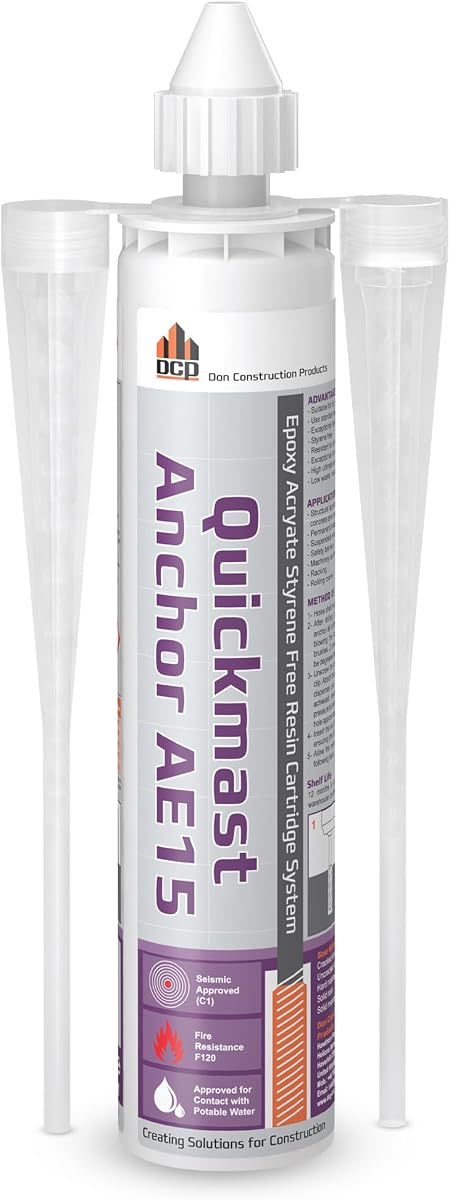





DCP Quickmast AE15 is a two-part acrylate epoxy cartridge designed to anchor rebar, threaded rods, and other fasteners in concrete and several masonry materials. It carries a 4.5 customer rating, making it a well-regarded general-purpose option. Its most useful combination of features is the ability to work in dry, wet, or flooded holes while still offering a relatively short working and curing cycle.
We may earn a commission when you buy through this link, at no additional cost to you.
The cartridge contains 10.1 fluid ounces and is described as compatible with a standard caulking gun, so it may appeal to installers who do not want to purchase specialized dispensing equipment. After injection, the stated working time is four to ten minutes, depending on conditions. Full load-bearing capacity can be reached in approximately 40 to 145 minutes depending on base-material temperature, making temperature management especially important when planning installation timing.
Its substrate flexibility is another strength. The listed applications include concrete, masonry, stone, and rock, with use in indoor and outdoor environments. That breadth does not mean every possible base or load is approved for every project, so the technical documentation and local engineering requirements should still be checked. Proper resin mixing and hole preparation are also essential when using a two-part chemical anchor.
This product is a strong choice for contractors, fabricators, and property maintenance teams that need a single cartridge to cover rebar, rod, and masonry anchoring work. It is especially attractive where holes may contain water and where a standard caulking gun is the preferred application method. Choose it when fast handling, environmental versatility, and straightforward dispensing matter more than having a larger cartridge or bundled applicator.
The stated ability to bond in dry, wet, and flooded concrete holes gives AE15 an advantage on unpredictable job sites. Its compatibility with masonry, stone, and rock also makes it more adaptable than a narrowly specialized concrete adhesive, provided the selected substrate is covered by the product documentation.
A short working time helps move through anchors efficiently, while the stated full-cure window ranges from 40 to 145 minutes. Installers should account for actual concrete temperature rather than assuming room-temperature conditions, and they should not load the connection before the published cure period has elapsed.
We may earn a commission when you buy through this link, at no additional cost to you.
The Fast Curing Construction Adhesive is a polyester-resin anchoring product with a 4.2 rating. It is designed for a simple installation sequence: drill and clean the hole, inject the adhesive, and insert the fastener before curing. Unlike mechanical anchors, it does not depend on expansion pressure, which can be useful where limited clearance or a nonstandard geometry is involved.
We may earn a commission when you buy through this link, at no additional cost to you.
The adhesive is listed for concrete, brick, stone, granite, and other solid base materials. It can also be used in hollow block, brick, or cavity walls when a mesh sleeve is inserted into the drilled hole. That distinction matters because the sleeve is not an optional stylistic accessory; the product description says to use it in hollow materials to support a reliable connection.
One convenience feature is the included extra mixing nozzle. That can be valuable when a static mixer becomes obstructed or when several independent holes are filled during one session. The stated fast-curing polyester formula is intended to reduce waiting time, but users still need to follow the instructions regarding injection, insertion, and load timing.
This adhesive is most appropriate for installers seeking a versatile resin system for several types of masonry and stone, particularly where solid substrates predominate. It may also suit hollow-wall work when the proper sleeve is used. The key trade-off is that it is not a universal drop-in answer for every cavity condition, and the 4.2 rating is somewhat lower than the strongest customer feedback in this list.
The mesh sleeve is the defining installation detail for hollow block, brick, or cavity walls. It allows the resin to form a mechanically supported key in the cavity rather than relying only on adhesion to a weak internal surface, so users should not skip it in hollow substrates.
The straightforward drill-clean-inject-insert process keeps the adhesive approachable for routine maintenance and installation work. The extra nozzle adds practical flexibility, although cure timing and correct resin placement remain essential to achieving the intended bond.
We may earn a commission when you buy through this link, at no additional cost to you.
Akona Fast-Setting Anchoring Epoxy is an 8.45-ounce epoxy tube for concrete floors, walls, driveways, stairs, anchor bolts, dowels, and rebar. Its 4.4 rating reflects generally favorable customer feedback. The central selling point is speed: the product sets in 12 minutes and is described as fully dry in 16 hours.
We may earn a commission when you buy through this link, at no additional cost to you.
The adhesive is moisture tolerant and resists chemicals and solvents, making it suitable for locations where moisture exposure could be a concern. It works in concrete and masonry, covers common project surfaces, and uses a caulk-style application tube. That format may make the product more approachable for smaller jobs, individual fasteners, and installers who prefer a simple tube over a larger cartridge system.
An important distinction is between setting and being ready for full structural load. The 12-minute set figure should not be interpreted as permission to apply the final load after the same short interval. The stated full-dry period is 16 hours, and any load, torque, or installation instructions supplied with the product should take precedence over general expectations.
This is an attractive option for routine concrete and masonry anchoring where fast handling and broad household or maintenance uses matter. It is less suited to a demanding engineered connection unless its technical approval and published performance data cover that specific application. For most users, it combines a useful cure profile, moisture tolerance, and a clean gray appearance in a convenient format.
The 12-minute set time can improve workflow when several anchors are installed in sequence. Since full drying is listed at 16 hours, plan loading around the longer cure stage and avoid confusing the initial set with final load capacity.
Moisture tolerance is useful for concrete holes that are damp or exposed to challenging service conditions. The stated resistance to chemicals and solvents also makes the epoxy more broadly relevant, although users should still confirm compatibility with any specific substance present at the installation site.
We may earn a commission when you buy through this link, at no additional cost to you.
The Fischer FIS A Anchor Rod M8 x 130 is a pack of ten M8-by-130-millimeter anchor rods associated with the Fischer FIS A chemical anchoring system. It has a 5.0 customer rating, the highest numeric score among the products with published feedback. Because the supplied listing does not include adhesive specifications, this should be understood as a rod component rather than a complete standalone chemical-anchor kit.
We may earn a commission when you buy through this link, at no additional cost to you.
Buying the rods as a matched set can simplify planning when several identical anchors are required. The M8 designation gives installers a clear thread size, while the 130-millimeter length helps determine hole depth and available embedment. A pack of ten also reduces the need to source each rod separately for repetitive installations.
The main limitation is that this product does not include the resin adhesive. A separate chemical anchor compatible with the Fischer system would be required, along with the appropriate mixing nozzle, hole preparation, and installation process. The absence of additional supplied specifications also means users should not infer load values, cure times, approvals, or base-material limits from the rod listing alone.
This pack is a strong choice for professionals already using the Fischer FIS A system and needing a supply of matching M8 rods. It is also potentially convenient for a larger installation that requires ten equal-length anchors. It is less suitable for a first-time buyer looking for a complete, ready-to-install chemical anchoring product, so confirm the full system and accessory requirements before ordering.
This package supplies the anchor rods, not the adhesive cartridge. Buyers should plan for a compatible Fischer FIS A resin, suitable mixing and dispensing equipment, and the correct installation accessories if those items are not already on hand.
Ten rods of one stated size are convenient for repeat connections where uniform M8 dimensions are valuable. The 130-millimeter length gives the installer a defined component for calculating hole depth, embedment, and projection, subject to the adhesive system's requirements.
We may earn a commission when you buy through this link, at no additional cost to you.
SIKA AnchorFix-2 is a professional-strength epoxy cartridge intended to anchor threaded bars in uncracked concrete, solid masonry, steel, and similar hard materials. The product has a 4.1 rating, the lowest published customer score in this group. Despite that, its careful cartridge design, broad base-material description, and drinking-water certification make it a serious option for specialized installations.
We may earn a commission when you buy through this link, at no additional cost to you.
The 10.1-fluid-ounce cartridge uses a static mixer and fits most applicator guns. Its narrow tip is designed to support accurate placement, while the fast-curing formula is intended to keep the bar in position and reduce the time required to complete the job. The product description emphasizes curing quickly, but it does not provide a specific numerical cure window, so the published instructions should govern actual loading time.
Another meaningful benefit is its certification for use in drinking water systems. The anchoring adhesive is described as free of styrene and solvents, which supports its suitability for sensitive applications. Proper preparation is still critical: the instructions call for cleaning drilled holes with a blow pump and bristle brush to remove dust and debris before applying the epoxy.
AnchorFix-2 is a good candidate for professional contractors and installers working with threaded bars in uncracked concrete or solid masonry, particularly where precise resin placement or drinking-water suitability is required. Buyers should not extend the uncracked-concrete statement to cracked or otherwise compromised substrates without confirming approval. Its 4.1 rating and limited supplied cure data warrant checking the current technical documentation and project requirements.
The narrow cartridge tip and included static mixer help installers place resin accurately in the prepared hole. Consistent dispensing and complete mixing are important in a chemical anchor, so the applicator setup should be checked before beginning a production run.
Drinking-water certification gives AnchorFix-2 a distinct advantage for potable-water applications. It is also listed for solid masonry, steel, and other hard materials, provided the particular base and installation conditions are covered by the relevant approvals.
We may earn a commission when you buy through this link, at no additional cost to you.
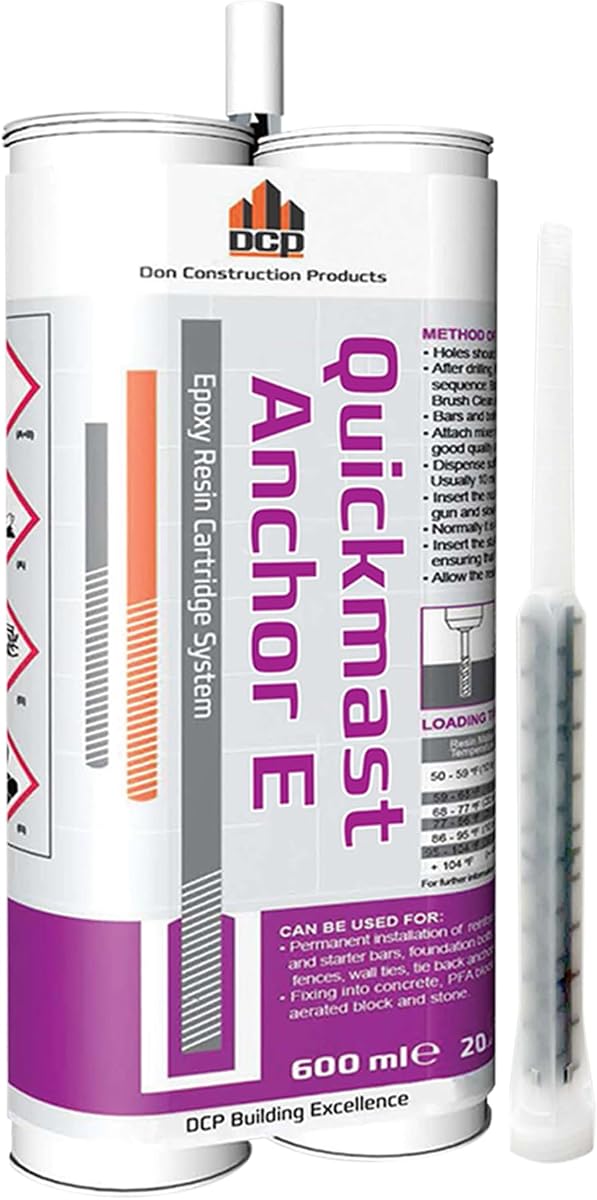
DCP Quickmast Anchor E is a 20.2-fluid-ounce, two-part, fast-setting epoxy system with a 4.7 customer rating. It is designed for rebar, threaded rods, crack repair, and fastenings ranging from handrails and safety fences to heavier applications such as railway tracks and ground anchors. Its dual-cartridge format favors installers who can use a standard applicator gun and need enough material for repeated anchors.
We may earn a commission when you buy through this link, at no additional cost to you.
After dispensing, the product provides a stated three-to-twenty-minute installation window. That range gives the user some flexibility compared with a very short gel window, but it still requires preparation before injecting resin. Full loading time is listed at three to 24 hours depending on the temperature of the base material, so users must distinguish the time available to insert the rod from the time required before the connection carries its final load.
The system bonds to concrete and steel and can be used in dry or damp concrete holes. It is described as compatible with standard dual-cartridge application equipment, which is helpful for contractors who already own that style of gun. The larger cartridge can also reduce the number of reloads during repetitive work, provided stored cartridges can be used within their own storage and material-life recommendations.
This is an excellent high-output choice for professional installation teams handling multiple anchors, mixed rebar and rod work, or load categories that require a robust two-part epoxy. The 4.7 rating supports its strong overall customer reception, while the temperature-dependent cure window is the principal point to plan. Confirm the required load design, substrate condition, and complete cure period before putting the connection into service.
A 20.2-fluid-ounce dual cartridge is well suited to production work involving multiple holes. Using standard dual-cartridge equipment keeps the setup familiar, and the material can cover both rebar and threaded-rod installations without changing adhesive systems.
The three-to-twenty-minute working time concerns installation, not final load readiness. Since full cure may take as long as 24 hours in cooler base conditions, schedule the work so the anchor remains unloaded until the specified period has passed.
We may earn a commission when you buy through this link, at no additional cost to you.
Quickmast E is a 20.2-fluid-ounce, two-part concrete anchor epoxy offered as a two-pack with an epoxy applicator gun. It has a 5.0 customer rating, placing it among the most well-reviewed items in the guide. The complete setup is particularly attractive to users who want the resin, cartridges, and dispensing tool in one coordinated package.
We may earn a commission when you buy through this link, at no additional cost to you.
The applicator is designed for a one-to-one mixing ratio and accommodates 20.2-fluid-ounce or 600-milliliter dual cartridges, as well as 22-fluid-ounce or 650-milliliter sizes. Its stated 25:1 thrust ratio is designed to produce smooth, accurate dispensing with less mess. Even a well-designed gun cannot replace correct technique, however, so users should purge the mixer and confirm uniform material before placing resin in a production hole.
The adhesive supports rebar and threaded rods in concrete and steel, and it can be used in dry or damp concrete holes. The description also gives a three-to-twenty-minute working window, allowing enough time to insert the anchor when preparation is organized. The package's two cartridges and included gun make it particularly practical for users planning several anchors or a substantial single project.
This is the most complete all-in-one option in the list and an especially strong recommendation for contractors who do not already own a suitable two-part gun. It is less rational for a one-hole household task because of the package's scale, and users must still observe working and curing limits. For repeated professional anchoring, however, the included equipment and 5.0 rating create a compelling package.
The included 25:1-thrust applicator is designed to meter and mix the two resin components through the cartridge system. Compatibility with common dual-cartridge sizes adds flexibility, while proper purging and consistent nozzle placement remain necessary for clean results.
Two 20.2-fluid-ounce cartridges support a meaningful amount of installation work and reduce equipment shopping. The package is particularly practical for users who plan multiple anchors, need both rebar and threaded-rod capability, or want to avoid relying on separate applicator components.
We may earn a commission when you buy through this link, at no additional cost to you.
The Internal Thread Epoxy Anchor is a zinc-plated steel anchor designed for epoxy installation in concrete. It has a 5/16-18 internal thread, a 2-3/4-inch overall length, and a specified 1/2-inch drill size. Unlike a conventional straight rod, its internally threaded body allows a machine screw or other matching fastener to be installed and potentially removed.
We may earn a commission when you buy through this link, at no additional cost to you.
The product is listed for theater and stadium seating, material handling, conveyor belts, machinery, and ductwork applications where vibration may be present. It is also described as better suited than mechanical anchors for close-edge or close-installation situations. The listed ultimate tension is 7,272 pounds in 4,000 PSI concrete, but the listing does not provide enough context to treat that as a general design value for every concrete condition.
Installation dimensions are clearly stated: a 1/2-inch drill hole, 2-3/4-inch minimum hole depth, 2-5/8-inch minimum embedment, and 3/4-inch thread depth. These dimensions should be followed exactly, and the manufacturer or supplier instructions should be consulted for resin selection, hole cleaning, cure time, and edge-spacing requirements. A steel anchor can still perform poorly if the adhesive is incompatible or improperly installed.
This anchor is a strong option when a removable, vibration-resistant, internally threaded connection is needed in concrete, especially around equipment or structural edges. It is less suitable for buyers who want a complete adhesive-and-fastener system, because the supplied information does not indicate that adhesive is included. No customer rating was provided, so the decision should rely on the detailed dimensions, intended applications, and project engineering requirements.
The internal thread allows a matching machine screw to be installed after the anchor cures, which can be advantageous when a component may need to be removed. The listed applications include conveyor belts, machinery, ductwork, and seating, where vibration resistance is valuable.
The specified drill, hole-depth, embedment, and thread measurements give installers clear targets for proper placement. Hole size, cleaning, resin filling, and insertion must be controlled carefully because dimensional accuracy alone cannot compensate for poor adhesive installation.
We may earn a commission when you buy through this link, at no additional cost to you.
The Fischer Reaction Filters RSB 12, Mini, 518822 is a specialized filter designed for use with a two-cartridge mortar anchoring system. It has a 4.4 customer rating. Rather than being a complete adhesive cartridge or a standalone mechanical anchor, it is an internal component that helps a compatible Fischer installation achieve a higher load level while dispensing resin from two cartridges.
We may earn a commission when you buy through this link, at no additional cost to you.
The filter is particularly suited to filled drilled holes and overhead mounting. Both features address practical installation challenges: resin must remain controlled during placement, and overhead work requires a system designed to retain material inside the hole as the fastener is inserted. Its lamination design is also described as economical for installation, because it can help reduce the number of attachment points required.
The product can be processed at temperatures down to minus 30 degrees Celsius, according to the supplied information. That makes it relevant for cold-weather work, but the complete resin system, cartridge conditioning, and installation instructions must support the same conditions. The filter should not be treated as independently responsible for bond performance because it works as part of a specified system.
This RSB 12 filter is best for trained installers already using the appropriate two-cartridge Fischer chemical anchoring system, especially for overhead or filled-hole applications. It is not the most convenient choice for a homeowner seeking a complete cartridge and nozzle. Confirm compatibility with the selected mortar, applicator gun, filter size, and fastener before ordering.
The RSB 12 Mini is intended to help control resin placement in filled holes and overhead installations. Those conditions make careful material retention critical, so the filter should be used only as part of the specified compatible system rather than improvised into an unrelated cartridge setup.
Processing capability down to minus 30 degrees Celsius is valuable for cold-weather installations. Users should verify that the chosen resin, cartridges, mixer, and installation procedure are approved for the actual site temperature and the material's required conditioning.
We may earn a commission when you buy through this link, at no additional cost to you.
PC Products PC-Concrete PRO is a two-component, professional-grade high-strength anchoring epoxy with a 4.3 rating. It is intended for anchoring threaded rod and reinforcing bar in cracked or uncracked concrete. That cracked-concrete capability is a major technical feature and distinguishes this system from many general-purpose resin adhesives whose applications are more narrowly stated.
We may earn a commission when you buy through this link, at no additional cost to you.
The product is listed as code compliant for bulk applications and associated with several building and engineering standards, including IAPMO UES ER-632, editions of the IBC and IRC from 2009 through 2018, Florida Building Code editions from 2014 and 2017, and ASTM C881-15 classifications. Those listings show broad code-related documentation, but a specific design still needs to satisfy the applicable local rules and the complete approval conditions.
PC-Concrete PRO may be used in dry, water-saturated, and water-filled conditions when installing threaded rod or rebar. It can also be placed in smooth bore holes without roughening the interior walls, reducing one preparation step. A high-thrust standard caulk gun can be used for the smaller cartridge, while a 600-milliliter dual-cartridge gun handles the dual format.
This epoxy is a strong choice for professional or engineered work involving cracked concrete, wet holes, rebar, or threaded rod and where documented code performance matters. The main trade-off is that a small job may not justify the equipment and procedural discipline required for a professional-grade system. Always confirm the exact approval, installation configuration, and design load relevant to the project.
Approval for cracked concrete is the standout technical feature of PC-Concrete PRO. It gives engineers and installers a documented option for applications where the base material may contain cracks, provided the design and installation remain within the listed approval conditions.
The system supports dry, water-saturated, and water-filled holes, making it useful where excavation or rainfall has left the opening wet. It can also be used in smooth bore holes without roughening the walls, which can simplify preparation while still requiring all other prescribed steps.
We may earn a commission when you buy through this link, at no additional cost to you.
Selecting a chemical anchor requires matching the resin and accessory system to the base material, fastener, installation environment, and load design. The most important details are compatibility, cure timing, approved hole preparation, and the applicator equipment available at the job site.
Epoxy, acrylate, and polyester resin adhesives have different working times, handling characteristics, temperature limits, and cured properties. A high-strength epoxy may be preferable for engineered or high-load connections, while a fast-curing polyester can be useful for routine maintenance. The choice should not be based on the word epoxy alone, because some listings use that term broadly. Read the technical data sheet and verify that the resin is approved for the intended base material, fastener, load direction, cracked or uncracked concrete condition, and service environment.
A complete chemical-anchor product usually combines adhesive, mixing components, and instructions, but some listings are individual rods, filters, or fasteners intended for a broader system. Internal-threaded anchors offer a different result from straight rebar or threaded rod because they accept a removable machine screw. A filter for a two-cartridge system may be essential for overhead work but is not a substitute for adhesive. Identify whether you need a complete installation product, a single anchoring component, or an entire coordinated system before comparing options.
Working time is the period available to insert or position the fastener after the resin is dispensed. Full cure time is the period before the anchor should be loaded or placed into service. These are different values, and the listings contain substantial variation. Some products set in minutes but require hours to become fully dry, while temperature can extend a stated cure window considerably. Plan installation around the actual base-material temperature and allow the complete curing period before applying torque, tension, vibration, or structural load.
Single-component caulk-style cartridges are convenient for smaller jobs and can often be used with familiar caulking guns. True two-part systems require a dual-cartridge applicator that meters and mixes the resin as it is dispensed. A bundled gun simplifies procurement and improves the chance of proper mixing, while an existing applicator can make a separate cartridge more economical for experienced users. Confirm cartridge volume, mixing ratio, mixer type, thrust requirements, and whether replacement nozzles or static mixers are available.
Concrete anchors are used in more conditions than the word concrete alone suggests. Some products are also approved for solid masonry, stone, rock, or steel, while hollow block and cavity walls may require a mesh sleeve or a specialized filter. Hole condition matters just as much: dry, damp, water-saturated, and water-filled holes are all listed in this market. Confirm that the product permits the actual condition and whether special placement, sleeve use, or overhead procedures are required.
Customer ratings and a high-strength description are not substitutes for a load design. Look for published tension values, approval listings, engineering reports, and code references, then confirm that the stated hole size, embedment, edge distance, spacing, concrete condition, and installation method match the intended design. Products such as PC-Concrete PRO list several code-related standards, while the internal-thread anchor supplies a tension value for 4,000 PSI concrete. Those details provide useful starting points, but the final connection should be evaluated for the actual installation.
Temperature, moisture, chemicals, and vibration can affect the resin, the base material, or the finished connection. Some products emphasize cold-temperature processing, chemical resistance, cracked-concrete use, or vibration-resistant anchor design. Others specify only dry or damp holes. Consider both installation conditions and long-term service exposure, and check whether the fastener and any sleeve or filter are also suitable for the environment.
Chemical anchoring depends on disciplined hole preparation, correct resin volume, complete mixing, proper insertion, and undisturbed curing. Hole diameter and depth are product-specific, and many instructions require removal of dust with a brush and compressed air or a blow pump. Some systems permit smooth bore holes, while others require roughening. Read the full instructions, understand which tools are mandatory, and avoid relying only on a quick product summary. Correct installation can matter as much as the chosen resin.
Start by confirming that the resin, anchor rod or fastener, base material, hole geometry, and applicator form an approved system. Drill the specified hole diameter and depth, then clean it using the methods required by the instructions. Remove drilling dust and debris completely, inspect the hole, and address any standing water or surface condition only as permitted by the product documentation. Do not substitute a different resin or omit a required mesh sleeve, filter, roughening step, or static mixer.
Set up the applicator correctly and verify the mixing ratio before dispensing into a production hole. Purge the mixer as directed, install a fresh static mixer or nozzle when required, and inject the resin while withdrawing the nozzle if the instructions call for that technique. Fill the hole consistently, insert the correct rod or fastener to the specified embedment, and ensure the fastener remains in position during the entire working and curing period. Remove excess cured or uncured resin only in the manner allowed by the instructions.
Treat the anchor as a curing assembly rather than an immediately loadable connection. Mark the installation if helpful, protect it from movement, and wait for the full cure time at the actual base-material temperature before applying service loads. Store cartridges and components according to the manufacturer's guidance, replace nozzles or mixers that become obstructed, and inspect installed anchors periodically for movement, cracking, corrosion, or other signs of distress. If an anchor is overloaded, damaged, or exposed to conditions outside its approval, have it assessed before reuse.
A chemical anchor uses resin to bond a threaded rod, rebar, or other insert inside a drilled hole. A mechanical anchor relies on mechanical features such as expansion to develop resistance in the concrete. Chemical anchors can be useful where expansion is undesirable, but they require careful hole preparation, resin placement, insertion, and curing.
Several products in this guide explicitly permit damp, water-saturated, or water-filled holes. DCP Quickmast AE15, DCP Quickmast Anchor E, Quickmast E, and PC-Concrete PRO list applicable wet-hole conditions. The instructions may require specific placement or curing procedures, so confirm the exact product and base condition before installation.
Wait until the product has reached its full cure time at the actual base-material temperature. Working or gel time is only the window for inserting the anchor, not the time at which it can carry full load. Some listed systems range from a few hours to 24 hours for complete cure, and cooler concrete can extend that period.
A proper dual-cartridge applicator is generally needed to meter and mix the two resin components consistently. Some products, such as Quickmast E, include a suitable gun, while DCP Quickmast Anchor E is designed for a standard dual-cartridge applicator. Check the mixing ratio, cartridge size, and applicator specifications before ordering.
Some products are approved for concrete, masonry, stone, rock, or steel, but approval is not automatically interchangeable. A hollow block or cavity wall may require a mesh sleeve, while a smooth bore hole may or may not require roughening. Always consult the technical data for the precise substrate and installation condition.
There is no single answer because performance depends on resin, embedment, concrete strength, edge distance, spacing, and installation quality. Some chemical systems offer advantages near edges or where expansion is undesirable, while mechanical anchors may be faster or easier in suitable conditions. Use approved design data for the specific application rather than comparing general labels.
An internal-threaded anchor is designed so a matching machine screw can be removed while the anchor remains embedded. The listed product uses a 5/16-18 thread. Removal should follow the manufacturer's procedure, and the remaining anchor should not be assumed to accept a different fastener without checking the dimensions and load rating.
A reaction filter is a specialized internal component that helps control resin flow and supports the system's installation method, particularly in filled holes or overhead applications. The Fischer RSB 12 Mini is designed to work with two mortar cartridges. It must be paired with compatible resin, applicator, and anchor components rather than used independently.
Quickmast E with its applicator stands out as the most complete high-output package in the guide, earning an Editor's Choice designation with a 5.0 customer rating. DCP Quickmast Anchor E is a strong alternative for professional users who already have compatible dual-cartridge equipment, while Akona Fast-Setting Epoxy offers a convenient option for routine anchoring and quicker project turnover.
Prioritize verified compatibility with the base material, hole condition, fastener, and intended load before comparing cure speed alone. For engineered work, examine approval listings, code information, embedment, and design constraints. For smaller jobs, cartridge size, applicator requirements, and storage may be more important. The specialist rod and filter products are best chosen by users who already understand the broader system they need.
Before ordering, verify the current listing, seller information, included components, technical documents, and market price. Formulations, packaging, approvals, and availability can change, and online information may not reflect the current version. A final check of the manufacturer or supplier instructions helps ensure that the selected chemical anchor is installed as intended and reaches the required cure before service.