
Gideal 20-Pack Dual-Sided Yellow Sticky Traps
4.2Editor score
Twenty double-sided trap cards
Includes ties and stands
Targets thrips and other flyers
Suitable indoors and outdoors
Discover the best thrips traps for plants by comparing capture area, adhesive design, durability, placement options, pest coverage, and pack size.
Thrips are small, agile pests that can damage flowers, vegetables, houseplants, and greenhouse crops. Effective thrips traps combine a visible or attractive surface with a dependable adhesive that captures insects on contact. The best choice depends on your growing space, infestation level, and preferred placement method.
This guide compares ten physical sticky traps based on features supplied by their manufacturers, including adhesive coverage, trap dimensions, hanging or staking options, weather resistance, and the range of plant pests each card targets. It covers compact options for individual pots as well as large monitoring sets for gardens and greenhouses.
Each review explains the strongest use case, practical advantages, and potential trade-offs. The top selections highlight budget-friendly bulk, versatile monitoring, and premium coverage, while prices and availability can change, so readers should confirm current listing details before purchasing.
4.2Editor score

4.1Editor score

4.4Editor score
The comparison below places all ten traps side by side, focusing on pack quantity, dimensions, mounting method, durability, and the plant pests each product is designed to catch.




The Catchmaster GRO Blue Regular Double Sided Sticky Traps earn an Editor's Choice position because they combine broad pest coverage with unusually flexible placement. With a 4.4 rating, this 72-card set is built for home plants, farms, gardens, hydroponics, and greenhouses. Its blue adhesive surfaces are designed to catch crawling plant pests, including thrips, without requiring chemical bait.
We may earn a commission when you buy through this link, at no additional cost to you.
A major strength is the product's range of mounting options. Cards can rest against walls, sit along pathways, be staked in soil, or be tied around plants and trees. The recommended three-zone strategy—beneath the canopy, within the middle, and above it—helps create a more useful vertical monitoring layout. Water resistance, UV resistance, and a potentially long service life make the traps suitable for changing indoor and outdoor conditions.
The trade-offs are modest for large-scale growers but meaningful for someone with only one houseplant. Seventy-two cards may be more than a small indoor collection needs, and effective capture still depends on placing each card where thrips travel. Since the traps are intended for use without fly bait, they should not be evaluated as if they contain an attractant; their performance comes from contact with the adhesive surface.
This is an excellent choice for gardeners, greenhouse operators, and indoor plant enthusiasts who want a dependable physical monitoring system with flexible placement. Choose it when coverage across multiple plant heights and a large selection of pest targets matter more than having the smallest possible pack.
The three-zone placement guidance is particularly useful because thrips and other plant pests can occupy different levels of a canopy. Spacing cards below, through, and above foliage creates a broader interception net than placing every trap at soil level.
The adhesive-only design avoids bait and is appropriate for growers who prefer physical pest monitoring. It also makes the traps suitable for use around homes where minimizing airborne pest-control chemicals is a priority.
We may earn a commission when you buy through this link, at no additional cost to you.
The Seabright HGSLTLT Sticky Thrip Leafminer Trap is a compact, plant-mounted option rated 4.1 stars. Its five-trap pack focuses on a broad range of flying insects, including thrips, aphids, whiteflies, leafhoppers, leafminers, and moths. That makes it more specialized for targeted thrips monitoring and less tied to a single pest species.
We may earn a commission when you buy through this link, at no additional cost to you.
The defining advantage is direct attachment. Each trap includes a wire twist that can secure the card to a plant or branch without the complexity of a separate stake or stand. Weatherproof construction supports outdoor use, and the sticky surface provides a physical interception point near foliage where flying pests are active.
Five traps are simply not enough for a broad garden or commercial greenhouse, so buyers with extensive planting areas may need several packs. Plant attachment also requires a suitable branch, stem, or support, and cards placed too tightly against foliage may collect dust or be harder to inspect.
This trap is best for houseplant owners, small gardens, or gardeners who want to monitor a limited number of plants closely. It is a sensible choice when simple hanging, broad insect coverage, and weather resistance are more important than a large monitoring inventory.
A five-card pack makes it practical to monitor several high-value plants without deploying a large grid of traps. Position each card near susceptible foliage and inspect it regularly for accumulated insects.
The included wire twist provides a straightforward way to hang the trap on a branch or plant support. Its weatherproof construction suits outdoor gardens where loose placement would be inconvenient.
We may earn a commission when you buy through this link, at no additional cost to you.
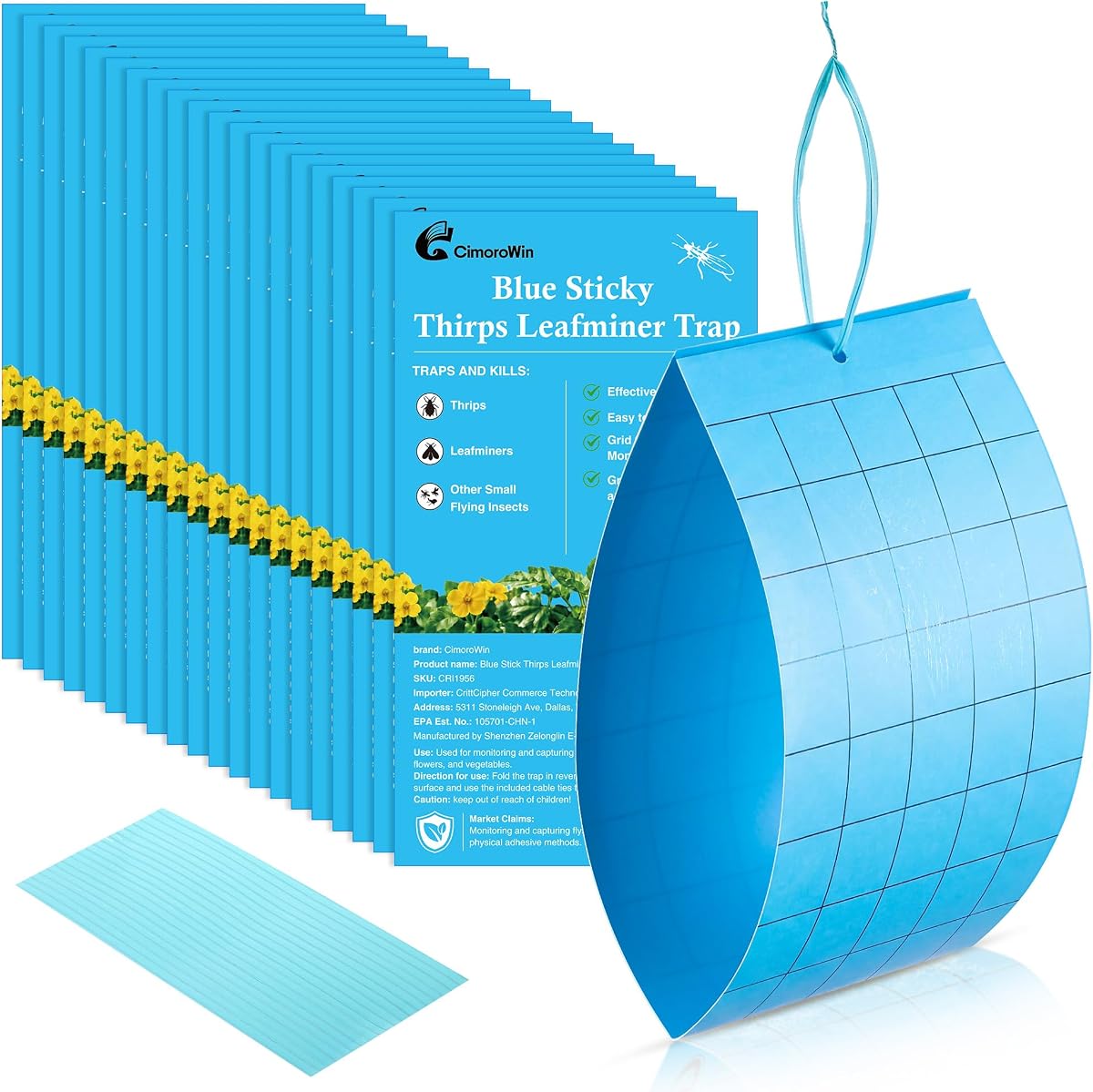
The 20 Pack Sticky Traps for Plants are designed for monitoring thrips, leafminers, and other small flying insects. Its distinguishing feature is the reverse-folding format, which reveals a 10 by 36 centimeter double-sided adhesive surface. Twenty metal twist ties make it possible to hang the folded cards near leaves, stems, or active growing areas.
We may earn a commission when you buy through this link, at no additional cost to you.
Built-in grid lines make this set particularly useful for structured monitoring. They help users identify and count insects on the adhesive surface, while also acting as cutting guides when smaller trap sizes are needed. The waterproof material is suitable for greenhouses, hydroponic systems, nurseries, flower beds, and outdoor gardens.
There is no customer rating for this listing, so its performance cannot be compared through the same volume of user feedback as the rated products. The long unfolded format also needs enough room to hang without folding onto surrounding foliage. Because no lure is included, the cards should be viewed as monitoring and interception surfaces rather than attract-and-trap devices.
This is a strong option for growers who value counting, customization, and a large adhesive area. It fits greenhouse and nursery workflows particularly well, while smaller-scale plant owners may find the narrower 20-card set more convenient.
The printed grid helps divide the sticky area into manageable sections for counting and inspection. This turns the trap into both a capture tool and a simple record of insect activity within a growing area.
Reversing the fold exposes a much larger adhesive surface than a compact card provides. Hanging the folded card allows growers to benefit from that coverage while keeping each unit relatively easy to position.
We may earn a commission when you buy through this link, at no additional cost to you.
The Qualirey 100 Pcs Blue Sticky Traps provide a large inventory of compact, double-sided monitoring cards. Rated 3.9 stars, the traps target thrips and other small flying insects, including leaf miners, aphids, black flies, and fungus gnats. The blue surface is specifically presented as especially effective for attracting thrips.
We may earn a commission when you buy through this link, at no additional cost to you.
Each card measures 7.87 by 3.9 inches, making it suitable for common four-to-six-inch flower pots. The narrow proportions also allow cards to fit around houseplants such as Monstera, fiddle-leaf figs, pothos, succulents, and roses without taking over the pot. One hundred twist ties are included, and the cards can be cut down for smaller containers without losing their stickiness.
The paper-based construction is a practical trade-off, and the 3.9 rating suggests that some buyers may have found aspects of the product less satisfactory. The traps should also be replaced when their surface is fully covered or dirty, rather than on an arbitrary schedule. Placement remains important because the cards do not actively draw thrips from throughout a room.
This set works well for plant owners who want frequent replacement options, multiple pots, or a comprehensive monitoring grid. Its main advantage is the combination of quantity, compact size, and customization, especially for indoor collections and small gardens.
The narrow card proportions make it easy to place a trap beside the foliage of a standard pot without obscuring the plant. This is especially useful when monitoring several indoor plants at once.
With one hundred cards and matching ties, the set supports a large monitoring program or routine replacement strategy. Compact cut-down sections can also be used in smaller pots and seedling areas.
We may earn a commission when you buy through this link, at no additional cost to you.
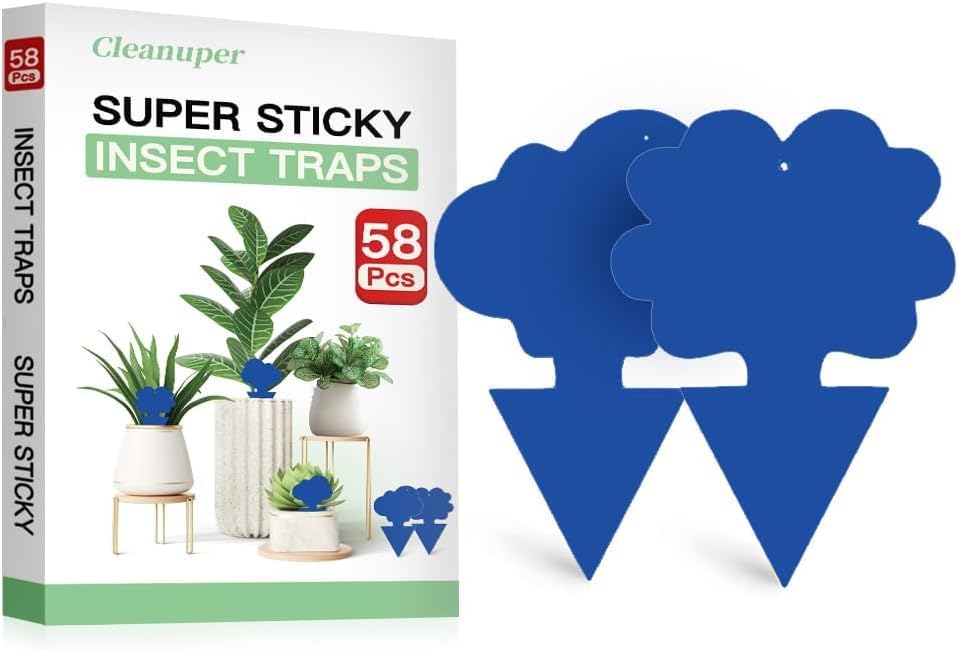
The 58 Pack Gnat Killer Sticky Traps combine pest monitoring with decorative flower and cloud shapes. The set receives a 4.5 rating and includes 29 cards of each shape. Its double-sided adhesive is designed to intercept fungus gnats, fruit flies, whiteflies, aphids, thrips, and midges upon contact without bait or batteries.
We may earn a commission when you buy through this link, at no additional cost to you.
Unlike cards that must be tied to a stake, these traps have pointed stakes for direct insertion into potting soil. That makes placement especially convenient in houseplant pots, kitchen herb containers, patios, and garden beds. The product information emphasizes removing both protective liners before insertion so the complete adhesive surface remains exposed.
The physical capture method is a clear limitation if growers expect an attractant to lure pests from a distance. The decorative shapes also prioritize appearance over maximum surface area, so a standard rectangular card may be better for extensive monitoring. Dense potting mix can make staking difficult unless the soil is moistened or a pilot hole is made first.
This set is ideal for houseplant enthusiasts who want pest-control cards that blend into a decorative plant arrangement. It also offers a convenient way to monitor multiple pots, provided the liners are removed correctly and the traps are positioned near affected stems and leaf undersides.
The blue flower and cloud shapes are intended to look more like decorative accessories than utilitarian pest cards. This makes the traps appealing on shelves, windowsills, and kitchen counters where conventional cards may be visually intrusive.
The integrated pointed stake eliminates the need to find a separate support. Moistening compact soil or making a small pilot hole can help keep the card upright through repeated watering.
We may earn a commission when you buy through this link, at no additional cost to you.
The 100 Pack Gnat Killer Sticky Traps are the high-volume version of the decorative flower-and-cloud trap set. Rated 4.5 stars, the package includes 50 flower-shaped cards and 50 cloud-shaped cards. Each uses a double-sided, odorless adhesive surface intended to catch fungus gnats, fruit flies, whiteflies, aphids, thrips, and midges.
We may earn a commission when you buy through this link, at no additional cost to you.
The integrated stake makes the traps practical for a wide range of growing environments, including potted plants, kitchen windowsills, patios, outdoor beds, and greenhouses. Waterproof and UV-resistant construction is intended to withstand rain, direct sunlight, and repeated watering. Both liner films should be removed before the card is inserted, preserving the full adhesive area.
A hundred cards may be excessive for a person with a handful of houseplants, although the quantity makes sense for large collections or repeated use. The product is a contact trap rather than a lure-based system, and the decorative design provides less adhesive area than some rectangular monitoring cards. Compact soil can also bend the pointed stake if it is forced.
This pack is a strong fit for plant lovers managing multiple pots or a broader indoor-outdoor garden. Its combination of generous quantity, simple installation, attractive styling, and broad pest coverage makes it particularly convenient for building a dense monitoring program.
Every card includes its own pointed support, which saves setup time when monitoring a large number of pots. The two decorative shapes also make it easy to distribute the set across different rooms or growing zones.
Waterproof and UV-resistant construction supports continued placement through rain and direct sun. Checking adhesion and cleanliness regularly remains important because trapped debris and foliage can reduce usable contact area.
We may earn a commission when you buy through this link, at no additional cost to you.
The Gideal 20-Pack Dual-Sided Yellow Sticky Traps are the best budget selection in this guide. The set receives a 4.2 rating and includes 20 yellow cards measuring 6 by 8 inches, 20 twist ties, and two trap stands. Its bright surface is intended to attract and capture thrips, whiteflies, fungus gnats, blackflies, fruit flies, midges, and other flying insects.
We may earn a commission when you buy through this link, at no additional cost to you.
The included mounting accessories provide more flexibility than a basic set of cards alone. Users can hang the traps with twist ties, place them on the two supplied stands, or position them in bright indoor or outdoor locations. Double-sided adhesive increases the usable capture area, while waterproof construction and resistance to temperature fluctuations help the cards remain functional in changing conditions.
Yellow traps are not as specifically targeted to thrips as the blue options in this roundup, although the product explicitly includes thrips among its target pests. Two stands are limited for a large installation, so additional supports may be needed for a dense grid. Like all contact traps, they work best where insect activity is concentrated.
This package offers an accessible balance of quantity, size, and mounting hardware. It is well suited to home growers who want to cover several plants or a small garden without purchasing a very large specialized monitoring program.
The package includes both ties and stands, so growers can move between hanging and freestanding placement. This makes the set practical for potted plants, windowsills, balconies, and outdoor beds.
The yellow cards are designed to attract a range of flying insects and can also act as an early warning system. Their 6-by-8-inch dimensions provide useful coverage without requiring very large mounting areas.
We may earn a commission when you buy through this link, at no additional cost to you.
The LFSYS 64 Pcs Yellow Sticky Fruit Fly Traps have the highest customer rating among the products listed here, at 4.6 stars. The set uses double-sided cards with a strong, chemical-free adhesive designed to capture insects on contact. It is suitable for gardens, kitchens, greenhouses, and potted plants.
We may earn a commission when you buy through this link, at no additional cost to you.
The straightforward installation method is the main convenience. Cards insert directly into soil, allowing them to stand beside affected plants without ties, hooks, or separate stands. Bright yellow coloring attracts a variety of flying insects, while the odorless, chemical-free adhesive is positioned as suitable around people and pets.
Despite its broad usefulness, the product is principally presented as a fruit-fly trap rather than a thrips specialist. It may still intercept thrips incidentally, but buyers focused on identifying thrips should consider the blue monitoring cards that explicitly emphasize thrips capture. The cooling recommendation for warmer weather is also worth following to make installation easier.
This set is an attractive choice for indoor fruit-fly monitoring and general garden use, especially for anyone who values a high customer rating and simple setup. It works particularly well where containers or garden beds make soil-staking more convenient than hanging.
Integrated insertion lets growers move a card directly into a pot or garden bed. This reduces setup time and keeps the trap upright near plant growth without additional accessories.
The chemical-free, odorless adhesive provides a contact-based alternative to sprays. It can be positioned in kitchens and living areas where minimizing odor and airborne products is important.
We may earn a commission when you buy through this link, at no additional cost to you.
The Fruit Fly Traps 100 Pack Yellow Sticky Traps offer a large supply of simple soil-mounted cards. Rated 4.4 stars, the set is designed for fungus gnats, fruit flies, and other plant flies in greenhouses, orchards, tea gardens, and backyard gardens. The cards use double-sided, thickened, odorless adhesive.
We may earn a commission when you buy through this link, at no additional cost to you.
Installation requires only two steps: uncover both protective liners and insert the trap into the soil. This makes the set convenient for houseplants and garden beds where many traps are needed. UV-resistant and waterproof materials are intended to preserve performance during outdoor exposure, and the instruction to replace cards only when fully covered helps avoid unnecessary waste.
The product is not marketed specifically around thrips, so it is a secondary option for that purpose. Its yellow surface and fruit-fly positioning may be less discriminating than the blue products that explicitly target thrips. As with other soil-staked designs, compact soil and repeated watering can affect stability, making careful placement important.
This pack is best for general flying-pest monitoring across a large number of plants. It is especially attractive to users who want an odorless physical trap, a substantial replacement inventory, and rapid soil installation without additional mounting hardware.
One hundred cards make it practical to create a consistent monitoring grid across numerous pots, beds, or greenhouse zones. The bulk quantity also supports replacement when cards become dirty or covered.
Thickened adhesive on both faces increases the chance of contact, while waterproof and UV-resistant materials suit changing outdoor conditions. Removing both liners is essential to preserve the advertised two-sided capture.
We may earn a commission when you buy through this link, at no additional cost to you.
The Qualirey 100 Pcs 6×8 Inch Blue Sticky Traps are a thrips-focused bulk set rated 4.1 stars. The blue surface is specifically presented as more effective for thrips than yellow alternatives, while the double-sided adhesive is designed to reduce escape opportunities for thrips and other small flying insects.
We may earn a commission when you buy through this link, at no additional cost to you.
One hundred cards offer enough inventory for a wide monitoring program. The 6-by-8-inch size is large enough for useful coverage but still fits a standard pot, and the sheets can be cut for succulents or seedling trays without weakening the adhesive at the cut edges. Twist ties allow placement on flower pots, grow-light stands, greenhouse benches, kitchen sinks, trash cans, garden trellises, and other suitable locations.
The cards are made from paper, so they are less substantial than rigid plastic traps and may be more easily damaged when exposed to rough handling or persistent weather. They should remain in place until the adhesive surface is fully covered, but heavily soiled traps should not be left in place indefinitely. Placement near active foliage remains more useful than random distribution.
This is the premium pick for growers who want a dedicated blue thrips-monitoring system backed by a large quantity and flexible mounting. It is particularly well suited to houseplant collections, rose gardens, greenhouses, and mixed vegetable plots where consistent, repeated coverage is valuable.
The blue surface gives this set a clearer pest focus than general-purpose yellow cards. It is a practical choice for rose gardens, houseplant collections, and crops where thrips are a known concern.
The included ties make it easy to place traps beside pots, on grow-light frames, across greenhouse benches, or near garden trellises. Cutting the cards provides additional flexibility for very small plants and seedling areas.
We may earn a commission when you buy through this link, at no additional cost to you.
The right thrips trap depends on where pests are active, how much area you need to monitor, and whether visual appearance, placement convenience, or precise insect counting matters most. These factors help narrow a broad range of sticky cards to a practical option for your plants.
Blue cards are the more explicitly thrips-focused options in this roundup. Both Qualirey sets state that the blue surface is more effective at attracting thrips than yellow, while the larger monitoring trap also uses blue to support thrips and leafminer observation. Yellow cards remain useful for a broader mix of flying plant pests, including thrips, whiteflies, aphids, fungus gnats, fruit flies, and midges.
Choose blue when thrips are the main concern and you want a more targeted monitoring surface. Choose yellow when your garden has several flying-pest problems or when yellow better fits the plant area and existing monitoring setup.
Double-sided traps provide more interception opportunity than single-sided cards, and a larger surface can be useful in dense foliage. The 20 Pack Blue Monitoring Traps open into a 10 by 36 centimeter surface, while most other products use compact 6-by-8-inch or similarly manageable cards. Larger cards require more room to position and may be easier to fold against leaves.
Prioritize enough exposed adhesive to cover likely flight paths without trapping foliage. Small cards suit pots and seedling trays; large or foldable surfaces suit greenhouse rows and broader monitoring programs.
Staked cards are inserted directly into soil, making them quick to deploy around houseplants and garden beds. Hanging options include twist ties, wire twists, or included stands and are useful when soil placement is impractical. Some products bundle both types of hardware, allowing traps to be moved as plant growth and pest activity change.
Consider the location before choosing. Soil stakes work well in containers and beds, while hanging cards are better for branches, trellises, grow-light stands, or greenhouse benches. Whichever method you select, avoid pressing adhesive surfaces against damp leaves.
Pack sizes range from five traps to one hundred, and the right quantity depends on the number of plants and monitoring density. Small packs suit a handful of houseplants, while bulk sets make it easier to establish a consistent grid and replace cards when they become dirty or covered. Larger inventories also require a plan for storage and organized placement.
Estimate one trap per monitored plant or plant zone as a starting point, then add more when multiple canopy levels need coverage. Avoid buying a huge pack for a small collection simply because a lower unit cost looks appealing.
Waterproof and UV-resistant materials are valuable for outdoor gardens, balconies, and greenhouses where cards encounter rain and direct sunlight. The Catchmaster set, both Gnat Killer sets, Gideal traps, and the 100-pack fruit-fly traps are specifically described as weather resistant or waterproof. Paper-based Qualirey cards also state that they will not melt in sunlight, lose stickiness in rain, or crack under grow lights.
For outdoor use, choose cards intended for weather exposure and inspect them often. Dirt, water, foliage, and trapped insects can all reduce usable adhesive area, regardless of the stated material durability.
The most thrips-specific products mention thrips first and are suitable for rose gardens, houseplants, flowering plants, greenhouses, and vegetable gardens. General-purpose yellow cards catch a wider range of flying insects and can be useful where thrips coexist with whiteflies, aphids, gnats, fruit flies, or midges. The Seabright set adds leafhoppers, leafminers, and moths to its target list.
Match the stated targets to the pest you have actually identified. A broad-spectrum card may support general monitoring, but a dedicated thrips card can make inspections and management decisions more focused.
Thrips traps are not only catchers; they can help growers estimate pest pressure and determine whether an infestation is persisting. Printed grid lines on the 20 Pack Blue Monitoring Traps make counting easier and provide cutting guides. Several Qualirey sheets can also be cut into smaller pieces for compact pots without reducing stickiness along the cut edges.
Choose a grid-marked option when precise monitoring matters. Standard cards remain adequate for general interception, while customization is helpful for seed trays, succulents, and densely planted containers.
Pest-control equipment is often placed where people can see it, particularly on indoor shelves and kitchen counters. The blue flower and cloud designs offer a more decorative alternative to plain rectangular cards. If appearance is a priority, choose the decorative set; if maximum adhesive coverage is the priority, a conventional rectangular or foldable card is usually more practical.
Check that traps are positioned out of reach of children and pets whenever possible, even when the adhesive is described as odorless or family friendly. Physical trapping does not make careless placement appropriate.
Start by identifying where thrips are most active. Inspect leaf undersides, flower petals, tender growth, and places where leaves touch. Place traps close to these areas, but leave enough space for the adhesive surface to remain exposed. For outdoor plants, a useful arrangement includes traps beneath, within, and above the canopy so the monitoring pattern covers several flight and movement levels.
Prepare each trap according to its design. Remove every protective liner from double-sided cards before hanging or staking them. For soil-staked traps, water compact soil slightly or create a small pilot hole rather than forcing the stake into the mix. Use twist ties, wire twists, or included stands for hanging products, and position them near foliage without allowing leaves to stick directly to the glue.
Inspect traps regularly and replace them when the adhesive becomes covered, dirty, wet, or difficult to use. Store unused traps in a clean, dry place, and follow the listed care guidance for the chosen product. Thrips traps can support an integrated pest-management plan, but they should be combined with proper plant identification, sanitation, habitat inspection, and other appropriate controls when an infestation is established.
The blue products in this guide explicitly emphasize their effectiveness for thrips, so they are a focused choice when thrips are the primary concern. Yellow traps remain useful for monitoring a broader range of flying pests, including thrips, aphids, whiteflies, fungus gnats, and fruit flies. The best color depends on the pests present, placement, and the monitoring system you already use.
These are physical sticky traps designed to trap and hold small insects that contact the adhesive. They do not use bait, sprays, electricity, or systemic ingredients, and effectiveness depends heavily on placement near active plant growth. A good monitoring program can capture thrips, while a severe infestation may also require additional appropriate management steps.
A useful starting point is one trap near each affected plant or group of plants, with extra traps where foliage is dense or pest activity is concentrated. Larger gardens and greenhouses benefit from a distributed grid covering multiple canopy levels. Very small collections may need only a few cards, while bulk packs are better suited to widespread monitoring and regular replacement.
Place traps near stems, tender growth, flowers, and leaf undersides, where thrips are commonly found. Avoid pressing foliage onto the adhesive, and position the card where it will not be knocked over or obscured by watering. If possible, use a separate card for each plant and rotate its position as growth changes.
The Qualirey products specifically state that cutting does not reduce stickiness, and the 20 Pack Blue Monitoring Traps include grid lines that serve as cutting guides. Cut only the product whose instructions permit modification, and avoid cutting through an active adhesive area in a way that causes sections to fold together.
Several products use odorless adhesives, and the Catchmaster description states that consuming the glue is not recommended but is not harmful to people or pets. Even so, traps should be positioned out of reach and handled carefully. Physical trapping avoids releasing an airborne chemical, but it does not justify leaving adhesive within reach of curious children or animals.
Replace a trap when its adhesive surface becomes fully covered, dirty, wet, or otherwise no longer usable. In active infestations, check cards frequently because small traps can fill quickly. Several products state that they may remain effective for up to one year when the surface stays clean, but environmental conditions and pest pressure will vary.
Every product in this guide is suitable for indoor use, and all list outdoor applications such as gardens, patios, balconies, greenhouses, or nurseries. Outdoor cards should be chosen for waterproof and UV-resistant construction, then checked often because rain, direct sunlight, dust, and plant debris can shorten their effective service life.
The three standout options serve different needs. Gideal's 20-pack is the best budget choice because it combines double-sided cards, useful dimensions, twist ties, and stands. Qualirey's 6-by-8-inch blue set is the Editor's Choice for dedicated thrips monitoring and broad placement options, while Catchmaster's 72-card system takes the Best Premium position for flexible multi-zone use across home, farm, and greenhouse environments.
Prioritize the features that match your growing conditions: choose blue for a focused thrips program, yellow for broader flying-pest monitoring, stakes for fast soil placement, and ties or wire for hanging. Also consider adhesive area, pack quantity, weather resistance, and whether the layout can cover multiple canopy heights without wasting cards.
Before ordering, confirm the current listing details, package contents, and current pricing, since availability and prices can change. The right trap is the one you can place accurately, inspect regularly, and replace at the right time; those habits matter as much as the color or package size.