
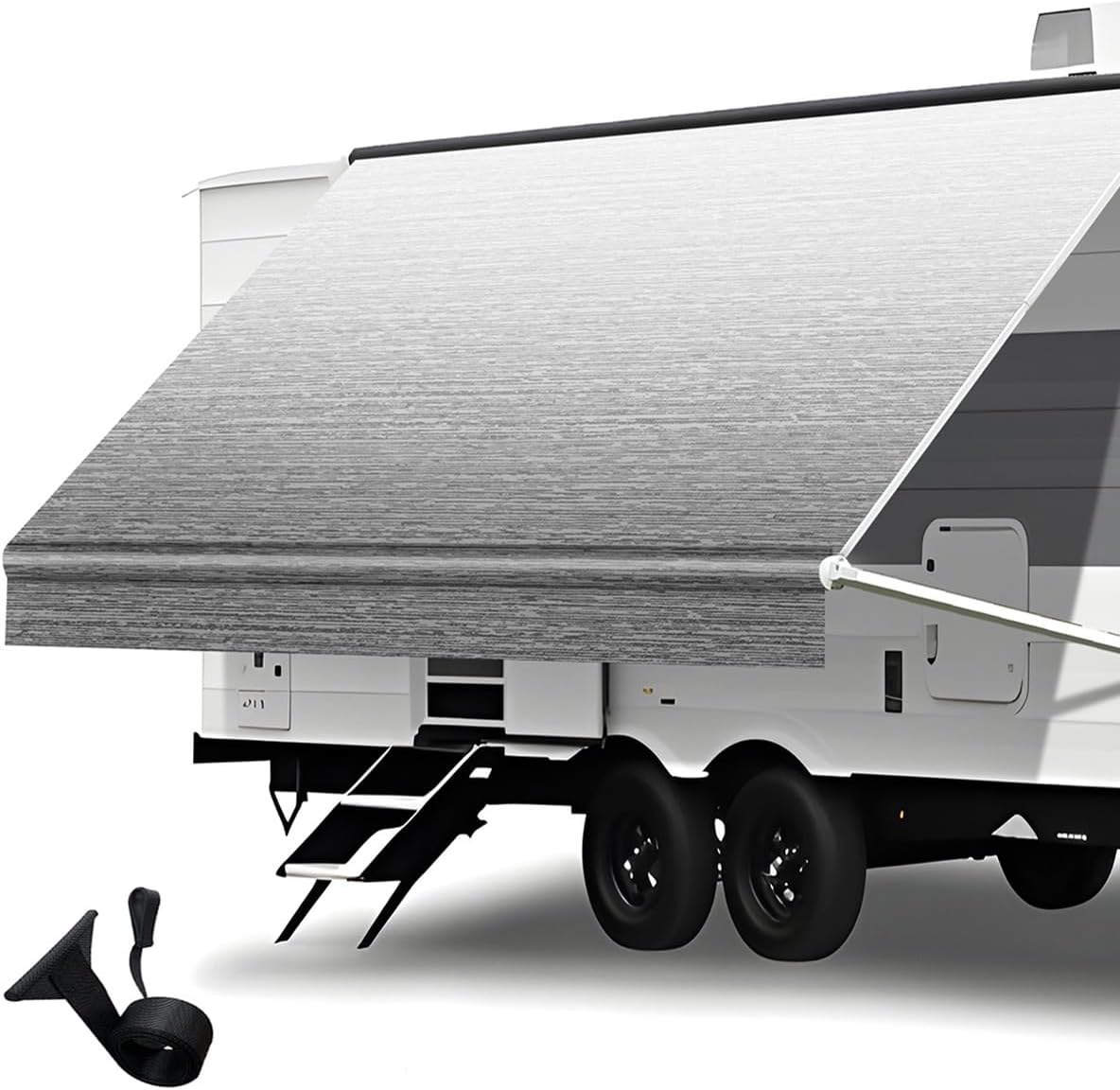
16ft RV Awning Fabric Replacement, 19.5oz, Ombré Gray
4.7Editor score
19.5oz five-ply PVC vinyl
UPF 50+ sun protection
Heat-pressed seamless edges
Polycord track installation
Repair patch and pull strap
An RV awning fabric replacement can restore a faded, torn, or leaking canopy without replacing the entire awning system. A useful replacement should match your arm-to-arm measurement, use durable multilayer vinyl, resist ultraviolet exposure, and include the correct attachment cords for smooth installation.
We compared ten replacement fabrics based on the supplied material weights, construction, sizing, weather claims, UV protection, installation method, included accessories, warranty details, and customer ratings. The guide includes 16-, 18-, 21-, and 14-foot options, along with several sizes designed for different RV awning systems.
Each review explains where the product is strongest, what trade-offs to consider, and which campers it may suit best. Ratings and specifications reflect the provided product data, while availability and pricing can change, so confirm the current listing and measure your awning before ordering.
4.7Editor score

4.6Editor score

4.6Editor score
As an Amazon Associate we earn from qualifying purchases.
The comparison below places every replacement fabric by size, material weight, construction, installation approach, and customer rating, making it easier to identify the option that matches your RV and expected outdoor conditions.


The Graphite Gray 16FT Replacement is a well-balanced option for RV owners who want substantial fabric weight, reinforced construction, and a straightforward DIY installation. It carries a 4.6 customer rating and uses 19.5oz vinyl with a 1200D high-tenacity mesh. The supplied data also describes a 15-foot-2-inch fabric width for a nominal 16-foot awning.
We may earn a commission when you buy through this link, at no additional cost to you.
Its heat-sealed edges are a major attraction because they replace stitched hems with thermal bonding, helping limit fraying, seam leakage, and pinholes at vulnerable fold lines. A softening treatment is intended to improve flexibility and reduce cracking. The fabric is described as waterproof, UPF 50+, and flexible at temperatures down to minus 40°F, making it a sensible choice for year-round shade.
Reinforced stress points add credibility for RV use, where fabric is repeatedly rolled, unrolled, and exposed to changing wind and weather. Pre-installed polycords simplify installation because the replacement can slide into the awning track. The stated compatibility with Dometic, Carefree, and Lippert systems is useful, although buyers should still compare their roller configuration and dimensions before ordering.
This is a particularly balanced pick for campers seeking robust construction without a specialized fabric system. The main limitation is that the Graphite Gray color may not suit every RV, and the advertised 8.6-foot extension should be checked against available space. Confirm your arm-to-arm measurement, track type, and desired projection before purchase.
Heat-sealed edges create fewer potential leak paths than exposed stitching. The waterproof claim and softened vinyl are particularly relevant for campers who store and deploy the awning in cool or wet conditions.
Pre-installed cords allow the fabric to slide into compatible tracks without a complex fabrication job. Review the included steps and inspect the old roller and guide components before removing the damaged fabric.
We may earn a commission when you buy through this link, at no additional cost to you.
The 16FT Five-Layer Replacement combines a 19.5oz fabric weight with a 1200D rip-stop structure and a five-layer high-density vinyl construction. Its 4.6 rating reflects generally favorable customer feedback, and the supplied information targets both electric and manual awnings. The actual fabric measures 15 feet 2 inches for a 16-foot arm-to-arm awning.
We may earn a commission when you buy through this link, at no additional cost to you.
Dual-sided heat-sealed construction is designed to eliminate needle holes and create a more consistent barrier against rain. A UPF 50+ coating is stated to block 99% of harmful ultraviolet rays, while the reflective pattern is intended to reduce heat beneath the canopy. The material is described as maintaining flexibility without cracking at temperatures down to minus 40°F.
The fabric includes three standard 0.2-inch-diameter polycords intended to glide through compatible roller tube slots. Stated compatibility includes Carefree, Dometic, Lippert, Carter, and Faulkner awnings, and no specialized tools are said to be required. That makes it a practical option for owners of common RV awning systems who prefer a repair rather than a full mechanical replacement.
Its primary compromise is that the measurement guidance is important: measure from the center of one arm to the center of the other, not from the old fabric. The designer pattern and reflective technology may also be less desirable for a minimalist exterior. For owners of a 16-foot system who value strong construction and straightforward installation, it remains one of the most balanced selections.
The layered vinyl and rip-stop reinforcement are intended to resist tearing, everyday abrasion, and pinhole formation. That makes the fabric suitable for regular deployment rather than only occasional shade use.
A nominal 16-foot model has a 15-foot-2-inch fabric width. Using arm-center measurement rather than the old fabric dimensions helps prevent a mismatch when the awning is extended.
We may earn a commission when you buy through this link, at no additional cost to you.
The 18FT Five-Layer Replacement is intended for RV owners whose awning measures 18 feet from arm center to arm center. It has a 4.6 rating and uses 19.5oz five-layer high-density vinyl reinforced with a 1200D rip-stop structure. The actual fabric is listed at 17 feet 2 inches, following the common pattern of sizing the material slightly shorter than the full arm span.
We may earn a commission when you buy through this link, at no additional cost to you.
The construction focuses on the two problems most likely to end an awning fabric's life: weakening along folds and leakage along seams. Dual-sided heat sealing is described as removing needle holes, allowing water to bead and roll away. A UPF 50+ coating blocks a stated 99% of harmful UV rays, and the reflective design is intended to help keep the area below cooler.
Reinforced stress stitching and 2mm material thickness add support, while thermal-balance technology is described as retaining flexibility in cold conditions down to minus 40°F. Three 0.2-inch-diameter polycords are included for sliding into compatible roller tube slots. The product information lists Carefree, Dometic, Lippert, Carter, and Faulkner among the supported awning brands.
This is a good fit for larger campers or motorhomes that use an 18-foot awning and require more coverage than the 16-foot versions. A larger sheet can be less convenient to store and handle, and the length must match precisely. As with all replacements in this guide, confirm the center-to-center arm measurement, roller configuration, and available installation space.
An 18-foot configuration creates a larger shaded area for chairs, tables, and campground routines. The trade-off is a bulkier fabric that needs adequate storage and handling space.
The stated low-temperature performance is useful for winter camping and cold storage. Vinyl that remains flexible is less likely to develop permanent fold-line cracks.
We may earn a commission when you buy through this link, at no additional cost to you.
The Graphite Gray 18FT Replacement offers a larger version of a construction centered on sealed seams, reinforcement, and cold-weather flexibility. It has a 4.6 customer rating and uses 19.5oz heavy-duty vinyl with a 1200D high-tenacity mesh. The listed fabric width is 17 feet 2 inches for a nominal 18-foot awning.
We may earn a commission when you buy through this link, at no additional cost to you.
Heat-sealed edges replace traditional stitching with thermal bonding, reducing the likelihood of fraying, seam leaks, and pinholes. The supplied information also mentions a specialized softening treatment intended to resist cracks and pinholes along fold lines. Reinforced stress points support the fabric at high-tension areas, while the stated waterproof construction covers both the surface and seams.
The fabric offers UPF 50+ protection and is described as reducing the UV index by 86%, contributing to a cooler shaded area. Its low-temperature rating of minus 40°F is another point of interest for cold-climate camping. Pre-installed polycords, laser-cut square edges, and compatibility with Dometic, Carefree, and Lippert systems simplify the replacement process.
This model is a good candidate for a larger RV with an 18-foot arm span and a preference for dark gray styling. Dirt and road grime are intended to blend into the pattern, and the surface can be rinsed or wiped for routine care. Before buying, check the 8.6-foot extension against the site where the awning will operate and verify the exact track arrangement.
Graphite gray and the dirt-resistant designer pattern are intended to maintain a clean appearance during travel. Routine cleaning is described as a quick rinse or wipe.
Stress points are especially relevant at the leading edge and roller area. The 1200D mesh and reinforced construction are intended to distribute loads and resist tearing.
We may earn a commission when you buy through this link, at no additional cost to you.
The 16ft Ombré Gray Replacement is a compact, accessorized option for a 16-foot RV awning. It has a 4.7 rating, the highest among the supplied products, and uses 19.5oz five-ply PVC vinyl. The construction is designed for outdoor durability with heat-pressed folded edges measuring 1.18 inches wide.
We may earn a commission when you buy through this link, at no additional cost to you.
Its 2500mm waterproof rating and UPF 50+ coverage provide the two basic functions most owners seek from an awning fabric: rain protection and shade. The product blocks a stated 95% or more of harsh sun rays. Heat pressing creates a seamless, hole-free edge intended to outperform a conventional stitched hem during repeated rolling and deployment.
Installation is centered on sliding the polycord into the existing awning track, and the supplied information says no prior experience is required. A manual guide supports the process, while a repair patch and pull strap add practical value. A one-year warranty and customer support are also included, providing some reassurance for buyers who want more than just a bare fabric sheet.
This is an attractive choice for 16-foot awning owners who value included accessories and straightforward setup. It offers sizes from 9 feet 2 inches to 20 feet 2 inches across the product line, so other RV dimensions are possible. The main drawback is that no specific low-temperature crack rating is supplied, making it less clearly targeted for severe cold conditions.
The repair patch can address a small damaged area, while the pull strap assists with positioning the sheet. These extras make the package more useful than a replacement fabric alone.
A user-friendly manual walks first-time installers through sliding the polycord into the track. Checking track condition and arm spacing before starting will make the process smoother.
We may earn a commission when you buy through this link, at no additional cost to you.
The 18FT Gray Fade Replacement uses 19.5oz four-ply PVC vinyl and has a 4.6 rating. Its 17-foot-2-inch fabric width is designed for an 18-foot awning, and the package includes the replacement fabric and a pull strap. The product information emphasizes a 36-month warranty, which is longer than the term stated for the 16-foot Ombré Gray model.
We may earn a commission when you buy through this link, at no additional cost to you.
Hot-pressing technology creates a seamless surface intended to resist holes and moisture entry. The waterproof membrane carries a stated 2500mm rating, while the UV-resistant finish blocks 98% of UV rays and is intended to limit fading and interior heat buildup. Cold-crack resistance down to minus 30°F gives it a defined low-temperature specification.
Reinforced stress points and a fixed 8.6-foot fabric width, including the valance section, are designed to support full extension. Three sewn-in polycords attach the fabric to compatible roller tubes, and step-by-step instructions are provided. Carefree, Dometic, and Lippert are among the listed compatible brands, with sizes available from 10 to 21 feet.
This is a well-supported option for owners of an 18-foot awning who place importance on warranty duration and included installation aids. Compared with five-layer fabrics, however, this is a four-ply design, and its stated cold-crack threshold is less aggressive. Verify the valance, projection, and roller setup before committing to the fit.
A 36-month warranty provides a meaningful support period for a frequently used outdoor component. Keep your receipt and installation records in case support is needed later.
The four-ply PVC build still provides substantial 19.5oz weight and a 2500mm waterproof rating. Buyers who prefer more embedded layers can compare the five- and six-layer alternatives in this guide.
We may earn a commission when you buy through this link, at no additional cost to you.
The 21FT Five-Layer Replacement is the widest configuration in this roundup, with 20 feet 2 inches of actual fabric intended for a 21-foot arm-to-arm awning. It has a 4.6 rating and uses the same 19.5oz five-layer high-density vinyl and 1200D rip-stop reinforcement as the related 16- and 18-foot versions.
We may earn a commission when you buy through this link, at no additional cost to you.
Its dual-sided heat-sealed technology is designed to eliminate needle holes and encourage water to bead away. UPF 50+ protection blocks a stated 99% of harmful UV rays, while the reflective pattern is intended to reduce heat and the power needed to cool the RV. Reinforced stress stitching and thermal-balance technology support resistance to gusts and cold-condition cracking down to minus 40°F.
Three standard 0.2-inch-diameter polycords slide into compatible roller tube slots without requiring specialized tools. The stated brand compatibility includes Carefree, Dometic, Lippert, Carter, and Faulkner, and the fabric is suitable for electric and manual systems. Its designer pattern is also described as dirt resistant and easy to clean with a water rinse.
This model makes the most sense for a large motorhome or trailer equipped with a 21-foot awning. The tradeoff is practical rather than functional: a 20-foot-2-inch sheet is heavier and more difficult to maneuver than the smaller choices. Buyers must confirm arm-center spacing and ensure the fabric can be stored without forcing it into tight folds.
The 21-foot sizing offers considerable coverage for larger camping areas. Proper measurement is essential because a slight dimensional mismatch can affect how the leading edge aligns.
The reflective pattern is designed to reduce the amount of heat felt beneath the awning. Actual cooling varies with sun angle, weather, and the surrounding campsite.
We may earn a commission when you buy through this link, at no additional cost to you.
The Smoke Grey 15'2" Replacement is built for a 16-foot awning, with a 15-foot-2-inch finished fabric that is described as 0.8 foot shorter than the distance between the arms. It has a 4.6 rating and combines 19.5oz five-layer vinyl with a particularly tight 1250D mesh designed to improve strength in both directions.
We may earn a commission when you buy through this link, at no additional cost to you.
The fabric blocks a stated 98% of UV rays and has a 2500mm waterproof rating. Its listed coverage is 7.7 feet by 15.2 feet, which gives buyers a useful check on the space it will occupy when extended. The material is also described as remaining intact without cracking or tearing at temperatures down to minus 40°F.
Installation is tool-free according to the supplied information. Three sewn-in polycords slide into the RV awning guide rail, making this a practical fabric-only repair for owners whose existing mechanism remains functional. The product is stated to work with Carefree, Dometic, Lippert, and other common awning brands.
This model is a good candidate for campers with a 16-foot system who prioritize dense mesh reinforcement and quick installation. The dimension difference between the arm span and finished fabric is essential to understand and is clearly explained in the product guidance. A slightly shorter sheet should be expected, so compare the available projection with your campsite needs.
The 1250D tight mesh is designed to resist tearing and preserve fabric stability. It is a useful specification for campers who frequently deploy their awning in windy or exposed locations.
Replacing the sheet preserves the original roller and arms when they remain functional. Inspect those parts because worn hardware can compromise even a new fabric installation.
We may earn a commission when you buy through this link, at no additional cost to you.
The Graphite Gray 14FT Replacement provides a 13-foot-2-inch fabric for a nominal 14-foot RV awning. It has a 4.6 rating and uses 19.5oz heavy-duty vinyl with 1200D high-tenacity mesh, bringing the same substantial construction to a more compact listed size than the 16-, 18-, and 21-foot alternatives.
We may earn a commission when you buy through this link, at no additional cost to you.
Heat-sealed edges and a specialized softening treatment are designed to prevent fraying, seam leakage, and fold-line cracks. The fabric is described as waterproof, UPF 50+, and capable of reducing the UV index by 86%. It is also stated to remain flexible at temperatures down to minus 40°F, supporting use in cold weather.
Laser-cut square edges support a precise fit, while the 8.6-foot extension is intended to provide full usable shade. Pre-installed polycords make the replacement easy to slide into a compatible track. Dometic, Carefree, and Lippert are named as common compatible brands, which covers many mainstream RV awning setups.
This is a useful selection for a smaller trailer, camper, or motorhome with a 14-foot awning. The advantage is a reduced sheet size that may be easier to handle than the widest replacement, though it provides less overall shade. Confirm arm spacing, track layout, and available extension space before ordering this particular size.
The 14-foot configuration can be more manageable during installation and storage. It remains a broad shade surface while reducing excess material compared with larger models.
A softer vinyl treatment is intended to reduce cracking where the fabric stays folded on the roller. Periodic operation can also help the material settle into a smooth shape.
We may earn a commission when you buy through this link, at no additional cost to you.
The 20.8oz Six-Layer Replacement is the heaviest and most elaborately layered product in the list, with a 4.6 rating. Its vinyl weighs 20.8 ounces, or 550 grams, and is organized into six functional layers rather than the four- or five-layer constructions used by most alternatives.
We may earn a commission when you buy through this link, at no additional cost to you.
Those layers address sun exposure, waterproofing, tear resistance, ultraviolet resistance, a second waterproof barrier, and scratch resistance. Within the material is a 1.2mm high-density anti-tear grid, finer than the 3mm spacing attributed to many standard fabrics. The stated goal is to distribute pulling forces more evenly and resist tearing, sagging, and deformation during long-term use.
Water is intended to bead and roll off the surface, while the UV-resistant layer supports cooler shade. Heat-sealed edges reduce potential leakage points and create a cleaner finish. Sewn-in polycords slide into the RV body slot and awning roller slot, and the fabric is stated to suit most manual and electric RV awning systems.
This is the premium choice for owners who prioritize maximum material thickness, layered protection, and tear resistance. A heavier construction can feel substantial and may require care when folding it into the roller, so storage space matters. Select the size by measuring from one arm center to the opposite arm center, then verify that your track accepts the supplied cords.
Separating waterproofing, UV defense, tear resistance, and scratch protection into dedicated layers can help the fabric address several forms of wear at once.
The 1.2mm grid spacing is designed to distribute stress more effectively than a more open structure. It is particularly appealing for exposed campgrounds and frequent awning use.
We may earn a commission when you buy through this link, at no additional cost to you.
Choosing a replacement is mostly a matter of matching the awning geometry and choosing a material construction that suits your climate, usage, and maintenance preferences. The following factors cover the details that have the greatest effect on fit, protection, and long-term satisfaction.
Choose the nominal size that exactly matches your arm-center measurement and then verify the stated finished width before purchase. If the old fabric is stretched, sagging, or damaged, its dimensions may not be reliable.
For regular use in mixed conditions, a 19.5oz multilayer fabric is a practical middle ground. Choose the heavier six-layer construction when maximum abrasion and tear resistance matter more than low weight.
Look for a dense grid, reinforced stress areas, and tear-resistant construction if your RV is often parked in windy environments. No fabric makes an improperly stowed awning immune to severe weather.
Favor sealed or heat-pressed edges for rain-heavy climates. Inspect the finished installation and repair small punctures promptly to prevent them from expanding.
Prioritize at least UPF 50+ for hot climates and consider darker or reflective finishes when reducing radiant heat is a main goal.
Use a listing that specifically fits your awning system, and ask the seller if your exact roller configuration is uncertain. Replacing only the fabric is practical only when the arms, roller, brackets, and tension system remain sound.
Give the heavier options extra consideration if storage is tight. Operate the new awning periodically so the material can relax into a smooth profile instead of remaining sharply folded.
Check what is included before buying, then save the instructions and warranty information. Replacement parts and repair supplies can make routine maintenance easier.
Begin by fully retracting the old awning and inspecting the roller tube, arms, brackets, guide rails, and body slot. Confirm the arm-center measurement, remove the damaged fabric carefully, and clean any debris from the track. Compare the new cords and overall geometry with the existing mechanism before installing the replacement. If an awning component is bent, cracked, or excessively worn, address it rather than placing additional strain on the new sheet.
Follow the product-specific instructions to feed the sewn-in or pre-installed polycords through the appropriate guide rail and roller slot. Work gradually from one side to the other, keeping the fabric square and avoiding twists. A pull strap may make positioning easier. Once fully inserted, roll the awning out and back in to check alignment, tension, and leading-edge clearance before using it normally.
For care, rinse the fabric with clean water when dirt or grime accumulates and use a soft cloth or soft brush for stubborn marks. Avoid harsh chemicals and abrasive tools that could damage the vinyl coating. Let the fabric dry before retracting it, inspect the seams and cords periodically, and store the awning in a clean, dry location. Operate it periodically to reduce prolonged compression, and repair small tears promptly before they enlarge.
Measure from the center of the left awning arm to the center of the right arm, rather than measuring the old fabric. A nominal 16-foot awning may require a 15-foot-2-inch sheet, while an 18-foot awning may use 17-foot-2-inch fabric. Compare the arm-center measurement with the seller's sizing chart, and check the listed finished width and projection before ordering.
Yes, if the existing arms, roller, brackets, cords, and tension mechanism are still functional. A new fabric can restore shade and weather protection without replacing the whole awning system. Inspect the hardware carefully, because a damaged roller or bent arm can affect the new sheet just as it affected the original one.
Most list compatibility with Carefree, Dometic, and Lippert systems, but exact fit can depend on the model year, awning generation, roller configuration, and guide rail. The five-layer products also list Carter and Faulkner compatibility. Sellers generally specify three standard 0.2-inch-diameter polycord tracks, so confirm that the existing awning accepts the same arrangement.
Stitched edges pass through the fabric with thread, while heat-sealed edges use thermal bonding to join the material without exposed stitching. The latter is intended to reduce fraying, pinholes, and seam leakage. It can also produce a cleaner appearance, although the fabric's overall durability still depends on material quality, installation, and handling.
Not necessarily. Heavier material can improve abrasion and tear resistance, but it may also be harder to roll, fold, and store. A 19.5oz multilayer fabric is a practical option for many campers, while the 20.8oz six-layer choice is aimed at buyers who prioritize maximum thickness and protection over handling convenience.
No. A waterproof fabric and sealed seams reduce the chance of water passing through the material, but leaks can still occur from punctures, damaged hardware, poor installation, or water entering at another point on the RV. Inspect the full awning and test the replacement in a controlled setting before relying on it in heavy rain.
Use clean water and a soft cloth or brush for ordinary dirt and road grime, and avoid abrasive pads and harsh chemicals. Let the fabric dry before retracting it, because trapped moisture can encourage mildew. Periodically check seams, cords, and fold areas for early signs of damage.
Cold temperatures can make some vinyl stiffer and more vulnerable to fold-line cracking, particularly if the fabric remains tightly compressed. Several options in this guide claim flexibility down to minus 40°F, while the 18FT Gray Fade model states cold-crack resistance to minus 30°F. Store the awning cleanly and avoid forcing it into sharp folds.
The 16ft Ombré Gray Replacement stands out as a value-focused option with a 4.7 rating, a five-ply 19.5oz build, useful included accessories, and a straightforward track installation. The 16FT Five-Layer Replacement is the most balanced Editor's Choice for owners who prioritize 1200D reinforcement, dual-sided heat sealing, and compatibility with many common awning brands.
For buyers seeking the most substantial construction, the 20.8oz Six-Layer Replacement offers the highest listed material weight, a 1.2mm anti-tear grid, and six distinct protective layers. In every case, prioritize an exact arm-center match, compatible track geometry, and a fabric weight you can comfortably roll and store. Weather claims should support your climate, but correct installation and regular maintenance remain essential.
Ratings, product details, availability, and pricing can change, so review the current listing before making a final decision. Confirm the finished fabric dimensions, included components, warranty terms, and compatibility with your specific awning system. Taking these final checks seriously is the surest way to avoid an inconvenient mismatch and restore dependable shade for your RV.