
Redding Model No. 2 Scale
3.9Editor score
One-tenth-grain stated accuracy
505-grain measuring capacity
Hardened precision knife edges
Pour-spout and platform pans
This Reloading Beam Scale guide compares accuracy, capacity, damping, readability, portability, and ease of use across the top options for handloaders.
A reloading beam scale provides the sensitivity needed to measure small powder charges, compare case weights, and make consistent ammunition-related decisions without relying on a digital display. The best choice depends on capacity, readability, stability, and whether you prefer a dedicated handloading pan or a general-purpose balance.
This guide compares ten available and currently listed products against practical reloading criteria. We examine stated accuracy, weighing capacity, damping, counterweight systems, platform design, included accessories, power requirements, and ease of use. The list also considers general mechanical balances and electronic powder tools so readers can understand how they differ from traditional beam scales.
Each review explains the product's strongest qualities, limitations, and ideal use case, from precision-sensitive beam models to digital scales and automatic powder dispensers. Ratings reflect the supplied customer feedback where available, while listings without product details are treated cautiously. Prices and availability can change, so confirm the current listing before purchasing.
3.9Editor score

4.7Editor score

4.6Editor score
This side-by-side comparison covers dedicated reloading scales, general mechanical balances, a digital bench scale, and an electronic powder dispenser. The specifications make clear that not every product is a traditional beam scale, helping you distinguish sensitivity and mechanical readability from digital convenience or automated powder handling.


The Lyman Brass Smith 500 Metal is a dedicated mechanical reloading scale with a stated 505-grain capacity and a customer rating of 4.7. It stands out for its sturdy aluminum body, double-sided beam, and two-handled pan, all of which are directly relevant to making small measurements at a reloading bench.
We may earn a commission when you buy through this link, at no additional cost to you.
Its double-sided scale is especially useful when different benches or seating positions make viewing from one direction inconvenient. Black markings against a white background improve scale visibility, while the aluminum body helps reduce vibration. Magnetic damping lets the beam settle quickly, and the precision-ground knife edges support consistent movement as the load changes.
The main trade-off is that this is a traditional mechanical design rather than a digital scale or automatic dispenser. It will not display a numeric total, convert units, count components, or remove the need to interpret a graduated beam. Those limitations are acceptable for reloaders who value stable mechanical operation and direct visual readings over electronic conveniences.
This is the strongest all-around recommendation in the guide for a handloader seeking a purpose-built beam scale. The combination of a readable 505-grain scale, quick damping, a vibration-conscious body, and a pan with two handles makes it particularly practical for routine powder checks and other precision bench work.
The double-sided beam gives the user more flexibility at the bench. Its black markings on a white background are designed for quick visual interpretation without navigating menus or waiting for a digital response.
Magnetic damping reduces the time spent waiting for the beam to stabilize. This makes repeated small measurements more convenient while retaining the direct, analog character of a beam scale.
We may earn a commission when you buy through this link, at no additional cost to you.
The Redding Model No. 2 Powder & Bullet Scale combines a 505-grain capacity with a stated one-tenth-grain accuracy. Its 3.9 rating is lower than the leaders in this list, but the supplied specifications position it as a sensitive, dedicated instrument for powder charges and bullet-related weighing.
We may earn a commission when you buy through this link, at no additional cost to you.
A magnetically dampened beam is intended to settle quickly after each adjustment. Hardened knife edges ride in precision stainless steel seats, which are intended to preserve alignment and support long-term durability. The scale also offers over-and-under graduations, a pour-spout pan, and a flat platform, allowing it to handle different forms of small components.
Its fully mechanical operation is both an advantage and a limitation. It avoids batteries and electronics, but the user must interpret the beam rather than receive a numeric result. The lower customer rating suggests that some buyers may not have been fully satisfied with the overall experience, although the provided feature set remains focused on precision.
The Redding is worth considering for a reloader who wants fine stated sensitivity, a traditional beam mechanism, and a purpose-built capacity close to that of the Lyman. It is best suited to users comfortable making analog adjustments and verifying a charge repeatedly rather than relying on automatic output.
The stated one-tenth-grain resolution and 505-grain capacity target the small quantities used in careful charge development. Over-and-under graduations also help the user judge which side of the target the beam has reached.
The pour-spout pan supports powder handling, while the flat platform offers a separate surface for small components. This versatility is useful when the scale is used for more than a single measurement task.
We may earn a commission when you buy through this link, at no additional cost to you.
The Frankford Arsenal DS-750 is a digital reloading scale with a stated 750-grain capacity, one-tenth-grain accuracy, and a 4.6 customer rating. It offers a simpler reading experience than an analog beam, which can be attractive to reloaders who want immediate numeric results without interpreting graduations.
We may earn a commission when you buy through this link, at no additional cost to you.
The blue-backlit LCD makes the measurement visible under different bench conditions. The scale can display grains, grams, ounces, and carats, and its tare function allows the container or pan to be accounted for before weighing. A counting function adds another layer of usefulness, while automatic calibration and overload protection support dependable operation.
It is not a traditional beam scale, so buyers specifically seeking the feel and mechanical construction of a beam should choose one of the dedicated analog products instead. It also depends on two included AAA batteries, meaning readings are unavailable if power runs low. Auto shut-off after 60 seconds helps conserve those batteries but may interrupt a particularly long workflow.
For a reloaders searching for an affordable, readable, general-purpose scale, the DS-750 is a compelling choice. The included powder pan, soft carry case, calibration weight, and protective cover make it particularly well equipped for a portable reloading setup.
The illuminated LCD presents a direct number rather than requiring the user to locate a mark along a moving beam. This reduces interpretation time and can make small adjustments easier to evaluate.
Grains, grams, ounces, carats, tare, and counting functions make the DS-750 useful beyond powder weighing. That flexibility also helps justify it as a general bench scale for a workshop or reloading room.
We may earn a commission when you buy through this link, at no additional cost to you.
The QWORK Triple Beam Mechanical Balance is a general-purpose mechanical scale with a stated capacity of 2610 grams and 0.1-gram accuracy. It receives a 3.7 rating and is not designed specifically for reloading, but its large platform and included calibration weights can make it useful for broader workshop tasks.
We may earn a commission when you buy through this link, at no additional cost to you.
The balance includes two 1000-gram weights and one 500-gram weight, raising the stated capacity from 610 grams to 2610 grams. A zero adjustment knob lets the user return the pointer to its reference position before measuring. Magnetic damping is included to limit sway, and the clear graduation is intended to make readings easier to interpret.
Its most important caveat for reloaders is the granularity. One-tenth of a gram is much coarser than the grain-level resolution offered by dedicated powder scales, so it should not be treated as an equivalent to a purpose-built reloading beam. The product also notes that transportation may disturb the zero and require recalibration, adding a setup step that many reloaders may find inconvenient.
The QWORK makes sense for classroom, laboratory, kitchen, or general bench weighing and can serve as an occasional backup scale. For repeated powder-charge work, however, a grain-sensitive reloading model would be the more appropriate purchase.
The supplied weights expand the scale to 2610 grams, giving it substantially more capacity than a typical reloading beam. That makes it useful for workshop tasks beyond small ammunition components.
The stated recalibration warning is worth considering before buying. Checking the zero before each important session helps identify whether movement or vibration has shifted the balance.
We may earn a commission when you buy through this link, at no additional cost to you.
The product represented by ASIN B0874454P6 appears in the supplied roundup data, but its title, rating, image, and descriptive specifications are unavailable. Without those details, it is impossible to determine whether it is a beam scale, a digital scale, or another type of reloading balance.
We may earn a commission when you buy through this link, at no additional cost to you.
This listing should not be evaluated as though it had the same evidence as the fully documented products above it. There are no supplied facts about its capacity, accuracy, damping, counterweight arrangement, platform, included accessories, or power source. A customer rating is also not available in the provided information.
The main downside is obvious: there is no factual basis for claiming that it outperforms the documented alternatives. Even the type of scale is uncertain, so matching it to a traditional beam or electronic design would be speculation. A buyer should inspect the live listing carefully before relying on it.
At present, this ASIN is best treated as an unverified option rather than a recommended pick. Check that the listing provides a genuine reloading scale, suitable capacity, legible graduations, stable readings, and any required calibration instructions before making a final decision.
Open the product page and verify the model name, scale type, maximum capacity, and smallest graduation. These details determine whether the listing belongs in a serious reloading-scale shortlist.
The absence of supplied details makes capacity and sensitivity the most important items to confirm. A suitable powder scale should have enough resolution for the small measurements required by the intended task.
We may earn a commission when you buy through this link, at no additional cost to you.
ASIN B0C9Z1GLDZ is another entry for which the source data provides no title, rating, image, or product description. Consequently, the guide cannot responsibly identify it as a beam scale or compare its accuracy, capacity, and construction with the documented choices.
We may earn a commission when you buy through this link, at no additional cost to you.
A listing identifier alone does not reveal whether the product offers grain graduations, a calibrated counterweight system, magnetic damping, or any of the features that make a scale useful at a reloading bench. There is also no supplied evidence about its platform, included weights, dimensions, or power requirements.
This lack of information presents the same risk as any unfamiliar scale: the visible listing may not match the user's intended use. It would be especially important to verify whether the scale can resolve powder-charge differences, whether the pan is suitable for small components, and whether calibration is performed correctly.
The listing should therefore be considered unverified rather than an automatic recommendation. Visit the product page, look for a clear capacity and graduation statement, and compare the actual model with one of the documented beam or digital scales before ordering.
First determine whether this is a true balance beam, a general laboratory scale, or an electronic model. That distinction affects readability, calibration needs, and suitability for powder work.
Find the smallest stated division or resolution and compare it with the quantities being measured. General-purpose accuracy alone does not guarantee useful reloading-scale sensitivity.
We may earn a commission when you buy through this link, at no additional cost to you.
The source information for ASIN B0BQYNHJC1 contains only an identifier and link. There is no model name, customer rating, image, capacity, accuracy statement, or description of the weighing mechanism to support a meaningful review.
We may earn a commission when you buy through this link, at no additional cost to you.
Because the balance system is unknown, it would be inappropriate to label this option as a beam scale or recommend it for measuring tiny powder charges. A mechanical balance with coarse graduations, a digital scale with limited capacity, and a dedicated reloading model may all occupy very different categories of performance.
Its principal limitation is uncertainty. A buyer could encounter useful features such as damping, tare, or a protective pan, or could find none of them. Without specifications, the listing also cannot be compared fairly on accuracy, stability, portability, or setup requirements.
This entry remains a placeholder in the roundup rather than a recommended choice. Review the live listing for capacity, resolution, included weights, calibration details, and a clear explanation of what the scale is designed to measure before deciding whether it meets your needs.
The smallest readable increment matters more than a broad capacity claim for many reloading tasks. Verify that the displayed divisions support the precision of the materials you intend to weigh.
Check whether the scale requires manual leveling, calibration weights, batteries, or a zero adjustment. Each requirement affects convenience at a busy reloading bench.
We may earn a commission when you buy through this link, at no additional cost to you.
ASIN B0BZKM34WN is included in the supplied ten-product list, but the available source data does not include a title, rating, image, or factual description. As a result, there is no supported basis for describing its capacity, sensitivity, or weighing system.
We may earn a commission when you buy through this link, at no additional cost to you.
This uncertainty is particularly relevant to reloading scales, where small divisions, stable support, and proper calibration can influence the usefulness of a balance. The entry could represent a dedicated powder scale, a general triple-beam balance, or a digital unit. Those designs have different strengths and setup routines.
Because no customer rating is supplied, there is also no defensible way to compare user satisfaction. Similarly, no claims can be made about magnetic damping, counterweights, units, accessories, portability, or durability. Buying based on the ASIN alone would amount to relying on a marketplace listing without confirming what it contains.
The sensible approach is to open the live listing and identify the exact model. Compare its specifications with the Lyman, Redding, or Frankford options in this guide, paying close attention to capacity, smallest graduation, stability, and included calibration equipment.
A scale should cover the largest item you plan to weigh while providing sufficiently small divisions for routine precision work. Check both values rather than focusing on maximum capacity alone.
A stable base, suitable pan, readable markings, and fast settling are important for repeated work. Confirm these qualities on the actual listing because no construction details are available here.
We may earn a commission when you buy through this link, at no additional cost to you.
The Triple Beam Mechanical Balance, 2610g x 0.1g Lab Scale with Weights has a 4.7 rating and offers a stated 2610-gram capacity with 0.1-gram precision. It is a general laboratory and workbench balance rather than a dedicated handloading scale, but it may be useful for larger tasks and occasional precision checks.
We may earn a commission when you buy through this link, at no additional cost to you.
The included 1000-gram and 500-gram weights expand the scale's usable range, while the stainless steel pan provides a stable and easy-to-clean surface. Built-in magnetic damping should reduce pointer sway, and the clear graduations are intended to make readings straightforward. A zero adjustment knob permits recalibration when needed.
For reloading, the central limitation is the 0.1-gram resolution. That is not equivalent to the one-tenth-grain resolution advertised by the dedicated scales in this guide. A general balance may be useful for component organization or less granular checks, but it should not replace a fine-resolution scale when powder-charge accuracy is the main objective.
The scale earns its place for users who want a large-capacity mechanical balance, included weights, and a durable pan without needing batteries. Its rating and stated feature set make it appealing as a secondary workshop tool, while dedicated reloaders should look to the Lyman or Redding for finer grain-scale readings.
The six-inch stainless steel pan is designed to resist corrosion and simplify cleanup. Its broad diameter also makes the scale more adaptable than a small dedicated powder pan.
The mechanical design requires no batteries or external power. That simplifies bench setup and keeps the scale functional in workshops where electrical access may be inconvenient.
We may earn a commission when you buy through this link, at no additional cost to you.
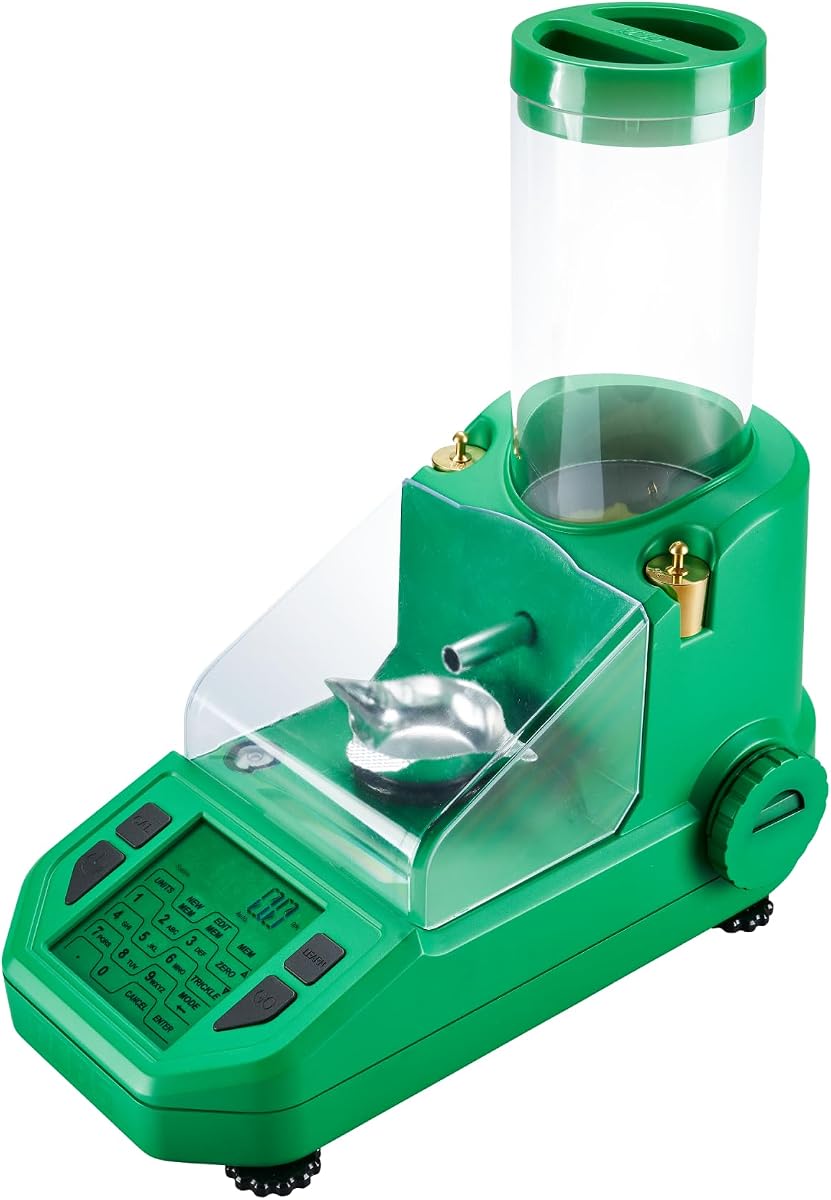
The RCBS ChargeMaster Supreme Powder Dispenser is an electronic powder-handling tool rather than a conventional beam scale. It has a 4.5 rating and combines powder throwing with weighing in one unit, offering a different approach for reloaders who value automation and electronic controls.
We may earn a commission when you buy through this link, at no additional cost to you.
Its stated resolution is 0.1 grain, supported by a large-volume load cell. A touchscreen display provides the primary bench interface, while Bluetooth connectivity allows setup and control through the RCBS app when desired. The sealed platen, quick warm-up, and optional silent operation can improve workflow during repeated charge preparation.
This product is not a substitute for the intuitive comparisons offered by a mechanical beam. It depends on electronics, requires a warm-up, and introduces a more complex interface. It also performs one specific task—automated powder dispensing—rather than offering the broad multi-unit utility of a general digital bench scale.
For a reloader who wants the most automated powder workflow in this guide, the ChargeMaster Supreme is the relevant selection. It is best suited to users comfortable with touchscreen controls and app-based setup, while traditionalists seeking a simple analog beam should favor the Lyman or Redding instead.
Integrating throwing and weighing reduces the need to move powder between separate tools. The design focuses on repeatable electronic control rather than analog beam adjustment.
Bluetooth app support provides another route for setup and control. The option is useful for users who prefer a connected workflow, while the touchscreen keeps essential functions accessible at the bench.
We may earn a commission when you buy through this link, at no additional cost to you.
The right reloading scale depends on what you need to measure, how much precision you require, and how much automation you want. Compare resolution, capacity, stability, reading style, calibration demands, and included accessories before making a selection.
Choose a capacity that comfortably covers the heaviest item or assembly you expect to weigh. The Lyman and Redding beam scales each support up to 505 grains, while the Frankford DS-750 reaches 750 grains and the two documented triple-beam balances extend to 2610 grams. Capacity alone does not guarantee precision, but too little capacity can make a scale unsuitable for larger cases, components, or containers.
Match capacity to the task without paying for unnecessary range. A dedicated powder or bullet scale is usually better matched to small reloading quantities than a broad laboratory balance.
Sensitivity determines how finely a scale can distinguish between nearby weights. The Redding and Frankford products state one-tenth-grain accuracy, while the Lyman provides a graduated 505-grain beam. General triple-beam options specify one-tenth-gram accuracy, which is useful for workshop tasks but not directly equivalent to grain-level sensitivity. Review the smallest division, accuracy claim, and graduation spacing together.
Choose a scale whose resolution matches the smallest change you need to detect. More graduations are not automatically better if they cannot be read clearly or the mechanism does not settle reliably.
A traditional beam scale requires you to compare the load with a marked scale and interpret the position of the beam. The Lyman offers a double-sided beam with black markings on a white background, while the Redding includes over-and-under graduations. Look for strong contrast, visible graduations, and a viewing orientation that fits your bench.
Digital scales remove much of the interpretation step, but a numeric display still needs to be easy to read. Consider lighting, viewing angle, font size, and how the selected unit appears on screen.
Stable readings save time and make small adjustments easier to evaluate. Magnetic damping is featured on the Lyman, Redding, and both documented triple-beam balances. Damping helps the beam or pointer settle quickly, reducing the sway that can obscure a precise reading. A sturdy base and vibration-resistant construction are equally important in a working reloading room.
Look for both damping and a stable platform rather than assuming one guarantees accurate results. Place the scale on a level, vibration-free surface away from repeated impacts.
The weighing surface affects how easily materials can be placed and removed. The Lyman uses a pan with two handles for right- or left-handed access. The Redding combines a pour-spout pan with a flat platform, while the Frankford includes a powder pan. General triple-beam balances use broad platforms for a wider variety of objects. Select the surface that matches the material and the frequency of use.
A flat platform is useful for small parts, while a pour-spout pan can make powder transfer easier. Consider cleanup, access from your dominant hand, and whether the pan is large enough without making tiny measurements awkward.
Mechanical balances need correct leveling and zeroing, and some may require included weights for verification. The QWORK balance includes a zero adjustment knob and notes that transportation may disturb its zero. Digital products may offer automatic calibration, while the Frankford includes a calibration weight. Understand the setup process before choosing a model.
Frequent zero checks are a useful habit regardless of model. Keep calibration weights clean and stored securely, and never adjust a scale using a load that is not appropriate for the intended calibration procedure.
Beam and triple-beam scales operate without batteries, while the Frankford DS-750 uses two AAA batteries and the RCBS ChargeMaster Supreme relies on electronics and offers app connectivity. Battery-free models reduce interruptions, whereas digital and automated tools can provide automatic calculations, menus, or powder dispensing. Choose based on convenience rather than assuming one operating approach is inherently better.
Consider how often the scale will be used and whether you value immediate digital output or a straightforward mechanical process. Keep spare batteries available for electronic models and review app compatibility for connected tools.
A portable scale can be moved between a reloading bench, a cleaning area, or a storage cabinet. The Frankford includes a soft carry case, powder pan, calibration weight, and protective cover. The RCBS tool is designed as a bench dispenser with a touchscreen and sealed platen. General balances often include larger platforms and weight sets. Included accessories can materially improve organization and setup convenience.
Check whether a protective cover or carrying case is important in your workflow. Also consider the amount of bench space and storage required by the scale and its accessories.
Begin by placing the scale on a firm, level surface away from vibration, drafts, and direct impact. For a mechanical model, confirm that the beam or pointer rests at zero before adding anything. For a digital scale, switch it on, allow the stated warm-up period if applicable, select the desired unit, and use tare to account for the pan or container.
Add the material gradually while watching the beam, pointer, or digital readout. For a traditional beam scale, move the counterweight in small increments and allow magnetic damping to settle the mechanism before taking a reading. Keep the pan centered and avoid touching the scale while it is balancing. When using an automated dispenser, follow the manufacturer's setup procedure and confirm the displayed target before starting a powder cycle.
After use, remove any powder or residue from the pan, using a soft brush or method approved for the scale's surfaces. Do not flood a mechanical scale with liquid or use harsh chemicals that could damage markings, knife edges, or the counterweight system. Store the scale with its pan protected and its beam or pointer supported according to the manufacturer's instructions.
A beam scale can be suitable for powder charging when its capacity, graduations, and sensitivity match the required charge weight. Dedicated models such as the Lyman and Redding are designed around reloading use, while general laboratory balances may have coarser divisions. Check the smallest graduation and stated accuracy before choosing.
A beam scale uses a balanced mechanical beam and graduated markings, while a digital scale converts force into a numeric display. Beam scales do not require batteries and can provide a direct analog reading. Digital scales may add tare, counting, multiple units, and automatic calibration, but they require power and electronics.
The required capacity depends on whether you weigh individual charges, bullets, cases, or larger groups. The documented Lyman and Redding scales support up to 505 grains, and the Frankford DS-750 supports 750 grains. General triple-beam balances offer much higher gram capacity but generally coarser resolution.
Yes. Magnetic damping reduces sway so the beam or pointer settles more quickly, which improves readability and workflow. Zero adjustment establishes the reference position before weighing. A scale that has been moved or transported should be checked and zeroed before it is used for a precise measurement.
A general balance may be useful for larger or less granular tasks, but it should not automatically replace a grain-sensitive reloading scale. The documented triple-beam options state 0.1-gram accuracy, whereas dedicated models offer one-tenth-grain accuracy or fine graduated beams. Choose according to the smallest change you need to measure.
Keep it on a stable level surface, handle it by the body rather than the pan or beam, and check the zero before a session. Avoid leaving powder on the pan or exposing the mechanism to moisture. If readings become inconsistent, follow the manufacturer's instructions for leveling, cleaning, and calibration.
Neither is universally better. A digital scale offers faster numeric interpretation, unit changes, tare, and sometimes counting functions. A beam scale provides a direct mechanical reading without batteries. The right choice depends on precision needs, bench setup, personal preference, and whether automated powder handling would be valuable.
An automatic dispenser can streamline repeated powder preparation, but it serves a different purpose from a weighing scale. The RCBS ChargeMaster Supreme combines throwing and weighing with electronic controls, while a beam or digital scale is generally better for verifying individual weights. Some reloaders may use both styles for different stages of their process.
The Lyman Brass Smith 500 is the best overall choice for a dedicated mechanical reloading scale because it combines a 505-grain double-sided beam, quick magnetic damping, an aluminum body, and a two-handled pan. The Redding Model No. 2 stands out for its stated one-tenth-grain accuracy and premium precision features, while the Frankford DS-750 is the best budget option for anyone who prefers a clear digital display and multiple functions.
Prioritize resolution, readable graduations or display, stability, and a capacity that fits your actual measurements. Mechanical buyers should consider damping, counterweight quality, pans, and zeroing, while digital shoppers should examine units, tare, calibration, and battery life. For repeated automated powder handling, the RCBS ChargeMaster Supreme offers a specialized alternative to conventional weighing.
Ratings, product details, availability, and prices can change over time, so review the current listing before buying. Confirm the scale's specifications, included accessories, and suitability for the quantities you plan to weigh, and compare the final options according to accuracy, workflow, and bench space rather than price alone.