
Solar Animal Repellent with Flashing Lights
4.7Editor score
Adjustable PIR detection sensitivity
Three selectable spray patterns
IP65 waterproof housing
This guide compares the best motion activated sprinkler for garden animal protection, including sensor range, coverage, power options, and durability.
A motion activated sprinkler can protect flowers, vegetables, lawns, and landscaping without trapping or harming visiting animals. The best units combine reliable motion sensing, a sudden but controlled burst of water, useful coverage controls, and secure outdoor installation, making each model suited to a different yard and set of nuisance animals.
This comparison evaluates ten options by examining detection technology, sensing distance, spray pattern, adjustability, power source, weather resistance, installation method, and intended animal coverage. The list includes hose-powered, battery-powered, solar-assisted, single-unit, and multipack designs, allowing readers to compare practical differences rather than relying on generic marketing claims.
Each numbered review explains the product's strongest attributes, compromises, and best-fit situation. The featured choices range from a straightforward budget model to solar options with flashing lights, so shoppers can decide which approach fits their garden. Product configurations and availability may change, and current prices should be checked before buying.
4.7Editor score

4.5Editor score

3.7Editor score
The table below compares all ten sprinklers by sensing method, detection reach, spray controls, power arrangement, and standout outdoor features. Product 4 stands out for its dual visual and water deterrent, while the two-pack option offers broader property coverage and the Havahart model provides a straightforward budget-friendly setup.


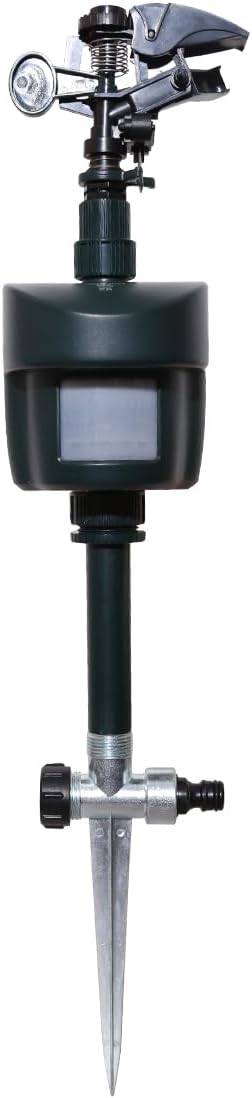

The Solar Motion Activatied Sprinkler combines a PIR motion sensor with a synchronized water jet and bright strobe light. Its 4.5 rating reflects a capable feature set, particularly for properties where a water-only response may not discourage persistent visitors. The 110-degree detection field and listed distance of up to 26 feet make it appropriate for flower beds, vegetable plots, orchards, and lawn edges.
We may earn a commission when you buy through this link, at no additional cost to you.
Its most impressive feature is the dual-stimulation response. Animals receive both a sudden spray and a flashing visual cue, which can make the deterrent feel more disruptive than ordinary watering. The nozzle can be adjusted from 1 to 360 degrees, and the spray can shift between a concentrated jet and a wider mist. Four rear-mounted sensitivity levels help control unwanted activation, while the supplied ground stake and standard 3/4-inch hose connector support quick setup.
Power flexibility is another strength. A high-efficiency solar panel and built-in 1,800 mAh lithium-ion battery support unattended use, while DC charging takes around three hours and solar charging takes approximately nine hours. The stated IP65 rating provides confidence for outdoor exposure to rain and dust. A self-maintenance spray after 24 hours without a trigger can also help clear sediment from the nozzle, although this feature uses additional water.
This is the most complete option for a shopper who wants more than a basic hose-connected sprinkler and values customizable coverage. It is particularly well suited to yards with repeated deer, cat, dog, or fox activity and enough sunlight for the panel. Buyers should position the panel where it receives direct light, begin at a lower sensitivity setting, and confirm that the hose and stake are secure before leaving the device outdoors.
Combining a sudden water spray with a strobe light adds a second layer of disruption. This can improve the impression of a protected area without introducing chemicals or traps into the garden.
The wide nozzle adjustment, four sensitivity levels, and timed self-cleaning spray make the unit adaptable to different entry points. Periodic inspection remains important because soil, leaves, and mineral deposits can still affect any outdoor nozzle.
We may earn a commission when you buy through this link, at no additional cost to you.
This one-pack solar animal repellent pairs a PIR sensor with water and flashing lights, and its 4.7 rating is the highest among the ten products reviewed. It is aimed at homeowners seeking a versatile deterrent for deer, cats, raccoons, rabbits, and similar visitors. The listed 26-foot range and 110-degree detection angle provide a meaningful starting point for protecting a concentrated garden zone.
We may earn a commission when you buy through this link, at no additional cost to you.
A four-level sensitivity knob helps reduce false alarms, while the adjustable head offers 360-degree rotation, wide-angle coverage, and a focused jet. Those options allow the same unit to serve a flower bed, trash-can area, or narrow approach route. The quick-connect fitting, metal stake, and IP65 waterproof casing are practical features for long-term outdoor placement.
Solar/DC charging is advertised for up to 60 days of operation, and a brief automatic spray after 24 hours without a trigger helps keep the nozzle clear while lightly hydrating the lawn. The trade-off is that solar performance depends on panel placement, weather, and charging conditions. The self-maintenance cycle is useful, but it should be considered alongside any local watering restrictions.
This is a strong premium pick for users who want broad animal targeting, multiple spray patterns, and fewer visible power constraints than a small battery-only unit. It is best positioned in an open area with direct sunlight and a clear line of approach. Before buying, check hose compatibility and plan how the detection zone will overlap the area animals regularly use.
Rotation, broad coverage, and a focused stream let the owner match the deterrent to the target. This versatility is useful when one garden contains both open beds and narrow paths.
The waterproof casing, metal stake, leak-proof connection, and dual charging options support dependable seasonal positioning. Routine checks are still needed to keep the panel unobstructed and the nozzle clear.
We may earn a commission when you buy through this link, at no additional cost to you.
The two-pack Solar Animal Repellent offers the same broad feature set as the one-pack model but supplies two units for separate protection zones. Its 4.7 rating makes it one of the strongest options in the comparison. It is a logical choice for a front vegetable garden and rear flower bed, or for a property with two distinct approaches used by deer, cats, raccoons, or rabbits.
We may earn a commission when you buy through this link, at no additional cost to you.
Each unit uses a 110-degree PIR sensor with a listed range of up to 26 feet and four sensitivity settings. The spray head supports 360-degree rotation, wide-angle spraying, and focused jets, helping owners cover a small planting area or a larger lawn section. Water and flashing lights create a dual deterrent intended to condition animals to avoid the area.
This version lists solar/USB charging for up to 60 days of operation. That is helpful for installations where running a conventional power cable would be inconvenient, although each unit still needs an appropriate hose connection and well-placed solar panel. The automatic spray after 24 inactive hours can clear the nozzle and provide a small amount of lawn hydration.
The main advantage over a single unit is placement flexibility. Animals approaching from different sides may not trigger a device positioned to face only one direction. Two sprinklers can cover those routes and reduce the need for manual repositioning. The drawback is added setup work, and the owner must maintain both hoses, stakes, sensors, and charging areas.
Two units can watch different sides of a home or garden, covering routes that a single fixed sensor might miss. This is especially helpful where animal traffic changes throughout the day.
The two charging options give owners more ways to prepare the units for outdoor use. Direct sunlight remains the most natural choice for long unattended operation.
We may earn a commission when you buy through this link, at no additional cost to you.
The Motion Animal Repellent Two Pack is a conventional motion-activated sprinkler aimed at cats, birds, dogs, and other garden visitors. Its 3.8 rating places it among the moderately rated products, but the included pair and broad listed coverage are attractive for protecting larger areas without buying two separate units.
We may earn a commission when you buy through this link, at no additional cost to you.
The detection zone can cover up to 1,000 square feet with a stated 120-degree angle, and sensitivity is adjustable. The head rotates 360 degrees, allowing a unit to cover a frontage rather than a single narrow target. Once an animal is detected, the sprinkler sprays for five seconds, and repeated detections can initiate another cycle while the animal remains in the sensing area.
Unlike the solar models with strobe lights, this design relies on water alone. That makes it mechanically simpler and potentially suitable for users who do not want an electronic visual deterrent. Its connection information mentions both a 3/4-inch GHT brass-thread option and a quick-connect arrangement, so buyers should compare their existing hose and connection setup before installation.
This two-pack is best for buyers who want broad, adjustable water coverage and already have suitable hose access. It is less suitable for a location where electrical charging, solar placement, or a flashing light is specifically wanted. Its compatibility with two connection methods is a potential advantage, but clear installation is still essential for leak-free operation.
The stated 1,000-square-foot range and 120-degree angle can cover a large lawn or garden frontage. Sensitivity adjustment helps owners balance early detection against unnecessary spraying.
The response relies on a brief but repeatable spray rather than flashing lights. This is a straightforward approach for properties where an uncomplicated water connection is preferred.
We may earn a commission when you buy through this link, at no additional cost to you.
The Rotating Yard Animal Deterrent is a straightforward motion-activated sprinkler with a 3.7 rating. Its core appeal lies in a rotating head, durable metal stake, and quick-connect hose fitting. It is marketed for a range of common yard visitors, including deer, cats, raccoons, skunks, and dogs, while also functioning as a conventional garden sprinkler.
We may earn a commission when you buy through this link, at no additional cost to you.
Rotation increases the area reached by each activation without requiring the owner to aim one fixed stream at a single point. The sturdy stake is useful for lawns and planted areas where the unit needs to remain upright. Quick connection can make relocation easier, allowing the owner to respond to changing animal traffic or seasonal garden activity.
The supplied information gives less detail about sensing range and detection angle than some competing products. It also does not specify a sensitivity control, solar charging, flashing lights, or a weather-resistance rating. Those omissions make it harder to compare precise detection performance, but the core design remains easy to understand and likely easier for a new buyer to set up.
This sprinkler is a reasonable choice for a straightforward yard where the priority is rotating water coverage, stable placement, and a simple hose connection. It may work particularly well near trash cans, vegetable rows, or flower beds. Buyers should confirm the included connection parts match the available hose and verify coverage through daylight and nighttime observation.
The rotating head can distribute water over a wider section than a fixed spray pattern. It is well suited to beds, lawns, and areas where animals approach from more than one angle.
A metal stake and quick-connect fitting support secure placement and easier seasonal movement. The connection should still be checked regularly for leaks or hose strain.
We may earn a commission when you buy through this link, at no additional cost to you.
The Havahart Critter Ridder is a simple infrared motion-activated sprinkler with a 3.7 rating. It is positioned as a budget-oriented option for homeowners who want a chemical-free response to squirrels, cats, deer, raccoons, rabbits, birds, and other nuisance animals without installing a more complex solar unit.
We may earn a commission when you buy through this link, at no additional cost to you.
The product description claims animal heat and movement detection within 60 feet, four sensitivity levels, and distance controls extending as far as 100 feet. Those are generous stated figures and make the unit appealing for a relatively open property. Each activation uses only about two to three cups of water according to the supplied information, which is useful for conserving water while still delivering a noticeable spray.
The main caveat is that two AA batteries are required and are not included. The instructions also note that batteries can self-discharge during storage, so their voltage should be checked before installation. Because the unit is battery-powered, it avoids a continuous hose or electrical-cable dependency, although water still needs to reach the sprinkler through the appropriate connection arrangement.
For a shopper seeking an uncomplicated and economical garden deterrent, this is a sensible place to start. It may be especially useful on smaller budgets or in locations where a simple, adjustable unit is preferable to a solar panel and strobe system. Treat the stated detection distances as adjustable maximums rather than guaranteed coverage, and test the sensor around the intended target area.
The long listed detection reach can cover a broad yard, while sensitivity settings help narrow the trigger behavior. Test these controls in different weather and lighting conditions.
The stated use of two to three cups per activation supports an economical approach. It also offers an alternative to poisons or traps while allowing the unit to function as a small garden sprinkler.
We may earn a commission when you buy through this link, at no additional cost to you.
The Single Motion Animal Repellent provides the same core detection and spray characteristics as the two-pack version without including a second unit. Its 3.8 rating reflects a straightforward product aimed at protecting a garden or lawn from cats, birds, dogs, squirrels, deer, skunks, foxes, herons, and raccoons.
We may earn a commission when you buy through this link, at no additional cost to you.
The sprinkler head adjusts through 360 degrees, while the detection area is stated at up to 1,000 square feet with a 120-degree angle. Sensitivity can be changed to suit the environment. When movement is detected, the unit sprays for five seconds, and a subsequent detection can start another spray until the animal leaves the monitored space.
As a water-only design, it avoids solar panels, batteries, and flashing lights. That simplicity can be attractive for owners who want a familiar garden-hose device rather than a multi-component deterrent. The trade-off is that one sensor and one spray pattern may not cover multiple approaches as effectively as a pair of units or a unit with a wider selection of spray modes.
This single-unit model is a good fit for one defined zone, such as a vegetable bed, trash-can area, or flower border. It is also likely easier to position and maintain than a multipack installation. Before purchase, verify the appropriate hose connection and test the sensor at different times because changing vegetation and ambient heat can influence triggering.
The single unit concentrates the budget on one well-chosen location. Positioning it near a repeated animal route can be more effective than placing it in a distant, infrequently used corner.
The 360-degree head and sensitivity control allow the owner to shape the spray and trigger area. Periodic testing helps account for vegetation growth and seasonal changes.
We may earn a commission when you buy through this link, at no additional cost to you.
The two-pack Solar Dual-Stimulation Sprinkler offers synchronized water jets and strobe lights from two separately positionable units. Its 3.8 rating is lower than the closely related one-pack dual-stimulation product, but the pair remains appealing for larger gardens, orchards, farms, or properties with multiple vulnerable areas.
We may earn a commission when you buy through this link, at no additional cost to you.
Each unit uses a 110-degree PIR sensor with a listed range of up to 26 feet. Four sensitivity levels and a 1-to-360-degree nozzle adjustment provide considerable control over where the unit detects animals and where it directs water. The spray can change between concentrated and diffused modes, which allows a single device to serve a narrow trail or a broader planting area.
The units include solar panels and built-in 1,800 mAh lithium-ion batteries, with DC charging taking about three hours and solar charging around nine hours. They are described as IP65 rated for rain and dust resistance. After 24 hours without detected movement, each unit performs a brief maintenance spray to help prevent nozzle blockage.
The primary benefit is coordinated coverage from two positions without buying two unrelated systems. The main inconvenience is the need to install and maintain two stakes, hoses, sensors, and panels. Shoppers should select spots with direct sun and good views of animal approaches, then test the units individually before relying on them for complete property protection.
A pair can monitor separate vulnerable zones or opposite approaches. This reduces blind spots and makes the setup more adaptable than a single fixed sprinkler.
The IP65 construction and automatic nozzle-clearing cycle support extended outdoor use. Routine cleaning and unobstructed solar exposure are still necessary for dependable performance.
We may earn a commission when you buy through this link, at no additional cost to you.
The Orbit Yard Enforcer 62100 is a recognizable lawn-and-garden sprinkler with a 3.8 rating. It uses passive infrared sensing to detect movement from heat-producing animals and responds with a controlled water burst. The listed detection range reaches up to 40 feet, and adjustable spray duration spans approximately three to ten seconds.
We may earn a commission when you buy through this link, at no additional cost to you.
Its standout feature is the choice of Day, Night, and Always-On operating modes. Day mode avoids unnecessary operation, night mode targets nocturnal activity, and Always-On provides a traditional watering option. A separate 30-minute manual watering function adds a practical way to water lawn edges, gardens, and planting areas when the motion feature is not needed.
Installation uses an included metal step spike, and the sensor and sprinkler can be angled toward common entry points. The main limitation is that one fixed unit cannot monitor every direction. A hose connection must also remain secure, and the stated detection performance can vary with animal size, weather, environmental conditions, and sensor placement.
This model is best for owners who want one device to combine animal deterrence with occasional lawn irrigation. It is particularly suitable for a predictable route, such as the edge of a flower bed or the approach to a vegetable garden. The varied operating modes make it more versatile than many basic motion sprinklers, although a second unit may be needed for a wide property.
Day, Night, and Always-On settings let owners tailor operation to local animal activity. The mode choice can also reduce unnecessary watering during inactive hours.
The 30-minute manual cycle adds everyday irrigation value beyond deterrence. It can be useful around lawns and planting areas, although the user remains responsible for managing water use.
We may earn a commission when you buy through this link, at no additional cost to you.
The Solar Flashing-Light Repellent combines a water spray, flashing lights, and PIR motion detection in a single outdoor unit. Its 3.4 rating is the lowest among the products in the comparison, so shoppers should examine current customer feedback carefully. Nevertheless, the supplied specifications describe a capable system for deer, cats, raccoons, rabbits, and other visitors.
We may earn a commission when you buy through this link, at no additional cost to you.
The sensor covers a stated distance of up to 26 feet across a 110-degree angle, with four sensitivity settings for tuning. Its spray head supports 360-degree rotation, wide-angle coverage, and a focused jet, allowing the owner to cover flower beds, trash cans, or a defined entry route. Water and flashing lights provide a stronger sensory response than water alone.
Solar/DC charging is advertised for up to 60 days of operation, while the IP65 casing supports outdoor use in rain and dust. A brief spray after 24 hours without a trigger helps keep the nozzle clear and lightly hydrates the lawn. The included metal stake and quick-connect fitting simplify placement, although panel position and hose routing require attention.
This unit makes the most sense for a buyer who values a compact, single-location deterrent and wants visual as well as water stimulation. Its main weakness is the lower listed rating compared with the similar two-pack and one-pack solar products. Confirm the included accessories, current customer feedback, and connection compatibility before ordering.
The combined water and light response can make the protected zone feel less inviting to visiting animals. It may be particularly noticeable at dusk or during nighttime activity.
The metal stake and quick connector allow focused placement near a vulnerable area. A single unit is simpler to maintain, but it cannot cover as many approaches as a multipack arrangement.
We may earn a commission when you buy through this link, at no additional cost to you.
The right motion sprinkler depends on the animals visiting your property, the size and shape of the area, available water and power, and how much adjustment you want to perform. Reviewing detection, spray coverage, installation, and maintenance features before buying helps prevent disappointing placement or unreliable operation.
Detection range indicates how far the sensor can potentially register movement, while the sensing angle shows the width of the monitored zone. Listed figures vary substantially: the Havahart advertises 60-foot detection with distance controls up to 100 feet, the Orbit reaches up to 40 feet, the solar models list 26 feet, and two hose-powered models cite coverage of up to 1,000 square feet. These are maximum operating specifications, not guaranteed detection in every setting. Animal size, vegetation, sunlight, weather, and mounting height can all influence real-world performance. A longer range is useful across an open lawn, while a narrower or adjustable zone may prevent nearby pedestrians or household pets from triggering the unit.
Choose a model whose stated reach comfortably covers the animal route without creating excessive unwanted activations. Test the sensitivity at the lowest effective setting before expanding it.
The products in this guide are designed for different combinations of nuisance animals. The hose-connected units and Havahart list broad coverage that includes cats, dogs, birds, squirrels, deer, skunks, raccoons, rabbits, foxes, and herons. The solar dual-stimulation models emphasize deer, cats, dogs, and foxes, while the flashing-light options also name raccoons and rabbits. No motion sprinkler is guaranteed to deter every species, and a sudden spray may be more effective against some animals than others.
Match the stated target list to the animals entering your garden most often, but also consider whether pets or neighboring pedestrians use the same path.
Spray controls determine whether water reaches a single target, a broad flower bed, or an entire lawn. Models 2, 3, and 10 offer rotation, wide-angle, and focused-jet choices, while the dual-stimulation units support fine adjustments from 1 to 360 degrees. Basic models use a 360-degree adjustable head and fixed five-second activation, and the Orbit allows spray duration to be tuned from approximately three to ten seconds. Shorter bursts conserve water, whereas longer or broader bursts may discourage animals that initially approach the edge of a zone.
Prioritize a model with independent direction or pattern adjustment if your garden has both narrow paths and open beds. Test the spray before moving vegetation or placing vulnerable plants within the wetted area.
Power options range from standard hose supply to AA batteries, solar panels, DC charging, and USB charging. Hose-powered units are dependable where a water source is available, while battery-operated models offer quick installation. Solar-assisted designs reduce the need for a nearby outlet and are advertised to operate for extended periods, but charging quality depends on direct sunlight and panel position. The two solar options described as using up to 60 days of operation should be evaluated as stated operating claims rather than guaranteed results in every climate.
Choose the power method that matches your site and maintenance habits. Confirm hose thread standards, connector inclusion, battery requirements, and charging access before purchase.
A sprinkler is exposed to rain, sun, soil, insects, and water around the nozzle. Several solar models specify an IP65 waterproof rating, and most products use metal stakes or metal components to remain stable in the ground. Weather resistance does not eliminate the need for maintenance: mineral deposits, leaves, and sediment can restrict spray patterns, while moving parts and connections should be checked after storms or freezing conditions. The Havahart specifically requires two AA batteries, which are not included, and notes that stored batteries may lose charge.
Favor a product with a stated outdoor rating when frequent rain or dust is expected. Clean the sensor and nozzle regularly and confirm that the housing, stake, and hose connection remain secure.
A single sprinkler is easier to install, maintain, and move between seasons, but it can leave vulnerable approaches uncovered. Multipacks make it possible to monitor two separate areas, face different directions, or surround a larger garden. They are particularly useful for properties where animals enter from more than one route. The trade-off is additional hoses, panels, stakes, batteries or charging tasks, and inspection points. Two units placed strategically can outperform one unit with more complicated settings.
Buy one device for a single clearly defined hot spot. Choose a pair when separate entry points, a large garden, or wider perimeter coverage is the priority.
Water sprays are the core deterrent, but several solar models add bright flashing lights. A dual response may provide a more noticeable cue to animals, particularly in dim conditions, and can reinforce the idea that an area is actively monitored. These lights do not replace a properly aimed water spray; they are an additional feature. Buyers who are sensitive to light near windows, neighbors, or nighttime activity may prefer a water-only model.
Consider flashing lights when animals are persistent or when nighttime activity is the main concern. Choose a conventional water-only unit for simplicity or sensitivity to light.
Most models use a metal ground stake and quick-connect or 3/4-inch hose fitting, while the Orbit also provides a step spike. Tool-free assembly is advertised for the solar dual-stimulation units, but every installation still requires a stable anchor, correct hose connection, and a sensor aimed toward the expected approach. Outdoor hoses can leak, settle, or become kinked, and stakes can lean as soil softens. Many solar models also include a maintenance spray after 24 hours of inactivity to reduce nozzle blockage.
Plan installation before ordering by identifying animal routes, water access, sunlight, and protected plants. Recheck alignment, connections, sensor windows, and nozzle openings throughout the season.
Begin by mapping the places animals enter most often, such as a vegetable bed, flower border, trash-can area, fruit tree, or lawn edge. Place the unit within hose reach, securely stake it in soil, and position the sensor toward the approach path rather than toward a neighboring walkway. Adjust the sensitivity conservatively and the spray pattern to cover the vulnerable plants without unnecessarily soaking paths or structures. For solar models, install the panel where it receives direct sunlight and where vegetation will not shade it.
Test the device with a helper walking through the intended detection zone during daylight and, if the model supports night operation or has a light, after dark. Observe the trigger point, spray direction, duration, and whether nearby movement creates false activations. Adjust the nozzle and sensitivity, then check the hose connection for leaks. Do not assume the maximum listed detection distance will be achieved in every location; dense foliage, heat, obstacles, and animal size can alter performance.
Care for the unit by cleaning the motion-sensor window and nozzle, removing debris, and confirming that the stake remains upright. Inspect hoses, connectors, and solar panels regularly. If the model uses batteries, check their condition before and after storage periods. Follow any local watering guidance, especially because self-maintenance features can add small automatic sprays. At season's end, drain and disconnect the unit if local conditions warrant it, wipe the sensor and housing, and store it dry according to the manufacturer's guidance.
A motion sprinkler can discourage many animals by delivering a sudden, unexpected burst of water without injuring them. Results vary by species, the animal's familiarity with the property, spray intensity, and how consistently the device is used. Placement near a repeated entry route is more effective than placing the unit in an area the animals rarely visit. Keep the unit active and the nozzle unobstructed for the best chance of establishing a consistent deterrent pattern.
Aim the sensor away from paths, doors, play areas, and other places where people or household pets regularly pass. Use the lowest sensitivity setting that still detects the target animals, then raise it gradually if needed. Adjustable detection zones and narrower spray patterns can also reduce unnecessary activation. Test the system from several directions and at different times because a setting that works during the day may behave differently at night.
It depends on the property layout, the animal's approach routes, and the unit's stated detection reach. One fixed device is best for a defined bed, lawn edge, or entry point, while a large or irregular property may need two or more units. Models with rotating heads and broad spray patterns can cover more area, but detection claims are maximum specifications rather than guaranteed real-world coverage. A site walk before installation is essential.
The products are designed to deter animals through water rather than harmful chemicals, but a spray can still surprise a child or pet. Keep units away from places where people regularly play, wash vehicles, or walk barefoot, and supervise children around active sprinklers. Teach household pets to avoid protected zones and choose settings that reduce unintended activation. Proper aiming and restricted access remain important regardless of the product's humane animal-deterrent design.
Solar charging can be slower in cloudy conditions, and performance depends on panel position, weather, and how much sunlight the unit receives. Models with DC or USB backup charging give the owner another way to replenish the battery before deployment. A panel placed under trees, against a shaded wall, or among dense vegetation may charge poorly. Check the charging area periodically and keep the panel free of dirt and leaves.
Water consumption depends on the model, activation frequency, spray duration, and nozzle setting. The Havahart is specifically described as using only two to three cups per activation, while other models do not provide a comparable per-use figure. Repeated triggers, long spray settings, wide patterns, and self-maintenance cycles can increase consumption. Owners should monitor use and follow applicable local watering restrictions.
The sensor may be blocked by dirt, leaves, water droplets, or direct sunlight, or its sensitivity may be set too low. The target animal may also be smaller or moving outside the effective detection zone. Check the sensor window, clean the nozzle, confirm the power source, and raise sensitivity gradually. At night, test any light-sensitive mode and avoid aiming the sensor directly into strong nearby illumination that could interfere with detection.
Inspect the sensor, nozzle, hose connection, stake, and power system every few weeks during active use, and check them more often after storms, heavy rain, or seasonal changes. Clean debris from the sensor window and nozzle because blockage can distort the spray. Solar panels need unobstructed sunlight, while battery models require periodic voltage checks. Models with an automatic 24-hour maintenance spray still benefit from occasional manual cleaning.
The strongest all-around option is the Solar Dual-Stimulation Repellent because it combines adjustable water coverage, a flashing light, four sensitivity levels, flexible charging, and a timed maintenance spray. The Solar Animal Repellent One Pack also stands out with its high rating and three spray configurations, while the Havahart Critter Ridder offers the simplest budget purchase with useful range and low stated water consumption.
Prioritize the animal route first, then match the power system and coverage to the site. A single hose-connected sprinkler may be sufficient for one flower bed, a battery model may suit a location without a nearby outlet, and a solar pair can cover separated approaches. Before ordering, check hose compatibility, available sunlight, water restrictions, and the need for a visual deterrent as well as a water spray.
Current product configurations, customer feedback, and prices can change, so check the latest listing before making a final decision. Review the included parts carefully and verify that the model suits your climate and yard. With thoughtful placement and routine maintenance, the right unit can provide a practical, chemical-free way to protect a garden from persistent animal visitors.