
AudioControl LC1i
4.7Editor score
Two-channel speaker-level conversion
Built-in high-voltage line driver
Ground isolation and GTO
Selectable OEM load compatibility
Optional dash-mounted level remote
Compare the best Line Driver Car Audio Options, including budget converters, high-voltage drivers, crossovers, and bass processors for car audio upgrades.
A car audio line driver helps preserve weak factory signals as they travel from a head unit, OEM amplifier, or processor to aftermarket amplifiers and subwoofers. A capable driver provides clean gain, practical noise control, reliable turn-on behavior, and enough voltage to reduce the likelihood of unwanted distortion.
The products in this guide cover dedicated line output converters, high-voltage line drivers, active crossovers, graphic equalizers, and bass-restoration processors. We compared their stated channel counts, input and output options, voltage capabilities, signal-processing features, installation controls, and suitability for factory or aftermarket systems.
Each review explains where the product stands out, where compromises appear, and which system builder is most likely to benefit. Ratings reflect the supplied customer feedback, while feature details come from the manufacturer information. Product prices and configurations can change, so confirm current details and fit before purchasing.
This comparison is intended to help installers and enthusiasts narrow the field without overlooking how different line drivers serve different roles in a car audio system.
4.7Editor score
4.8Editor score

4.8Editor score
The table below compares all ten products by their core signal paths, output capabilities, adjustment features, and ideal installation role.




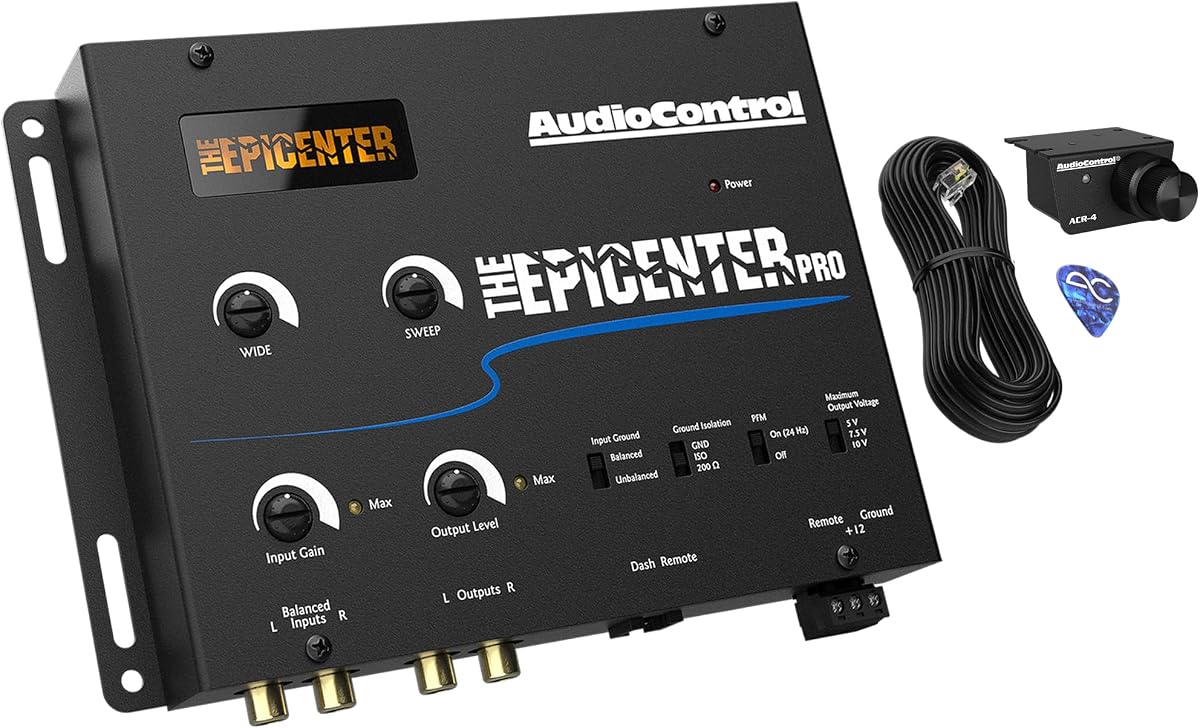
The AudioControl The EPICENTER PRO combines a bass-restoration processor with a high-voltage line driver, earning a supplied rating of 4.8. It is aimed at systems that need stronger low-frequency impact, cleaner signal transfer, and a straightforward path to equalizers, crossovers, and amplifiers. Its most distinctive feature is the patented bass restoration circuit, which detects upper-range harmonics and synthesizes a low-frequency foundation for recordings that lack bass authority.
We may earn a commission when you buy through this link, at no additional cost to you.
Signal quality is a major strength. The processor provides more than 105dB signal-to-noise performance and 0.03% total harmonic distortion, while balanced line-level input and output provide a clean path into downstream equipment. Selectable output voltage helps installers match the signal to an amplifier input stage more precisely, reducing the need to work with excessive gain. Dedicated frequency and width controls cover a 27–63 Hz center-frequency range, giving the installer meaningful control over where the synthesized bass appears and how broadly it affects nearby content.
The practical trade-off is that this is more than a simple signal converter. Installers who only need speaker-level conversion may find a dedicated locator more direct, and the optional ACR-4 dual-knob remote must be purchased separately. A programmable subsonic filter and integrated status LED add complexity, but they also make the unit easier to tune correctly and easier to monitor during gain adjustments.
This is an excellent choice for builders who want bass restoration and line-driving capability in one processor rather than a basic adapter. It is particularly attractive for modern factory systems that preserve low-bass impact poorly at higher volume levels. Installers should confirm the connection type, select the appropriate output voltage, and establish gain properly before making extensive bass adjustments.
The restoration circuit is most useful when the source contains harmonic information that can be used to reconstruct low-frequency content. The adjustable 27–63 Hz center frequency and selectable bandwidth let the installer place the effect more precisely than a fixed bass-restoration switch.
Balanced connections, selectable output voltage, and a stated 105dB-plus signal-to-noise ratio support a disciplined installation. These features are especially relevant when a line driver feeds a high-power amplifier through a longer cable run.
We may earn a commission when you buy through this link, at no additional cost to you.
The AudioControl LC1i is a two-channel line output converter with an integrated line driver, and it carries a supplied rating of 4.7. It is designed for the common task of taking speaker-level signals from an OEM radio or amplifier and producing RCA preamp signals for aftermarket subwoofers, amplifiers, or processors. That clear focus makes it one of the most approachable options in this guide.
We may earn a commission when you buy through this link, at no additional cost to you.
The LC1i accepts speaker-level input up to 400 watts per channel and uses onboard load-selection switches so compatible factory amplifiers continue to detect speaker loads. Its integrated line driver supports downstream amplification, while selectable Great Turn On signal sensing can power the unit without relying entirely on a conventional remote wire. A ground-isolation switch is useful when alternator whine or ground-loop noise is present, and the Remote Out connection can trigger downstream equipment.
The obvious limitation is its two-channel format. A complex factory system with multiple independently controlled zones may require a larger converter or a different architecture. The optional ACR-1 dash remote is also sold separately, and choosing the correct load setting is important because the unit is intended to cooperate with modern OEM amplifier electronics.
For a straightforward factory-radio upgrade involving a subwoofer or two-channel amplifier, the LC1i offers a compelling combination of useful features and a small footprint. It is a strong budget choice for installers who need clean RCA output, automatic turn-on, and modern vehicle load compatibility without buying a full crossover or bass processor.
The selectable 20-ohm, 60-ohm, and 20k-ohm load options help the LC1i emulate the load that a factory amplifier expects. This is important in newer vehicles where incorrect speaker-load detection can affect audio output or system behavior.
Great Turn On detects an audio signal and can power the converter automatically. The ground-isolation control adds another practical layer when the installation has a noise problem, although each adjustment should be made methodically rather than changed randomly.
We may earn a commission when you buy through this link, at no additional cost to you.
The AudioControl Epicenter Micro PRO is a premium bass-restoration processor and line driver with a supplied rating of 4.8. Unlike simpler converters, it accepts both speaker-level and balanced line-level inputs and provides balanced outputs for downstream equalizers, crossovers, and amplifiers. Its combination of flexible connectivity, clean output, and compact enclosure makes it particularly appealing for carefully planned factory-system upgrades.
We may earn a commission when you buy through this link, at no additional cost to you.
The patented bass restoration circuit detects upper-range harmonics and adds synthesized low-frequency content when a track lacks low-end authority. A 27–63 Hz center-frequency sweep and adjustable width allow the result to be aligned with the vehicle. The built-in line driver supports a high-voltage signal path, while the programmable frequency-match subsonic filter can reduce unwanted output. For specialized setups, the filter can be bypassed and 10V-plus maximum output accessed.
Signal performance is specified at more than 105dB signal-to-noise ratio and 0.03% THD. The chassis includes a conformal-coated circuit board for protection against moisture, dust, and temperature changes, and Great Turn On provides selectable signal-sensed startup. Although the enclosure is only stated as 1 by 8 by 3 inches, its feature density and processing capability put it firmly in a premium class.
This model makes the most sense for an enthusiast who wants more than basic conversion, particularly when the factory source has weak bass or the downstream amplifier benefits from a high-voltage signal. The optional ACR-4 dual-knob remote is necessary if the goal is convenient driver-seat control, so it should be considered part of the planned budget rather than an incidental accessory.
The selectable high-output mode and more than 105dB signal-to-noise specification distinguish this model from entry-level locators. High voltage can give a downstream amplifier a cleaner operating point, particularly where cable length or system complexity makes noise more difficult to control.
The combination of harmonic detection, generated low-frequency signal, adjustable center frequency, and width control gives the installer more influence over bass than a simple bass boost. The settings should be tuned alongside the subwoofer amplifier to prevent the processing from overwhelming the original music.
We may earn a commission when you buy through this link, at no additional cost to you.
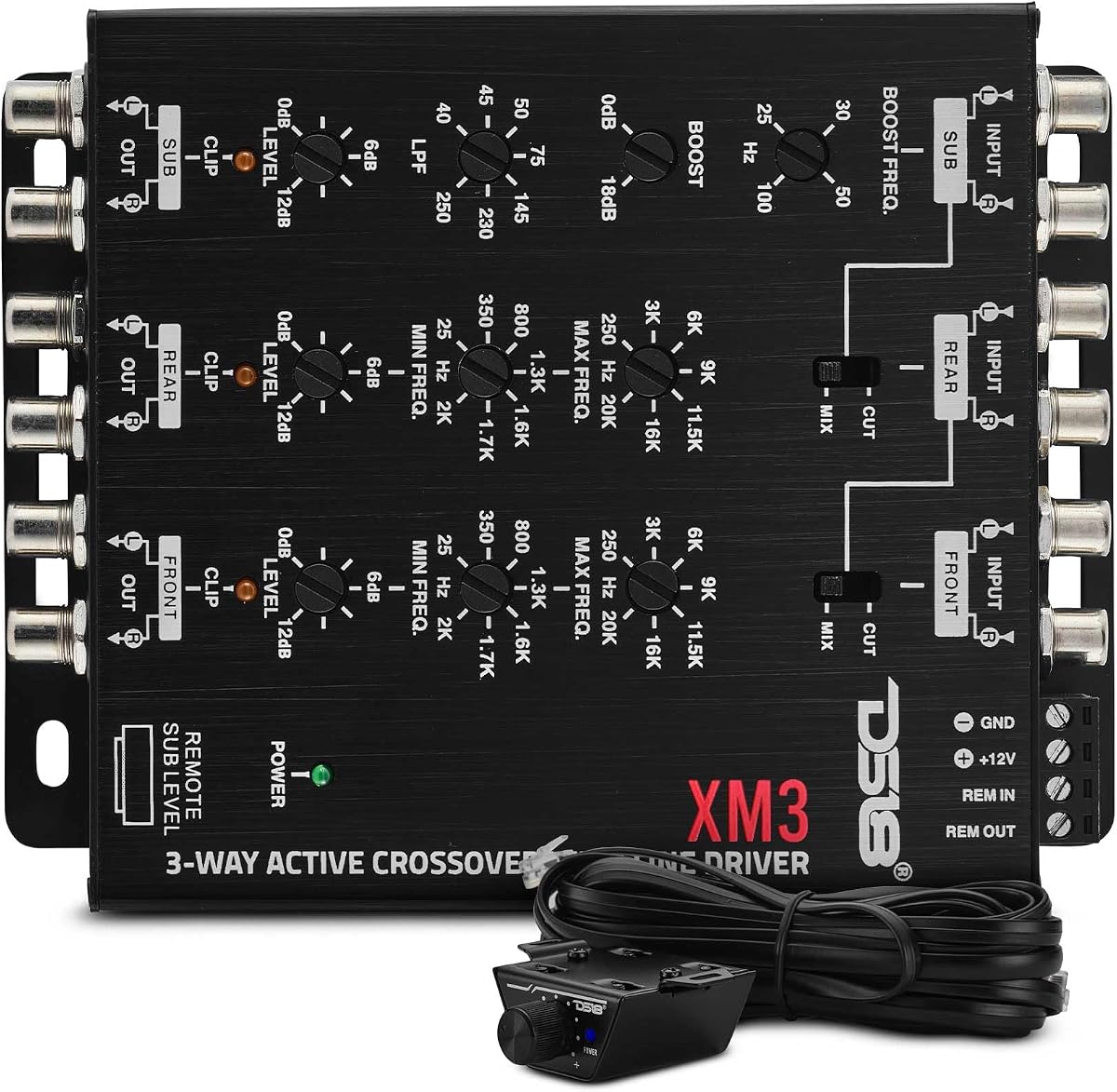
The DS18 XM3 is a three-way active crossover with an 11V line driver, adjustable bass boost, and a remote subwoofer controller. Its supplied rating is 4.1, the lowest among the ten products, but the underlying feature set is broad for a frequency processor. It gives installers separate front, rear, and subwoofer control rather than serving as a simple signal converter.
We may earn a commission when you buy through this link, at no additional cost to you.
The crossover supports three-, two-, and one-way configurations, making it adaptable to different system layouts. High-pass filters cover 25Hz to 2kHz, while low-pass filters range from 250Hz to 20kHz. The line output reaches up to 11 volts and is specified at 0.01% THD, giving downstream amplifiers a stronger and potentially cleaner input. A remote level controller with a clip indicator allows the driver to adjust bass while receiving a visual warning when the signal reaches the clipping point.
Tiffany RCA connectors, fast-connect power terminals, and a delayed remote output reinforce the product's professional-installation orientation. The main limitation is that the 4.1 rating suggests some degree of customer dissatisfaction, even though the listed specifications are attractive. As with any crossover, incorrect filter settings can reduce available gain or introduce phase problems, so setup knowledge is more important than simply having many controls.
The XM3 is best for a system builder who wants crossover and line-driving functions in one compact unit and values the included remote. It is less suitable for someone who only needs a two-channel adapter for a factory subwoofer installation. Confirm amplifier input compatibility and plan the filter layout before installing it.
Independent front, rear, and subwoofer adjustment lets the installer match different speaker locations and cabin positions. The ability to operate in one-, two-, or three-way modes also makes the unit useful as a system evolves.
The included remote level controller includes a clip indicator, which is useful when reducing gain or adjusting subwoofer output from the driver seat. Watching the indicator helps preserve headroom and avoid driving the output into distortion.
We may earn a commission when you buy through this link, at no additional cost to you.
The Timpano TPT-EQ7 combines a seven-band graphic equalizer, high-level input conversion, a crossover, subwoofer level control, and a high-voltage line driver. Its supplied rating is 4.6, placing it among the stronger customer-feedback results in the guide. The device is especially interesting for OEM upgrades because the built-in speaker-wire-to-RCA converter allows a factory radio to feed aftermarket amplification without replacing the head unit.
We may earn a commission when you buy through this link, at no additional cost to you.
Seven bands cover 50Hz, 125Hz, 320Hz, 750Hz, 2.2kHz, 6kHz, and 16kHz, with plus or minus 12dB adjustment at each frequency. Two inputs and six-channel RCA output provide more routing flexibility than a basic two-channel converter. RCA output can reach 10 volts, offering useful headroom for long runs, while the adjustable subwoofer output gives the installer a convenient method for balancing bass against the front stage.
The tradeoff is that a graphic equalizer is less surgical than a parametric processor. Its bands are fixed, and the product does not advertise phase correction or the fine notch filtering offered by the Wavtech linkDQ. It is best suited to broad tonal shaping and system integration rather than diagnosing a narrow frequency problem.
The TPT-EQ7 is a compelling choice for a factory-audio build that needs RCA conversion, modest bass management, and multi-channel adjustment in one slim package. Installers should use the equalizer conservatively, because aggressive boosts across several bands can reduce headroom and make the line driver's clean output more difficult to maintain.
The built-in high-level converter removes the need for a separate box when adding amplifiers to a factory radio. Combining that function with six-channel RCA output makes the TPT-EQ7 efficient for systems with front, rear, and subwoofer zones.
The advertised 10V line output improves signal headroom and can be useful when the amplifier is positioned farther from the source. Its value is greatest when paired with correct gain staging and properly shielded cables.
We may earn a commission when you buy through this link, at no additional cost to you.
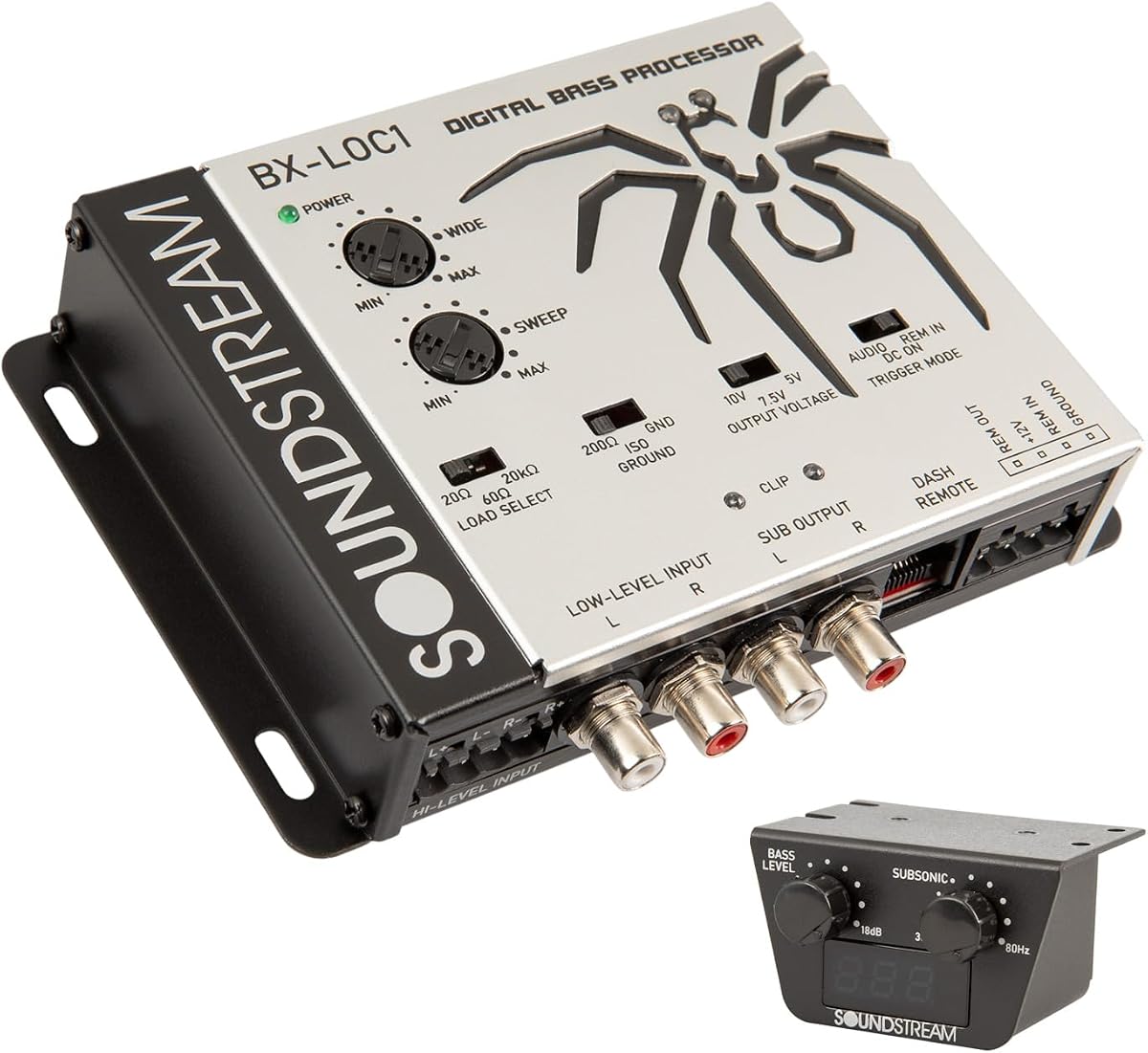
The Soundstream BX-LOC1 is a hybrid bass processor, line converter, and adjustable line driver with a supplied rating of 4.2. It accepts both speaker-level and RCA inputs, making it useful in factory and aftermarket installations. Its main purpose is to improve weak or compressed source material, add low-frequency impact, and deliver a clean preamp signal to an amplifier or subwoofer.
We may earn a commission when you buy through this link, at no additional cost to you.
The digital bass reconstruction feature targets tracks whose low end has been reduced, while the adjustable high-voltage output can reach 9V. Built-in line-output conversion, impedance matching, selectable turn-on methods, and an LED clipping indicator cover several common installation needs. Shielding and ground isolation are also included to reduce hiss, hum, and engine noise, while the small footprint and clearly labeled RCA connections support a tidy installation.
Compared with the AudioControl and DS18 options, the supplied information offers fewer precise filter and processing specifications. That makes the BX-LOC1 appear simpler to configure, but it also leaves questions about exactly how much adjustment is available beyond output level and bass restoration. Its 4.2 rating should prompt buyers to read recent customer feedback and verify compatibility before committing.
The BX-LOC1 is best for an installer who wants flexible input handling and bass reconstruction without a large processor. It can modernize a factory head unit or improve a modest aftermarket source. The main recommendation is to set output gain conservatively, watch the clipping indicator, and use the ground-isolation option only as needed during noise diagnosis.
The ability to accept either RCA or speaker-level input means the processor can sit between nearly any head unit and amplifier. That flexibility is valuable when a system is being assembled in stages or when the source equipment may change.
The onboard clipping indicator gives the installer a visible warning when output levels are too high. Used alongside a multimeter or careful listening, it can help preserve clean output and reduce the likelihood of distortion at the amplifier.
We may earn a commission when you buy through this link, at no additional cost to you.
The AudioControl LC2i is a two-channel line output converter created for adding subwoofers or amplifiers to a factory receiver while preserving useful factory-system behavior. It has a supplied rating of 4.6. Its defining feature is AccuBASS processing, which corrects the bass roll-off often heard when the volume on a factory radio is raised.
We may earn a commission when you buy through this link, at no additional cost to you.
Speaker-level signals up to 400 watts per channel can be converted into high-quality preamp outputs for aftermarket subwoofers, amplifiers, and processors. The LC2i provides both fixed and variable outputs with discrete level controls, allowing the installer to choose between a stable signal and an adjustable subwoofer feed. Great Turn On can automatically power the converter, while Remote Out can trigger up to two devices in the signal chain.
The important limitation concerns factory fader behavior. The supplied information specifically states that the LC2i does not retain fader control when running multiple amplifiers, and it points users toward the LC5i PRO, LC6i, LC7i, or LC7i PRO for that requirement. There is also no stated maximum output voltage, so the product should not be chosen for high-voltage line-driving duty.
This is an excellent option for a straightforward subwoofer addition where a factory radio is being retained. The compact chassis and integrated mounting brackets simplify placement, and AccuBASS makes it more useful than an unadorned converter in vehicles with pronounced volume-dependent bass loss. Installers needing full fader compatibility should choose a more specialized model.
AccuBASS addresses a specific and common weakness in upgraded factory systems: bass that fades away as the radio's volume rises. It can make a retained head unit feel more consistent, particularly when the goal is to add a subwoofer without replacing the factory electronics.
The distinction between fixed and variable outputs is essential. A fixed output is useful when a dedicated amplifier gain is managed elsewhere, while a variable output offers another level of control for a subwoofer system.
We may earn a commission when you buy through this link, at no additional cost to you.
The Wavtech linkDQ combines a two-channel line output converter, line driver, bass-frequency processing, and an adjustable parametric equalizer. It has a supplied rating of 4.7. The product description says it brings together the best features of the linkD, linkQ, and bassFREQ, giving it a broader toolset than a conventional locator.
We may earn a commission when you buy through this link, at no additional cost to you.
Its key advantage is the adjustable parametric EQ, which supports narrow or wide correction bands. That flexibility is valuable when the problem is a specific low-frequency deficiency or an unwanted resonance that a fixed seven-band equalizer cannot target accurately. Automatic startup can use either DC offset or audio signal detection, and an RJ45 port allows a compatible remote level control to be added later. OEM load detection is also supported to help the unit integrate with factory systems.
The main drawback is that the optional remote is not included, so a driver-friendly installation requires another purchase. The supplied information also does not state a maximum output voltage, THD figure, or detailed input rating. Buyers seeking documented high-voltage performance may find the AudioControl or DS18 specifications easier to compare.
The linkDQ is an attractive choice for an installer who wants accurate frequency correction rather than only baseline signal conversion. It is well suited to a carefully tuned two-channel factory upgrade, particularly when the issue is a defined bass problem. A measurement tool and disciplined gain staging remain important because parametric settings can easily overcorrect if the original problem is not properly diagnosed.
A parametric equalizer can address a narrower problem than a fixed-band graphic equalizer. Choosing a narrow band creates a more focused correction, while a wider setting addresses a broader region and produces a gentler tonal adjustment.
DC-offset and audio-signal detection offer two approaches to automatic power control. The RJ45 connection also makes the product easier to expand with a compatible remote, although that control is an optional addition.
We may earn a commission when you buy through this link, at no additional cost to you.
The AudioControl Matrix Plus 6-Channel High Voltage Car Audio Line Driver is a six-channel signal processor with a supplied rating of 4.5. It is designed for elaborate systems in which multiple balanced inputs, high-voltage outputs, gain control, and noise-management options are more useful than a simple two-channel conversion.
We may earn a commission when you buy through this link, at no additional cost to you.
Three sets of balanced differential line-level inputs feed three sets of low-impedance line-level outputs. The output reaches 13V peak, or 9.5V RMS at 14.4V, and the stated distortion is below 0.005% across a frequency range from 10Hz to 100kHz. A signal-to-noise ratio of -110dB is also listed. Variable output gain extends to +24dB, and LED indicators identify optimal and maximized output conditions.
Ground-loop management is unusually flexible, with common, ISO, and 200-ohm circuit choices. A 33Hz high-pass filter operating at 18dB per octave can protect speakers and reduce wasted amplifier power, while the optional ACR-1 remote provides front-seat master and subwoofer level control. The conformal-coated circuit board is designed to withstand vibration and environmental exposure.
The tradeoff is complexity and footprint. The enclosure measures 8.7 by 6.7 by 1.15 inches, larger than most two-channel locators, and the number of controls may be unnecessary for a simple subwoofer upgrade. This model is most appropriate for a complex multi-zone system where disciplined routing, high headroom, and flexible grounding justify the added sophistication.
The 13V peak output and gain range of up to +24dB provide substantial control for a system with several amplifiers and processors. This capability can reduce sensitivity to cable length and help create a cleaner gain structure in a professionally routed installation.
Selectable grounding circuits give installers several paths for addressing hum, while the adjustable 33Hz high-pass filter helps prevent infrasonic content from wasting amplifier power. Both features should be configured based on the actual vehicle and speaker requirements.
We may earn a commission when you buy through this link, at no additional cost to you.
The AudioControl Matrix Plus 6-Channel Line Driver offers a more focused six-channel gain solution, with a supplied rating of 3.6. It provides up to 24dB of gain and a stated maximum output of 9.5V RMS. The top-mounted controls make basic output adjustment accessible, and indicator lights show one-, two-, or five-volt output levels alongside a Maximized status.
We may earn a commission when you buy through this link, at no additional cost to you.
The product's appeal lies in its combination of channel capacity and gain range. It can support a system that needs more than a two-channel converter without adding a full equalizer or crossover. The illuminated output references can be particularly useful while establishing amplifier gain because they provide a visual indication of the available signal level.
The 3.6 rating is the weakest customer-feedback result among the ten listed products, so potential buyers should consider recent reviews carefully. The supplied information is also less extensive than for the other Matrix Plus model, omitting information about input type, noise performance, grounding options, filter controls, dimensions, and remote capability. That lower level of documentation limits a fully informed comparison.
This model is most defensible for an installer who already knows the required six-channel architecture and wants straightforward top-accessed gain control. It may be a practical option for a multi-amplifier build, but it is not the safest recommendation for a first-time builder. Confirm the connector layout, input compatibility, grounding method, and current manufacturer instructions before finalizing the installation.
The unit provides broad channel capacity while remaining focused on signal gain. That makes it potentially useful in a system where separate amplifiers handle different zones and no additional equalization is required at this stage of the signal chain.
The one-, two-, and five-volt indicators provide simple reference points during setup. The Maximized light shows when the unit is being used at its stated upper output capability, which is helpful during gain matching.
We may earn a commission when you buy through this link, at no additional cost to you.
The right line driver depends on the source, downstream equipment, channel count, factory-system behavior, and degree of signal processing required.
A line output converter is primarily used when a factory head unit or amplifier provides only speaker-level wiring. A device with both speaker-level and RCA inputs offers more flexibility, making it easier to build a new system, replace one component, or connect a factory source to aftermarket processing. Check the connector types and ensure the selected product is intended for the signal source rather than assuming every line driver accepts every input.
Choose a dedicated high-level converter for a simple subwoofer installation. Choose a mixed-input processor when the system may evolve or already includes aftermarket head units and processors.
Output voltage determines how much signal the downstream amplifier receives. Products in this guide range from units with no stated maximum voltage to models reaching 10V, 11V, or 13V peak. Greater headroom can be beneficial in long cable runs or complex systems, but voltage alone does not guarantee a clean result. Input impedance, grounding, cable quality, gain staging, and amplifier sensitivity all influence the final outcome.
Prioritize a stated output specification when line-driving quality matters. Match that output to the amplifier rather than maximizing it without measuring.
Two-channel products are appropriate for many factory subwoofer upgrades, while six-channel units can support front, rear, and additional zones. Count the actual preamp feeds required, including full-range and subwoofer outputs. A larger device may also provide a crossover or equalizer, but unnecessary channels can complicate the installation and make gain management less intuitive.
Match channel count to the signal chain, not the number of speakers in the vehicle. Extra channels are useful only when they have a defined destination.
Some modern factory amplifiers inspect speaker impedance to determine whether a speaker load is present. A converter that presents an unexpected load can interfere with that detection. Products such as the AudioControl LC1i and The EPICENTER PRO provide selectable load options so an installer can present a compatible load to compatible OEM electronics.
Confirm the vehicle's load-detection behavior before installation. Use the manufacturer's recommended setting and do not assume every factory amplifier behaves identically.
Alternator whine, hum, and hiss can result from ground differences, improper cable routing, or poor grounding. A selectable ground-isolation circuit can break a noise loop, while a high-voltage line driver may improve signal-to-noise performance. Neither feature should be used indiscriminately. Inspect the installation first and change one connection or setting at a time so the cause can be identified.
Look for grounding flexibility when a factory system is likely to be involved. Always test with the vehicle running and electrical loads active.
A dedicated locator preserves the source signal, while a bass-restoration processor may generate low-frequency content from upper-range harmonics. Graphic equalizers offer broad tone control at fixed bands, and parametric equalizers allow more targeted correction. These functions can improve a factory system, but they also create another set of variables that must be tuned with the subwoofer amplifier.
Choose bass restoration for weak low-end content and parametric EQ for a specific frequency problem. Use a graphic EQ when broad, repeatable tone shaping is the goal.
Automatic turn-on methods include audio-signal detection, DC-offset sensing, and conventional remote voltage. Great Turn On is useful in factory installations where finding a reliable remote-trigger wire is inconvenient. A dash-mounted level remote improves daily control but is typically an optional accessory. Confirm whether the product includes that remote before planning the controls around it.
Select an activation method that matches the source. If the remote is a major requirement, budget for the compatible accessory and verify its mounting style.
THD, signal-to-noise ratio, frequency response, input impedance, and maximum output voltage offer useful ways to compare line drivers. The supplied specifications vary in detail, so readers should avoid treating a missing figure as proof that a product performs poorly. Instead, consider how much the manufacturer documents and whether the product is specifically designed for the intended installation.
Use published specifications as a starting point, not a substitute for a correctly configured system. A clean installation remains the foundation of low-distortion audio.
Begin by identifying the source and destination. Determine whether the head unit or amplifier provides speaker-level or RCA output, note the number of channels, and inspect the factory amplifier's load-detection requirements. Disconnect vehicle power before wiring, use an appropriate fuse for the remote connection, and follow the manufacturer's terminal and polarity instructions.
Place the processor where it remains accessible for gain adjustment but away from moisture, excessive heat, and moving components. Route signal and remote cables away from high-current power wiring where possible. Establish output levels conservatively, turn the amplifier's gain down initially, and raise it only after the line driver is operating correctly.
Care involves checking connections, retaining proper grounding, and avoiding repeated changes without testing. Use the clipping indicators and voltage references provided by the selected product, then verify the final system with a range of music. Clean the enclosure gently, keep terminals free of debris, and review the manufacturer's installation instructions before changing any settings or adding accessories.
A line driver receives an audio signal and provides a cleaner, stronger output for the next stage in the system. It can convert speaker-level wiring to RCA preamp signals, increase voltage, reduce noise, and help an amplifier achieve a cleaner gain structure. Its exact role depends on the inputs, outputs, and processing features of the chosen model.
Usually, an aftermarket head unit with RCA outputs does not require a separate line driver. A line driver becomes more useful when adding an amplifier to a factory system, correcting signal issues, providing additional processing, or extending a signal over a longer run. A powered signal processor may provide better control than a simple passive adapter.
No. Higher voltage can improve headroom and help preserve a clean signal, but the amplifier and processor must be matched to that output. Excessive voltage can reduce available gain or make setup more difficult. The best result comes from controlled output, proper grounding, suitable cables, and an amplifier input stage matched to the signal.
A line output converter is primarily designed to turn a speaker-level signal into an RCA preamp signal. A line driver emphasizes a strong, clean output and may also include conversion, grounding controls, or signal processing. The terms overlap because many modern products perform both jobs in one enclosure.
It can help if the noise is caused by a weak signal, unsuitable impedance, or a ground loop that the product is designed to address. A ground-isolation switch may break certain loops, while high-voltage output can improve signal-to-noise ratio. Persistent whine can also come from improper power or speaker routing and may require wiring changes rather than another processor.
It is important in many modern vehicles because factory amplifiers may monitor speaker impedance before passing audio. A converter with selectable load options can present a compatible load to supported factory systems. The correct setting depends on the vehicle and should be verified with the manufacturer or installer rather than copied blindly from another project.
Not inherently, but the effect can expose poor gain staging or drive the output too hard. A properly configured bass-restoration processor should remain within its output capability, and downstream gain should be set with the processed signal in place. Excessive boost, narrow corrective settings, or an unsuitable crossover frequency can produce audible problems.
A remote is convenient when the driver should adjust overall level or subwoofer output frequently. Some models include a remote, while others require a separate purchase. If the amplifier has usable controls and the system rarely needs adjustment, the remote may not be necessary; if daily level control is important, include it in the installation plan.
The AudioControl The EPICENTER PRO stands out for combining high-voltage line driving with detailed bass restoration, while the AudioControl LC1i is a more focused and budget-friendly two-channel solution. The AudioControl Epicenter Micro PRO serves buyers who want premium processing, flexible source inputs, and refined bass control in a compact enclosure.
For a simple factory subwoofer upgrade, prioritize the correct input type, automatic turn-on, ground control, and easy gain adjustment. More elaborate systems benefit from higher-voltage output, balanced connections, selectable load detection, crossover integration, or parametric equalization. Always match the device to the downstream amplifier and the vehicle's electrical behavior rather than selecting only on output wattage.
Features, accessory availability, manufacturer configurations, and product prices can change over time. Check the current listing and official instructions for the exact model, confirm that every connector fits the planned installation, and review the latest customer feedback before purchasing.