
Unocho 6V/12V Battery Charger Maintainer
4.6Editor score
Supports 6V and 12V
Five-stage charging process
Multiple built-in protections
LED charge status indicators
Our Lead Acid Battery Trickle Charger Maintainer guide compares ten smart chargers for safety, battery compatibility, charging stages, monitoring, and
A lead acid battery trickle charger maintainer does more than supply a small, steady current. Good units recognize battery type, complete a controlled charge, and then reduce output to a float stage that offsets natural self-discharge without continually overcharging. That balance makes these chargers useful for seasonal vehicles, motorcycles, boats, lawn equipment, and stored automobiles.
The ten products in this guide were compared using the supplied specifications, compatibility claims, safety features, charging methods, monitoring options, included accessories, warranties, and customer ratings. The list covers compact maintenance units, higher-output automotive chargers, selectable lead acid and lithium models, and direct-mount options designed for permanent installation.
Each review explains the features that distinguish its charger while identifying important trade-offs, such as lead-acid-only support, added installation requirements, or a specific use case. The top selections represent the strongest combinations of functionality, convenience, and value, and product listings, availability, and market conditions can change over time.
4.6Editor score

4.8Editor score
4.5Editor score
This side-by-side comparison highlights each charger's electrical range, charging approach, battery compatibility, monitoring, and practical advantages. It helps distinguish simple storage maintainers from higher-output, selectable, repair-oriented, or permanently mounted charging systems.


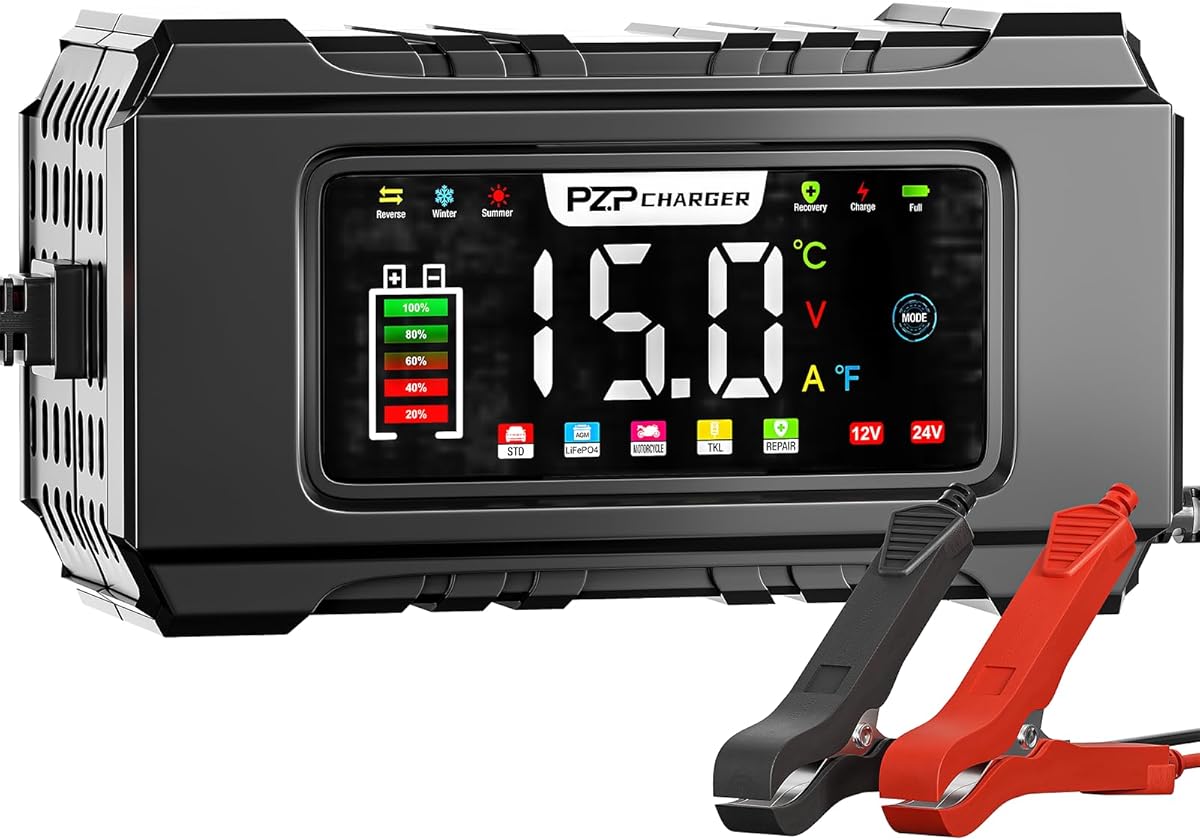
The PZ.P Smart Charger is the most feature-rich model in this guide, combining 12V and 24V operation with an automatic nine-stage charging process. Its 4.5 rating reflects a strong overall reception, while the color screen, selectable operating modes, and broad battery compatibility distinguish it from simple storage chargers. It is particularly attractive to owners with several types of 12V equipment or a 24V system.
We may earn a commission when you buy through this link, at no additional cost to you.
The charger supplies 15 amps for 12V batteries and 8 amps for 24V batteries, offering considerably more throughput than the compact maintenance units in the list. It supports LiFePO4, AGM, gel, SLA, and flooded lead-acid batteries, making it useful across cars, trucks, SUVs, motorcycles, lawn mowers, boats, and marine applications. After the main charge, it changes to trickle or float maintenance to support long-term storage.
Its large color display is unusually informative for this category, showing charging voltage, current, internal temperature, charge percentage, and separate summer and winter modes. A 6.7-foot cable adds reach for awkward battery locations. Temperature compensation adjusts charging behavior to the environment, while protections cover reverse polarity, overcurrent, overvoltage, short circuits, undercharging, and overheating.
The important limitation is clearly stated: the pulse repair function cannot activate or charge a totally dead battery. It is also more complex than a basic maintainer, so buyers who only need a small charger for one small motorcycle battery may find some of its functionality unnecessary. Even so, it is the strongest choice here for broad vehicle support, detailed monitoring, and high-current charging.
The 12V and 24V range separates this charger from most of the competition. Broad lead-acid chemistry support, plus LiFePO4 compatibility, means owners can use one unit across vehicles and equipment rather than maintaining separate chargers.
The color screen exposes more operating information than a basic LED indicator, including voltage, current, temperature, and charge percentage. That visibility is useful when diagnosing a weak battery or deciding whether a connection is behaving as expected.
We may earn a commission when you buy through this link, at no additional cost to you.
The Battery Tender Junior 750mA is our Editor's Choice because it combines a highly rated 4.8 customer score with a focused, uncomplicated approach to 12V powersport battery care. It fully charges a compatible battery and then switches to float mode, making it a natural choice for motorcycles, ATVs, and other small 12V lead-acid systems that sit unused for extended periods.
We may earn a commission when you buy through this link, at no additional cost to you.
Its complete four-step program consists of initialization, bulk charge, absorption, and float. The sequence is designed to optimize battery power without overcharging, while adaptive charging resumes full output if voltage drops too far under load. Compatibility covers flooded, AGM, and gel-cell batteries, giving it broader utility than a charger limited to one battery construction.
Installation is straightforward. The package includes a 12-foot output cord, a fused-ring terminal harness for difficult-to-reach batteries, and alligator clip cables for temporary connections. Spark-proof circuitry reduces risk during lead attachment, and automatic reversed-hookup detection verifies the connection before the unit supplies power.
Its 750mA output is intentionally modest, making it better suited to smaller powersport batteries than large automotive starting systems. It is also a 12V lead-acid-focused product without lithium support. Those limits are reasonable for its intended market, and the combination of four-step charging, automatic float behavior, included accessories, and strong customer feedback makes it an especially persuasive all-around storage maintainer.
Initialization, bulk charging, absorption, and float give the battery a controlled path to full charge before long-term maintenance. The transition to float makes the unit suitable for storage rather than merely a timed charger.
The fused-ring harness is especially valuable on motorcycles and ATVs where the battery sits beneath bodywork or inside a confined compartment. Alligator clips provide a convenient alternative when frequent removal is needed.
We may earn a commission when you buy through this link, at no additional cost to you.
The Battery Tender Plus 1.25A earns a 4.7 rating and sits between the very small Junior model and the more powerful automotive chargers in this roundup. Its 1.25-amp output and four-step charging program make it a versatile choice for 12V automotive batteries, motorcycles, ATVs, and lawn mowers that need more charging throughput than a minimal storage unit.
We may earn a commission when you buy through this link, at no additional cost to you.
Rather than applying a simple trickle, the charger follows initialization, bulk, absorption, and float stages. That controlled approach is intended to optimize battery health and avoid overcharging. A two-color status LED reports the current state, and if battery voltage falls too far under load, the charger resumes full output to compensate.
Convenience is a major strength. The quick-disconnect harness allows the charger to remain installed while the cable is removed for vehicle use, reducing the chance of wiring mistakes. The package also includes a fused ring terminal and alligator clip accessory cables, providing flexible options for routine maintenance and temporary connections.
The product is limited to 12V operation, and the supplied information does not identify lithium compatibility. It also relies on a simple status light rather than a screen showing voltage and current. Even so, it is a balanced general-purpose maintainer with a meaningful step up in output, a 10-year manufacturer's warranty, and broad support for common vehicles and equipment.
At 1.25 amps, the Plus model provides a useful middle ground between small powersport chargers and 2A or 3A automotive units. That makes it flexible for 12V batteries of several sizes.
Keeping the charging harness mounted simplifies recurring maintenance. A user can disconnect the lead quickly when the vehicle is needed and reconnect it for storage without rebuilding the entire setup.
We may earn a commission when you buy through this link, at no additional cost to you.
The Unocho 6V/12V Battery Charger Maintainer combines useful output with unusually broad battery support. Its 4.6 rating and five-stage microprocessor-controlled process make it an attractive general-purpose option for owners who need to service 6V as well as 12V lead-acid batteries without relying on a very basic trickle circuit.
We may earn a commission when you buy through this link, at no additional cost to you.
Compatibility extends to SLA, AGM, gel, VRLA, wet, and deep-cycle batteries. The charger is therefore suitable for a broad collection of cars, motorcycles, lawn mowers, boats, ATVs, RVs, scooters, golf carts, and snowmobiles. Its five stages cover detection, soft start, bulk charging, absorption, and float maintenance, providing a more structured process than a constant-current approach.
Safety is another strength. Reverse polarity, short-circuit, overvoltage, overcurrent, overload, and thermal protection are included. A 72-hour safety timer and inline 10A fuse add further safeguards during charging and maintenance. LEDs indicate charging, full charge, and maintenance status, allowing a quick visual check without interpreting a complex display.
The package includes detachable alligator clips, ring terminals, and an SAE quick-disconnect connection. That gives users several ways to reach batteries in vehicles, garages, workshops, or travel kits. Its drawbacks are the lack of lithium support and the presence of a timed safety cycle. Overall, it is a strong budget-oriented choice for lead-acid users who value compatibility and protections over advanced diagnostics.
Supporting 6V batteries makes this charger relevant to older equipment, small deep-cycle systems, and mixed collections. Most competing compact units focus only on 12V applications.
A timer, inline fuse, and multiple electronic protections help make unattended maintenance more practical. These safeguards supplement the automatic float stage rather than replacing it.
We may earn a commission when you buy through this link, at no additional cost to you.
The MOTOPOWER MP00205A is a compact 12V charger that combines conventional charging, float maintenance, trickle operation, and automatic desulfation. Its 4.5 rating reflects a balanced feature set, while the zero-output standby function and simple operating procedure make it convenient for owners who want storage maintenance to begin with minimal intervention.
We may earn a commission when you buy through this link, at no additional cost to you.
It is designed for 12V lead-acid batteries, including flooded, AGM, and gel-cell types. During operation, it detects sulfation and applies pulse current to attempt to improve battery condition. The unit can charge up to 14.4V and then maintain the battery at 13.6V, a transition intended to support long-term upkeep while limiting excessive gassing.
Safety features include protection against overcharging, short circuits, and reversed polarity. A 24-hour timer terminates the charging program and enters maintenance mode when the voltage reaches its specified threshold. The charger also uses spark-proof connection behavior and draws no standby output from the battery, which is valuable when a vehicle may remain outside in changing weather.
There are two notable constraints. It does not cover 6V or lithium batteries, and its timer can interrupt a prolonged charging session rather than allowing unrestricted operation. Even so, the automatic desulfation function, straightforward setup, and all-weather intent distinguish it from a bare trickle charger. It is a sensible compact option for flooded, AGM, and gel 12V batteries in motorcycles, cars, and similar equipment.
The pulse-based desulfation process is integrated into ordinary charging and requires no separate control cycle. This makes the feature convenient for users who may not know whether a stored battery has developed sulfation.
Zero output in standby mode helps ensure that the charger does not quietly consume battery energy while waiting. That is especially useful for seasonal equipment connected to mains power intermittently.
We may earn a commission when you buy through this link, at no additional cost to you.
The Battery Tender Junior 800mA shares the top customer rating in this guide at 4.8 and adds a feature missing from many compact maintainers: selectable LiFePO4 compatibility. It supports 12V lead-acid batteries, including AGM, flooded, and gel types, as well as lithium batteries, making it useful for mixed powersport collections.
We may earn a commission when you buy through this link, at no additional cost to you.
A push button changes the desired battery type, and the internal ISM microcontroller continually adjusts the charge sequence to the selected chemistry. Rather than treating lithium and lead acid identically, the charger provides a more appropriate operating mode for each. It is designed for motorcycles, ATVs, UTVs, personal watercraft, and scooters.
The unit is compact and lightweight, allowing operation in confined spaces where a larger charger would be inconvenient. Its safety design includes spark-proof lead connection behavior and automatic reverse-polarity detection, which helps confirm that the cables are attached correctly before power is supplied. The supplied information also lists ETL US/CSA, FCC, ICES, and BC certification, along with a five-year warranty.
The 800mA output is modest, so this is best suited to smaller powersport batteries rather than demanding large automotive starting batteries. It also remains a 12V-only charger without 6V support. For users who want a compact, well-reviewed unit and may own both lead-acid and lithium batteries, that chemistry flexibility makes this one of the most useful options in the roundup.
The battery-type selector is particularly practical for owners who maintain a mixture of powersports. Matching the charger to the battery chemistry is more important than treating every 12V battery identically.
The lightweight enclosure and low-maintenance operation suit motorcycles, personal watercraft, and other equipment where space is limited. It can remain on the battery for extended maintenance without occupying a large work area.
We may earn a commission when you buy through this link, at no additional cost to you.
The NOCO GENIUS2D is designed for a fundamentally different use from most portable maintainers: permanent installation near the battery. Its 4.6 rating, 2A output, and direct-mount bracket make it a strong choice for vehicles that remain connected to mains power during extended storage and require a reliable, always-ready charging arrangement.
We may earn a commission when you buy through this link, at no additional cost to you.
The charger supports a wide range of 12V lead-acid types, including AGM, gel, SLA, and VRLA batteries, along with flooded, maintenance-free, deep-cycle, marine, and RV batteries. An integrated thermal sensor adjusts the charge according to ambient temperature, helping prevent hot-weather overcharging and cold-weather undercharging.
Its recovery features go beyond ordinary float maintenance. The charger can work with batteries down to 1 volt, and Force Mode offers a manual path for batteries at zero volts. Precision pulse charging is designed to detect and reverse sulfation and acid stratification, with the goal of restoring battery health and extending useful service life.
The principal trade-off is installation complexity. A durable snap-fit bracket and self-tapping screws are included, along with 24-inch AC and DC cables and eyelet terminals, but the unit is intended to remain mounted. Its supplied compatibility information also focuses on lead-acid batteries rather than lithium. For a vehicle that benefits from a permanently installed maintenance system, these limitations are outweighed by the feature-rich onboard design.
A fixed charger eliminates repeated battery-terminal connections and provides a clean approach to long-term storage. The included bracket, screws, and eyelet terminals support a secure installation near the battery.
Low-voltage charging and Force Mode are useful when a battery has sat unused for an extended period. Pulse restoration also targets common forms of deterioration that a basic float charger may not address.
We may earn a commission when you buy through this link, at no additional cost to you.
The Suuwer 1.25A Maintainer is a dual-voltage lead-acid charger designed to combine regular charging, long-term maintenance, and clear status feedback. Its 4.6 rating and four-stage LED system make it easy to understand, while automatic float operation allows it to remain connected after the battery reaches full charge.
We may earn a commission when you buy through this link, at no additional cost to you.
It supplies stable 1.25A output and supports both 6V and 12V batteries. Its compatibility list includes AGM, gel, SLA, VRLA, flooded, maintenance-free, deep-cycle, and marine batteries. Potential applications include cars, motorcycles, ATVs, lawn mowers, boats, RVs, and tractors, giving it broad appeal across mixed equipment collections.
The indicator system provides more detail than a single status light. Red flashing signals an unrecognized battery or connection error, solid red shows normal charging, green flashing indicates approximately 80% charge, and solid green means the battery is full and the unit has entered auto-maintenance mode. This makes it possible to check the process at a glance without connecting a separate meter.
Low-voltage detection is another meaningful feature. The system identifies batteries below 3.5 volts and stops fast charging to avoid forcing energy into a severely depleted battery. Over-temperature, reverse-polarity, and over-voltage protections are included as well. Its limitations are the lack of lithium support and the absence of a screen showing exact voltage or current. For lead-acid users who prioritize understandable indicators and safe automatic behavior, it is a strong choice.
Four clearly differentiated states communicate errors, charging progress, near-full charge, and float maintenance. This is an effective compromise between a bare charger and a screen-equipped model.
Automatically stopping fast charge below the stated detection threshold helps protect a deeply discharged battery. The behavior is especially relevant for storage batteries that may have been neglected for months.
We may earn a commission when you buy through this link, at no additional cost to you.
The Battery Tender 3 AMP is built for owners of larger 12V batteries who need more charging current than a compact powersport maintainer can offer. Its 4.7 rating reflects a strong balance of features, including switchable 6V and 12V operation, lead-acid and lithium compatibility, and a three-amp output for cars, SUVs, and trucks.
We may earn a commission when you buy through this link, at no additional cost to you.
The charger first delivers a full charge and then transitions automatically into float mode, where it maintains the proper voltage without continuous overcharging. A solid two-color LED indicates the charging status, and ISM adaptive charging resumes full output if the battery voltage falls too far under load. That restart behavior makes it more responsive than a simple timed trickle device.
The combined reach of the 6-foot AC cord and 5-foot DC charging output is substantial for larger vehicles and installation areas where the battery is far from a wall outlet. The package includes a ring terminal and alligator clip combination cable, an instruction manual, and a five-year manufacturer's warranty. Spark-proof connection behavior and automatic reverse-polarity detection improve setup safety.
There is some ambiguity in the supplied product information, which refers to a three-amp charger while also mentioning five amps in one bullet, but the model name and primary description identify it as the 3 AMP unit. It also uses a simple LED rather than a detailed display. For larger automotive batteries and a broad mix of supported systems, the extra output makes it a compelling option.
A 3-amp output is meaningfully greater than the 750mA to 1.5A offered by most compact units in the list. That makes the charger more appropriate for larger vehicle batteries and prolonged maintenance.
Adaptive charging can return to full output when the battery voltage falls under load. The feature makes the maintainer better suited to irregular use than a fixed-current trickle charger.
We may earn a commission when you buy through this link, at no additional cost to you.
The Battery Tender 2 AMP combines a 2-amp output with selectable 6V and 12V operation, making it a flexible middle ground for a broad range of batteries. Its 4.7 rating indicates strong customer reception, and the complete four-step program ensures that the unit moves beyond an uncontrolled trickle into a managed charge-and-maintain sequence.
We may earn a commission when you buy through this link, at no additional cost to you.
Compatibility covers 12V lead-acid batteries, including flooded, AGM, and gel-cell types, while the selectable design also supports lithium operation. This breadth makes the charger useful for users who maintain equipment with different battery requirements rather than committing to a lead-acid-only unit.
The two-color solid-state LED shows charging status, and the adaptive charging system restores full charger output if the battery voltage falls too far under load. Once the battery is fully charged, the charger switches into float mode for long-term storage. A ring terminal and alligator clip combination cable supports flexible connections.
The product does not offer the detailed voltage, current, or temperature display found in the PZ.P model, and its 2-amp output may exceed what a very small motorcycle battery needs. Even so, it combines an output level capable of handling many automotive-sized systems with unusually broad voltage and chemistry support. The listed certifications and seven-year manufacturer's warranty add further confidence for owners seeking a long-term maintenance solution.
Selectable 6V, 12V, lead-acid, and lithium support allows the same charger to serve more equipment. It reduces the need to keep separate specialized chargers for older and newer battery systems.
At 2 amps, the unit offers more charging capacity than compact maintainers while remaining far less intensive than a high-current workshop charger. It sits comfortably between occasional maintenance and more demanding recovery.
We may earn a commission when you buy through this link, at no additional cost to you.
The right maintainer depends on battery voltage, chemistry, capacity, storage conditions, and how often you want to check the charge. These factors help separate a basic storage charger from a smarter system with recovery, monitoring, or permanent-mounting capabilities.
Voltage compatibility is the first filter because a charger designed for one battery system may not safely serve another. Many compact maintainers handle only 12V batteries, while several models in this guide support both 6V and 12V operation. The PZ.P charger goes further with 12V and 24V capability, including different maximum outputs for each voltage. Confirm the label on the battery and the charger's supported range before connecting anything, especially with older 6V equipment or commercial 24V systems.
Most conventional lead-acid maintainers support flooded, AGM, gel, SLA, VRLA, and related constructions, but lithium compatibility remains a separate decision. Models with selectable chemistry are useful for mixed collections because the charging profile can be adjusted to the installed battery. Do not assume that a charger advertised for 12V lead acid is automatically appropriate for LiFePO4. When lithium support is absent, use one of the lead-acid-focused models only for compatible lead-acid batteries.
Output determines how quickly a charger can deliver energy before moving into maintenance. The 750mA and 800mA models suit smaller motorcycle and powersport batteries, while 1.25A, 1.5A, and 2A units offer more flexibility across cars, motorcycles, lawn equipment, and boats. The 3-amp automotive model and the PZ.P unit's 15A or 8A output are better suited to larger batteries and more demanding charging situations.
A smart maintainer should move through controlled stages rather than applying one fixed current indefinitely. Four-step and five-stage programs in this roundup include bulk charging, absorption, and float maintenance, with detection or initialization stages helping the charger assess the battery. Float mode is the key long-term feature because it replaces lost energy without continuously driving the battery as hard as a full charging cycle.
Safety controls matter because a charger may remain connected for weeks or months. Look for reverse-polarity detection, short-circuit protection, overvoltage and overcurrent safeguards, thermal protection, and spark-resistant connection behavior. Timers and fuses provide additional layers, while temperature compensation can improve charging in hot or cold environments. The most valuable setup is one combining several protections rather than relying on a single warning feature.
A portable charger is convenient for occasional maintenance and can be moved between motorcycles, cars, and recreational equipment. An onboard model such as the NOCO GENIUS2D is designed to mount near the battery and remain installed, making it appropriate for long-term storage where mains power is available. Consider the location, mounting surface, cable reach, and whether a permanent installation is permitted before selecting an onboard design.
Monitoring ranges from a simple two-color status light to a full color screen showing voltage, current, temperature, and charge percentage. More detail can help with troubleshooting, but the most important behavior is automatic float activation and renewed output if voltage falls under load. Ring terminals, fused harnesses, alligator clips, and SAE quick disconnects improve installation flexibility, especially when a battery sits beneath body panels or inside a boat.
Some chargers add pulse-based desulfation, acid-stratification recovery, low-voltage charging, or a force mode intended for deeply discharged batteries. These features may help a neglected battery, but they do not guarantee that every abandoned battery can be restored. If a battery is completely dead, the PZ.P unit specifically cannot activate or charge it. Review recovery claims carefully, and recognize that a charger maintains a battery rather than replacing a battery that has reached the end of its service life.
Begin by identifying the battery's voltage, chemistry, and terminal locations. Consult the charger instructions and ensure its selected mode matches the battery. Clean the terminal area, connect the red lead to the positive terminal and the black lead to the negative terminal, then check the charger's status indication for a connection or polarity error before operating it.
Place the charger on a stable, dry, ventilated surface away from combustible materials. For a portable model, use the included ring terminal for a semi-permanent connection or alligator clips for occasional service. For a direct-mount unit, secure the bracket near the battery with the supplied hardware, route the cables carefully, and follow the manufacturer's installation requirements.
Allow the charger to complete its bulk and absorption stages, then confirm that it has entered float or maintenance mode. Check the status light or display periodically, especially after severe weather or a long period of inactivity. Use a proper battery tester or multimeter when more detailed voltage information is needed, and remove the charger if the battery, cable, connector, or charger shows physical damage, overheating, leaking, or an unexpected fault indication.
A smart maintainer can generally support long-term storage because it automatically transitions to float mode after the battery reaches full charge. The exact installation, battery condition, temperature, and charger quality still matter, so periodic visual checks are advisable. A maintainer preserves charge but cannot correct every type of permanent battery damage.
A basic trickle charger supplies a small, relatively constant current with little automatic regulation. A smart maintainer detects the battery, uses staged charging, and reduces output during float maintenance. The staged approach is better suited to lead acid because it manages bulk charge, absorption, and maintenance more deliberately.
Yes, if the charger explicitly supports AGM batteries and the battery's voltage matches the charger. Many maintainers in this guide support flooded, AGM, gel, SLA, or VRLA lead-acid batteries. Always confirm both the voltage and chemistry before connecting the charger.
Only when the manufacturer explicitly identifies the charger as compatible with that lithium chemistry, usually LiFePO4, and the correct selection is made. A 12V label alone does not prove lithium compatibility. Use a dedicated lithium-compatible charger for any lithium battery not expressly covered by the supplied product information.
Modern smart chargers are designed for extended maintenance and will reduce output to float after charging. For a seasonal vehicle, many owners leave the charger connected throughout storage, while still checking the connection and status periodically. Follow the charger instructions and stop using it if damage, overheating, or unexpected behavior is detected.
Adaptive chargers may resume full output when battery voltage falls too far, which can occur when the battery is loaded or is naturally losing charge during storage. This is normal behavior when the system judges that additional charging is needed. Repeated cycling may also point to a weak battery, poor terminal connection, or undersized charger, all of which deserve attention.
Ring terminals are convenient for a semi-permanent installation and are often easier to reach on motorcycles, boats, and other equipment with restricted access. Alligator clips are useful for temporary connections and quick checks. Including both gives the user more flexibility, especially when a battery is moved or inspected regularly.
It depends on the charger and the battery. Some models offer low-voltage or force modes, while the PZ.P charger expressly cannot activate or charge a totally dead battery. Even a capable charger cannot reverse every form of permanent damage, so a battery that will not recover may need replacement.
The Unocho is the best budget-oriented choice because it combines 6V and 12V support, five-stage charging, extensive protections, and several connection options. The Battery Tender Junior 750mA is the most focused solution for 12V powersports, offering a compact body, four-step charging, automatic float mode, and a 4.8 customer rating. For broad features, detailed monitoring, high current, and support for 12V, 24V, lead-acid, and LiFePO4 systems, the PZ.P Smart Charger stands apart.
Prioritize exact voltage and chemistry compatibility before considering output or extra features. Once those requirements are met, look for a proper charging sequence, reliable float mode, temperature awareness where possible, and layered protection against reverse polarity, short circuits, overcurrent, and overvoltage. A ring terminal and quick-disconnect option can make long-term use much more convenient.
The right charger should fit the battery without being unnecessarily complicated, but it should also be more controlled than a constant trickle. Review the current product listing carefully for compatibility, included accessories, warranty details, and operating instructions, since specifications and market conditions can change over time.