
WVL 7400mWh Emergency Weather Radio
4.6Editor score
Compact 231g construction
Three backup power sources
2000mAh phone charging battery
NOAA, AM, and FM radio
Discover the best hand crank radio cell phone chargers, comparing battery capacity, radio reception, lighting, charging options, and portability.
Hand crank radio cell phone chargers combine emergency radio reception, backup lighting, alternate power sources, and portable battery output in one preparedness tool. A strong model can provide weather alerts during outages, keep a phone available for essential calls, and offer hand-cranked, solar, and wall charging when conventional electricity is unreliable.
This guide compares ten hand crank radio cell phone chargers based on their stated battery capacities, supported radio bands, charging methods, lighting features, emergency alarms, dimensions, and water-resistance specifications. The list covers compact models for grab-and-go kits as well as higher-capacity units designed to power multiple devices during prolonged outages.
Each selection highlights the features that distinguish it from the alternatives, while also identifying practical trade-offs such as smaller internal batteries, required accessories, or limited charging output. Ratings reflect the supplied customer feedback, and prices, availability, and product configurations can change, so readers should verify current listing details before purchasing.
4.6Editor score

4.7Editor score

4.5Editor score
The table below compares the ten radios by battery capacity, radio coverage, emergency lighting, and physical design, making it easier to identify the model that best matches your emergency kit.




The Solar Radio Emergency Hand Crank 12000mAh with Clear Signal combines a 12000mAh internal battery, an unusually large 8500mm² monocrystalline solar panel, and a high-sensitivity reception system for NOAA, FM, and AM broadcasts. Its 4.7 rating reflects a favorable balance of useful emergency functions, and the stated charging performance makes it one of the most versatile selections in this guide.
We may earn a commission when you buy through this link, at no additional cost to you.
Its standout feature is the combination of charging flexibility and usable capacity. The radio can draw power through its hand crank, solar panel, or an internal charging path, while the 12000mAh battery can support a phone and keep the radio and lights operating. The upgraded generator uses a larger copper coil and reinforced magnet, and the extended crank arm is designed for smoother rotation. A high-sensitivity signal chip, noise-reduction circuitry, and an extended antenna support reception in a broad range of emergency and outdoor settings.
The lighting system is also more than a basic emergency beacon. Its focused flashlight is advertised with a beam reaching as far as 260 feet, while a flip-up frosted reading lamp provides softer illumination. Both lights offer two brightness levels, making the radio more useful around the home, in a tent, or along a dark trail. The radio measures 6.8 by 2.9 by 4.7 inches and uses a large tuning knob, responsive buttons, clear labels, and a nonslip grip.
The main trade-off is size. This is not as pocketable as the smaller 2000mAh alternatives, and the manufacturer advises checking the battery upon delivery and fully charging it before first use. Even so, households seeking one device that can combine weather information, portable power, phone charging, and dependable lighting will find this model particularly compelling. It is our overall choice because its stated capacity and broad feature set avoid the compromises imposed by smaller emergency radios.
The 8500mm² monocrystalline panel is substantially larger than the decorative panels used by many competitors. Combined with the 12000mAh battery and upgraded generator, it gives the radio a credible foundation for extended outages, remote travel, and repeated phone charging needs.
Noise-reduction circuitry, a high-sensitivity chip, and an extended antenna are designed to improve broadcast clarity. Large controls, straightforward labels, and a nonslip grip also make the unit easier to operate under stress or in the dark.
We may earn a commission when you buy through this link, at no additional cost to you.
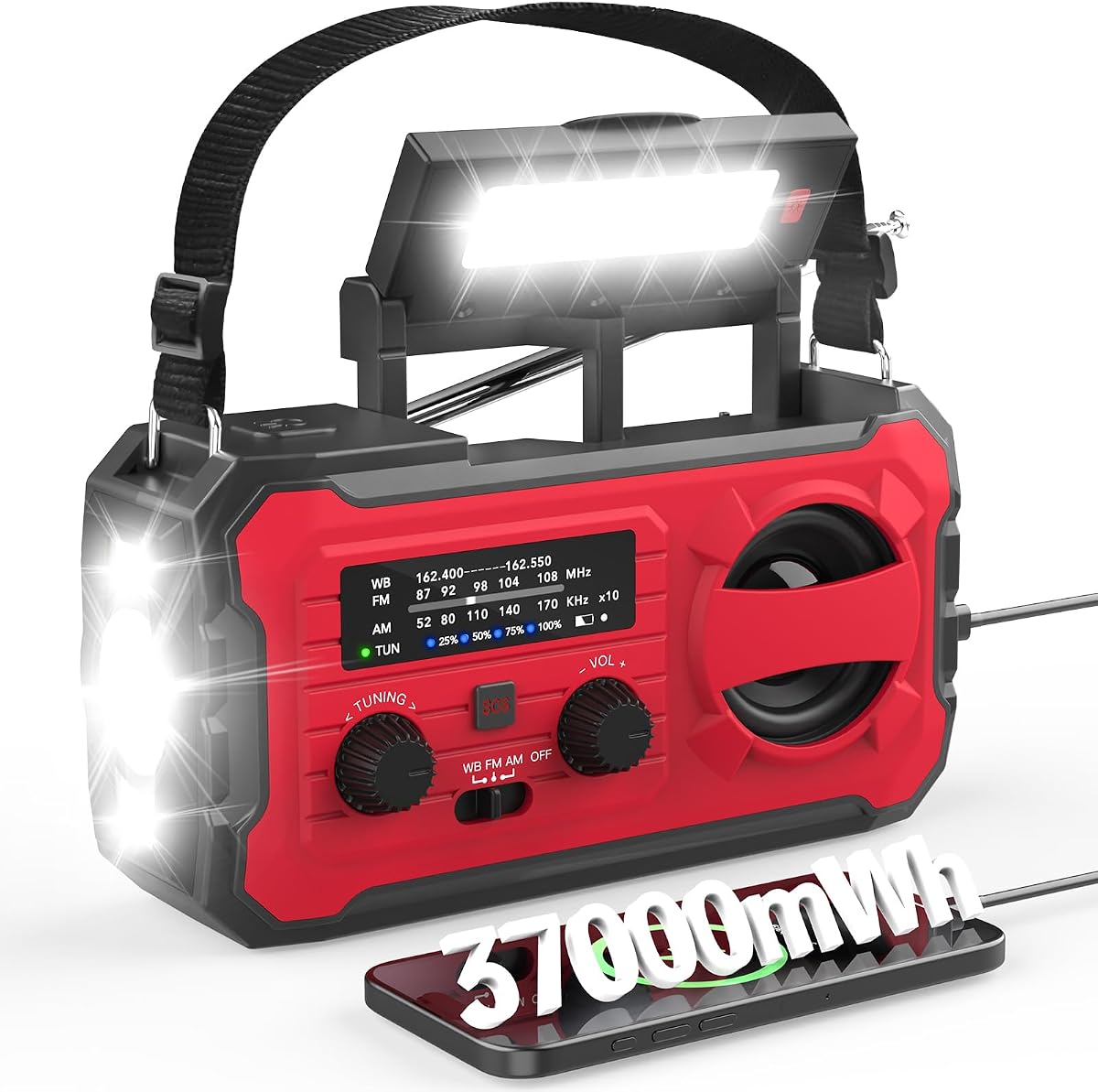
The WVL 7400mWh Emergency Weather Radio is a compact all-purpose unit for people who want NOAA information, AM and FM reception, lighting, a phone charger, and an SOS siren without carrying a large power station. Its 4.6 rating and 231g weight make it a practical grab-and-go option for a home emergency kit, vehicle, or hiking pack.
We may earn a commission when you buy through this link, at no additional cost to you.
The radio includes a 7400mWh internal energy source described as a 2000mAh portable charger for phones and small tablets. It can be replenished through a hand crank, solar panel, or built-in rechargeable lithium-ion battery. This three-source approach is valuable when a storm has interrupted grid power and sunlight or manual cranking may be the only ways to maintain stored energy.
Its dual lighting arrangement is particularly useful for an emergency package. A 1.5W bright LED flashlight provides focused illumination, while a motion-sensor reading lamp can supply softer light without requiring constant attention. The radio also includes an SOS siren and standard analog tuning for AM, FM, and NOAA weather channels, covering the information and signaling functions commonly needed during severe weather.
The 2000mAh battery does not offer the repeated phone-charging capacity of the 12000mAh and 20000mAh models in this roundup, and the radio's compact 130 by 50 by 60mm body is not designed to serve as a room-filling battery. Nevertheless, its portability, clear emergency feature set, and low weight are difficult to dismiss. It is our budget pick for travelers, apartment dwellers, and anyone who values a radio first with phone charging as a useful secondary function.
Hand-crank, solar, and built-in battery charging offer meaningful redundancy when the grid is unavailable. Keeping the unit charged before an emergency provides the best starting point, while the alternate inputs help extend readiness.
At 231g, the radio is light enough for routine carrying. Its flashlight, reading lamp, weather receiver, SOS siren, and phone output consolidate several emergency tools without requiring a large battery pack.
We may earn a commission when you buy through this link, at no additional cost to you.
The Emergency Weather Radio with Large Solar Panel is built around a real 12000mAh battery, an 8500mm² monocrystalline solar panel, and an efficient hand-crank generator. With a 4.7 rating and an IPX6 waterproof specification, it is especially appealing for wet climates, camping trips, and emergency kits that need meaningful resistance to rain and splashes.
We may earn a commission when you buy through this link, at no additional cost to you.
The radio supports five charging methods, giving users several ways to replenish its internal battery. Its reinforced crank arm and high-efficiency dynamo are advertised as capable of supporting emergency calls, lighting, or news updates after one minute of cranking. The large solar panel is another strong feature because it can collect more energy than smaller decorative panels while the unit remains stored for extended periods.
Emergency information receives equal attention. NOAA alerts are supported, and the radio can trigger a nine-second alarm to provide warning before severe weather arrives. It includes a powerful 5W adjustable-beam flashlight and a 12-LED reading lamp with multiple brightness levels. These lighting features are useful when an outage removes ordinary household illumination or when the radio is used outside a shelter.
Its size and feature complexity may be excessive for someone wanting only a pocket radio, and the manufacturer states that the battery should be fully charged before first use. Nevertheless, the combination of high capacity, water resistance, rapid manual generation, automatic alerts, and flexible lighting gives this model an excellent balance for outdoor preparedness. It is a particularly convincing option for households that want phone-charging capability without moving to the largest battery size.
Direct NOAA reception and the nine-second warning alarm can provide advance notice of threatening conditions. The radio also functions as a conventional NOAA receiver and emergency lighting source when power service is interrupted.
A one-minute crank claim and a large monocrystalline panel offer two practical recovery paths. These options are useful during extended outages when neither the grid nor an always-available USB source can be depended upon.
We may earn a commission when you buy through this link, at no additional cost to you.
The Hand Crank Emergency Radio 7400mWh distinguishes itself with three built-in device cables for Lightning, USB-C, and Micro USB connections. Its 4.6 rating and multi-source charging system make it a convenient option for people who want fewer loose accessories in a drawer, vehicle, or emergency bag.
We may earn a commission when you buy through this link, at no additional cost to you.
The internal 7400mWh battery can operate the radio, lights, and SOS alarm and can provide emergency power to compatible phones and other devices. Input charging is available through USB-C, while the hand crank and solar panel offer alternate ways to restore energy. The radio also accepts AAA batteries, creating a fourth source when regeneration and USB charging are not possible.
Reception features include an extended antenna and a DSP chip for NOAA broadcasts and AM or FM stations. The radio is designed to keep users informed about winter storms, hurricanes, tornadoes, and other hazards. A flashlight offers low, medium, and high brightness modes, while six additional LEDs serve as reading lights. Its SOS alarm is intended to attract attention when someone is stranded or needs assistance.
The stated 2000mAh capacity means this should not be treated as a heavy-duty charging station for several phones. The product listing also does not indicate that AAA batteries are included, so those cells should be treated as a separate preparation item. Even so, the integrated cables are a meaningful convenience, the four charging routes improve redundancy, and the combination of radio, lighting, alarm, and phone output makes this a versatile emergency radio.
The built-in Lightning, USB-C, and Micro USB cables remove the need to search for a matching lead after an outage. This is especially helpful in a vehicle or kit where accessories can easily become separated from the radio.
USB-C input, hand cranking, solar charging, and AAA battery support give the radio several recovery routes. This redundancy is useful in prolonged outages and when the built-in battery needs occasional reinforcement.
We may earn a commission when you buy through this link, at no additional cost to you.
The Emgykit Hand Crank Radio is a lightweight emergency radio aimed at portability and straightforward operation. It combines a 2000mAh rechargeable battery, NOAA and AM/FM reception, a three-LED flashlight, an SOS alarm, and phone charging in a housing measuring 5.1 by 2.1 by 2.4 inches and weighing 0.51 pounds. Its 4.6 rating indicates strong reception of its core features.
We may earn a commission when you buy through this link, at no additional cost to you.
The flashlight is upgraded to three LED beads producing 140 lumens, offering more practical illumination than a minimal emergency beacon. Holding the SOS control for three seconds activates a siren advertised at more than 80 decibels. Those two functions create a useful combination for drawing attention and navigating a dark location after a power failure.
Three charging methods keep the radio flexible. Users can replenish it with the hand crank, the solar panel, or a Type-C connection, which gives them more than one way to maintain the internal battery. The radio can also supply emergency power to a phone when an outage leaves the device without conventional charging.
Its 2000mAh battery is the primary limitation, particularly for users who expect to recharge a phone repeatedly or operate the flashlight for long periods. It also lacks the expanded shortwave coverage found on several higher-end choices. For people building a small everyday-preparedness kit, though, its low weight, compact dimensions, bright light, and siren make it a sensible radio-first alternative.
A three-LED, 140-lumen flashlight gives the unit more lighting capability than a basic phone or glow-only beacon. It is suitable for checking a dark room, finding supplies, or moving through a familiar outdoor area.
The radio retains NOAA, AM, and FM reception while remaining small and relatively light. That balance works well for travelers who need weather information and an alarm but do not want to carry a larger power station.
We may earn a commission when you buy through this link, at no additional cost to you.
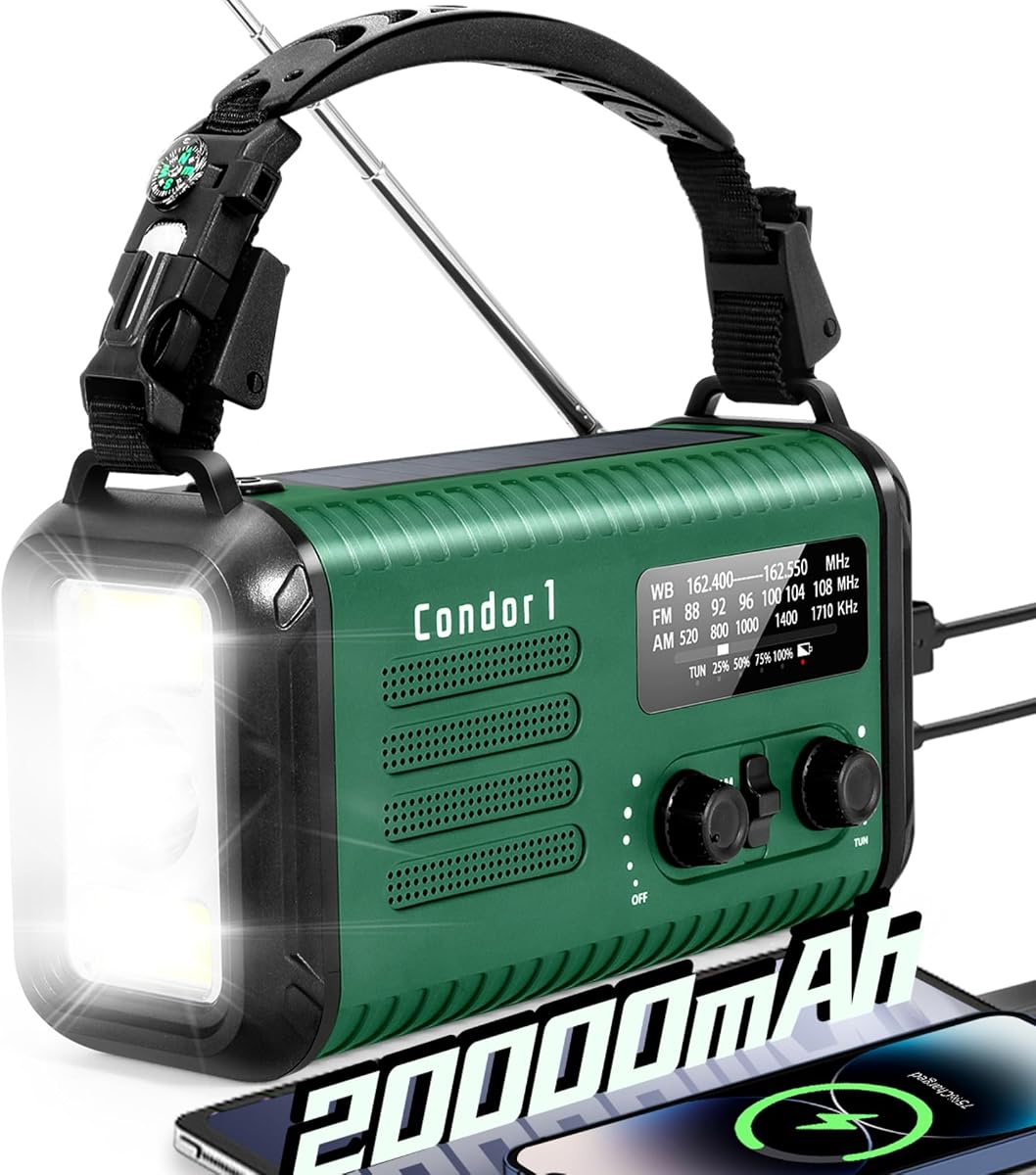
The Emergency Crank Radio 20000mAh is designed for people who expect an emergency radio to do more than receive alerts. Its 20000mAh rechargeable battery, stated at 74000mWh, can charge multiple mobile devices simultaneously and maintain the radio, lights, and alarm. The unit weighs 1.8 pounds, which reflects its high-capacity, survival-oriented design.
We may earn a commission when you buy through this link, at no additional cost to you.
A bidirectional USB-C interface supports both charging the radio and sending power to compatible devices. The crank lever and solar panel can regenerate energy for the internal battery, radio functions, lighting, and SOS alarm. This makes the product closer to a portable emergency power station than a lightweight radio, although conventional charging remains important for preserving the stated capacity.
The radio receives seven NOAA weather stations along with FM and AM broadcasts. Its survival handle adds practical tools such as a compass, cutter, whistle, and fire starter. Lighting is handled by a repositioned reading lamp and a flashlight with far-beam, low-beam, mixed-beam, and SOS-flashing modes. A 3.5mm headphone jack allows private listening without disturbing others.
The 4.4 rating is the lowest among the listed models, and the 1.8-pound weight is significant compared with the 231g WVL and 1-pound NITIGO. IPX3 water resistance is also less substantial than IPX6. Despite those caveats, this is the most compelling option for an extended household outage where several devices may need power and a conventional radio alone would be inadequate.
The 20000mAh capacity and support for charging two devices at once distinguish this model from smaller emergency radios. It is better suited to households that want reserve power for several essential phones or communication devices.
The carry handle includes a compass, cutter, whistle, and fire starter. These small additions make the radio more useful in a wilderness or roadside emergency, though users should still carry a dedicated first-aid and survival kit.
We may earn a commission when you buy through this link, at no additional cost to you.
The Raynic Emergency Radio 5000mAh is centered on timely weather alerts, readable controls, and a moderate amount of backup power. It supports AM, FM, shortwave, and NOAA reception, and its 4.5 rating reflects a generally favorable reception of the product's display, alert system, and emergency functions.
We may earn a commission when you buy through this link, at no additional cost to you.
Its automatic scanning is the defining feature. When switched on or placed in standby, the radio scans for emergency and weather warnings, then alerts the user when a warning is issued. This reduces the need to monitor broadcasts continuously and can provide advance notice of severe conditions, particularly overnight.
A large HD LCD shows the current frequency and battery level, while digital tuning and Tune plus or minus buttons make station selection more precise. The radio includes a 3W flashlight, a 2.5W reading lamp, a USB connector for USB-enabled devices, and an SOS alert paired with a flashing red light. Its six-way charging approach and built-in 5000mAh battery provide useful backup power.
At 1.2 pounds and 6.8 by 3.7 by 2.9 inches, it is portable but not especially compact. Its IPX3 rating should not be confused with full waterproofing, so prolonged rain exposure should be avoided. This model is best for someone who values automatic warnings and a clear display more than maximum battery capacity or the smallest possible footprint.
Automatic scanning in standby mode lets the radio watch for emergency broadcasts while reducing the need to listen continuously. The flashing SOS light and loud alarm add another way to gain attention during a critical event.
Digital tuning and a large LCD make it easier to identify the active station and monitor remaining power. A dimmer function can turn off the backlight when preserving battery life is more important than immediate readability.
We may earn a commission when you buy through this link, at no additional cost to you.
The NITIGO Weather Radio 10000mAh provides a balanced mix of battery capacity, reception, charging flexibility, and lighting. It supports NOAA weather broadcasts along with AM and FM radio, earns a 4.7 rating, and is positioned as a practical emergency radio for homes, travel, camping, and vehicles.
We may earn a commission when you buy through this link, at no additional cost to you.
A 10000mAh high-density battery gives the radio more endurance than compact 2000mAh alternatives without reaching the bulk and weight of the largest 20000mAh models. It can supply emergency power to USB devices such as smartphones and can be recharged through the solar panel, hand crank, or a USB charging port.
Reception is supported by an adjustable high-gain antenna intended to produce clear, loud audio across NOAA, AM, and FM channels. The lighting arrangement includes an ultrabright LED flashlight and a retractable lamp that rotates through 180 degrees. The lamp's positioning can direct light where it is needed, which is useful at a table, beside a bed, or inside a tent.
The radio does not list shortwave reception, so travelers interested in international shortwave broadcasts would need another model. Solar charging is also best understood as a supplementary method rather than a replacement for regular charging. Even with those qualifications, the balanced capacity, adjustable antenna, flexible lighting, phone output, and SOS signaling make this a strong general-purpose emergency radio.
A 10000mAh battery offers more useful reserve than small pocket radios without moving into the category of a large portable power station. That makes the NITIGO a useful middle ground for everyday preparedness.
The retractable 180-degree reading lamp can be positioned toward a book, work surface, or sleeping area. Combined with the bright flashlight, it provides both task lighting and broader emergency illumination.
We may earn a commission when you buy through this link, at no additional cost to you.
The 20000mAh Hand Crank Emergency Radio combines high battery capacity with an unusually long telescopic antenna and broad band coverage. It receives NOAA, AM, FM, and shortwave broadcasts, carries a 4.7 rating, and is marketed toward camping, mountain travel, and other situations where portable power and reception matter.
We may earn a commission when you buy through this link, at no additional cost to you.
The antenna extends to 20.5 inches and is paired with a noise-reduction chip to support clear broadcasts. A four-level power indicator and digital display provide visible battery and operating information. The radio supports solar, hand-crank, and Type-C charging, while its 20000mAh polymer battery is advertised to charge an iPhone 14 Pro up to five times or operate the radio for more than 48 hours.
The stated charging relationship deserves attention. Five minutes of hand cranking is described as equivalent to 30 minutes of emergency calls, but output will vary with device demands, battery condition, and the amount of energy actually stored. Regardless, the large capacity provides substantially more reserve than the smaller radios in this guide and could be valuable for a family grouping.
Its dual-lighting system includes a 3W spotlight and a 96-LED low-blue reading lamp, while the 120dB SOS siren is paired with a reflective rescue strap. The radio is IPX6 certified, described as surviving four-foot drops and rain splashes, and weighs one pound with a detachable carabiner. It is an ambitious outdoor-oriented option, but its many controls and wide feature set may be more than a simple home emergency kit requires.
The 20.5-inch telescopic antenna and noise-reduction circuitry are designed for stable reception across NOAA, AM, FM, and shortwave. This makes the radio particularly relevant to campers and travelers operating farther from populated broadcast areas.
The 20000mAh battery and stated multi-phone charging ability offer meaningful reserve during an extended outage. A four-level indicator helps users monitor remaining energy without guessing when reserves are becoming low.
We may earn a commission when you buy through this link, at no additional cost to you.
The Kaito KA500 is a premium-style emergency radio distinguished by an exceptionally broad set of power options, replaceable battery technology, and broad radio coverage. It provides hand-crank generation, solar charging, a three-AA battery compartment, USB input, AC or DC input with a separately sold adapter, and a built-in rechargeable NiMH pack. Its 4.5 rating reflects a well-rounded feature set.
We may earn a commission when you buy through this link, at no additional cost to you.
Reception includes AM, FM, two-band shortwave, and seven preprogrammed NOAA weather channels. A telescopic antenna extending to 14.5 inches, an LED signal-strength indicator, and semiconductor circuitry support accurate tuning. Coverage is stated for the United States and Canada, making it a strong fit for North American households, camping, travel, and home emergency preparation.
The KA500 can also operate as an emergency mobile battery through its standard 5V USB output. Compatible phones, GPS units, MP3 players, and digital cameras can use that output when conventional charging is unavailable. Additional features include an LED flashlight, a five-LED reading lamp, and a red SOS beacon, providing several ways to illuminate or signal during a crisis.
The replaceable NiMH pack is an important long-term advantage because a degraded internal battery can potentially be renewed rather than requiring an entirely new radio. On the other hand, the AA power adapter is sold separately, and NiMH capacity is lower than the large lithium batteries used by several newer competitors. It remains our premium pick because the six-way energy design, replaceable battery, and comprehensive radio coverage create a durable, adaptable system.
The replaceable NiMH pack can restore the radio's internal reserve after years of use. Six power sources create extensive redundancy for home, vehicle, and travel use, although users must obtain the separate AA wall adapter if they need that input method.
AM, FM, two-band shortwave, and seven NOAA channels make the KA500 useful for both emergency information and conventional listening. The long antenna and signal-strength display help users tune more precisely when conditions are challenging.
We may earn a commission when you buy through this link, at no additional cost to you.
The right emergency radio depends on how you plan to use it, the length of expected outages, and the devices you need to keep operational. Battery capacity, radio bands, charging resilience, lighting, and portability should be evaluated together rather than treating any one specification as decisive.
Battery capacity is the clearest indication of how much useful reserve a radio can store, but the listed watt-hour figure can be more useful for comparison when it is available. The options range from a compact 2000mAh internal battery to 20000mAh models. Larger capacity generally means more opportunities to replenish a phone, operate lights, and listen to broadcasts, but it also adds bulk and weight. Consider how many phones need support and whether the radio must fit into a small backpack, vehicle compartment, or countertop kit.
NOAA reception is the central feature for users in the United States because it provides official weather and hazard information without relying on cellular networks. AM and FM add entertainment and local programming, while shortwave can be useful for international news and long-distance reception. Automatic alert scanning is valuable when the user cannot continuously monitor the radio. Evaluate the antenna, tuning method, signal-strength support, and number of NOAA presets rather than assuming every radio provides equal warning coverage.
A useful emergency radio should not depend on one charging method. Hand cranking supports operation when electrical outlets and normal charging cables are unavailable, solar charging can maintain a stored charge, and USB or wall input is more efficient for routine preparation. AAA or AA battery inputs offer another fallback. Look for a strong manual generator and an adequately sized solar panel, but remember that hand cranking and small solar panels generally take longer than conventional charging. A good system still needs to be fully charged before an emergency.
Flashlights, reading lamps, and SOS sirens turn a radio into a broader survival tool. A focused beam is useful for searching outdoors, while a softer or directional reading lamp is better for bedrooms, tables, and tents. Multiple brightness settings can conserve power. A loud siren, flashing beacon, reflective strap, or integrated whistle provides additional ways to attract attention. Consider the intended setting rather than judging a flashlight only by its listed wattage or lumens, because beam focus and placement also affect usability.
The lightest radios are easier to carry during a quick evacuation or place in a daily backpack, while larger high-capacity units are better suited to a home, garage, vehicle, or base camp. Compare both the radio and any required cables or adapters. A compact unit with a 2000mAh battery may provide only a limited phone boost, whereas a 20000mAh model can serve as a more substantial power reserve. Choose the balance that matches the kit's location rather than automatically buying the largest option.
Emergency equipment may be needed in rain, around a wet campsite, or during flooding and storms. IPX3 indicates protection against light rain and splashes, while IPX6 is a stronger level of water protection. Neither rating necessarily means the radio can be submerged. Look for impact-resistant housing and secure covers over ports, and avoid treating a weather radio as a floating device. If water resistance is a priority, compare the stated rating and take care to operate the unit only within its documented limits.
A radio may be operated in darkness or under stress, so large buttons, clear labels, a prominent tuning knob, and a readable display can matter more than extra menu features. Automatic scanning is helpful for unattended warnings, while a battery-level display makes it easier to manage reserve. Backlight dimming can extend runtime. Users who listen at night may also value a headphone jack, and those using the radio in the field should consider nonslip grips and controls that can be operated with gloves.
Rechargeable batteries eventually lose capacity, making replaceability an important ownership consideration. The Kaito KA500 uses a replaceable NiMH pack, while most competing models use integrated lithium-ion batteries. A replaceable pack can extend the life of a radio, but it may require compatible batteries and occasional charging discipline. Integrated designs are often simpler and may offer greater stated capacity. Whatever the design, periodic charging and storage checks are essential because an emergency device with an uncharged internal battery offers little protection.
Before relying on the radio, charge it fully through its fastest supported conventional input and verify that the radio, flashlight, alarm, and USB output all work. Learn the controls while power and light are available. Identify which port charges the radio, which port powers a phone, and whether any cables are built in. Store the device where it is easy to reach but protected from moisture and excessive heat.
Test the NOAA receiver and note how the tuning dial or automatic scan behaves. Learn the SOS function but avoid leaving it activated. When a phone needs emergency power, connect it directly to the appropriate output and avoid heavy use that drains the radio while it is trying to charge another device. Use the hand crank only when needed, or during routine maintenance to supplement stored energy. Solar charging works best with the panel placed in direct sunlight for an extended period.
Inspect the radio every few months for battery condition, loose cables, corrosion, damaged seals, and accidental button activation. Recharge the internal battery before expected outages or travel, and install fresh cells in any backup compartment. Do not expose the unit to water beyond its stated rating, and keep charging ports dry. A simple written note showing the charging method, output port, and NOAA channel can also help household members use the radio correctly during a stressful event.
It depends on the radio's internal battery, the phone's battery capacity, and the amount of energy available. A small 2000mAh radio is better viewed as an emergency phone booster, while 10000mAh and 20000mAh models can provide substantially more charging. Hand cranking generates power slowly, so a wall or solar recharge before the emergency is more practical.
The radio battery stores energy for reception, lights, alarms, and power output to a phone. Charging a phone consumes some of that stored reserve, and the two uses are competing. A radio intended as a primary charging station needs a large battery and suitable output ports, while a compact weather radio should be treated mainly as an information and light source.
Yes, a functional NOAA radio can receive official weather broadcasts without a cellular signal, which is one of its main advantages during disasters. The phone charging feature may also help preserve access to emergency calls and text when some networks remain available. Neither feature guarantees that every phone or location will have usable service.
Charge it fully before expected outages, severe-weather seasons, camping trips, and other periods when it may be needed. Checking it every few months helps identify a damaged charger or a battery that no longer holds a charge. A brief charge test before storing it is also useful, but a quick top-up should not replace periodic full charging.
IPX6 indicates stronger resistance to heavy rain and water jets than lower IPX ratings, but it does not make a radio suitable for submersion. Ports, covers, and seals still need careful handling. Keeping the radio in a protective bag while preserving access to its controls is a prudent approach in severe weather.
Shortwave can provide international news and information when local AM, FM, or cellular services are disrupted, though reception depends on location, atmospheric conditions, and antenna quality. NOAA remains the most important source for official local weather alerts in the United States. A model with both NOAA and shortwave offers more flexibility, but the added bands may be unnecessary for some buyers.
Choose 5000mAh when moderate phone backup, compact size, and a lower overall footprint matter most. Choose 20000mAh when preparing for prolonged outages, powering multiple devices, or keeping a radio at a home command center. The larger battery typically increases weight and may make the radio less convenient to carry every day.
Keep the radio's charging cable, any required wall adapter, and backup cells with the unit. A small set of phone-charging cables is also wise, particularly if the radio does not have them built in. Headphones, a protective bag, spare light sources, and written operating instructions can further improve readiness.
The Solar Radio Emergency 12000mAh is the strongest overall choice because it combines a high-capacity battery, large solar panel, efficient hand crank, clear radio reception, phone charging, and useful lighting. The WVL 7400mWh model stands out as the best budget and compact option, while the Kaito KA500 earns the premium designation for its replaceable battery, six-way power system, and broad band coverage.
For most households, prioritize a radio that delivers reliable NOAA alerts, can be charged through more than one method, includes a bright flashlight and alarm, and has enough capacity for the phone use you realistically expect. Larger-capacity models suit extended outages, while smaller units are easier to carry. Whichever option is selected, correct charging, accessible controls, and regular testing matter more than the headline specification alone.
Ratings and product configurations can change, and current prices and availability should always be checked on the linked listing before purchase. Review the included accessories, output compatibility, regional radio coverage, and water-resistance limits to ensure the radio fits your specific kit.