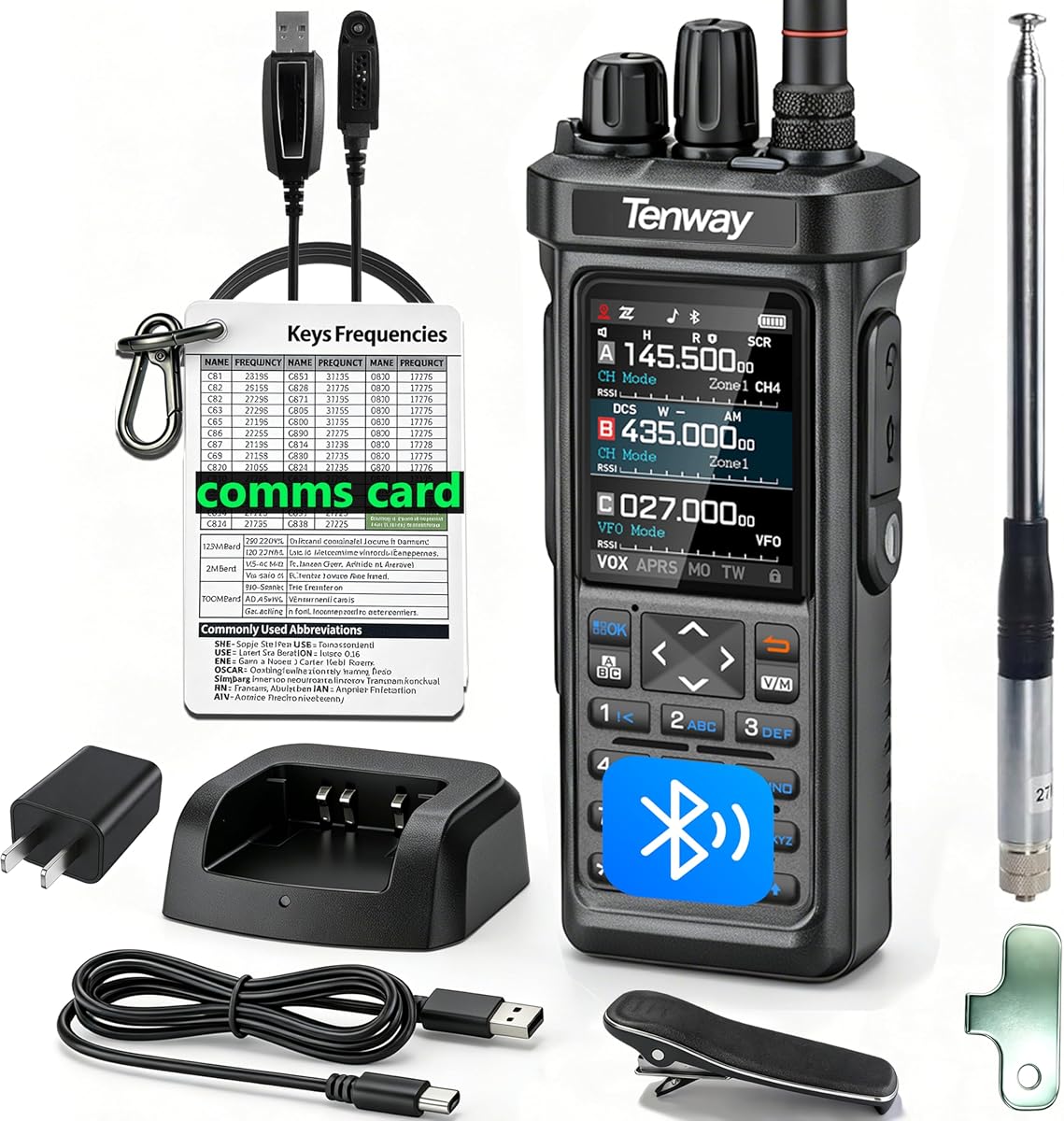
Tenway TP-900 PRO
5.0Editor score
Ten-watt FM transmission
Integrated GPS and APRS
Bluetooth smartphone programming
Ham Radios for Pota compared by range, features, programming, power, and portability, with practical picks for portable amateur radio operations in the field.
Ham Radios for Pota need to balance useful transmit power, dependable reception, manageable size, and enough battery life for portable operation. The best radio for one operator may differ from the ideal choice for a family, club, or traveling group, so programming support and accessory compatibility deserve careful attention.
We compared ten handheld radios based on their supplied frequency coverage, power options, memory capacity, programming methods, weather reception, emergency features, and physical design. The guide includes conventional FM radios, a tri-band model, and a dual-mode digital radio, with special attention to the needs of portable amateur radio activity.
Each pick reveals what distinguishes it from the alternatives, including practical strengths, limitations, and the type of POTA operator it may suit best. Product ratings reflect the available customer feedback, while current prices and availability can change at any time, so confirm the latest listing details before purchasing.
5.0Editor score

4.8Editor score

4.5Editor score
This side-by-side comparison highlights transmit power, frequency coverage, programming options, and portable features. It helps POTA users identify the right balance of capability, convenience, and complexity.


The Baofeng UV-5RM is a conventional handheld radio that combines dual-band amateur transmission with broad receive coverage and a 4.6 rating. Its standout feature is the ability to listen across 108–136MHz, 136–174MHz, 220–260MHz, 350–390MHz, and 400–520MHz while transmitting on the licensed 144–148MHz and 420–450MHz amateur bands.
We may earn a commission when you buy through this link, at no additional cost to you.
For POTA, this extra reception can be useful when monitoring local activity, aviation frequencies, NOAA weather channels, and other signals permitted by the radio and applicable rules. The 1.77-inch color display makes channel information easier to read, while 999 memory channels provide ample room for local repeaters, parks, travel routes, and portable operation plans.
Programming can be handled through compatible CHIRP software, and the one-touch cloning function offers a faster way to copy settings from another compatible radio. The included 2500mAh battery, USB-C cable, desktop charging base, and speaker microphone create a practical field kit. The tradeoff is that users who want extensive control may need to learn the keypad, menu structure, and computer programming process.
This is a strong recommendation for a POTA operator who wants traditional analog FM operation, flexible charging, and more receive coverage than a basic entry-level handheld. It is especially attractive for those who value color-screen readability and a microphone that supports hands-free communication in noisy environments.
The wide receiver makes this radio more versatile than a straightforward dual-band handheld. POTA operators can monitor a broader range of available signals without confusing reception capability with permission to transmit outside their authorized amateur bands.
USB-C charging works with wall outlets, power banks, laptops, and vehicle adapters, while the desktop base provides a convenient home option. The included speaker microphone supports clearer hands-free transmissions during travel and group activity.
We may earn a commission when you buy through this link, at no additional cost to you.
The Baofeng AR-5RM two-pack is designed for operators who want two matching radios and a broad set of field accessories. It carries a 4.5 rating and supports transmission on 144–148MHz and 420–450MHz, with the ability to receive 108–136MHz, 136–174MHz, 220–260MHz, 350–390MHz, and 400–520MHz.
We may earn a commission when you buy through this link, at no additional cost to you.
Its 999-channel capacity and 1.77-inch color screen are useful for storing local repeaters, parks, and channels that may become important while traveling. NOAA reception provides a way to monitor official weather alerts, while the frequency-copy function simplifies matching settings between compatible radios. CHIRP support gives users a more structured option for detailed frequency management.
The included accessories are notably extensive: two radios, two batteries, two USB-C cables, two base chargers, a programming cable, two speaker microphones, two AR-771 and AR-805S antennas, two earpieces, two belts, two straps, and a manual. That assortment reduces the need for several immediate add-ons, though the included antenna types differ and users should understand each radio's standard configuration.
This package is an excellent match for couples, families, or small teams coordinating POTA activations. It is also attractive to solo users who want a spare radio, a loaner unit, or a backup for field reliability. Its main limitation is that its menu-driven programming can feel involved to an operator new to ham radio.
A matched pair is valuable when everyone needs an independent radio or when a spare unit improves resilience during a park activation. The included microphones, earpieces, antennas, chargers, and straps make the package especially convenient for group outings.
The NOAA receiver can provide official alerts when cellular service is unavailable or conditions change quickly. It complements, rather than replaces, responsible planning and attention to local conditions.
We may earn a commission when you buy through this link, at no additional cost to you.
The Baofeng UV-5R is a straightforward dual-band handheld with a 4.5 rating and a feature set centered on traditional analog amateur operation. It transmits on 144–148MHz and 420–450MHz, and its 128 channels are enough for many local and travel-oriented channel plans.
We may earn a commission when you buy through this link, at no additional cost to you.
A large LCD, dual-frequency display, independent A/B band operation, and dual standby let users watch two channels at once. High and low transmit power provide flexibility between stronger output and lower battery consumption. Other practical functions include VOX, busy-channel lockout, a keypad lock, selectable background lighting, an emergency alert, and an LED flashlight.
CHIRP support and manual programming provide two paths for setting up frequencies. The radio can be configured according to local repeater and simplex needs, although the operating procedure can take time for first-time users. Compared with newer 999-channel models, its storage capacity is more limited, but many POTA operators can maintain a compact and effective channel list.
This radio is a sensible choice for a beginner building a first portable kit, particularly one who values a recognizable dual-band platform and basic programming flexibility. It lacks some of the broader receive, weather, and charging conveniences found in newer models, but its core operation remains focused and approachable.
Independent A/B bands and dual standby are helpful for monitoring a local repeater while remaining available on a park or simplex channel. This makes the radio practical for mobile operating and group coordination.
Although 128 channels are fewer than many contemporary alternatives offer, CHIRP support makes it easy to load only the channels needed for a trip. Keeping a short list can make operation simpler once the radio is in the field.
We may earn a commission when you buy through this link, at no additional cost to you.
The BTECH BF-F8HP PRO is a tri-band handheld built for operators who want more organized channel management than a conventional entry-level radio provides. Its 4.3 rating reflects a feature set centered on 1,000 memory locations, 10 named zones, clear English menus, and a full keypad for making changes directly on the radio.
We may earn a commission when you buy through this link, at no additional cost to you.
Users can scan selected zones, temporarily skip busy channels without changing the saved list, and choose between a two-channel view and a full-screen single-channel display. The radio also provides approximate dBm signal context. USB-C charging simplifies battery management, while supported CHIRP-next and BTECH CPS options handle larger computer-based programming tasks.
A major consideration is that the PC03 programming cable is sold separately, as are compatible firmware-update tools and instructions. Scanning applies to conventional analog channels and does not decode DMR, digital, or trunked systems. Direct location sharing can work between compatible BF-F8HP PRO radios on the same channel, but it is not a full APRS platform with maps, continuous tracking, or repeater passage.
This is a premium-style recommendation for a POTA operator who values organization, direct keypad control, and a larger memory plan. It suits someone willing to learn a more structured radio system, particularly one traveling across multiple regions or maintaining separate lists for home, clubs, events, travel, simplex, and receive channels.
Named zones let operators separate frequencies by purpose and scan only the groups relevant to a park or trip. The approach reduces the need to cycle through a long undifferentiated memory list.
Name and frequency can appear together in the two-channel view, while Single Watch creates a larger display for one channel's zone, name, and frequency. Approximate dBm readings add context when evaluating a received signal.
We may earn a commission when you buy through this link, at no additional cost to you.
The Baofeng K5PLUS is a ten-watt handheld that combines broad receive coverage with an unusually long flexible antenna. It has a 4.5 rating and supports up to 999 channels, FM reception, airband reception, NOAA weather channels, CTCSS and DCS codes, VOX, DTMF, an alarm, a stopwatch, and an LED flashlight.
We may earn a commission when you buy through this link, at no additional cost to you.
The included antenna measures up to 15.35 inches and can help improve received signal conditions and perceived communication distance. One-touch frequency copying provides a convenient way to transfer settings from another compatible radio, while the NOAA receiver offers access to emergency weather information during travel or outdoor work.
Two charging paths are provided: a desktop charger and a USB-C cable. That makes it easier to recharge from a power bank, laptop, vehicle adapter, or wall outlet. The broad feature set can take time to master, however, and the long antenna may be less convenient for pack-centered POTA setups than a shorter standard antenna.
This model fits operators who want more functions than a basic handheld without moving into a digital-radio platform. It is especially useful for camping, hiking, hunting, and other activities where long-range reception, weather monitoring, and flexible charging all carry value.
The long flexible antenna is a major differentiator because it can improve signal reception and extend practical range. Operators who prefer a compact package may consider a shorter compatible antenna for easier storage.
The flashlight, alarm, stopwatch, VOX, and NOAA channels are useful additions for portable activity. These features should complement—not replace—navigation gear, an appropriate power supply, and sound judgment in remote locations.
We may earn a commission when you buy through this link, at no additional cost to you.
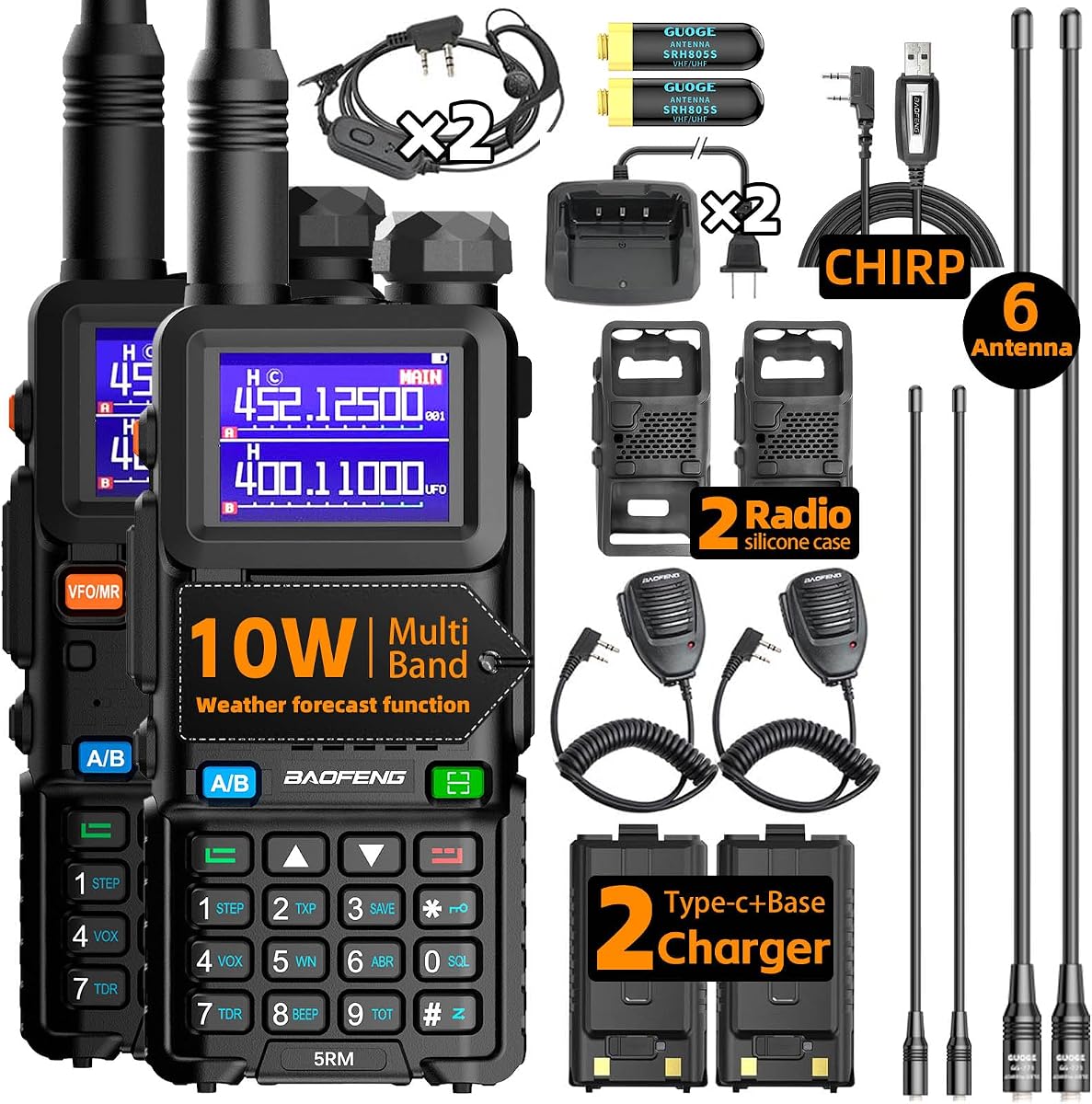
The Baofeng AR-5RM two-pack stands out with a 4.8 rating, the highest among the conventional handheld selections in this guide. It supports ten-watt transmission on 144–148MHz and 420–450MHz, while reception extends from 108–136MHz through 136–174MHz, 220–260MHz, 350–390MHz, and 400–520MHz.
We may earn a commission when you buy through this link, at no additional cost to you.
Its 999 channels, 1.77-inch color screen, CTCSS and DCS codes, LED flashlight, time-out timer, VOX, DTMF, and alarm functions cover the needs of a conventional portable kit. The radio supports CHIRP when the appropriate 5RM model is selected, which is an important detail during programming. One-touch frequency copying reduces setup time when working with a compatible partner radio.
Each unit includes a 2500mAh rechargeable battery, USB-C charging, and base charging. NOAA reception supplies official weather updates, adding context for camping, hiking, and travel. The main limitation is that this remains a menu-driven analog radio, so an operator who wants digital voice, text messaging, or advanced location functions should consider a different platform.
This is a compelling recommendation for couples, families, and small POTA teams that want two matching radios with flexible programming and charging. Its strong rating, expanded reception, and two-pack configuration make it a versatile middle ground between simple handhelds and more specialized premium radios.
Two radios make direct park-to-park or vehicle-to-trail communication possible without sharing equipment. It also provides a spare unit that can remain in a pack as backup during a longer outing.
CHIRP support is valuable, but users should select the matching 5RM model to avoid confusion. Saving and verifying the radio profile before travel helps reduce menu adjustments in the field.
We may earn a commission when you buy through this link, at no additional cost to you.
The Baofeng UV-32 two-pack is a high-power conventional handheld upgraded from the UV-5RM platform. It has a 4.4 rating and supports ten-watt output with high, medium, and low power settings, along with GPS, frequency copying, AM reception, a stopwatch, FM radio, an LED flashlight, an alarm, DTMF, and VOX.
We may earn a commission when you buy through this link, at no additional cost to you.
The tactical high-gain antenna can reach 18.89 inches, making antenna choice an important consideration for portability. Frequencies can be copied using side keys or written through an app, giving users more than one adjustment method. A 2500mAh battery, USB-C cable, and base charger support both travel and stationary charging routines.
The integrated GPS is the key differentiator from simpler dual-band radios, but it does not automatically make the UV-32 a full APRS radio. The supplied feature list identifies GPS and location-related functionality without describing a map display, continuous tracking, or a complete position-reporting system. Buyers who need detailed digital location mapping should look for a radio explicitly designed around APRS.
This package is best for POTA teams willing to carry a larger radio in exchange for ten-watt output, three power levels, and GPS. It suits operators who want application programming but still prefer conventional analog FM voice communication.
High, medium, and low output settings let operators balance communication reach against battery use. This flexibility is useful during a long park activation that includes both nearby simplex work and longer-distance contacts.
The built-in GPS can add valuable position awareness, but it should not be confused with a complete APRS mapping solution. Operators needing continuous reports and map displays should verify the exact functions of the model they purchase.
We may earn a commission when you buy through this link, at no additional cost to you.
The Tenway TP-900 PRO is a feature-rich portable radio with a 5.0 rating and a clear focus on field coordination. It provides up to ten watts of FM output and supports FM transmission and reception on 27MHz, a feature that differentiates it from conventional VHF/UHF handhelds.
We may earn a commission when you buy through this link, at no additional cost to you.
GPS and APRS support allow operators to share real-time location information, while NOAA reception keeps weather channels close at hand. The radio also supports AM, FM, shortwave, medium-wave, and long-wave reception, giving it broader monitoring capability than most dual-band handhelds in the list.
Bluetooth programming through a smartphone application removes the need to manage every setting through a cable or keypad. The included spectrum analyzer helps users view nearby signal activity and identify less crowded frequencies, a useful capability when planning local simplex operation. The main complexity is that newer operators may need to learn the relationship between the radio's bands, transmission modes, and programming options.
This is the premium recommendation for a POTA operator who wants location sharing, sophisticated programming, and wide-band monitoring in one handheld. It is particularly appropriate for solo activations, expedition-style travel, and group coordination where APRS and situational awareness add meaningful value.
GPS and APRS can show team members where one another is located, improving coordination across trails, roads, and large parks. This capability is especially useful when members spread out beyond visual or voice range.
Bluetooth application programming offers a quicker setup path for compatible phones and can simplify channel management before an outing. Operators should still save a backup copy of their radio configuration in case a device or app is unavailable.
AM, FM, shortwave, medium-wave, and long-wave reception extend listening options well beyond local VHF and UHF activity. The spectrum analyzer further helps identify cleaner channels when choosing an operating frequency.
We may earn a commission when you buy through this link, at no additional cost to you.
The Retevis RT85 two-pack is a rugged dual-band handheld with a 4.5 rating and a focus on durability, clear audio, and straightforward team operation. It delivers five watts of output, supports repeaters, and provides 200 channels for organizing local and travel frequencies.
We may earn a commission when you buy through this link, at no additional cost to you.
Its reinforced housing is designed to withstand shock and vibration, making it a sensible option for POTA activities involving hiking, travel, or frequent handling. Independent A/B band operation allows two teams or channels to be monitored at the same time. The screen, SOS alarm, and flashlight add useful emergency-oriented functions without changing the core analog operating model.
CHIRP support, VFO, and DTMF provide flexibility for users who want more than a fixed preloaded channel list. Five watts remains useful for conventional amateur communication, but it is lower than the maximum output offered by several ten-watt models. Users should also consider that the 200-channel limit is less extensive than the 999-channel capacity found in many competing handhelds.
This radio is a good fit for groups that value rugged construction and want two complete units. It is especially appropriate for beginners because its core functions are understandable, while CHIRP provides a path to more advanced frequency management.
The reinforced housing adds physical confidence during travel and outdoor activity. It does not make the radio waterproof or immune to damage, so appropriate storage and protection remain important.
Independent A/B bands and dual-channel monitoring allow separate groups to operate without interfering with each other. This is useful for family outings, local events, and coordinated park activations.
We may earn a commission when you buy through this link, at no additional cost to you.
The Baofeng DM-32UV is the most digitally focused handheld in this guide, with a 4.3 rating and support for both DMR digital mode and conventional analog FM. That dual-mode capability allows it to work with compatible digital systems while remaining usable on ordinary analog channels.
We may earn a commission when you buy through this link, at no additional cost to you.
Ten-watt maximum output can be switched to medium or low settings, and advanced voice coding and anti-interference processing are designed to improve clarity and reduce background noise. Digital functions include text messaging, call recording, remote monitoring, and ARC4, AES128, or AES256 encryption options. The radio also supports FM, AM, and NOAA reception.
Built-in GPS and APRS add position-related capability, while up to 4,000 channels and TDMA dual-time-slot support offer substantial capacity. The full keyboard and 2.0-inch screen allow direct menu control. A Type-C connection handles charging, frequency writing, and firmware updates, reducing the number of separate cables needed.
This is the strongest choice for a POTA operator already involved in DMR or needing advanced digital functions. A larger radio and a one-unit package may be less convenient than a two-pack for group travel, and digital communication requires compatible stations, proper talk groups, color codes, and settings.
Dual-mode operation can simplify a kit that mixes conventional FM with DMR networks. Users must ensure that their local contacts and repeaters use compatible digital parameters before relying on the radio for group communications.
Text messages, call recording, remote monitoring, encryption choices, GPS, and APRS give the DM-32UV more capability than a basic handheld. The 4,000-channel limit and full keyboard also suit operators who maintain extensive regional or travel plans.
A single Type-C connection is used for charging, writing frequencies, and firmware updates. Keeping the correct cable and software available is important because programming and firmware processes may depend on the computer connection.
We may earn a commission when you buy through this link, at no additional cost to you.
Choosing a POTA radio means balancing licensed-band operation, battery life, programming method, receive capability, physical size, and the type of contacts you expect to make. The most advanced radio is not automatically the most useful one for every activation.
Transmit power influences how strongly a handheld signal reaches a station or repeater. Several choices in this guide offer up to ten watts, while the Baofeng UV-5R and Retevis RT85 provide five-watt output. Higher power can improve access to distant stations and help with weak indoor or terrain-obstructed paths, but it also consumes more battery and may require a higher-capacity power supply for extended operation.
Verify the bands and modes you are authorized to use before choosing a radio. Most POTA activity centers on VHF and UHF amateur FM, but the list also includes a tri-band handheld, a model with 27MHz FM operation, and a DMR-capable radio. Expanded receiver ranges can be valuable for listening, yet receiving a frequency does not grant permission to transmit on it.
The best programming method is one you will actually use. CHIRP is supported by several models, BTECH offers CPS and CHIRP-next compatibility for the BF-F8HP PRO, the Tenway uses Bluetooth application programming, and the DM-32UV supports frequency writing over Type-C. Memory capacity ranges from 128 channels to 4,000, but a large list can be harder to navigate unless it is divided into useful zones.
A POTA radio may be carried for hours, so battery life and charging access matter as much as peak specifications. Several models include 2500mAh rechargeable batteries and USB-C charging, while desktop base chargers provide a convenient way to prepare radios before departure. High-power operation drains batteries faster, making spare batteries or a protected power bank worth considering for long activations.
Location features range from built-in GPS to complete GPS-and-APRS support. The Tenway TP-900 PRO explicitly supports real-time position sharing, while the DM-32UV includes GPS and APRS. The UV-32 has a built-in GPS function but should not be assumed to provide the same continuous reporting or mapping ecosystem. Verify whether location sharing, repeater passage, and map integration are actually included.
Antennas affect signal behavior, but a longer antenna is not always the more convenient choice. The K5PLUS includes a flexible antenna reaching up to 15.35 inches, and the UV-32 includes a tactical antenna reaching up to 18.89 inches. These can help reception or range, yet they add bulk to a pack and may be vulnerable to snagging. A conventional shorter antenna may be easier for walking and repeated setup.
NOAA reception is common across the list, giving operators access to official weather broadcasts and alerts. It is especially relevant when cellular service is unreliable, although a radio cannot replace forecast planning, navigation, first-aid equipment, or sound decision-making. Flashlights, alarms, dual watch, and emergency alert functions may also be valuable, depending on the local operating environment.
Conventional FM radios work well for simplex, repeater, and basic group communication, but a DMR radio can provide additional features when everyone uses compatible settings. Digital mode requires agreement on talk groups, color codes, and network configuration. For a family or small team without an existing digital system, a two-pack of conventional radios is usually easier to coordinate.
Before a POTA activation, confirm your amateur license and permissions, identify the applicable frequency and mode rules, and determine whether repeater or simplex operation is appropriate. Program the needed channels while seated with access to the radio manual and any relevant local frequency information, then save a backup copy of the configuration on a computer or phone.
Charge the radio and spare batteries fully, attach the antenna securely, inspect the housing, controls, belt clip, and connector, and carry an appropriate power source. Begin with a low-power setting when monitoring nearby stations, increase power only when necessary, and avoid transmitting unless you are authorized and have identified yourself as required. Listen before transmitting and pause between exchanges to let other stations respond.
Keep the radio protected from moisture, excessive heat, impact, and cable strain. Do not transmit with a damaged antenna or at unusually high power without a suitable antenna system. After the outing, document the channels used, note any battery or audio issues, clean debris from connectors, recharge batteries according to the manufacturer's guidance, and review the programming before the next trip.
Power requirements depend on terrain, repeater availability, antenna height, and the distances you want to cover. A five-watt handheld can work well for local simplex and nearby repeaters, while ten watts may improve access to more distant stations or obstructed paths. Higher power also increases battery consumption, so select the level that matches the activity rather than assuming maximum output is always necessary.
CHIRP is not absolutely necessary, but it can make channel planning and repeater configuration much easier. Many supported models can also be programmed manually or through a simpler frequency-copy function. If you plan to travel across regions or maintain many channels, computer programming is likely to be more efficient and less error-prone than repeatedly entering frequencies on the keypad.
No. Receiving coverage does not determine transmission authorization. Each product lists its supported transmit bands, and operators must use only frequencies and modes permitted by their license and local regulations. Listen-only sections such as airband, broadcast, and NOAA channels should not be treated as ordinary amateur transmission bands.
Not necessarily. GPS provides position information, while APRS can add a protocol for transmitting positions and other data. The Tenway TP-900 PRO explicitly supports GPS and APRS, and the DM-32UV includes both, but the UV-32's listed GPS feature should not automatically be interpreted as a complete APRS mapping platform. Verify continuous reporting, map display, and repeater behavior before purchase.
A two-pack is convenient for couples, families, and teams because each person can operate independently and a spare can provide resilience. A single radio may be sufficient for a solo operator who wants to minimize carried weight. Two-pack models also tend to include more accessories, so compare those extras against the need for a separate programming cable, spare battery, or improved antenna.
NOAA reception is a useful backup source for official weather information, especially where cellular service is weak. It should not be the only safety resource because conditions can change before an alert is issued, and radio reception can be affected by terrain. Carry appropriate navigation, clothing, food, water, first-aid supplies, and a plan for retreat or delayed return.
Yes, within applicable licensing and frequency rules. The listed products support conventional amateur communication and several include NOAA alerts, flashlights, VOX, alarms, and flexible charging suited to outdoor activity. A licensed amateur radio should not be treated as a substitute for public-safety, cellular, satellite, or other emergency communication systems.
A conventional FM handheld is usually easier for beginners because it offers straightforward operation and broad compatibility with local repeaters. A digital radio can add text messaging, recording, encryption, and efficient dual-slot operation, but every participant must use compatible digital settings. Beginners who already have access to a DMR network may benefit from digital capability; otherwise, a conventional radio is generally the more accessible starting point.
The Baofeng AR-5RM two-pack is the strongest conventional choice for teams seeking expanded reception, 999 channels, flexible charging, and a high customer rating. The Tenway TP-900 PRO is the feature-rich premium option for operators who want GPS APRS, Bluetooth programming, spectrum analysis, and 27MHz FM operation, while the Baofeng UV-5R remains a focused, budget-friendly dual-band entry point.
Prioritize the features you will actually use: authorized transmit bands, a programming method you understand, a power level that fits your battery plan, and controls that remain manageable in the field. GPS and APRS deserve extra attention when coordinating a group, while a two-pack offers convenience and resilience. Antenna length, menu complexity, and accessory weight can matter just as much as headline specifications during a long outing.
Ratings and product configurations provide a useful starting point, but current prices, availability, and listing details can change. Confirm the exact model, included accessories, programming requirements, frequency coverage, and charging equipment on the current product page before buying, and ensure that your setup complies with your amateur license and applicable operating rules.