
HFS-50-CsI
4.6Editor score
CsI scintillator sensor
Dynamic waveform display
Extended battery runtime
Explore the best Dosimeter options for home, lab, field, and professional monitoring, comparing sensors, displays, alarms, logging, accuracy, and portability
A dosimeter measures ionizing radiation so users can track dose rates, accumulated exposure, or both. A useful model should combine an appropriate sensor, readable readings, dependable alerts, and enough battery life for the environment in which it will be used. The right choice varies considerably between a pocket accessory, field instrument, and professional monitoring system.
The products in this guide were compared using their stated radiation types, measurement ranges, sensor technologies, display options, alarm systems, data-storage features, power methods, and intended uses. The list includes Geiger counters, scintillator-based personal dosimeters, and compact radiation monitors for home, laboratory, industrial, medical, environmental, and outdoor applications.
Each review explains the strongest reasons to consider a particular dosimeter while also identifying relevant limitations in its supplied specifications. Ratings reflect the listed customer feedback, while product features and capabilities are based on the provided product information. Prices and availability can change, so shoppers should verify current listings and confirm their monitoring requirements before buying.
4.6Editor score

4.6Editor score

4.4Editor score
The table below places all ten dosimeters side by side, emphasizing the factors that most directly affect monitoring: radiation coverage, sensor approach, alert options, data capabilities, and physical usability. Specifications come from the supplied listings and should be checked against the current product documentation before purchase.



The GQ GMC-800 combines a Geiger counter, real-time and time-frame meter, personal dosimeter, and location-monitoring device in one enclosure. Its stated 4.6 customer rating reflects a broadly favorable reception, while its defining strength is the breadth of functions offered in a single portable instrument. It detects beta, gamma, and X-ray radiation and presents results on a large color TFT screen.
We may earn a commission when you buy through this link, at no additional cost to you.
The display can show instantaneous readings in dosimeter units and supports graphic, large-font, light, and dark viewing modes. That flexibility makes it practical in laboratories, work areas, homes, and outdoor settings. Five alarm types—visual LED, audio, vibration, voice, and the combined alert structure described in the listing—give users several ways to notice a threshold event, including options intended for users with visual or hearing limitations.
The GMC-800 also includes a clock, memory for data retention described as lasting up to 10 years, downloadable history, free data-processing software, firmware updates, an open protocol, and online storage. Users can select alarm thresholds and examine readings through a four-screen shortcut structure. These capabilities add complexity compared with a basic meter, but they are valuable for repeated monitoring and long-term record keeping.
This is a strong all-around recommendation for someone who wants one dosimeter capable of spot checks, timed measurement, accumulated-dose tracking, and sustained location monitoring. It is less suitable for buyers seeking an ultra-thin pocket device, but its sensor coverage, display, alarms, and data ecosystem make it one of the most complete options in this guide.
Rather than limiting users to a single radiation reading, the GMC-800 supports instantaneous flux, real-time and time-frame measurements, personal dosimetry, and monitoring over time at a fixed location. That range lets buyers adapt the same unit to quick inspections, timed surveys, and cumulative exposure tracking.
Visual, audible, vibration, and voice alerts make it easier to monitor the instrument in noisy, bright, or shared environments. Adjustable thresholds also help users define when a warning should occur rather than relying on a single fixed response.
We may earn a commission when you buy through this link, at no additional cost to you.
The GQ GMC-300S is a digital radiation monitor centered on continuous measurement and practical data handling. It has a 4.6 rating and offers dosimeter mode, CPM count mode, and graph mode. Those modes cover the most common needs of a portable Geiger counter without requiring the more elaborate menu and alarm ecosystem of the GMC-800.
We may earn a commission when you buy through this link, at no additional cost to you.
Real-time logging occurs every second, with history downloadable to a computer. A free PC data viewer is included, which is useful for users who want to inspect trends rather than simply glance at the current number. The rechargeable battery supports longer monitoring sessions and reduces the inconvenience of carrying disposable cells for routine use.
The main compromise is simplicity of scope. The supplied information highlights data logging, downloadable records, three modes, a rechargeable battery, and viewer software, but it does not describe the GMC-800's color display, five alarm types, voice output, or 10-year storage. Those omissions should be considered if accessibility features or long-term retention are priorities.
The GMC-300S is a good fit for users who want straightforward monitoring plus computer-based history without a large feature set. It is particularly attractive for home projects, educational checks, and field surveys where one-second logging and a graph mode are more important than advanced customization.
Recording a reading every second gives users a more detailed history than a simple instantaneous display. Downloading those records and viewing them in the supplied PC software makes it possible to compare activity over a session and identify changes over time.
Dosimeter mode, CPM mode, and graph mode serve different levels of experience. New users can work with direct dose information, while those wanting count activity or a visual history can switch to the corresponding display.
We may earn a commission when you buy through this link, at no additional cost to you.
This GQ GMC-800 listing offers the same broad instrumentation concept as the first-ranked product while emphasizing global sharing in its title. It detects beta, gamma, and X-ray radiation, includes a large color TFT display, and has a 4.6 rating. Its four operating screens support location checks, time-frame measurement, personal dosimetry, and prolonged location monitoring.
We may earn a commission when you buy through this link, at no additional cost to you.
The five alarm types are among its most notable features, combining visual, audio, vibration, and voice responses. Users can set thresholds, while display options include color schemes, light and dark modes, graphics, and large fonts. The listing also states that the device is calibrated and designed around USA national standards, which gives technically minded buyers useful context when evaluating the instrument.
Data handling is a major strength. Memory can retain information for up to 10 years, and the package includes data-processing software, firmware updates, an open protocol, online storage, and history previews. The Type-C cable handles charging and data transfer, while the rechargeable battery is replaceable for long-term ownership.
This model is best for users who need more than a momentary meter and want to preserve, review, or share monitoring history. The learning curve and shared appearance with the other GMC-800 listing mean shoppers should carefully read the current package details, but its feature set makes it a compelling multipurpose option.
Long-duration memory and downloadable history make the GMC-800 more useful for repeated surveys than a display-only meter. The combination of local records, software, an open protocol, and online previews supports both retrospective review and broader sharing of collected readings.
A large color screen is easier to interpret than a minimal numeric display, particularly during active measurements. Adjustable brightness schemes, dark and light modes, and large fonts improve comfort across bright outdoor sites and dim indoor workspaces.
We may earn a commission when you buy through this link, at no additional cost to you.
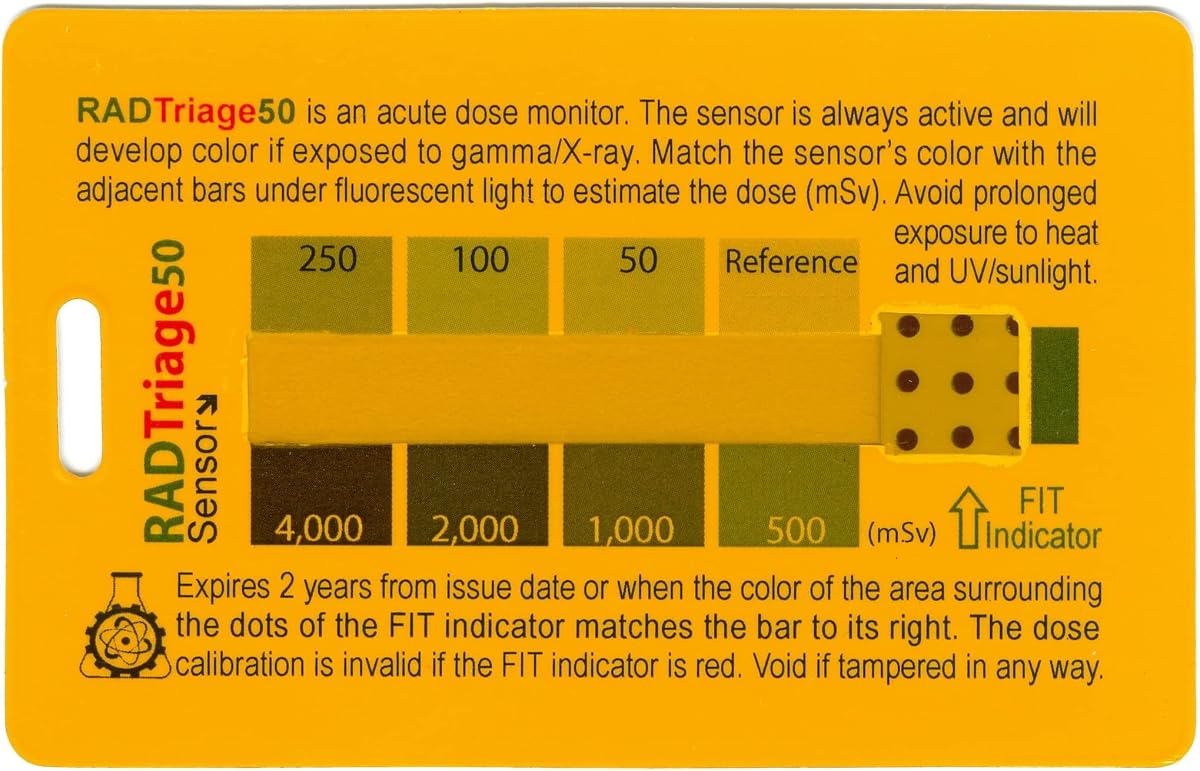
The Rad Triage 50 is designed around portability rather than the breadth of a bench-style digital dosimeter. It fits in a wallet or badge holder and is marketed as a personal detector for beta, gamma, and X-ray radiation. Its 4.4 rating places it among the stronger customer-rated choices in this guide while retaining a distinctly simple format.
We may earn a commission when you buy through this link, at no additional cost to you.
The most attractive feature is its readiness: no batteries and no calibration are required. The listing also says the unit is made in the USA, is military-grade, and has been field tested and approved by the U.S. Department of Homeland Security. It is positioned as a portable monitor for sources including fallout and dirty bombs, as well as a detector for uranium-bearing materials.
Users should understand the trade-off. Unlike the color-screen instruments elsewhere in the list, the Rad Triage 50 is a pocket detector that provides an immediate indication rather than a broad menu of measurement modes. The product title also includes electromagnetic field detection, but the supplied feature details focus primarily on ionizing radiation, so buyers needing a quantified electromagnetic measurement should verify that function before purchase.
This is an excellent choice for travelers, educators, responders, or anyone who wants a simple radiation alert that can remain on a person. It is less appropriate for formal dose records, extended surveys, or users who need adjustable thresholds, graphed history, and detailed cumulative-dose reporting.
Keeping a detector in a wallet or badge holder makes it practical to carry during travel or daily activities. Battery-free operation removes both charging and disposable-battery concerns, while the stated lack of calibration requirements simplifies upkeep.
The Rad Triage 50 prioritizes rapid awareness over advanced reporting. It is best suited to broad situational awareness, while users who need numerical dose history, timed sessions, or professional records should consider a more instrument-like option.
We may earn a commission when you buy through this link, at no additional cost to you.
The APOWER RD-3 is a capable Geiger counter for users seeking several core features without moving to a more specialized instrument. It has a 4.4 rating, detects beta, gamma, and X-ray radiation, and uses a built-in precision sensor. Its stated energy response is 33 keV to 3 MeV, while cumulative dose equivalent extends from 0.05 μSv to 50 mSv.
We may earn a commission when you buy through this link, at no additional cost to you.
Its clear color LCD presents readings and provides adjustable alarm thresholds, alarm modes, measurement units, brightness, and language. The warning system combines sound, visual indicators, red flashing, and a red screen when a threshold is exceeded. A timed measurement function records historical data, allowing users to review levels after each session instead of relying only on an instantaneous reading.
A rechargeable lithium battery is charged through Type-C, with the listing claiming up to eight days of operation when particle sound is off. The included package contains the detector, manual, charging cable, hand strap, and box. This is a well-rounded accessory set for home projects, vehicle inspections, laboratories, radiological work, and environmental checks.
The listing explicitly warns that accidental bumps or knocks may damage internal components and produce abnormal readings. With that caveat, the RD-3 offers a useful combination of sensitivity, logging, alarms, and portability, making it a strong value-oriented choice for buyers who want more than a basic alert device.
Users can set alarm thresholds, choose alarm modes, change measurement units, adjust screen brightness, and select the language. These options make the detector easier to adapt to different environments and to the way a particular user prefers to interpret readings.
The timed measurement function stores historical information after each session. Reviewing those records can provide a more useful account of how radiation levels changed than taking a single reading and immediately putting the instrument away.
We may earn a commission when you buy through this link, at no additional cost to you.
The AEGTEST Radar-5633 uses a semiconductor sensor to detect beta, gamma, and X-ray radiation. Its 3.9 rating is the lowest among the ten products, but its specifications are broad: a 33 keV to 3 MeV energy response, stated accuracy of -17% to +20% for Cs-137 gamma radiation, and a cumulative dose range from 0.1 μSv to 9999 mSv.
We may earn a commission when you buy through this link, at no additional cost to you.
One standout feature is the single-screen layout. Real-time dose rate, average dose rate, count rate, and cumulative dose appear together, with support for μSv/h, μR/h, CPM, and μSv units. A bright TFT color display and customizable menu help users move between these values, while visual and audible alerts can be activated at user-defined thresholds.
History logging records timed measurements, and Type-C charging supports a claimed battery life of up to 18 days when the particle sound is off. The supplied package includes the instrument, storage box, charging cable, lanyard, and manual. These inclusions make it suitable for professionals, laboratories, construction environments, and repeated field checks.
One limitation requires close attention: the listing states that the audible alert is unavailable while the screen is in sleep mode, although visual alerts continue. Buyers who depend on sound in a sleeping device should keep that distinction in mind. Otherwise, the Radar-5633 offers a clear, information-dense display and strong endurance.
Showing dose rate, average dose rate, CPM, and cumulative dose together reduces the need to navigate between pages. This arrangement is helpful when a user wants immediate access to several representations of the same measurement session.
The stated 18-day battery life under reduced-audio conditions makes the detector suitable for extended monitoring. Adjustable alarm thresholds let users define the point at which visual or audible warnings should begin.
We may earn a commission when you buy through this link, at no additional cost to you.
The HFS-50-CsI distinguishes itself with a cesium iodide scintillator sensor and built-in energy compensation. It has a 4.6 rating, a stated measurement range of 0.01 μSv/h to 20 mSv/h, and an error of ±10%. The listing also describes it as more resistant to interference and more operationally stable than traditional Geiger-Müller tubes.
We may earn a commission when you buy through this link, at no additional cost to you.
Its color display includes a 200-second dynamic waveform and a dose-rate indicator bar. Users can view dose rate, total dose, staged dose, average dose rate, and maximum dose rate. Measurements refresh every second, up to 100 recent records are retained, and total-dose and cumulative-time information is retained after power-off.
The triple alarm system combines sound, flashing lights, and on-screen numerical warnings, with a response time under three seconds. Thresholds and the particle sound are adjustable. A telescopic rod helps maintain distance from sources, while the included storage box supports transport. Its 2000mAh battery can provide up to 1700 hours in screen sleep mode and fully charge in three hours through Type-C.
This is a strong premium recommendation for users who value stability, waveform analysis, and an unusually long standby period. The stated coverage focuses on gamma and X-ray radiation rather than beta, so buyers needing all three radiation types should verify that requirement before choosing this model.
The 200-second dynamic curve gives users immediate visual context that a simple number cannot. Paired with total, staged, average, and maximum dose information, it is well suited to users who want more than a binary radiation alert.
Automatic startup, one-second refresh, retained cumulative totals, and 100 stored records reduce the need for constant interaction. The long sleep-mode runtime is especially relevant for deployments where recharging may be inconvenient.
We may earn a commission when you buy through this link, at no additional cost to you.
The GQ GMC-500Plus is built for users who need greater range and connected logging from a Geiger counter. It has a 4.6 rating, uses two Geiger tube sensors with independent calibration factors, and is described as having an upper detection limit increased tenfold. That makes it more relevant to repeated professional-style monitoring than a simple novelty meter.
We may earn a commission when you buy through this link, at no additional cost to you.
The large informative LCD can automatically switch between horizontal and vertical large-font displays, which helps maintain readability when the instrument changes orientation. An onboard speaker and audio output support audible radiation indications, while flash memory handles local information. The rechargeable battery is installed in the unit, keeping the package streamlined.
Its standout connectivity feature is unlimited server logging, with data that can be submitted automatically to a server anywhere in the world. This makes the GMC-500Plus appealing for users who want measurements collected over time without manually downloading every session. The exact setup requirements should be reviewed in the current documentation and software before deployment.
The trade-off is that the listing provides fewer details about measurement modes and alarm customization than the more recent GMC-800 products. Nevertheless, the dual-tube design, expanded range, automatic display orientation, and server submission make the GMC-500Plus a strong choice for connected, sustained monitoring.
Two tubes with independent calibration factors allow the instrument to combine sensing elements rather than relying on one detector alone. The stated tenfold increase in the upper detection limit supports use in environments with a broader expected range.
Unlimited server logging and automatic submission are useful for projects that extend across many sessions. Users can keep the instrument collecting information while directing attention to the monitored environment.
We may earn a commission when you buy through this link, at no additional cost to you.
The MOESAPU FS5000 is a handheld Geiger counter with a J321 GM sensor, a 2.4-inch TFT display, and coverage for X-ray, beta, and gamma radiation. It has a 4.2 rating and a stated energy response of 48 keV to 1.5 MeV with a 0.5-second response time. Distinctive clicks provide audible feedback as radiation events are detected.
We may earn a commission when you buy through this link, at no additional cost to you.
Dose tracking is one of its strongest areas. It monitors real-time dose rate from 0.01 μSv/h to 50 mSv/h, tracks total dose from 0 μSv to 1000 Sv, and offers timed dose. A live graph provides visual context, while the latest data remains in memory even without power and can be downloaded using PC software.
The alert system offers sound, light, and vibration. The listed default warnings activate above 2.5 μSv/h or 1 mSv total dose, and thresholds are customizable. A six-level TFT brightness adjustment helps with outdoor glare and low-light conditions, while the clip design makes the device convenient to carry.
A rechargeable 1800mAh battery provides a stated 720 hours of standby time in the shortest-backlight mode, and a low-battery warning supports timely recharging. It is a well-equipped option for home renovation checks, antique uranium-glass testing, radiology departments, and nuclear facilities, though no water resistance is specified.
The combination of a live graph, total-dose range, timed dose, and retained readings gives users several ways to understand an exposure session. Downloadable data adds value for longer projects where trends matter more than a momentary alarm.
Sound, light, and vibration provide alternatives when visual attention or ambient noise limits one type of alert. The clip design also supports hands-free carry, while adjustable brightness keeps the screen usable across lighting conditions.
We may earn a commission when you buy through this link, at no additional cost to you.
The Soogua Geiger Counter is a portable handheld monitor with a 4.2 customer rating. Its built-in GM sensor detects gamma, beta, and X-ray radiation over a stated 48 keV to 1.5 MeV energy range. The cumulative dose equivalent runs from 0.00 μSv to 500 mSv, with a listed sensitivity of 80 CPM/μSv and tolerance of no more than ±30% for Cs-137.
We may earn a commission when you buy through this link, at no additional cost to you.
The color LCD and straightforward menu show real-time readings and support several common functions. Users can configure alarm thresholds, alarm modes, measurement units, screen brightness, and language. Its four warning channels—sound, vibration, alarm light, and screen notification—make the instrument useful in settings where different forms of attention are needed.
A built-in 1800mAh lithium battery supports continuous work, and the listing identifies applications including home improvement, imported food and cosmetics, medical radiation, geological surveying, nuclear facilities, chemical laboratories, outdoor environments, and marble or stone testing. The broad scenario list reflects the instrument's general-purpose design.
Compared with the GMC-800 or FS5000, the Soogua model does not list waveform analysis, extensive server logging, or the same level of multifunction data tooling. It is therefore most appropriate for straightforward portable measurements, customizable alerts, and general environmental awareness rather than advanced laboratory reporting.
Language, brightness, unit, threshold, and alarm-mode settings make the interface easier to tailor. These options are useful when a device will be used by multiple people or carried between work areas with different monitoring requirements.
The listed use cases range from construction materials and stone to medical, laboratory, outdoor, and industrial checks. A rechargeable battery and handheld format support operation away from a convenient power outlet.
We may earn a commission when you buy through this link, at no additional cost to you.
Choosing a dosimeter requires matching radiation coverage and measurement performance to your intended environment, then balancing those needs against display, alarm, logging, power, and portability features. Start with the type of exposure you need to monitor rather than choosing solely by screen size or included accessories.
First establish which ionizing radiation types matter. Most products in this guide detect beta, gamma, and X-ray radiation, but the HFS-50-CsI is specifically listed for gamma and X-ray detection and uses a cesium iodide scintillator rather than a GM tube. Geiger counters are generally associated with particle counts and audible clicks, while scintillator-based devices emphasize stable readings, energy compensation, and waveform analysis.
Range matters because a detector optimized for low-level background readings may not accommodate a much stronger source, while an instrument with a broad upper range may offer less resolution at the low end. Compare the listed dose-rate, cumulative-dose, and energy-response figures. The products here span energy ranges from 33 keV to 3 MeV, and their cumulative limits differ considerably, from 50 mSv on the RD-3 to 9999 mSv on the Radar-5633.
A clear color LCD makes readings easier to interpret in bright work areas, and large-font modes are helpful for users who need quick access to dose information. Graph and waveform displays reveal changes that a single numerical value can hide. The GMC-300S offers CPM, dosimeter, and graph modes; the HFS-50-CsI provides a 200-second dynamic curve; and the FS5000 combines a live graph with detailed dose metrics.
Alerts must work in the environment where the instrument is used. Sound is effective in quiet areas, vibration can help in noisy workplaces, and flashing lights or screen warnings remain visible when audio is unavailable. The GMC-800 offers five stated alarm types, while the FS5000 and Soogua combine sound, light, and vibration. Adjustable thresholds are important because acceptable warning levels depend on the task and local procedures.
Data logging turns a detector into a record-keeping tool. The GMC-300S logs every second and includes free PC viewer software; the GMC-800 adds long-term memory, online storage, and global sharing; the GMC-500Plus supports automatic server submission; and several smaller models retain timed session records. Consider whether records need to remain on the device, appear in a graph, download to a computer, or reach a remote server.
Rechargeable batteries are convenient for repeated work, but runtime claims depend heavily on display and sound settings. Stated figures range from as much as eight days for the RD-3 and 18 days for the Radar-5633 to 1700 hours in sleep mode for the HFS-50-CsI. The GMC-800 uses a replaceable rechargeable battery, while the Rad Triage 50 requires no battery at all. Verify connector type, charging time, and likely screen usage before a long deployment.
Portability depends on more than weight. A wallet-sized detector is easy to carry but may not display detailed measurements, while a handheld color-screen unit is more practical for timed work and can still be transported in a bag. Look for a clip, lanyard, hand strap, stand, storage box, or telescopic rod. For outdoor use, readability and physical protection matter, but only the GMC-800 is explicitly described as thin, anti-drop, and readable under sunlight.
A home renovation check, radioactive-material inspection, laboratory survey, and hospital X-ray assessment are not identical use cases. Some products emphasize uranium glass and marble, others focus on medical imaging, and the Rad Triage 50 is built for pocket awareness. Review the complete package: Type-C cable, hand strap, lanyard, storage box, software, and manuals can materially improve daily usability. Warranty information, where supplied, can also affect ownership confidence.
Begin by reading the included manual and identifying the correct detector, calibration status, energy range, radiation types, and measurement units. Charge the battery or install the required power source, update any supplied software, and confirm that the current date and time are correct. If a particular radiation source is involved, follow local safety procedures and use the detector as an aid rather than as a substitute for qualified radiation-protection controls.
For a measurement session, choose the mode that matches the objective, set a sensible alarm threshold, and allow the device to stabilize as directed. Keep the sensor away from obstructions and avoid abrupt movement during timed readings. Record the location, duration, operating mode, and relevant conditions. When logging, use the computer software or server workflow to export the history, and back up important records before changing or clearing the device.
Care for the instrument according to its manual. The RD-3 listing specifically warns that bumps and knocks can damage internal parts and cause abnormal readings, so store it in its box and handle it carefully. Keep ports and battery compartments dry, clean the exterior with an approved method, and avoid exposing the device to temperature extremes, moisture, or direct impact. Recharge it before extended work, verify the display and alarm at the start of an important session, and schedule calibration or service according to the manufacturer's recommendations.
A Geiger counter typically reports radiation events as counts per minute and often produces audible clicks, although many modern devices also calculate dose rate and cumulative dose. A dosimeter is designed to measure absorbed dose, with some models acting as personal monitors and others providing environmental readings. Since the products in this guide overlap these categories, compare the actual units and measurement modes rather than relying on the product label alone.
Most models in this guide explicitly list beta, gamma, and X-ray detection, including the GMC-800, GMC-300S, Rad Triage 50, RD-3, Radar-5633, FS5000, and Soogua counter. The HFS-50-CsI is listed for gamma and X-ray detection, and the GMC-500Plus is described as a dual-Geiger-tube model. Confirm the exact radiation coverage in the current documentation if beta measurement is essential.
These products are useful for screening, awareness, and many routine monitoring tasks, but professional work may require instruments certified for a specific application, energy range, and regulatory standard. The GMC-800 is described as meeting USA national standards and being calibrated, while the Rad Triage 50 is described as military-grade and field tested. Employers and radiation-safety professionals should still verify that any device satisfies the requirements of their specific program.
Common units include μSv/h for dose rate, μSv or mSv for accumulated dose, and CPM for count rate. The Radar-5633 displays several of these simultaneously, while other products offer selectable units. Choose a model that shows the unit relevant to your procedure and learn how its readings should be interpreted instead of comparing numbers without considering the measurement mode.
A GM tube counts ionization events and is associated with particle clicks and relatively simple counters. A scintillator uses a crystal and an energy-compensation mechanism to produce readings with more emphasis on stability and measurement detail. The HFS-50-CsI is the clear scintillator example in this guide, offering a waveform, stated ±10% error, and stable operation compared with the traditional GM-tube models.
A threshold that is too low may create frequent distractions, while one that is too high may provide warning too late. Adjustable thresholds allow users to align alerts with local procedures and expected normal readings. Models offering sound, vibration, light, and screen warnings are more adaptable to noisy, bright, shared, or accessibility-sensitive environments.
Logging is valuable when a measurement must be documented, compared over time, or transferred to a computer. The GMC-300S logs every second and includes PC software, while the GMC-800 supports extensive memory, online storage, and history previews. For a quick one-time check, a simpler model may be sufficient, but repeated or formal monitoring generally benefits from stored records.
Store it in its supplied case or a suitable protective container, away from moisture, excessive heat, impact, and direct sunlight. Remove or charge the battery according to the manual, and record the last known configuration so alarm thresholds and units are not unintentionally changed. A quick function check before each important use can reveal a depleted battery or reading problem, but it does not replace calibration when required.
The GQ GMC-800 stands out as the most versatile all-around selection because it combines four measurement functions, a sunlight-readable color display, five alarm types, extensive memory, and data-sharing options. The HFS-50-CsI is the premium choice for users who prioritize a stable scintillator sensor, a 200-second waveform, retained records, and long battery life. The APOWER RD-3 offers a balanced budget package with beta, gamma, and X-ray detection, custom alarms, timed history, and an eight-day stated battery life.
The right priorities depend on the job. Carrying a pocket detector for general awareness calls for the Rad Triage 50, while detailed trend analysis favors the HFS-50-CsI or a GQ model with downloadable data. Professional users should consider connected logging, long-term storage, calibration information, and the exact energy range, while casual users can focus on a readable screen, adjustable alarms, and an easy-to-understand display.
Before ordering, verify the current specification, package contents, radiation coverage, compatibility, and warranty on the live listing. Prices, ratings, availability, and product variants can change over time, so the most economical choice is not necessarily the one with the lowest cost but the one that provides the measurements, alerts, and records required for the intended environment.