
HiFi DAC Pro Hat
4.5Editor score
ES9038Q2M conversion
DSD512 playback support
Balanced and headphone outputs
Explore the best DAC for Raspberry Pi options, comparing outputs, codecs, clocking, compatibility, and features for a better listening setup.
A dedicated DAC can turn a Raspberry Pi into a more capable music server, network player, or compact hi-fi system. The best DAC for Raspberry Pi depends on your Raspberry Pi model, preferred output connections, headphone needs, and the level of clock control and signal isolation you require.
This guide compares ten analog and digital audio add-on boards, standalone modules, and premium signal-processing options. We examined DAC chips, maximum resolutions, supported Raspberry Pi generations, output formats, oscillator design, software compatibility, and practical features such as EEPROM configuration and balanced connections.
The picks range from an approachable PCM5102 module to sophisticated PCM5122, ES9038Q2M, and S/PDIF solutions. Each review explains who the board suits, while ratings and specifications reflect the supplied product information; prices and availability can change at any time.
4.5Editor score
4.5Editor score

4.8Editor score
This side-by-side comparison highlights the major converter chips, output types, Raspberry Pi compatibility, resolution limits, and distinguishing features represented in the guide.


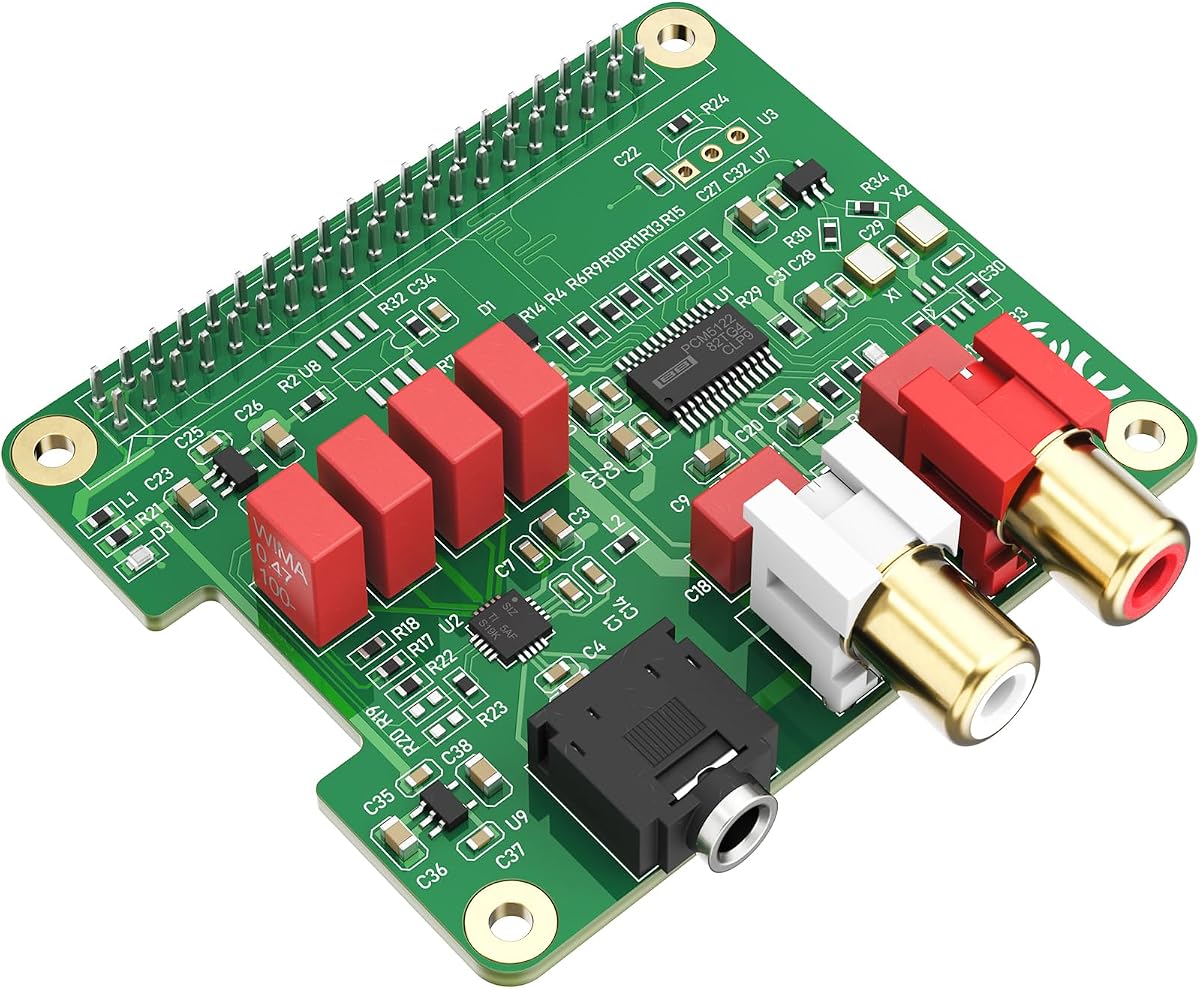
The HiFi DAC HAT is one of the strongest all-around choices in this guide, combining a PCM5122 converter, dual low-jitter oscillators, balanced analog output options, and a generous software support list. Its 4.5 rating reflects a feature set that is especially convincing for a Raspberry Pi-based music player intended for regular, long-term use.
We may earn a commission when you buy through this link, at no additional cost to you.
The board connects through the 40-pin GPIO header and works with Raspberry Pi 5, 4, 3B+, Zero, and Zero W models. It supports 32-bit PCM playback up to 384kHz, DSD over PCM, and a pair of external clock frequencies designed to improve timing accuracy. Separate RCA outputs and a 3.5mm headphone connection make it flexible enough for powered speakers, an amplifier, or compatible headphones.
A 112dB signal-to-noise ratio and negative 78dB THD+N specification provide a strong technical foundation, while the TPA6133 headphone amplifier is specified to deliver 138mW into a 32-ohm load. The lack of balanced outputs keeps it from matching the Pro Hat for specialized studio use, and the full-size form may be less convenient in a very compact Zero project.
This is an excellent choice for someone who wants a mature feature set without moving to a premium converter platform. It also suits users who value broad operating-system and player compatibility, since the supplied information names Volumio, Moode, RuneAudio, LibreELEC, and Raspberry Pi OS. For most music-server and desktop-audio projects, it provides the most persuasive balance of features here.
The independent 45.158MHz and 49.152MHz oscillators are among the board's most important technical details. They provide dedicated timing references rather than relying entirely on the Raspberry Pi's internal clock, which is valuable when playing high-resolution PCM and DSD-over-PCM material.
Gold-plated RCA outputs connect to line-level equipment, while the dedicated headphone amplifier offers a convenient path to compatible headphones. That combination makes the HAT useful for a bedroom system, office player, living-room amplifier, or a more serious digital listening setup.
We may earn a commission when you buy through this link, at no additional cost to you.
The DAC Mini Hat PCM5122 is built around the same broadly respected PCM5122 converter found in several higher-ranked boards, but its defining advantage is physical fit. It is specifically designed to avoid overhanging Raspberry Pi Zero, Zero W, Zero 2, and Zero 2 W boards while remaining compatible with the Pi 5, Pi 4, and Pi 3B+.
We may earn a commission when you buy through this link, at no additional cost to you.
It supports 32-bit audio at sampling rates up to 384kHz and includes both gold-plated RCA line outputs and a 3.5mm headphone connection. A TPA6133 headphone amplifier is included, with the supplied specifications identifying a 2.1Vrms output. That makes it possible to connect headphones directly or feed an external amplifier without relying on the Raspberry Pi's less capable onboard analog output.
Software readiness is another strength. The product information names Volumio, Moode, RuneAudio, OSMC, PiCorePlayer, and Max2Play, along with Raspberry Pi OS, Debian, and Ubuntu. The product does not advertise the same level of clock detail or the balanced outputs available from some alternatives, so buyers prioritizing timing transparency or professional connection options should investigate those differences.
For a small enclosure, portable project, or Zero-based player, the Mini Hat is a practical choice. Its 4.2 rating and specification set suggest a capable, approachable board for users who want more resolution and better analog output than the Pi provides onboard, while keeping the footprint suitably restrained.
The compact design is especially relevant for projects using a Zero in a tightly fitted enclosure. A board that does not overhang the Pi can simplify assembly and preserve space for the GPIO header and other connections.
Support for both dedicated music distributions and general-purpose operating systems gives users several practical paths. This is useful whether the goal is a dedicated network player or a Raspberry Pi desktop that also handles music playback.
We may earn a commission when you buy through this link, at no additional cost to you.
The HiFi DAC Pro Hat is the premium selection in this guide, built around the ESS ES9038Q2M and aimed at listeners who want maximum converter capability, balanced connectivity, and support for both high-resolution PCM and DSD512. Its 4.5 rating reflects a technically ambitious design with an emphasis on signal purity and flexibility.
We may earn a commission when you buy through this link, at no additional cost to you.
The supplied specifications list a 129dB dynamic range and negative 120dB THD+N, along with 32-bit PCM playback up to 384kHz. Two independent 45.158MHz and 49.152MHz oscillators address sample timing, while three Texas Instruments SoundPlus op-amps drive the output stage. Connections include a 3.5mm stereo jack at 2.1Vrms and balanced X+ and X- outputs.
The main trade-off is that balanced capability is only valuable when the rest of the signal chain can use it. Users with ordinary powered speakers or a conventional headphone amplifier may not hear the full benefit of the X+ and X- connections. The premium position also places it beyond simpler boards for users whose main goal is a basic improvement over Raspberry Pi analog audio.
Even so, this is the most advanced analog DAC in the list. It plugs into 40-pin GPIO headers across Raspberry Pi 5, 4, 3B+, 3B, Zero W, and Zero models, and supports Volumio, Moode Audio, RuneAudio, LibreELEC, and Raspbian. For a carefully assembled hi-fi system, a high-end headphone setup, or a project that needs balanced output and DSD512 support, it is the most compelling premium choice.
The ES9038Q2M platform supports 32-bit, 384kHz PCM and DSD512 playback, giving it the highest-format claims in this group. It is a logical fit for users who regularly handle high-resolution files and want the board to accommodate them.
The X+ and X- outputs allow compatible amplifiers, preamplifiers, and headphone equipment to receive a balanced analog signal. This differentiates the Pro Hat from compact boards whose primary connections are RCA and 3.5mm.
We may earn a commission when you buy through this link, at no additional cost to you.
The Digi One Hat is the standout digital-output board in this guide, earning a 4.8 rating and offering a different approach from the analog PCM5122 and ES9038Q2M DACs elsewhere in the list. It delivers S/PDIF audio through optical TOSLINK and electrical RCA connections rather than providing a conventional line-level analog output.
We may earn a commission when you buy through this link, at no additional cost to you.
Its S/PDIF interface complies with IEC60958-3 and supports sampling rates from 32kHz through 192kHz. Two low-jitter external crystal oscillators and an I2S master-mode design are included to improve clock accuracy. The board also uses a 150M industrial-grade digital signal isolator and an automotive-grade 1W power isolator to separate its power and digital signals from the Raspberry Pi.
Its limitation is fundamental: the Raspberry Pi still needs to perform the digital-to-analog conversion, either in the software stack or through a downstream device with a suitable DAC. A user seeking a complete analog headphone or speaker stage should look at an analog HAT instead. The Digi One is better suited to an external DAC, AV receiver, digital amplifier, or other S/PDIF-capable equipment.
Its exceptional rating, complete isolation design, broad operating-system list, and dual digital connections make it a compelling specialist choice. It is particularly relevant for a two-stage system in which the Pi acts as a network transport and another component handles final conversion. For that architecture, it offers the strongest combination of isolation and digital interface features among the products reviewed.
The dedicated digital signal and power isolators separate the audio path from the Raspberry Pi, helping reduce unwanted hum and noise. That makes the board especially interesting where the Pi is connected to substantial power transformers or sensitive audio equipment.
Because the board outputs a digital stream, final sound quality depends on the receiving DAC. Pairing it with a capable external converter can make the separation of transport and conversion a deliberate, high-quality system architecture.
We may earn a commission when you buy through this link, at no additional cost to you.
The HiFi DAC Audio Sound Card is the best budget selection, combining a PCM5122 converter with 384kHz sampling, 16-to-32-bit resolution, and a 4.8 rating. It offers a straightforward route to higher-quality analog audio for a Raspberry Pi music player without introducing the complexity of balanced or digital-only designs.
We may earn a commission when you buy through this link, at no additional cost to you.
The board uses the Pi's I2S interface and provides two kinds of analog output for external amplifiers and other equipment. Its stated performance includes a 120dB signal-to-noise ratio, negative 93dB THD, and 112dB dynamic range. Red and green LEDs provide at-a-glance status information: red indicates normal DAC power, while green indicates active decoding.
Compatibility is the most important caveat. The supplied title and specifications focus on the Raspberry Pi B+, Pi 2 Model B, and the broader Pi 2 and Pi 3 families. An infrared receiver interface is also available, but it occupies GPIO26, so users planning to use that pin for another purpose should account for the conflict.
For a builder with an older Pi who wants PCM5122-level specifications and simple analog outputs, this board remains a compelling option. The high rating and clear specifications make it attractive, though buyers with a Pi 4, Pi 5, or Zero should ensure their software and mechanical setup is compatible before committing.
Separate power and decoding indicators make it easy to see whether the converter is running and processing audio. This is particularly useful during initial software setup, when distinguishing an inactive player from a hardware problem can otherwise be frustrating.
The converter supports high sampling rates and impressive stated noise and distortion figures without introducing a balanced requirement. That keeps the system easy to connect to ordinary amplifiers and speakers through its analog outputs.
We may earn a commission when you buy through this link, at no additional cost to you.
The RASPIAUDIO Audio DAC Hat is an easy-to-understand HAT for improving Raspberry Pi audio while retaining familiar connections. It supports 32-bit PCM at sampling rates up to 384kHz, offers both RCA and 3.5mm outputs, and carries a 4.2 rating that reflects a practical balance of functionality and ease of use.
We may earn a commission when you buy through this link, at no additional cost to you.
One of its most attractive features is the onboard EEPROM, which allows the board to be recognized without manually installing drivers according to the product information. That makes it particularly suitable for users who want a music player or desktop installation that works quickly after setup rather than a board requiring extended configuration.
The board is compatible with Raspberry Pi 5, 4, Zero 2, and earlier models including Pi 3, Pi 2, and Zero 1. Its 3.5mm jack can serve compatible headphones, while RCA provides line-level connectivity to an amplifier or powered speakers. The supplied information does not detail a dedicated balanced stage or advanced clock arrangement, so those needs point toward more specialized models.
This HAT is best for mainstream users who value simple installation, broad Raspberry Pi support, and a conventional analog output layout. It is not the most technically exotic option in the guide, but it removes several common obstacles to building a clean Raspberry Pi audio system.
The EEPROM-based setup is a meaningful convenience for dedicated music systems. Automatic board recognition can make the difference between a quick installation and a lengthy troubleshooting session for users who are less familiar with Linux audio configuration.
RCA and 3.5mm outputs cover most conventional listening arrangements. Headphones can connect directly, while an amplifier or powered desktop speakers can be reached through the line-level RCA sockets.
We may earn a commission when you buy through this link, at no additional cost to you.
The Argon BLSTR DAC is a focused upgrade for Raspberry Pi 5 owners, with a perfect 5.0 rating and a streamlined feature set. It uses a Texas Instruments PCM5122 digital audio codec and provides a 3.5mm audio output through a plug-and-play board designed for the Pi 5.
We may earn a commission when you buy through this link, at no additional cost to you.
Its distinguishing feature is the included ground-loop isolator. Rather than merely improving the digital-to-analog conversion, the product addresses a common system-level issue: unwanted noise or hum can enter when a Raspberry Pi and connected audio equipment share a power environment or introduce ground-related interference. The isolator is intended to help prevent that transmission.
The hardware restriction is important. The title specifies that it is for the Argon ONE V3 only, so it should not be treated as a universal HAT for older Pi models or unrelated cases. It also lists only a 3.5mm output, which may be limiting for users who require RCA line-level connectivity or balanced outputs.
For someone already using an Argon ONE V3 enclosure with a Raspberry Pi 5, the dedicated fit and included isolator make this a strong recommendation. It is less suitable as a general purchase because the case and generation requirements narrow the audience considerably.
The included ground-loop isolator is intended to reduce unwanted hum and noise between the Pi and the listening system. It can be particularly useful in setups where the computer, amplifier, and other powered components share power or are connected in ways that expose ground differences.
This board is not simply a generic expansion card. Its design is tied to the Argon ONE V3 and Raspberry Pi 5, allowing buyers to create a more integrated enclosure-based audio system rather than adapting a general-purpose module.
We may earn a commission when you buy through this link, at no additional cost to you.
The HiFiBerry DAC+ DSP is the most processing-focused product in the guide. Rather than being simply an analog output HAT, it combines stereo digital input and output with a 300MHz digital signal processor capable of handling as many as 6,144 instructions per sample. Its 4.1 rating reflects a specialized platform with broad capabilities but a more constrained physical use case.
We may earn a commission when you buy through this link, at no additional cost to you.
A major advantage is the high-quality asynchronous sample-rate converter. It can upsample, downsample, or mix audio sources while allowing DSP parameters to be changed on the fly. Digital input extends to 96kHz, and digital output extends to 192kHz. The stated applications include standalone DAC use, source conversion, and room equalization.
The onboard EEPROM allows the board to boot and operate even without the Raspberry Pi, which turns it into a more autonomous audio component rather than a board that only exists as a Pi peripheral. However, the product can only be used with HiFiBerry's Universal Case III enclosure. That enclosure requirement is substantial and narrows the board's appeal to dedicated builders.
This is a compelling choice for a carefully planned custom system involving a Pi inside a compatible HiFiBerry enclosure and a user who actively wants DSP control. It is less appropriate for a simple desktop project, a portable build, or anyone who needs a straightforward HAT that can be installed without considering a specific case.
The 300MHz processor and 6,144-instruction capability allow the board to handle more than a direct conversion function. Sample-rate conversion, mixing, parameter changes, and room equalization can be managed within the hardware.
The onboard EEPROM gives the board enough stored configuration to boot and run without the Raspberry Pi. For a dedicated standalone DAC installation, that can be a more elegant arrangement than keeping the computer active for every listening session.
We may earn a commission when you buy through this link, at no additional cost to you.
The HiFiBerry Digi+ Standard is a dedicated digital-output board for Raspberry Pi 2 Model B, B+, and A+ owners. It has a 4.6 rating and uses a dedicated S/PDIF interface chip to provide optical TOSLINK and coaxial electrical outputs with bit-perfect transmission.
We may earn a commission when you buy through this link, at no additional cost to you.
The board supports digital audio up to 192kHz and 24-bit resolution, making it appropriate for streaming a digital signal to a separate DAC, AV receiver, or digital amplifier. Because the data stream is not modified, the receiving device handles the final digital-to-analog conversion rather than the Raspberry Pi.
Its age is visible in the compatibility list. It was designed for the Pi 2 and A+ era rather than the Pi 4, Pi 5, or current Zero models, so modern owners should confirm mechanical and electrical compatibility before purchasing. It also requires a downstream DAC and therefore does not directly serve speakers or headphones in the way an analog HAT would.
For someone building a digital transport around one of the supported older Pi boards, the dedicated interface, broad output selection, and bit-perfect behavior remain solid reasons to choose it. The board also includes four M2.5 by 12mm spacer bolts and screws, helping with installation on compatible hardware.
The dedicated S/PDIF chip and unmodified output path make the board useful when the Raspberry Pi is intended to act only as a transport. The downstream DAC receives the digital signal without an analog conversion stage inside the Pi.
TOSLINK provides a convenient fiber connection, while the coaxial output can suit receivers and DACs with that input. Having both options makes it easier to assemble a system around the connections already available in the user's equipment.
We may earn a commission when you buy through this link, at no additional cost to you.
The HiLetgo PCM5102 is the most accessible product in the guide, offering a straightforward PCM5102A digital-to-analog module for Raspberry Pi or Arduino projects. It has a 4.2 rating and prioritizes simplicity: the board uses the Raspberry Pi's I2S interface and arrives with a stereo jack already soldered on.
We may earn a commission when you buy through this link, at no additional cost to you.
That combination makes it useful for learning how digital audio works, building a small local player, or replacing the Raspberry Pi's onboard analog output in a simple project. Because the audio remains digital from the source through the I2S connection, the product information describes it as offering better sound than the onboard analog path.
The specification information is intentionally modest compared with the more advanced HATs. It does not present the same high-resolution sampling, clocking, balanced-output, or isolation details, and the module is not a full HAT with an onboard EEPROM. Buyers should therefore expect a straightforward converter rather than a feature-rich, automatically configured audio board.
For a first Raspberry Pi DAC project, a compact enclosure experiment, or an Arduino-compatible audio project, the module offers a clear path from digital samples to a stereo analog output. It is the least advanced recommendation here, but its low-complexity approach and pre-soldered headphone jack make it a sensible educational or hobbyist choice.
The module exposes the basic stages of a digital audio path without requiring a complex HAT design. That makes it approachable for people who want to understand I2S communication, configure an audio player, and experiment with a dedicated converter.
Because the stereo jack is soldered onto the board, the builder does not need to complete that connection before using the module. A suitable Raspberry Pi configuration and compatible headphones or line input remain necessary for operation.
We may earn a commission when you buy through this link, at no additional cost to you.
The right Raspberry Pi DAC depends on the board you own, the equipment you want to connect, and the balance between resolution, clock control, isolation, convenience, and physical fit.
Compatibility should be checked at both the electrical and mechanical levels. A 40-pin GPIO header is common across many Raspberry Pi generations, but a board can still overhang a compact Zero, rely on an older HAT footprint, or target a specific enclosure. The HiFi DAC HAT supports several current and older boards, while the DAC Mini Hat is especially attentive to Zero dimensions. The Argon BLSTR is tied to Raspberry Pi 5 and the Argon ONE V3, while the HiFiBerry Digi+ is designed for Pi 2 Model B, B+, and A+ hardware.
Choose a board that explicitly fits your model, case, and intended GPIO layout. In addition to the printed model name, check the required header, mounting holes, and software guidance.
The converter chip establishes the board's underlying capability, but the most useful figures remain maximum resolution, sampling rate, noise, and distortion. PCM5122 boards in this guide support up to 384kHz PCM, while the ES9038Q2M Pro Hat adds DSD512 support and a 129dB dynamic range specification. The Digi One and HiFiBerry Digi+ are digital-output devices rather than final analog converters, so their 192kHz limits describe the digital transport path. The PCM5102 module is useful for simpler I2S projects but provides fewer detailed specifications.
Prioritize a converter and supported format that match your actual music library. A very high maximum rate does not help if your player, source, or downstream DAC cannot operate at that rate.
Output selection determines which amplifiers, speakers, headphones, and digital components can join the system. RCA provides line-level stereo, a 3.5mm jack supports compatible headphones, balanced X+ and X- outputs can feed specialist equipment, and TOSLINK or coaxial S/PDIF requires a downstream DAC. Some boards offer RCA and 3.5mm together, as the HiFi DAC HAT and RASPIAUDIO do, while the Argon BLSTR lists only 3.5mm and the Pro Hat adds balanced outputs.
Inventory the ports on your existing equipment before buying. Choose the board that matches that equipment without requiring unnecessary adapters, and avoid paying for balanced capability unless you can actually use it.
Clock quality influences how accurately a converter receives digital samples. The HiFi DAC HAT, HiFi DAC Pro Hat, and Digi One Hat advertise dedicated oscillators designed to reduce timing uncertainty. The Pro Hat uses independent 45.158MHz and 49.152MHz clocks, while the Digi One uses two low-jitter external crystal oscillators and I2S master mode. Boards without such claims may still perform well, but they offer fewer details about how the Raspberry Pi's clock is handled.
Look for independent clocking and master-mode support when timing precision is central to your system. Also verify that the relevant Raspberry Pi operating system or player supports the board's preferred clock configuration.
Not every line-level output drives the same range of equipment. The TPA6133-based boards include dedicated headphone amplification, while the Pro Hat uses three Texas Instruments SoundPlus op-amps. Stated figures such as 2.1Vrms output and 138mW into 32 ohms can help indicate intended use, but actual compatibility depends on the impedance and sensitivity of your headphones or the input requirements of your amplifier. RCA outputs are generally the most convenient route to powered speakers and stereo amplifiers.
Match output level and impedance to the destination device. Headphones with demanding requirements may benefit from the Pro Hat, while ordinary speakers and amplifiers are likely to pair more naturally with RCA line outputs.
Isolation can be valuable when a Raspberry Pi shares power or ground paths with larger audio components. The Digi One Hat includes separate digital signal and power isolators, while the Argon BLSTR comes with a ground-loop isolator intended to prevent hum and unwanted noise. These features are particularly relevant to a Raspberry Pi, whose switching power supply and digital circuitry may sit close to sensitive audio hardware.
If you hear buzzing, humming, or intermittent noise, isolation may be more valuable than another increase in nominal sample rate. Conversely, a short, clean installation with uncomplicated power may not require a specialist isolation feature.
A technically capable board still needs software that recognizes its audio interface. Most products here mention Volumio, Moode, and Raspberry Pi OS, with several also listing RuneAudio, LibreELEC, OSMC, Max2Play, PiCorePlayer, Debian, or Ubuntu. The HiFi DAC HAT includes an onboard EEPROM for plug-and-play configuration, and the RASPIAUDIO similarly uses EEPROM-assisted setup. Other boards may require more driver or mixer configuration.
Confirm that your preferred music player explicitly supports the board, particularly when using a Raspberry Pi OS release newer than the board documentation. Automatic configuration is valuable, but it does not replace checking the required ALSA, mixer, or device-routing steps.
The broader system design often matters more than an isolated specification. A Zero-based portable player needs a board that does not overhang the computer and may need battery-conscious setup. A fixed living-room system benefits from balanced outputs, a reliable enclosure, and straightforward software. A two-stage system can use an S/PDIF transport and place a high-quality external DAC nearby. The HiFiBerry DAC+ DSP can even boot without a Pi, but only inside its specified Universal enclosure.
Design the complete signal chain before choosing. Consider Raspberry Pi generation, case dimensions, connector clearance, power arrangement, source formats, downstream equipment, and whether advanced processing or simple plug-and-play operation matters more.
Before installation, shut the Raspberry Pi down and disconnect its power. Confirm that the DAC board is electrically and mechanically compatible with the model and GPIO header, then seat it carefully without forcing the connector. For a Zero, check that the board does not extend beyond the intended enclosure or interfere with a display, USB adapter, or HAT used at the same time.
Install the software named in the board's documentation, select the correct audio device, and choose the desired output in Volumio, Moode, Raspberry Pi OS, or another supported player. Set the player's output level appropriately before changing it. Connect RCA or balanced cables for line-level equipment, plug compatible headphones into the 3.5mm socket, or route a TOSLINK or coaxial digital output to a suitable DAC or receiver.
For a stable installation, use short, undamaged cables, secure the board without stressing the GPIO connector, and keep audio connections away from power supplies and other sources of interference. If the included isolator is part of the design, use it as specified. Do not repeatedly hot-plug the board or connected headphones, and check the current Raspberry Pi OS and player documentation whenever an update changes driver or mixer behavior.
No. Compatibility depends on the board's GPIO, power, dimensions, and software support. The HiFi DAC HAT, DAC Mini Hat, HiFi DAC Pro Hat, Digi One Hat, and RASPIAUDIO explicitly support the Raspberry Pi 5. The Argon BLSTR is designed specifically for Raspberry Pi 5 and Argon ONE V3, while older boards such as the HiFiBerry Digi+ target earlier Pi generations.
A dedicated HAT can offer a direct digital audio path, useful analog outputs, and clock features that may suit a carefully built system. USB audio offers broader device support and a simpler connection method. The better choice depends on the Raspberry Pi, player software, outputs, and whether your priority is convenience, clock control, balanced connectivity, or physical integration.
It depends on the output. RCA line-level outputs normally feed an amplifier or powered speakers, while a 3.5mm output may drive compatible headphones directly. Headphone output level and impedance requirements vary, so users with demanding headphones should check the board specifications and their headphone requirements before connecting them.
An analog DAC converts the Raspberry Pi's digital samples into line-level or headphone audio. A digital S/PDIF card instead sends a digital stream through optical or coaxial connections, and another DAC performs the final conversion. The Digi One Hat and HiFiBerry Digi+ belong to the digital-output category, while the PCM5122, ES9038Q2M, and PCM5102 products provide analog conversion.
Many 40-pin HATs support both boards electrically, but physical fit can differ. The DAC Mini Hat is specifically designed not to overhang compact Zero models. Other boards may work electrically while extending beyond the Zero or conflicting with an enclosure, so check the dimensions, GPIO header, and mounting arrangement before purchasing.
The most commonly named options include Volumio, Moode, RuneAudio, Raspberry Pi OS, LibreELEC, OSMC, Max2Play, PiCorePlayer, Debian, and Ubuntu. Support varies by board, and some products include EEPROM-based configuration while others need manual driver or mixer setup. Check the documentation for the exact board and current operating-system release.
No. Balanced output can reduce interference and offer a cleaner signal path when used with a properly matched balanced input, but the full benefit depends on the entire chain. If the amplifier or headphone device accepts only unbalanced connections, the balanced option may go unused. Choose the output type based on the equipment you already own or plan to use.
Start by checking the power supply, cables, grounding, and connection arrangement. A board with dedicated isolation, such as the Digi One Hat, or an included ground-loop isolator, such as the Argon BLSTR, may help in systems prone to interference. A shorter audio connection and a cleaner separation between Raspberry Pi power components and sensitive equipment can also improve reliability.
The HiFi DAC HAT is the most versatile overall recommendation, combining PCM5122 conversion, dual oscillators, RCA and headphone outputs, an EEPROM, and wide software support. The HiFi DAC Pro Hat is the premium choice for balanced output, DSD512, and higher-end conversion, while the HiFi DAC Audio Sound Card stands out as an approachable high-resolution option for appropriately compatible older Pi systems.
Prioritize the connection you can actually use, confirmed Raspberry Pi and case compatibility, and the software support required by your player. Digital isolation matters in noisy or hum-prone systems, dual clocking is attractive for high-resolution enthusiasts, and compact fit is essential for Zero projects. A simpler board that integrates cleanly is often a better purchase than a more advanced one whose key features remain unused.
Ratings, specifications, product availability, and prices can change, so check the current listing before purchasing. Compare the latest board documentation with your Raspberry Pi model and chosen player, then verify that the output connectors, power arrangement, and enclosure all support the system you intend to build.