
FNIRSI DSO152
4.4Editor score
Compact handheld construction
200 kHz signal bandwidth
2.5 MS/s sampling rate
One-key automatic setup
A useful oscilloscope should reveal a signal clearly without making the learning curve or the bill unnecessarily complicated. Cheap models range from pocket-sized single-purpose tools to touchscreen instruments that combine waveform measurement, digital multimeter functions, and a signal generator. The right choice depends on the signals you expect to inspect and the level of detail your work requires.
We compared the ten products using their published bandwidth, sampling rate, channel count, record depth, trigger features, display characteristics, battery capacity, and measurement functions. The list covers highly portable automotive and educational units as well as more capable portable laboratory models, helping readers balance signal fidelity with useful extras and screen size.
Each review explains where a particular model is most practical, what capabilities set it apart, and where its specifications may constrain more advanced work. Ratings and product details reflect the supplied listing information, while availability and pricing can change. Always confirm the current specifications, accessories, and seller terms before purchasing.
4.4Editor score
4.3Editor score

4.1Editor score
As an Amazon Associate we earn from qualifying purchases.
The comparison below organizes the ten scopes by their most consequential published specifications, including bandwidth, sampling, channel count, display, and integrated functions. It shows how the list progresses from compact entry-level tools to portable instruments with deeper analysis features.


The FNIRSI DSO152 is a compact handheld oscilloscope with a 4.4 rating, and it serves as the most straightforward entry point in this guide. Its defining qualities are portability, a simple automatic setup function, and a 2.8-inch display. It is aimed at users who need to confirm basic waveform behavior rather than perform detailed laboratory analysis.
We may earn a commission when you buy through this link, at no additional cost to you.
The listed 200 kHz bandwidth and 2.5 MS/s real-time sampling rate make it suitable for low-frequency tasks such as basic automotive diagnostics, electronics education, battery-related checks, and slow control signals. The attached 10-times probe is rated by the manufacturer to measure up to 800 VPP, while the listed voltage-measurement capability extends to 400 V. Automatic, normal, and single trigger modes support both periodic and aperiodic signals.
The limitations are equally important. A 200 kHz bandwidth cannot reveal the fine detail expected from a 10, 50, 70, 100, or 350 MHz model, and only one measurement channel is available. Its 320 by 240 display is adequate for a compact unit but offers less working space than the larger screens found on the midrange and premium alternatives.
Choose the DSO152 when portability, simple operation, and basic signal confirmation matter more than fast-edge capture or multi-channel comparison. It is a sensible first oscilloscope for students, hobbyists, and field technicians who need a lightweight tool without the complexity of a full laboratory instrument.
The one-key AUTO function adjusts measurement parameters and presents the waveform without lengthy manual setup. Holding the AUTO button can also recalibrate the baseline, making repeated checks faster.
Its assembled construction, compact body, and built-in 1000 mAh battery support use away from a workbench. The Type-C interface handles charging and data transfer, while the listing cites roughly four hours of continuous use after a full charge.
We may earn a commission when you buy through this link, at no additional cost to you.
The FNIRSI 2C53T combines a two-channel 50 MHz oscilloscope, a 19,999-count multimeter, and a DDS signal generator. Its 4.3 rating reflects a generally capable approach to portable instrumentation, and the integration of three measurement tools makes it one of the most versatile options in the guide.
We may earn a commission when you buy through this link, at no additional cost to you.
Oscilloscope performance is based on 250 MSa/s sampling, 1 Kpts of record depth, and a 400 V maximum measurement voltage. Vertical sensitivity spans 10 mV per division through 10 V per division. The upgraded model adds math operations, cursor measurement, persistence, and X-Y mode, while the display can store and export waveform images through a Type-C connection.
The multimeter is unusually capable for a combined unit, covering AC and DC voltage, AC and DC current, resistance, capacitance, and continuity. The signal generator reaches 50 kHz with 1 Hz steps and provides 13 waveform choices. These additions let a user capture a circuit response, take a reading, and then apply a test signal without carrying three separate instruments.
The main compromise is record depth. One thousand points is modest for long captures and detailed post-analysis, while the 2.8-inch display is small for sustained engineering work. Nevertheless, the 2C53T is a strong choice for electronics education, maintenance, and field diagnosis where two channels and multiple instruments in one enclosure are more valuable than deep memory.
Persistence and X-Y mode help reveal signal behavior over time and compare the relationship between two channels. Reference-waveform comparison further supports repeatable diagnostics by placing saved and current views together.
The 19,999-count meter measures a broad mix of voltage, current, resistance, capacitance, and continuity. This turns the unit into a useful general-purpose tool for troubleshooting beyond pure waveform capture.
We may earn a commission when you buy through this link, at no additional cost to you.
The FNIRSI DSO-510 pairs a 10 MHz handheld oscilloscope with a DDS signal generator and carries a 4.4 rating. Its appeal lies in offering two important functions in a highly portable format, with a 2.8-inch 320 by 240 display and straightforward automatic operation.
We may earn a commission when you buy through this link, at no additional cost to you.
The oscilloscope section offers 48 MS/s sampling, a 50 ns to 20-second time-base range, and a listed voltage capability up to 400 V. Infinite afterglow is a notable feature for observing repetitive or low-duty-cycle activity, while waveform scaling, pause, movement, saving, and exporting are all supported. Automatic, normal, and single trigger modes handle both recurring and isolated signals.
Its DDS generator produces 13 waveform types with output up to 50 kHz. That makes it useful for driving inputs, checking timer circuits, comparing expected responses, and demonstrating how a circuit responds to a known signal. The automatic mode optimizes measurement settings for periodic analog and aperiodic digital waveforms.
This is not a substitute for a multi-channel scope or a high-bandwidth laboratory model. It also has only a 1000 mAh battery, which is smaller than several competitors in the list. Even so, the DSO-510 stands out for users who want a compact oscilloscope-generator pairing and do not need simultaneous channel comparison.
Infinite afterglow can make intermittent features easier to identify by retaining a visual history of changing waveform activity. It is particularly helpful when a signal appears briefly and would otherwise be missed on a small display.
The thirteen selectable waveform forms and one-key automatic capture make the generator useful for quick bench experiments. Users can apply a known input and observe the resulting response without another dedicated source.
We may earn a commission when you buy through this link, at no additional cost to you.
The FNIRSI DPOS350P is the feature-heavy premium choice in this roundup, with a 4.1 rating and published specifications that extend well beyond the basic portable scopes. Its 350 MHz bandwidth, 1 GSa/s sampling rate, two channels, digital phosphor, and seven-inch touchscreen make it suitable for more demanding field and lab analysis.
We may earn a commission when you buy through this link, at no additional cost to you.
The integrated spectrum analyzer uses FFT-based analysis from 200 kHz through 350 MHz, with selectable FFT lengths from 4K to 32K. It includes harmonic markers, cursor readouts, and real-time 2D and 3D waterfall views for EMI and signal-integrity work. A separate frequency response analyzer covers 10 Hz through 50 MHz and measures gain, phase, and frequency for Bode plots, loop stability, and analog filter tuning.
The DDS generator supports fourteen standard waveforms plus clipped waveforms, with output to 50 MHz, 1 Hz resolution, adjustable amplitude and offset, and duty-cycle control from 0.1% to 99.9%. The device can store 500 waveforms and 90 screenshots. An 8000 mAh battery and USB-C charging support extended mobile work.
The trade-off is cost and complexity compared with simpler models. Two channels may be limiting for systems requiring more simultaneous views, and the feature set is more than many beginners need. For an engineer who wants spectrum analysis, response measurement, fast waveform capture, and portable operation in one device, however, this is the most capable scope in the guide.
The FFT analyzer, harmonic markers, and waterfall displays add a deeper view of frequency content. These tools can help identify interference, harmonics, and unexpected spectral activity while the instrument remains portable.
The frequency response analyzer can measure gain, phase, and frequency from 10 Hz to 50 MHz. That expands the device beyond general signal capture into practical filter tuning, loop stability checks, and Bode-oriented testing.
We may earn a commission when you buy through this link, at no additional cost to you.
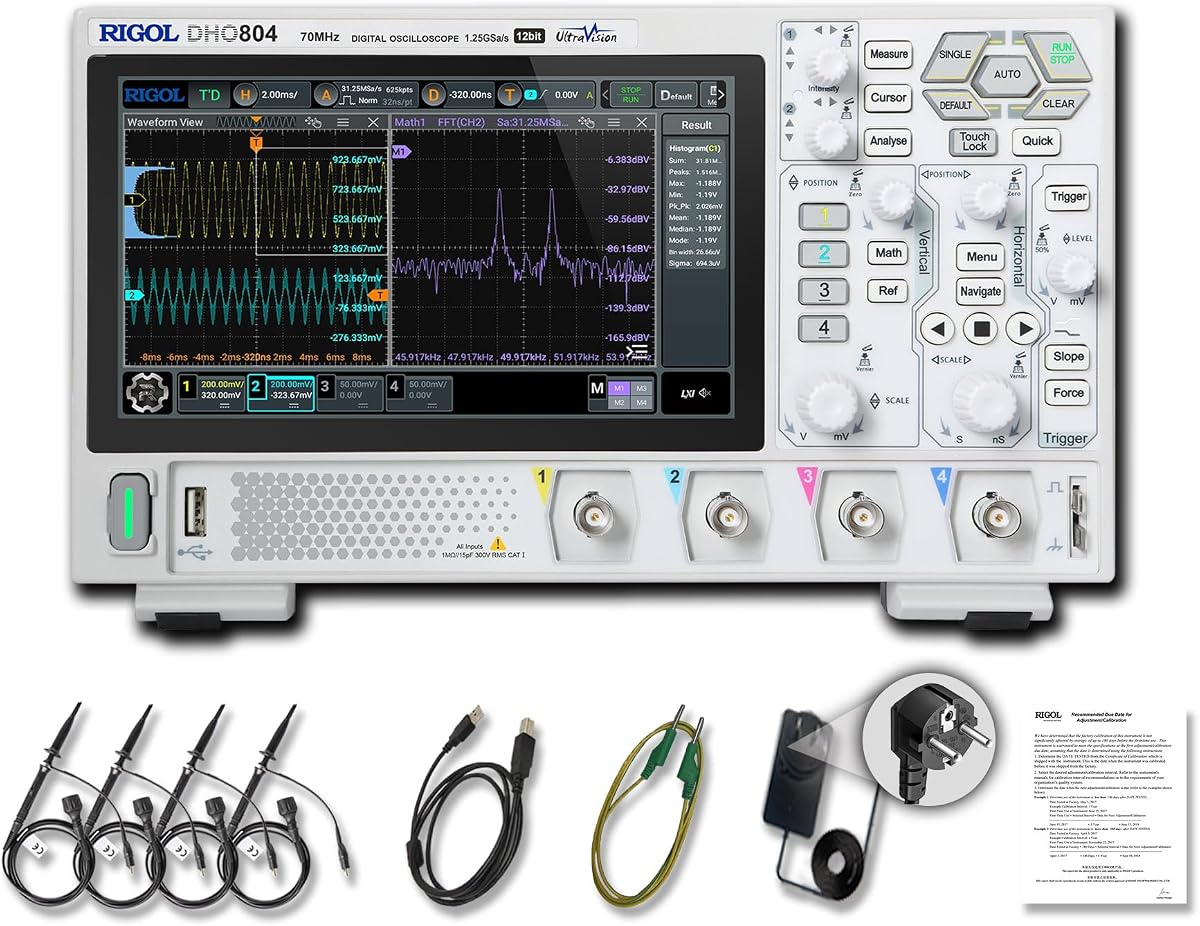
The RIGOL DHO804 is the most balanced overall pick, combining four analog channels, 70 MHz bandwidth, 12-bit vertical resolution, and 1.25 GSa/s sampling in a portable format. Its 4.3 rating and broad feature set make it especially suitable for users who need serious measurement capability without moving to a full benchtop model.
We may earn a commission when you buy through this link, at no additional cost to you.
The four channels allow direct correlation of multiple power rails, control lines, or sensor outputs. Up to 25 Mpts of memory provides substantially more capture history than the smaller portable scopes, while 12-bit resolution can reveal smaller vertical changes in noisy or low-amplitude signals. UltraAcquire supports up to 1,000,000 waveforms per second, and intensity grading helps locate brief glitches.
Processing and decoding are major strengths. Peak detection can capture glitches down to 1.6 ns, FFT analysis can use up to 1 Mpts, and 41 automatic measurements are listed. Standard decoding covers CAN, RS232 or UART, I2C, SPI, and four-bit parallel data. LAN support includes LXI-C, browser-based Web Control, and SCPI commands, while USB and HDMI improve exports, documentation, and external-display use.
The seven-inch 1024 by 600 touch screen and Flex Knob make daily operation efficient, but the feature set is less introductory than several FNIRSI alternatives. It is best for embedded bring-up, power-ripple checks, protocol troubleshooting, and teaching environments where four channels and reliable exports justify the added complexity. For most serious portable users, it offers the strongest balance in this list.
Capturing four analog signals at once helps reveal causal relationships and timing dependencies. This is a major advantage over single-channel tools when diagnosing power systems, embedded boards, or sensor interfaces.
Built-in support for common serial protocols allows faster inspection of communications and control buses. Engineers can verify timing and data while retaining the same timebase view used for analog signals.
We may earn a commission when you buy through this link, at no additional cost to you.
The FNIRSI 2C53P combines a two-channel 50 MHz oscilloscope, a 19,999-count multimeter, and a DDS signal generator. It has a 3.8 rating, the lowest among the ten products, but its specifications and 4.3-inch IPS touchscreen make it a distinctive option for users who prioritize screen size and integrated analysis.
We may earn a commission when you buy through this link, at no additional cost to you.
The oscilloscope offers 250 MS/s sampling, 400 V maximum measurement voltage, automatic, normal, and single trigger modes, and one-key automatic configuration. X-Y mode enables comparison of phase, amplitude, and frequency between two signals. FFT spectrum analysis can estimate harmonic content, adding a useful frequency-domain perspective to a compact unit.
The multimeter displays five measurement values and supports maximum and minimum readings. The generator provides 12 waveform types up to 10 MHz. Waveforms can be preserved, reviewed, and exported. A 4000 mAh battery is rated for around four hours of use, and Type-C charging keeps the connection method consistent with several other devices in the guide.
Its lower rating suggests some inconsistency in customer experience, although the supplied listing does not identify a specific defect. The smaller display than some larger alternatives and the 10 MHz generator ceiling may limit demanding work. It remains a good fit for education and field troubleshooting that value touch operation, two channels, a meter, and spectrum analysis in one portable device.
The 480 by 272 IPS panel offers more visible waveform area than the 2.8-inch units in the guide. That makes the 2C53P useful for classroom demonstrations, collaborative troubleshooting, and users who prefer touch navigation.
FFT and X-Y functions provide useful context beyond a standard time-domain display. They can help users estimate harmonics and examine the relationship between two signals without carrying separate analysis instruments.
We may earn a commission when you buy through this link, at no additional cost to you.
The FNIRSI 1013D Plus is a portable two-channel scope centered on a bright seven-inch 800 by 480 touchscreen. It has a 4.4 rating, 100 MHz bandwidth, and 1 GSa/s sampling, making it a compelling option for learners and professionals who want a large, responsive display without carrying a large benchtop instrument.
We may earn a commission when you buy through this link, at no additional cost to you.
Automatic, normal, and single trigger modes support periodic analog and aperiodic digital signals. The waveform image manager provides 1 GB of storage for up to 1,000 screenshots and 1,000 sets of waveform data, with thumbnail browsing, zoom, pan, and detailed review. Touch gestures and cursor measurement make parameter reading more direct than relying solely on graticule divisions.
Lissajous graphic display can compare amplitude, frequency, and phase between the two channels, while FFT viewing offers a rough estimate of harmonic content. A built-in high-voltage protection module is listed as tolerating continuous voltage up to 400 V. The 6000 mAh battery supports approximately four hours of use.
The listing does not identify a separate signal generator, and the published resolution is less compelling than the RIGOL DHO804's 12-bit specification. Still, for a student, instructor, or technician who values a large display, 100 MHz bandwidth, and easy storage, the 1013D Plus delivers a strong and approachable package.
The seven-inch touch panel gives beginners more room to inspect a trace and makes menus easier to navigate. Cursor readouts also reduce the need to calculate values manually from screen divisions.
With storage for 1,000 screenshots and 1,000 waveform sets, users can retain examples for reports, lessons, or later comparison. The thumbnail manager helps organize a large collection without navigating long filenames.
We may earn a commission when you buy through this link, at no additional cost to you.
The FNIRSI 2C23T has the highest customer rating in this selection at 4.6 and combines a 10 MHz oscilloscope, a 10,000-count multimeter, and a DDS signal generator. It is a well-rounded educational choice that covers the basic tasks most beginners perform without reaching the complexity of advanced analysis hardware.
We may earn a commission when you buy through this link, at no additional cost to you.
The oscilloscope samples at 50 MSa/s, records 32 kb of waveform data, and measures voltages up to 400 V. Vertical sensitivity ranges from 200 mV per division to 10 V per division. Automatic measurement, image storage, export, and reference-waveform comparison are supported. The 2.8-inch HD display sits alongside a 3000 mAh rechargeable battery rated for up to six hours of standby.
The multimeter includes AC and DC voltage, AC and DC current, resistance, capacitance, diode, and continuity measurements. Its signal generator reaches 2 MHz in 1 Hz steps and offers sine, square, triangle, full, half, noise, and DC waveforms. The FPGA, MCU, and ADC architecture is intended to support reliable waveform capture across modes.
It is not appropriate for high-speed digital edges, communications analysis, or detailed multi-rail debugging. However, its broad feature set and favorable rating make it especially attractive for students, electronics courses, and general-purpose hobby work. It is one of the clearest ways to obtain several familiar test functions in a single compact unit.
The combination of scope, meter, and source covers basic circuit observation, voltage and resistance measurement, and input-signal generation. Students can complete introductory experiments without borrowing separate equipment for each function.
Saved images can be displayed alongside current measurements, helping users compare a known result with a suspect circuit. Export through a data connection also supports documentation and deeper analysis.
We may earn a commission when you buy through this link, at no additional cost to you.
The FNIRSI 2D15P is a balanced three-in-one diagnostic instrument with a 4.1 rating. It combines a 100 MHz two-channel oscilloscope, a 19,999-count TRMS multimeter, and a 10 MHz DDS signal generator, offering substantial measurement breadth in a 4.3-inch touchscreen format.
We may earn a commission when you buy through this link, at no additional cost to you.
At 500 MS/s, the scope provides enough sampling performance for many general-purpose tasks, while memory depths of 10 K, 100 K, and 1 M let users balance detail against record length. Thirteen automatic parameters and six math functions support routine analysis. A 20 MHz bandwidth limit, afterglow, cursor measurement, and waveform saving and exporting make it particularly useful for power, switching, and embedded troubleshooting.
The TRMS meter automatically measures AC and DC voltage and current, resistance, capacitance, diode, and continuity. Curve view, maximum and minimum displays, and dedicated single or auto trigger modes improve interpretation. The generator offers nine waveform types, adjustable 0.1 to 3 Vpp amplitude, and duty-cycle control across the full 0 to 100% range.
Its 5000 mAh battery supports extended field use, and quiet fan cooling is intended to provide stable operation without excessive acoustic interference. The 10 MHz generator limit and two-channel layout are modest for advanced work, but the 100 MHz bandwidth and broad diagnostics make the 2D15P a compelling choice for maintenance professionals who need one adaptable instrument.
Three selectable memory depths allow users to choose between longer records and finer detail. This flexibility is useful when a brief transient needs resolution or a long pattern needs a more complete view.
The 20 MHz bandwidth limiter can suppress high-frequency content when investigating slower system behavior. It may help isolate lower-frequency components when switching noise is not central to the diagnosis.
We may earn a commission when you buy through this link, at no additional cost to you.
The ZT-703S is a two-channel handheld instrument that combines an oscilloscope, digital multimeter, and signal generator. Its 4.6 rating places it among the strongest customer-rated products in the guide, and its dual operating modes make it particularly interesting for automotive diagnosis and mobile troubleshooting.
We may earn a commission when you buy through this link, at no additional cost to you.
In normal mode, the listed sampling rate is 200 MSa/s with a 30 MHz maximum measurement bandwidth, offering lower power consumption for routine work. High-speed mode increases sampling to 280 MSa/s and bandwidth to 50 MHz. Both modes use 128 K of storage, and automatic waveform recognition adjusts for different pulse, circular, and noise waveforms, though recognition time varies with signal complexity.
The 25,000-count multimeter measures resistance, capacitance, continuity, diodes, and current. Signal-generator mode produces sine, square, and triangle waves along with other options, and the selected output appears synchronously in the demonstration window for comparison. Type-C supports both charging and data transfer, adding convenience for field operation.
The listing's generic name provides less model-specific documentation than some competing products, so buyers should consult the supplied manual and confirm the included accessories. Even so, the 4.6 rating, 50 MHz high-speed mode, and broad integrated toolset make this a strong option for automotive technicians and mobile electronics users.
Normal mode prioritizes efficiency with a 30 MHz bandwidth, while high-speed mode raises the ceiling to 50 MHz. The ability to move between them lets users tailor the instrument to the task and available power.
The generator can be viewed synchronously with the measured output, making it easier to compare an applied waveform with a response. That visible feedback simplifies basic signal and circuit experiments.
We may earn a commission when you buy through this link, at no additional cost to you.
The best inexpensive oscilloscope is not simply the model with the longest specification list. Match bandwidth, sampling, channels, display, and analysis functions to the signals you expect to measure, while also considering the probes, battery, and connectivity required in your work environment.
Bandwidth determines how quickly a scope can faithfully display changing signals. The list ranges from 200 kHz in the DSO152 to 350 MHz in the DPOS350P. A 10 MHz scope is appropriate for many educational and low-frequency waveforms but is not a sensible choice for fast digital edges, high-speed communications, or detailed switching analysis. A 50 MHz or 70 MHz model offers more general-purpose headroom, while 100 MHz and 350 MHz instruments suit increasingly demanding work.
Match bandwidth to the highest-frequency content you expect, not merely the operating speed of your system. Consider probe bandwidth as well, because a narrow probe can limit the usable performance of the instrument.
Sampling rate controls how densely the instrument samples a waveform, while record depth determines how much captured history is available. The DSO152 combines 2.5 MS/s sampling with a very small display, while the 2C53T reaches 250 MSa/s but provides 1 Kpts of storage. The RIGOL DHO804 combines 1.25 GSa/s sampling with 25 Mpts of memory, giving it a stronger balance for extended observation and deeper analysis.
Avoid choosing by sampling rate alone. Very fast sampling with shallow memory may record only a short interval, while deep memory needs sufficient processing and display performance to remain practical.
Two channels allow timing, phase, noise, and voltage comparisons, which can reveal relationships that a single trace cannot. The DSO152 and DSO-510 are single-channel scopes, while most multi-function models in the guide provide two channels. The RIGOL DHO804 goes further with four analog channels, making it a stronger choice for multi-rail power systems, embedded boards, and protocol troubleshooting.
More channels are not automatically better, but they can prevent repeated probe movement and repeated trigger setup. Consider how many signals you genuinely need to observe at the same time.
A larger screen makes traces easier to read, provides more room for menus, and improves the experience of teaching or collaborative troubleshooting. The DPOS350P and RIGOL DHO804 have seven-inch touchscreens, the 2C53P and 2D15P use 4.3-inch IPS panels, and several compact models use 2.8-inch displays. Touch controls are convenient, but physical buttons and knobs can be preferable for repeated adjustments.
Consider screen resolution, readability in bright environments, and whether the on-screen workflow matches your habits. A highly portable body can be less stable for precise work unless supported or positioned carefully.
A built-in multimeter and signal generator can reduce the number of tools needed for basic experiments. The 2C53T, 2C53P, 2C23T, 2D15P, and ZT-703S provide this three-in-one approach. Their meters measure combinations of voltage, current, resistance, capacitance, diode, and continuity, while their generators produce varying selections of sine, square, triangle, noise, and other waveforms.
Check the generator frequency ceiling before planning to use it for high-speed tests. An integrated function is most valuable when its specified range matches your work; it should not be assumed to replace a dedicated arbitrary waveform generator or precision meter.
Portable scopes are valuable for vehicle repair, field service, demonstrations, and work away from a bench. Battery capacities in the list range from 1000 mAh in the DSO152 and DSO-510 to 8000 mAh in the DPOS350P. Published continuous-use and standby figures vary, so the most useful comparison is not just capacity but the workload and screen size the manufacturer expects to support.
Also consider charging method, physical size, and weight. A large touchscreen can consume more power, while a compact unit may be easier to carry throughout a full workday.
Analysis features can save substantial time. FFT and spectrum views reveal frequency content, X-Y mode clarifies phase relationships, persistence highlights intermittent activity, and automatic measurements reduce manual calculations. The RIGOL DHO804 adds CAN, RS232 or UART, I2C, SPI, and parallel decoding, while the DPOS350P includes waterfall views, harmonic markers, and a frequency response analyzer.
Choose advanced analysis only if it supports a real need. Export and remote-control options are also valuable for reports, teaching records, automated workflows, and deeper analysis on a computer.
Oscilloscope probes are essential to safe and accurate measurements, yet they are not always identical across listings. Several products state maximum voltage handling, including 400 V measurement limits and protection modules, but the included probe's rating should always be confirmed. Incorrect probe attenuation, grounding practices, or voltage selection can invalidate readings and create hazards.
Use the appropriate probe for the voltage and frequency involved, inspect insulation and connectors, and follow the manual's safety instructions. Never treat a scope's input rating as permission to exceed the probe or measurement accessory limits.
Before the first measurement, read the manual, identify every input and accessory, and verify that the probe compensation and device settings are correct. Inspect leads and probe insulation, select the proper voltage range, and connect the ground reference only where the circuit permits. Begin with a familiar low-voltage signal to confirm that the display, trigger, and channel controls behave as expected.
Choose a time base and vertical scale that keep the relevant portion of the waveform visible without clipping. Use automatic setup for an initial view, then refine the trigger, acquisition mode, channel coupling, and measurement parameters. Save reference waveforms when comparing a known-good circuit with a faulty one, and record the operating conditions alongside exported images.
For care, keep the instrument within its specified charging and operating conditions, use a suitable USB-C cable when required, and avoid leaving it in hot cars, damp environments, or crowded storage spaces. Clean the screen and case with a soft, dry or lightly dampened cloth, and store probes separately when possible. Periodically check probe integrity, battery performance, trigger behavior, and calibration-related functions before relying on the device for important work.
For basic electronics, automotive, and low-frequency work, a model around 10 to 50 MHz may be sufficient. A 70 to 100 MHz scope provides more margin for switching signals and embedded circuits. Choose a higher-bandwidth instrument when you need to resolve fast edges, communications signals, or short transients. Always consider the bandwidth of the probe as well as the scope.
Two channels let you compare voltage, timing, phase, and noise between two signals at once. That makes them substantially more useful for diagnosing relationships and verifying timing. A single-channel model can be adequate for demonstrations and simple confirmation, but it often requires repeated measurements to make comparisons.
A built-in meter is convenient when diagnosing electronics because resistance, voltage, continuity, and capacitance readings can be taken without another device. It does not automatically outperform a dedicated meter, so check the displayed counts, functions, and accuracy specifications. For basic field troubleshooting, the integration usually adds meaningful versatility.
A signal generator produces a known test waveform for checking a circuit's response. It can help verify amplifiers, trigger circuits, filters, switching behavior, and educational demonstrations. Check the maximum output frequency and waveform options carefully, as lower-cost integrated generators may not reach the speeds required for modern digital systems.
Touchscreens are intuitive for menus, cursors, zoom, and waveform review, especially on larger displays. Physical buttons and knobs can be faster for frequent changes to time base, position, and trigger level. The best choice depends on workflow, but a large touch display is often particularly helpful for beginners and teaching.
Shallow record depth is adequate for quick checks but limits the amount of waveform history available for analysis. Deeper memory is valuable for long events, rare glitches, and post-capture investigation. Consider record depth alongside sampling rate, since very fast acquisition and deep memory together can be more demanding than either specification alone.
Only if its input rating, probe rating, grounding method, and measurement category are appropriate for the circuit. Several listed models support automotive-oriented use and cite high-voltage capabilities, but users must still confirm the exact accessory ratings and manufacturer instructions. Incorrect connection procedures can damage the instrument or create a safety hazard.
Prioritize portability for field service, vehicle repair, and frequent mobile use. Prioritize screen size and resolution for teaching, prolonged troubleshooting, and detailed waveform inspection. A two-channel compact scope with a small screen may be more practical than a large unit that is inconvenient to carry, while a large screen becomes essential when multiple traces or menus must remain visible.
The FNIRSI DSO152 is the leading budget option for basic, portable signal checks, while the RIGOL DHO804 is the strongest all-around choice because four channels, 12-bit resolution, deep memory, decoding, and connectivity support substantially more demanding work. For advanced portable analysis, the FNIRSI DPOS350P provides the widest collection of high-end features, including spectrum and frequency-response analysis.
The rest of the guide covers useful compromises: the 2C53T and 2C23T for education, the DSO-510 for a compact generator pairing, the 1013D Plus for a large touchscreen, and the 2D15P or ZT-703S for versatile field diagnostics. Match the scope's bandwidth, channel count, analysis tools, and battery life to your actual signals rather than choosing solely on the longest feature list.
Product listings, ratings, included accessories, and pricing can change over time. Before buying, confirm the current specifications and package contents on the linked listing, verify probe and voltage ratings, and read the manufacturer's safety guidance. Those checks will help ensure that the inexpensive oscilloscope you choose is genuinely suitable for the work you have in mind.