
Underwater Fishing Camera 1080P HD
4.1Editor score
1080P wide-angle underwater viewing
Fifty-foot load-rated cable
Eight-hour rechargeable battery use
Choosing a camera for kayak fishing involves balancing underwater visibility, portability, battery life, and resistance to splashes, changing water, and awkward angling positions. Action cameras excel at recording casts, wildlife, and forward-facing adventures, while underwater fishing cameras help anglers observe fish and submerged structure before committing to a spot.
The products in this guide were compared using the supplied specifications and customer ratings. The list covers waterproof action cameras, live underwater viewers, infrared systems, and longer-cable fishing cameras, with particular attention to screen size, viewing angle, illumination, deployment convenience, recording limitations, and suitability for a kayak.
Each review explains the strongest reasons to consider a particular model, along with trade-offs that may matter in open water. Ratings and technical details can change, and current product listings may also differ, so readers should confirm the latest specifications and features before making a final purchase decision.
4.1Editor score

4.6Editor score

4.6Editor score
As an Amazon Associate we earn from qualifying purchases.
This side-by-side comparison highlights the major differences among action cameras and live underwater fishing systems, including display technology, image resolution, underwater illumination, cable length, battery endurance, and whether footage can be recorded.


The AKASO EK7000 is a versatile action camera rated 4.4 out of 5 by customers. Rather than providing a live underwater fish-viewing monitor, it is designed to document the kayak experience itself: paddling, casting, strikes, scenic water, wildlife, and any action that unfolds around the angler.
We may earn a commission when you buy through this link, at no additional cost to you.
Its strongest specifications are 4K30 video, 2.7K30 video, 20MP photographs, and 4X zoom. Electronic image stabilization is particularly relevant in a kayak, where constant movement can otherwise produce distracting shake. The included waterproof case is rated to 131 feet, allowing the camera to be mounted in a compatible underwater position as part of a complete action-camera setup.
The AKASO GO app and built-in Wi-Fi make the camera convenient for transferring footage to a phone or tablet, although the stated wireless range of 10 meters is modest. The 2.4GHz wrist remote helps start recording or frame shots without reaching for the camera, but it is not waterproof and should be kept away from splashes. A microSD card is also not included.
This is a strong choice for anglers who want shareable video rather than a dedicated live fish finder. It is especially useful for recording approaches, casts, catches, and other action from a deck or pole mount. It is less appropriate as the primary tool for studying fish directly below the kayak, since it does not provide the same purpose-built underwater monitor experience as the fishing cameras later in the guide.
Electronic image stabilization helps reduce the visual shake caused by paddling, wind, and the subtle movement of a kayak on the water. Combined with 4K30 recording, it gives creators a practical way to preserve fine details in action footage.
The wrist remote allows recording to begin without reaching toward a mounted camera, while the 4X zoom provides a closer view of distant subjects. The wrist remote itself should remain dry because it has no waterproof protection.
We may earn a commission when you buy through this link, at no additional cost to you.
This AKASO EK7000 variant carries a 4.6 rating and offers the core combination of 4K30 video, 20MP photographs, a 131-foot waterproof case, and a wireless wrist remote. It is a practical choice for kayakers who want one action camera for both above-water memories and compatible underwater recording setups.
We may earn a commission when you buy through this link, at no additional cost to you.
The supplied accessory kit broadens the ways the camera can be used. A 4X zoom can help isolate distant action, while the waterproof case allows use below the surface when paired with a suitable mount. Built-in Wi-Fi connects to the AKASO GO app for editing and sharing, reducing the need to move files manually after returning from the water.
Compared with dedicated underwater viewers, the EK7000 does not offer a built-in screen for observing fish in real time. The wrist remote also needs to be protected from water. As a result, its appeal depends on whether recording high-resolution video and sharing the experience matter more than seeing fish behavior immediately beneath the kayak.
Choose this model if the goal is to capture a complete fishing trip in 4K, including casts, fish jumps, paddling, and underwater sequences. It works well for creators who already understand action-camera mounting. Those searching primarily for live underwater intelligence should instead examine the dedicated fish-finder systems in this comparison.
The large waterproof accessory kit gives owners more options for securing the camera on a helmet, pole, deck, or other compatible support. That flexibility makes the camera useful across a full day of kayaking and shoreline activity.
Built-in Wi-Fi and the AKASO GO app simplify transferring footage to a compatible phone or tablet. This is useful for anglers who want to assemble a short fishing recap without relying on a computer every time they return to shore.
We may earn a commission when you buy through this link, at no additional cost to you.
The Portable Fish Finder Camera is one of the most ambitious systems in the guide, with a 4.6 customer rating and a feature list designed for serious observation. Its six-inch OLED screen, 1080P resolution, maximum brightness of 2000 nits, and foldable sun visor should make live viewing easier under open sky and strong reflected sunlight.
We may earn a commission when you buy through this link, at no additional cost to you.
The underwater unit uses a 220-degree wide-angle lens and offers day, night, murky-water, and clear-water modes, along with three adjustable viewing perspectives. A 25-meter cable can extend the camera farther from the kayak, while the stated 80-kilogram load capacity suggests the line is intended for substantial deployment. The 10,000mAh battery is advertised for up to 12 hours of continuous operation.
Unlike the live-only products elsewhere in the list, this system supports timed video recording in one-to-three-minute segments, zoom, and replay functions. The included 32GB memory card makes that recording capability immediately usable. The 25-meter lead, storage case, OLED display, mounting hardware, adapter, and other accessories create a more elaborate kit that may require deliberate organization in a kayak.
This is an excellent choice for an angler who wants both live observation and the ability to capture selected underwater sequences. Its bright screen and multiple viewing modes also make it more versatile for ice, lake, pond, and shoreline conditions. Kayak anglers should secure the monitor, cable, and camera so that a long deployment does not interfere with paddling or create a snag risk.
The OLED panel's stated peak brightness and included sun visor address a common problem with portable electronics outdoors. Visibility should remain more practical around reflective water, bright snow, or an open lake under direct sunlight.
Timed recording, replay, zoom, and the included memory card distinguish this model from real-time-only viewers. Those features let an angler revisit unusual underwater activity instead of relying entirely on what appeared in the moment.
We may earn a commission when you buy through this link, at no additional cost to you.
The 4.3-inch 1080P HD Underwater Fishing Camera provides a useful balance of image quality, screen usability, and compact monitoring for a 4.1 customer rating. It is one of the most approachable choices for a kayaker who wants to look below the surface without carrying a large action-camera system.
We may earn a commission when you buy through this link, at no additional cost to you.
The 220-degree wide-angle lens gives the underwater unit a broad field of view, which helps reveal fish and structure around the bait instead of requiring a straight-down orientation. The 4.3-inch IPS screen is designed to remain readable in direct sunlight, and the included sun visor adds protection from glare. A 6000mAh rechargeable battery is stated to deliver more than eight hours of continuous use.
The 50-foot waterproof cable is described as tangle-resistant and rated to support 66 pounds. That makes it suitable for meaningful deployment from a kayak, although it is shorter than the 82-, 98-, and 100-foot options in the guide. Infrared LEDs provide a black-and-white view in dark or murky water, with the supplied information indicating 15-to-20-foot visibility in clear conditions and 8-to-12-foot visibility in murky water.
This model is a sensible budget-oriented option for anglers who primarily want live viewing. It does not support video recording or phone streaming, so it is less suitable for creating underwater recordings. Buy it if clear live observation, an IPS screen, and manageable cable length are more important than documentation features.
A 220-degree field of view reduces the need to keep the camera aimed exactly downward. It can reveal fish movement across a broader patch of bottom, helping the angler decide whether a promising area is worth working.
The camera focuses on real-time monitoring without photo, video, or streaming functions. That simpler design can reduce setup complexity for anglers who want to scan water and then return to fishing.
We may earn a commission when you buy through this link, at no additional cost to you.
The TMACTIME 1080P HD camera combines a 4.3-inch LCD, a 1080P underwater lens, six infrared lights, and an IP68 waterproof camera and cable system. Its 4.2 rating reflects a straightforward live-viewing product designed for ice, lake, boat, and kayak fishing without recording.
We may earn a commission when you buy through this link, at no additional cost to you.
The 30-meter cable provides enough reach to position the camera beyond the kayak and search around submerged targets. The camera and cable are waterproof to a stated depth of 15 meters, while the 100-kilogram load capacity adds confidence when retrieving the unit in deeper water. Six infrared lights help reveal activity in low-light or murky conditions.
The 5000mAh battery is advertised for up to 10 hours of continuous use, making it suitable for extended outings. Setup is described as plug-and-play, and the package includes a monitor, underwater camera and cable, stand, charging cable, and manual. Its basic LCD lacks some of the viewing refinement offered by IPS or OLED panels, but it remains a practical travel companion.
Choose this camera if you want a capable underwater viewer with a generous cable and long battery runtime but do not need to save recordings. It should appeal to kayak anglers who can mount the display securely and want to move the camera around different fishing spots. The absence of video recording limits its appeal for content creators.
The stated ten-hour runtime is useful for full-day fishing trips. It reduces the need to interrupt a session to recharge the display, particularly when moving between a kayak, shoreline, and boat launch.
A 30-meter lead gives the camera room to explore beyond the immediate hull. The supplied stand keeps the monitor accessible while the waterproof camera and cable remain deployed underwater.
We may earn a commission when you buy through this link, at no additional cost to you.
The FishPRO 2026 Upgrade is the premium live-viewing choice in this guide, combining a 4.6 rating with a seven-inch full-color IPS monitor, true 1080P underwater imaging, a 10,000mAh battery, and an 82-foot cable. Its larger display and flexible magnetic connection make it particularly suitable for anglers who spend considerable time studying submerged activity.
We may earn a commission when you buy through this link, at no additional cost to you.
The system stands apart by offering both infrared and white LED illumination. Infrared produces a high-contrast monochrome view in dark water, while LED can provide full-color scenes where the water is sufficiently clear. The monitor also has a backlight, flip-up cover that doubles as a sunshade, and a stated 20-hour operating time. USB-C charging allows use with a power bank or charger, and fishing can continue while charging according to the supplied information.
The 82-foot line uses a stated 1.8mm aramid-fiber core with an 88-pound maximum load. A magnetic connection allows the monitor and cable spool to be operated separately or joined for transport, and standard 1/4-20 mounting points support optional accessories. Included 45-, 90-, and 180-degree fins allow the underwater unit to be aimed in different directions.
This is a strong premium choice for serious anglers who value screen size, lighting options, cable reach, and battery endurance more than recording. The absence of HDMI and recording is an important limitation, but live-only operation keeps the focus on immediate observation. It may also occupy more space than a 4.3-inch system, so compact kayak storage deserves consideration.
The seven-inch IPS panel offers a larger viewing area than the compact systems in the guide, while its viewing-angle consistency is useful when the monitor is not positioned directly in front of the angler. Adjustable fins also help direct attention toward fish or bottom structure.
Switching between LED and infrared lets the angler choose between color imagery and high-contrast monochrome viewing. A real-time status display reduces the chance of using the wrong illumination mode while the camera is underwater.
We may earn a commission when you buy through this link, at no additional cost to you.
The compact 4.3-inch Underwater Fishing Camera offers a 4.2 rating, a 4.3-inch HD LCD, 720P live imagery, a 50-foot cable, and 12 infrared LEDs. It is aimed at anglers who want a simple night-viewing system that is easy to carry and deploy.
We may earn a commission when you buy through this link, at no additional cost to you.
The 200-degree wide-angle lens provides broad underwater coverage, while the 12 infrared lights are intended to reveal fish and terrain in murky or dark water. The 50-foot cable has a stated tensile capacity of 220 pounds, giving it ample strength for regular retrieval in lakes and ponds. The IP68-rated lens is designed for cold, muddy, and deep-water conditions.
A 5000mAh rechargeable battery supplies up to eight hours of continuous use. The package includes a rugged carrying case and LED finger lights for night operation, which makes it easier to handle small tackle or line tasks after dark. Resolution is lower than the 1080P alternatives, so fine details are less distinct, and there is no stated photo or video recording function.
Choose this model if portability, night illumination, and a durable cable matter more than maximum image resolution. It suits kayak anglers who need to conserve storage space and want a straightforward live monitor. The included finger lights and case make it particularly friendly for organized dawn, dusk, and night sessions.
The infrared array is the defining feature of this model. It helps produce a visible monochrome scene when daylight cannot reach the underwater area being examined.
The 4.3-inch display and 50-foot deployment line keep the overall package relatively manageable. That is useful in a kayak where every piece of equipment must fit without interfering with paddles, tackle, or line.
We may earn a commission when you buy through this link, at no additional cost to you.
The 5-Inch IPS Fishing Camera combines a 4.4 customer rating with a five-inch IPS display, a 100-foot cable, a 220-degree lens, and infrared night vision. It is a logical choice for kayakers who want to inspect a broad area of bottom and structure without keeping the camera close to the hull.
We may earn a commission when you buy through this link, at no additional cost to you.
The long cable provides considerable placement flexibility, while the IP68 waterproof camera and 100-kilogram pull strength are designed for demanding deployments. A broad viewing angle helps the angler see around the camera rather than only directly beneath it. The 6000mAh battery is advertised for up to nine hours of continuous use, and the monitor can be mounted for hands-free viewing.
This system is focused entirely on real-time observation. It does not capture photos or video, which means it will not replace an action camera for documenting a catch. A fishing rod and pulley are also not included. The supplied carrying case and straightforward plug-and-play operation help offset the size of the long cable and make the package easier to organize.
Buy this model if cable reach, a wider IPS screen, and infrared illumination are central to your fishing strategy. It is particularly useful for checking drop-offs, vegetation, submerged wood, and other structure from a stable kayak position. Make sure the line is routed carefully so that it cannot become caught in a paddle or trailer system.
The 100-foot cable lets an angler position the camera beyond the kayak's immediate footprint. Combined with the wide lens, this is useful for checking a larger section of the bottom without repeatedly moving the boat.
The five-inch IPS display offers more room to examine the image than a 4.3-inch LCD. IPS technology is also a sensible choice when sunlight reflection is a concern on open water.
We may earn a commission when you buy through this link, at no additional cost to you.
The Underwater Fishing Finder Camera offers the strongest overall balance for kayak anglers in this roundup, earning a 4.6 rating while combining a five-inch IPS display, a 220-degree lens, an 8000mAh battery, and a 98-foot cable. It covers the most important needs without requiring the larger footprint of the FishPRO system.
We may earn a commission when you buy through this link, at no additional cost to you.
The stated 1500-nit peak brightness, foldable sunshade, and IPS panel are well suited to daylight use. Eight infrared LEDs support low-light and murky-water viewing, while adjustable voltage, backlight, and chroma settings give users some control over image presentation. The broad lens helps reveal fish and vegetation around the bait rather than confining the view to a narrow cone.
The 98-foot line has a stated 170-pound tensile strength and should provide useful reach from a kayak. An 8000mAh battery is advertised for up to 15 hours of continuous operation, while USB charging allows recharging from a power bank. The complete kit includes the main device, 30-meter cable with camera, adapter, stand, and manual.
This is the most versatile option for a day on the water because it combines a readable screen, strong battery endurance, night illumination, and generous cable reach in a relatively portable package. It is a particularly strong match for anglers moving between kayak, boat, shoreline, and pond. The system should remain rigged for live observation rather than documentation, since recording is not listed among its features.
A bright IPS screen, integrated sunshade, and adjustable backlight cover the changing light conditions encountered during a fishing day. Eight infrared LEDs extend the system into darker water and early-morning or evening use.
The advertised 15-hour operating time makes this one of the strongest choices for long outings. USB charging adds flexibility when a power bank is available, while the 98-foot cable allows broad inspection of the underwater environment.
We may earn a commission when you buy through this link, at no additional cost to you.
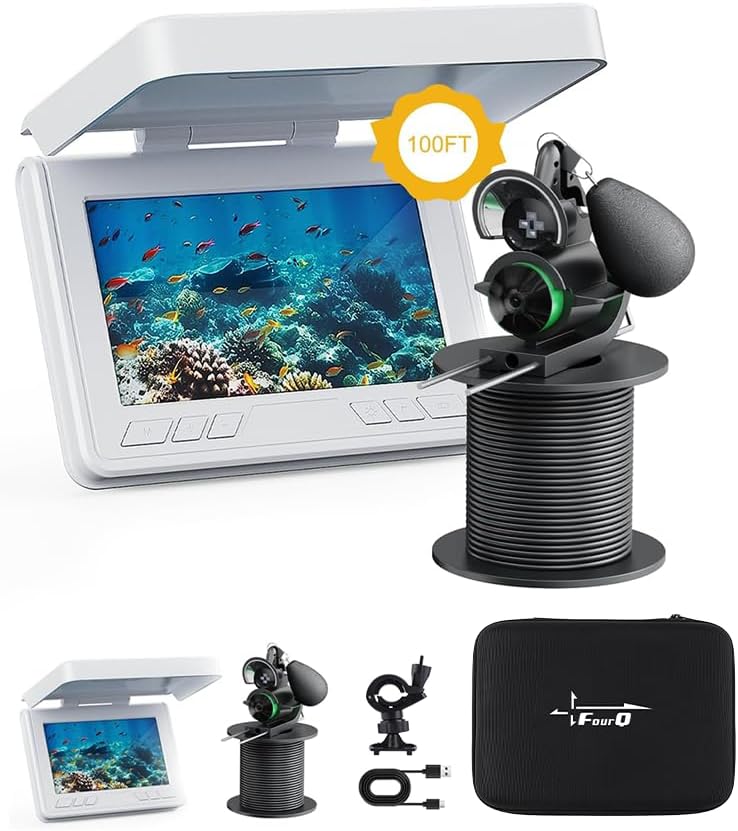
The 4.3-inch Underwater Fishing Camera provides a 100-foot cable, 12 infrared lights, a 5000mAh battery, and a 4.2 customer rating. It combines substantial deployment reach with a portable display, making it worth considering when cable length is a priority.
We may earn a commission when you buy through this link, at no additional cost to you.
The underwater unit uses a stated 1000TVL program chip, 12 infrared lights, and a fish-friendly shape intended to avoid alarming nearby fish. The supplied information also mentions a 100-foot depth range and a cable load capacity of 88 pounds. Mounts are included for attachment to a fishing rod or boat, though kayak anglers may need to adapt the mounting position to their setup.
The rechargeable battery is stated to provide more than 10 hours of continuous use. A portable box is included for transport, and the product includes a 12-month warranty. The main distinction from many competing systems is its IPX6 waterproof rating rather than IP68. It also lacks a higher-resolution specification such as 720P or 1080P, so the monitor's stated 1000TVL camera should be considered the deciding factor.
Choose this model if long cable reach, night viewing, and long battery life matter most. It may be less suitable for anglers who need the strongest possible underwater detail or require the highest stated water-resistance rating. Careful line management remains essential in a kayak because a 100-foot cable can easily snag if it is not controlled.
The 100-foot line can reach well beyond the kayak's immediate position while the monitor remains compact. This makes the system practical for anglers who want to search a broad area but prefer a smaller screen.
Twelve infrared lights support dark-water viewing, and the battery is advertised for more than 10 hours of operation. Together, they make the camera practical for extended evening sessions and cold-weather trips.
We may earn a commission when you buy through this link, at no additional cost to you.
The best camera for kayak fishing depends on whether you want to document the outing, inspect fish below the surface, or do both with separate devices. Waterproofing, viewing quality, deployment reach, illumination, screen readability, battery life, and recording support should be evaluated together.
An action camera is built to record a sequence in 4K or capture still images while mounted in motion. It is the better tool for filming casts, paddling, fish strikes, and scenic encounters, especially when a waterproof housing is included. An underwater fishing camera instead provides a live view of fish, bait, and bottom structure so the angler can make an immediate tactical decision. Many kayak anglers use both because each answers a different question.
Choose an action camera for content creation and an underwater viewer for active fishing intelligence.
Waterproof ratings describe different levels of protection. IP68 systems are described as resistant to dust and prolonged immersion under specified conditions, while IPX6 indicates protection against powerful water jets but not necessarily submersion. The rating printed on a product is only part of the answer: confirm whether the entire system, including connectors and the display, is intended for wet use. The camera in the water is often only one component of a system whose cable, monitor, and remote may have different exposure limits.
Verify the full system rating and keep non-waterproof accessories dry.
A 4.3-inch LCD is portable and easy to secure in a tight kayak, while a five-inch IPS display offers more room to examine details and generally handles viewing angles and sunlight more effectively. A six-inch OLED screen is the largest option in this guide and is suited to anglers who prioritize image presentation over compactness. Brightness figures, IPS or OLED panel technology, and included sun visors are more informative than screen size alone.
Prioritize IPS or OLED quality and glare protection for open-water use.
A 1080P camera can provide more detail than a 720P or 1000TVL unit, especially when fish are close and the screen is enlarged. Resolution alone does not determine visibility in murky water, however. A 200- or 220-degree lens gives a broader view of surrounding bottom and can make it easier to spot fish approaching from the side. The best combination is adequate resolution paired with a genuinely wide field of view.
Pair higher resolution with a broad lens for effective spot-and-approach fishing.
Cable length determines how far the underwater camera can be moved from the kayak. Thirty meters and 50 feet suit nearby inspection, while 82 to 100 feet provide more room to scan structure around the boat. Load rating matters because retrieval can place substantial force on the cable when it catches on rocks, weeds, or heavy structure. A strong line should still be deployed carefully, because excessive force can damage both cable and camera.
Choose a length that reaches useful structure without creating paddle or snag hazards.
Infrared lighting is essential for deep water, shaded structure, nighttime docks, and ice fishing. Most underwater viewers use infrared to create a monochrome image, while the FishPRO model also offers white LED for color viewing in suitable water. Lighting can improve the apparent range of the camera, but turbidity may still limit useful visibility. A wide lens and correct camera angle can sometimes be as important as additional illumination.
Use infrared for dark water and white LED when color visibility is worth attempting.
A long outing can easily exceed the needs of a compact battery, especially when the screen remains at maximum brightness and infrared lights stay active. Advertised runtimes range from about eight hours to 20 hours across the guide. USB-C charging is useful because it can reduce dependence on proprietary power connections, and a model that operates while charging offers extra flexibility. The stated runtime should be treated as an ideal condition rather than a guarantee in cold weather or heavy use.
Match expected session length to rated runtime and carry a backup power source.
Most dedicated underwater viewers provide live monitoring only, while the portable fish finder with the OLED display supports timed recording, zoom, and replay. Action cameras offer the most extensive recording capabilities, but their footage must be reviewed afterward rather than used for immediate underwater observation. Decide whether preserving images matters enough to justify the extra complexity. For kayak storage, also consider the monitor size, carrying case, cable bulk, and the need to secure every item away from paddles.
Choose recording for documentation and live viewing for immediate decisions.
Begin by choosing a clear location for the monitor and a cable route that cannot cross a paddle, line, foot brace, or trailer attachment. Lower the camera slowly, keep the lens free of mud and algae, and use the wide view to survey the surrounding bottom rather than only pointing straight down. Pause long enough to observe how fish move before changing bait or position.
Match the light setting to the environment. Use normal viewing in clear daylight, infrared in dark or shaded water, and white LED only when the water is clear enough for color to be useful. After each deployment, retrieve the camera slowly, inspect the cable for abrasion or kinks, and rinse the underwater unit with fresh water, especially after use in saltwater.
Let the camera and cable dry before storing them, and keep connectors and the remote away from moisture unless the supplied information specifically says they are waterproof. Use the protective case for transport, coil the cable without creating tight bends, and check the battery level before a long outing. Follow the manufacturer's instructions for charging, media, and any recording functions.
Yes, an action camera can record underwater sequences when paired with a compatible waterproof housing and appropriate mount. The AKASO EK7000 models listed here include 131-foot waterproof cases and can capture 4K30 video. They are better for recording the experience than for showing live fish behavior below the kayak. A dedicated underwater viewer is more useful when the angler needs to choose a fishing position in real time.
A longer cable allows the camera to inspect structure beyond the immediate kayak, but it also needs more careful management. Models in this guide range from 30 meters to 100 feet. For tighter water or sheltered areas, a shorter line is easier to control. For drop-offs, vegetation, and open water, a cable around 82 to 100 feet provides greater reach but requires attention around paddles and fishing line.
Most dedicated underwater viewers in this guide are real-time only. The 4.3-inch 1080P model, TMACTIME, FishPRO, five-inch IPS, and the 4.3-inch 1000TVL model do not list recording support. The portable fish finder with the six-inch OLED display is an exception because it supports timed video capture and replay. The AKASO action cameras are designed primarily for recording and storing footage.
Infrared is particularly valuable in deep water, shaded banks, nighttime structures, and water with limited sunlight. It creates a high-contrast monochrome view of nearby fish and bottom terrain. In bright, shallow, clear water, natural light may be sufficient. The FishPRO model's white LED option can also provide color imagery where water clarity allows, although the supplied specifications do not promise comparable range in every condition.
Route the cable away from paddle arcs, foot braces, and moving tackle, and keep enough tension to avoid loops without pulling the camera against rocks. Lower it into open water rather than dragging it across vegetation. Retrieve it slowly if the view becomes obstructed, and avoid applying more force than the cable's stated load rating. A protective sled and float, when supplied, can also help the camera glide over uneven bottom.
Some of the systems are explicitly described for pond, lake, ice, and sea use, but care is still essential. Rinse the underwater camera and cable with fresh water after every saltwater outing to reduce corrosion risk. The supplied guidance for the 50-foot 1080P model specifically recommends immediate freshwater rinsing after saltwater use. Check connector seals, cable damage, and the manufacturer's care instructions before repeated saltwater deployment.
IPS screens are a strong middle ground because they offer clear images and useful viewing angles in a portable format. OLED provides a larger, high-contrast display in the featured six-inch model, while standard LCD screens keep smaller systems affordable and straightforward. Brightness, a sun visor, screen size, and viewing angle should be considered together because direct sunlight can make even a good display difficult to read.
Use the supplied carrying case and coil the cable loosely so that it is not twisted or sharply bent. Keep the monitor and camera separated from hooks, lures, and hard tackle that could scratch the display or damage the lens. Before packing, rinse away salt and mud, dry the equipment thoroughly, and confirm that every connector is seated and protected from moisture.
The Underwater Fishing Finder Camera is the most balanced overall pick because its five-inch IPS display, 220-degree lens, infrared illumination, 98-foot cable, and long advertised battery life cover the main needs of a mobile angler. The FishPRO system is the premium option, offering the largest screen, multiple lighting modes, an 82-foot cable, and up to 20 hours of stated use.
The 4.3-inch 1080P HD Underwater Fishing Camera represents the budget-focused choice, with a useful IPS screen, 220-degree lens, 50-foot cable, and more than eight hours of stated operation. Kayakers who prioritize video creation should consider the AKASO EK7000 instead, while anglers who want live observation plus recorded sequences may prefer the feature-rich OLED fish finder.
Before buying, verify the latest specifications, included accessories, waterproof limits, recording functions, and current listing details. Conditions on the water can change quickly, so choose the system that solves the task you actually need: recording the outing, locating fish below the hull, inspecting deeper structure, or operating after dark.