
Membrane Solutions String-Wound Filters
4.7Editor score
Five-micron sediment filtration
Six replacement cartridges
Food-grade polypropylene media
Universal housing compatibility
Calcium filters for well water range from true ion-exchange softeners to scale-inhibiting cartridges, calcite neutralization media, and sediment pre-filters. A useful system depends on your water chemistry, flow requirements, plumbing layout, and whether you need hardness reduction, corrosion control, or protection from particles.
We compared all ten products by function, treatment media, compatibility, capacity, filtration claims, installation considerations, and suitability for well water. The list includes complete whole-house systems, replacement cartridges, bulk filter media, and supporting filters that occupy different roles in a practical treatment train.
Each review explains what the product is best positioned to do, where it fits, and what buyers should verify before purchasing. Ratings and specifications reflect the available product information, while product availability and prices can change, so readers should confirm current listing details.
4.7Editor score

4.4Editor score

4.0Editor score
As an Amazon Associate we earn from qualifying purchases.
The comparison below organizes all ten products by their primary treatment function, format, compatibility, and practical well-water role. Because these options are not interchangeable, buyers should first decide whether they need hardness removal, scale prevention, pH neutralization, sediment protection, or a complete filtration train.
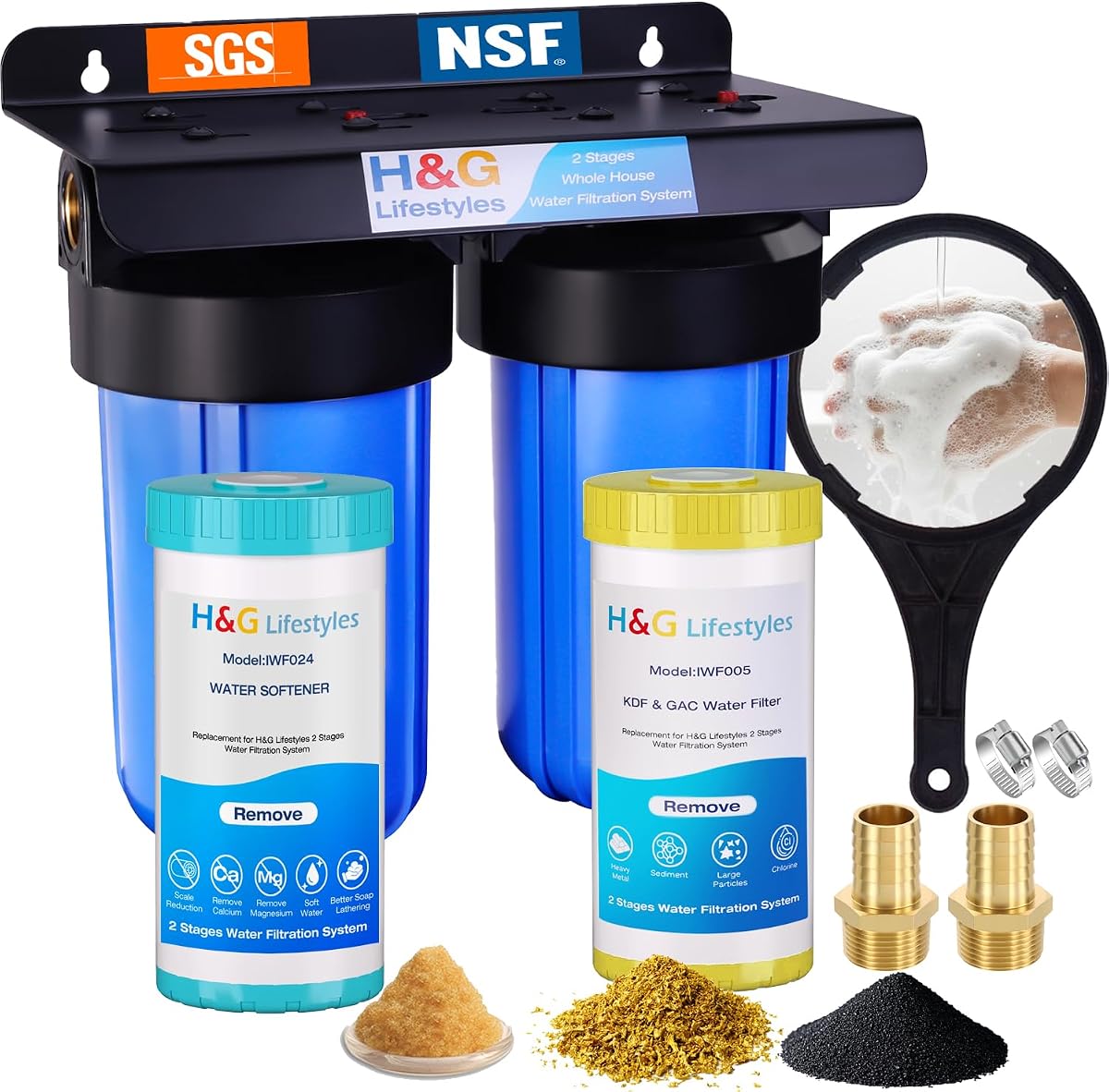


The H&G Lifestyles Whole House Water Filter and Softener Filtration System is a two-stage, point-of-entry solution that combines cation-resin softening with KDF and granular activated carbon filtration. Its 3.9 rating places it below several specialized products in the group, but the combination of functions gives it broad appeal for a homeowner seeking one compact unit rather than separate treatment stages.
We may earn a commission when you buy through this link, at no additional cost to you.
The resin cartridge is intended to reduce calcium and magnesium, while the second cartridge uses KDF and GAC media to address chlorine, heavy metals, odors, and sulfur smells commonly associated with well water. The manufacturer states a 7–12 GPM flow range, 20–100 PSI operating pressure, and a filtration capacity of up to 70,000 gallons. Actual life will vary substantially with hardness, sediment, iron, and household consumption.
There are trade-offs. A combined system is convenient, but a single platform may not be ideal for every well. The listed sulfur-odor capability and hardness treatment suggest a broad marketing message rather than a substitute for laboratory analysis. The cation resin is also described as designed for chlorinated municipal water, so buyers with untreated well water should ask about chlorine exposure, resin protection, and pretreatment requirements.
This product is most appropriate for a buyer who wants integrated softening and carbon filtration in a compact 10-by-4.5-inch assembly and has verified that the media configuration matches the well's actual contaminants. It is less suitable as a universal answer for severe iron, manganese, sediment, or pH problems. Confirm flow requirements, plumbing space, drainage needs, and cartridge availability before installation.
Pairing a cation cartridge with a KDF and GAC cartridge in one housing arrangement can simplify installation and maintenance compared with two separately plumbed units. That makes the system worth considering for moderate well-water conditions where both hardness and taste or odor issues are present.
The stated maximum capacity of 70,000 gallons should be treated as a system-level estimate rather than a guaranteed service interval. High hardness, iron, sediment, and continuous household flow can shorten cartridge performance and make regular inspections essential.
We may earn a commission when you buy through this link, at no additional cost to you.
The PUREPLUS 10-by-4.5-inch Whole House Scale Inhibitor and Sediment Water Filter is a three-pack of replacement cartridges built around PHO polyphosphate and silica-phosphate beads. These media are intended to bind with hardness ions and discourage scale formation in pipes and heating equipment. They protect against scale rather than fully softening the water by exchanging calcium and magnesium for sodium.
We may earn a commission when you buy through this link, at no additional cost to you.
The cartridge has a multi-layer construction described as three polypropylene layers, coconut-shell activated carbon, and a food-grade Siliphos layer. It fits many common 10-by-4.5-inch housings, including several named models, and is advertised to treat up to 30,000 gallons. A suggested replacement interval of three to six months depends on water quality and use, so heavily consumed households may need a shorter schedule.
The most important limitation appears in the supplied product information: the manufacturer explicitly says this filter may not perform as expected with well water and directs buyers toward a well-specific alternative. That statement should carry more weight than general claims about scale inhibition. Scale can also be managed by a true ion-exchange softener, while this cartridge is primarily a maintenance and prevention component.
Choose this product if your goal is economical scale control in a compatible housing, your water has already been assessed, and the manufacturer accepts its limitations for your source. Do not treat it as the sole solution for a new untreated well. For many well owners, it is more useful as a downstream support cartridge after sediment and contaminant-specific treatment.
Polyphosphate-based media can reduce the tendency of hardness ions to form scale, but they do not lower total dissolved solids or provide the same mineral-removal approach as cation exchange. Buyers who need genuinely softer water should select an ion-exchange system instead.
Because the listing specifically discourages this cartridge for well water, it is best viewed as an optional stage in a more comprehensive treatment plan. Confirm the chemistry, treatment goals, and housing arrangement before purchasing the three-pack.
We may earn a commission when you buy through this link, at no additional cost to you.
VICAL 1000 is a bulk calcite medium rather than a household cartridge or complete filter. Made from natural limestone, it is designed for acid neutralizer tanks and other compatible water-treatment vessels. Its 4 rating reflects a specialized product with clear certification and controlled grading, although the supplied listing does not provide a customer review count.
We may earn a commission when you buy through this link, at no additional cost to you.
The media carries NSF/ANSI Standard 60 certification for drinking-water treatment applications when installed in compatible equipment. Its uniform 16-by-40 mesh size supports stable flow and consistent contact time, while the listed composition is approximately 96% calcium carbonate. As water passes through the bed, the calcite gradually dissolves and raises low pH toward a less acidic condition.
This distinction is essential: calcite is often marketed in calcium-filter discussions, but it does not remove hardness the way a cation-exchange softener does. It is intended to address acidity and help reduce corrosion of copper pipe and fixtures. It also will not independently handle iron, manganese, sediment, microbes, nitrates, or other well-water contaminants.
The product is best for homeowners with low-pH well water who have selected a properly sized neutralizer tank and understand that the vessel must be periodically replenished or backwashed. Its certification and uniform sizing make it a premium media option. Confirm tank volume, media retention, backwashing requirements, and local water chemistry before buying.
Calcite performs as a slowly dissolving treatment bed rather than a disposable inline cartridge. Uniform 16-by-40 mesh particles help water move through the tank consistently while maintaining contact with the medium.
NSF/ANSI 60 certification indicates that the material is certified for drinking-water treatment use in appropriate equipment. That certification does not mean the media alone treats every contaminant or makes a poorly designed installation safe.
We may earn a commission when you buy through this link, at no additional cost to you.
The 3M Aqua-Pure C-050P Calcium Carbonate Media is a specialized replacement medium for 3M Aqua-Pure automatic backwash filters. Its 4.6 rating makes it one of the better-reviewed items in this guide, although the supplied information is concise and does not include a customer review count or detailed capacity figures.
We may earn a commission when you buy through this link, at no additional cost to you.
Its stated functions are neutralizing moderate acidity and helping prevent corrosion of copper pipes and fixtures. That makes it relevant to a common well-water problem: low-pH water can be aggressive toward plumbing even when visible scale is not the primary complaint. The automatic backwash system also helps maintain the media bed and remove accumulated particles.
The limitations come from the product's narrow purpose and equipment dependency. It is not a universal calcium filter, does not soften water, and cannot be assumed to handle iron, manganese, bacteria, sediment, or chemical contaminants. Buyers need a compatible Aqua-Pure automatic backwash filter and must follow the manufacturer's media-loading and maintenance instructions.
This is a good choice for an existing compatible Aqua-Pure installation or a builder who has selected that filtration platform. The strong rating and specific corrosion-control purpose make it practical, but a water analysis and equipment review should come before ordering. Do not substitute it for a softener when the primary goal is hardness reduction.
When well water is acidic, untreated water can gradually damage susceptible metal components. Calcite provides a controlled way to neutralize moderate acidity and reduce the aggressive character of the water.
The media is designed for 3M Aqua-Pure automatic backwash filters. Matching the product to the vessel and observing the specified backwashing and replacement routine is essential for consistent treatment.
We may earn a commission when you buy through this link, at no additional cost to you.
The AFWFilters Acid Neutralizer for Well Water is a complete calcite-based system associated with the Clack brand. Unlike bulk media or replacement cartridges, it provides a dedicated vessel intended to neutralize acidic well water. Its 4.3 rating suggests generally positive customer reception, although the available listing information is minimal.
We may earn a commission when you buy through this link, at no additional cost to you.
The primary benefit is straightforward system-level treatment: water passing through the calcite bed receives pH adjustment, helping reduce the corrosive qualities associated with acidic supply. Buyers do not have to source compatible media separately, although they should still verify the vessel's media type, tank sizing, and whether additional treatment stages are required.
The sparse specifications deserve attention. The supplied data does not provide flow rate, media volume, port details, backwash configuration, or replacement guidance. Those omissions make installation planning more difficult than with a well-documented cartridge. A neutralizer also does not remove hardness or treat sediment, iron, manganese, microbes, and many other contaminants that can occur in a well.
This system is a sensible candidate for a homeowner whose main problem is acidic well water and who wants a complete, purpose-labeled neutralizer rather than loose media. Before purchase, obtain the missing dimensional and performance information, assess whether a drain or backwash route is required, and test the incoming water. It should be one stage in a treatment plan, not a substitute for comprehensive testing.
A dedicated vessel gives the calcite enough bed depth and space to dissolve gradually. That arrangement can be more practical for ongoing pH correction than forcing neutralization media into an unrelated inline housing.
Acidic water treatment does not solve every well-water concern. A sediment pre-filter, softener, iron filter, disinfection stage, or other targeted component may still be needed depending on the test results.
We may earn a commission when you buy through this link, at no additional cost to you.
This 20-by-4.5-inch cation resin cartridge is a focused hardness-reduction solution. It uses ion exchange to reduce calcium and magnesium, helping soften water and limit scale in washing machines, espresso equipment, water heaters, pipes, and other fixtures. The product holds a 4 rating, while its stated capacity reaches 4,500 grains of hardness.
We may earn a commission when you buy through this link, at no additional cost to you.
A maximum flow of 2 GPM makes cartridge size the central consideration. The unit is suitable for smaller homes, wells with modest flow, or point-of-use locations, but it may struggle when several high-demand fixtures operate simultaneously. It fits Big Blue-style housings and operates between 40 and 100 degrees Fahrenheit, giving buyers a clear set of environmental and flow constraints.
The supplied customer note recommends using the cation filter between a sediment pre-filter and a carbon post-filter. That sequence is sensible: sediment can foul resin media, while carbon can address chlorine, taste, or odor after softening. The cartridge also requires proper regeneration or replacement to remain effective, and well water should be evaluated for competing iron content.
Choose this cartridge when your primary goal is mineral softening, your flow demand is modest, and you can follow a sensible filtration sequence. It is less suitable as the only treatment for a heavily contaminated well or as a high-flow whole-house solution. Confirm housing dimensions, available regeneration equipment or service, brine-handling requirements if applicable, and local hardness before installation.
Unlike polyphosphate scale inhibitors, cation resin exchanges dissolved hardness ions for other ions. That can provide meaningful softening and reduce the mineral burden reaching household equipment.
The 2 GPM maximum should be checked against faucets, irrigation, and other demand. Sediment protection upstream helps preserve resin performance, particularly where untreated well water carries sand or iron.
We may earn a commission when you buy through this link, at no additional cost to you.
The iSpring WSP-50SL is a reusable spin-down sediment filter intended as the first stage of a residential whole-house filtration system. Its 4.6 rating is among the strongest in the group. At 50 microns, it catches sand, rust, dirt, and larger suspended material before that load reaches finer downstream cartridges.
We may earn a commission when you buy through this link, at no additional cost to you.
The filter is designed to be flushed with a garden hose and reused rather than discarded at a fixed interval. A see-through housing lets the owner monitor collected sediment, while dual-threaded ends and a 1-inch male NPT inlet with a 3/4-inch female NPT outlet simplify common installation arrangements. Siliphos media is included to help reduce scale and corrosion in addition to sediment capture.
The product also has clear boundaries. It is rated for indoor use, 20–100 PSI, and 40–100 degrees Fahrenheit. A 50-micron filter cannot protect delicate membranes or fine filters from very small particles, and the listing recommends replacement every three to six months to prevent scale accumulation even though the housing itself can be flushed.
This is a strong first-stage choice for an indoor well-water entry point where sediment and scale are concerns. It is particularly valuable ahead of a softener, carbon stage, or reverse osmosis system because it protects those components from larger particles. For severe sediment, a finer primary filter or a dedicated sediment stage may still be necessary.
The flushable design makes it practical to establish sediment control before more sensitive treatment media. A visible housing also helps owners recognize when the element needs attention instead of relying only on a calendar.
Siliphos can help discourage scale, but this cartridge should not be represented as a substitute for ion-exchange softening when substantial calcium and magnesium reduction is required.
We may earn a commission when you buy through this link, at no additional cost to you.
The Membrane Solutions 5-micron string-wound cartridge is a six-pack of replacement filters made for well water and other sediment-heavy applications. Its 4.7 rating is the highest numeric rating among the listed products. The cartridges are constructed from food-grade polypropylene and are described as lead-free and BPA-free.
We may earn a commission when you buy through this link, at no additional cost to you.
A string-wound design forms a deep, graded structure that traps larger particles near the outside and progressively smaller ones closer to the core. The manufacturer says this configuration provides four times the dirt-holding capacity and twice the flow rate of a typical polypropylene sediment cartridge. A stated capacity of 15,000–20,000 gallons varies with inlet quality, and replacement is recommended at least every six months.
These are five-micron replacement cartridges, not complete systems, so compatible 10-inch housings and plumbing are required. Their NSF/ANSI 42 testing is specified for material requirements only, which should not be interpreted as a broad contaminant-reduction certification. They also do not soften water or neutralize acidity.
This pack is an attractive budget choice for homeowners who already have compatible housings and need reliable sediment protection. It is particularly useful ahead of softeners, carbon filters, or reverse osmosis equipment that can be damaged or restricted by well sediment. The six-cartridge format reduces replacement frequency, while careful change-outs based on pressure and water conditions help maintain flow.
Removing sediment before a softener or finer filtration stage helps preserve flow and media life. The five-micron rating is substantially more protective for downstream equipment than a coarse spin-down element.
The graded construction captures progressively smaller particles through the cartridge depth. It is especially valuable for well water containing sand, rust, silt, and other undissolved material.
We may earn a commission when you buy through this link, at no additional cost to you.
The Waterdrop WHF21-FG is a two-stage, whole-house filtration system designed for both municipal and well water. Its 4.4 rating and broad contaminant focus make it the strongest integrated choice in the list for wells dealing with iron, manganese, sediment, taste, or odor concerns. It is not, however, presented as a true hardness softener.
We may earn a commission when you buy through this link, at no additional cost to you.
The first stage uses iron and manganese reduction media, while the second incorporates natural coconut-shell granular activated carbon. Third-party testing is cited for reductions of up to 96.4% iron, 98.2% manganese, and 95.63% chlorine, along with selected heavy metals and particles larger than five microns. Both cartridges are listed as meeting NSF/ANSI 372 lead-free requirements, and the iron media is described as meeting several additional standards.
The system supports flow up to 15 GPM through standard 1-inch NPT connections. Both filters provide up to 50,000 gallons or six months of use, with actual service life dependent on water quality. Reinforced brass threads, dual O-rings, pressure testing, and a stated water-hammer cycle count add installation confidence, while a one-year warranty and lifetime technical support are included.
This system is a strong candidate for a high-flow home whose well analysis confirms iron, manganese, sediment, or chlorination needs. Buyers seeking calcium removal should add a compatible softener rather than assume carbon and oxidation media provide that function. Confirm third-party certification reports, available flow at the actual pressure, installation space, and cartridge replacement logistics before ordering.
Combining iron and manganese media with coconut-shell carbon addresses several common well-water issues in one point-of-entry assembly. The arrangement is more targeted than a general carbon-only filter and more compact than several separately plumbed stages.
An up-to-15-GPM rating gives the system more headroom for households running multiple fixtures at once. Actual performance still depends on incoming pressure and contaminant load, so flow testing during installation remains important.
We may earn a commission when you buy through this link, at no additional cost to you.
The H&G Lifestyles 20-by-4.5-inch Water Softener Cartridge is a replacement ion-exchange cartridge for existing compatible housings. Its 4.1 rating indicates a favorable but moderate customer reception. The product is built for hardness reduction rather than sediment filtration, scale-only inhibition, or pH neutralization.
We may earn a commission when you buy through this link, at no additional cost to you.
It combines cation resin with silver-ion enhancement to reduce hardness minerals such as calcium and magnesium. The resin is described as NSF certified and food-grade, while the cartridge's 10% crosslinked formulation is intended to improve chlorine resistance and durability. Those properties can be useful where residual disinfectant protects the resin from fouling.
The main caveat is that this is a cartridge, not a complete treatment system. The supplied information does not state a grain capacity, maximum flow, regeneration method, or service life. It also emphasizes chlorinated municipal water, so an untreated well owner should ask how the resin is protected from iron, sediment, and other contaminants before installation.
The cartridge is best for existing owners of a compatible 20-inch system who need a straightforward softening replacement. Named compatible models include several whole-house filtration configurations, but dimensions and fittings should be verified. Pair it with upstream sediment filtration, use a regeneration plan appropriate to the housing, and avoid assuming the silver-ion feature replaces disinfection or contaminant-specific treatment.
Ion-exchange resin directly reduces dissolved hardness, helping protect water heaters, dishwashers, washing machines, and fixtures. The listed food-grade certification supports use in suitable drinking-water treatment equipment.
The 4.5-by-20-inch format and listed compatible models make this convenient for maintenance of an existing system. Buyers should still compare housing dimensions, connection details, regeneration configuration, and actual capacity requirements.
We may earn a commission when you buy through this link, at no additional cost to you.
The right calcium treatment choice depends on the problem being solved. Start with a complete water analysis, then match hardness, pH, sediment, iron, manganese, flow, and space requirements to the appropriate treatment technology.
A calcium filter is not a universal description. It may refer to a system that reduces hardness, a cartridge that inhibits scale, calcite used to neutralize acidity, or a sediment filter that protects downstream equipment. Ion-exchange softeners exchange calcium and magnesium for other ions, while polyphosphate and Siliphos cartridges primarily reduce the tendency of dissolved minerals to form scale. Calcite raises low pH and helps control corrosion but does not soften water in the conventional sense. Establish whether the priority is softer water, lower scale potential, corrosion control, or equipment protection before choosing a format.
Well water varies by location, well depth, season, and aquifer conditions. A useful panel should include total or calcium hardness, alkalinity, pH, iron, manganese, sediment or turbidity, chloride, sulfate, dissolved solids, and any locally relevant contaminants. Very low pH can make water aggressive toward copper even without a major scale problem, while high iron can interfere with resin and certain oxidation media. Testing also helps distinguish a treatment problem from a plumbing issue. Use a reputable laboratory or properly operated field-testing process, and avoid designing the entire system from odor or taste alone.
A cartridge with a low maximum flow can work well at a small point-of-use location but struggle with a busy whole-house installation. The 20-inch cation cartridge in this guide is limited to 2 GPM, while the larger complete systems support substantially higher flow. Calculate likely simultaneous demand from showers, faucets, laundry, dishwashing, irrigation, and other equipment. Also consider pressure loss through long runs and multiple housings. If demand is uncertain, select a system with headroom and avoid restricting the main line with undersized components.
Inline cartridges require the correct diameter, length, port thread, and housing model. The PUREPLUS and H&G whole-house products use 10-by-4.5-inch formats, while the H&G replacement softener and separate cation cartridge use 20-by-4.5-inch housings. The Membrane Solutions cartridges use a compact 10-by-2.5-inch format. Do not assume that a similar-looking cartridge will create a watertight or pressure-safe connection. Measure available vertical space, check nearby clearances for cartridge removal, and verify whether the housing is rated for the pressure and temperature of the installation.
Certification can add confidence, but its scope matters. NSF/ANSI 60 applies to drinking-water treatment media, while NSF/ANSI 42 addresses specific contaminant-reduction and material claims. The VICAL media is listed as NSF/ANSI 60 certified, and the Waterdrop system is listed under NSF/ANSI 372 with multiple additional standards for its iron-reduction media. The Membrane Solutions cartridge is tested and certified to NSF/ANSI 42 for material requirements only. Read the applicable certification report and verify the exact model, media, and contaminant claim instead of treating a broad certification mark as proof of universal purification.
The best results often come from a staged train. A sediment filter should protect sensitive softener, carbon, and membrane components from sand, rust, and dirt. Iron and manganese treatment may need to occur before carbon or softener media, depending on the media and concentration. pH correction should be planned around the effect of other stages on mineral balance. Carbon may serve as a polishing stage after particulate treatment, while a dedicated disinfectant or other contaminant-specific device may be necessary when testing identifies it. The cation filter in this guide is specifically recommended between sediment and carbon stages.
Every treatment method has a maintenance cycle. Softening resin normally requires periodic regeneration or replacement, carbon cartridges need exchange according to usage and contaminant load, neutralizer media must be replenished as it dissolves, and sediment elements must be inspected or replaced. Spin-down housings reduce replacement frequency but still need regular flushing. Choose a system whose service parts are available in the required size and consider whether regeneration brine, a drain connection, and routine monitoring are practical at the installation site.
Untreated well water can contain contaminants that neither hardness filters nor scale cartridges address. Iron and manganese may foul resin; sediment can overwhelm cartridges; acidic water can damage copper; and microbial or chemical contamination requires appropriate specialist treatment. The PUREPLUS listing itself warns that it may not achieve the expected filtering effect with well water, illustrating why a broad replacement cartridge should not be treated as a universal solution. Confirm source-water conditions, protect the well pump and pressure tank as needed, and include any disinfection needs in the overall plan.
Begin with a complete water test and identify the role each product will play. Install the system at the appropriate point of entry, after the pressure tank and well pump but before the home's branch plumbing when treatment is intended for the entire house. Use a sediment pre-filter upstream of softener or carbon media, provide adequate vertical clearance, and verify all threaded connections with appropriate sealant. Never use thread tape on fittings unless the manufacturer specifically allows it.
Flush and test the installation according to the product instructions. Check for leaks, unusual noise, restricted flow, and changes in water taste or odor. For a softener, follow the housing's prescribed conditioning or regeneration cycle before treating the water as fully conditioned. For calcite neutralizers, confirm the media bed, backwashing or drain arrangement, and proper flow direction. For sediment cartridges, discard the initial rinse water if directed and make sure the housing is fully purged of air.
Establish a monitoring routine rather than relying only on a fixed calendar. Check filter housings for sediment, track pressure changes, test hardness and pH at useful intervals, and arrange service for any media that cannot be inspected easily. Replace or regenerate media when performance declines or the manufacturer specifies a limit, whichever comes first. If water quality changes after storms, construction, or seasonal changes, repeat the analysis and reassess the treatment plan.
The best type depends on the water analysis and the intended result. A cation-exchange softener is appropriate for genuine calcium and magnesium reduction, while Siliphos or polyphosphate cartridges focus on scale inhibition. Calcite media is used to neutralize acidity and help control corrosion, and sediment cartridges protect downstream components rather than soften the water.
Only some calcium-related products genuinely reduce hardness. Cation-exchange resins remove calcium and magnesium through ion exchange, while calcite and scale-inhibitor media generally do not lower hardness in the same way. Always review the exact treatment mechanism and verify hardness with a water test before and after installation.
Usually not. A sediment filter removes suspended particles but does not reliably address hardness, iron, manganese, acidity, microbes, nitrates, or many dissolved contaminants. It is most useful as pretreatment for a more complete system designed around the results of a proper water analysis.
It depends on the plumbing and treatment objectives. A properly sized softener can substantially reduce hardness and scale, while a scale inhibitor may offer additional protection in selected pipe or appliance locations. Redundant components should have a clear purpose and should not be assumed to improve every aspect of water quality.
The terms can describe closely related products because calcite is a form of calcium carbonate. In this guide, both are neutralization media intended to raise low pH and help reduce corrosion. They are not interchangeable with cation resin cartridges that soften water or with polyphosphate cartridges that primarily inhibit scale.
Replacement depends on contaminant load, water use, and cartridge type. The listed sediment cartridge is recommended for replacement at least every six months, while the PUREPLUS cartridge is suggested every three to six months. Other systems are rated by gallons or months, but actual well conditions can shorten service life, so pressure and water-quality monitoring are important.
No single treatment is designed to address every possible well-water contaminant. Sediment filters capture particles, softeners address hardness, iron media target dissolved metals, carbon improves taste and handles certain chemicals, and neutralizers adjust pH. Combining the correct stages is usually more effective than expecting a universal filter to do everything.
Yes. Testing identifies whether your primary need is hardness reduction, scale prevention, pH correction, sediment removal, iron treatment, or contaminant-specific filtration. It also helps determine the correct media, flow capacity, filtration sequence, and maintenance schedule, while preventing you from buying a cartridge that is not appropriate for your source water.
The top choices reflect different jobs. The Waterdrop WHF21-FG is the most complete option here for high-flow filtration targeting iron, manganese, sediment, chlorine, and taste or odor concerns, while the Membrane Solutions string-wound pack is the economical sediment-protection choice. VICAL 1000 stands out for certified, controlled calcite media when the real need is pH neutralization rather than hardness removal.
Prioritize the contaminant you can confirm, not the most familiar product description. A softener cartridge is appropriate for hardness reduction, calcite is better for acidic water, and sediment filters should protect the more sensitive stages in the system. Confirm flow, housing dimensions, certification scope, drainage, regeneration, and replacement availability before ordering anything for a well.
Finally, recheck the current listing details and costs at the time of purchase, because availability, promotions, and product configurations can change. The right calcium filter is the one that fits the water analysis, plumbing, household demand, and maintenance plan rather than simply the one with the most attractive headline features.