
BURMONG Battery Disconnect Switch
4.2Editor score
Affordable 275A-rated option
12V through 48V compatibility
Simple ninety-degree operation
Our battery disconnect switch guide compares 10 leading models for terminal fit, current capacity, installation, waterproofing, theft deterrence, and power
A battery disconnect switch gives vehicle, RV, boat, and equipment owners a direct way to isolate a battery, reduce unwanted drain, and improve electrical security. The most useful model matches your battery-post style, handles the electrical load, fits the available space, and provides a control method that suits routine maintenance and long-term storage.
We compared the ten switches in this guide using their stated construction, voltage compatibility, current ratings, mounting methods, control options, and intended environments. The list includes manual top-post and side-post models, compact low-clearance designs, waterproof switches, and remote-controlled units with voltage-based safety features.
Each review explains the switch that stands out, the compromises worth considering, and the situations in which it makes the most sense. Ratings and specifications can change over time, product availability also varies, and current prices should be checked on the linked listing before making a purchase.
4.2Editor score

4.7Editor score

4.3Editor score
The table below compares the ten switches by control style, electrical capacity, terminal compatibility, and practical installation considerations. It is a quick way to identify the right mounting style and feature set before reading the detailed reviews.



The Joinfworld Top Post Battery Disconnect Switch is a manual, two-position isolator designed for DC systems from 12 to 48 volts. It does not have a published customer rating, but its stated 250A continuous and 1,000A cranking capacities make it a broadly capable choice for common automotive, marine, RV, and trailer electrical systems.
We may earn a commission when you buy through this link, at no additional cost to you.
Its main strength is the combination of a straightforward on-off control and flexible application potential. The included negative battery clamp and tapering post support a direct installation at the battery, while the copper components are intended to provide dependable conductivity. Unlike a more specialized remote unit, the operating principle is immediately understandable and does not require pairing a controller or learning an electronic menu.
The main limitation is that the switch must be matched carefully to the battery and electrical system. A top-post design will not suit a side-post battery without suitable additional hardware, and the stated capacity should be considered alongside the alternator output, starting load, and wiring gauge of the installation. It also does not provide a remote control or automatic low-voltage cutoff.
This is a sensible choice for an owner who wants a dependable manual switch without paying for powered controls. It is particularly attractive for boats, campers, travel trailers, trucks, and older vehicles that remain stored for extended periods, provided the negative terminal has a compatible top post and there is adequate clearance around the battery.
The two-position on-off design lets the user open the battery circuit without repeatedly removing a terminal. That makes scheduled storage checks and electrical maintenance faster while providing a visible indication of the switch state.
The stated voltage range and current levels suit numerous cars, boats, RVs, trailers, ATVs, UTVs, and battery banks. Its broad compatibility is valuable only when the terminal geometry and current requirements of the specific installation are confirmed first.
We may earn a commission when you buy through this link, at no additional cost to you.
The Adjustable Top Post Switch carries a 4.4 customer rating and is built for 12-volt installations using negative battery posts measuring 15–17 millimeters. It combines an adjustable mounting design with an on, off, and removable-knob control, making it one of the more installation-flexible models in this roundup.
We may earn a commission when you buy through this link, at no additional cost to you.
Two details set it apart. First, the mounting angle can be adjusted to help fit a crowded engine compartment rather than forcing attached cables into an uncomfortable direction. Second, the knob can be removed when the vehicle is parked, providing a simple deterrent against unauthorized use without requiring an electronic remote or separate lock.
The construction uses Nylon 66 and solid brass, which the product information describes as stronger and more flame-resistant than typical ABS plastic while providing corrosion resistance and good conductivity. One trade-off is the narrower operating specification: the switch is presented for 12V systems and 15–17mm top posts, so it is less versatile than models covering 24V or 48V use.
This switch is best for owners of compatible cars and light vehicles who want both installation flexibility and a removable security control. It is less suitable for side-post batteries, unusually small posts, or systems requiring higher voltage support, so checking the battery diameter before ordering is essential.
The ability to alter the terminal orientation helps cable routing in crowded engine bays. It can reduce strain on attached leads and make the switch easier to reach without competing with brackets, covers, or nearby equipment.
Removing the knob offers a useful deterrent during long-term parking. The remaining on and off positions remain intuitive, so the user does not need a separate remote, app, or complicated control sequence.
We may earn a commission when you buy through this link, at no additional cost to you.
The Dual Rotating Terminal Switch has a 4.6 customer rating and targets 12- to 24-volt systems with SAE top-post negative terminals measuring 17–19 millimeters. Its dual terminals can rotate through 180 degrees, offering a practical answer to cable alignment problems in confined engine compartments.
We may earn a commission when you buy through this link, at no additional cost to you.
The thickened copper construction is designed to support stable current flow while limiting resistance and heat associated with poor contact. Installation follows a familiar sequence: remove the original negative cable, attach the disconnect, and reconnect the cable. A wrench and two washers are included, which reduces the need to source small hardware separately.
Its limitations are specific and should not be overlooked. The stated fit excludes side-post batteries, positive terminals, and posts smaller than 17 millimeters. It also lacks the removable-knob security feature offered by some competitors and does not include automatic voltage protection, so shutoff remains a manual responsibility.
This model is a strong match for compatible cars, SUVs, pickup trucks, RVs, campers, box trucks, and boats that need flexible cable positioning. Buyers should measure the negative post before ordering and inspect the available engine-bay space to ensure the rotating ends and attached lugs can be positioned without strain.
Each end can rotate through 180 degrees, allowing the battery cable to approach from a more natural angle. This is especially helpful when a fixed-angle switch would place unnecessary leverage on the terminal connection.
The thickened high-purity copper structure is intended to reduce contact resistance and associated heat buildup. It is especially relevant for installations expected to carry substantial cranking current.
We may earn a commission when you buy through this link, at no additional cost to you.
The Nilight 90015A earns a 4.7 customer rating, the highest published score among the products in this guide. It is a manual two-position battery isolator for DC 12- to 48-volt systems, with a stated 275A continuous rating, 455A intermittent capability, and 1,250A momentary cranking capacity.
We may earn a commission when you buy through this link, at no additional cost to you.
Its practical appeal comes from the balance between electrical capability, environmental protection, and simple operation. The ABS housing is paired with a rear cover intended to insulate terminals against short circuits, while the waterproof construction is well suited to marine and RV use. Four sets of bolts are included, providing a more complete mounting package than many alternatives.
The trade-off is that it is entirely mechanical. There is no remote function, automatic low-voltage cutoff, or removable control knob to prevent someone from turning the switch back on. Users who need active theft deterrence from a distance may prefer an electronic model, while most storage and maintenance applications are well served by the direct action of the manual control.
This is an excellent general-purpose choice for cars, trucks, boats, RVs, campers, trailers, ATVs, UTVs, and battery banks within its voltage range. It stands out for owners who want proven customer feedback, strong cranking capability, and broad application support without electronic complexity.
The waterproof housing and insulated rear terminal area add useful protection in engine compartments, battery boxes, and marine environments. Exposure to moisture and accidental contact are important concerns in those environments.
The stated current levels support demanding starting use, while the 12- to 48-volt range makes the switch relevant to automotive, marine, trailer, and stationary battery applications.
We may earn a commission when you buy through this link, at no additional cost to you.
The Compact 300A Disconnect Switch combines a 300A continuous and 900A cranking specification with a mounting height of only 1.5 inches. Its 4.3 customer rating and compact design make it a notable option for tightly packed engine compartments where conventional switches may not fit.
We may earn a commission when you buy through this link, at no additional cost to you.
It also has a number of premium details. The heavy-duty copper terminals are designed for conductivity, the switch carries an IP66 waterproof rating, and the large red knob is removable as a deterrent against unauthorized operation. The supplied package includes an installation guide, negative SAE female clamp, negative SAE male terminal post, and an adjustable spacer.
One important operational warning is that disconnecting the battery may cause electronics that store settings, such as a radio, to lose memory. The switch also needs sufficient physical clearance despite its low profile, and its SAE components are intended for compatible top-post arrangements. It is more specialized than a universal low-cost isolator.
Owners of performance vehicles, trucks, boats, or RVs with restricted hood space can benefit from the compact form and high current capacity. It is especially compelling for users who want both waterproof construction and a removable security control, provided the electrical memory settings can be reconfigured when needed.
The low profile directly addresses a common installation obstacle: the switch can sit close to the battery top rather than extending far above it. The adjustable spacer helps accommodate different installation geometry.
An IP66 rating supports use in wet or exposed environments, while the removable knob prevents a parked vehicle from being re-energized by someone who finds the switch.
We may earn a commission when you buy through this link, at no additional cost to you.
The RVBOATPAT Remote Disconnect is designed for 12-volt cars, trucks, RVs, and boats, with a stated 240A continuous and 1,000A instantaneous current capability. Its remote control and automatic low-voltage response give it a distinctly more sophisticated feature set than a conventional manual isolator.
We may earn a commission when you buy through this link, at no additional cost to you.
The magnetic latching relay is designed to consume only 3mA in standby mode. It also disconnects power at 11.8V, which can reduce the risk of deep discharge during long-term parking or after a lighting or electronics load remains on. The remote is disabled during cranking and when voltage exceeds the stated safe driving range, helping prevent accidental shutdown while the vehicle is operating.
Those protections come with added complexity. The switch depends on electrical logic rather than a purely mechanical break, and the 12V limitation makes it less relevant to 24- or 48-volt systems. Its specified current capacity also deserves comparison with the vehicle's charging and starting equipment rather than assuming every installation has identical demands.
This is a compelling option for someone who routinely parks a vehicle for weeks or months, wants remote shutoff, and prefers automatic protection against excessive discharge. It is best for owners with compatible 12V electrical systems who understand that a powered isolator introduces both installation and standby-current considerations.
Disconnecting the battery from a distance avoids crawling under a vehicle or opening a hood solely to reach a manual knob. It is particularly convenient for RVs, boats, and stored cars.
The 11.8V cutoff provides a defined response when battery voltage becomes low. This can help reduce discharge-related damage when an accessory, circuit, or aging wiring system continues to draw power.
We may earn a commission when you buy through this link, at no additional cost to you.
The Remote Anti-Theft Kill Switch is a 12-volt remote isolator with a 4.3 customer rating. It combines distance control with a manual fallback, making it a practical option for a stored vehicle where security and service access are equally important.
We may earn a commission when you buy through this link, at no additional cost to you.
When voltage falls below 11.8V, the product information states that power is automatically cut after 120 seconds. The remote is disabled above 13.2V to reduce the risk of an accidental shutdown while driving. A magnetic switching structure is specified with a standby draw of only 0.003A, addressing the concern that a powered disconnect could itself consume the battery it is meant to protect.
The manual control is valuable during electrical work because it provides a way to isolate the battery even if the remote function is unavailable or the user simply prefers direct operation. The trade-off is that the switch has a narrower 12V focus than universal 12- to 48-volt models and depends on the installed system presenting the expected voltage range.
This switch suits owners of compatible cars and trucks who want remote anti-theft control but also value a physical backup. It is less appropriate for 24- or 48-volt installations, and careful placement is needed to ensure the receiver and wiring do not create new vulnerability points.
The 120-second delay prevents the system from reacting to a brief voltage fluctuation. The longer response is intended to isolate the battery only after sustained low-voltage conditions are detected.
A manual option is a meaningful advantage when servicing wiring or responding to a situation in which remote operation is impractical. It provides redundancy without abandoning the convenience of remote access.
We may earn a commission when you buy through this link, at no additional cost to you.
The Joinfworld Side Post Switch is a dedicated two-position isolator for 12- to 48-volt systems with side-post batteries. It has no published customer rating, but it addresses a common fitting problem directly by using M10 studs and included copper conductive mounting sheets.
We may earn a commission when you buy through this link, at no additional cost to you.
The stated 275A continuous, 455A intermittent, and 1,250A cranking ratings place it in a strong performance class. Its waterproof ABS housing, rear terminal cover, tinned copper studs, and conductive mounting brackets are designed for conductivity and protection against accidental shorts. The product is listed for cars, boats, RVs, campers, trailers, trucks, ATVs, UTVs, and battery banks.
The important limitation is that it is a side-post solution, not a universal top-post model. Users must confirm that the battery's side terminals and mounting geometry match the included hardware. The switch also lacks remote operation and automatic low-voltage response, so its benefits center on straightforward, robust manual isolation.
This is a logical pick for a vehicle or marine installation that already uses side-post terminals and values a direct bolt-on solution without separate adapters. It is less suitable for top-post batteries, and the lack of published ratings means buyers should give extra attention to dimensions, included hardware, and overall installation quality.
The supplied mounting brackets and M10 tinned copper studs are designed to connect directly to side-post batteries. This avoids adapting a top-post switch to a terminal style for which it was not intended.
Waterproof construction and a rear terminal cover are meaningful benefits in damp or exposed battery compartments. The added insulation can reduce the likelihood of accidental contact with conductive components.
We may earn a commission when you buy through this link, at no additional cost to you.
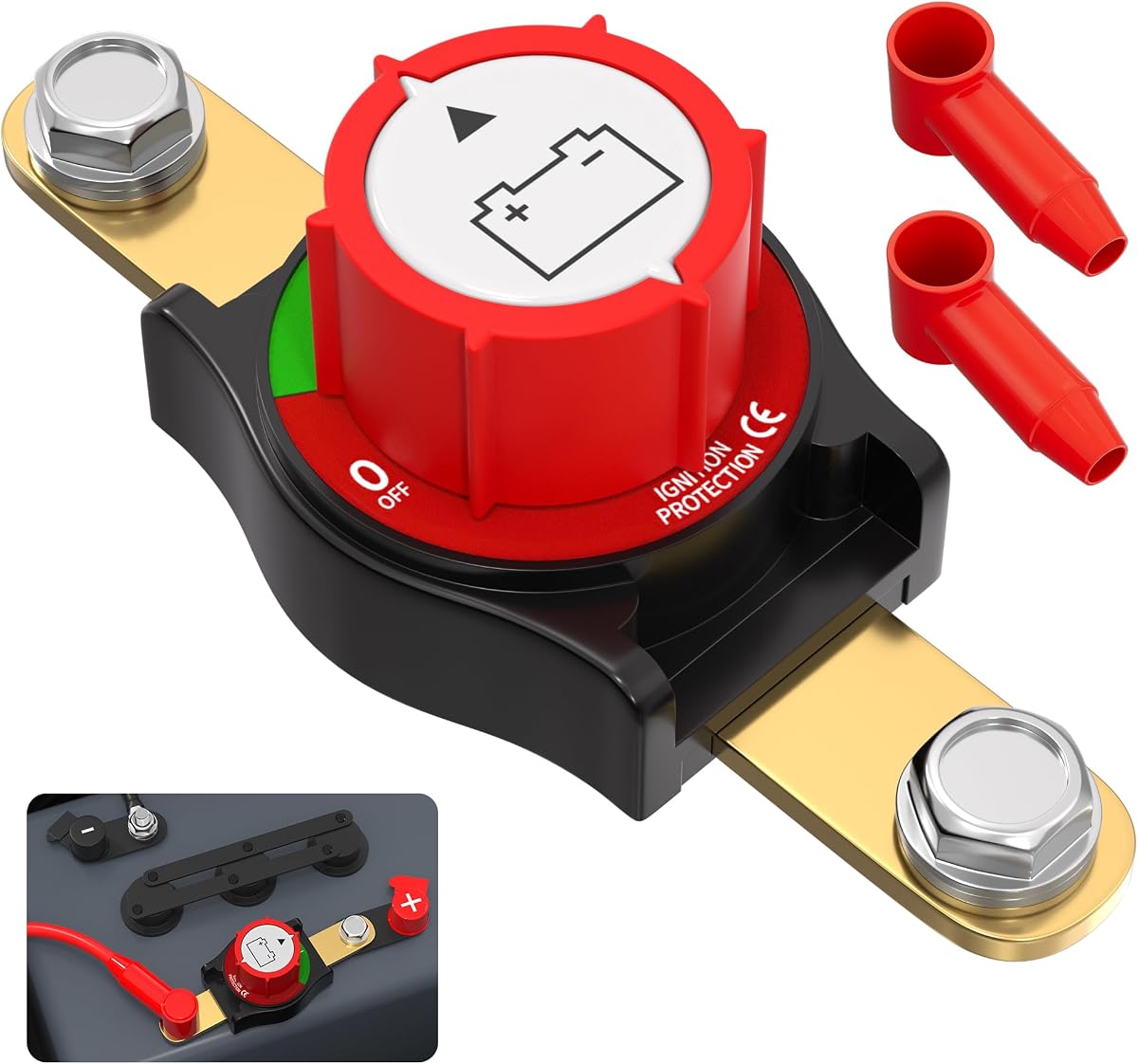
The BURMONG Battery Disconnect Switch has a 4.2 customer rating and offers a straightforward way to isolate a battery across 12-, 24-, and 48-volt systems. Its stated 275A continuous rating, brass or copper clamp, ABS housing, and simple ninety-degree rotation make it a practical budget-oriented option.
We may earn a commission when you buy through this link, at no additional cost to you.
Installation is described as a basic bolt-on process, normally positioned at the negative terminal. The clear on and off positions make daily use easy to understand, and the corrosion-resistant clamp and housing are appropriate for a range of automotive, RV, marine, and powersports applications.
The switch does not provide the more advanced protections found in remote units. There is no automatic low-voltage response, driving-related remote lockout, or specified removable security control. Its anti-theft value therefore depends on the user making the switch less accessible or treating it as one part of a broader security plan.
This model makes the most sense for a straightforward battery-isolation task on a compatible system. It offers generous voltage support and a respectable current rating without electronic complexity, making it a strong value option for DIY users, seasonal vehicles, trailers, and basic marine applications.
A basic bolt-on design and ninety-degree control reduce the learning curve. It is a practical choice for owners who need dependable isolation but do not require remote or automatic functions.
The clamp and housing materials are selected to resist corrosion in varied environments. That makes the switch more broadly relevant to boats, RVs, and exposed battery installations.
We may earn a commission when you buy through this link, at no additional cost to you.
The Two-Pack Copper Rotary Switches include two manual battery isolators intended for 12- and 24-volt systems. Their 4.0 customer rating is the lowest published score in this group, but the two-switch package and pure-copper contact structure create a distinctive proposition for multi-battery or multi-vehicle installations.
We may earn a commission when you buy through this link, at no additional cost to you.
Each switch uses a simple ninety-degree rotary action: rotating upward cuts battery power, while rotating downward restores it. That mechanical design is easy to understand and does not depend on electronics, standby current, or a remote control. The pure-copper contact structure is intended to promote conductivity and reduce voltage drop.
The principal weakness is incomplete information in the stated specifications. The product description does not provide a continuous, intermittent, or cranking current rating, so buyers should not infer heavy-duty capability solely from the copper materials. It is also limited to 12- and 24-volt use rather than the broader 48-volt compatibility offered by several alternatives.
The package is most attractive to users who need two compact manual isolators, whether for separate batteries, separate vehicles, a backup arrangement, or a planned future installation. For a single basic disconnect, the individual switch remains functional, but current-limit verification and careful terminal compatibility checks are especially important.
Two complete switches provide more flexibility than a single-unit purchase. They can serve separate battery banks, be assigned to different vehicles, or provide a spare for future electrical work.
The rotary design has no standby consumption and no pairing process. That simplicity can be beneficial in older vehicles, storage applications, and situations where electronic controls are unnecessary.
We may earn a commission when you buy through this link, at no additional cost to you.
Choosing a battery disconnect switch starts with the battery connection and electrical system, not with appearance. Terminal fit, voltage, current, mounting space, environmental exposure, and control style determine whether a switch will work safely and conveniently in the intended installation.
Top-post and side-post batteries use different physical connections, and a switch designed for one is not automatically compatible with the other. Measure the negative battery post and inspect the available mounting area before buying. The Dual Rotating Terminal Switch is intended for 17–19mm SAE top posts, the Adjustable Top Post Switch for 15–17mm top posts, and the Joinfworld Side Post Switch for side-post systems with M10 hardware. Always confirm the product's dimensions and included mounting parts against the battery.
A switch must support the voltage of the connected battery bank rather than merely matching the nominal voltage of a familiar passenger vehicle. Several models cover 12 through 48 volts, while the two remote units are designed for 12-volt systems and the two-pack option supports 12 and 24 volts. For dual-battery installations, account for series and parallel arrangements, controller equipment, and the voltage range experienced during charging.
Continuous current describes the load the switch can carry for an extended period, while cranking or momentary current reflects short-duration starting demand. The Nilight is listed at 275A continuous and 1,250A momentary, while the Compact 300A model offers 300A continuous and 900A crank amps. A switch should be selected for the installation's cables, alternator output, and starting load, not simply for the largest headline number on the listing.
Battery compartments can be surprisingly crowded, and a switch that works electrically may still be impossible to position without touching a hood, brace, cover, or moving cable. The Compact 300A model addresses this with a stated 1.5-inch mounting height, while the Adjustable Top Post Switch and Dual Rotating Terminal Switch provide rotation to improve cable alignment. Include the height of attached lugs and the room needed to turn the knob when assessing clearance.
Manual switches are direct, dependable, and easy to understand, but the operator must physically reach them. Remote models are convenient for stored vehicles and can provide automatic low-voltage cutoff, yet they add wiring, control electronics, and a small standby draw. A removable knob offers a middle ground by discouraging use while preserving straightforward manual operation.
Marine installations, open RVs, and road vehicles may encounter moisture, salt, dust, vibration, and temperature changes. The Nilight has a waterproof housing, and the Compact 300A model carries an IP66 rating. Protective rear terminal covers can also reduce accidental short-circuit risk. These features are particularly relevant when the battery is outside a sealed cabin or near the engine bay, trailer frame, or marine compartment.
Disconnecting power can reset radios, clocks, programmable systems, and other memory-based electronics. The Compact 300A listing explicitly warns that stored radio memory may be lost each time the system is switched off. Electronic remote models also need a safe-driving strategy, and two of them disable their remote functions above specified voltage levels. Think about which accessories must remain active and which settings can reasonably be restored after shutdown.
A switch may arrive with only the main body, or it may include a battery clamp, terminal post, washers, spacers, bolts, and a small installation tool. The Adjustable Top Post Switch supports direct clamping or a wired configuration, while the Compact 300A model includes an adjustable spacer and both negative SAE connection parts. Confirm whether the listed hardware supports your intended mounting method and whether additional cable or lugs are required.
Begin with the vehicle or equipment fully shut down, and follow the manufacturer's instructions before disconnecting the battery. Identify the negative terminal, remove the existing negative cable, and protect the cable from contact with positive battery hardware. Position the switch so the control faces an accessible location and the attached cable can be routed without sharp bends, strain, or interference with moving parts.
Attach the switch according to its specified method. Some models use a clamp directly at the battery, while others are designed for wire lugs or a combination of both. Tighten fasteners evenly to maintain solid contact, inspect the terminal for correct polarity, and ensure the insulating cover or rear terminal guard is fully seated. Reconnect the negative cable and confirm that the control clearly indicates the intended on or off position.
For routine use, switch the battery off before long-term storage or electrical maintenance, then reconnect it before operating the vehicle or equipment. Do not attempt to remove a terminal while substantial current is flowing, and do not use the switch as the sole means of controlling power while the engine is running. Periodically inspect the mounting hardware, cable connections, housing, and corrosion around the battery, and address a loose, heated, discolored, or corroded connection promptly.
Most vehicle installations place the disconnect on the negative terminal because that reduces the risk of the tool contacting a grounded positive connection. Some specialized systems use positive-side disconnects, but the correct arrangement should follow the equipment wiring plan and manufacturer instructions. Always confirm polarity before tightening connections and avoid routing the disconnected cable where it can contact a positive terminal.
A switch prevents the connected circuit from drawing power while it is open, but it cannot stop current that bypasses the switch. A parasitic drain can also remain if the switch is not installed on the relevant path or if another connection is wired around it. For suspected drain, test the vehicle before and after installation and inspect circuits that remain powered.
It can. The Compact 300A Disconnect Switch specifically warns that electronics storing information, including a radio, may lose memory whenever the battery is disconnected. Some vehicles also have alarm, key-programming, or convenience settings that are affected, so owners should know which settings may need to be restored before operating the switch routinely.
Only if the product information explicitly approves the higher voltage. The remote RVBOATPAT and Remote Anti-Theft Kill Switch are specified for 12 volts, while several manual models support broader ranges. Exceeding the rated voltage can damage internal contacts, insulation, or control electronics and may create a serious fire or equipment-failure risk.
Measure the diameter of the negative battery post without relying on visual estimation, and identify whether the battery uses a top-post or side-post connection. For example, the Adjustable Top Post Switch is specified for 15–17mm posts, whereas the Dual Rotating Terminal Switch targets 17–19mm top posts. The Joinfworld Side Post Switch is intended for compatible side terminals with M10 studs.
They can be, but the remote is generally disabled while driving or cranking to prevent an accidental shutdown of a moving vehicle. The installation must also provide reliable electrical connections and place any receiver or control wiring where it will not be exposed to heat, moisture, or impact. A manual switch may be preferable for users who prioritize simplicity.
Compare the switch's continuous current rating with the demands of connected equipment and battery bank, and check cable size and protection as well. Cranking or momentary ratings matter for starting loads but should not be treated as a substitute for continuous capacity. Marine environments also justify a switch with suitable waterproofing and corrosion-resistant terminals.
Periodically check that the mounting bolts remain tight and that the cable terminals show no heat damage, discoloration, or excessive corrosion. Keep the housing and insulating cover free of dirt and moisture, and confirm that the control moves cleanly between its stated positions. If an electronic switch is used, also inspect the wiring and remote-control behavior.
The Nilight 90015A is the strongest all-around choice for buyers seeking a highly rated, mechanical, waterproof isolator with broad voltage and vehicle compatibility. The BURMONG switch stands out as the best budget-oriented option, while the Compact 300A model offers specialized advantages in low-clearance installations, weather resistance, and removable-knob security.
Remote users can look to the RVBOATPAT model for automatic low-voltage cutoff and magnetic latching operation, or to the Remote Anti-Theft Kill Switch for a combination of remote access and manual backup. Whichever control style appeals to you, prioritize exact post fit, voltage, current handling, available clearance, and the consequences of losing power to memory-based electronics.
Before making a final selection, verify the dimensions and electrical requirements against your specific battery and wiring. Customer ratings and product details can evolve, inventory can change, and current prices vary by listing, so check the latest product page, included hardware, and customer feedback before purchasing.
