
FiiO K13 R2R Desktop DAC
4.6Editor score
Fully differential R2R DAC
2400mW headphone output
Ten-band PEQ customization
Discover the best audiophile DACs, comparing sound quality, connectivity, headphone power, streaming features, and desktop audio performance.
Audiophile DACs convert digital music into analog signals with greater precision, helping computers, streamers, optical sources, and game consoles deliver cleaner, more detailed sound to headphones, amplifiers, and powered speakers. A good model should match your source, speakers, listening habits, and preferred controls.
This guide compares ten DACs across sound conversion, supported resolutions, input and output options, headphone amplification, wireless codecs, construction, and everyday usability. It covers portable adapters, compact desktop converters, preamps, and all-in-one headphone amplifiers so readers can find a model suited to a particular system.
Each pick highlights the strongest reason to consider that model, along with practical limitations and ideal use cases. Product ratings and specifications reflect the supplied information, while availability, promotions, and prices change over time, so readers should verify the latest listing before purchasing.
4.6Editor score

4.7Editor score

4.6Editor score
The comparison highlights each product's conversion hardware, resolution support, primary connectivity, headphone capability, and most distinctive function, helping reveal which model best fits a portable, desktop, balanced, wireless, or home-audio setup.
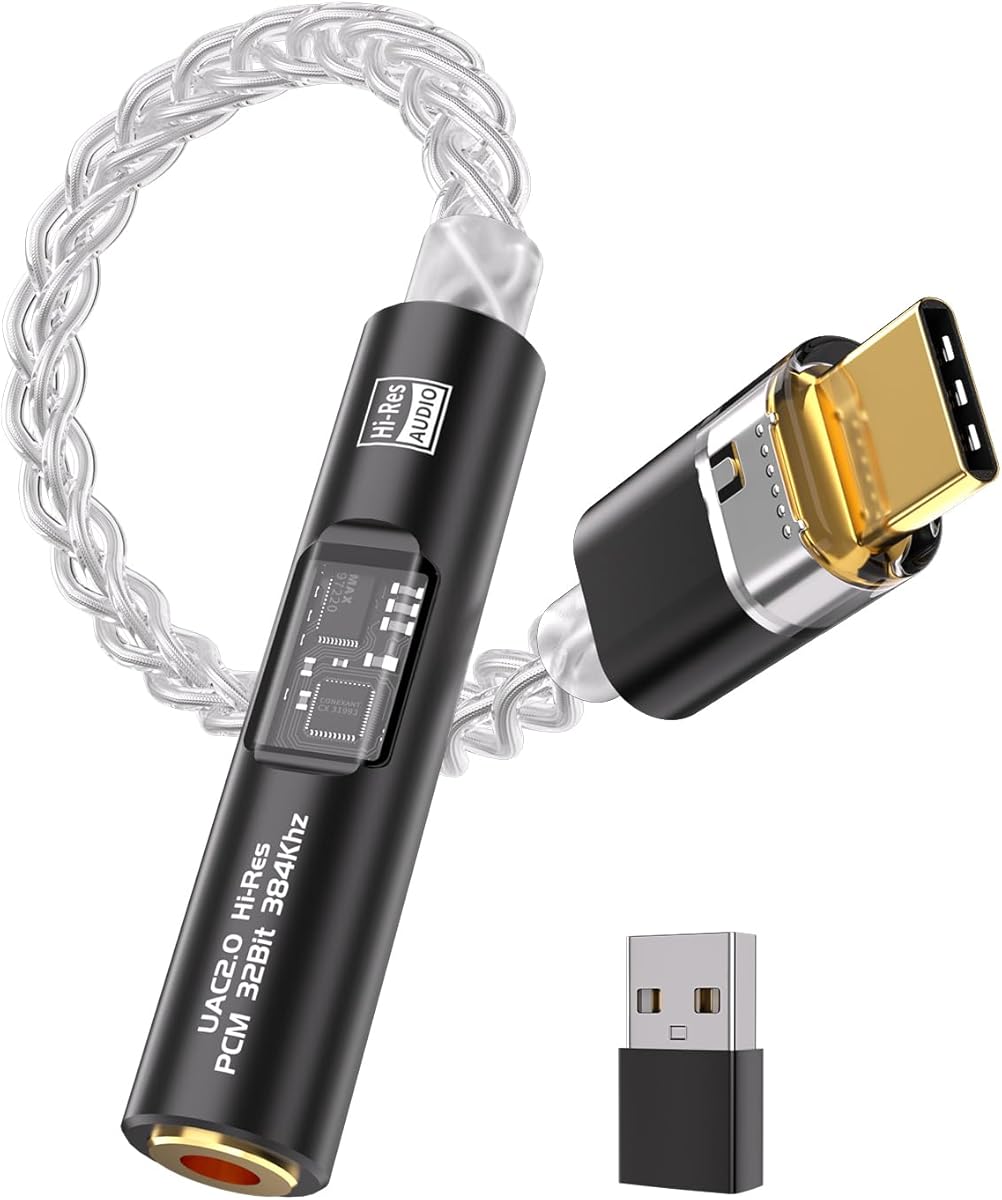


The BZINK USB-C to 3.5mm Audio Adapter combines CX31993 and MAX97220 chips in a compact adapter format, earning a 4.4 rating. Its strongest appeal is portability: the slim body can move easily between a phone, laptop, tablet, or USB-C-equipped car stereo without occupying a desk.
We may earn a commission when you buy through this link, at no additional cost to you.
The product information emphasizes high-resolution decoding up to 32-bit/384kHz and Hi-Res Gold Label certification. Its 8-strand, 4N single-crystal copper wire with silver plating is intended to preserve bass, midrange, and treble information, while the aluminum housing adds scratch and corrosion resistance.
Its limitations are equally clear. There is no balanced output, digital display, volume control, or room for advanced source and gain management. The included USB-A interface broadens compatibility, but this remains primarily a portable headphone adapter rather than a full desktop control center.
Choose it when portability matters more than expansive connectivity. It is a practical option for mobile listening, travel, office use, and simple digital-to-analog conversion. Buyers seeking a dedicated desktop DAC, adjustable gain, or balanced output should consider a larger Fosi, FiiO, or SMSL model instead.
The adapter's small footprint and dual-chip signal path make it useful when a full-size desktop unit would be inconvenient. Its stated 32-bit/384kHz support gives compatible sources a clear resolution path without requiring additional equipment.
USB-C connection covers modern phones, tablets, and computers, while the included USB-A adapter supports more source types. That versatility makes the adapter suitable for music, calls, livestreams, and content creation.
We may earn a commission when you buy through this link, at no additional cost to you.
The Fosi Audio K7 is a desktop DAC, headphone amplifier, and wireless hub with a 4.7 rating. It combines an AK4493S DAC, XMOS XU208 processor, and TPA6120 amplification in a compact aluminum enclosure, allowing it to serve music, gaming, and productivity setups.
We may earn a commission when you buy through this link, at no additional cost to you.
Its distinguishing strength is connection variety. USB-C, optical, coaxial, Bluetooth with aptX HD and Low Latency, and microphone input are supported, while outputs include 4.4mm balanced, 3.5mm single-ended, and RCA. The stated 2100mW output should suit many demanding headphones.
The K7 supports PCM 32-bit/384kHz and DSD256, which is impressive but not the highest specification in this group. Its display, dual knobs, and five shortcut buttons also make it more substantial than a simple converter, potentially overwhelming buyers who want only a minimal desktop box.
For most listeners building a flexible headphone system, the K7 is an excellent recommendation. Choose it for balanced output, strong amplification, console compatibility, and wireless streaming in one enclosure. It is less ideal for listeners whose priority is the absolute maximum PCM rate available in a desktop DAC.
The K7 can accept digital audio from computers, optical and coaxial sources, consoles, and Bluetooth devices. Its mix of RCA, 3.5mm, and balanced outputs reduces the need for separate desktop components when switching between headphones and speakers.
With output power listed at up to 2100mW and a dedicated 4.4mm balanced connection, the K7 is well suited to power-hungry headphones. Balanced output can also help users access compatible headphones that would not be practical on a basic adapter.
We may earn a commission when you buy through this link, at no additional cost to you.
The Fosi Audio Q6 is a compact desktop DAC with a 4.6 rating and a high-resolution AK4493S, XMOS XU316, and OPA1612 signal chain. It targets listeners who want a clean digital-to-analog stage for an existing amplifier, headphone amp, or powered speakers.
We may earn a commission when you buy through this link, at no additional cost to you.
Maximum PCM 32-bit/768kHz and DSD512 support put its format capabilities at the top of this roundup. Optical, coaxial, and USB-C inputs provide flexibility, while RCA and subwoofer outputs expand the possibilities for a home or desktop stereo system.
The important limitation is explicit: the Q6 cannot directly drive headphones or passive speakers. It also omits Bluetooth, which may disappoint buyers seeking wireless playback. For its intended role as a line-level converter, however, the stated 121dB signal-to-noise ratio and less than 0.00012% total harmonic distortion are impressive figures.
This is a strong recommendation for users who already own appropriate amplification or active speakers. It offers advanced format support in a small, tidy enclosure without pretending to be a headphone amplifier. Buyers wanting one box to power headphones directly should choose the K7 or ZH3.
The Q6's support for PCM 32-bit/768kHz and DSD512 makes it relevant to listeners with high-resolution libraries. Its job is to preserve and convert those signals before passing them to the next stage in the system.
Its small aluminum body is easy to position beside a streamer, computer, or television. Optical, coaxial, and USB-C inputs allow existing digital sources to share a clean analog output without replacing the rest of the setup.
We may earn a commission when you buy through this link, at no additional cost to you.
The Fosi Audio ZD3 is a fully balanced desktop DAC and preamp with a 4.6 rating. Built around the ES9039Q2M, it is designed for home stereo systems where clean balanced connections, flexible source switching, and integration with an existing amplifier matter.
We may earn a commission when you buy through this link, at no additional cost to you.
Bluetooth, USB, optical, coaxial, and HDMI ARC inputs make it particularly useful for consolidating a varied media system. XLR and RCA outputs cover conventional and balanced amplifier connections, while the OLED display, remote, preamp bypass, and 12V trigger interfaces improve daily operation.
Its chipset supports PCM 32-bit/768kHz and DSD512. Unlike a headphone-oriented model, it has no dedicated headphone output, and balanced versus RCA output levels may need careful matching with an amplifier. It therefore rewards buyers who already understand home-audio signal flow.
Choose the ZD3 when television, streaming, and traditional stereo sources need to share a high-quality preamp. It is less appropriate for direct headphone listening or users wanting a simple one-cable computer adapter. Its strongest feature is bringing HDMI ARC into a balanced DAC-preamp workflow.
Fully balanced XLR and RCA output options provide a more professional connection style than a typical compact converter. This makes the ZD3 relevant to listeners using an amplifier that benefits from balanced line-level signaling.
HDMI ARC, Bluetooth, USB, optical, and coaxial inputs allow many source types to share one control center. The remote and display simplify selection, while preamp bypass and trigger interfaces support more conventional home setups.
We may earn a commission when you buy through this link, at no additional cost to you.
The FiiO K13 R2R in black is a premium desktop DAC and headphone amplifier with a 4.6 rating. Its self-developed, fully differential 24-bit R2R converter uses 192 ultra-precise 0.1% thin-film resistors, distinguishing it from the delta-sigma designs used by many competitors.
We may earn a commission when you buy through this link, at no additional cost to you.
FiiO gives listeners a choice of NOS and OS modes. NOS retains the source sampling rate for a natural presentation, while OS upsamples to 384kHz. The K13 also supports PCM 32-bit/384kHz and DSD256, 2400mW headphone output, XLR and dual RCA line outputs, and both balanced and single-ended headphone connections.
Ten-band PEQ, Auto EQ, app control, a web interface, and shareable presets make the K13 especially useful for headphone enthusiasts. LDAC, AAC, and SBC over Bluetooth 5.4 add wireless flexibility. The breadth of controls can require setup time, and the maximum PCM rate is lower than some desktop alternatives.
This is an excellent recommendation for listeners who prioritize R2R character, customization, robust headphone power, and premium connectivity. It is less necessary for someone seeking only a simple converter or the highest advertised PCM rate. For a serious desktop system, the feature set is unusually complete.
The K13's four-channel fully differential R2R network is the centerpiece of its design. NOS mode avoids unnecessary upsampling, while OS mode provides a higher-rate alternative for listeners who prefer the resulting measurements and presentation.
Ten independently adjustable PEQ bands, Auto EQ tools, and preset sharing give the K13 more room to shape headphone response. The result is particularly relevant to owners of multiple headphones who want repeatable profiles rather than a single fixed output.
We may earn a commission when you buy through this link, at no additional cost to you.
The B3 Professional XLR Bluetooth 5.1 Audio Receiver has a 4.7 rating and focuses on bringing wireless audio into an existing sound system. It receives Bluetooth from phones, tablets, and computers, then outputs analog or digital audio to amplifiers, mixers, powered speakers, and other components.
We may earn a commission when you buy through this link, at no additional cost to you.
Its QCC5125 chipset supports LDAC, aptX HD, aptX Low Latency, aptX, SBC, and AAC. The ESS ES9018K2M handles conversion, while RCA, balanced XLR, optical, and coaxial outputs provide several routing choices. A removable RP-SMA antenna is listed for extended range.
The B3 is not a general-purpose DAC/amplifier. It cannot drive passive speakers, cannot transmit television or stereo audio to Bluetooth headphones, and does not accept optical input. It also has no built-in internet-streaming function, so apps still need to run on a paired source device.
Choose it for wireless integration with an established stereo, professional, hospitality, classroom, or commercial system. Its customization controls and silent pairing make it useful in shared spaces. For desktop headphone listening, a dedicated DAC/amplifier such as the K7 or K13 offers more direct headphone control.
Multiple output formats, including XLR and RCA, make the B3 useful where analog connectivity is standard. Its ability to operate the outputs simultaneously gives installers and listeners flexible routing options.
LDAC and aptX HD provide high-quality wireless transmission from compatible phones and computers. Low-latency aptX is also included for users who prioritize reduced delay in interactive applications.
We may earn a commission when you buy through this link, at no additional cost to you.
The SMSL SU-1 is a high-resolution desktop decoder built around the AK4493S and XMOS XU316. Its 4.2 rating reflects a more specialized proposition, particularly for users interested in MQA decoding, MQA-CD workflows, and high-resolution source material.
We may earn a commission when you buy through this link, at no additional cost to you.
The supplied information highlights MQA support over USB and the ability to receive optical or coaxial digital audio from an MQA-enabled CD player. Maximum PCM resolution is listed at 32-bit/768kHz, with DSD512 support and distortion below 0.00013%.
Compatibility is broad across Windows, macOS, Linux, Android, and iOS, although Windows and some Linux configurations require driver considerations. The product is presented primarily as a converter and decoder, so buyers needing headphone amplification, extensive controls, or balanced outputs should verify the full connection layout before choosing.
The SU-1 makes sense for MQA-focused listeners and owners of compatible CD-player digital outputs. It may be less appealing for buyers primarily seeking Bluetooth, gaming features, or an all-in-one headphone stage. Its value rests on focused decoding rather than system-wide convenience.
The SU-1 can decode MQA over USB and receive the digital output of an MQA-enabled CD player through optical or coaxial connections. This makes it relevant to listeners with a dedicated MQA source chain.
Support for PCM 32-bit/768kHz and DSD512 covers demanding digital files, while the AK4493S provides the central conversion function. Its compatibility with major desktop operating systems broadens the range of possible source computers.
We may earn a commission when you buy through this link, at no additional cost to you.
The SMSL D1 is a high-resolution desktop DAC with a 4.2 rating and a distinctive conversion chip: ROHM's BD34352EKV. It is aimed at listeners connecting digital sources to an existing stereo amplifier, powered speakers, or other line-level equipment.
We may earn a commission when you buy through this link, at no additional cost to you.
PCM 32-bit/768kHz and DSD512 are supported, along with USB, optical, and coaxial inputs. The listed 126dB signal-to-noise ratio and 0.00038% THD+N indicate a focus on clean conversion, while touch controls and an anodized CNC aluminum unibody chassis keep the enclosure refined and compact.
This is not a headphone amplifier, and the supplied details do not identify wireless connectivity. Windows requires a driver, while macOS and Linux can use the included USB-A-to-C cable directly for supported computer workflows. USB bus power and the built-in filtering system are also highlighted as practical considerations.
Choose the D1 for a dedicated digital source and a clean desktop-to-stereo connection. Its unconventional chipset may appeal to listeners interested in alternative DAC implementations. Those needing direct headphone output should look to the K7, K13, or ZH3 instead.
The BD34352EKV is the D1's defining technical feature. Its use, paired with careful tuning and precision circuit design, provides an alternative to the AKM and ESS chips found elsewhere in this roundup.
The CNC aluminum unibody enclosure and touch interface give the D1 a restrained, modern appearance. It can sit discreetly beside a computer or streamer while serving several digital sources.
We may earn a commission when you buy through this link, at no additional cost to you.
The FiiO K13 R2R in silver provides the same core feature set as the black version, including a fully differential 24-bit R2R DAC, 2400mW headphone output, ten-band PEQ, and balanced outputs. It carries the same 4.6 rating and is a distinct finish option within the K13 line.
We may earn a commission when you buy through this link, at no additional cost to you.
Its self-developed R2R network uses 192 ultra-precise 0.1% thin-film resistors with 30ppm temperature drift. Buyers can choose NOS and 384kHz OS modes, while PCM 32-bit/384kHz and DSD256 decoding are supported alongside XLR, dual RCA, 4.4mm, and 6.35mm outputs.
Because its technical features match the black model, the choice is primarily aesthetic and availability-driven. The silver finish may integrate differently with a desk or equipment rack, but it does not introduce a different converter, output power level, or EQ feature set.
Choose the silver version if it is the finish you prefer or if it is more readily available from your preferred retailer. It is equally suitable for discerning headphone listeners who want R2R conversion, strong amplification, wireless streaming, and detailed EQ control.
The silver K13 gives buyers the same high-performance platform in a different visual treatment. It is useful for matching a desktop setup where black equipment may feel less coordinated.
Ten-band PEQ, Auto EQ tools, app and web control, and multiple headphone outputs make this a complete desktop command center. The dual power supply and R2R architecture reinforce its premium positioning.
We may earn a commission when you buy through this link, at no additional cost to you.
The Fosi Audio ZH3 is an all-in-one DAC, preamp, and headphone amplifier with a 4.6 rating. Its fully balanced architecture, AKM4493SEQ converter, XMOS XU316 processor, and four OPA1612 amplifiers make it one of the most comprehensively equipped desktop units here.
We may earn a commission when you buy through this link, at no additional cost to you.
The ZH3 supports PCM 32-bit/768kHz and DSD512, with digital inputs through USB, optical, coaxial, RCA, and 12V trigger. Outputs include 4.4mm balanced, 6.35mm single-ended, RCA, and XLR, allowing it to serve headphones, powered speakers, and conventional amplifiers.
Its balanced headphone output is listed at 2570mW per channel into 32 ohms, while the single-ended output is listed at 640mW. A three-level gain switch supports headphones from 16 to 300 ohms. Bass and treble controls, six filter types, bypass mode, and swappable op-amps add further customization.
The main trade-offs are complexity and signal-matching care. XLR and RCA output levels differ significantly, and EQ only affects headphone output. Even so, the ZH3 is an excellent recommendation for an enthusiast who wants one box to cover high-resolution conversion, preamp duties, gaming, and serious headphone driving.
The ZH3 can accommodate many headphone types through selectable gain and both balanced and single-ended connections. That makes it easier to move between sensitive in-ears and demanding over-ear models while retaining control over output behavior.
Bass and treble EQ, multiple filter modes, and swappable op-amps allow meaningful experimentation. Since these adjustments apply only to headphone outputs, users should keep line-level signal paths in mind when comparing settings.
We may earn a commission when you buy through this link, at no additional cost to you.
The right audiophile DAC depends less on a single chipset name than on source compatibility, output requirements, headphone power, control features, and the rest of the audio chain. Review the following factors before deciding which model deserves a place in your system.
Begin by listing every digital source you expect to use. A computer-centric system may need USB-C, while a television or game console may require optical, coaxial, or HDMI ARC. The ZD3 stands out for HDMI ARC, the B3 supports Bluetooth and USB audio, and most desktop units rely on USB, optical, and coaxial connections. Confirm that the source and included cable format match, because USB-C describes a connector rather than the underlying audio protocol and may require a USB-A-to-C data cable or suitable adapter.
A DAC with only line-level RCA outputs cannot directly power conventional headphones, while a model with 3.5mm or 6.35mm output may include useful amplification. Balanced 4.4mm or XLR connections are worth considering for compatible equipment. Pay attention to stated output power, impedance support, and gain settings: the K7, K13, and ZH3 are better matches for demanding headphones than the Q6, which cannot drive headphones directly.
High-resolution labels are useful only when the rest of the chain can preserve their value. PCM 32-bit/768kHz and DSD512 appear on the Q6, ZD3, SU-1, D1, and ZH3, while the K7 and K13 support PCM 32-bit/384kHz. The B3's USB mode is limited to 16-bit/48kHz, although its Bluetooth codecs serve a different purpose. Consider file formats, playback software, operating-system driver requirements, and the source device rather than selecting solely on the largest advertised number.
Balanced output can reduce interference and offers more headroom, but it only has an advantage when every participating device supports the connection. RCA is more universal, while XLR and 4.4mm serve specialist systems. Output levels also need to match: the ZH3 notes that its XLR and RCA levels differ significantly, so an amplifier with adjustable input gain may be necessary. A converter designed for line-level equipment should not be judged as a headphone amplifier simply because it has an analog output.
Bluetooth can remove cables from a listening room, but codec support and behavior vary by source. LDAC is offered by the K13 and B3, while the K7 supports aptX HD and Low Latency and the B3 includes LDAC, aptX HD, aptX Low Latency, aptX, AAC, and SBC. Low-latency codecs can help with interactive gaming, although wireless compression does not recreate the same chain as a wired high-resolution connection. For critical listening, wired inputs remain the straightforward choice.
Built-in EQ can make a system easier to tailor to different headphones and room conditions. The K13 provides ten-band PEQ, Auto EQ, app and web control, plus preset sharing. The ZH3 offers bass and treble adjustments, six filter types, bypass, and swappable op-amps, although its EQ applies only to headphone outputs. The K7 favors large physical controls and a display. Decide whether deep calibration is worthwhile or whether simple volume, source selection, and gain adjustment better match your habits.
A stable power supply can help a converter maintain consistent performance, particularly in a densely wired desktop system. The K13 uses a dual power supply, while the K7, ZD3, Q6, SU-1, and D1 use aluminum construction to varying degrees. The B3 can operate from USB power, with its antenna and multi-output design intended for installed systems. Consider enclosure size, thermal behavior, display readability, and whether the unit should remain permanently on near an amplifier.
Some DACs also work as preamplifiers or control centers, adding value when several sources feed one amplifier. The ZD3 includes a remote, preamp bypass, trigger interfaces, and HDMI ARC. The ZH3 combines preamp duties with extensive headphone controls and console compatibility. The B3 is a receiver that can route Bluetooth or USB audio into an existing system but cannot transmit that audio onward as a headphone transmitter. These functions simplify setup, but they also create more opportunities for incorrect level matching.
Begin with the correct signal path. Connect the digital source to the DAC using the specified input, then send the analog output to an amplifier, powered speakers, or compatible headphones. Do not connect passive speakers directly to a line-level model such as the Q6, and do not assume a 3.5mm socket on every product provides the same type of headphone amplification. Review the product manual before changing gain, output-level, or preamp settings.
For computer use, install any required operating-system driver before judging performance or changing sample-rate settings. Select a rate the source and DAC both support, and allow the correct playback software to be selected. On Windows, the SU-1 and D1 are described as requiring drivers, whereas the D1 supports direct operation for compatible macOS and Linux setups. Wired connections generally offer the most direct path when file quality and latency are priorities.
Keep the DAC and connected equipment on a stable surface with ventilation, and avoid leaving cables under tension. Clean the enclosure with a dry or lightly damp soft cloth rather than spraying cleaner directly onto it. For the B3, install the removable antenna when extended range is needed and use the included feet to reduce vibration. Finally, save software EQ profiles and document input, output, gain, and filter settings so you can restore a known-good configuration after making changes.
It depends on your existing equipment and how the files are played. A DAC can improve conversion consistency, reduce unwanted noise, and provide access to outputs your source device lacks. It cannot restore detail absent from a lossy file, and a low-quality DAC can also make shortcomings more obvious. Match the converter to your amplifier, headphones, and source before assuming a specification alone will produce a major improvement.
A conventional DAC converts digital audio into analog line-level signals meant for an amplifier or powered speakers. A DAC headphone amplifier includes circuitry capable of driving headphones directly. Products such as the K7, K13, and ZH3 combine both functions, while the Q6 is designed primarily for line-level output. Always confirm the intended connection before purchase.
A higher supported rate can be useful when the source delivers files at that rate and the rest of the chain preserves the signal. It does not automatically mean the unit will sound better with ordinary material. Software resampling, source quality, system matching, and the amplifier or headphones often have a greater effect on the listening experience. Choose support for formats you genuinely use rather than for the largest headline number alone.
Balanced connections can provide lower interference, greater output headroom, and compatibility with certain high-end headphones and amplifiers. The benefit depends on using genuinely balanced equipment throughout the path and matching output levels correctly. A balanced link can also introduce problems if one side is misconfigured or if a device offers different RCA and XLR levels.
It can add lower-latency wired connectivity, high-quality headphone amplification, and useful volume control compared with a basic controller output. The K7 supports gaming-oriented sources, while the ZH3 includes UAC mode switching for compatibility with game consoles. Latency still depends on the source, display, game engine, software settings, and selected mode, so the exact result should be verified in the user's setup.
A receiver accepts Bluetooth audio from a phone, tablet, or computer and sends it to a wired system. A transmitter sends audio from a wired source to Bluetooth headphones or speakers. The B3 is strictly a receiver and cannot transmit television or stereo audio to Bluetooth headphones. It can also work as a limited USB DAC, with Bluetooth taking priority when both inputs are active.
It depends on the model. Some desktop units include their own power supply or can operate from an available power connection, while others are designed around a specific external supply. Check the package contents and manual because a missing adapter can prevent setup. For consistent operation, use the intended supply and a stable connection rather than an uncertain substitute.
Connect headphones directly only when the DAC has a headphone amplifier compatible with their impedance and sensitivity. Otherwise, use the DAC's line output into a suitable amplifier or powered speakers. The Q6 explicitly cannot drive headphones or passive speakers directly. Matching the output stage to the intended load avoids weak amplification, excessive output, or incompatibility.
The Fosi Audio K7 is the strongest general recommendation because it combines high-resolution conversion, substantial headphone power, balanced outputs, broad wired inputs, and useful Bluetooth codecs in one desktop enclosure. The FiiO K13 R2R stands out for premium R2R architecture, ten-band PEQ, and refined headphone integration, while the Fosi Audio Q6 delivers high-resolution conversion in a particularly compact and practical line-level design.
Specific needs should determine the alternative. The ZD3 is ideal for balanced home systems and HDMI ARC integration, the ZH3 suits enthusiasts who want extensive conversion, preamp, gaming, and headphone functions, and the B3 brings flexible wireless routing into an installed system. The SU-1 favors MQA workflows, the D1 offers a distinctive ROHM chipset, and the BZINK adapter remains the most travel-friendly option.
Before purchasing, verify the current listing, included accessories, driver requirements, and compatibility with your existing equipment. Specifications, promotions, availability, and prices can change over time, so the current product page is the best final source for purchasing details.