
Zoom H1 XLR 2-Channel Recorder
4.5Editor score
Two XLR/TRS inputs
32-bit float recording
OLED waveform monitoring
SDXC storage support
Discover the best audio field recorders for film, compared for inputs, recording quality, timecode, portability, power, and features for filmmakers.
Audio field recorders for film provide the control, reliability, and recording flexibility needed to capture production sound beyond the camera's built-in microphone. The right model can preserve quiet dialogue, handle sudden environmental peaks, support multiple microphones, and simplify synchronization during post-production.
This guide compares ten recorders suited to documentary, narrative, wedding, interview, and independent film work. We evaluated the supplied specifications for microphone inputs, floating-point recording, timecode, storage, power options, monitoring, portability, and standalone production features, from compact personal recorders to professional multi-input systems.
Each recommendation identifies the strongest use for its model, along with practical trade-offs, so you can choose according to crew size, recording complexity, and budget. Product ratings and availability can change, and current prices should be checked before purchasing to confirm the best value for your particular setup.
4.5Editor score

4.7Editor score
4.6Editor score
The comparison below shows how the ten recommended field recorders differ in input count, recording format, timecode support, storage, and workflow flexibility, making it easier to match a recorder to a specific film production.



The Zoom F3 is a compact professional field recorder built for filmmakers who want more control than a camera microphone provides without carrying a full multi-input bag. Its 4.6 rating reflects a strong balance of recording performance and portability. The standout attraction is 32-bit float capture, which lets quiet dialogue and sudden peaks coexist without requiring constant gain changes.
We may earn a commission when you buy through this link, at no additional cost to you.
Two locking XLR inputs make the recorder suitable for a lavalier on a subject and a boom or environmental microphone on a second channel. Locking connections are especially useful when the unit is mounted, operated away from a crew member, or used in a larger production rig. Ultra-low-noise preamps also support clean results in controlled rooms and on location, while flexible power and USB options support both standalone and computer-based workflows.
The main limitation is input count. Two channels are ample for interviews, small documentary crews, and compact narrative scenes, but they cannot accommodate a lav, boom, wireless receiver, stereo ambience pair, and a mix feed at the same time. The supplied specifications also do not identify timecode connectivity, so crews that depend on frame-accurate synchronization should confirm their existing camera workflow before committing.
Buy the F3 when you value confidence, compactness, and protected recording over extensive I/O. It is a particularly strong fit for solo filmmakers, second-unit recordists, and small crews that want a dedicated production recorder without a large multi-channel body. For most such users, it offers the right balance of professional features and field-ready simplicity.
The 32-bit float format gives recordists valuable headroom when a subject moves from a whisper to a raised voice or a location produces an abrupt peak. This reduces the likelihood that a once-in-a-take recording will be ruined by clipping or an aggressive level adjustment.
The dual locking XLR inputs are enough for common interview or documentary pairings, and their secure connections suit mounted or unattended setups. It is a focused two-channel tool rather than a full production mixing console.
We may earn a commission when you buy through this link, at no additional cost to you.
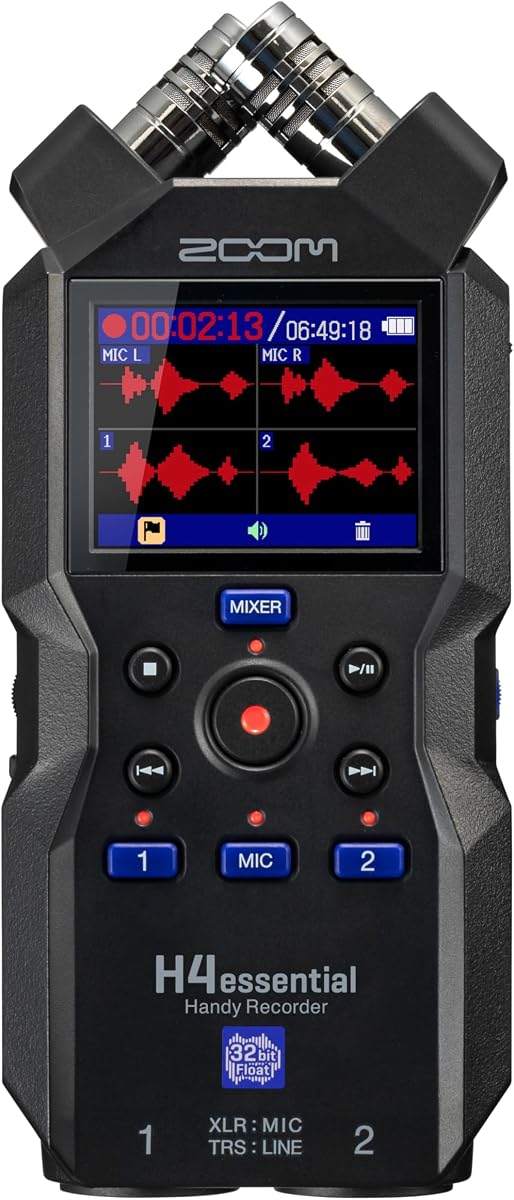
The Zoom H4 Essential is a versatile four-track recorder aimed at creators who move between video audio, interviews, music, podcasts, and live sound. Its 4.4 rating signals a well-rounded, approachable option. The combination of built-in stereo microphones, two XLR/TRS inputs, and four-track capture gives it more flexibility than a basic stereo-only recorder.
We may earn a commission when you buy through this link, at no additional cost to you.
You can use the built-in microphones for ambience, room tone, or a quick reference recording while reserving external inputs for a lavalier and another microphone. Its ability to connect to a mixer or soundboard adds another useful production path. USB-C recording and streaming, together with direct SD card backup, makes the device convenient for transferring files while preserving a local copy.
The H4 Essential is not the right choice for every professional location workflow. It does not list timecode input or output, and two physical microphone inputs will limit larger multi-source productions. Users accustomed to professional field recorders may also find four tracks less than they need for redundant channels, multiple wireless receivers, and a mix bus.
Choose this model for independent filmmakers, small interview teams, and creators who value an all-in-one recorder with external-input flexibility. It is particularly helpful when a director needs room tone or environmental sound while also recording cleaner production dialogue. For a compact four-track workflow, it provides one of the most adaptable configurations in this list.
The built-in stereo microphones make it possible to record location ambience or a natural sound bed while external inputs handle a lavalier and a second source. That makes the H4 Essential useful for building a richer sound bed than a two-input dialogue-only setup.
USB-C connection supports recording or streaming to a phone, tablet, or computer, while SD card recording provides a separate on-device record. This dual workflow is helpful when a location demands both rapid transfer and media redundancy.
We may earn a commission when you buy through this link, at no additional cost to you.
The Zoom F6 sits at the center of this guide because it combines a generous six-input count, 32-bit float recording, and timecode connectivity in a portable professional package. Its 4.7 rating is the highest among the listed products. The recorder is aimed at filmmakers, broadcasters, and recordists who need serious I/O without moving to the largest multi-channel systems.
We may earn a commission when you buy through this link, at no additional cost to you.
Six XLR inputs can accommodate several microphones at once, while the ability to record up to 14 tracks provides room for mixes, duplicated channels, or multiple outputs. Dual AD converters and 32-bit float capture help manage the broad dynamic range of film dialogue and environmental sound. Timecode I/O is the decisive feature for crews recording picture separately, and headphone monitoring plus line input support controlled review and monitoring.
Its capabilities come with a learning curve. A six-input device demands a clearer plan for levels, channel assignment, and signal flow than a two-channel recorder. The body is also less discreet than the compact options, and professional results still depend on suitable microphones, cables, storage, and disciplined gain staging. Despite those realities, each complexity delivers meaningful production capability.
The F6 is the strongest all-around recommendation for a small professional film crew, documentary team, or demanding independent filmmaker. It offers the timecode, channel count, and level protection needed for serious location work while remaining portable. Choose it when one device must handle several sound sources, reliable synchronization, and post-production flexibility.
Timecode input and output are especially useful when video and audio are recorded on separate devices. The connection allows a production to maintain a shared timing reference, reducing synchronization work during editing.
Six XLR inputs and as many as 14 recorded tracks cover common small-crew configurations while keeping the body portable. This provides room for a lav, boom, wireless feeds, stereo ambience, and safety channels when needed.
We may earn a commission when you buy through this link, at no additional cost to you.
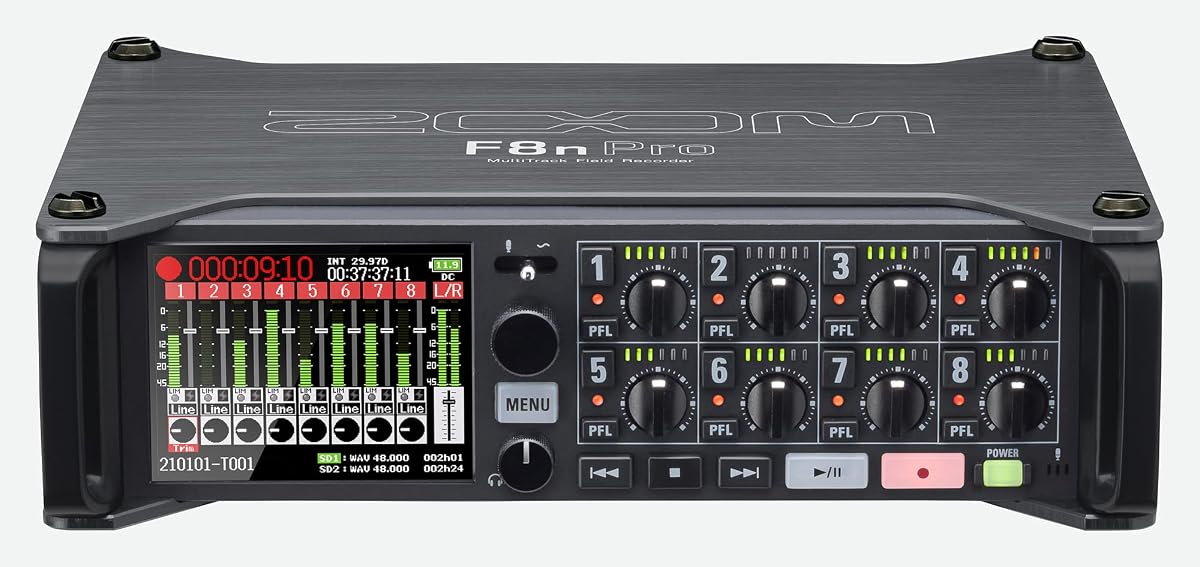
The Zoom F8n Pro is the premium choice for productions that need a large number of sources, redundant storage, and exact synchronization. Its 4.6 rating is backed by a professional feature set built around eight inputs, ten tracks, 32-bit float recording, and dual AD converters. It is best suited to experienced recordists and crews whose channel count and reliability needs exceed a compact recorder's limits.
We may earn a commission when you buy through this link, at no additional cost to you.
The recorder's high-quality preamps offer up to 75 dB of gain and a stated -127 dBu equivalent input noise, providing useful sensitivity for quiet sources and controlled gain for louder environments. Its TCXO-based timecode accuracy of 0.2 ppm is a particularly valuable specification for picture workflows requiring precise alignment. Dual SD card slots support redundant recording, while three outputs allow connections to camera feeds, headphones, and external devices.
As a USB audio interface, it can operate as an 8-in/4-out device at 32-bit float and 96 kHz while continuing to record to SD cards. That flexibility is useful but may exceed the needs of a small shoot. The physical footprint, menu system, and input density also make it less convenient for solo creators who mainly need a discreet lav or stereo ambience capture.
Buy the F8n Pro for a larger narrative unit, documentary crew, commercial production, or location team that values redundant capture and high timing precision. It is a premium tool rather than an entry point, but its combination of capacity, synchronization accuracy, and workflow options makes it a serious all-in-one production recorder.
Dual SD card slots allow recording to two cards, reducing the risk associated with a failed or removed card. The protection is particularly valuable during weddings, live events, narrative scenes, and interviews that cannot be repeated easily.
A 0.2 ppm timecode clock provides exceptionally tight timing accuracy. In a film workflow, that precision can simplify alignment between camera audio, separate field recordings, and post-production synchronization.
We may earn a commission when you buy through this link, at no additional cost to you.
The Zoom H1 XLR is the best budget-oriented choice in this guide for filmmakers who need genuine XLR/TRS connectivity and 32-bit float recording in a small package. Its 4.5 rating indicates a capable recorder without the feature density of a professional multi-input body. Two combo inputs make it suitable for a lavalier, boom microphone, instrument, or another line-level source.
We may earn a commission when you buy through this link, at no additional cost to you.
Recording in 32-bit float at 96 kHz helps preserve detail and offers protection from accidental clipping. The OLED waveform display gives operators an immediate view of levels, which is particularly valuable when a recorder is mounted close to a subject and cannot be watched constantly. A 3.5 mm input and headphone output add further monitoring and connection flexibility.
Its limitations are clear: two inputs are not enough for a full multi-microphone crew, and the supplied feature list does not include timecode. Large SDXC support extends recording capacity, but storage and microphones are separate considerations from the recorder itself. For users who need frame-accurate sync across separate devices, the F6 or F8n Pro may be a more appropriate investment.
Choose the H1 XLR for independent filmmakers, student productions, interviews, and small crews that want dependable level monitoring and protected recording in a straightforward package. It is particularly useful as a dedicated dialogue or sound-effects recorder. The combination of two physical inputs, float capture, and waveform visibility makes it unusually capable for the category.
The OLED waveform display helps recordists judge signal activity without repeatedly opening menus. It is a useful safeguard when levels change quickly and manual intervention is inconvenient.
SDXC compatibility up to 1TB means the recorder can hold substantial amounts of high-quality audio. Capacity is especially helpful for documentaries, interviews, and multi-day shoots that generate many files.
We may earn a commission when you buy through this link, at no additional cost to you.
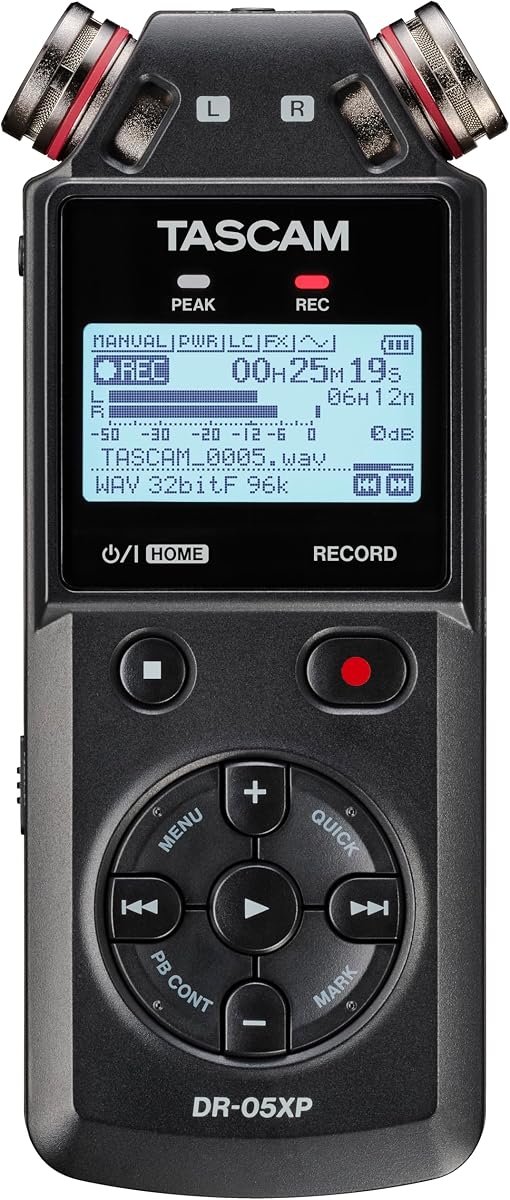
The TASCAM DR-05XP is a compact stereo recorder for filmmakers who primarily need ambience, sound effects, interviews in close, or scratch audio rather than a large multi-microphone rig. Its 4.2 rating reflects a straightforward and portable approach. It supports 32-bit float, 24-bit, and 16-bit recording at several sample rates, including 96 kHz, 48 kHz, and 44.1 kHz.
We may earn a commission when you buy through this link, at no additional cost to you.
The built-in omnidirectional condenser microphones can handle loud environments and sources up to 125 dB SPL, giving the recorder a useful role for ambience, Foley, location sound, and reference tracks. Its 2-in/2-out USB-C audio interface function also lets it connect to a computer for direct recording, expanding its role beyond standalone capture.
The important limitation is that it lacks external XLR inputs. That means it cannot accept a lavalier, boom microphone, or wireless receiver in the same way as most other film-oriented models in this guide. It also has no listed timecode function, so independent picture synchronization would depend on a different method. The batteries and SD card are not included, adding essentials that must be considered separately.
This recorder fits independent documentary work, sound-design collection, travel filming, and creators who want a low-friction way to capture stereo location sound. It is also a companion tool for a camera-based filmmaker who needs room tone or effects. For those purposes, its portability and flexible recording formats outweigh the absence of professional microphone inputs.
The built-in stereo microphones make the DR-05XP well suited to ambience, environmental beds, and sound effects. These recordings can give a film greater depth, especially when a production later mixes dialogue with location texture.
USB-C interface mode lets the recorder capture directly into a computer, while standalone operation supports quicker location work. That flexibility is useful for creators who move between field sessions and a post-production desk.
We may earn a commission when you buy through this link, at no additional cost to you.
The Zoom H5 earned a 4.7 rating through a proven combination of approachable operation, four-track recording, and interchangeable input capsules. For filmmakers, its X/Y configuration and two XLR/TRS combo inputs make it useful for capturing stereo ambience, dialogue, and a second microphone source. The system can expand beyond the included capsule as a production's needs change.
We may earn a commission when you buy through this link, at no additional cost to you.
Four-track simultaneous recording provides useful flexibility for combining a stereo pair with two external inputs. Each XLR/TRS connection supports phantom power and a -20 dB pad, helping the recorder handle professional microphones and strong line sources. Its multichannel and stereo USB audio interface modes, including Loop Back for PC, Mac, or iPad, extend its usefulness for voiceover and post-production tasks.
The H5 is an established platform, and some specifications are less future-facing than newer float recorders. It records to SD or SDHC cards up to 32GB, which is a meaningful storage constraint for long productions. Its supplied feature list does not mention 32-bit float or timecode, so modern requirements for extreme level protection or frame-accurate synchronization are not emphasized.
Choose the H5 for a filmmaker who values a mature, modular recorder and may also use it for music, podcasts, or voiceover. It is a capable four-track tool for small productions, especially when the included X/Y capsule offers a quick way to capture location sound. Users needing large media capacity should verify their storage plan before the shoot.
Interchangeable input capsules let the recorder change with the job, much as a camera system changes lenses. The included detachable X/Y capsule provides a protected stereo option for ambience and environmental sound.
Two physical inputs and four simultaneous tracks make the H5 more versatile than a basic stereo recorder without reaching the complexity of a six- or eight-input professional system. It is well matched to compact crews.
We may earn a commission when you buy through this link, at no additional cost to you.
The TASCAM DR-10L Pro takes a different approach from conventional mixers and multi-input recorders. It is a compact personal recorder bundled with a matched TM-10L clip-on lavalier, designed to capture clean dialogue directly on a subject. Its 4.4 rating makes it an interesting option for independent films, interviews, events, and content production where a wireless lav system might otherwise be considered.
We may earn a commission when you buy through this link, at no additional cost to you.
The included microphone is matched to the recorder for clear, lifelike personal audio, while 32-bit float capture protects recordings across a wide range of levels. Firmware version 2.0 adds LTC Jam Sync for timecode synchronization, making the recorder more relevant to multi-device film workflows. Support for high-capacity microSDXC media is also useful for extended recording sessions.
Because the product is dedicated to a single personal audio source, it cannot replace a multi-channel field recorder. It also requires care with synchronization accessories. The supplied data specifies compatibility with the Atomos Wireless Timecode AK-BT1 and states that the AK-BT2 is not compatible. The CONNECT App can control up to five simultaneous recordings, but that feature is most valuable to a coordinated crew rather than a lone operator.
Buy the DR-10L Pro when a subject needs a reliable lav, multiple performers or interview subjects need separate tracks, and the team wants simple personal recorders rather than a central mixer. It is particularly effective for backup dialogue, wedding coverage, and documentary interviews. For multi-source sound or camera-feed monitoring, select a conventional field recorder instead.
The matched TM-10L lavalier, windscreen, and recorder are supplied as a coordinated package. That reduces the need to match a separate microphone to the recorder and makes deployment at the subject straightforward.
LTC Jam Sync support and control of up to five simultaneous recordings help larger teams keep separate units coordinated. The required AK-BT1 compatibility should be checked carefully when planning accessories.
We may earn a commission when you buy through this link, at no additional cost to you.
The Zoom H1 Essential is a straightforward stereo recorder for creators who want better sound for videos, tutorials, interviews, voiceovers, and behind-the-scenes material without carrying a complex production rig. Its 4.0 rating reflects a simple approach with broad creative appeal. The built-in microphones capture stereo audio for social clips, short films, podcasts, and environmental documentation.
We may earn a commission when you buy through this link, at no additional cost to you.
The device is designed to be ready quickly, which can be valuable during a short production window or when a sound opportunity appears without warning. It can also record ambience, nature, room tone, sound effects, and travel audio, giving filmmakers a simple tool for building atmosphere. USB-C connectivity expands its use as a microphone for livestreams, remote meetings, video calls, voiceovers, podcasts, and desktop or mobile recording.
Its main constraint is that it does not accept professional XLR microphones. Dialogue recorded with a separate boom, radio microphone, or high-end lavalier cannot be connected directly. There is also no listed timecode support, so it is better suited to content created on one timeline than to a camera-centered, frame-synchronized production.
Choose the H1 Essential for social video, educational content, personal projects, travel films, and filmmakers who need quick stereo ambience. It can work as a secondary recorder beside a more capable production system. Its value lies in convenience rather than channel control, making it ideal for creators who want polished results without complex setup.
The H1 Essential is aimed squarely at creators who want a clearer, more polished recording than a camera or phone microphone often provides. Its stereo presentation can make narration, room sound, and environmental recordings more engaging.
USB-C use as a microphone makes the recorder convenient for livestreams, calls, tutorials, and voiceovers. It can function as a dedicated capture tool without requiring a separate interface.
We may earn a commission when you buy through this link, at no additional cost to you.
The Zoom F2 is a tiny, purpose-built lavalier recorder for filmmakers and content creators who want a reliable personal audio track with minimal handling. Its 4.0 rating reflects a simple but well-focused feature set. The included LMF-2 omnidirectional lavalier has a screw-lock connector, windscreen, and lapel clip, allowing it to be placed discreetly on a subject.
We may earn a commission when you buy through this link, at no additional cost to you.
The recorder captures at 44.1 kHz or 48 kHz using 32-bit float technology and does not require gain adjustments for different volume levels. That makes operation simple for a wearer who cannot monitor the device. It supports microSD, microSDHC, and microSDXC storage up to 512GB, which is useful for long-form shoots and extended field sessions.
This is a single-purpose tool, not a central production recorder. It cannot accept multiple microphones, create a multichannel mix, or provide the extensive monitoring and routing controls of larger devices. The stated internal clock accuracy of +/-0.5 ppm is useful for sync, but the supplied specifications do not list dedicated timecode input or output, so a complete camera synchronization workflow may require another approach.
Buy the F2 for a director recording their own interview, a videographer wanting a backup lav track, a wedding team, or a journalist who values a tiny wearable recorder. Its long stated battery life and included microphone make it especially convenient for all-day personal capture. It works best as a dedicated talent track rather than the sole recorder for a film crew.
The 32-bit float format captures the signal without requiring the wearer to monitor or adjust gain. This is valuable on a subject who is moving, speaking at different volumes, or unable to operate controls during a take.
The compact body, included lavalier, and stated 15-hour operation on two AAA batteries support extended, low-intrusion use. The REC Hold switch also helps prevent accidental stops during important takes.
We may earn a commission when you buy through this link, at no additional cost to you.
Choosing a film field recorder means balancing channel count, recording reliability, synchronization, monitoring, storage, power, and physical handling. The right choice depends less on maximum headline features than on the number of sound sources your production actually needs and the workflow your editor will use afterward.
Start with the number and type of sources you expect to record. Two XLR or XLR/TRS inputs are enough for a focused interview, dialogue, and isolated sound-effect session, while four tracks offer room for stereo ambience alongside dialogue. Six or more inputs suit crews combining a lavalier, boom, wireless receivers, and stereo sound beds. Combo connectors can simplify a mixed microphone and line-level rig, but dedicated models such as the Zoom F2 and TASCAM DR-10L Pro focus on one personal channel rather than a mixer-style setup.
Choose an input count that matches the production rather than the largest available. Extra unused channels increase setup complexity, consume storage, and can make monitoring harder to understand.
A 32-bit float recorder offers a major safety advantage for film because it can preserve quiet speech and sudden loud peaks with less risk of digital clipping. This is especially useful for documentary subjects, uncontrolled locations, and productions where a take cannot be repeated. It does not replace good microphone choice, placement, or gain discipline, but it gives the recordist more recovery options when levels change unexpectedly.
Models with float recording include the Zoom F3, F6, F8n Pro, H1 XLR, TASCAM DR-05XP and DR-10L Pro, and Zoom F2. If unpredictable levels are central to your work, this feature deserves priority.
If picture and sound are captured on separate devices, timecode can make editing considerably easier. The Zoom F6 includes timecode input and output, while the F8n Pro adds a specified 0.2 ppm clock accuracy. The TASCAM DR-10L Pro supports LTC Jam Sync and the Atomos Wireless Timecode AK-BT1, with the AK-BT2 expressly not compatible. A device with a precision internal clock, such as the Zoom F2, may support a different synchronization approach, but dedicated timecode connections should be verified before purchasing.
If your editor requires frame-accurate timecode across several devices, confirm connector type, supported frame rates, clock source, and required accessories before the shoot.
Match media support to the expected session length and file format. Higher-resolution or multichannel recordings consume more space, while 32-bit float files can be larger than conventional fixed-point captures. The Zoom H1 XLR supports SDXC up to 1TB, the F8n Pro uses dual SD slots, the DR-10L Pro supports high-capacity microSDXC, and the F2 accepts media up to 512GB. By contrast, the Zoom H5 is specified for SD and SDHC cards up to 32GB, which demands more frequent offloading or card changes.
For important takes, redundancy is more important than maximum capacity. Dual-card recording, regular backups, and a disciplined media-management plan protect a shoot more effectively than an unused large card.
Reliable monitoring helps a recordist judge gain, noise, interference, and headphone mix before an important scene ends. Headphone outputs are standard across the recommended models, but the H1 XLR goes further with an OLED waveform display, while larger Zoom models provide dedicated monitoring and line-input options. Built-in microphones can be useful for checking ambience, but they should not be confused with a production microphone input.
Choose a model whose screen and controls you can read quickly in the field. Clear metering matters even with float recording because microphones, placement, and ambient noise still need attention.
A recorder that cannot last through a shooting day can interrupt a production regardless of its audio quality. The Zoom F2 is specified for up to 15 hours on two AAA batteries, while the TASCAM DR-05XP offers up to 17.5 hours with two AA alkaline batteries. The DR-05XP requires batteries and an SD card separately, while the F6 and F3 support flexible power options suited to longer or more demanding schedules. For crew work, consider whether spare batteries, USB power, or a swappable system best matches the production.
Balance battery life with size. The smallest wearable recorders are discreet, while multi-input professional bodies are easier to operate and more capable when several sources must be monitored.
The best recorder is one a sound recordist can place safely and operate under pressure. The F2 and DR-10L Pro are designed to wear or place with a subject, the H1 Essential and DR-05XP prioritize portable stereo capture, and the F6, F8n Pro, H5, and H4 Essential are better suited to a bag-mounted production role. Locking XLR connectors on the F3 add security for mounted or unattended setups, while shock-mounted capsules help reduce handling noise on stereo systems.
Choose the form factor that matches the recording role. A wearable personal recorder and a centrally managed field recorder solve very different production problems.
Many modern recorders can also function as USB audio interfaces, reducing the need to move files manually before a backup. The F6 works as a standalone recorder or USB interface, the F8n Pro can record to SD while operating as an 8-in/4-out interface, and the H5 supports multichannel and stereo computer modes. The H4 Essential, H1 Essential, and DR-05XP also offer USB-C workflows for recording, streaming, calls, or direct computer capture.
Decide whether the recorder will spend most of its time in the field or move regularly between a camera bag and editing desk. A hybrid workflow should be tested before production rather than assumed to be seamless.
Before a shoot, format the memory card in the recorder, confirm the intended sampling rate and file format, install fresh batteries, and perform a short test recording. Check input levels, headphone monitoring, recording status, remaining capacity, and timecode synchronization. A brief pre-production test prevents avoidable problems that may not become obvious until playback.
On location, place microphones according to the scene rather than relying on the recorder to correct a poor source. Keep cables and connectors strain-free, protect the device from impact and moisture, use windscreen or wind protection outdoors, and avoid leaving it in direct heat. Use the REC Hold function when the risk of an accidental stop is high, but continue to monitor storage and battery status.
After filming, save each file to two separate locations before formatting any media. Preserve the original filenames, take notes linking recordings to scenes, and avoid renaming files in ways that break the log. Clean the body gently, remove batteries during long storage, and keep the recording heads and ports dry. Periodically test the setup with a full-length recording and backup routine.
The best choice depends on the number of microphones and synchronization requirements. The Zoom H1 XLR is a capable budget option for two-channel work, while the F6 offers six inputs, float recording, and timecode for more demanding productions. Choose based on your actual channel count rather than on features you will not use.
It is highly useful when levels can change suddenly or quiet dialogue is mixed with loud environmental sound. The extra headroom reduces the consequences of clipping and can make gain adjustment less delicate during production. It does not prevent poor placement, wind noise, hum, or an unsuitable microphone, so good recording technique remains essential.
Timecode is valuable whenever picture and production sound are recorded on separate devices and you want dependable alignment during editing. A recorder with a precision clock can support synchronization in some workflows, while dedicated timecode I/O is more appropriate for multi-camera or multi-recorder productions. Confirm the exact method before the shoot.
Two inputs are generally sufficient for a focused interview or a dialogue-plus-ambience setup. Four tracks or more help when recording stereo sound effects alongside dialogue, while six to eight inputs suit crews using booms, wireless receivers, and multiple sound sources. Extra channels also increase setup and monitoring demands.
A wearable recorder is excellent for a dedicated dialogue track, backup audio, interviews, and event coverage, but it does not replace a multi-input mixer for a full crew. Many productions use wearable recorders alongside a central field recorder so each subject has a close, isolated source while the sound mixer captures the wider environment.
Built-in microphones are useful for ambience, room tone, sound effects, quick reference tracks, and simple stereo content. Professional film dialogue usually benefits from an external lavalier, boom, or shotgun microphone. A recorder with both built-in microphones and external inputs offers the broadest range of uses.
Redundant recording is valuable whenever a take cannot be repeated, such as a wedding, live performance, costly commercial shoot, or unrepeatable documentary scene. The Zoom F8n Pro provides dual SD slots for this purpose. If choosing another model, maintain a disciplined backup routine with separate cards or storage devices.
Required capacity depends on the format, channel count, sampling rate, and session length. Float and multichannel files can consume substantial space, so large-capacity media and frequent backups are valuable. Check the recorder's supported card type and maximum capacity, and avoid relying on a single card for irreplaceable production audio.
The Zoom F6 is the strongest all-around choice for professional film work because it combines six inputs, up to 14 tracks, 32-bit float recording, and timecode in a portable form. The F8n Pro is the premium option for larger crews that need eight inputs, redundant SD recording, and high timing precision. For a smaller budget, the Zoom H1 XLR provides XLR/TRS connections, float capture, and waveform monitoring in an approachable package.
Prioritize the features your production cannot work without: protected recording for unpredictable levels, enough inputs for real sound sources, timecode when picture is separate, reliable monitoring, and storage that supports redundancy. A simpler wearable or stereo recorder may be perfect for a small or single-person project, but a central multi-input model is the safer choice when several microphones must be managed together.
Ratings, bundle contents, accessories, and prices can change, so confirm the current specifications and product availability before purchasing. Check the microphone inputs, synchronization method, media requirements, power plan, and included accessories against your actual shooting setup to choose the most dependable audio field recorder for film.