Explore the best AI Desk Fan options in this expert guide comparing head tracking, airflow, noise, controls, portability, battery life, smart features, and
As an Amazon Associate we earn from qualifying purchases. We may earn a commission when you buy through links on this page, at no additional cost to you.As an Amazon Associate we earn from qualifying purchases.Purchases through our links may earn us a commission, at no extra cost to you.
An AI desk fan combines personal cooling with automated or intelligent control, making it especially useful for offices, bedrooms, studies, and compact living spaces. The most appealing models can follow a user, provide fine-grained speed adjustment, operate quietly, and integrate with a broader smart-home setup. Important differences include tracking reliability, airflow reach, noise levels, controls, and battery portability.
This guide compares ten desk fans with AI, smart, automatic-tracking, or connected-control features. The evaluation focuses on the specifications and functions listed for each product, including motor type, oscillation, airflow distance, sound levels, battery capacity, charging options, app support, and voice-platform compatibility. It also considers how each design fits different rooms and routines rather than treating every fan as a direct substitute.
Each pick below reveals which product stands out, what compromises accompany its strongest features, and who may benefit most from its design. Rankings reflect the supplied product information and customer ratings, while two models without a listed rating are presented without a numerical score. Product availability, features, and prices can change, so readers should confirm current details before purchasing.
Top 3 Picks for Best AI Desk Fan
Best Budget
Honeywell TurboForce Air Circulator, Small Tabletop Fan, Quiet Personal Fan for Home or Office, 3 Speeds, 90 Degree Pivoting Head, Black, HT900
SwitchBot Smart Desk Fan for Bedroom, 3600mAh Rechargeable, Corded & Cordless Air Circulator, 90° Oscillation, 22dB Quiet, 9 Speeds, App & Remote Control, Works with Alexa, Google Home, Apple Home
This side-by-side comparison highlights the strongest differences among the ten featured fans, including tracking behavior, sound levels, airflow reach, oscillation, battery capacity, controls, and smart-home compatibility.
The Desk Fan with AI Tracking Head Movement Follow 200 Speeds Digital Display is a feature-rich personal fan with a 3.7 customer rating. Its defining capability is automatic head tracking within a stated range of 20 centimeters to 2 meters, supported by 150-degree horizontal movement. That tracking behavior distinguishes it from conventional oscillating fans and is particularly relevant to users who move around while working, studying, reading, or resting.
Pros
Detailed speed adjustment
Useful tracking distance
Long cordless runtime
Compact and lightweight
Cons
Mixed customer rating
Tracking works best in daylight
We may earn a commission when you buy through this link, at no additional cost to you.
The 1-to-200 speed range offers much finer control than the three settings on many standard desk fans. A digital display presents the current speed and battery level, making it easier to make deliberate adjustments. The built-in 5000mAh battery is among the larger capacities in this list, and the stated charging time of about two to three hours supports approximately six to eight hours of cordless use. USB-C operation adds flexibility with laptops, power banks, and car chargers.
The main drawback is the 3.7 rating, which is the lowest numerical score among the rated products featured here. The listing also states that tracking works best in daylight, potentially reducing reliability in dim bedrooms or evening workspaces. Its listed dimensions of 5.9 by 8 by 4.4 inches and weight of 1.32 pounds prioritize portability over the larger footprint of an air circulator. Ambient lighting adds atmosphere but does not strengthen the underlying cooling performance.
This is a strong choice for someone who specifically wants head-following airflow, extensive speed control, and cordless flexibility in a compact body. It is less persuasive for buyers who place the highest priority on customer ratings, low minimum sound specifications, or whole-room circulation. Confirm that automatic tracking suits the intended lighting conditions and desk layout before choosing it over the higher-rated smart alternatives.
Automatic Tracking for Moving Users
The tracking system is designed to redirect airflow as the user changes position within the stated detection range. It may be especially useful at a work desk where posture changes, leaning, or shifting away from a fixed monitor can leave a stationary fan poorly aimed.
Fine-Grained Cooling and Display
Two hundred speed settings and a numeric display offer precise airflow control. The display also reports battery status, reducing uncertainty when the fan is being used away from a wall outlet.
The ciciglow AI Smart Desk Fan with Head Tracking, 3000mAh combines automatic direction control with a compact footprint and ambient lighting. No numerical customer rating is supplied for this model, so its evaluation depends more heavily on the listed functions than on direct rating evidence. Like several other tracking designs in this guide, it follows head movement from approximately 20 centimeters to 2 meters with 150-degree horizontal tracking.
Pros
Automatic head movement tracking
Extensive speed control
Compact desktop dimensions
Attractive ambient lighting
Cons
No customer rating listed
Tracking daylight limitation applies
We may earn a commission when you buy through this link, at no additional cost to you.
Its digital screen displays the active wind speed and remaining battery level, while the 1-to-200 speed range allows airflow to be adjusted in small increments. The rechargeable 3000mAh battery provides a stated six to eight hours of cordless operation after a roughly four-hour charge. USB-C compatibility means it can also draw power from a laptop, power bank, or vehicle charger, making it useful for travel and locations without a nearby outlet.
At 5.9 by 8 by 4.4 inches, the fan is small enough for a nightstand, office desk, kitchen counter, or study table. The changing LED light gives it a distinct bedside or low-light presentation that standard air circulators do not offer. Its trade-offs include a smaller battery than the 5000mAh options, no stated numerical customer rating, and the same general limitation of tracking being most effective in daylight.
Choose this model when automatic tracking, granular speed control, and a decorative night light matter more than long-established rating data. It is also a sensible fit for shared bedrooms where a visible ambient glow complements the fan's practical cooling role. Buyers wanting a quieter-rated unit, broad whole-room airflow, or a more established customer-review history should look elsewhere.
Tracking That Follows the User
Automatic head tracking helps maintain a personal breeze when the user shifts position. The 150-degree horizontal range covers a meaningful area around the desk, although daylight conditions are identified as the best operating environment.
A Two-Feature Personal Fan
Cooling and ambient lighting are combined in one device. The light can cycle through colors or be turned off, allowing the fan to blend into a bedroom or dim workspace without sacrificing airflow controls.
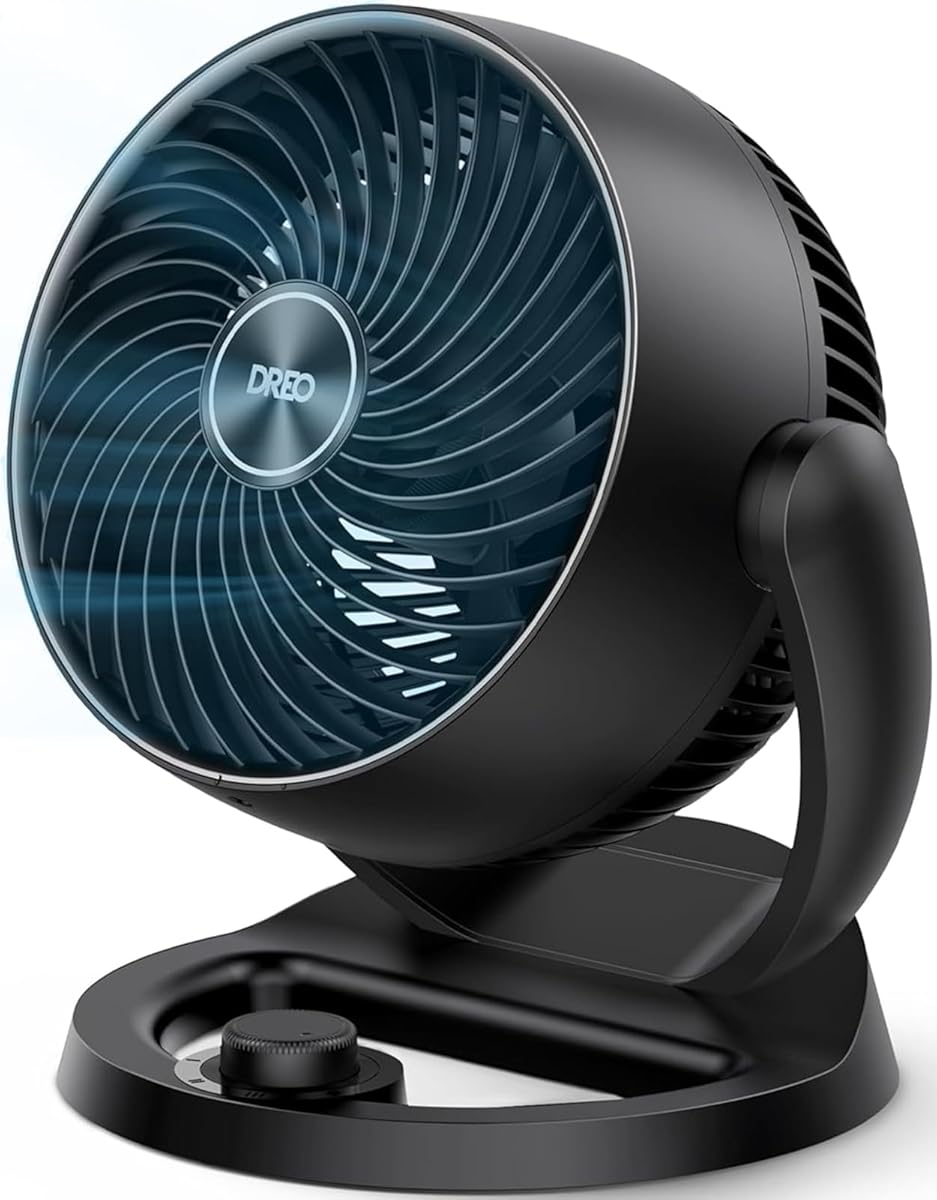
The DREO 12-inch table air circulator has a 4.6 rating and prioritizes efficient room airflow over app-based intelligence. Its WingBoost system is described as moving air as far as 70 feet, making it suitable for bedrooms, offices, kitchens, and other spaces where a personal breeze is not enough. A 120-degree adjustable tilt allows the airflow to be aimed toward different parts of a room.
Pros
Strong whole-room airflow
Low minimum noise
Simple knob operation
Easy-remove cleaning parts
Cons
Only three speed settings
No intelligent tracking features
We may earn a commission when you buy through this link, at no additional cost to you.
The listed minimum sound level of 25dB is appropriate for sleep, focused work, and background use. Three speeds controlled by a knob make operation straightforward, which can be preferable to navigating a digital menu or app. The fan is also designed to support other appliances, including heaters, humidifiers, and purifiers, by moving air more effectively around the room.
Unlike the explicitly AI-driven products, this model has no face tracking, head tracking, voice control, or automatic occupancy sensing. Its appeal comes from established mechanical features: deep-pitched blades, aerodynamic design, a removable handle and base, and parts that can be detached for cleaning. The 10.8-by-9.5-by-11.8-inch footprint is larger than the compact tracking fans but remains suitable for a tabletop.
This is a good match for someone who wants dependable whole-room circulation and quiet operation without needing an app. It is especially attractive for sleep, where its low stated noise and broad tilt can be more valuable than granular speed adjustment. Choose a true tracking model instead if automatically following a person is the central requirement.
Room-Focused Airflow Engineering
The 70-foot airflow reach and aerodynamic blade system distinguish this model from a typical personal desk fan. That makes it useful for sharing a broader room with an air conditioner, heater, humidifier, or purifier.
Simple Controls and Maintenance
A three-position knob keeps everyday operation uncomplicated. Removable parts make routine cleaning easier, helping the fan remain ready for regular bedroom, office, or kitchen use.
The Coolhill USB desk fan has a 4.2 rating and delivers broad personal control through 100 adjustable speed levels. Its digital screen makes the selected setting easy to read, including in a dark room. Short presses jump through five groups of settings, while a long press increases speed continuously, providing both quick and precise adjustment methods.
Pros
Wide speed selection
Useful turbo airflow
Cordless and USB-C operation
Versatile mounting options
Cons
No face or head tracking
Less room reach than circulators
We may earn a commission when you buy through this link, at no additional cost to you.
The fan produces a maximum stated airflow velocity of 6 meters per second and oscillates through 120 degrees. That combination can cover more of a desk than a fixed personal fan. Its minimum noise level is listed at 28dB, which supports use during work, rest, and light sleep. Unlike the AI tracking models, the direction changes by a preset oscillation pattern rather than detecting the user's position.
A built-in 3000mAh battery charges in about 2.5 hours and is stated to support three to ten hours of operation, depending on use. USB-C power lets it run from a laptop, wall USB port, power bank, or car charger. The listing also describes bedroom, kitchen, office, camper, and outdoor applications, while wall mounting offers an alternative to placing it directly on a desk.
This model is best for buyers who want fine airflow control and portability without investing in a smart-home ecosystem. It may not satisfy someone whose main requirement is automatic face tracking, and its stated airflow focus is more personal than whole-room. It is a versatile middle ground for a dorm room, home office, or compact bedroom.
Control Across 100 Levels
Hundred-step adjustment is useful for finding a comfortable balance between a gentle breeze and stronger cooling. The combination of grouped short presses and continuous long-press adjustment makes the settings easier to approach from different perspectives.
Cordless Cooling With Flexible Placement
The rechargeable battery and USB-C input support use away from a wall outlet. Oscillation expands personal coverage, while wall mounting offers flexibility in rooms where desk space is limited.
The DREO Smart 565S combines a 4.7 rating with extensive connected controls, making it one of the strongest all-around choices in the guide. Its TurboWind system is listed as delivering up to 950 CFM and moving air as far as 85 feet. The 9.45-by-9.45-by-12.2-inch body is designed for room circulation rather than only a narrow personal zone.
Pros
Highest listed customer rating
Exceptional low-noise specification
Broad smart-home compatibility
Extensive oscillation coverage
Cons
Larger desktop footprint
No automatic person tracking
We may earn a commission when you buy through this link, at no additional cost to you.
Quietness is a major strength. The brushless DC motor can operate as low as 20dB, the lowest listed minimum in this comparison, while still providing substantial airflow. Ninety-degree horizontal and vertical oscillation allow the fan to cover a broad area and reduce persistent warm spots. Nine speeds and six airflow modes offer more variation than the three-speed models, although fewer increments than the 100- or 200-level products.
The smart controls are extensive. Users can operate the fan through the DREO app, Alexa, or Google Home, with an eight- or twelve-hour timer, child lock, power-off memory, and automatic screen-off. It does not track faces or heads, so its intelligence is based on remote control, scheduling, and home integration rather than recognizing a user's movements.
This fan is well suited to a bedroom, home office, dorm, or living area where low noise, long-range airflow, and automation are priorities. It is a particularly strong option for readers who want the benefits of a smart desk fan without needing to position a camera-based tracking sensor toward themselves. Its larger size and broader feature set require more desk or floor space than the compact models.
Smart Control Without Tracking
App access, voice platforms, timers, and memory provide intelligent convenience for a stationary fan. This is useful in a bedroom or office because users can change settings remotely instead of returning to the desk.
Quiet, Long-Range Air Circulation
A stated 20dB minimum and 85-foot airflow reach create an unusual combination of quiet operation and broad circulation. Two-axis oscillation further reduces the need to reposition the fan manually.
The SwitchBot Smart Desk Fan is a polished connected option with a 4.4 rating, a 22dB minimum noise level, and broad support for app, remote, touch-panel, and voice control. It offers nine speeds, a nine-hour timer, schedules, and compatibility with Alexa, Google Home, and Apple Home when paired with the appropriate SwitchBot Hub. The breadth of automation makes it especially relevant to existing smart-home users.
Pros
Comprehensive smart-home support
Corded and cordless flexibility
Very quiet listed operation
Timer and scheduling functions
Cons
Some voice features require hub
No automatic person detection
We may earn a commission when you buy through this link, at no additional cost to you.
The built-in 3600mAh battery supports cordless use, while corded operation is available for longer sessions. An 11-inch air circulator design produces airflow up to 39 feet and uses 90-degree horizontal and vertical oscillation. This two-axis movement is less expansive than the DREO Smart 565S's 85-foot reach but remains suitable for distributing air through a bedroom, office, or nursery.
The DC brushless motor and 22dB minimum make the fan appropriate for sleep, study, or focused work. SwitchBot Meter and Hub integration can also support automations based on temperature or humidity, such as activating cooling during warmer periods. The trade-off is that some voice and advanced automation functions depend on ecosystem accessories rather than working entirely from the fan alone.
This model is a strong fit for someone who wants a premium bedside or office fan integrated into a broader SwitchBot setup. It is less compelling for buyers whose main priority is following a person around a desk, because the fan does not include face or head tracking. Its combination of quiet operation, battery flexibility, and smart access is nevertheless one of the most balanced in the guide.
Flexible Smart-Home Access
Users can choose the touch panel, included remote, SwitchBot app, or compatible voice assistants. Schedules and a nine-hour timer add convenience for bedrooms and rooms that need unattended circulation.
Cordless and Corded Versatility
A 3600mAh battery makes portable cooling possible, while corded operation removes runtime as a concern. The fan can move between a desk, patio, dorm, RV, or camping setup more easily than a permanently installed unit.
The Titanium Alloy USB Desk Fan has a 4.3 rating and differentiates itself through its metal construction, folding mechanism, and flexible three-way positioning. Unlike most plastic competitors, the body is described as aerospace-grade aluminum alloy that resists shattering, corrosion, and fingerprints. It weighs 2.7 pounds, giving it a more substantial feel while remaining portable for travel, work, or exercise setups.
Pros
Durable aluminum construction
Compact folding design
Strong battery capacity
Quiet brushless motor
Cons
No app or voice control
No automatic head tracking
We may earn a commission when you buy through this link, at no additional cost to you.
The fan combines 360-degree horizontal rotation with 180-degree vertical tilt and can fold down to 6.7 inches. It can function as an adjustable desk fan, indoor air circulator, or portable USB fan. The 23dB minimum comes from a brushless DC motor, while a seven-blade turbine and aerodynamic duct are stated to propel air as far as 33 feet. Ten speed settings and a front LED display provide clear control.
Its 5000mAh battery supports up to eight hours in eco mode, and the universal USB Type-C port works with common charging equipment. The major omissions are connected controls and person tracking. There is no app, voice assistant, or camera-based automatic direction system, so users must set the position and speed manually. The heavier metal body is also less convenient for users who prioritize the lightest possible travel option.
Choose this model for its material quality, compact folding profile, and flexible positioning. It suits a desk that needs a refined metal appliance, a camper seeking a sturdier portable fan, or a user who values precise physical adjustment over app-based intelligence. It is not the most directly relevant choice for the narrowest interpretation of an AI fan, but it provides strong conventional features in a durable package.
Built for Flexible Positioning
The combination of folding, horizontal rotation, and vertical tilt lets the fan address different airflow directions without repeated manual repositioning. Its compact folded height also simplifies storage in a drawer, vehicle, or travel bag.
Metal Construction and Long Runtime
Aluminum alloy provides a more durable alternative to a lightweight plastic shell. A 5000mAh battery and up-to-eight-hour eco runtime support cordless use, while USB Type-C charging offers broad device compatibility.
The AI Smart Face Tracking Fan offers the most direct interpretation of intelligent desk-fan technology: it detects and follows a user's face in real time. Its 5.0 rating is the highest numerical score among the products with listed customer feedback. The sensor redirects airflow as the user works, studies, reads, or moves around the desk, reducing the need to adjust the fan manually.
Pros
Direct face recognition
Highest listed rating
Real-time temperature display
Simple touch operation
Cons
Fewer speed levels than rivals
No listed app or voice control
We may earn a commission when you buy through this link, at no additional cost to you.
The model provides six wind speed settings with a straightforward touch panel. A digital display shows room temperature, adding useful ambient information without requiring another device. Its compact footprint of 150 by 203 by 112 millimeters and five ABS blades make it suitable for a desk, bedside table, dorm, countertop, or vanity. The rechargeable battery and included USB-C cable support cordless placement.
The primary limitation is that six speed levels are less granular than the 100- or 200-step models. There is also no listed app, voice assistant, timer, or broad smart-home integration. The product information does not specify a minimum sound level, measured airflow reach, or exact battery capacity and runtime, so comparisons involving those points rely more heavily on the other models' published specifications.
This is the most compelling choice for a reader who specifically wants facial recognition rather than generic oscillation. It is ideal for a home office or study desk where a person changes position and wants the breeze to follow. Buyers seeking verified battery specifications, extensive smart-home automation, or very fine speed control should examine the DREO, SwitchBot, or 200-level tracking models instead.
Recognition That Directs the Breeze
Unlike a fixed oscillation, face recognition follows the person rather than simply sweeping through an arc. That makes the fan well suited to active work sessions where posture and position change throughout the day.
Useful Information at a Glance
The digital temperature display gives the unit a broader environmental role beyond airflow. Its small size and simple touch controls make it straightforward to operate on a nightstand or compact work surface.
The Honeywell TurboForce HT900 has a 4.6 rating and offers a straightforward alternative to feature-heavy smart fans. It is designed for tabletop, floor, or wall-mounted use, making it flexible for small and medium rooms. Its aerodynamic turbo design is stated to move air as far as 25 feet, providing enough reach for personal cooling and modest room circulation.
Pros
High customer rating
Simple three-speed control
Flexible mounting options
Compact personal airflow
Cons
No intelligent tracking
No battery operation
We may earn a commission when you buy through this link, at no additional cost to you.
Three speeds and a 90-degree pivoting head make it easy to select a suitable level and direction. The product is described as 25 percent quieter than comparable fans, though a precise decibel figure is not provided. That makes it a practical choice for readers who want fewer controls and a less complicated setup than an app, remote, digital display, or tracking sensor.
There are no AI features, battery, smart-home connections, or fine-grained speed steps. Its advantages are dependable physical airflow, recognizable brand positioning, flexible placement, and a high customer rating. The absence of a rechargeable battery also means it must remain near a power outlet, so it is less suitable for travel, camping, or a patio without access to power.
This is the best budget-oriented option for a home office or bedroom where a traditional circulator is enough. It is also suitable for readers who dislike app dependence and simply want a quiet personal fan with manual direction control. If automatic following, remote scheduling, or cordless portability is the deciding requirement, one of the compact smart or tracking models is a better fit.
Physical Controls Without Complexity
Three speeds and a pivoting head cover the essential functions with little learning curve. The design is easy to understand, which can be valuable in a guest room, office, or household with mixed comfort preferences.
Placement That Fits Small Rooms
The fan works on a table or floor and can be mounted on a wall, offering more placement options than a purely desktop model. Its 25-foot stated reach is aimed at personal cooling and small-to-medium spaces.
The Fabater Desk Fan with AI Tracking Head Movement Follow, 200 Speeds combines automatic tracking, extensive airflow control, and cordless operation. No numerical customer rating is listed, so buyers must evaluate it primarily by its stated functions. The fan tracks head movement from 20 centimeters to 2 meters and uses 150-degree horizontal tracking to redirect airflow as the user's position changes.
Pros
Automatic head movement tracking
Highly granular speed control
Compact and rechargeable
Ambient lighting included
Cons
No numerical rating listed
Tracking favors daylight conditions
We may earn a commission when you buy through this link, at no additional cost to you.
Its digital display indicates wind speed and battery level, while the 1-to-200 adjustment range supports very fine changes in intensity. The compact 5.9-by-8-by-4.4-inch body is easy to place on a bedroom, office, or study desk. A 3000mAh battery charges in approximately four hours and is stated to deliver six to eight hours of cordless operation, with continued operation available through USB-C power.
The main drawbacks are the absence of customer rating data and the note that tracking works best in daylight. It also lacks the documented whole-room airflow reach, low minimum decibel figure, app, voice control, and three-axis circulation found among some premium competitors. Its ambient light adds a pleasant bedside effect but should be considered secondary to cooling and tracking.
This model is well suited to someone who wants the fan to follow a changing work or study position and values precise speed control. It is a practical choice for cordless cooling at a desk, with the USB-C connection also supporting travel, vehicle use, or locations without a nearby outlet. Buyers wanting a broader smart-home ecosystem or stronger room circulation should compare it with the DREO and SwitchBot options.
Personalized Direction and Intensity
The tracking system and 200 speed levels work together to deliver a personalized breeze. A user can move around a desk while the fan redirects airflow, then fine-tune its intensity without relying on broad preset steps.
Compact Cooling for Flexible Spaces
The small dimensions make the fan easy to carry between a desk, nightstand, and countertop. Rechargeable battery support and USB-C input provide useful freedom when a fixed outlet is inconvenient.
We may earn a commission when you buy through this link, at no additional cost to you.
Buying Guide – How to Choose the Best AI Desk Fan
The right AI desk fan depends on whether the priority is automatic person tracking, smart-home control, quiet sleep performance, whole-room circulation, or cordless portability. Reviewing these factors together prevents an attractive feature from distracting from a mismatch in space, power access, or everyday use.
Tracking Method and Range
Choose a tracking fan if you often change posture, lean away from a monitor, or move around while working. A conventional oscillating model is more predictable and may be better if the fan should move through a fixed pattern rather than react to a person.
Airflow Reach and Circulation
Prioritize reach for a bedroom, shared office, or living room. Choose a compact personal model when the fan must sit close to you and only needs to cool your immediate workspace.
Noise Level and Sleep Use
For a bedroom, prioritize a documented low minimum noise level. For an office, look for a balance between quiet operation and a setting strong enough to circulate air through the room.
Controls and Smart-Home Compatibility
Choose app and voice control when the fan will run unattended or integrate with an existing smart home. Favor simple physical controls for bedrooms, children's rooms, temporary workspaces, or anyone who wants minimal setup.
Battery and Charging Flexibility
Choose a rechargeable model for travel, camping, hot outdoor spaces, or rooms without easy outlet access. If the fan will stay on a desk beside a reliable power source, corded operation may be simpler and eliminate battery-management concerns.
Speed Range and Airflow Adjustment
Fine adjustment is valuable for light sleep, focused work, or close personal use. A small number of clearly separated settings may be easier for households seeking straightforward operation.
Size, Weight, and Placement
Measure the intended surface before buying. Use a compact model for a crowded desk and a larger circulator for an open room, then confirm that the airflow direction reaches the seating area.
Lighting, Display, and Ambient Features
Treat lighting as a secondary benefit. Prioritize tracking accuracy, sound, battery life, and airflow when those features are more important to the room's daily use.
How to Use and Care for Your AI Desk Fan
Begin by placing the fan on a stable, level surface with adequate clearance around its air intake and outlet. For a tracking model, sit within the stated detection area and make sure the sensor has a clear view of your face or head. Give the fan time to recognize you after switching on, and confirm that tracking is active before moving farther from its initial position.
Set the lowest comfortable speed first, then increase it gradually. Use the digital display to verify the selected level and battery status. If the fan has oscillation, three-axis positioning, or smart controls, configure those options for the room rather than leaving every feature active. Cordless models should be fully charged before extended travel, while corded and cordless models can remain plugged in when continuous operation is desired.
Unplug the fan before cleaning. Remove loose dust from accessible vents with a soft brush or a vacuum attachment held away from the fan, and wipe the exterior with a lightly dampened cloth. Avoid immersing the unit, pouring liquid into openings, or using harsh chemicals. Keep the battery dry, inspect the charging cable for damage, and follow the manufacturer's instructions for battery care and long-term storage.
Frequently Asked Questions
What is an AI desk fan?
An AI desk fan is a small fan that uses intelligent or automated functions to adjust its operation. Common features include recognizing a face, following head movement, oscillating automatically, and providing app or voice controls. Not every fan with digital controls qualifies as AI, so buyers should distinguish person-aware tracking from basic programmability and remote operation.
How does head-tracking technology work?
A sensor identifies the user's position and directs the fan toward that person as they move. The featured head-tracking models generally operate within approximately 20 centimeters to 2 meters and cover 150 degrees horizontally. Accuracy can vary with lighting, so several descriptions state that tracking works best in daylight.
Are AI desk fans quiet enough for sleeping?
Several models are designed with quiet operation in mind. The listed minimum sound levels range from 20dB to 28dB among the products that provide a figure, making them suitable candidates for light sleep. Actual noise will vary with speed, surface vibration, room acoustics, and the distance between the fan and sleeper.
Can I use an AI desk fan without connecting it to Wi-Fi?
That depends on the model. Face and head-tracking fans generally perform their local automated functions through built-in sensors and physical controls, while app and voice features may require a connection and compatible hub. The DREO Smart 565S and SwitchBot offer broader connected functionality, whereas simpler circulators and tracking units can be operated directly.
Which AI desk fan is best for a small office?
The DREO Smart 565S stands out for a stated 20dB minimum, broad oscillation, app controls, and long airflow reach. The compact AI Face Tracking Fan is a more direct choice for a single worker who changes position frequently. For a shared office, the longer reach and automation of the DREO may be more practical than a closely focused personal breeze.
Do rechargeable AI desk fans work without an outlet?
Yes, within the stated battery runtime. The featured rechargeable models offer approximately three to ten hours depending on capacity and operating conditions. USB-C models can also run from a laptop, power bank, or vehicle charger, which adds flexibility when no wall outlet is available.
Is a personal fan better than an air circulator?
A personal fan is usually better for a desk, nightstand, or single seating area because it can focus airflow directly on one person. An air circulator is generally more suitable for distributing air throughout a bedroom, office, or living space. The best choice depends on the room size and whether automatic tracking or broad circulation is the priority.
How should I choose between 100 and 200 fan speed levels?
More speed levels provide finer adjustments and can help multiple users find a preferred level. They do not necessarily mean the fan produces a more powerful maximum airflow, so buyers should also check airflow reach, motor design, and noise specifications. A model with fewer clearly labeled speeds may be simpler and more convenient for everyday use.
Final Thoughts on Choosing the Best AI Desk Fan
The AI Smart Face Tracking Fan is the strongest choice for direct person-aware cooling, offering facial recognition, a digital temperature display, and the highest listed customer rating. The DREO Smart 565S is the strongest all-around smart circulator because it combines strong airflow, a 20dB minimum, two-axis oscillation, app control, and voice-platform support. For a simpler and more economical approach, the Honeywell TurboForce HT900 delivers dependable airflow with a high rating, although it lacks intelligent tracking and battery operation.
Prioritize the feature that changes daily comfort most: face or head tracking for users who move around, long airflow reach for shared rooms, a documented low minimum noise level for sleep, and smart-home control for unattended schedules. Battery capacity and USB-C charging are also important if the fan will be used away from a reliable outlet. Comparing these priorities against the room and control preferences is more useful than selecting solely by the word AI.
Before making a final choice, confirm the current product listing, availability, included accessories, compatibility requirements, and latest customer feedback. Specifications and prices can change over time, as can the availability of app platforms and accessories. Reviewing the current listing ensures that the selected model still provides the tracking, power, control, and placement features that matter most.
Our surge protector for sauna guide compares ten leading power strips, plug-in devices, and whole-home models based on capacity, safety, and installation.