
2mm Double-Sided Adhesive Sticker Tape
4.4Editor score
Useful 2mm tape width
Includes tweezers and cloth
Designed for electronic repairs
Adhesive Tape for Electronics must balance secure bonding, clean application, and compatibility with delicate components. Phone screens, LCD panels, batteries, cameras, circuit boards, and lenses each present different surface and clearance requirements, making tape width, thickness, temperature resistance, and adhesive chemistry especially important.
This guide compares ten tape products designed for electronics work, including narrow screen-repair strips, clear double-sided acrylic tape, polyimide heat tape, and bonding tape for displays and electronic components. The comparison considers dimensions, material claims, intended uses, included accessories, adhesion characteristics, removal behavior, and operating-temperature guidance.
Each product entry highlights the option's strongest use case, practical limitations, and ideal buyer. The top selections cover a versatile precision-repair tape, a well-equipped budget option, and a more specialized bonding product, while the full list also includes heat-resistant choices. Product details and listing terms can change, so verify specifications before purchasing.
4.4Editor score

4.6Editor score
4.6Editor score
As an Amazon Associate we earn from qualifying purchases.
The table below compares all ten products by format, size, material or temperature characteristics, and repair focus so readers can quickly distinguish screen-bonding tape from high-temperature polyimide tape.


This is the strongest all-around choice for delicate electronics work, combining a narrow 2mm profile with a generous 50-meter roll. Its 4.6 rating reflects a favorable balance of useful features and customer feedback, while the included ESD tweezers make it easier to position narrow strips without touching sensitive components.
We may earn a commission when you buy through this link, at no additional cost to you.
The tape is described as waterproof, sealed, resistant to aging, solvents, and softening, and capable of maintaining adhesion across low and high temperatures. Its ultra-thin 0.1mm construction is particularly useful around phone screens, touch panels, cameras, lenses, batteries, and display assemblies where a bulky adhesive layer could interfere with fit or alignment.
The main trade-off is that only one width is supplied. That makes the product excellent for hairline seals and flexible cable anchoring, but less adaptable when a broader panel or a 3mm replacement edge needs support. The manufacturer also advises that extended exposure to high temperatures may prevent a permanent bond, so it should not be confused with a dedicated polyimide heat tape.
This is the most practical selection for phone, tablet, and laptop screen repairs, especially for buyers who value precision and roll length. It is also a sensible first tool for controlled electronics work because it covers many common bonding tasks and comes with an appropriate handling accessory.
The 2mm width can follow narrow display edges and flex-cable routes without creating a visibly oversized adhesive band. Combined with the 0.1mm thickness, it suits devices where clearance around the frame is limited.
At 50 meters, the roll provides substantial material for repeated screen, lens, battery, and panel work. The included ESD tweezers help control placement and reduce the chance of contaminating the bonding area.
We may earn a commission when you buy through this link, at no additional cost to you.
This option stands out because it supplies both 2mm and 3mm rolls, each measuring 50 meters. That combination gives repairers more flexibility than a single-width product and makes it easier to handle narrow display edges, wider frame sections, lenses, camera parts, and battery components.
We may earn a commission when you buy through this link, at no additional cost to you.
Its double-sided acrylic construction is described as waterproof, sealed, and resistant to aging, solvents, softening, and tensile stress. The listing also claims high initial adhesion, solid peel strength, and easy removal without visible traces, all of which are meaningful considerations when replacing a screen or reseating a small electronic assembly.
The product information does not state the tape thickness, so buyers who need an exact fit around tight display bezels may need to confirm dimensions before starting. It also appears to use broad compatibility language rather than identifying a precise adhesive model, making the inclusion of ESD tweezers especially useful for handling.
Overall, this is a strong choice for a technician or advanced hobbyist who wants two common widths without purchasing separate rolls. It is less attractive than the first pick for applications requiring a documented ultra-thin profile, but its longer rolls and dual-width format remain compelling.
The 2mm roll fits delicate perimeter applications, while the 3mm roll provides additional contact area for slightly broader edges. This makes the package useful across different phone and tablet screen geometries.
Each 50-meter roll is suited to repeated repairs. The substantial length can also be cut into custom shapes for flex cables, battery covers, camera lenses, and compact display assemblies.
We may earn a commission when you buy through this link, at no additional cost to you.
This Kaisiking set is aimed at buyers who need more adhesive coverage than a narrow screen strip can provide. The 5mm and 10mm rolls are useful for larger display panels, tablet components, camera covers, battery areas, rubber pads, and other electronics projects where broader contact improves support.
We may earn a commission when you buy through this link, at no additional cost to you.
Its transparent construction uses a polyester and soft PET base with acrylic coating on both sides. The product information highlights aging, shear, solvent, softening, and moisture resistance, along with adhesion from approximately minus 25 to 150 degrees Celsius. The clear color is particularly useful when the bonded area remains visible beneath a cover.
The wider formats are not ideal for extremely narrow flex-cable channels or tight bezel edges where excess material would be difficult to conceal. At 25 meters per roll, the package also provides less total length than several narrow-tape competitors, although the greater width increases the bonding area available per inch.
Choose this product for screen-protector work, tablet panels, camera covers, and moderately sized component mounting. It is less of a universal precision-repair tape than the top selection, but its two wider formats make it a useful complement for larger electronic surfaces.
The 10mm roll can support wider panels and covers, while the 5mm roll offers a middle option. This makes the set useful for repair benches handling devices of several sizes.
The clear adhesive is designed to remain inconspicuous beneath a screen, lens, or cover. That matters when a finished repair is visible from the exterior.
We may earn a commission when you buy through this link, at no additional cost to you.
This is the most useful budget package for a new repair kit because it includes the tape, anti-static tweezers, and a microfiber cleaning cloth. Its 2mm width and paper backing make it approachable for smartphone LCD, digitizer, tablet, and small-electronics work, even for someone building a toolkit for the first time.
We may earn a commission when you buy through this link, at no additional cost to you.
The acrylic adhesive is described as having strong bonding ability and resistance to heat, moisture, and solvents. The tape can bond plastic, metal, and other materials, making it relevant to small parts, flex cables, battery compartments, lens elements, camera covers, and motherboard-area components as described in the product information.
Its main limitation is the absence of a stated roll length and exact thickness in the supplied specifications. That makes it harder to compare with products that clearly document their dimensions. The 4.4 rating is also slightly lower than the leading choices, although that difference remains small and should be considered alongside the included accessories.
For a cost-conscious buyer who needs a compact screen-repair tape and proper handling tools, this is an excellent starting package. It is best suited to occasional repairs and should be paired with careful surface cleaning and gradual pressure during application.
The bundled tweezers and microfiber cloth address two basic needs: controlled placement and surface preparation. That makes this product convenient for new users who do not already own dedicated electronics tools.
The product information lists plastic, metal, and other materials among compatible surfaces. This broadens its use beyond touchscreen replacement into battery covers, small brackets, lenses, and other compact electronic assemblies.
We may earn a commission when you buy through this link, at no additional cost to you.
QDiShi offers a balanced repair bundle with 2mm and 3mm rolls, a pair of tweezers, and three alcohol preparation pads. That combination is especially useful for phone and tablet screen work because the accessories cover both clean application and accurate positioning.
We may earn a commission when you buy through this link, at no additional cost to you.
The clear acrylic tape is described as maintaining adhesion from approximately minus 25 to 150 degrees Celsius. It also has stated resistance to tensile stress, aging, shear, solvents, water, softening, and moisture. Its transparent appearance allows it to remain discreet beneath a touch screen or cover.
Each roll measures 25 meters, which is less than the 50-meter rolls offered by the first two products. The manufacturer also lists uses such as posters, signs, and craft work, so the electronics positioning is not quite as focused as that of a specialist screen-repair product.
Despite that broad application language, the QDiShi set is a strong pick for repairers who value the included alcohol pads and need both common widths. It is particularly convenient for routine phone, tablet, laptop, and camera work without requiring separate cleaning consumables.
The three alcohol prep pads support the essential practice of cleaning bonding surfaces before placement. This helps reduce the chance that dust or oils interfere with adhesion.
The product is listed for phones, tablets, laptops, cameras, LCD panels, lenses, batteries, and general electronic equipment repair. That makes it a versatile bench option rather than a single-device solution.
We may earn a commission when you buy through this link, at no additional cost to you.
This polyimide heat tape is the leading option for electronics tasks involving soldering, thermal processing, or circuit-board protection. It has a 4.7 rating and a stated maximum heat resistance of 482 degrees Fahrenheit, or 250 degrees Celsius, which clearly separates it from ordinary acrylic screen tape.
We may earn a commission when you buy through this link, at no additional cost to you.
The heat-activated adhesive is described as peeling away cleanly without residue. Each roll measures 10mm wide by 33 meters, and the package includes two rolls. This format is useful when shielding a board or component during heat-intensive work rather than forming a delicate display perimeter bond.
Its heat-activated nature is also the main limitation. This is not the natural choice for directly bonding a phone digitizer or a small flex cable, and its 10mm width may be excessive around a narrow component. The listed 482F figure is a maximum resistance claim, not a recommendation to expose the bonded area to that temperature indefinitely.
For solderers, electronics fabricators, and hobbyists working around heat-sensitive areas, this is a strong protective and masking tape. Buyers seeking a screen-repair bond should instead choose one of the narrow clear acrylic options.
The polyimide film and heat adhesive are suited to shielding nearby circuitry during soldering or other elevated-temperature processes. The material can serve as a temporary barrier that peels away afterward.
Two 33-meter rolls provide enough material for repeated board work and many custom-cut strips. The 10mm width is especially convenient for slicing into smaller pieces around components.
We may earn a commission when you buy through this link, at no additional cost to you.
This tape occupies a practical middle ground between very narrow screen strips and wider panel tape. Its 3mm width, 25-meter length, and documented 0.2mm thickness make it easier to evaluate for a specific repair before ordering.
We may earn a commission when you buy through this link, at no additional cost to you.
The transparent double-sided acrylic construction is listed for laptops, cellphones, LCD panels, tablets, lenses, batteries, and cameras. The stated operating range of minus 25 to 150 degrees Celsius, along with high-temperature and corrosion resistance, suggests useful performance across many normal repair environments.
Because it is wider and thicker than an ultra-thin 2mm option, it may not suit the narrowest bezels. The listing also cautions against dusty walls, brick walls, broken walls, and oily surfaces, although those cautions concern general mounting rather than typical clean electronics components.
This is a good selection for tablet panels, camera covers, battery retention, and display work where 3mm offers a useful balance of coverage and concealment. It is also a clearer choice for buyers who prioritize documented dimensions over having multiple widths.
The 3mm width provides more bonding area than a hairline strip without becoming as broad as a 10mm roll. It works well for display edges, camera covers, and small mounting points.
The stated 0.2mm thickness and 25-meter length make it easier to estimate whether the tape will fit a particular housing. Confirming dimensions before cutting can prevent avoidable rework.
We may earn a commission when you buy through this link, at no additional cost to you.
Pimoys provides another dual-width option, with clear 2mm and 3mm rolls measuring 25 meters each. It is aimed at phone and tablet screen work but also has stated uses for LCD panels, camera covers, batteries, lenses, and rubber pads.
We may earn a commission when you buy through this link, at no additional cost to you.
The permanent acrylic adhesive is described as strong, long-lasting, and capable of being cut into arbitrary shapes. Its red backing liner is intended to make the tape easier to peel and position, while the clear adhesive remains visually unobtrusive after placement.
The product does not state a precise thickness in the supplied information, which limits fine-fit comparisons with the 0.1mm and 0.2mm alternatives. Its application list also extends well beyond electronics, and the 4.4 rating sits slightly below the most highly rated products in the guide.
Despite these limitations, Pimoys is a convenient option for buyers who want both common screen-repair widths in a compact set. It is particularly useful when a project needs one narrow strip and one slightly wider strip for different edges or components.
The red peel-back layer gives the user a visible handle during positioning. This is helpful when aligning a narrow strip along a display edge or over a small component.
Because the tape can be cut freely, the two rolls support short tabs, perimeter strips, lens patches, and compact component mounts rather than only full-width screen bonds.
We may earn a commission when you buy through this link, at no additional cost to you.
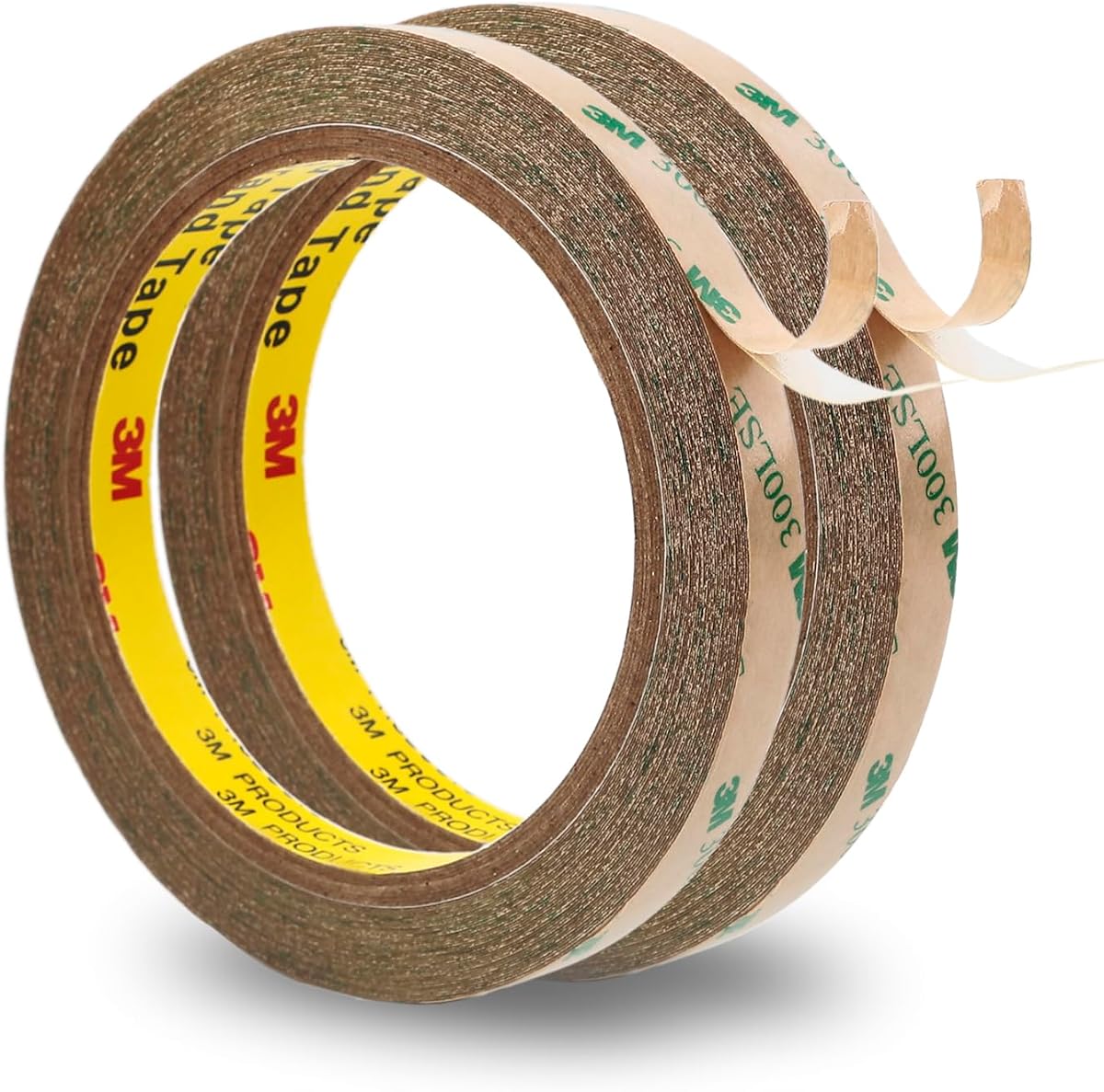
The 3M 300LSE option is the premium pick for demanding electronics bonding applications, particularly when low-surface-energy plastics are involved. Its acrylic adhesive is designed to bond materials such as polypropylene, while the polyester film carrier adds dimensional stability for die-cutting and controlled handling.
We may earn a commission when you buy through this link, at no additional cost to you.
The product information describes a 170-micron, or 6.7-mil, thickness and a 0.39-inch width. Applications include lens and LCD bonding, battery doors, LED strips, touchpad brackets, electronic components, camera modules, speaker modules, memory cards, PET card modules, and display assemblies.
This is much wider and thicker than the precision screen-repair strips, so it is not the natural option for an extremely narrow bezel. Application conditions also matter: the recommended range is 70 to 100 degrees Fahrenheit, and initial use below 50 degrees Fahrenheit may reduce adhesion.
The tape earns the premium position because of its chemical resistance, long-term bond behavior, and support for challenging substrates. It is best for display, lens, camera, and component assemblies where durability matters more than a hairline-width strip.
The 300LSE adhesive is intended for low-surface-energy materials that can challenge ordinary tapes. This makes it useful for selected housings, trim pieces, and internal electronic modules.
The polyester carrier supports die-cutting and helps maintain dimensions during application. That is valuable when manufacturing or repairing repeated component assemblies.
We may earn a commission when you buy through this link, at no additional cost to you.
APT's 1 mil polyimide tape is a wide, high-temperature option for masking, soldering, insulation, and 3D-printer work. Its 4.7 rating places it alongside the leading heat-resistant product in this guide, although its larger 1-inch width serves a different set of tasks.
We may earn a commission when you buy through this link, at no additional cost to you.
The silicone adhesive and premium film are described as resisting heat up to 400 degrees Fahrenheit, or 260 degrees Celsius, while maintaining electrical insulation. The listing also highlights minimal shrinkage after baking, clean removal, and resistance to curling, shrinking, and lifted edges.
The one-inch width is too broad for many screen-edge and tiny component applications. It is also not a double-sided bonding tape for display assembly, so comparing it directly with clear screen-repair strips would be misleading. Its value comes from broad masking coverage and thermal protection.
Choose APT for solder masking, circuit-board insulation, high-temperature coating work, or heat protection during fabrication. It is also a good general-purpose polyimide tape for a workshop that wants a generous roll without sacrificing clean removal.
The polyimide film is designed to resist curling, shrinking, and lifted edges during heated processes. These characteristics help preserve flat coverage around protected components.
The tape provides electrical insulation in addition to serving as a heat-resistant mask. It can protect selected areas during soldering, manufacturing, and circuit-board work.
We may earn a commission when you buy through this link, at no additional cost to you.
The right electronics tape depends on the component, required bond width, operating conditions, and whether the tape is being used for permanent attachment or temporary heat protection.
Narrow tape is essential when working around smartphone bezels, digitizer edges, flex cables, and small display components. A 2mm strip can fit where a 3mm or 10mm roll would overlap adjacent parts, while the 0.1mm and 0.2mm products offer more clearance for extremely compact assemblies. Wider tape provides greater contact area and is better suited to tablet panels, camera covers, battery doors, and larger components.
Choose the narrowest width that provides adequate bonding coverage, then confirm the thickness against the device clearance.
Acrylic adhesives are common in electronics because they offer strong holding power, temperature tolerance, and useful chemical resistance. However, adhesion varies with the surface energy and texture of the substrate. The 3M 300LSE product specifically targets difficult low-surface-energy plastics such as polypropylene, while polyester and PET-based tapes are frequently used for smooth frames, lenses, and display surfaces.
Match the adhesive to the materials being joined rather than assuming every electronics surface behaves identically.
Screen-repair tape is designed to create a controlled bond between a display and its frame, whereas polyimide heat tape is generally used as a temporary mask, shield, or insulating layer during soldering and elevated-temperature processes. Choosing by the word adhesive alone can lead to an unsuitable result because heat-activated film and double-sided display tape serve fundamentally different functions.
For permanent component bonding, choose a double-sided tape; for heat shielding, choose heat-resistant polyimide.
Electronics repairs can involve hot tools, enclosed displays, batteries, or curing and bonding processes. Several acrylic screen tapes state an operating range of approximately minus 25 to 150 degrees Celsius, while the dedicated heat products claim higher resistance. A maximum temperature is not the same as a recommended continuous exposure, and one product warns that extended high heat may interfere with a permanent bond.
Compare both the operating range and the duration of heat before choosing tape for a thermally demanding job.
Roll length influences the number of repairs a tape can support. Products with 50-meter rolls are well suited to frequent work, while 25-meter and 25-foot rolls may be sufficient for occasional repairs. Most clear acrylic rolls can be cut to a custom length, allowing a single purchase to cover long perimeter strips and short component tabs. The heat tapes in this guide are also supplied in useful continuous lengths.
Estimate your likely repair volume, then favor a longer roll if the available width matches your project.
Anti-static or ESD tweezers are particularly helpful for positioning narrow tape without touching fragile electronics. Microfiber cloths and alcohol prep pads help remove dust, oils, and fingerprints before bonding. These accessories do not guarantee a successful repair, but they improve control and make it easier to maintain a clean bonding surface.
Choose a package with tweezers and preparation supplies if you lack basic electronics repair tools.
A tape that bonds strongly but leaves residue can create additional cleanup work around a display frame or finished exterior. Several products claim easy removal without traces, while the 3M tape specifies residue-free performance across glass, plastics, metal, paper, cards, powder-coated surfaces, and vinyl. Always confirm that both the adhesive and the receiving surface are suitable, and avoid painted walls with the 3M product.
Prioritize clean removal when the tape may later need to be heated, repositioned, or replaced.
Clear tape is advantageous when the bonded line remains visible beneath a screen, lens, or cover. A transparent adhesive can preserve the smooth appearance of an exterior panel, whereas an opaque or visibly colored strip may stand out. The red peel-back liners found on some products are useful during application, but the red layer is not the finished bonding surface and should be fully removed.
Choose clear adhesive for visible assemblies and confirm that the tape will not create an obvious edge or bubble.
Begin by identifying the bonding surfaces and checking that the tape width, thickness, and material are appropriate for the component. Power down and disconnect the device when working on a powered electronic assembly. Remove the old display or adhesive carefully, and avoid pulling on fragile flex cables, speakers, or ribbon connectors.
Clean both surfaces thoroughly using suitable electronics-safe preparation supplies. The 3M product specifically recommends a 50:50 mixture of isopropyl alcohol and water, followed by firm pressure for approximately 30 seconds when the tape and substrate are compatible. Allow the surface to dry, then position the tape gradually rather than pressing the entire strip down at once.
Use tweezers or a suitable positioning tool to align the tape, press firmly along the bond line, and remove the backing gradually to reduce bubbles and folds. Keep liquids away from exposed components. After installation, inspect for gaps, lifting, or trapped debris, and allow any specified bonding time before applying heat, pressure, or final assembly.
A narrow, clear, double-sided LCD repair tape is usually the most suitable format for phone screens. A 2mm width fits many bezels, while a 3mm option can provide more contact area when the housing allows it. The device's internal clearance should be checked before installation, and all old adhesive should be removed before positioning the new strip.
The featured 3M 300LSE tape is described for lens and LCD bonding, battery doors, camera modules, electronic components, and display assemblies. It is especially relevant to low-surface-energy plastics. Its 0.39-inch width and 170-micron thickness make it more substantial than ultra-thin screen-edge tape, so it is better suited to selected component and display bonds.
Only heat-resistant tape should be considered for protection during soldering. The dedicated polyimide options state maximum resistance of approximately 400 to 482 degrees Fahrenheit, whereas standard screen-repair acrylic tape is intended for bonding and may not be suitable near hot tools. Heat shielding should not be confused with a permanent heat-resistant structural bond.
Several products claim that they can be removed without leaving traces, but results depend on the adhesive, surface, age, heat, and removal method. Residue-free claims should not be treated as universal guarantees. Removing tape while it is warm can make residue more likely, so follow the manufacturer's guidance and avoid pulling bonded sections sharply.
LCD repair tape is a double-sided bonding strip used to secure a screen, lens, battery, or other component. Heat tape is a polyimide film product used mainly for masking, insulating, or shielding components during elevated-temperature work. The products can appear similar on a roll, but their adhesive jobs and intended operating conditions are different.
Yes, the clear acrylic products are narrow rolls that can be cut into short tabs, perimeter strips, and custom patches. Cutting with clean scissors or precision tools can reduce fraying and help maintain straight edges. Heat-resistant polyimide tape can also be cut, although its one-inch or 10mm formats are generally intended for broader coverage.
The surface should be clean, dry, smooth, and free of dust, fingerprints, oils, and old adhesive residue. Use electronics-safe cleaning supplies and allow the solvent to evaporate before applying the strip. Press the tape firmly and inspect the bond line for bubbles, wrinkles, or incomplete contact.
Not necessarily. Wider tape generally provides more adhesive area, but adhesion also depends on the adhesive chemistry, surface material, cleanliness, pressure, and fit. A narrow tape that bonds cleanly to the intended edge can perform better than a wider strip that overlaps a component or does not conform to the surface.
The Kaisiking 2mm LCD Repair Tape is the most versatile overall selection because its narrow profile, 50-meter length, 0.1mm thickness, and included ESD tweezers suit delicate screen and component work. The 2mm Double-Sided Adhesive Sticker Tape is the strongest budget-oriented kit, while the 3M 300LSE tape stands out for demanding display, lens, camera, and low-energy-plastic bonding.
For high-temperature protection, the 10mm heat transfer tape and APT 1 mil polyimide tape are better choices than standard screen adhesive. Before purchasing any option, match the width and thickness to the device, verify the bonding surfaces, and confirm whether the tape must handle heat, difficult plastics, repeated removals, or only a routine screen reseal.
Product listings, included accessories, and pricing can change over time, so check the current listing details before making a final selection. Also review the manufacturer's surface preparation and temperature guidance to improve the likelihood of a clean, durable, and properly aligned repair.
