
M-Audio Keystation 88 MK3
4.5Editor score
Velocity-sensitive semi-weighted keys
Direct Mac and PC connectivity
Pitch and modulation wheels
Our expert guide compares the best 88 key weighted MIDI controllers, covering key action, performance controls, DAW integration, connectivity, and build
An 88-key weighted MIDI controller combines a full piano-style keyboard with the control needed to operate virtual instruments, samplers, effects, and recording software. A satisfying action is only the beginning: velocity response, aftertouch, assignable controls, DAW support, and connectivity can determine how naturally the instrument fits into a home or professional studio.
We compared the supplied specifications, ratings, control layouts, keybed characteristics, and feature sets of ten full-size models. The list includes true hammer-action controllers, semi-weighted and hybrid keybeds, and a standalone weighted digital piano so buyers can distinguish dedicated MIDI workflow tools from instruments with a different primary purpose.
Each review explains the controller's strongest qualities, practical trade-offs, and ideal user profile. The guide also explains how to compare weighted key actions, control surfaces, software integration, and hardware connectivity, while recognizing that ratings, bundles, availability, and other product details can change over time.
4.5Editor score

4.6Editor score
4.6Editor score
This side-by-side comparison highlights the keybed type, performance controls, software features, and practical strengths of each model, helping pianists and producers identify the controller that best matches their playing style and studio requirements.


The M-Audio Keystation 88 MK3 is a straightforward full-size MIDI controller built around 88 velocity-sensitive semi-weighted keys. Its 4.5 rating reflects a broadly practical approach: enough performance controls for immediate music production, straightforward computer connectivity, and a slim body that is easier to accommodate than many studio keyboards.
We may earn a commission when you buy through this link, at no additional cost to you.
Its principal appeal is the combination of a complete 88-note layout and accessible plug-and-play operation. The keyboard can control virtual instruments, software samplers, and plug-in synthesizers without a separate power supply. A volume fader, transport and directional buttons, pitch and modulation wheels, octave controls, and sustain pedal input cover many common tasks without overwhelming the player.
The semi-weighted action is the important compromise. It offers more resistance and a more piano-like feel than a lightweight unweighted controller, but it does not reproduce the graduated response of a true hammer-action instrument. A player who prioritizes a broad range of notes, direct computer control, and a manageable footprint will find that trade-off reasonable.
This is a strong choice for pianists beginning a home-studio setup, composers who need the full keyboard range, and users who want an uncomplicated path into software instruments. It is less suited to performers whose primary requirement is the most detailed physical key response, but it remains one of the most approachable options in this roundup.
The Keystation keeps the workflow centered on the computer. USB connectivity works directly with Mac or PC systems, and the stated package includes MPC Beats, Ableton Live Lite, Mini Grand, Xpand!2, TouchLoops, and Velvet, giving new users several ways to begin making music.
Its slimline design is useful for home studios where a deep controller would dominate the available desk space. The full range remains intact, while the relatively restrained control layout keeps the instrument focused on playing and essential navigation.
We may earn a commission when you buy through this link, at no additional cost to you.
The M-Audio Hammer 88 Pro is built for players who want a genuine weighted-key response and a deep set of production controls. Its 88 velocity-sensitive keys are graded and use hammer action, while aftertouch and assignable zones expand the expressive and organizational options available to serious pianists.
We may earn a commission when you buy through this link, at no additional cost to you.
The control surface is unusually complete. Sixteen RGB-backlit, velocity-sensitive pads can handle beat production, clip launching, and soundboard triggering. Eight assignable knobs and buttons, nine assignable faders, pitch and modulation wheels, three foot-switch inputs, and an expression pedal input create a tactile center for operating instruments, effects, and DAW parameters.
Its 3.9 rating is the most notable reason for caution. A keyboard that offers this many capabilities can present a steeper learning curve, and buyers should ensure that the physical controls align with the software they already use. Native Kontrol Standard support and the included curated Komplete 15 Select bundle help reduce that friction for compatible workflows.
The Hammer 88 Pro makes the most sense for pianists who prioritize key feel, producers who want extensive hardware control, and users willing to learn a deeper feature set. It is less attractive as a simple first controller, but for a demanding production environment, its weighted action and broad control coverage are compelling.
Graded hammer action gives the keybed a traditional piano-oriented feel, while velocity sensitivity and aftertouch allow finer control over virtual instruments. Assignable zones add another layer of utility by letting performers divide the keyboard for different sounds or functions.
The pads, faders, knobs, and buttons are designed to remain useful beyond basic note entry. Automatic mapping can simplify initial setup, while assignable controls support more deliberate production setups involving effects, samplers, and virtual synthesizers.
We may earn a commission when you buy through this link, at no additional cost to you.
The black Arturia KeyLab 88 mk3 combines a fully weighted hammer-action keybed with a relatively focused set of performance features. Its 4.3 rating suggests a solid all-around proposition, especially for musicians who want realistic keyboard resistance without a large collection of unfamiliar hardware controls.
We may earn a commission when you buy through this link, at no additional cost to you.
Twelve pressure-sensitive performance pads add a practical creative dimension. They can be used for triggering and percussion-oriented tasks, while sustain and auxiliary pedal inputs broaden the controller's usefulness for hands-on performance. USB-C power provides a modern, straightforward connection for compatible computer-based music systems.
The supplied specification list is intentionally limited, so buyers should confirm current software bundles, DAW mapping options, and connectivity details for the exact package. Compared with controllers offering banks of faders, knobs, and screens, the KeyLab 88 mk3 places more emphasis on the keybed and uncluttered operation.
This model is well suited to pianists who regularly perform with virtual pianos, composers who want a full weighted range, and studio users who prefer a controller without an elaborate learning curve. The choice between black and white is primarily aesthetic, with the supplied core specifications otherwise matching.
The fully weighted hammer-action keys are the defining feature. They provide a more substantial playing surface than semi-weighted or hybrid models, making the controller relevant to pianists accustomed to resistance, weight, and expressive control.
USB-C power simplifies the connection, while dedicated sustain and auxiliary inputs make it easier to integrate traditional pedals. Those details are particularly valuable for pianists who want to preserve familiar performance habits in a computer-based setup.
We may earn a commission when you buy through this link, at no additional cost to you.
The white Arturia KeyLab 88 mk3 offers the same fundamental proposition as its black counterpart: 88 fully weighted hammer-action keys in a modern controller format. Its 3.8 rating is lower than that of the black version despite the matching core specifications, so prospective buyers should pay close attention to current customer feedback and the exact package.
We may earn a commission when you buy through this link, at no additional cost to you.
Pressure-sensitive pads, sustain and auxiliary pedal inputs, and USB-C power give the controller a practical performance foundation. The white finish may suit studios where the instrument needs to coordinate with other light-colored equipment or a deliberately bright visual setup.
Because the supplied information is sparse, it would be misleading to promise a particular DAW integration, display, or software bundle not stated in the product data. Prospective owners should verify those details with the seller. The same applies to aftertouch, which should not be assumed solely from the presence of pressure-sensitive pads.
The controller is best considered by pianists seeking a true weighted 88-key action who prefer a clean aesthetic and straightforward accessory set. Its lower rating warrants more caution than the closely related black model, but the core hardware specifications make it a credible option for weighted-key performance.
The full hammer-action layout gives players the resistance and range expected from a traditional keyboard. That makes the model a more natural fit for pianists moving between acoustic or digital instruments and software-based piano sounds.
Twelve pressure-sensitive pads provide a useful performance layer while maintaining a relatively simple control surface. The included sheet music stand and pedal inputs support a practical rehearsal or recording arrangement.
We may earn a commission when you buy through this link, at no additional cost to you.
The Novation Launchkey 88 MK3 is an excellent general-purpose controller for producers who spend significant time working inside a DAW. Its 4.6 rating, deep integration across leading DAWs, and broad creative feature set make it especially compelling for songwriters, beat makers, and performers who value a fluid computer workflow.
We may earn a commission when you buy through this link, at no additional cost to you.
Its 88 premium semi-weighted keys and 16 velocity-sensitive pads provide a versatile performance surface. A powerful arpeggiator with Strum Mode, three chord modes, Custom Modes, and MIDI output expand the instrument beyond direct software control. These features can support rapid composition, live performance, and control of external hardware.
Its main limitation is the key action. Semi-weighted keys feel more substantial than lightweight controllers, but they do not deliver the graduated, true weighted response associated with hammer action. Players accustomed to a weighted acoustic piano may find that difference especially noticeable during quiet, technically demanding passages.
The Launchkey 88 MK3 is ideal for buyers who want a polished, integrated DAW controller rather than the most physically weighted keybed. It also makes sense for keyboardists who value performance pads, chord tools, and MIDI output. It ranks as a strong general choice, while true piano purists should investigate heavier alternatives.
Scale Mode, fixed chord Mode, user chord Mode, and the arpeggiator reduce the effort required to build repeating musical structures. These features are particularly useful for sketching ideas quickly or creating electronic performances without manually triggering every note.
Deep DAW integration is the controller's defining advantage. Immediate access to relevant controls can make navigation, mixing, and instrument operation feel more natural, particularly for users who already understand how their preferred DAW is organized.
We may earn a commission when you buy through this link, at no additional cost to you.
The Studiologic SL88 MK2 pairs an 88-key weighted action with a compact set of performance controls. Its 4.5 rating indicates a well-regarded balance of essentials, while the onboard display, seven encoders, and Numa Player compatibility give it a focused identity.
We may earn a commission when you buy through this link, at no additional cost to you.
The weighted keybed is the most important feature for players who want greater keyboard resistance. Seven encoders offer direct access to multiple parameters without filling the surface with dozens of controls, and the display can provide feedback while navigating settings or connected software.
Numa Player compatibility is a meaningful advantage for musicians who use that software, but buyers focused on a different virtual instrument ecosystem should investigate compatibility before committing. The supplied specifications do not detail jack configuration, pedal behavior, dimensions, or included accessories, so those points deserve confirmation with the seller.
The SL88 MK2 is a good middle-ground choice for pianists seeking weighted keys, students building a focused home studio, and producers who prefer a display and a manageable number of encoders. It may be less compelling for users wanting extensive pad banks or a large bank of faders, but its core design keeps daily operation direct.
The onboard display distinguishes this controller from models that offer almost no visual guidance. It can help users understand selected functions and navigate software more efficiently, although the exact displayed pages should be checked in current product documentation.
Seven encoders provide enough control for common instrument and effect adjustments without creating an oversized learning burden. This makes the SL88 MK2 attractive to players who want tactile editing but do not need dozens of specialized buttons.
We may earn a commission when you buy through this link, at no additional cost to you.
The YAMAHA P71 is the highest-rated product in this guide at 4.7, but it occupies a different category from the dedicated computer controllers. It is a standalone 88-key weighted-action digital piano designed primarily for immediate playing, with built-in sounds, simple controls, and no requirement to manage a complex software workflow.
We may earn a commission when you buy through this link, at no additional cost to you.
Its touch-sensitive weighted action reproduces an acoustic-piano-oriented experience, while ten voices offer a range of instrumental sounds. Dual Mode allows two voices to be blended, and the included sustain pedal supports more nuanced expression. The streamlined one-button design keeps attention on the instrument rather than menu navigation.
Most importantly, the supplied product title and description identify it as a digital piano, not explicitly as a MIDI controller. Users searching specifically for computer control should not assume that every function available on a dedicated MIDI keyboard is present. They should confirm current MIDI, USB, and computer connectivity details before purchasing for that purpose.
For a pianist wanting an affordable-feeling standalone weighted instrument, the P71 is a strong recommendation. It suits practice, casual performance, and immediate keyboard play, with the highest rating among the listed products. It is less appropriate as a substitute for a control-heavy MIDI controller, but it offers a clear and satisfying alternative for players whose first priority is touch and sound.
The keybed is the model's defining attraction. Touch sensitivity and weighted action create a familiar response for pianists, making it easier to focus on dynamics, articulation, and the instrument's built-in sounds.
The power supply and sustain pedal remove several common setup tasks. Ten voices and Dual Mode add useful variety without requiring extensive menu navigation, which suits students, home players, and performers who value immediate access.
We may earn a commission when you buy through this link, at no additional cost to you.
The Arturia KeyLab Essential mk3 combines an 88-key hybrid synth-piano action with a broad software and creative feature set. Its 4.4 rating reflects a balanced approach that emphasizes comfortable playing, flexible DAW control, visual feedback, and access to a large library of sounds.
We may earn a commission when you buy through this link, at no additional cost to you.
The waterfall-style keybed is designed to provide a synth-piano feel rather than true hammer action. Above that foundation, the controller adds Scale Mode, Chord Mode, an arpeggiator, custom DAW scripts for major DAWs, velocity- and pressure-sensitive RGB pads, contextual buttons, and a 2.5-inch LCD.
The software package is unusually generous in the supplied description. It includes Analog Lab Pro with 2,000 presets, UVI Model D, Native Instruments' The Gentleman, and subscriptions to Loopcloud and Melodics. Buyers should verify the current duration and status of subscriptions, but the stated preset library adds immediate value for songwriting and sound exploration.
This is a strong match for producers who want meaningful DAW integration, a complete creative toolkit, and a comfortable full-size keybed without moving to a heavier hammer-action model. It is also a practical choice for beginners because the included software supports both learning and immediate performance.
The included presets span vintage-inspired sounds, modern synths, orchestral colors, and hybrids. This variety helps new users make music before assembling a large collection of third-party plugins, while experienced users can treat the package as a broad source of starting points.
The bright LCD provides real-time feedback, while the context-sensitive buttons and pressure-sensitive pads help turn the controller into more than a basic input device. Custom scripts add deeper DAW operation for users who want more control than automatic mapping provides.
We may earn a commission when you buy through this link, at no additional cost to you.
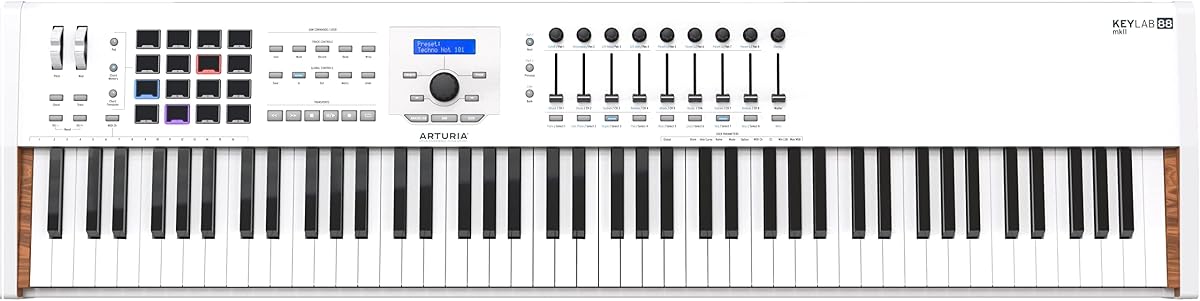
The Arturia KeyLab 88 MkII remains one of the most compelling premium choices in the roundup. Its 4.6 rating reflects a combination of a sophisticated weighted keybed, broad hardware control, and substantial sound-making potential, while the long title accurately captures the feature set.
We may earn a commission when you buy through this link, at no additional cost to you.
Its 88-note Fatar TP/100LR keybed offers hammer-action piano feel with velocity sensitivity and aftertouch. Aftertouch is particularly valuable for nuanced expression, allowing the instrument to respond to pressure changes after a note begins. The 16 RGB-backlit performance pads and bank of nine faders and nine rotary knobs create a substantial production surface.
The included Analog Lab V software expands the instrument's practical value, giving users immediate access to a broad collection of sounds. By comparison, the control surface is unusually comprehensive for a model in this category. The notable omission is a stand, which should be considered as part of the complete setup rather than overlooked after purchase.
The KeyLab 88 MkII is ideal for serious pianists, composers, and producers who want expressive feel and extensive tactile control. It is particularly attractive where aftertouch is part of the playing style. Although the MkII designation suggests an older generation compared with newer models, its core hardware remains a compelling reason to consider it.
Aftertouch lets the keyboard respond to changes in pressure during a sustained note. Combined with velocity sensitivity and hammer action, it offers a high level of physical expression for pianists and sound designers working with virtual instruments.
Nine faders, nine knobs, and 16 illuminated pads make it possible to organize sounds, effects, and performance tasks around hardware. The result is more suitable for an established studio workflow than for someone who wants only a minimal set of note-playing controls.
We may earn a commission when you buy through this link, at no additional cost to you.
The Roland A-88MKII is a professional 88-key MIDI controller built around Roland's PHA-4 action. Its 3.8 rating is lower than those of most alternatives, but the supplied specifications indicate a well-conceived performance instrument with a durable chassis, flexible zones, modern connectivity, and a deliberately thin profile.
We may earn a commission when you buy through this link, at no additional cost to you.
The PHA-4 keyboard is the central attraction for pianists who value a recognized action design. Eight RGB-lit assignable knobs, eight RGB-lit pads, and three pedal inputs support real-time control. Three customizable zones, onboard arpeggiator, and chord memory add compositional tools directly to the hardware.
The shallow body is especially notable for contemporary studios where depth is limited. USB-C connectivity and bus power simplify operation, while MIDI 2.0 readiness prepares the controller for newer communication capabilities. The included control application supports deeper customization and instant recall of configured settings.
The A-88MKII is best suited to pianists who prioritize a familiar professional action, a durable body, and flexible live-performance controls. Its lower rating calls for attention to current owner feedback, and buyers wanting more pads or pedal connections may prefer a larger control surface. Even so, it remains a credible professional choice.
Roland's PHA-4 action is the defining feature for players accustomed to the company's keyboard feel. It supports a piano-oriented performance style while remaining a controller designed to send performance and control information to a computer or other MIDI system.
The thin, shallow-depth design helps conserve valuable desk space. That makes the controller easier to position in a compact production room while preserving a complete 88-note layout and assignable hardware controls.
We may earn a commission when you buy through this link, at no additional cost to you.
Choosing an 88-key weighted MIDI controller involves balancing keyboard realism with the controls, software, connectivity, and physical footprint needed for your particular music-making workflow.
True hammer-action and graded weighted keybeds aim to reproduce the mechanics of an acoustic piano, including resistance that changes across the range. Semi-weighted keys use a lighter, more uniform response designed to feel substantial without the bulk of a piano action. Hybrid synth-piano keys blend characteristics and may feel particularly comfortable for synthesis-oriented playing. The term weighted does not describe one identical mechanism across every category.
Choose a true weighted or graded action for expressive piano playing and sustained software-piano performance. A semi-weighted keybed may be sufficient for composition, lightweight stage use, or users who prioritize compactness. Confirm the exact action type rather than relying on the broad phrase weighted keys.
Velocity sensitivity allows the controller to report how forcefully a key is pressed, giving virtual instruments a more musical dynamic range. Aftertouch goes further by responding to pressure changes during a note, particularly after the initial attack. It is valuable for vibrato, swelling tones, filter movement, and other expressive techniques, but not every virtual instrument uses it effectively.
Prioritize velocity sensitivity for virtually any serious controller. Treat aftertouch as a specialized advantage for pianists, expressive performers, and sound designers. Confirm that the sound library can interpret it and that the playing style will actually use the additional control.
Pads, faders, knobs, encoders, transport buttons, pitch and modulation wheels, and pedal inputs each serve different roles. A songwriter may prioritize chord modes, an arpeggiator, and DAW navigation, while a producer may want numerous assignable controls. A hardware surface is useful only when its layout matches the software and tasks you use most.
Favor a manageable set of well-labeled controls over an overwhelming number of unlabeled functions. Check whether buttons are assignable, whether displays provide meaningful feedback, and whether common actions can be reached without navigating deeply through menus.
Automatic mapping can make setup easier, while custom scripts and dedicated integration modes provide more precise control over a DAW. Compatibility may include direct access to transport, tracks, mixer channels, plugins, or instrument parameters. Software bundles also matter because they determine which sounds are available immediately after installation.
Use the DAW you already know as a central criterion. Check whether the controller supports it directly, whether its integration is customizable, and whether the included software covers your preferred genres. Treat bundled subscriptions as temporary resources unless their duration is confirmed.
USB connectivity, bus power, MIDI output, and digital audio connections affect how the controller fits into a studio. Native MIDI output is valuable for controlling hardware synths, while a single USB connection can simplify a computer-based setup. Pedal inputs matter most to pianists, but count the available sockets and verify the supported pedal types.
Prioritize a connection method that matches your equipment and avoid assuming every keyboard function is available through a simple USB cable. Check the latest manual or listing for supported operating systems, drivers, cable requirements, and audio features before finalizing the purchase.
A full 88-key controller requires a broad playing area, but its depth and weight can vary substantially. A slim model may be easier to integrate into a compact studio, while a heavier premium instrument can feel more stable during long sessions. Material quality also affects perceived durability and appropriate use in touring, rehearsal rooms, and fixed studios.
Measure the available desk or stand space and consider how often the controller will be transported. Choose a sturdy keybed and chassis for frequent use, but do not overlook the logistics of moving and storing a full-size instrument.
A dedicated MIDI controller is primarily an input device for software or hardware, while a digital piano is designed to produce sound directly. Some digital pianos can also communicate with a computer, but a MIDI output alone does not provide a controller's DAW buttons, assignable faders, transport controls, or production pads. A product's primary purpose should match the intended use.
Buy a digital piano for standalone playing and built-in sound, and buy a MIDI controller for software control. If both goals are essential, confirm the digital piano's computer and MIDI features directly, or plan to use each instrument for its most appropriate role.
Begin by placing the controller on a stable, appropriately sized stand or desk, then connect its power and data cables before starting the computer software. Select the correct MIDI input in the DAW, set the controller as the active keyboard source, and confirm that a software instrument is receiving notes. Configure velocity, pitch bend, modulation, and pedal assignments one at a time so each control can be verified independently.
Next, tailor the control surface to the project. Assign only the pads, knobs, faders, or buttons that will be used regularly, and give them clear names or color-coded labels. Use zones when different sections of the keyboard need to control different instruments, and save separate DAW or controller presets for songwriting, live performance, and mixing. Test chord, scale, and arpeggiator modes in a safe section before relying on them during a performance.
Care for the weighted action gently and consistently. Avoid leaving liquids, food, or debris near the keys, and clean the surface with a soft, dry or lightly damp cloth according to the manufacturer's instructions. Do not push down individual keys unnecessarily, tighten the chassis beyond its normal setting, or use force when reconnecting cables. Store the instrument in a stable environment with minimal humidity variation, and inspect pedals, connections, and controls periodically.
Weighted keyboards are designed to resist key movement, but the term can cover several different action styles. Semi-weighted models use moderate, relatively consistent resistance, while hammer-action models imitate the graduated mechanical action of an acoustic piano. Hybrid synth-piano keybeds blend characteristics from different instrument types. The most realistic option generally depends on the player's technique and the virtual instruments being used.
No. Heavier or more mechanically complex models often feel more substantial, but weight alone does not determine quality. Key action, sensitivity, build, controls, software integration, and portability all affect the experience. A lighter controller may be better for mobile work, while a more substantial model may suit a fixed studio and long performance sessions.
Aftertouch is not essential for every piano recording. Velocity sensitivity is the primary way a MIDI keyboard communicates initial note strength, while aftertouch captures later pressure changes. It becomes valuable for expressive phrasing, vibrato, and sounds that respond to continuous pressure. If the software piano does not use aftertouch, the feature may add little to the final recording.
A digital piano can be suitable if it provides the required MIDI and USB connectivity, but it is not automatically equivalent to a dedicated MIDI controller. A digital piano may offer excellent playing feel and built-in sounds while providing fewer DAW controls, assignable buttons, or production pads. Confirm its computer-related features before choosing it for a production-centered setup.
For many home-studio users, velocity-sensitive keys, pitch and modulation wheels, sustain pedal input, and a modest set of assignable knobs or pads are enough. DAW integration can add substantial value by exposing transport, mixer, and plugin controls. The most useful configuration is the one that supports recurring tasks without requiring constant navigation through software menus.
Prioritize controls only if they correspond to tasks performed regularly; unused buttons add complexity rather than capability. A display is valuable when it shows settings, parameter values, track information, or modes that would otherwise be difficult to remember. For a simple setup, a focused control surface and clear software feedback may be more useful than either an enormous button count or an elaborate display.
Use a properly fitted padded case or flight case and support the instrument so that its weight is not carried by the keys. Protect the key surfaces from impacts, keep cables secured, and avoid placing heavy objects on the controller. Before moving it, unplug the cables and remove any detachable accessories. For frequent travel, a case rated for the keyboard's size and weight is especially important.
Ratings can provide useful context, but they do not capture every aspect of a keyboard's feel, build, software support, or workflow. Key action and control layout vary even among closely related models. Reviews should be combined with verified specifications, especially when comparing a digital piano with dedicated MIDI controllers or different weight technologies.
The M-Audio Keystation 88 MK3 stands out as a value-focused and approachable full-size controller, while the Novation Launchkey 88 MK3 offers polished DAW integration and creative performance tools. The Arturia KeyLab 88 MkII is the strongest premium selection here for its hammer-action feel, aftertouch, extensive faders and knobs, and illuminated performance pads.
Your priorities should determine the final choice. Choose a true weighted or hammer-action model for piano-oriented expressiveness, a semi-weighted or hybrid keybed when portability and a more manageable action matter, and a digital piano when standalone sounds and immediate playing are the main goals. Verify DAW support, pedal connections, included software, and current specifications before purchasing.
Product ratings, software bundles, configurations, and availability can change, so check the current listing and manufacturer information at the time of purchase. Taking the time to match the key action and control layout to your actual playing style will produce a more satisfying and productive long-term setup.