
Antrader 20-Pin IDC Cable
4.7Editor score
Six matching cables included
30 cm usable length
2.54 mm connector spacing
28 AWG stranded conductors
Female-to-female construction
20 Pin Flat Ribbon Cable guide comparing connector types, pitch, length, voltage, and applications to help you choose a cable for electronics projects.
A 20 pin flat ribbon cable is a compact way to connect circuit boards, memory devices, displays, programmers, and other electronics. Because connector pitch, row configuration, cable length, and termination style can differ significantly, the right cable depends on the hardware and the space available inside your project.
This guide compares ten 20 conductor ribbon cables with an emphasis on pin pitch, connector arrangement, length, construction, electrical specifications, and intended applications. It includes traditional IDC assemblies, dual-row female-to-female leads, and compact FFC cables so readers can distinguish between physically different options before buying.
Each numbered review explains the cable's defining characteristics, practical advantages, and limitations based on the supplied product information. Ratings are included for quick reference, while product availability and pricing can change over time. Always verify connector dimensions and pin compatibility with the equipment before ordering.
4.7Editor score
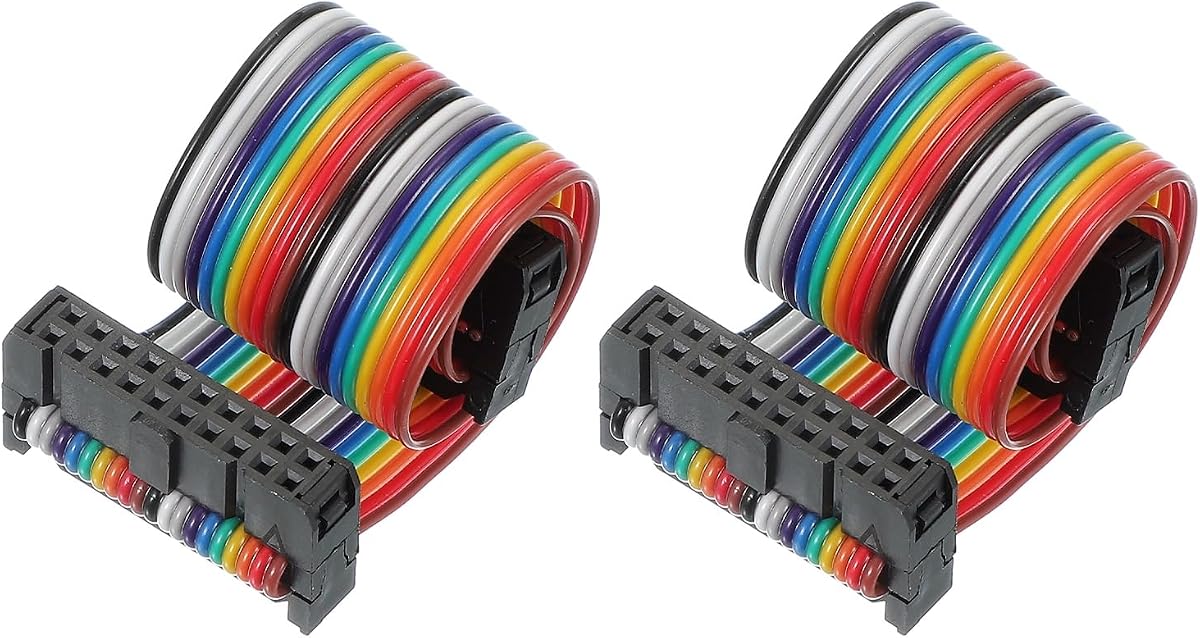
5.0Editor score

4.8Editor score
The comparison below highlights the major differences among these ten cables, including conductor pitch, connector type, cable length, package quantity, and typical use. These specifications matter because a visually similar 20 pin lead may still be incompatible if its pitch, contact arrangement, or termination differs.


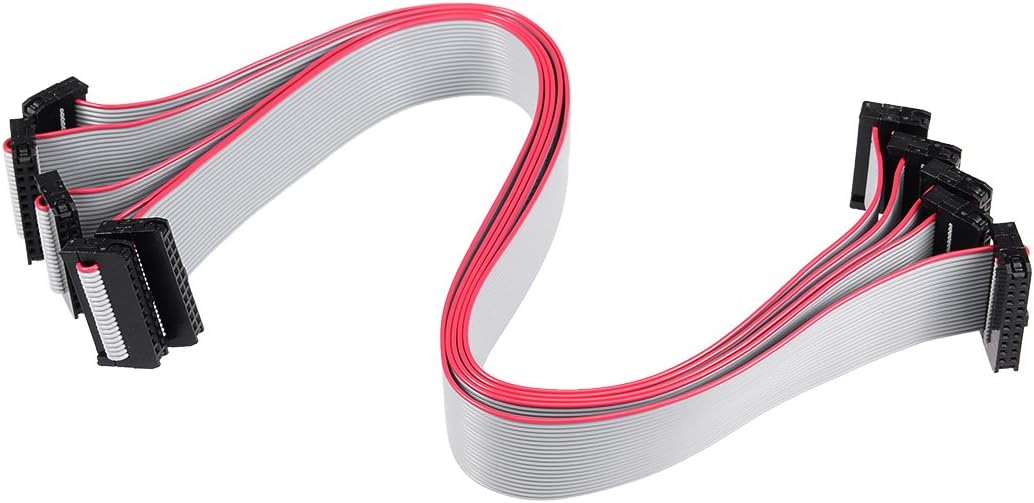
The Antrader F/F IDC Connector cable earns a 4.7 rating and stands out as a practical choice when a project needs several ready-to-use ribbon leads. Each 30 cm assembly has female connectors at both ends, while the 20 contacts are arranged as two rows of ten. The package contains six matching cables, reducing the need to buy individual assemblies for repeated connections.
We may earn a commission when you buy through this link, at no additional cost to you.
Its most useful features are the 2.54 mm female connector spacing, 28 AWG stranded wire, and 300 V specification. The flat construction suits digital cameras, camcorders, laptops, LCD televisions and monitors, Atmel AVR JTAG debuggers, in-system programmers, and ISP download equipment. Because the conductors can be separated for clean terminations with standard wire connectors, jacks, and pins, the cable also offers some flexibility for custom work.
The tradeoff is the relatively short 30 cm length. That is enough for a close internal connection inside a compact enclosure, but it may not reach between widely separated components. Users must also match the connector geometry carefully; the cable is designed around 2.54 mm headers and a two-row, 20-contact arrangement, so it will not fit a connector with a different contact spacing.
This is a strong selection for builders assembling several small systems, prototyping multiple boards, or keeping spare ribbon leads on hand. It is particularly useful when a 30 cm lead and 2.54 mm female-to-female connection meet the project requirements. For those needs, the multi-pack format makes it a practical budget-oriented choice without requiring cable fabrication.
Six identical assemblies are useful for repeatable prototypes, maintenance work, or projects involving several boards. Having multiple matched leads also makes it easier to replace a lead without searching for another unit with the same length and termination.
The 28 AWG stranded conductors and 300 V specification suit many low-voltage internal interconnects. The stated uses span programming equipment, consumer electronics, displays, and embedded-development accessories, making this a versatile lead for common maker tasks.
We may earn a commission when you buy through this link, at no additional cost to you.
This uxcell IDC cable has a 4.8 rating and offers a compact solution for internal wiring where 1.27 mm conductor spacing is required. The package includes two 20 cm assemblies with female connectors. Its small 12.6 mm total width and short length are useful in tightly packed electronics, where a broader or longer ribbon could be inconvenient.
We may earn a commission when you buy through this link, at no additional cost to you.
The 1.27 mm pitch is the defining specification. It differs from the more familiar 2.54 mm arrangement found on many development boards, so users should confirm the receiving connector before purchasing. Once compatibility is established, the female connector can be inserted directly into a suitable PCB header, and the flat profile helps keep internal wiring tidy.
Its main limitation is the 20 cm length, which is better suited to a nearby connection than a larger enclosure or a cable run between distant components. The product information lists office equipment and video machines as suitable applications but does not provide the same detailed voltage or temperature information given for some competing products.
This cable is a sensible pick for electronics builders working with 1.27 mm headers and compact internal layouts. The two-pack format is useful for projects needing more than one short lead, while the 4.8 rating adds confidence for buyers comparing a small, precisely specified IDC option.
The narrow 12.6 mm width and short 20 cm lead can make routing easier around crowded PCB components. It is particularly relevant to office and video equipment where a compact internal connection is more useful than maximum reach.
The 1.27 mm pitch is correct for devices with matching fine-pitch contacts, but it will not substitute for a standard 2.54 mm ribbon. Confirm both contact spacing and the number of rows before installation.
We may earn a commission when you buy through this link, at no additional cost to you.
The uxcell FC/FC A-Type cable combines a 4.8 rating with an unusually useful one-meter length. It has 20 contacts at a 2.54 mm pitch and FC-to-Female connectors on both ends. That combination makes it a better fit than a short assembly when two boards or devices need more separation.
We may earn a commission when you buy through this link, at no additional cost to you.
Color-coded wires make individual conductors easier to identify during installation or troubleshooting. The ribbon design supports neat circuit interconnections, and the conductors can be separated for clean terminations with standard wire connectors and pins. Listed applications include digital cameras, camcorders, laptops, LCD televisions and monitors, 3D-printer expansion, circuit boards, LEDs, lights, and computers.
The trade-off is that FC-to-FC A-type is a specific termination, and the supplied information does not indicate that these connectors are interchangeable with standard female IDC headers. Buyers should inspect the socket shape and orientation. One meter may also be excessive for a small enclosure, where excess ribbon can interfere with neighboring components or make closure difficult.
This is the top choice for a long, color-coded 20 pin connection using FC A-type sockets. It combines a useful length with a conventional 2.54 mm pitch, while the 4.8 rating places it among the strongest-reviewed products in the group. It is particularly useful in larger builds, educational electronics setups, and multi-board arrangements that need extra reach.
A one-meter ribbon can connect components located farther apart than the 15 to 30 cm alternatives. It also provides enough material to route around obstacles while preserving a clean, flat appearance.
Distinct conductor colors help users keep track of individual lines during setup and inspection. The color scheme is particularly helpful in crowded assemblies where individual signal paths need to remain visually traceable.
We may earn a commission when you buy through this link, at no additional cost to you.
The 20 Pin Rainbow Color Flat Ribbon IDC Cable has a 4.7 rating and offers a different kind of flexibility from the pre-terminated options. Its five-meter length provides ample material for custom projects, while the absence of fixed end connectors allows the ribbon to be cut and terminated according to the equipment involved.
We may earn a commission when you buy through this link, at no additional cost to you.
The cable uses plastic and copper, with a total width of 24 mm and 1.27 mm pitch. The product information also lists a capacitance of 40 PF/M and a conductor stranding measurement of 10.7 mm. Rainbow coloring helps distinguish individual circuits, which is valuable when the cable is divided among several destinations.
The primary drawback is that this is not a ready-to-connect lead. Suitable IDC connectors, a crimping process, and careful conductor alignment may be required. Users without experience terminating ribbon cables should account for the extra setup involved. The long cable can also be unnecessary for straightforward projects with short internal connections.
Choose this option when custom cable length, routing, or termination is more important than immediate plug-and-play convenience. It is a good workshop material for creating several specialized 20-conductor leads from one long ribbon, especially where individual signal identification and extra material are priorities.
Five meters gives enough ribbon for custom leads, multiple branches, or unusually long routes. Users can create a length that matches a specific enclosure instead of accepting a fixed pre-terminated dimension.
Because the ends are unterminated, the ribbon can be fitted to compatible IDC contacts and configured for a particular board or enclosure. The rainbow conductor colors remain useful when many separate circuits occupy the same ribbon.
We may earn a commission when you buy through this link, at no additional cost to you.
The Antrader 1.27 mm gray ribbon earns a 4.6 rating and is positioned for users who want a long, unterminated 20 pin cable suitable for 2.54 mm IDC connectors. Its five-meter length is generous, and the gray construction gives it a neutral appearance for internal assemblies.
We may earn a commission when you buy through this link, at no additional cost to you.
Its conductor construction uses seven-core tinned copper with a PVC insulation cover. The cable has 1.27 mm conductor spacing, while the product title specifies compatibility with 2.54 mm connectors. This distinction matters: the spacing between individual conductors is finer than the pitch of the finished IDC contacts to which the ribbon will be attached.
As with other unterminated ribbon options, users need suitable connectors and the correct termination equipment. The fine 1.27 mm conductor spacing can make alignment more demanding than working with a wider ribbon. The product information lists computers, industrial instruments, and automation machinery among its applications, which is useful context for industrial and maker environments.
This cable is a good workshop option when a project requires several 2.54 mm IDC-terminated leads of different lengths. The lengthy spool, durable conductor specification, and matching of the ribbon to 2.54 mm contacts make it more specialized than a ready-made female-to-female cable, but also more adaptable for custom internal wiring.
The long ribbon can produce multiple leads for equipment, prototyping, or maintenance inventories. Because it is designed to match 2.54 mm IDC connectors, it can serve as a common source material when a project uses that connector size.
Seven-core tinned copper and a PVC cover make the listed construction suitable for internal wiring in computers, industrial instruments, and automation machinery. Actual suitability still depends on the project's electrical and environmental requirements.
We may earn a commission when you buy through this link, at no additional cost to you.
The uxcell 150 mm FFC cable is a 20 pin, 0.5 mm-pitch option built for compact electronics. Its 4.3 rating is the lowest in this group, but its defining advantage is physical density. The thin flexible construction is well suited to laptop, LCD, DVD-player, camera, stereo, and computer-module connections where a conventional IDC ribbon would be too large.
We may earn a commission when you buy through this link, at no additional cost to you.
The A-type configuration places the contacts on the same side at each end. Reinforced stiffeners at the ends support easier insertion, while the flexible plastic-film base and bonded metallic conductors create the characteristic FFC form. Five cables are included, giving users several short options for display and module work.
Compatibility is the main consideration. A 0.5 mm pitch and A-type contact arrangement must match the equipment exactly, and the 60 V dielectric strength and 80-degree Celsius heat-resistance figure should be considered for the intended installation. Its short length and lower rating also make it less compelling for general-purpose use than the higher-rated IDC options.
This is a focused choice for compact display or module projects with matching 0.5 mm contacts. It is not a general substitute for a 2.54 mm ribbon, but in a suitable laptop, display, or electronics module, its thin profile and reinforced ends can be exactly what a conventional cable cannot provide.
The 0.5 mm pitch allows 20 contacts to fit into a much narrower cable than a standard IDC assembly. That makes the lead appropriate for high-density devices where connector footprint matters as much as signal routing.
Stiffeners at both ends help the thin cable enter its matching socket more reliably. The A-type same-side contact arrangement still needs to match the device exactly, but it reduces the need to manipulate a very delicate flexible end.
We may earn a commission when you buy through this link, at no additional cost to you.
The uxcell 250 mm FFC cable provides a longer version of the compact 20 pin format. With a 4.5 rating, five included cables, and an A-type configuration, it suits projects that need more routing freedom than a 150 mm lead but still require a slim flexible cable.
We may earn a commission when you buy through this link, at no additional cost to you.
The cable maintains a 0.5 mm contact pitch, 60 V dielectric strength, and an 80-degree Celsius heat-resistance specification. Metallic conductors are bonded to a flat flexible plastic-film base, and each end has a stiffener to support insertion. Listed applications include digital cameras, camcorders, laptops, LCD televisions and monitors, DVD players, stereo and audio systems, and computer modules.
Like other FFC products, it has narrow application boundaries. The 0.5 mm socket and A-type contact orientation must match, and the stated voltage and temperature figures should be checked against the equipment. The 250 mm length is more useful for routing around a display housing or between separated modules, but it can still be excessive in a very compact enclosure.
This is a good selection for display, camera, and module builders who need a little more length than the shorter 150 mm option. Its 4.5 rating and included five-pack offer a practical middle ground between ultra-compact FFC leads and much larger standard-pitch IDC cables.
At 250 mm, the lead offers extra routing distance while retaining a very small cross-section. It can bridge separated components in a display or module assembly without introducing the width of a conventional ribbon cable.
The package contains five matching assemblies, which is helpful for prototyping or maintaining more than one device. All have the same length, pitch, and A-type orientation, simplifying replacement and inventory management.
We may earn a commission when you buy through this link, at no additional cost to you.
The BLS 20-Pin F/F extension has a 4.8 rating and is one of the strongest choices for a long, ready-terminated connection. Its 150 cm length provides much more reach than the 15 to 30 cm assemblies, while the 2.54 mm pitch corresponds with widely used dual-row headers.
We may earn a commission when you buy through this link, at no additional cost to you.
The specification is particularly useful for technical buyers. It lists a 300 V withstand voltage, a maximum temperature of 105 degrees Celsius, 28 AWG wire, a width of 2.5 cm, and a 58 g net weight. Female IDC connectors at both ends allow a direct extension between compatible devices without separately preparing the ribbon.
The obvious trade-off is that 1.5 meters is too long for many compact projects. Unused cable can complicate enclosure closure or occupy space around a board. Users must also avoid sharp bends and verify that both ends have the required 2.54 mm female header configuration.
Choose this cable when the distance between two compatible boards or devices is substantial and a ready-made extension is preferred. The high rating, 150 cm length, and clearly stated electrical limits make it one of the most balanced options for prototypes, educational setups, and larger electronics assemblies.
The 150 cm lead can bridge components that are too far apart for compact ribbon assemblies. It can also be routed around obstacles while retaining a low-profile path between devices.
A 300 V withstand rating and 105-degree Celsius temperature specification provide useful reference points when designing an installation. These figures should still be considered in relation to the connected equipment and operating environment.
We may earn a commission when you buy through this link, at no additional cost to you.
The uxcell 2 mm IDC cable has a 4.6 rating and fills a useful gap between common 1.27 mm and 2.54 mm options. It includes five 30 cm assemblies with female connectors, giving buyers a small stock for projects or repairs using 2 mm pitch.
We may earn a commission when you buy through this link, at no additional cost to you.
The cable measures 20 mm in total width and uses plastic construction. It has a 300 V withstand voltage and a 105-degree Celsius temperature rating. Compatible female connectors can be inserted directly into a suitable PCB header, while the flat ribbon format keeps internal wiring organized in office equipment and video machines.
The chief limitation is connector availability. A 2 mm pitch is less common than 2.54 mm, so users must confirm that the target board has the correct contact arrangement. The 30 cm length is also short for widely separated components, and excess cable would need to be managed if a shorter route were possible.
This option is most useful for builders who already know their equipment uses a 2 mm connector. The five-pack, 30 cm length, and clear electrical specifications make it a practical choice for internal wiring and compact prototypes where 2 mm compatibility has been established.
The 2 mm contact spacing offers an option for hardware that cannot use a standard 2.54 mm header. It is valuable in specialized repairs, but exact confirmation of the mating connector is essential.
The female connector, 30 cm lead, and compact 20 mm width suit short internal interconnects. Five included cables make it easy to complete multiple connections without purchasing separate assemblies.
We may earn a commission when you buy through this link, at no additional cost to you.
The PATIKIL 20 Pins IDC Connector cable holds the highest listed rating in the group at 5.0. It combines a compact 150 mm length with 2.54 mm dual-row female-to-female connectors, making it a straightforward option for close-range connections between compatible devices.
We may earn a commission when you buy through this link, at no additional cost to you.
Its practical strengths are easy installation and clear orientation. No soldering is required: users align the ribbon with the mating header and press firmly. A color-coded red stripe identifies pin one, reducing the chance of placing the cable in reverse. The 25 mm width and 2.54 mm spacing fit a broad range of conventional dual-row connections.
The two included cables and short 150 mm length may be less convenient for larger projects. Users needing several spare leads or a longer run should consider a multi-pack or extended cable instead. As with every female IDC lead, the target header must have matching 2.54 mm contacts and the correct two-row arrangement.
The PATIKIL cable is the strongest all-around recommendation because it combines a top rating with useful installation guidance and a conventional format. It is a good choice for IDE drives, printers, JTAG debuggers, in-system programmers, ISP download equipment, cameras, displays, monitors, and general industrial or DIY electronics work.
The red pin-one stripe removes much of the uncertainty from connecting the ribbon. Press-to-install IDC contacts also allow the lead to be attached without a soldering process, provided the mating header is compatible.
The 2.54 mm dual-row format is associated with many listed applications, including drives, printers, programmers, and display equipment. That makes the cable a versatile starting point for common electronics interconnects.
We may earn a commission when you buy through this link, at no additional cost to you.
Choosing the correct 20 pin ribbon cable begins with the mating connector, not simply the number of conductors. Pitch, contact arrangement, length, termination type, and construction must all align with the device and the space available in the project.
Pitch is the distance between adjacent contacts and is the most important compatibility check. Products in this guide use 0.5 mm, 1 mm-scale fine spacing, 1.27 mm, 2 mm, or 2.54 mm arrangements. A cable with the correct 20 conductor count can still be unusable if its pitch does not match the receiving header. Measure or consult the documentation for the device and compare that value with the cable specification before buying.
Choose the cable with exactly the pitch required by the equipment, not merely the closest option.
Even with the same pitch and conductor count, connectors can use different contact arrangements. IDC products in this list include female-to-female, dual-row, FC-to-FC A-type, and other female configurations, while the FFC leads use same-side A-type contacts. The number of rows, socket shape, and orientation must match the target device.
Treat conductor count as necessary but not sufficient; confirm the complete mating geometry.
The listed lengths range from 15 cm to five meters for unterminated stock. A short cable is convenient inside a compact enclosure, but it may force an awkward route between distant components. A longer cable provides routing flexibility, although excess length can complicate closure and take up unnecessary space. Measure the intended path, allow a little service margin, and include room for bends and connector insertion.
Select the shortest length that comfortably reaches while still allowing easy routing.
Pre-terminated cables are ready for immediate installation and reduce the risk of incorrect termination. Unterminated ribbon stock provides much greater freedom in length, branching, and connector choice, but it requires compatible contacts, correct tools, and more care. The five-meter products are especially useful for builders who want to create several custom leads rather than connect one pre-made assembly.
Choose finished leads for straightforward projects and raw ribbon for custom fabrication.
IDC ribbons are built for circuit interconnections and may use stranded copper conductors with plastic insulation. FFC and FPC-style cables use bonded metallic conductors on a thin flexible film base, making them much more compact but less mechanically robust. The supplied options describe 28 AWG stranded wire, seven-core tinned copper, plastic insulation, and reinforced FFC ends. These distinctions influence flexibility, installation method, and expected handling.
Use flexible FFC construction for dense modules and IDC cable for broader interconnects.
Some listings provide detailed voltage and temperature figures, including 300 V withstand ratings and 105-degree Celsius limits, while others provide less complete information. The 60 V dielectric strength of the FFC options is notably lower than the 300 V figures given for several IDC products. Users should compare the cable's stated limits with the device's requirements rather than assuming every 20 pin ribbon has the same electrical capacity.
Check voltage, temperature, and conductor details against the intended installation.
A flat ribbon can route through narrow gaps, but the correct width and bend behavior still matter. IDC cables with a 25 mm width may need more clearance than a 12.6 mm or 20 mm option. Thin FFC cables excel in laptop, display, and module applications, although they require exact connector alignment and careful handling. Consider the enclosure, neighboring components, and the amount of flex the installation will experience.
Prioritize physical clearance and flex demands before selecting a cable.
Multi-packs are useful for prototypes, repeated repairs, and keeping spare assemblies on hand. The available quantities range from one to six cables, with two-cable and five-cable packs providing a middle ground. A larger set can also simplify replacement because the user does not need to find another cable with the exact same length, pitch, and termination. For one-off installations, a two-piece pack may already be sufficient.
Choose a pack size that matches expected use without creating unnecessary clutter.
Begin by disconnecting the power to both connected devices. Identify pin one on the cable and the receiving header, align the connector with the correct row, and insert it evenly. IDC-style assemblies are typically pressed into place, while FFC cables may use a locking latch. Never force a connector whose pitch, row arrangement, or orientation does not match the socket.
Route the ribbon away from sharp edges, moving fans, hot components, and places where it could be pinched during closure. Avoid tight bends and excessive pulling, particularly with fine-pitch FFC and unterminated ribbon. For a custom termination, use contacts and tools appropriate for the conductor pitch, maintain conductor alignment, and follow the connector manufacturer's handling guidance.
Inspect connectors and cable surfaces periodically. Look for loose contacts, damaged insulation, conductor exposure, sharp creases, or contamination. Keep the ribbon away from moisture and excessive heat, and do not exceed the cable's listed voltage or temperature specifications. Disconnect it before servicing the connected equipment, and replace the cable if a connector becomes loose or the conductors are damaged.
An IDC ribbon cable uses individual or grouped conductors that are pressed into insulation-displacement contacts, while an FFC uses conductors bonded to a very thin flexible film. IDC cables are common for internal board interconnects and programming equipment, while FFC cables are especially common in laptops, displays, cameras, and compact modules. The connector style, pitch, and mechanical construction determine which device each cable can connect to.
No. The conductor count alone does not guarantee compatibility. The cable must also match the header's pitch, number of rows, contact spacing, connector type, and orientation. A 20 pin 2.54 mm female IDC lead cannot safely connect to a 1.27 mm or 0.5 mm header, even though each product has 20 contacts.
A female-to-female cable has a socket-style connector at both ends. It usually connects to male header pins on two devices. These leads are convenient for extension, programming, and internal interconnections, but the user must still confirm the pitch, row count, and physical shape of the male headers on both sides.
Measure the shortest practical path between the two connection points and add enough margin for bends, insertion, and servicing. A 15 to 30 cm lead is usually convenient for devices in the same enclosure, while a 90 to 150 cm assembly offers more routing freedom. Unterminated five-meter stock is useful when several custom lengths are required.
Pre-terminated IDC leads generally do not require soldering because the connectors are already crimped onto the ribbon. A user aligns the IDC socket with a compatible header and presses it firmly into place. Custom-terminated raw ribbon is different because the contacts must be attached with the correct crimping tool and procedure.
Avoid sharp bends and repeated flexing at the connector ends. The thin conductor film and reinforced ends are designed for flexibility, but tight folding can damage internal traces or make insertion unreliable. Route the cable in a broad curve, keep it clear of pinch points, and use the device's supported orientation or guide.
Not necessarily. A listed withstand voltage indicates a level associated with insulation or dielectric survival, not an automatic recommendation to operate continuously at that level. The actual operating voltage, current, temperature, and circuit conditions must remain within the requirements of the connected devices and the complete installed system.
Many assemblies use a color-coded stripe, with red commonly identifying the conductor corresponding to pin one. The PATIKIL product explicitly identifies a red pin-one stripe, while the color-coded IDC products provide a similar visual aid. If the cable lacks a clear marker, consult its documentation and confirm the header orientation before applying force.
The PATIKIL dual-row cable stands out as the strongest all-around option because it combines a 5.0 rating, conventional 2.54 mm spacing, a compact 150 mm length, and clear pin-one orientation guidance. The uxcell FC-to-FC A-Type cable is ideal when more routing length and color-coded conductors are priorities, while the six-pack Antrader is a practical choice for repeated prototypes and common 2.54 mm interconnects.
Before choosing any cable, verify the mating pitch, row arrangement, connector shape, and contact orientation. Then consider length, package quantity, and construction: a raw 1.27 mm ribbon offers fabrication flexibility, an FFC is best for dense display and module applications, and a ready-terminated lead is usually the simplest option for internal wiring.
Ratings and product details provide a useful starting point, but current prices, availability, and seller details can change. Check the latest listing and manufacturer information before purchasing, and select the cable that matches the actual device rather than relying on the shared 20 pin description alone.