
UGREEN NAS DH2300
4.5Editor score
Simple two-bay personal storage
4GB onboard memory
1GbE network connection
AI-assisted photo organization
Phone backup and sharing
NAS for Jellyfin guide: compare 10 models for local media streaming, storage capacity, network speed, app support, setup ease, and overall value.
A NAS for Jellyfin can turn scattered movie files, television episodes, home videos, and music into a private, always-available media library. The right enclosure should offer enough storage, responsive networking, quiet operation, and the processing power needed for direct playback or hardware-accelerated transcoding.
This guide compares ten NAS models based on the information supplied for each product, including drive-bay count, networking, memory, supported applications, expandable storage, and setup features. It covers entry-level units, creator-oriented enclosures, premium four-bay systems, and high-capacity models for demanding libraries.
Each pick highlights a different path for Jellyfin users: the DXP4800 Plus leads as a versatile all-rounder, the DXP2800 targets advanced home users, and the DH2300 offers a simpler personal media hub. Ratings, specifications, availability, and prices can change, so confirm the current listing and compatibility details before purchasing.
4.5Editor score
4.6Editor score

4.3Editor score
This side-by-side comparison highlights the major differences in drive capacity, network performance, processor class, memory, and application support. It is designed to show which models suit personal libraries, busy family homes, active creators, and larger media collections.




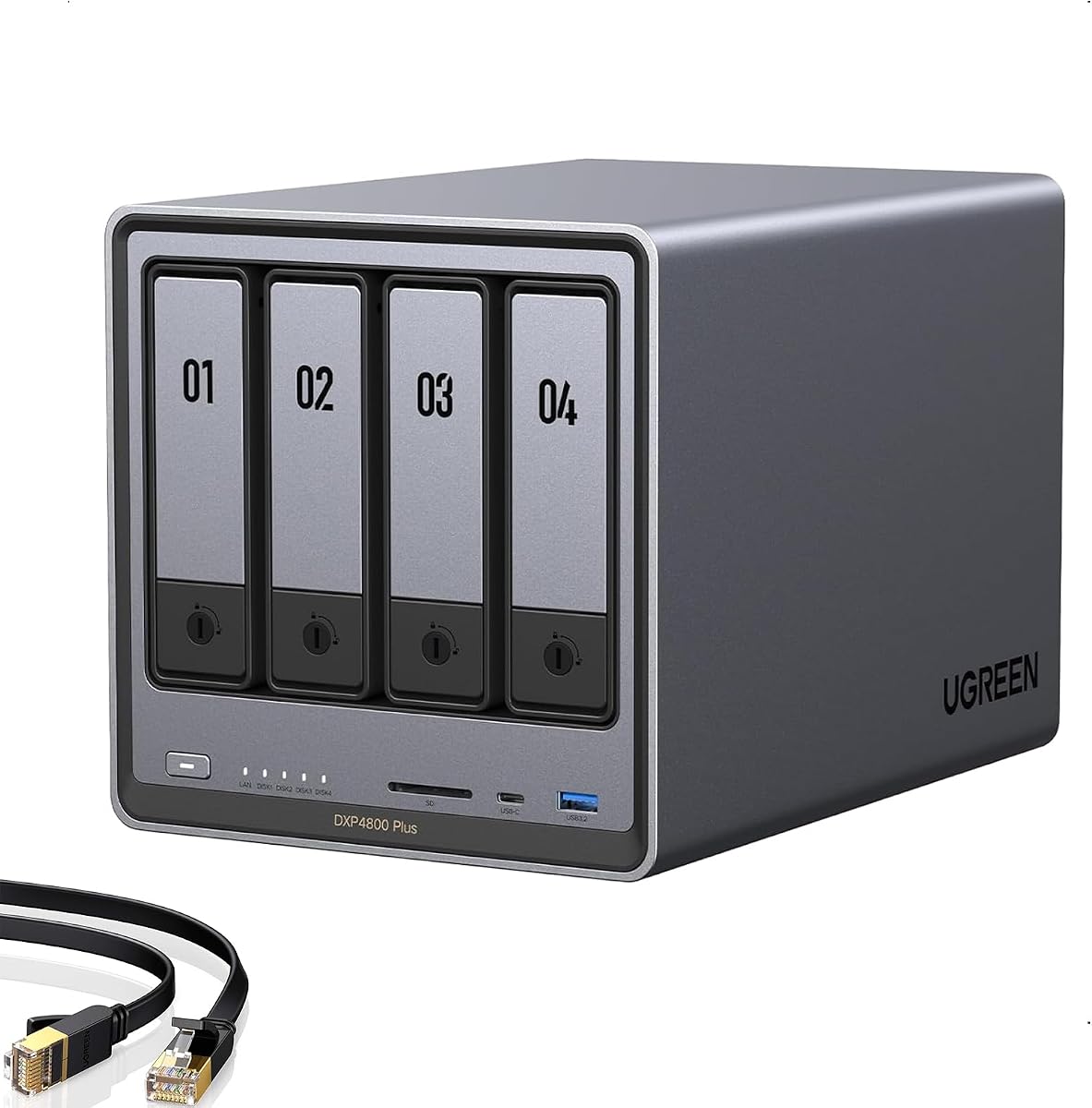
The UGREEN DXP4800 Plus is the most balanced enclosure in this guide for a household that wants more than simple file storage. It carries a 4.6 rating and combines four drive bays, a 10GbE network connection, 10Gbps USB ports, Docker support, virtual-machine capability, and a stated maximum capacity of up to 144TB. Those features make it well suited to hosting Jellyfin in Docker while retaining room for backups, applications, and additional services.
We may earn a commission when you buy through this link, at no additional cost to you.
Its standout strength is network headroom. A 10GbE connection is valuable when a large file library must be indexed, reorganized, or copied from another high-speed source. It also makes the NAS more practical as a general-purpose home server rather than a media-only appliance. The four-bay layout permits a balanced storage strategy, such as pairing drives in a mirrored arrangement for protection while considering SSD acceleration or separate application storage.
There are trade-offs to consider. No hard drives are included, so the completed system requires a storage investment and compatible media drives. The supplied information also notes that actual transfer speed depends on the router, CPU, drive, and size of the files. In addition, Plex is run through Docker, illustrating that app-based media servers require manual configuration rather than a fully automatic installation.
The DXP4800 Plus is the strongest general recommendation for families, creators, and small teams that want room to grow. It suits users comfortable with basic NAS administration, especially those who understand drive compatibility, RAID, and Docker. Those wanting a completely simple appliance with minimal configuration should consider a more conventional option, but few models combine this much storage flexibility with high-speed networking and broader server features.
The 10GbE port gives this NAS enough network bandwidth to handle large libraries and active multi-user access. It is particularly useful when transcoding, thumbnail generation, or file indexing keeps the storage system busy while media plays elsewhere.
Docker and virtual-machine support create a flexible base for Jellyfin and other self-hosted services. Users can keep the media server on the same enclosure as file sharing, photo management, remote access, and automated backup workflows.
We may earn a commission when you buy through this link, at no additional cost to you.
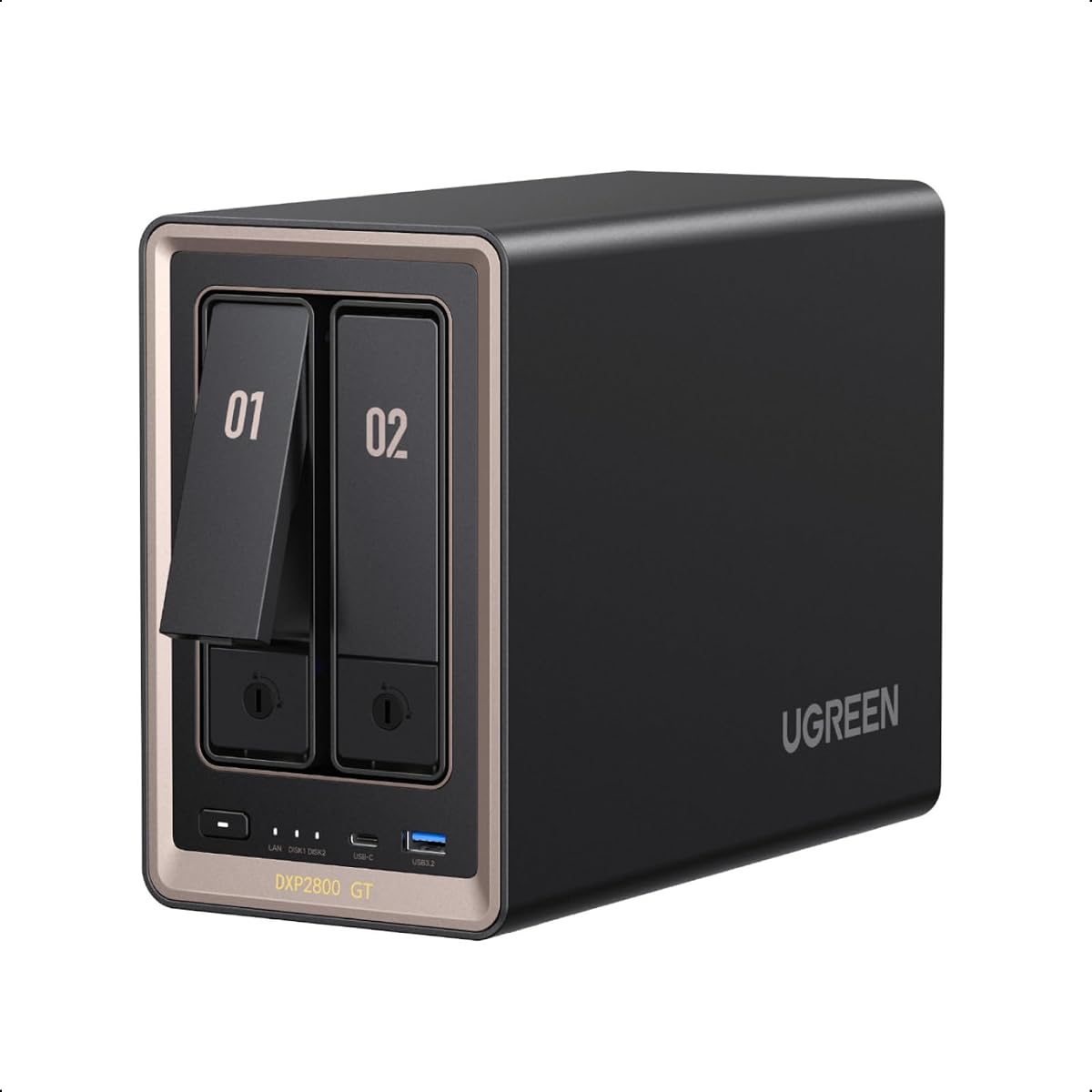
The UGREEN NAS DXP2800 is a compact yet unusually capable choice for an advanced home user who wants to run Jellyfin and several other services. Its 4.6 rating reflects a competitive feature set: an Intel N100 quad-core processor, 8GB DDR5 RAM, 2.5GbE networking, two M.2 NVMe slots, Docker, virtual machines, and support for up to 80TB across two HDD bays and the NVMe expansion positions.
We may earn a commission when you buy through this link, at no additional cost to you.
The processor and memory combination is the key differentiator. This is not positioned as a basic file box; it is designed for heavier workloads, multiple applications, and media libraries that benefit from a dedicated app environment. The NVMe slots can provide fast storage for databases, application data, transcoding scratch files, or other frequently accessed content, while the SATA bays handle the bulk media collection.
Its limitations are mostly about physical expansion. Two main bays place it below four-bay alternatives when a collection is growing quickly, and a two-drive configuration may require careful RAID planning if data protection is important. Like the DXP4800 Plus, it arrives without hard drives or SSDs, and Jellyfin is treated as an application that can run through Docker rather than a preinstalled media-server appliance.
Choose the DXP2800 when two high-capacity drives are enough for your library but you still want modern app support and faster networking than an entry-level 1GbE model. It is particularly attractive to creators, remote workers, and technical enthusiasts who value 2.5GbE, NVMe expansion, and a capable processor. For straightforward family streaming with minimal administration, the simpler DH2300 may be easier to live with.
The Intel N100 and 8GB of DDR5 memory give the DXP2800 more headroom for Docker-based media services than a basic personal NAS. That advantage is most valuable when Jellyfin runs alongside backups, indexing, file sharing, and other always-on applications.
Two SATA bays and dual M.2 slots separate bulk media from fast application storage. This mixed-drive design can keep frequently used data responsive while dedicating larger hard drives to movies, shows, music, and archives.
We may earn a commission when you buy through this link, at no additional cost to you.
The UGREEN NAS DH2300 is the entry-level recommendation for a person or couple who wants a private media repository without buying into a complex server platform. It has a 4.5 rating, two bays, 4GB of onboard memory, a 1GbE connection, and a stated maximum capacity of up to 64TB. Those specifications are modest, but they align well with basic Jellyfin use on a home network.
We may earn a commission when you buy through this link, at no additional cost to you.
The product information emphasizes intuitive setup, automatic phone and device backups, cross-platform access, and AI-assisted organization of photos. A NAS also makes sense for users moving away from scattered external drives or recurring cloud-storage habits. For Jellyfin, the appeal is straightforward: keep a personal film, music, or home-video collection on drives that the household controls and reach it from supported devices.
The trade-off is explicit. The DH2300 does not support Docker, virtual machines, or SAN Manager, so it cannot follow the same container-based Jellyfin route offered by the DXP models. Plex also cannot be run through Docker on this unit. Its 1GbE port is suitable for ordinary streaming, although it will not exploit the speed of a 2.5GbE or 10GbE network, and the supplied information notes that actual performance also depends on the router, CPU, drive, and file size.
The DH2300 is best for beginners, personal collections, and households seeking an approachable first NAS. It is not intended for server applications, critical business use, or elaborate multi-service setups. If your goal is simply to organize a manageable personal Jellyfin library and enjoy remote access, this is a sensible option. If you expect heavy transcoding, frequent large-file transfers, or other containers, choose a DXP-series model instead.
The DH2300 avoids the container and virtual-machine complexity found in the DXP range. That simpler design suits someone who wants centralized files, phone backups, and a private media library without maintaining an advanced self-hosted ecosystem.
A 1GbE connection is adequate for typical home playback and many routine file transfers. Larger libraries, simultaneous users, or frequent transfers between high-speed storage devices will benefit more from the faster networking offered by higher-tier models.
We may earn a commission when you buy through this link, at no additional cost to you.
The UGREEN NAS DH4300 Plus gives beginners a four-bay platform with more room than a typical two-bay appliance. Its 4.2 rating is slightly lower than those of the leading DXP models, but the supplied specifications identify a capable feature set: 2.5GbE networking, 8GB LPDDR4X memory, a high-performance processor, up to 128TB of stated capacity, Docker support, and 4K HDMI video output.
We may earn a commission when you buy through this link, at no additional cost to you.
For Jellyfin, the most important strengths are the four-drive layout and faster network connection. Four bays provide a better foundation for a growing family library or a storage plan that balances usable capacity with redundancy. The 2.5GbE port can make initial library population and large transfers noticeably more responsive than a 1GbE alternative, especially when the client and NAS share a suitably fast network.
The unit supports Docker, and the product information states that Plex can be run via Docker. That makes it a more flexible middle ground than the DH2300, although it does not support virtual machines. Storage disks are not included, and advertised capacity is based on RAID 0 with compatible drives. Real-world speed remains dependent on the chosen hard drives, router, processor workload, and file sizes.
The DH4300 Plus is a good fit for home users and remote workers who want a generous four-bay system without moving to a more advanced DXP platform. It is less attractive than the DXP4800 Plus for 10GbE networking, virtual machines, and broader high-performance positioning. However, for local Jellyfin streaming, Docker-based media services, and private family storage, its combination of bays, memory, and network speed deserves consideration.
Four drive bays make this enclosure easier to grow with than a two-bay unit. Buyers can start with the drives they need and add storage later without moving immediately to a larger chassis.
The DH4300 Plus supports Docker but not virtual machines, placing it between the application-ready DXP models and the simpler DH2300. It offers an accessible route to container-based media-server workflows for users who want more flexibility without a premium platform.
We may earn a commission when you buy through this link, at no additional cost to you.
The UGREEN NAS DXP4800 GT is a performance-focused four-bay system for creators, technical enthusiasts, and office teams. It carries a 4.6 rating and is built around an AMD Ryzen Embedded R2514 processor with four cores, eight threads, and speeds up to 3.70GHz. Its 8GB DDR4 memory is expandable to 64GB, while dual 10GbE ports create a strong foundation for large libraries and demanding local workflows.
We may earn a commission when you buy through this link, at no additional cost to you.
Jellyfin is one of several self-hosted applications explicitly supported through the UGOS Pro Docker environment. The product information also lists Emby, Plex, Home Assistant, web hosting, and virtual-machine support, showing that this is intended to be a broader server platform. Its high-speed networking, fast USB connections, 4K HDMI output, SD-card import, and support for M.2 and U.2 NVMe storage can benefit creators moving footage onto a shared library.
Advanced capability brings added complexity. Drive storage is not included, and the preinstalled memory is non-ECC even though ECC upgrades are supported. Plex requires manual Docker setup. Link Aggregation can theoretically combine the two 10GbE connections for greater aggregate bandwidth, but the stated throughput depends on compatible network equipment and a correctly configured setup.
The DXP4800 GT is best for users who want more than a media server and have the technical confidence to configure containers, storage tiers, and network infrastructure. Its advantages become most visible in large libraries, active creative teams, and environments where fast data movement is routine. For simpler household streaming, the DXP4800 Plus provides many of the same broad capabilities with a less specialized configuration.
Two 10GbE ports support high-speed transfers and can use Link Aggregation on compatible equipment. This is valuable when several users access the library or when large media assets move between editing systems and the NAS.
UGOS Pro brings Docker, virtual machines, SAN Manager, surveillance functions, and self-hosted app support into one platform. The result is better suited to creators and small offices that want centralized infrastructure rather than a single-purpose streaming box.
We may earn a commission when you buy through this link, at no additional cost to you.
The UGREEN DXP2800 GT combines a two-bay design with unusually strong performance specifications. Its 4.3 rating accompanies an AMD Ryzen Embedded R2514 processor, 8GB of expandable DDR4 memory, 10GbE networking, and a stated capacity of up to 80TB. That combination makes it a compelling choice for a creator or freelancer who wants faster networking and application capability without moving to a four-drive enclosure.
We may earn a commission when you buy through this link, at no additional cost to you.
The product information explicitly includes Jellyfin among the services that can be expanded through UGOS Pro. Docker, virtual machines, SAN Manager, and Home Assistant support make the unit useful beyond entertainment, while the high-speed network connection can benefit large file transfers, remote access, and media workflows. A built-in surveillance center for compatible ONVIF/RTSP cameras adds another local-storage use case.
The main limitation is drive-bay count. Two SATA bays can hold a significant amount of media, especially with high-capacity drives, but offer less flexibility than a four-bay model when storage needs expand. Like the DXP4800 GT, it supports ECC memory upgrades, although the installed 8GB is non-ECC. Storage drives are separate, and Plex can run through Docker with manual setup.
The DXP2800 GT suits advanced users with a focused library who prioritize processor performance, 10GbE, and server flexibility. It is a stronger fit for active creative workloads than a basic two-bay NAS. If your priority is simply playing a collection of films and shows, much of that extra capability may remain unused, and a simpler or four-bay alternative may deliver a more appropriate balance.
A 10GbE connection gives this two-bay model performance that many larger-capacity competitors lack. It is well matched to users who routinely move large collections or operate a faster local network.
The Ryzen processor, expandable memory, Docker, virtual machines, and 10Gbps USB connectivity create a capable environment for Jellyfin and related workflows. It also suits freelancers who want a compact home server for project files, backups, and media.
We may earn a commission when you buy through this link, at no additional cost to you.
The Synology DiskStation DS925+ is the premium pick in this roundup for buyers who value a mature NAS platform, capable networking, and broad built-in management features. The diskless four-bay model has a 4.3 rating, dual 2.5GbE ports, and stated sequential read/write throughput of up to 522/565 MB/s. Those figures make it attractive for a fast, organized Jellyfin library with room for other household services.
We may earn a commission when you buy through this link, at no additional cost to you.
Dual 2.5GbE connectivity is a major strength. The second port can add flexibility, including link aggregation or a separate network path, when supported by the rest of the environment. The sequential throughput specification also suggests that fast HDD arrays can deliver practical transfer performance for initial library population, backups, and maintenance. Synology's built-in file and photo management, data-protection tools, virtualization options, and surveillance solutions round out the platform.
The enclosure does not include drives, so buyers must select storage that appears on the official compatibility list. The supplied information does not state the installed processor, memory configuration, or Jellyfin installation method, so those details should be confirmed before purchase. The premium positioning also makes this model less compelling for a small library where only basic local streaming is needed.
The DS925+ is best for households, creative professionals, and small offices seeking a dependable, feature-rich NAS with strong networking. It is especially attractive when the user wants a broad Synology ecosystem rather than assembling every media, backup, and surveillance function around a generic container platform. Confirm current hardware specifications and Jellyfin compatibility in the official documentation for the exact configuration.
Two 2.5GbE ports provide a noticeable upgrade over single-gigabit networking and can support aggregation with suitable equipment. This helps when multiple people stream from the NAS or when a large media archive must be copied locally.
Built-in file management, photo tools, data protection, virtualization, and surveillance support make the DS925+ a complete home-server platform. It is a strong option for users who prefer managing media, backups, and shared storage within one established ecosystem.
We may earn a commission when you buy through this link, at no additional cost to you.
The Synology DS425+ is a four-bay private-cloud and media-server model with a 4.7 rating, the highest listed rating in this guide. The supplied information highlights file and media sharing at speeds up to 278 MB/s, support for more than ten concurrent users, granular access controls, audit logs, automated backups, snapshots, and surveillance support for up to 30 IP cameras.
We may earn a commission when you buy through this link, at no additional cost to you.
Those specifications point toward a capable household or small-team NAS. A four-bay layout provides room for a larger Jellyfin collection, and the concurrency figure is reassuring for families watching in different rooms or accessing files while media is streaming. The combination of RAID redundancy, snapshots, and automated backups also addresses the fact that a media server frequently contains valuable personal files alongside disposable entertainment.
Jellyfin-specific installation details are not supplied for this model, so buyers should confirm the appropriate package or container method in current Synology documentation. The enclosure is diskless, requiring compatible storage drives to be added. Its private-cloud focus, audit tools, and enterprise-support option may be more than an individual viewer needs, particularly for a small collection served mainly from one room.
The DS425+ is a strong family pick for buyers who want Synology management and a four-bay design without necessarily choosing the DS925+ tier. It makes sense when simultaneous access, centralized backup, structured permissions, and possible surveillance use matter alongside media streaming. For a single-user library, a two-bay model may be simpler; for larger professional workloads, the higher DS925+ tier offers more stated throughput and networking capability.
Support for more than ten concurrent users makes the DS425+ a credible choice for a busy family. That headroom can be helpful when several people browse libraries, stream simultaneously, or sync files at the same time.
Granular permissions, audit logs, snapshots, automated backups, and RAID redundancy create a strong management foundation. These features are especially useful when a Jellyfin library shares a NAS with work documents, family photographs, and other irreplaceable files.
We may earn a commission when you buy through this link, at no additional cost to you.
The QNAP TS-673A-8G is the high-capacity and highly expandable option in this guide. It has a 5.0 rating, six drive bays, 8GB of installed memory, two 2.5GbE ports, and two M.2 PCIe NVMe SSD slots. That foundation makes it attractive for a large Jellyfin collection, especially when the user also wants room for virtual machines, surveillance, or other networked applications.
We may earn a commission when you buy through this link, at no additional cost to you.
Networking can be expanded through PCIe cards, including options for 10GbE, additional USB 3.2 Gen 2 ports, wireless networking, or Fibre Channel. The two 2.5GbE ports are backward compatible with 1GbE and 100MbE, and port trunking can reach 5 Gbps with suitable networking equipment. Two M.2 NVMe slots support Qtier and SSD caching functions intended to optimize storage performance.
This is a flexible platform rather than a simple appliance. The supplied information notes support for entry-level NVIDIA graphics cards for video processing or GPU passthrough to virtual machines, but it does not state the exact Jellyfin installation workflow. Buyers therefore need to review the current QNAP documentation and their chosen hardware configuration. A six-bay system also demands careful planning for drive compatibility, cooling, backup strategy, and long-term data protection.
The TS-673A-8G is best for enthusiasts, small creative organizations, and households with a large or fast-growing library that justify extensive expansion. It is less attractive for a beginner wanting a small personal collection, but its six bays, memory, dual networking, and PCIe options offer exceptional flexibility. It ranks highly for capacity-oriented Jellyfin use and for users who expect the NAS to evolve into a broader server.
Six drive bays offer a substantial native storage foundation, reducing the need to redesign the entire system as the library grows. That capacity is especially relevant for users collecting high-resolution films, television archives, music, and personal footage.
PCIe expansion can add faster networking, while the M.2 NVMe slots support caching and tiered storage. These features make the TS-673A-8G a strong platform for users willing to tune storage and networking for sustained media performance.
We may earn a commission when you buy through this link, at no additional cost to you.
The Synology DS1823xs+ is the choice for very large media collections and infrastructure-grade storage. Its 4.2 rating accompanies eight native drive bays and support for up to two DX517 expansion units, allowing the enclosure to grow to 18 bays. That scale makes it relevant to users building a serious Jellyfin library or operating the NAS as a shared media and backup platform.
We may earn a commission when you buy through this link, at no additional cost to you.
Operational features are designed for sustained use. Hot-swappable drives support maintenance without powering down the system, while online volume expansion allows administrators to grow storage as needs develop. Synology High Availability clustering, backup, replication, and recovery solutions add availability and resilience options that go well beyond the requirements of an ordinary home streaming box.
This level of capacity carries obvious trade-offs. The product is diskless, so the owner must purchase and configure enough storage for a useful media archive. Eight bays also require consideration of power use, heat, noise, and drive management. The supplied information does not provide processor, memory, networking, or Jellyfin installation details, which means buyers should verify the exact current model specifications and software requirements before committing.
The DS1823xs+ is best for organizations or dedicated enthusiasts who need extensive, serviceable storage and plan to use the NAS for more than casual media playback. A home user with dozens of films may find a two- or four-bay model easier to justify. At the other extreme, users who want large capacity with active expansion should also examine the QNAP TS-673A-8G, which offers six bays and more explicitly detailed networking options in the supplied information.
Eight bays provide substantial room for a large movie and television library without requiring an immediate expansion unit. Users can also add storage through online volume expansion as the collection develops.
Hot-swappable drives, replication, recovery tools, and High Availability clustering make this enclosure appropriate for demanding shared-storage environments. These features matter more when the media library supports several users or business-critical workflows.
We may earn a commission when you buy through this link, at no additional cost to you.
The right NAS for Jellyfin depends on library size, number of viewers, media formats, network equipment, and willingness to manage the system. Drive capacity and bay count determine future flexibility, while processor power, memory, and networking affect indexing, transcoding, and transfer speed.
Drive bays determine how many disks can be installed and how easily storage can expand. A two-bay NAS is sufficient for a personal collection when its two drives can hold the library, while four or more bays offer more freedom for mirrored storage, larger pools, and incremental expansion. The DXP4800 Plus, DH4300 Plus, DS925+, and DS425+ provide four bays, the TS-673A-8G provides six, and the DS1823xs+ starts with eight and supports expansion units.
Match the bay count to realistic growth, not just the largest library imaginable. More bays increase flexibility but also introduce drive costs, heat, and management complexity. For most households building a long-lived Jellyfin server, four bays offer a useful balance.
Advertised maximum capacity describes the sum of compatible drives under a permissive configuration and should not be treated as the usable protected volume size. RAID can add redundancy, but it is not a substitute for backups. Jellyfin libraries, personal media, family photographs, and configuration files should also be backed up to another location or device.
Plan a RAID layout around recovery priorities before adding disks. A mirrored arrangement protects against a single-drive failure, while larger pools offer more raw capacity but different rebuild characteristics. Verify how the model handles expansion and what happens when a disk fails.
The network connection affects how quickly Jellyfin indexes files, how quickly clients can browse artwork and metadata, and how long it takes to populate a new library. A 1GbE connection can handle ordinary home streaming, but 2.5GbE offers useful headroom for larger libraries, multiple viewers, and local transfers. The DXP2800 GT and DXP4800 GT go further with 10GbE, while the DXP4800 Plus includes a 10GbE port.
A fast NAS cannot deliver full network speed through outdated routers, switches, Wi-Fi systems, or client adapters. Use wired connections for the NAS and compare it with the speed of your storage devices and local network before deciding that a faster interface is necessary.
Jellyfin may need to transcode media when the client cannot play the original format or resolution directly. The available processor, memory, and any supported graphics hardware influence how efficiently those conversions run. The DXP2800 uses an Intel N100, the GT models use an AMD Ryzen Embedded R2514, and the QNAP supports entry-level NVIDIA graphics cards for video processing or GPU passthrough to virtual machines.
Most standard-definition and many high-definition files can be direct-played, reducing the need for constant transcoding. However, users collecting 4K or 8K files in less universal formats benefit from a stronger CPU and more memory. Confirm the codec, container, client, and server settings for the media you actually stream.
Jellyfin can be managed through different methods depending on the NAS platform. Several UGREEN DXP and DH4300 Plus models support Docker, providing a flexible way to run Jellyfin alongside other services. The DH2300 does not support Docker or virtual machines, so its suitability depends on the media-server options available through its platform. The Synology and QNAP products require checking the current official documentation for the appropriate installation method.
Docker is powerful but introduces updates, permissions, storage paths, and compatibility management. A native package may be easier for some users, while a container gives more control to experienced administrators. Do not assume every app can be installed in the same way on every model.
Memory helps when the NAS manages several applications, users, indexing tasks, and background processes. The DXP2800 has 8GB DDR5 memory, the DH4300 Plus has 8GB LPDDR4X memory, and the TS-673A-8G includes 8GB. The DXP2800 GT and DXP4800 GT support memory expansion up to 64GB, with ECC-compatible upgrades available for the GT models.
Do not buy extra memory simply because a specification says it is expandable. First estimate the services you will run and consult the product documentation for supported modules and upgrade procedures. The most important benefit of more memory appears when Jellyfin operates alongside other always-on applications.
A Jellyfin server must be filled with content before it becomes useful. USB ports, fast network transfers, mobile-device backups, and removable media imports all affect that workflow. The DXP4800 Plus and DXP4800 GT include 10Gbps USB connections, while the DXP4800 GT also has a built-in SD card slot for importing photo and video files through the NAS app.
Build a repeatable process: connect or copy source media, place it in a deliberate library folder, let Jellyfin scan, and confirm the result. Keep an independent backup of irreplaceable files. Speed during ingestion matters, but data protection and an organized naming structure matter every day.
Long-term ownership involves troubleshooting, drive replacement, software updates, and recovery procedures. UGREEN models listed here provide a two-year warranty and access to guides, troubleshooting resources, a knowledge center, and customer support. The Synology DS925+ includes a three-year limited hardware warranty, while the DS425+ lists enterprise support availability for business-critical environments.
Review the manufacturer's documentation and support structure before setup. Download the relevant user guide, check the drive compatibility list, and record the initial configuration. A clear recovery plan is more valuable than a small difference in advertised transfer speed.
Begin by confirming the enclosure's drive compatibility list and choosing drives appropriate for the intended workload. Install the approved drives, connect the NAS to the wired network, and follow the manufacturer's setup guide. If the enclosure supports Docker and you intend to run Jellyfin as a container, complete the operating-system configuration and container setup before importing the main media collection.
Create separate storage areas for media, metadata, configuration files, and any application-specific data. Give the Jellyfin container access only to the folders it needs, and avoid mixing important source material with a folder that may be modified by indexing or transcoding tasks. Then add the library paths, set the appropriate media types, and allow the initial scan to finish before judging library performance.
Maintain the system by installing important updates, checking storage health, reviewing backup results, and keeping enough free capacity for indexing and temporary work. Use the manufacturer's monitoring and alert tools, replace failed drives according to the documented procedure, and test whether a backup can actually be restored. Keep the enclosure ventilated, avoid placing it in a closed or overheated cabinet, and periodically verify that remote clients can connect without disrupting local playback.
A NAS provides centralized access, automatic organization, remote availability, and a service that can remain running without a computer attached. External drives are simpler for temporary storage or offline backups, but they become less convenient when several household members need simultaneous access. A NAS also makes it easier to combine Jellyfin with photo management, file sharing, surveillance, and automated backup routines.
A two-bay NAS can be sufficient for a modest personal media library, especially if both drives are used efficiently. The DXP2800 adds strong application and networking features, while the DH2300 targets simpler personal use. If you want mirrored protection or expect the collection to grow quickly, four bays generally offer more flexibility.
It matters most when clients cannot play the original file directly and Jellyfin must convert formats, resolutions, or bitrates. A stronger processor can reduce transcoding load and improve responsiveness, particularly for 4K or 8K collections. Standard playback is often dominated by direct play, network speed, and storage rather than processor power alone.
Docker support provides a flexible way to run Jellyfin and manage its configuration, library paths, and updates in a container. The DXP2800, DXP4800 Plus, DH4300 Plus, and both GT models are identified as supporting Docker. You must still create the container, assign the correct media paths, configure permissions, and maintain the image according to the manufacturer's guidance.
For a small number of users watching standard or high-definition media, 1GbE is often adequate. Large 4K files, simultaneous viewers, frequent indexing, and local file transfers benefit from 2.5GbE or faster networking. The entire path matters, including the router, switch, client device, and any intermediate wireless connection.
RAID helps maintain availability when a drive fails, but it does not protect against accidental deletion, malware, enclosure failure, software mistakes, or damage affecting every copy. Keep a separate backup of the Jellyfin configuration, database, and irreplaceable media. RAID should be treated as one layer of protection rather than the only layer.
Several models support NVMe SSDs, which can be valuable for application data, metadata, caching, or frequently accessed files. The DXP2800 includes two M.2 NVMe slots, and the DXP4800 GT supports both M.2 and U.2 NVMe expansion. Check the official compatibility and configuration guidance before installing drives, and remember that storage media is generally sold separately.
Estimate the average size of your movies, television episodes, music, and home videos, then add room for growth and temporary processing. Also consider whether you want mirrored drives, which protect data but require twice the raw drive capacity for one copy. A larger library benefits from a four-, six-, or eight-bay enclosure, while a small personal collection may fit comfortably in two bays.
The UGREEN DXP4800 Plus is the most versatile recommendation because it combines four bays, 10GbE networking, fast USB, substantial expandable capacity, and broad application support. The DXP2800 is an excellent compact alternative for advanced users who can manage their collection in two main bays, while the DH2300 offers the most approachable route for a smaller personal media library.
Prioritize the needs that affect daily use: bay count for future storage, networking for library population and multi-user access, processor capability for transcoding, and software support for the way you want to run Jellyfin. Large or demanding libraries may justify the DXP4800 GT, TS-673A-8G, or DS1823xs+, while Synology buyers can consider the DS925+ or DS425+ for their established management ecosystem.
Before buying, check the current product listing, official drive compatibility list, memory options, and Jellyfin installation guidance. Ratings, specifications, and prices can change, and storage drives are additional components that must be selected for the enclosure. Treat the NAS as the foundation of a long-term media system, and include backups, ventilation, monitoring, and a realistic expansion plan from the beginning.