
QPower 12 Inch Vented Box
4.2Editor score
1.65 cubic-foot internal airspace
Tuned for 42-hertz response
Charcoal carpet exterior finish
Solid MDF tabletop construction
A single 12 Inch Subwoofer Box is the foundation of a capable car-audio bass system, but the best enclosure depends on more than speaker size. Airspace, tuning frequency, port placement, construction quality, mounting depth, and available vehicle space all influence how a subwoofer performs and whether it installs cleanly.
This guide compares ten single-subwoofer enclosures, including portable vented boxes, competition-oriented universal-fit models, a side-ported high-airspace design, a down-firing enclosure, and two complete amplified subwoofer systems. The evaluation considers the supplied specifications, installation features, construction methods, and intended applications rather than claiming hands-on testing.
Each review identifies the enclosure most likely to suit a particular setup, from space-conscious builders to drivers seeking a straightforward powered upgrade. The rankings also show how tuning, internal volume, port design, terminal access, and enclosure shape affect each choice. As with all automotive products, availability, ratings, and market pricing can change, so confirm current details before purchasing.
4.2Editor score

4.5Editor score

4.8Editor score
As an Amazon Associate we earn from qualifying purchases.
The comparison below places every enclosure on the same practical framework, covering configuration, internal airspace, tuning, cutout, and terminal style. It also distinguishes passive boxes from self-contained amplified systems and flags fit details that deserve confirmation before installation.


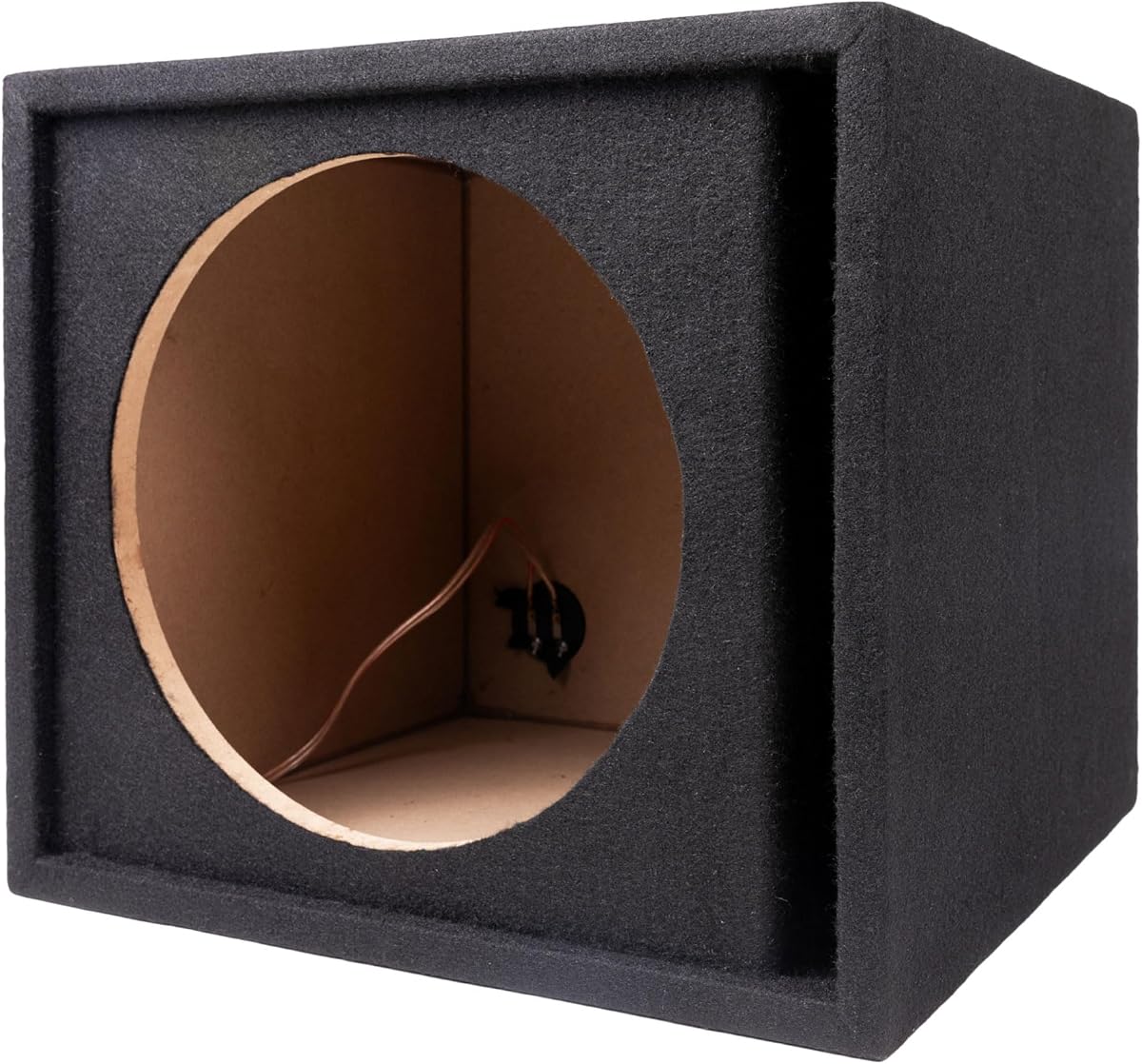


The QPower 12-inch single vented box is a straightforward enclosure for building a compact car-audio system, and its supplied 4.2 rating reflects a broadly practical design rather than an exotic high-output design. Its distinguishing feature is a 1.65-cubic-foot internal chamber tuned to 42 hertz, giving installers a defined starting point for compatible 12-inch subwoofers.
We may earn a commission when you buy through this link, at no additional cost to you.
The enclosure uses solid MDF construction, which helps create a rigid cabinet for a portable installation. Its vented design allows air to move through the box, while the charcoal carpeting provides a neutral appearance inside a vehicle. Overall dimensions of 16 by 18 by 13.25 inches make it easier to assess against trunk, hatch, or rear-seat space than a much larger competition-style enclosure.
The main limitation is that 1.65 cubic feet is less internal volume than many of the larger enclosures in this guide. That can favor deeper, more controlled subwoofers over drivers that require a lot of airspace, and the supplied information does not list a precise mounting cutout or maximum depth. Buyers should also account for the space occupied by the vent and any amplifier positioned nearby.
This is a strong option for a first enclosure, a compact build, or a driver who wants a conventional vented design without moving a very large cabinet. It offers the most accessible combination of portable dimensions, recognizable MDF construction, and a clearly specified tuning frequency. Verify the subwoofer manufacturer's recommended enclosure volume and all mounting dimensions before committing.
The 1.65-cubic-foot chamber and 42-hertz tuning create a useful starting point for conventional 12-inch subwoofers. The listed dimensions also make this box easier to place in a compact vehicle than the largest side-ported and amplified designs.
Solid MDF, vented airflow, and a carpeted finish support a practical car installation. The tabletop mounting feature adds another way to position or transport the enclosure outside the vehicle.
We may earn a commission when you buy through this link, at no additional cost to you.
The Skar Audio SK1X12V combines one of the strongest supplied ratings with unusually clear installation figures. Its single 12-inch ported chamber provides 2.00 cubic feet of internal airspace and is tuned to 36 hertz, making it a logical choice for a standard subwoofer-and-amplifier installation where a conventional deep-bass enclosure is desired.
We may earn a commission when you buy through this link, at no additional cost to you.
One of the most useful features is the rounded kerf port design, intended to provide deep, accurate, and responsive bass while reducing disruptive airflow turbulence. The listed 11-inch cutout and 13.75-inch mounting depth also allow installers to compare the box directly with a candidate subwoofer. Premium push terminals and internal speaker-wire leads simplify the transition from enclosure to amplifier.
Its tradeoff is that the enclosure is not especially compact compared with the smallest options in the list. Universal fit does not remove the need to measure the subwoofer, account for terminal clearance, and check port orientation against a trunk opening. The 36-hertz tuning also may not align with every driver, particularly those designed around a different sealed or vented volume.
For installers who want specified dimensions, understandable tuning, and a well-established universal-fit format, the SK1X12V is one of the most balanced choices here. Match the enclosure to the subwoofer manufacturer's recommendations, confirm the full external footprint, and position the port where it will not be blocked. It is particularly appealing for a traditional trunk-mounted bass upgrade.
The two-cubic-foot internal volume, 36-hertz tuning, 11-inch cutout, and 13.75-inch mounting depth make compatibility easier to evaluate. Those figures should be checked against the chosen subwoofer before installation.
The kerf-rounded port is designed to promote smoother airflow, while push terminals and internal wire leads reduce connection work. Port placement should still account for vehicle openings and nearby passengers.
We may earn a commission when you buy through this link, at no additional cost to you.
The QPower QBOMB12VL is a conventional single vented enclosure that combines a 1.8-cubic-foot chamber with a 4.6 rating. Its stated purpose is straightforward: provide airflow around a single 12-inch subwoofer, reduce unwanted cabinet flex, and produce a practical upgrade for a car or truck.
We may earn a commission when you buy through this link, at no additional cost to you.
The box uses three-quarter-inch MDF, which gives the panels meaningful rigidity, and a black bedliner spray that is described as resistant to weather and corrosion. A spring-loaded terminal is intended to make wiring secure and efficient. Its 22-inch width, 15-inch height, and 13.5-inch depth are important planning figures because the enclosure is broad despite its relatively moderate internal volume.
Buyers will need to confirm the subwoofer cutout and maximum mounting depth because those dimensions are not included in the supplied specifications. They should also consider whether the single vent can remain unobstructed in the intended position. Like any vented enclosure, its performance depends on pairing the box with a subwoofer whose recommended volume and tuning align with the 1.8 cubic feet provided.
The QBOMB12VL is a good middle-ground option for builders who value a tough exterior, straightforward terminal access, and a moderate amount of airspace. It suits a standard single-subwoofer installation better than an ultra-compact vehicle project or a large, high-airspace competition enclosure. Measure the available cargo area and verify driver fitment before ordering.
The black bedliner surface is described as resisting weather and corrosion. That makes the enclosure visually appropriate for a vehicle and suitable for exposure beyond a carefully controlled indoor installation.
A spring-loaded terminal supports fast, secure hookup, while the single vent provides the airflow needed for a vented design. Keep the port clear and secure the enclosure firmly in the vehicle.
We may earn a commission when you buy through this link, at no additional cost to you.
The Atrend Bbox 12SVSC is the most construction-focused enclosure in this group, with a 4.5 rating and a detailed approach to panel joins. It is designed as a single vented 12-inch enclosure intended to improve bass response, low-frequency reproduction, and the overall coherence of a car-audio system.
We may earn a commission when you buy through this link, at no additional cost to you.
Atrend uses five-eighth-inch MDF, aliphatic wood glue, a CNC miter, and a dado design. Glue is applied between the MDF parts, followed by a second application around internal joints after final assembly. Recessed side panels and brad nails during glue drying are intended to create a tight, airtight chamber that reduces leaks and panel rattle. Nickel-finish terminals add a refined connection point.
The supplied dimensions are 16 inches wide, 13.625 inches high, and 17.375 inches deep, with a 13.875-inch mounting depth and an 11.125-inch subwoofer cutout. Those figures are thorough, but the absence of stated internal airspace makes volume matching less direct than with the Skar, QPower, and Maxxlink boxes. Buyers should seek the subwoofer maker's recommended vented-box specifications and compare them with this enclosure.
This premium construction-focused model is a persuasive choice for an installer who values rigidity, clean assembly, and resistance to vibration. Its depth may limit placement in smaller vehicles, and the four listed dimensions should be checked against the subwoofer's physical limits. For a quality passive build with careful installation, the Bbox 12SVSC stands apart from generic MDF boxes.
Two glue applications, CNC-mitered joints, and dado construction are designed to limit leakage and movement. A rigid, sealed cabinet helps the subwoofer operate in a more consistent acoustic environment.
The 11.125-inch cutout and 13.875-inch mounting depth provide useful compatibility checks. The 17.375-inch overall depth remains the main constraint for tightly packaged trunks and hatchbacks.
We may earn a commission when you buy through this link, at no additional cost to you.
The QPower HD112VL is built for drivers who want more internal airspace and an aggressive, high-volume bass presentation. Its 3.7 cubic feet of air space is the largest figure listed among the passive enclosures here, while the optimized side port is intended to improve airflow and efficiency.
We may earn a commission when you buy through this link, at no additional cost to you.
Construction centers on thick MDF: one inch at the face and three-quarter-inch MDF for the remainder. That heavier front baffle is intended to minimize flex and vibration as output increases. A gold-tipped spring-loaded terminal supports solid amplifier connections, and the carpeted exterior is appropriate for a vehicle installation.
The tradeoff is size. At 30 inches long, 14.75 inches wide, and 14.75 inches high, the box needs a substantial cargo area. Because the supplied data does not provide a cutout diameter, mounting depth, or exact tuning frequency, installers must verify compatibility with the selected subwoofer. The side port also needs room to discharge cleanly rather than being pressed against a wall or seat.
This enclosure is most suitable for a large trunk, spacious hatch, or pickup-bed application where volume can be sacrificed for a flexible, forceful low-frequency platform. It can suit an amplifier setup intended for volume, impact, and clarity. Before buying, compare the subwoofer's recommended vented volume, physical mounting needs, and excursion requirements with the enclosure's 3.7 cubic feet and broad external footprint.
The 3.70-cubic-foot chamber is substantially more generous than the compact single-box alternatives. It can accommodate a broader range of vented subwoofer designs, subject to the driver's own recommendations.
A one-inch MDF face helps control panel flex, while the side port promotes moving air. Install the box with enough clearance around the port to preserve its intended airflow.
We may earn a commission when you buy through this link, at no additional cost to you.
The Skar Audio AR1X12V-SPL is the highest-rated product in this roundup, with a supplied 4.8 rating and an explicit focus on deep bass and maximum SPL output. Its universal-fit format is designed to accommodate a single 12-inch subwoofer in a 2.65-cubic-foot gross internal space tuned to 41 hertz.
We may earn a commission when you buy through this link, at no additional cost to you.
Its standout physical feature is the rear port on the right side of the enclosure. The port measures 2.5 inches wide, while the one-inch MDF front baffle is thicker than the three-quarter-inch material used elsewhere. The supplied 11.2-inch subwoofer cutout and 13.8125-inch maximum mounting depth help with driver selection, and the armor-coated exterior is intended to withstand demanding vehicle use.
The word gross is important when interpreting the 2.65-cubic-foot specification because it may include space beyond the precise net chamber volume. The location of the rear-right port also means careful orientation is needed to prevent access restrictions. A slightly deeper mounting allowance than some competing boxes means the selected subwoofer should be checked carefully against the listed maximum depth.
The AR1X12V-SPL is a strong all-around recommendation for an installer who values explicit competition-style specifications, a robust baffle, and a highly rated enclosure. It is less compelling when cargo space is extremely limited or when a very small net-air-volume enclosure is required. Confirm the subwoofer recommendation, terminal position, and available port clearance before installation.
The 2.65-cubic-foot gross space and 41-hertz tuning provide a clear design target for a punchy vented system. The one-inch front baffle supports a rigid mounting surface for a high-output driver.
The 11.2-inch cutout and 13.8125-inch maximum depth make initial screening straightforward. Net air volume and the final driver-to-box match should still be confirmed with the subwoofer manufacturer.
We may earn a commission when you buy through this link, at no additional cost to you.
The Maxxlink single ported enclosure is a compact, precisely described option with a 4.2 rating. Its 1.3-cubic-foot internal space is tuned to 38 hertz, giving builders a smaller target than most conventional vented boxes while still using a ported design to produce low-frequency output.
We may earn a commission when you buy through this link, at no additional cost to you.
Medium-density fiberboard is used to improve rigidity and reduce vibration, and a UV-treated black carpet wrap gives the enclosure a fade-resistant, OEM-style appearance. A spring-loaded wiring terminal supports fast, tool-free setup and secure connections, making the box approachable for a first installation or an upgrade that prioritizes simplicity.
The 1.30-cubic-foot volume is the most significant constraint. It may suit subwoofers specifically designed for compact vented enclosures, but it can be insufficient for drivers that need a larger chamber for low-frequency extension or controlled excursion. The supplied information does not list the cutout diameter, maximum mounting depth, or overall dimensions, so those compatibility points must be confirmed before purchase.
This enclosure makes the most sense for a space-conscious project with a compatible 12-inch subwoofer. Its 38-hertz tuning, compact volume, restrained visual treatment, and simple terminal make it an attractive match for daily-driven vehicles where every inch matters. Confirm the driver's recommended enclosure volume and measure the available area before ordering.
The 1.30-cubic-foot chamber is tuned to 38 hertz, creating a compact target for compatible subwoofers. That defined focus makes it easier to compare with a driver's published vented-box recommendation.
The UV-treated black carpet resists fading and blends with common vehicle interiors. The spring terminal simplifies connection while the MDF cabinet is intended to reduce vibration.
We may earn a commission when you buy through this link, at no additional cost to you.
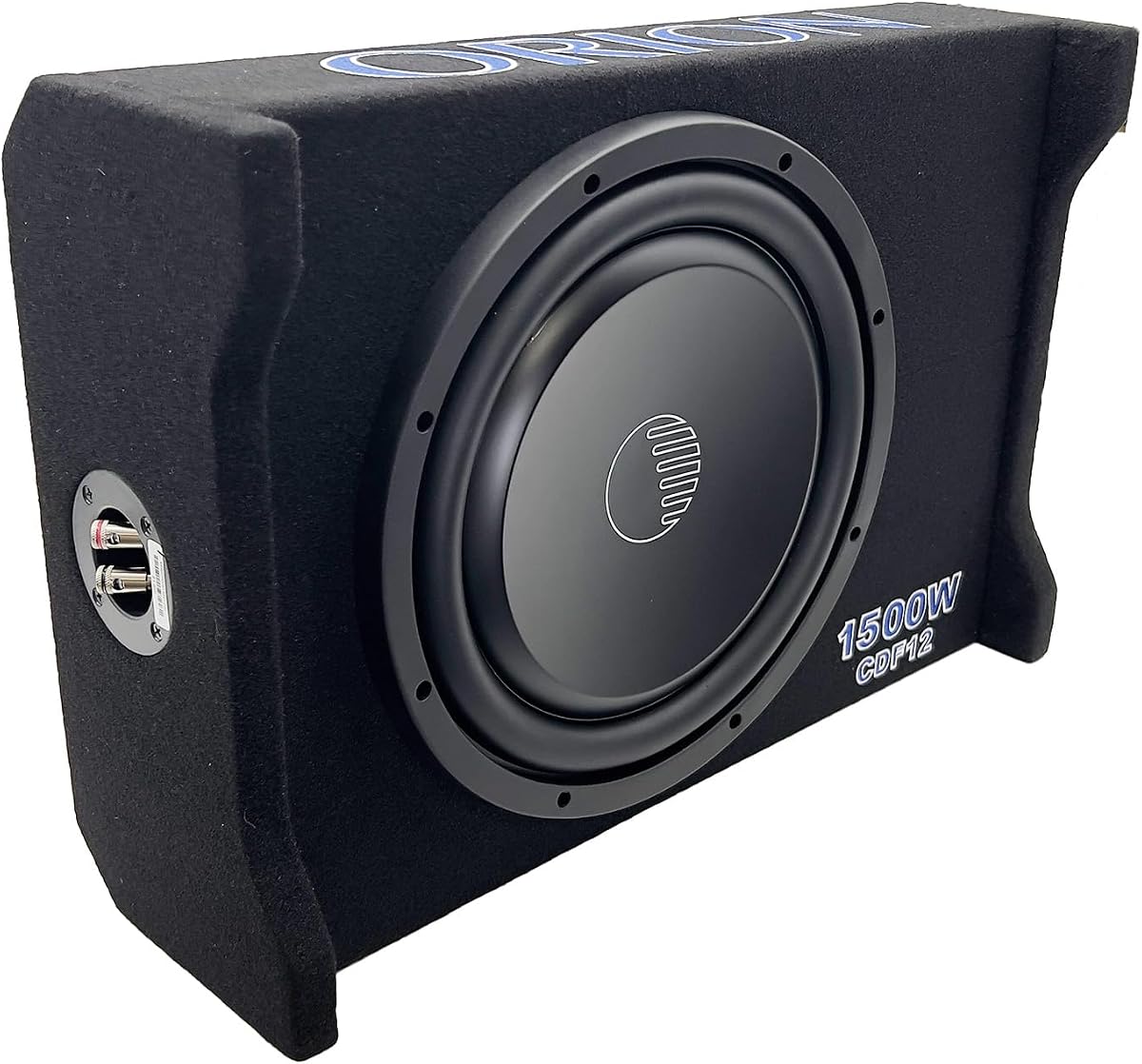
The ORION Cobalt CDF12 offers a different approach from the conventional vented boxes in this guide: a passive down-firing enclosure intended to enhance bass while protecting the mounted subwoofer. Its supplied 3.7 rating is the lowest of the ten products, but the rating alone does not capture the value of a protected, low-profile installation format.
We may earn a commission when you buy through this link, at no additional cost to you.
The down-firing arrangement directs sound through the surface beneath the enclosure and is intended to create more immersive low-frequency output while shielding the driver from direct contact. MDF construction, an airtight seal, and a carpeted finish are intended to reduce vibration and deliver controlled bass. The enclosure measures 20.47 inches wide, 6.7 inches high, and 14.1 inches deep, making its low height the key installation advantage.
There is an important ambiguity in the supplied compatibility information. Although the product is named and described as a 12-inch enclosure, one bullet says it works with most 8-inch subwoofers. That inconsistency should be resolved with the manufacturer before buying. A user should also verify the actual cutout, mounting depth, internal volume, and any amp-clash clearance, because those details are not provided.
The CDF12 is best suited to a builder who specifically wants a down-firing passive enclosure and can confirm driver compatibility. Its slim profile may fit under or behind a seat better than a tall vented cabinet, while the passive design allows aftermarket amplifier selection. It is not the most flexible enclosure for a 12-inch driver, so due diligence is essential.
At 6.7 inches high, the enclosure can suit installations where a full-height ported box will not fit. Its footprint still needs to be measured, and the mounting surface should be secure and appropriately isolated.
The stated 12-inch naming conflicts with a supplied reference to most 8-inch subwoofers. Verify the manufacturer's exact driver compatibility, cutout, mounting depth, and volume requirements before ordering.
We may earn a commission when you buy through this link, at no additional cost to you.
The Rockford Fosgate Punch P300-12T is a complete amplified system rather than an empty enclosure, pairing a 12-inch high-output subwoofer with a built-in 300-watt class-D amplifier. Its 4.7 rating reflects a straightforward solution for adding bass without selecting a separate amp or enclosure.
We may earn a commission when you buy through this link, at no additional cost to you.
Its sealed, slim enclosure measures 15 by 25.8 by 4.8 by 8.5 inches as listed, which is easier to position in many trunks than a large ported cabinet. The built-in amplifier includes an adjustable 12-decibel-per-octave low-pass crossover, adjustable bass-boost EQ, and a phase switch. Speaker-level inputs allow connection to a factory system, while line-level inputs suit an aftermarket system.
The main limitation is flexibility. Because the subwoofer, amplifier, and enclosure are integrated, the driver cannot be exchanged independently and the amplifier's settings are not as granular as those in a separately tuned system. The enclosure is also long, even though it is slim. Buyers should check the stated dimensions, wiring location, power requirements, and vehicle electrical system before installation.
The P300-12T is ideal for a first system, a factory-audio upgrade, or a user who wants fewer separate components. Its factory and aftermarket input options make it adaptable to different source systems, and the included crossover, bass boost, and phase controls provide meaningful setup flexibility. It is less appropriate for a builder committed to selecting individual high-excursion subwoofers and a custom amplifier.
The integrated amplifier, 12-inch driver, and sealed enclosure reduce the number of major components that must be selected. Wiring and amplifier placement are still necessary, but there is no separate power amplifier to install.
An adjustable low-pass filter, bass-boost EQ, and phase switch give the system several ways to fit factory or aftermarket head units. Start with conservative settings and test the enclosure in its installed position.
We may earn a commission when you buy through this link, at no additional cost to you.
The Rockford Fosgate Punch P500-12P is a complete amplified bass system built around a single 12-inch high-output subwoofer, a vented enclosure, and a built-in 500-watt class-D amplifier. Its 4.4 rating places it among the stronger choices for drivers who want a ready-made system with several adjustment options.
We may earn a commission when you buy through this link, at no additional cost to you.
The enclosure uses a precision-constructed MDF ported wedge shape with a heat-activated vinyl finish. Its listed dimensions are 15 inches high, 24.76 inches wide, and 10.91 by 7.71 inches for the two depths. The shape reflects the need to package the subwoofer, internal volume, port, and electronics within one enclosure while retaining a practical automotive form.
Installation flexibility comes from speaker-level and line-level inputs, an adjustable 12-decibel-per-octave low-pass crossover, bass-boost EQ, a zero- or 180-degree phase switch, and an included remote bass-level controller. The tradeoff is again the integrated design: the subwoofer and amplifier cannot be selected separately, and the wedge dimensions require close attention in a compact trunk or hatch.
The P500-12P is well suited to hatchbacks, sedans, and SUVs seeking more output and control than a basic sealed package. The remote makes everyday bass adjustment convenient for drivers. Buyers should confirm electrical requirements, fuse location, port clearance, and the installed footprint, and compare the system with a separate passive enclosure if long-term component flexibility is a priority.
The remote bass-level controller lets the driver change output without reaching the enclosure. The low-pass crossover, bass boost, and phase switch add useful adjustment for different music and vehicle conditions.
A built-in 500-watt class-D amplifier removes the need to choose a separate power amplifier. The ported wedge enclosure still needs adequate clearance, and the vehicle's power and grounding system must support the powered subwoofer.
We may earn a commission when you buy through this link, at no additional cost to you.
The right enclosure depends on the subwoofer, amplifier, vehicle, and installation method. Compare internal volume, tuning, port behavior, panel construction, mounting dimensions, terminal access, and whether a complete powered system better suits the project.
In short, match volume first and use enclosure shape second.
In short, choose a subwoofer and enclosure as a matched pair.
In short, measure the driver and read every clearance specification.
In short, orient the box before drilling or planning the layout.
In short, favor substantial panels and dependable sealing over a thin shell.
In short, measure the whole installation, not just the enclosure.
In short, passive for control, powered for convenience.
In short, choose secure connections and a finish suited to the vehicle.
Begin by confirming that the subwoofer matches the enclosure's cutout, mounting depth, internal volume, and tuning. Mount the driver according to the subwoofer manufacturer's instructions, connect the enclosure leads to the proper amplifier outputs, and confirm polarity before operating the system. For a powered enclosure, route power and ground according to the included amplifier requirements and use an appropriate fuse or circuit protection.
Position the enclosure so its port remains open and away from walls, seats, luggage, or other surfaces that could block airflow. Strap it securely to prevent movement during driving, but avoid compressing the port or loading the panels. Leave practical space around terminals for wiring, amplifier adjustments, and future service without creating a loose cable that can move near moving components.
Start the amplifier or built-in amplifier at low gain, use a conservative crossover setting, and gradually increase level while listening for clean bass, port noise, and unwanted vibration. Secure loose vehicle panels that may resonate. Periodically inspect the mounting screws, wiring, port area, and enclosure finish, and clean the box with a soft brush or suitable interior-safe method rather than saturating MDF or letting moisture collect around terminals.
A vented box uses a port to reinforce low-frequency output and typically supports a more energetic, audible bass response. A sealed box relies on the trapped air volume to control the subwoofer and generally offers a tighter, more controlled presentation. The correct choice depends on the subwoofer manufacturer's recommendations, the available space, and the sound you want.
The correct airspace varies by driver because cone size, excursion, motor design, and suspension all affect performance. Some subwoofers perform well in compact sealed chambers, while others are designed for a much larger vented enclosure. Check the driver's recommended net cubic feet and matching tuning frequency before choosing a box.
An exact match is not always required, but close alignment is desirable. The enclosure's tuning influences where port output is strongest, and the subwoofer must be suitable for that chamber and port arrangement. Use the manufacturer's vented-box recommendation as the primary guide rather than matching only the nominal frequency.
Many models can fit, but external dimensions matter more than the speaker size alone. A shallow sealed powered system may be easier to place than a deep competition-style box, while a side- or rear-ported enclosure needs room around its port. Measure the cargo opening, available floor area, seat position, and amplifier space before purchasing.
A powered enclosure combines the subwoofer, enclosure, and amplifier, reducing the number of separate components an installer must choose. It can also simplify connections to factory systems through speaker-level inputs. The trade-off is reduced flexibility because the driver and amplifier are integrated and cannot be upgraded independently.
Airflow noise can result from a blocked port, turbulence inside the port, a loose enclosure, or incorrect crossover and gain settings. Check that the port is unobstructed, the box is firmly secured, and the amplifier is not operating into distortion. If the noise changes with box orientation, reposition the enclosure to improve airflow.
Thicker MDF generally helps a panel resist flex, but overall quality also depends on sealing, joinery, bracing, and how the enclosure is installed. A well-built box with consistent seals and secure joints can outperform a poorly assembled box made from thick panels. Consider the complete construction method rather than material thickness alone.
Verify the cutout diameter, maximum mounting depth, minimum mounting depth, internal airspace, tuning, port dimensions, overall footprint, and terminal location. Also confirm that the selected subwoofer is designed for the enclosure type. For a powered system, check the amplifier's power needs, input options, dimensions, and remote-control compatibility.
The QPower single vented box is a practical entry-level option for compact installations, while the Skar Audio SK1X12V stands out through clearly specified airspace, tuning, cutout, and mounting depth. The Skar AR1X12V-SPL is the strongest premium-oriented choice for a high-output passive build, and the Atrend Bbox 12SVSC emphasizes detailed airtight construction for installers who prioritize cabinet quality.
Before choosing, prioritize the match between the subwoofer and enclosure rather than exterior appearance alone. Internal volume, tuning, driver clearance, port positioning, and vehicle space determine whether the installation can perform as intended. A passive enclosure provides more component freedom, while the Rockford Fosgate P300-12T and P500-12P simplify the process with integrated amplification and multiple input options.
Ratings, product availability, and market pricing can change, so confirm the current specifications and current prices directly on the product page before buying. Take measurements of the vehicle, review the subwoofer maker's enclosure recommendations, and make sure every dimension and connection requirement agrees before installation.
