
TADA 200g Mechanical Balance Scale
3.8Editor score
Compact portable construction
200 g maximum capacity
0.2 g readability
Included classroom weight set
Explore 10 top mechanical balance options for labs, classrooms, medicine, and precision weighing, with clear comparisons of capacity, accuracy, durability, and
A mechanical balance uses sliding counterweights and a damped pointer to reveal mass without relying on batteries or electronic components. The right model depends on capacity, readability, beam arrangement, leveling, and the environment, from a busy classroom to a clinical weighing station.
This guide compares ten mechanical balances using the specifications supplied by each manufacturer. We examine capacity, readability, included weights, damping, adjustment systems, construction, intended applications, and important limitations to create a practical shortlist.
Each review identifies the product's strongest use case and trade-offs, while the comparison table puts the specifications in a direct format. Ratings reflect the information available at publication, and prices and availability can change, so readers should verify current listing details.
3.8Editor score

4.4Editor score

4.4Editor score
The table below compares all ten balances by purpose, capacity, readability, and core construction. It reveals a mix of portable teaching scales, full-capacity laboratory models, and a heavy-duty medical beam scale.

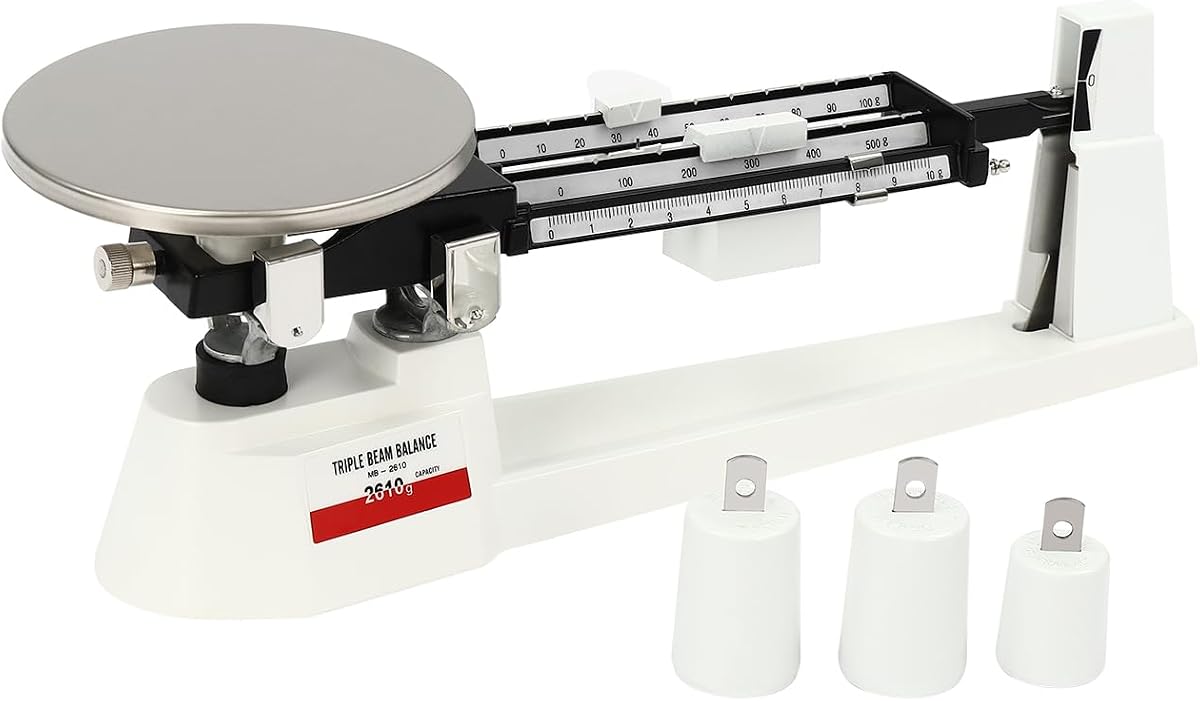


The QWORK Triple Beam Mechanical Balance has a listed rating of 3.7 and combines a 2610 g capacity with 0.1 g readability. Its three-beam format, included weight set, and battery-free operation make it a general-purpose option for school laboratories, university teaching, and kitchen weighing where a traditional balance is useful.
We may earn a commission when you buy through this link, at no additional cost to you.
The main appeal is its combination of capacity and portability. Two 1000 g weights and one 500 g weight expand the practical range beyond the base capacity, while the three graduated beams allow the operator to read the mass without electronic displays. A magnetic damping system helps the pointer settle, and the zero adjustment knob can compensate for systematic error before a weighing session begins.
The important caveat is transport. The manufacturer notes that the balance is professionally calibrated, yet movement during shipping can disturb the zero position. Buyers may therefore need to follow the supplied image instructions or video to zero it before use. That requirement adds a setup step, although it is common among sensitive mechanical instruments and does not eliminate the broad measurement range.
This balance suits buyers who want more capacity than a compact teaching model without moving to a medical-scale format. It is especially useful for demonstrations, material checks, and routine laboratory exercises. Buyers who need a large platform, heavier counterweights, or a more specialized calibration system should consider a different design, but for general classroom and lab work, this offers a practical balance of features.
The included counterweights let the scale handle substantially larger samples than many portable classroom balances. That makes it useful when lesson plans combine small objects with bulkier teaching materials.
Because shipping and relocation can shift the pointer, start each setup by confirming the zero position. A quick check helps ensure the advertised 0.1 g readability is applied to the actual reading rather than an uncorrected offset.
We may earn a commission when you buy through this link, at no additional cost to you.
The TADA 200g/0.2g Mechanical Balance Scale has a listed rating of 3.8 and is explicitly designed for classroom teaching. Its compact, lightweight format focuses on portability and ease of demonstration rather than the large capacity offered by full laboratory triple beam balances.
We may earn a commission when you buy through this link, at no additional cost to you.
The scale measures up to 200 g with 0.2 g readability and includes 5 g, 10 g, two 20 g, 50 g, and 100 g weights. Those components make it possible to begin teaching basic mass comparison without separately assembling a full set of classroom masses. High-grade materials are specified for frequent educational use, while the compact body fits easily into a lab cabinet.
Its limitations are directly tied to that smaller scale. The 200 g capacity will not handle larger samples, and 0.2 g readability is less precise than the 0.1 g resolution offered by most laboratory-oriented models in this guide. It is also a single-purpose teaching instrument rather than a heavy-duty medical or industrial platform.
This is a sensible choice for elementary or secondary classrooms, demonstration kits, and educators who need an inexpensive-looking, easy-to-store balance for standard lessons. For advanced chemistry work, larger specimens, or very fine measurements, buyers should select a higher-capacity 0.1 g model instead.
The 200 g limit aligns well with small classroom samples and common introductory exercises. It provides enough range for basic mass comparisons without making the instrument unnecessarily large.
Its lightweight construction makes it easier to move between classrooms or place inside a compact cabinet. Portability is one of this model's clearest advantages over full-size laboratory balances.
We may earn a commission when you buy through this link, at no additional cost to you.
The MB2610 Triple Beam Mechanical Balance Scale carries a listed rating of 4.4 and offers 2610 g capacity with 0.1 g resolution. It sits among the strongest all-around choices here because it combines useful laboratory resolution, a relatively high capacity, and a clear three-beam reading system.
We may earn a commission when you buy through this link, at no additional cost to you.
The included set contains two 1000 g weights and one 500 g weight, and the balance can accept two attachment weights at the same time. Sliding weights of 10 g, 500 g, and 100 g are positioned along the three beams. Magnetic damping stabilizes the pointer after movement, helping users reach a reading more efficiently in a classroom or laboratory.
Durability is another strength. The described base and beams are designed to withstand regular use, while the clear display supports direct interpretation. The trade-off is size and specialization: this is still a bench-scale laboratory instrument, not a platform for people, and it does not offer the specialty finish or warranty of the medical model later in the list.
We recommend the MB2610 for teachers, students, lab technicians, and serious home experimenters who need a meaningful balance of range and precision. It is particularly attractive when a standard laboratory balance is wanted without a battery or electronic interface.
The separated beam scales and sliding masses make the measurement process visible, which supports teaching as well as routine analysis. Users can see how different counterweight positions combine to determine total mass.
Built-in magnetic damping shortens the wait after placing a sample. This is a practical feature in repeated classroom exercises or any workflow where many objects must be weighed consecutively.
We may earn a commission when you buy through this link, at no additional cost to you.
This Triple Beam Scale is rated at 2610 g with 0.1 g readability and is positioned for laboratories, classrooms, universities, industrial weighing, agriculture, and kitchen use. It combines a durable platform with a practical layout designed to keep frequently used components close at hand.
We may earn a commission when you buy through this link, at no additional cost to you.
Its materials include stainless steel, aluminum alloy, zinc alloy, and plastic. The steel weighing tray measures six inches in diameter, while the overall unit is listed at 18 by 6.7 by 7 inches. Two 1 kg weights and one 500 g weight are included, and two additional attachment weights can be used to extend the range from 610 g to 2610 g.
A recessed base accommodates three weights, reducing the chance that they will be misplaced. The threaded zero adjustment knob is designed to maintain a stable finger position, while magnetic damping shortens stabilization time after the riders are moved. These details improve routine handling even though the mix of materials may not be as visually unified as an all-metal premium instrument.
This model is a good fit for buyers who prioritize a cleanable platform, clear range markings, and organized storage. Since no customer rating was supplied, prospective buyers should examine the current listing carefully and consider how the construction suits their own environment.
Keeping the three primary weights in the recessed base makes them easier to manage and helps support a smoother workflow. It is especially useful in shared classrooms and busy teaching labs.
The zero adjustment knob is threaded to reduce slipping during calibration. Accurate zeroing is essential because an unnoticed offset can make later readings unreliable.
We may earn a commission when you buy through this link, at no additional cost to you.
The Health o meter Professional 400KL is a mechanical beam medical scale with a listed rating of 4.4. It supports up to 390 lb, or 177 kg, and uses quarter-pound or 100 g graduations, making it suited to routine patient and physician-office weighing rather than fine laboratory analysis.
We may earn a commission when you buy through this link, at no additional cost to you.
Its powder-coated construction is applied inside and out for rust protection in high-use settings. A black non-slip mat improves stability and patient comfort, while the alloy steel platform provides a durable base for repeated use. The scale also supports optional wheels and counterweights, with the latter capable of increasing capacity to 490 lb or 210 kg.
The strongest differentiator is the ten-year limited warranty, which adds a level of institutional confidence not offered by the general-purpose teaching balances. The trade-off is measurement granularity: 100 g divisions are appropriate for many clinical applications but far too coarse for a laboratory balance that promises 0.1 g readability.
This premium pick is recommended for clinics, physician offices, rehabilitation spaces, and other facilities that regularly weigh people. Buyers who need fine object analysis should choose one of the 0.1 g laboratory models instead, while organizations prioritizing durability and warranty coverage will find the 400KL particularly compelling.
The protected alloy steel body and non-slip mat are tailored to environments where the scale must withstand frequent use. These features make the instrument more specialized than a classroom beam balance.
Compatible wheels can make repositioning easier, while optional counterweights extend the maximum load. These options are useful for facilities whose weighing needs may evolve over time.
We may earn a commission when you buy through this link, at no additional cost to you.
The Ohaus 80000012 is a specialty mechanical triple beam balance with a listed rating of 4.3, a 610 g capacity, and 0.1 g readability. It is a refined laboratory and classroom instrument rather than a high-capacity counterweight model, making it especially useful when precision matters more than weighing large samples.
We may earn a commission when you buy through this link, at no additional cost to you.
Notched and tiered beams help support accurate, repeatable readings, while three sliding weights provide direct measurement. Magnetic damping reduces the time required for the pointer to settle. A spring-loaded zero compensator allows fine modifications, which can be valuable in a balance used repeatedly by different students or operators.
The base and beams are made from metal, reinforcing the instrument's suitability for demanding classroom and laboratory settings. Its chief limitation is capacity: without the additional 2 kg weights offered by several 2610 g models here, it cannot handle larger objects. It also has a smaller platform and a more specialized purpose than a medical scale.
Choose the Ohaus when your work stays within 610 g and requires 0.1 g readability. It is a strong match for precision demonstrations, school laboratories, and bench-scale analysis where a sturdy beam system and fine adjustment are central to the workflow.
The notched and tiered construction helps riders settle into defined positions. This design can make successive readings more consistent than an improvised sliding-weight setup.
The spring-loaded zero compensator permits controlled corrections. Operators can bring the pointer back to the reference point before placing a sample on the platform.
We may earn a commission when you buy through this link, at no additional cost to you.
The MB2610 Stainless Plate Balance offers 2610 g capacity and 0.1 g readability for school teaching, laboratories, universities, and kitchen weighing. Its listed uses also extend to electronics, agriculture, and textiles, reflecting the broad versatility of a standard three-beam balance format.
We may earn a commission when you buy through this link, at no additional cost to you.
Two 1 kg weights and one 500 g weight are included, with capacity extending from 610 g to 2610 g as attachment weights are used. The six-inch weighing tray provides a stable place for samples, and clear range markings on the base help operators understand the usable range. A zero adjustment knob and magnetic damping support accurate, efficient readings.
The stated construction combines stainless steel, aluminum alloy, zinc alloy, and plastic to provide stable, durable performance. As with many multi-material instruments, long-term care should include gentle cleaning and protection from impact. No customer rating was supplied, so the objective specifications are more useful for an initial evaluation than buyer feedback.
This model fits buyers who need fine readings across a broad collection of materials. It is a sensible classroom or general laboratory choice, though those requiring a more premium warranty or specialized medical platform should look elsewhere.
The stated range from classroom samples to industrial and agricultural materials reflects a versatile design. Buyers should still confirm that their samples fit the platform and remain within the intended weighing range.
Magnetic damping reduces rider stabilization time after adjustment. This makes repeated weighing more convenient when several samples or lesson groups need to be handled in sequence.
We may earn a commission when you buy through this link, at no additional cost to you.
The Lightweight Triple Beam Balance Scale has a listed rating of 5.0, 2610 g capacity, and 0.1 g readability. It combines a relatively high maximum load with a compact 18 by 6.7 by 7-inch format, giving it useful flexibility for teaching, research, and general weighing.
We may earn a commission when you buy through this link, at no additional cost to you.
The scale includes two 1 kg weights and one 500 g weight, and two attachment weights can be used simultaneously. Its stainless steel platter has a six-inch diameter, while a magnetic damping system shortens rider stabilization. The zero adjustment knob helps reduce systematic error before each measurement.
The supplied materials include stainless steel, aluminum alloy, zinc alloy, and plastic, which are chosen for stability and durability. Intended applications include electronics, medicine, food, agriculture, textiles, and scientific research. These are broad claims, so buyers should still evaluate the six-inch platform and confirm that their samples suit the instrument's format.
With a perfect listed rating but limited visible rating history, this product appears promising for buyers seeking a portable, high-capacity balance. It is a strong choice for demonstrations and routine sample checks where a larger platform or medical-scale warranty is unnecessary.
The model offers the same maximum range as several larger laboratory balances while remaining compact enough for a teacher's desk. That balance of capacity and footprint is its defining strength.
A stainless steel platter is easy to clean and provides a consistent support for varied samples. Magnetic damping further improves the pace of repeated measurements.
We may earn a commission when you buy through this link, at no additional cost to you.
The EISCO Triple Beam Mechanical Balance is a 610 g single-pan instrument designed as both a visual and tactile teaching device. It is also described as suitable for professional laboratories, classrooms, households, and shops, giving it a wider practical scope than a basic classroom balance.
We may earn a commission when you buy through this link, at no additional cost to you.
Spring-loaded zero adjustment, magnetic damping, and calibrated resting notches work together to support stable readings. The three beams are offset from one another, creating an unobstructed vertical view of the scale. That visibility is particularly useful when students are learning how counterweight positions relate to total mass.
Durability comes from a stainless steel pan and a coated corrosion-resistant aluminum frame. The single-pan configuration is worth noting because it differs from models that place the weighing platform above the beam assembly. Buyers should compare dimensions and operating style with other products rather than assuming every triple beam balance has the same layout.
The EISCO is a good choice for instructors who want the mechanics of weighing to remain visible and intuitive. It is less suitable for samples above 610 g, and the absence of a supplied customer rating means buyers should check the current product page for updated feedback and availability.
The offset beams preserve a clear view of the scale, helping learners follow the movement of each rider. This makes the instrument more than a measuring device; it becomes part of the lesson.
Calibrated resting notches give the sliding weights defined stopping points. Consistent placement helps reduce avoidable variation when an operator changes counterweights.
We may earn a commission when you buy through this link, at no additional cost to you.
The Triple Beam Mechanical Balance with Weights has a listed rating of 4.0 and combines a 2610 g maximum capacity with 0.1 g readability. It is designed for schools, universities, kitchens, and industrial environments, making it a broadly understandable laboratory scale with a straightforward feature set.
We may earn a commission when you buy through this link, at no additional cost to you.
The package includes two 1000 g weights and one 500 g weight, allowing the stated range to expand from 610 g to 2610 g. A corrosion-resistant stainless steel platform measures six inches in diameter, and magnetic damping helps the pointer settle quickly after a measurement. The clear scale is intended to make readings accessible without an electronic display.
A threaded zero adjustment knob supports recalibration and helps reduce systematic error. The scale requires no batteries, avoiding both charging interruptions and power-related concerns in laboratories. Its main limitations are the modest platform size and the absence of specialized premium features such as the medical model's warranty or optional wheeled configuration.
This is a sensible general choice for users who need the full 2610 g range and 0.1 g readability without requiring a specialized platform. It is especially suitable for teaching labs and routine material checks where straightforward operation and included counterweights are the priorities.
The supplied 1000 g and 500 g masses allow immediate use across a wide range of loads. Additional attachment weights can further extend the balance's range.
The stainless steel weighing pan is easy to clean and resists corrosion. That makes it practical for diverse materials in teaching, food-related, and general industrial settings.
We may earn a commission when you buy through this link, at no additional cost to you.
A mechanical balance purchase should begin with the object, sample size, and required precision. Capacity, readability, platform design, counterweight system, damping, adjustment method, construction, and intended environment determine which instrument will work most effectively.
Capacity is the maximum mass the balance can accommodate, and it should be chosen with room to spare rather than exactly equal to the heaviest expected sample. The products in this guide range from 200 g for compact teaching work to 2610 g for more substantial samples, while the medical model supports 390 lb. A 610 g scale may be sufficient for small solids but unsuitable for bulkier materials, and a 200 g model is best restricted to appropriately small items. For general laboratory use, a balance around 2610 g offers more flexibility, whereas patient weighing calls for a purpose-built medical platform.
Readability is the smallest graduation the scale can display, while accuracy describes how closely the result reflects the true mass. These terms are sometimes used loosely, so buyers should examine both the graduation interval and the manufacturer's stated accuracy. Most laboratory models offer 0.1 g readability, the TADA classroom model offers 0.2 g, and the medical scale uses quarter-pound or 100 g graduations. Fine object analysis favors 0.1 g, teaching demonstrations can often work with 0.2 g, and routine patient monitoring does not normally require tenth-of-a-gram resolution. Capacity and readability should therefore be evaluated together.
A triple beam balance distributes mass across several sliding riders, making the reading transparent and often reducing the need for a full set of large masses. Confirm that the included counterweights match the stated capacity, and check whether extra attachment weights are supported. Models with 10 g, 500 g, and 100 g riders allow a readable result across the range, but a capacity of 2610 g generally depends on adding the supplied large weights. Buyers should also consider whether the beam markings are clear and whether the resting positions feel precise. A visible, well-marked beam system is especially valuable in teaching environments.
A mechanical balance's pointer can continue moving after a sample is added or the riders are adjusted. Magnetic damping reduces this swing, allowing the user to reach a reading more quickly and with less uncertainty. It is particularly valuable during repeated classroom demonstrations, batch sample checks, and routine laboratory work. Damping does not replace proper leveling or zeroing, but it improves the usability of an otherwise traditional design. The general laboratory models in this guide prominently feature magnetic damping, while the compact TADA model focuses its specification on portability and basic classroom use.
Zero adjustment compensates for the pointer not resting exactly at the reference point. A spring-loaded, threaded, or standard knob may be used across these products, and each offers a different balance of fine control and convenience. A stable adjustment mechanism is important because an incorrect zero creates a systematic reading error. Mechanical balances can also be disturbed by movement, so users should level the instrument on a stable, even surface and recheck zero before a session. Some manufacturers specifically warn that transportation may alter the balance, making the included calibration instructions important for new owners.
The platform should be large enough for the sample, stable enough for liquids or irregular objects, and compatible with the intended workflow. Many laboratory models in this guide use a six-inch round stainless steel platter, which works well for small containers and teaching samples but may not suit bulky objects. The EISCO model uses a single-pan arrangement, while the medical scale includes a broad non-slip mat for people. Material also matters: stainless steel is easy to clean and corrosion-resistant, whereas non-slip matting is better for patient comfort and traction. Buyers should compare platform diameter, shape, clearance, and cleanup requirements.
A balance that feels solid can remain useful through years of service, but construction quality should be assessed by component materials rather than appearance alone. Metal bases and beams suit demanding laboratory settings, while stainless steel pans provide easy cleaning and corrosion resistance. Powder-coated alloy steel is particularly appropriate for clinics and other high-use areas. Some educational models combine metal and plastic to control weight and maintain portability. Consider the frequency of use, exposure to moisture or chemicals, and the likelihood of impact or transport. A ten-year limited warranty on the Health o meter model provides a different kind of reassurance from purely material-based construction claims.
Portability is a decisive factor when equipment must move between classrooms, laboratories, or work areas. The TADA scale is explicitly described as compact and lightweight, and several 2610 g models measure approximately 18 by 6.7 by 7 inches while remaining easy to carry. A larger footprint can improve stability, but it can also make storage inconvenient. Look for a recessed base that stores included weights, since loose masses are easily misplaced. The medical scale can accept optional wheels, which may be more useful in a clinic than in a fixed teaching position. Balance portability against stability and platform size.
Place the balance on a firm, level surface away from vibration, drafts, direct sunlight, and excessive heat. Before adding weights or samples, inspect the beams, riders, platform, and zero point. Make sure the mechanism moves freely and that all sliding pieces rest securely. If the balance has just been transported, allow it to settle and follow the manufacturer's zeroing instructions before taking a measurement.
Zero the instrument with an empty platform. Confirm that the pointer aligns with the reference mark, using the zero adjustment knob as needed. Place the sample centrally on the platform so it does not touch the beam or supports. Move the riders gradually from their starting positions until the pointer reaches the balance point, then read the beam markings and record the result. For routine work, repeat the zero check between groups of measurements and remove each sample before changing the counterweights.
Clean only with methods appropriate for the materials. Remove loose material from the platform with a soft brush or suitable cloth, avoid flooding the mechanism, and never submerge the balance. Protect the platform and beam surfaces from impacts, harsh chemicals, and abrasive cleanup. Store the counterweights in their recess or designated container, and recheck the zero whenever the instrument is moved. Periodic inspection of the pointer, riders, adjustment knob, and platform helps identify loose or damaged parts before they affect measurements.
No. The mechanical balances in this guide use sliding counterweights and a physical pointer rather than an electronic load cell and display. They need no batteries or other power source, which makes them convenient for teaching spaces and locations where electrical access is limited. Mechanical operation also does not inherently require recharging, although periodic leveling and zero checks remain necessary.
Capacity is the largest mass the balance is designed to support, while readability is the smallest graduation shown on its scale. A 2610 g balance with 0.1 g readability can handle larger samples while still displaying relatively fine divisions. A medical scale may support hundreds of pounds but have 100 g graduations, so maximum load and precision should always be considered together.
Small shifts in the mechanism, movement during transport, or placement on an uneven surface can move the pointer away from its reference position. Re-zeroing removes this offset before measurement. Some manufacturers explicitly warn that transportation may disturb the calibration, so checking the pointer with an empty platform is an essential first step.
It depends on the model and required application. Several options in this guide provide 0.1 g readability, magnetic damping, adjustable riders, and clear graduations, making them appropriate for many teaching and analytical tasks. Users should still follow zeroing, leveling, and reading instructions, and verify whether a particular laboratory or procedure demands a certified instrument.
No. A laboratory balance has a small platform and counterweight system designed for objects, not people. Patient weighing requires a medical scale with a broad non-slip platform, higher load capacity, and a suitable base such as the Health o meter 400KL described in this guide. Using a small laboratory balance for a person would be unsafe and inappropriate.
Magnetic damping is a mechanism that reduces pointer oscillation after the sample or riders are moved. It does not calculate the mass or improve the stated graduation by itself. Instead, it helps the pointer settle faster, making repeated readings more stable and convenient during classroom exercises and routine laboratory work.
Store them in the supplied recess, tray, box, or another labeled container where they cannot be knocked onto the floor or confused with similar masses. Some models have a recessed base designed specifically to hold the three primary weights. Keeping weights organized also makes it easier to confirm that every required mass is present before a lesson or measurement session.
Confirm that the pointer returns consistently to zero, all riders move smoothly, the zero adjustment works, and the platform is level and undamaged. Check whether the beams, platform, and base show bends, corrosion, or excessive wear. It is also important to verify that the included counterweights match the advertised capacity and that the manufacturer's calibration instructions are available.
The MB2610 Triple Beam Balance is the strongest general laboratory choice in this group, combining a 4.4 listed rating, 2610 g capacity, 0.1 g readability, and magnetic damping. The TADA 200g model is a compact budget option for basic classroom demonstrations, while the Health o meter 400KL is the premium choice for clinical settings that need a durable patient platform and long warranty.
For object weighing, prioritize the smallest readable division, adequate capacity, a suitable platform, and a mechanism that feels stable and easy to zero. For teaching, visibility and a clear weight set may matter more than maximum capacity. For patient use, select a medical scale rather than adapting a small laboratory instrument, and consider stability, traction, mobility, and warranty coverage.
Final specifications and availability can change, and customer feedback may evolve over time. Before ordering, verify the current capacity, readability, included weights, dimensions, zeroing procedure, and warranty directly on the listing. Those details help ensure that the selected mechanical balance matches the intended samples, workflow, and working environment.