
galphi 4K Dash Cam Front
4.4Editor score
Compact screen-free 4K design
5GHz Wi-Fi app transfers
Low-distraction windshield setup
Our Dash CAM guide compares 10 leading models for video quality, night coverage, parking mode, connectivity, storage, ease of use, and value.
A Dash CAM is more than a camera attached to a windshield: it is a continuous record of what happened before, during, and after a drive. A worthwhile model should capture readable road details, handle tunnels and nighttime streets, record in several directions, and protect important clips without demanding constant attention from the driver.
We compared the ten featured models using their stated recording channels, resolutions, sensors, viewing angles, night-vision features, Wi-Fi performance, GPS functions, parking options, storage support, included accessories, and installation considerations. The list includes front-only, front-and-rear, three-channel, and four-camera systems for commuters, families, rideshare drivers, and owners who need broad vehicle coverage.
Each review explains where a particular Dash CAM stands out and where compromises remain. We also explain how 4K, upscaled 4K, STARVIS 2 sensors, G-sensor locks, loop recording, and hardwired parking surveillance affect real-world use. Product specifications and availability can change, so readers should confirm the current configuration, included memory card, parking-kit requirement, and warranty before purchasing.
4.4Editor score

4.8Editor score

4.4Editor score
The table below compares all ten models by coverage, imaging approach, connectivity, and parking surveillance, making it easier to identify the right system for different vehicles and driving routines.




The ROVE R2-4K Dual combines a front and rear camera in a feature-rich package, earning a 4.5 rating. Its standout attraction is the front camera's QHD capture with intelligent upscaling to 2160P, paired with a Sony STARVIS 2 IMX675 sensor, F1.5 aperture, HDR, and a three-inch IPS screen. The rear channel records at Full HD 1080P through an F1.8 lens.
We may earn a commission when you buy through this link, at no additional cost to you.
That combination gives drivers a useful balance of clarity and manageability. The upscaled 4K front image is not native 4K, so it should not be judged as equivalent to a camera that records every pixel at 3840 by 2160. Even so, the stated 2.5K source and sharper-than-1080P output can preserve useful detail around plates, signs, and nearby vehicles. The STARVIS 2 sensor and wide aperture are particularly valuable after dark, in tunnels, and during dawn or dusk.
Connectivity is another major strength. Dual-band 5.8GHz and 2.4GHz Wi-Fi supports app-based viewing and downloads stated at up to 20MB/s, making it practical to retrieve a clip without physically removing the card. Built-in GPS adds speed, compass direction, route, and location information, while the G-sensor can lock incident footage. The included 128GB card, loop recording, emergency locking, motion detection, and support for cards up to 1TB make the system ready for regular use.
The main compromise is that parking surveillance requires a separate hardwire kit, and the headline front resolution is upscaled rather than native. Those limitations may not bother drivers who mainly want balanced front-and-rear evidence and fast wireless access. For commuters, rideshare drivers, and anyone who values low-light performance, GPS, and flexible monitoring modes, the ROVE R2-4K Dual is a well-rounded recommendation.
The Sony STARVIS 2 IMX675 sensor, F1.5 aperture, and HDR work together to improve low-light visibility and balance bright and dark areas. These features are especially relevant for license-plate capture, road signs, and surrounding traffic when headlights and streetlights create harsh contrast.
ROVE offers one-frame-per-second time-lapse, motion detection, and collision detection parking modes. When an event is detected, the system records and locks a one-minute event clip, although permanent parking operation requires a separately purchased hardwire kit.
We may earn a commission when you buy through this link, at no additional cost to you.
The REDTIGER F7N TOUCH is a dual-channel Dash CAM built around accessibility. It carries a 4.3 rating and records 4K UHD through a STARVIS 2-equipped, 170-degree front camera, while the rear camera captures 1080P through a 140-degree lens. WDR and HDR are included to improve balanced exposure and low-light visibility.
We may earn a commission when you buy through this link, at no additional cost to you.
Its unusual strength is the choice of interfaces. Users can operate the system through physical buttons, a smart touchscreen, voice commands, or the REDTIGER Cam app. The touchscreen can lock emergency video, toggle Wi-Fi, and start a capture, while voice control supports a more hands-free approach. This variety is useful for different preferences, although the safest choice is to configure settings while parked.
The 5.8GHz Wi-Fi connection is stated to deliver downloads at up to 20MB/s, and built-in GPS records traceable routes, speed, and location. Loop recording manages storage continuously, while the G-sensor detects sudden movement or impact and protects the associated file. A 128GB card is included, and the system also supports time-lapse and collision-detection parking modes once a separate hardwire kit is installed.
This is a strong option for drivers who want both touchscreen convenience and traditional physical controls. The hardwire-kit requirement and a screen that invites interaction may be less attractive to minimalist setups, but the combination of resolution, night-oriented imaging, fast transfers, GPS, and flexible controls makes the F7N TOUCH a well-rounded dual-camera system.
Buttons, touchscreen functions, voice commands, and app management make the F7N TOUCH easy to tailor to different habits. Voice operation and phone-based settings reduce the need to manipulate the unit while the vehicle is moving.
The 4K front and 1080P rear channels cover both traffic ahead and incidents behind the vehicle. Wide viewing angles, WDR, HDR, and a STARVIS 2 sensor help preserve context across daylight, tunnels, and darker roads.
We may earn a commission when you buy through this link, at no additional cost to you.
The AProX HD Night Vision 3 Channel Dash Cam is the most complete forward-and-interior system in this group, with a 4.8 rating. It records true 4K from both the front and rear cameras and 1080P from a cabin camera, using 170-degree, 150-degree, and 150-degree viewing angles respectively. That combination directly addresses the road ahead, traffic behind, and activity inside the vehicle.
We may earn a commission when you buy through this link, at no additional cost to you.
Its cabin camera differentiates it from most dual-channel competitors. Four infrared lights make interior recording possible in complete darkness, which is valuable for rideshare drivers, families monitoring the cabin, or anyone documenting vehicle security. A laminated 3.18-inch display is designed to reduce reflections, while WDR and the stated AProX HD night-vision technology support visibility in difficult lighting.
Connectivity is unusually advanced. Dual-band Wi-Fi 6 combines 5.8GHz and 2.4GHz bands, with transfers stated at up to 20MB/s through the TERUNSOUL app. That app supports live viewing, downloading, sharing, settings management, and over-the-air firmware updates. Built-in GPS stores speed and location directly into the video, while a 128GB card is included and storage support extends to 512GB.
Parking mode adds time-lapse and collision detection, but a hardwire kit is required. A three-camera installation also takes more planning and produces more files than a front-only or two-camera arrangement. Even so, this is the pick for buyers who prioritize comprehensive coverage, true 4K front and rear footage, interior night visibility, modern wireless connectivity, and a generous three-year guarantee.
Four infrared lights illuminate the cabin without relying on street lighting. Combined with a 1080P cabin channel and 150-degree field of view, this makes the system especially useful for rideshare work, family travel, and overnight vehicle monitoring.
Recording 4K from the front and rear simultaneously avoids the resolution trade-offs seen in many dual-camera systems. Drivers can review fine road details ahead while retaining equally sharp coverage of vehicles and incidents behind.
We may earn a commission when you buy through this link, at no additional cost to you.
The REDTIGER F7NP is a conventional front-and-rear Dash CAM built around proven imaging components. Its 4.1 rating reflects a capable but less expansive feature set than the top three-channel models. The front camera records 4K through a STARVIS 2 sensor, F1.5 aperture, and six-layer optical lens, while the rear records 1080P through a 140-degree lens.
We may earn a commission when you buy through this link, at no additional cost to you.
WDR and HDR are used to balance highlights and shadows, helping the camera retain useful information when bright headlights, tunnels, or shaded streets are present. The wide front aperture should also assist low-light recording. Its 170-degree front perspective captures a broad view of the road, while the narrower rear perspective concentrates on vehicles directly behind.
The built-in 5.8GHz Wi-Fi is stated to support app transfers at up to 20MB/s, and GPS can display route, speed, and location information. Seamless loop recording overwrites older files, the G-sensor protects incident footage, and a free memory card is included. Parking mode offers time-lapse and collision-detection options, but requires a separate hardwire kit.
A supercapacitor replaces a conventional lithium battery, improving heat resistance and supporting longer parked operation. REDTIGER backs the camera with an 18-month guarantee. This model suits buyers who prioritize the front image, wide aperture, and established STARVIS 2 performance without needing cabin coverage or a touchscreen.
The F1.5 front aperture lets in more light than a conventional narrower aperture, while STARVIS 2 and HDR improve low-light balance. The result is most useful on unlit roads and during sharp transitions between bright and dark areas.
The built-in supercapacitor is better suited to sustained recording and hot parking environments than a setup relying on a standard internal battery. REDTIGER also advises using original or officially recommended cables and accessories.
We may earn a commission when you buy through this link, at no additional cost to you.
The 4 Channel 360° Dash Cam offers the broadest perspective in the group and holds the highest listed rating at 5.0. It synchronizes four lenses: a 4K front camera and three adjustable 1080P cameras for the rear, left, and right sides. A three-inch IPS screen provides an on-device view of the multi-camera system.
We may earn a commission when you buy through this link, at no additional cost to you.
This is a compelling choice when reducing blind spots matters more than preserving native 4K on every channel. Seeing both sides can help document adjacent-lane movements, parking contact, side impacts, and the environment around the vehicle. The 64GB card is preinstalled, so the system is ready for loop recording immediately after installation.
Dual-band 5GHz Wi-Fi and GPS support fast phone-based review through the Viidure app. The G-sensor locks footage when it detects sudden movement or a collision. For low-light use, eight infrared LEDs, an F1.6 aperture, and WDR work together to balance dim scenes and reduce overexposure from headlights.
Its 24-hour parking mode uses a front sensor to detect objects approaching within approximately three to four meters, then records a one-minute clip after a five-second quick start. A separate hardwire kit is necessary. The additional cameras also require more installation planning, but drivers seeking maximum directional awareness will find the four-channel design compelling.
The front, rear, left, and right cameras record simultaneously, creating a more complete record than a standard dual-channel setup. Adjustable auxiliary lenses help users tailor the side views to the dimensions and placement of their vehicle.
After hardwiring, the front sensor watches for nearby movement and triggers a short recording when an object approaches. The system can continue monitoring after the engine is turned off, subject to the parking-mode power requirements.
We may earn a commission when you buy through this link, at no additional cost to you.
The galphi 4K Dash Cam Front is a compact, single-camera option with a 4.4 rating. Its defining feature is the absence of a built-in screen, allowing drivers to record without adding a visual display to the windshield. A slim body and 160-degree lens balance broad road coverage with a relatively unobtrusive installation.
We may earn a commission when you buy through this link, at no additional cost to you.
The front camera records 4K UHD, and its F1.6 aperture works with WDR to balance exposure during low-light and bright conditions. This makes the system useful for ordinary driving, new drivers, family cars, and rideshare use where forward evidence is the primary need. The lack of a rear camera means it cannot independently record a following vehicle or cabin activity.
5GHz Wi-Fi connects through a companion app for viewing and downloads stated at up to 8MB/s, which is faster than the cited 2.4GHz alternative. Loop recording manages the microSD card, and the G-sensor locks a clip when it detects a sudden shake or collision. A 32GB card is preinstalled, with support for cards up to 256GB.
Parking mode uses low-power time-lapse recording but requires a separately sold Type-C hardwire kit. Compared with multi-camera systems, this model offers a straightforward setup and fewer installation points. It is the strongest choice for someone who wants a small 4K recorder, 5GHz app connectivity, and minimal windshield clutter without paying for rear or cabin coverage.
Removing the screen eliminates one source of visual distraction and keeps the camera compact. The body is designed to mount without dominating the driver's view, while the 160-degree lens still covers a broad section of the road.
The 5GHz connection allows phone-based playback and downloads up to 8MB/s without removing the card. Owners can retrieve a specific event or share it more quickly than they could through a slower wireless standard.
We may earn a commission when you buy through this link, at no additional cost to you.
The Vantrue N4 Pro S is the most technically advanced premium Dash CAM in the list, with a 4.4 rating. Its three-channel configuration combines a 4K front camera, a 2.5K rear camera, and a 1080P interior camera. Triple STARVIS 2 sensors and triple HDR provide a strong foundation for low-light capture and balanced exposure.
We may earn a commission when you buy through this link, at no additional cost to you.
The rear camera is unusually adaptable because it can rotate through 360 degrees. Owners can point it toward traffic, the trunk, or another interior area rather than accepting a fixed orientation. A dedicated front-and-rear mode records 4K and 2.5K while omitting the cabin channel; Vantrue says this reduces heat by 30% and saves power compared with triple recording, a useful option in hot climates.
PlatePix technology is designed to improve license-plate recognition in dim nighttime scenes and strong backlight. Vantrue states that plates can be captured clearly at speeds up to 31mph under suitable nighttime conditions. This should be treated as a performance claim rather than an unconditional guarantee, since distance, lighting, vehicle motion, and plate contrast all affect results.
For parked protection, buffered motion and impact detection can preserve video from 10 seconds before an event while all three cameras remain active. That requires a separately sold hardwire kit. The supercapacitor, support for cards up to 1TB, and an estimated 37-plus hours of triple-channel 4K recording make the system appropriate for high-mileage users, although a memory card is not included.
The 360-degree rotating rear camera can move between traffic monitoring, trunk surveillance, and interior use. Drivers can also select front-and-rear recording to prioritize resolution, reduce heat, and lower power consumption.
Buffered recording retains several seconds before a detected motion or impact, rather than beginning only after contact occurs. The system needs permanent power through a separate hardwire kit to keep all three channels active in parking mode.
We may earn a commission when you buy through this link, at no additional cost to you.
The 4K+4K Starlight Night Vision Dash Cam delivers true 4K from both front and rear cameras, earning a 4.9 rating. The front records at 3840 by 2160 through a 170-degree lens, while the rear uses the same nominal resolution with a 150-degree perspective. Balanced exposure and wide-angle coverage make it a strong contender for evidence-focused drivers.
We may earn a commission when you buy through this link, at no additional cost to you.
Low-light performance is supported by an F1.5 aperture, five-element optical lens, and WDR. The stated Starlight-level sensor is intended to preserve contrast and color in poor lighting, while WDR helps prevent bright headlights and dark road surfaces from overwhelming the image. It does not identify a specific sensor brand, which makes direct sensor-to-sensor comparison difficult.
Dual-band 5.8GHz and 2.4GHz Wi-Fi supports live preview, playback, downloads at up to 20MB/s, app-based photo capture, and GPS review through a phone. A collision sensor protects parking-event clips, while emergency lock and loop recording help maintain continuous coverage. The included 128GB card makes the package ready to use.
Time-lapse parking mode records a full one-minute clip and locks it in the event folder when the collision sensor detects an incident. A compatible hardwire kit is required for that function. The high rating and matching 4K channels make this model especially attractive to buyers who want sharp rear footage without moving to a three-channel system.
Recording 4K on the rear as well as the front preserves fine detail in both travel directions. That is useful for rear impacts, lane changes, following vehicles, and road signs visible through the back window.
The app provides live viewing, video and photo retrieval, GPS information, and settings management. Transfers stated at up to 20MB/s are particularly useful for moving a selected event clip to a phone for insurance or sharing purposes.
We may earn a commission when you buy through this link, at no additional cost to you.
The REDTIGER F17 combines a 4K front camera with 1080P cabin and rear cameras, giving it a 4.4 rating. The front uses a STARVIS 2 IMX675 sensor, while WDR and HDR improve dynamic range and low-light performance. Its 150-degree front, 160-degree cabin, and 155-degree rear perspectives create broad coverage around the vehicle.
We may earn a commission when you buy through this link, at no additional cost to you.
The triple-channel arrangement is useful for daily drivers, family trips, and rideshare operators. The cabin channel can document passenger activity, while the rear camera records traffic and potential following incidents. A 64GB card is included, and dual-band 5.8GHz and 2.4GHz Wi-Fi allows the app to replay all three channels and access live GPS information.
Recording modes give owners an important degree of flexibility. In triple-channel mode, the front records at 4K with 1080P interior and rear footage. Alternatively, the system supports 2.5K dual-channel recording with the STARVIS 2 front camera, or 4K front and 1080P rear recording when the cabin channel is disabled. This allows owners to balance resolution, heat, and storage demands.
For parked surveillance, time-lapse and collision-detection modes can keep an eye on the vehicle using the front, rear, and interior cameras, but an extra hardwire kit is needed. The supercapacitor is a meaningful advantage for heat resistance. Overall, the F17 stands out for adaptable channels and a sophisticated front sensor, though buyers should not expect 4K from every camera.
The F17 can prioritize a sharper front image, retain all three directions, or balance processing demands with a 2.5K dual mode. That flexibility is useful when storage space, heat, or the need for cabin coverage changes from one trip to the next.
The STARVIS 2 IMX675 sensor, WDR, and HDR are most relevant to the front channel, where headlights, oncoming vehicles, and road lighting create difficult exposure conditions. The remaining cameras retain 1080P coverage for context.
We may earn a commission when you buy through this link, at no additional cost to you.
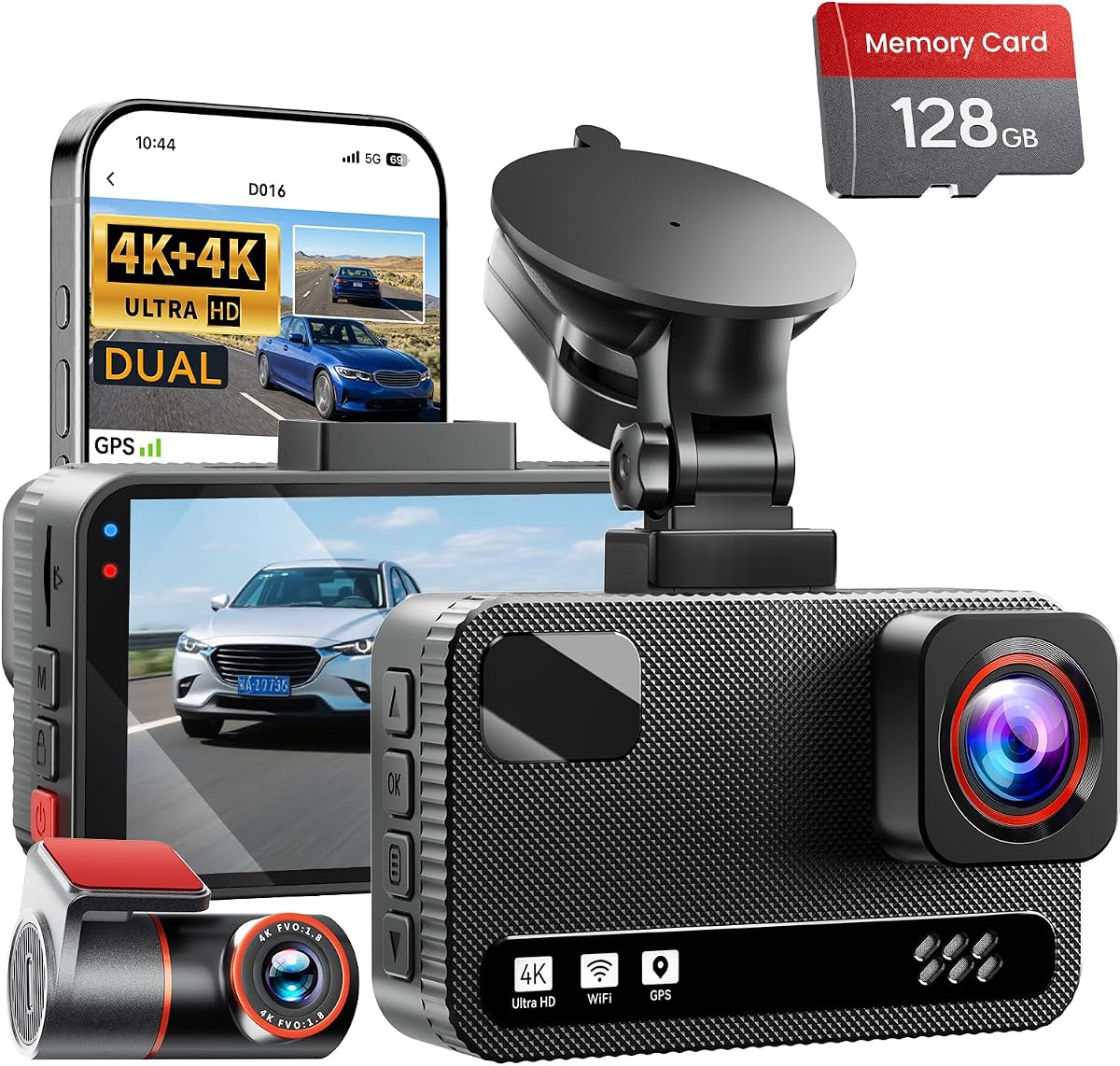
The 4K+4K Front and Rear Dash Cam is a clean, direct dual-camera system with a 4.9 rating. It records 3840 by 2160 footage from both the front and rear, focusing on license plates, road signs, traffic lights, lane changes, and evidence of impacts from either direction. It is a strong alternative for drivers who prioritize resolution over cabin or side coverage.
We may earn a commission when you buy through this link, at no additional cost to you.
A 3.39-inch IPS screen helps with installation, camera-angle adjustment, live viewing, and playback. The F1.8 front lens is intended to retain clarity in ordinary road scenes, although the supplied information does not identify a specific low-light sensor or claim a particular night-vision technology. Buyers focused on night performance may want to compare that with models featuring named STARVIS 2 sensors.
The 5.8GHz Wi-Fi connection supports live preview, playback, fast downloads, saving key clips, and sharing without removing the memory card. Built-in GPS records route, speed, and location alongside the footage, adding context when reviewing a journey. A 128GB card is included, so users can begin recording without sourcing storage first.
Loop recording overwrites older unlocked files, and the G-sensor helps protect footage associated with sudden impacts. Parking Monitor and Time-Lapse functions require a compatible hardwire kit sold separately. This model's main advantage is its uncomplicated feature set; the main limitation is that it stops at two exterior channels and offers less detail about its sensor and night imaging.
Integrated GPS records route, speed, and location directly with the video. That information can make a clip more useful when a driver needs to establish where a journey took place or reconstruct the circumstances surrounding an event.
The front-and-rear arrangement covers the most important exterior directions without the installation demands of a cabin or side camera. An on-device IPS screen keeps basic setup and review approachable.
We may earn a commission when you buy through this link, at no additional cost to you.
The best Dash CAM for one driver may be inadequate for another, so the right choice depends on coverage, image quality, storage, connectivity, parking power, and installation constraints. Use the following factors to narrow the field before comparing individual models.
Choose coverage that matches your actual need. For commuting, a front-and-rear camera may be enough; for commercial passenger work, a cabin channel is valuable; for large vehicles or parking-lot awareness, side cameras can help.
Check the actual front and rear resolutions rather than relying on the marketing label. Drivers prioritizing rear incidents should look for 4K on both exterior channels, while budget buyers may accept a 1080P rear camera.
For frequent night driving, prioritize a named low-light sensor, wide aperture, and HDR or WDR. For rideshare use, consider whether the cabin camera includes infrared lights for dark interiors.
Prefer a reliable card suited for continuous video, and confirm the maximum capacity before purchasing. Never rely on an included card without checking its specifications and condition.
Choose 5GHz or dual-band Wi-Fi for faster retrieval, and confirm that the manufacturer's app supports your phone. GPS is especially helpful for road disputes, route history, and incident reviews.
Confirm that a compatible hardwire kit is sold separately and budget for installation if needed. Review the parking-mode settings carefully, especially when the vehicle is parked in exposed or unattended locations.
Look for automatic event locking, a supercapacitor, and manufacturer guidance on heat and power accessories. Check the event folder periodically to confirm that important clips are being preserved.
Choose controls that encourage safe use. A simple screen-free design may be preferable for a minimal dashboard, while a touchscreen or voice system may be worthwhile if it makes everyday management easier.
Begin by reading the model's manual, checking the included components, and confirming that the memory card is seated correctly. Mount the main camera high enough to avoid blocking the driver's view, clean the glass with the supplied wipe, and route cables along trim panels where they will not interfere with airbags, controls, or the driver's hands. Aim the lens to include useful road context without spending the frame on excessive sky or dashboard.
Format the storage card in the dash cam when the manual recommends doing so, then set the date, time, resolution, exposure, and loop-recording preferences. Connect to the app while parked, test live preview, confirm the angle, and practice downloading a short clip. Activate the G-sensor and emergency-lock features, and make sure the phone has enough free storage for the file transfer. If using GPS, allow the system time to establish a clear position before relying on route information.
For parking surveillance, use only the compatible hardwire kit and follow the vehicle-specific installation instructions. Check the cable routing, fuse selection, and parking-mode settings before leaving the vehicle unattended. Review locked event clips regularly, keep the lens and memory-card slot clean, and avoid leaving the camera exposed to extreme heat beyond its operating guidance. Replace a card if recordings become unreliable, and check for firmware updates through the official app.
4K can help preserve small details such as license plates, road signs, and lane markings, particularly when a vehicle is relatively close to the camera. It also creates larger files and increases storage and transfer demands. A good 1080P system with a strong sensor may still provide useful evidence, while a well-performed upscaled 4K model may offer a practical middle ground. Compare the native resolution, sensor, aperture, and night performance together.
A front-and-rear system is advisable if you want evidence of a rear collision, reckless following, or events occurring while your vehicle is stopped. A front-only camera is simpler, lighter, and less distracting, making it suitable for drivers mainly concerned with the road ahead. Three- and four-channel systems add cabin or side coverage, which can benefit rideshare drivers, families, and security-conscious owners.
Many models offer time-lapse, motion-detection, or collision-detection parking modes. In this guide, parking operation generally requires a separately sold hardwire kit so the camera can remain powered after the engine is turned off. Buffered systems can preserve several seconds before an event, which is useful because a collision may not be recognized immediately. Installation must follow the vehicle and hardwire-kit instructions to maintain safe electrical operation.
Choose a reliable microSD card that meets the dash cam's speed and capacity requirements, and format it according to the manufacturer's instructions. Many included cards provide 64GB or 128GB, but multi-camera systems may fill them quickly. Maximum supported capacity differs by model, ranging from 256GB to 1TB in the featured products. Replacing a card with read errors or failed recordings is generally preferable to continuing to use unreliable storage.
A screen makes installation, angle adjustment, live viewing, and local playback easier, but it can add visual clutter and tempt the driver to interact with the camera. Screen-free models are more compact and can be mounted with less obstruction. Touchscreens and voice commands add convenient alternatives, although settings should still be configured while parked. The best choice is the interface you will use safely and consistently.
No. Loop recording maintains a rolling history by overwriting older files, while the G-sensor detects sudden movement or an impact and locks the associated file so it is not overwritten. Manual emergency locking can also preserve a clip. Using both features gives the driver continuous coverage while protecting footage associated with an incident.
GPS records route, speed, compass, and location information with the drive, adding context when reviewing a trip. Wi-Fi allows phone-based preview, playback, downloads, settings management, and sharing without removing the memory card. Faster 5GHz or dual-band connections are convenient for retrieving 4K clips. Neither feature replaces the actual video, but both can make stored evidence easier to find, understand, and share.
Keep the lens clean, protect the card slot from dust, and check recordings and locked event files regularly. Avoid exposing the unit to heat beyond the manufacturer's guidance, use approved power cables, and follow any warnings about non-original accessories. Install firmware updates through the official app, inspect cables for damage, and remove the card before formatting it when the manual requires that step.
The AProX 3 Channel Dash Cam is the strongest all-around choice for buyers who want true 4K recording from the front and rear, a 1080P cabin camera, infrared interior visibility, and fast Wi-Fi 6 transfers. The compact galphi 4K Front is the best budget-oriented option for a simple, low-distraction setup, while the Vantrue N4 Pro S leads the premium group with triple STARVIS 2 sensors, a rotating rear camera, and buffered parking protection.
For most drivers, begin with coverage: decide whether you need only the road ahead, the road in both directions, or a cabin and side cameras as well. Then prioritize genuine low-light performance, a suitable storage card, a safe G-sensor lock, and the power arrangement needed for parking mode. The ROVE R2-4K Dual, REDTIGER F7NP, and other dual-channel models remain strong alternatives when three-camera installation would be excessive.
Finally, check the current listing before buying. Included memory cards, supported capacities, parking-kit requirements, app compatibility, and warranty terms can change, and the distinction between native and upscaled 4K should be verified carefully. Compare the current configuration with the guide, choose a model that suits your vehicle and driving routine, and use the included instruction materials to complete a safe and reliable installation.