
Sony GV-D1000 Portable MiniDV Video Walkman
3.9Editor score
Four-inch viewing screen
Built-in USB terminal
iLink DV input output
Composite and S-Video
Portable playback design
A Mini DV cassette player for PC is most useful when it combines reliable tape playback with a practical way to transfer footage to a computer. The right device should support the connections available on your computer, accept the output format of your camcorder, and make the transfer process easy enough for occasional family archives or larger collections.
We compared the listed products by examining their playback capabilities, input and output connections, computer compatibility, included accessories, recording functions, and suitability for digitizing Mini DV tapes. The guide also identifies standalone converters, cleaning supplies, blank media, and other accessories that can complement a transfer setup.
Each entry explains what the product can actually do, where it fits into a Mini DV workflow, and which buyers should consider it. Our top three highlight the strongest starting points for different needs, while product availability and prices can change, so confirm the current listing details before purchasing.
3.9Editor score

3.8Editor score

4.6Editor score
As an Amazon Associate we earn from qualifying purchases.
The table below compares all ten products by function, playback support, connectivity, and likely role in a PC digitization workflow. Only some are actual computer-facing players, so the comparison also distinguishes standalone converters and supporting accessories from devices designed to transfer footage directly.

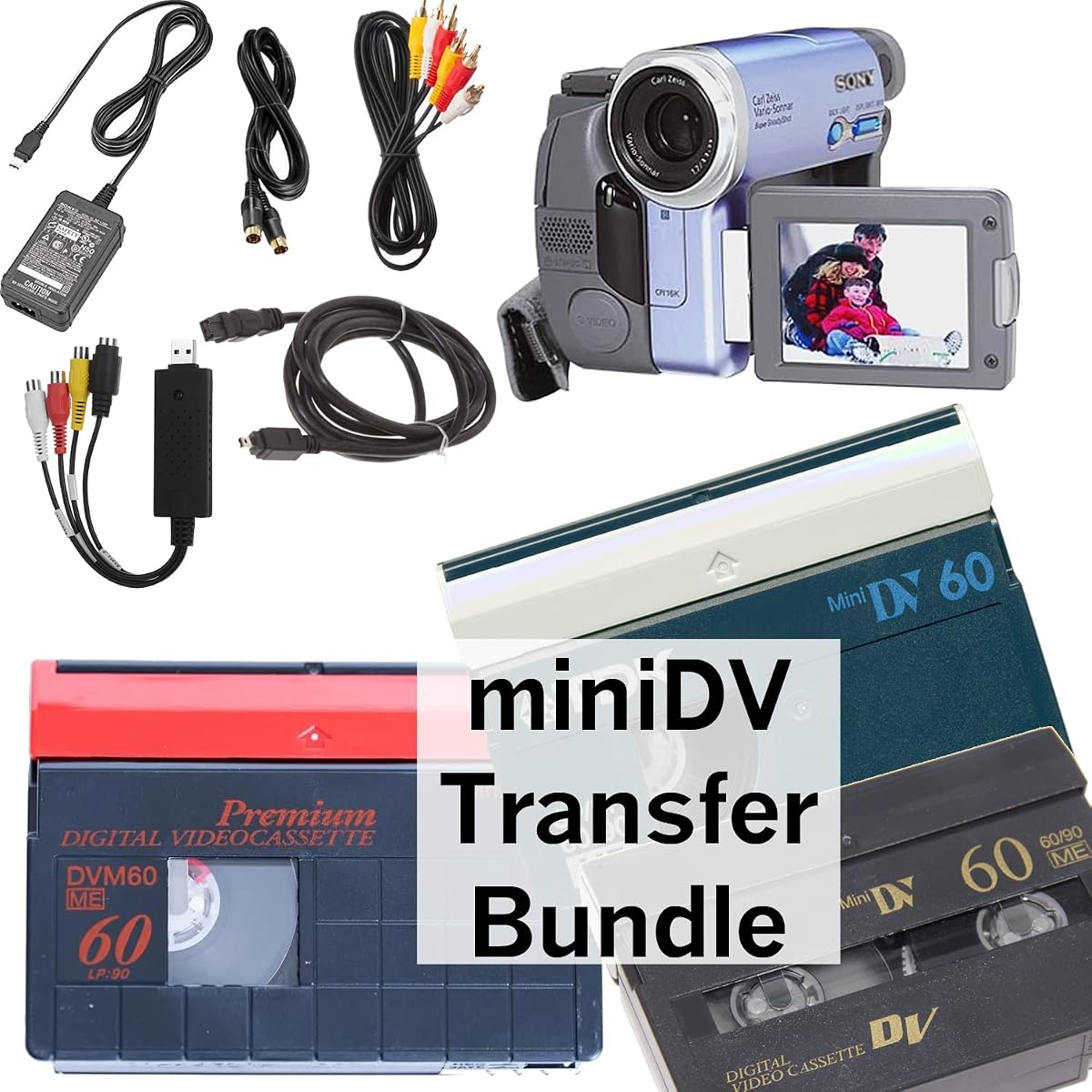


This Sony camcorder is the clearest match for the core task of transferring Mini DV tapes to a computer. Its 3.8 rating is moderate, but the supplied specifications directly address playback, USB capture, and computer access. It can play Mini DV tapes from any brand and transfer their contents into computer files or make them available for burning to DVD.
We may earn a commission when you buy through this link, at no additional cost to you.
The package includes a USB capture device, a power supply, and both AV and S-Video cables. That collection is useful because a dependable signal path matters more than simply owning a player with a USB port. Compatibility with Windows and Mac is also stated, with USB, FireWire, and Thunderbolt listed among the available connection methods.
Its important limitation is that it is a playback and transfer device, not a new recording camcorder. The manufacturer also notes that HDV is unsupported. That means it should be evaluated specifically for accessing a Mini DV archive rather than as a general-purpose modern video camera, and buyers with HDV tapes need a different solution.
This is the best overall recommendation for someone who already has Mini DV tapes and wants a relatively direct PC workflow. Choose it when the priority is dependable playback and computer transfer, and when the included cables and capture hardware offer a more convenient package than assembling each component separately.
The device is designed around the final stage of digitizing an existing tape collection. Its included capture hardware and cables reduce the chance that a buyer will discover a missing adapter only after arranging the camcorder and computer.
Windows and Mac compatibility makes this option relevant to mixed-computer households. Users should still confirm the current operating-system requirements and connection driver situation before starting a large project.
We may earn a commission when you buy through this link, at no additional cost to you.
The Portta converter is a 4.5-rated standalone digitizer that can accept video from Mini DV camcorders and players as well as numerous older sources. It records up to 1080P at 30Hz and stores video in MP4 or audio in MP3. Its preview LCD and built-in speaker are particularly useful for framing and monitoring a source without relying on the computer.
We may earn a commission when you buy through this link, at no additional cost to you.
Connections include AV/RCA, S-Video, and AUX input. Saved files can be placed on a USB drive or TF card, with no stated capacity limit for those storage devices. The package includes a power adapter, USB Type-A to Type-C cable, remote, AV cable, 3.5mm audio cable, manual, warranty, and lifetime technical support.
This is not a tape player by itself. It cannot independently play Mini DV, VHS, DVD, or other media, so a compatible camcorder or tape player remains necessary. The product description also highlights specific setup checks, including confirming the correct input and unmuting the relevant video and audio volume controls.
For PC-oriented buyers, this converter offers a practical alternative to direct USB capture: record directly to removable storage, then move the files to a computer. It is best for an archivist who wants a self-contained workflow, remote operation, and broad source compatibility rather than a conventional computer capture card.
Because the converter writes directly to USB or TF storage, the computer does not need to remain beside the player during recording. That can simplify long capture sessions and reduce dependence on live computer capture software.
Support for Mini DV, VHS, Hi8, DVD sources, DVRs, and gaming consoles makes the device useful for mixed-format collections. It also reduces the need to purchase a separate converter for every legacy video standard.
We may earn a commission when you buy through this link, at no additional cost to you.
The Tech Collector bundle is aimed at a simple starting setup for Mini DV digitization. It combines a miniDV player or camcorder, a USB capture device, a battery, AV cables, and a blank miniDV tape. The 2.9 rating is the lowest among the listed products, so careful attention to device condition and included documentation is advisable.
We may earn a commission when you buy through this link, at no additional cost to you.
Its strongest feature is convenience. A buyer can begin with one package rather than separately sourcing playback hardware, a capture interface, basic cables, and a test tape. The stated purpose is playback and transfer of miniDV tapes into computer files, with the option to burn captured content to DVD.
The product data does not explicitly list operating-system compatibility, advanced video outputs, or the exact transfer speed. It also does not make recording a central feature. Buyers comparing it with the first-ranked Sony package should verify whether they need additional cables, broader legacy support, or a more clearly documented cross-platform workflow.
This bundle is most suitable for a beginner who wants a straightforward, contained Mini DV transfer kit. It may be less attractive to an experienced archivist who already owns a compatible player and needs advanced controls, particular connection standards, or a proven computer-capture process.
Including a USB adapter, AV cables, a battery, and a blank tape removes several early obstacles. A newcomer can check the signal path with familiar components before building a more specialized setup.
The information does not enumerate every port, cable type, or software detail. Reviewing the package contents and current compatibility documentation is sensible before purchasing for an extensive archive.
We may earn a commission when you buy through this link, at no additional cost to you.
The Sony GV-D1000 is a portable MiniDV Video Walkman with a built-in USB terminal and several analog connections. Its 3.9 rating gives it a stronger score than the first-ranked transfer-focused camcorder while offering a different mix of viewing, editing, and connection features.
We may earn a commission when you buy through this link, at no additional cost to you.
The four-inch LCD provides a convenient way to monitor tapes directly. For archiving, the iLink DV input and output, composite video, S-Video, audio jack, and USB terminal create several possible routes into a computer or other editing equipment. The device can also record, view, and edit digital footage and still images.
Its age is the main practical concern. Newer computers may not include iLink or FireWire ports, and compatibility with current transfer software may be limited. The USB terminal is convenient, but the actual transfer workflow can depend on what the operating system recognizes and which drivers or editing applications remain available.
For a budget-conscious buyer who wants both a standalone Mini DV player and a computer-oriented device, this Sony remains compelling. It is particularly useful when a larger screen and legacy outputs matter more than a modern all-in-one appearance, provided the connection plan matches the computer and software you already own.
The GV-D1000 does not merely display tapes. Its USB terminal and iLink connections allow it to serve as one component in a broader digital editing and archival setup.
The four-inch display makes it easier to identify tape problems, check playback, and monitor footage without carrying a separate monitor into the process.
We may earn a commission when you buy through this link, at no additional cost to you.
This 4.6-rated converter is one of the strongest options for preserving tapes with a standalone workflow. It accepts signals from a Mini DV player, VCR, camcorder, Hi8 device, DVD player, DVR, and other legacy sources, then saves video as MP4 without requiring a computer, software, or drivers.
We may earn a commission when you buy through this link, at no additional cost to you.
Its four-inch LCD and speaker allow real-time monitoring, while HDMI output allows the image to be shared with a larger television or monitor. Recordings can be stored on USB drives or TF cards, and the stated capacity support extends to 512GB for each medium. Files can also be divided by length or size without affecting playback quality.
As with the Portta converter, a working source player is required. The box cannot play Mini DV tapes independently. Its feature set does, however, include S-Video and CVBS recording, separate audio inputs, screenshots, timed recording, NTSC and PAL compatibility, and a built-in storage speed test.
The included power adapter, USB-A to Type-C cable, AV cable, AUX cable, manual, and remote make setup more complete. For a PC user, the files can later be copied from USB or TF storage. This is an excellent choice when computer-free recording and a larger preview display are the top priorities.
The four-inch screen is larger than the Portta converter's three-inch display. That difference can make framing, playback checks, and menu navigation more comfortable during lengthy digitization sessions.
USB and TF support makes it possible to select storage based on the archive's size. HDMI output also allows recorded material to be reviewed on a larger display before copying it to a computer.
We may earn a commission when you buy through this link, at no additional cost to you.
The Sony DVM60PRR/3 is a 60-minute premium Mini DV tape rather than a player or converter. It earns a 4.5 rating and is relevant to this guide because a dependable tape player cannot capture footage without usable record media, particularly when preserving new recordings or testing a transfer setup.
We may earn a commission when you buy through this link, at no additional cost to you.
Sony describes the tape as using advanced metal evaporated technology with a diamond-like carbon protective layer. Those features are intended to support picture and sound quality while improving durability and reducing the likelihood of dropouts. Hang-tab packaging also reflects the format's professional and enthusiast heritage.
It should not be confused with a transfer solution. Buyers looking for a Mini DV cassette player for PC still need compatible playback hardware and a capture route to the computer. A recording tape becomes most useful when paired with a camcorder or another device that can record Mini DV video.
This tape is best for owners of a functional Mini DV camcorder who need one reliable recording. For a computer-digitization setup, consider it complementary rather than central. It is particularly appropriate when preserving short events, creating test recordings, or backing up footage in a widely compatible Mini DV format.
The protective coating and metal evaporated formulation are intended to support stable playback. This matters when recordings will eventually need to be transferred from a camera to a computer and retained for years.
A new tape can help verify that playback, capture cables, and computer software are working correctly. It also provides a practical way to confirm that a selected Mini DV player is moving the tape and producing a usable signal.
We may earn a commission when you buy through this link, at no additional cost to you.
The Sony dvm4cld2 is a dry cleaning cassette designed to maintain the heads of Mini DV camcorders. It is not a player, converter, or blank tape, but it can be an important accessory for anyone experiencing picture noise, dropouts, or playback trouble during a PC digitization project.
We may earn a commission when you buy through this link, at no additional cost to you.
The procedure is straightforward: insert the cleaning cassette into a compatible Mini DV camcorder and play it for about ten seconds. Because it uses a dry cleaning system, the process does not require liquid solution, and the product is stated to work with Mini DV camcorders from any brand.
Cleaning cannot recover information already lost because of physical tape damage, severe demagnetization, or a defective mechanism. It is preventive maintenance rather than a universal repair tool. A user with consistently poor playback should inspect the tape, player heads, and signal path before assuming the cassette itself is the source of the problem.
This accessory is best for archivists transferring a large number of tapes, particularly older collections that have been stored for years. It also makes sense as a low-complexity maintenance purchase for owners who want to keep a camcorder's playback mechanism in good working condition.
Head cleanliness can help maintain consistent contact with the tape. That supports smoother playback and more reliable capture when many recordings are processed in succession.
A short cleaning cycle is an accessible first maintenance step for intermittent noise or dropouts. If the problem continues, test another tape and inspect every cable and connection before attributing the fault to the player.
We may earn a commission when you buy through this link, at no additional cost to you.
The Panasonic 60-minute three-pack supplies three Mini DV videocassettes for recording and archiving. Its 4.6 rating is among the highest in the supplied list. Although it is not a Mini DV cassette player for PC, blank media is relevant to anyone building a camera-based digitization workflow or preserving newly captured family footage.
We may earn a commission when you buy through this link, at no additional cost to you.
Each cassette offers 60 minutes of recording time and uses a diamond-like carbon-coated thin film. The product data also notes reduced tape friction for more stable running performance. Those characteristics make the tapes useful for regular recording sessions and for creating test footage that can be transferred through a compatible computer setup.
The main limitation is that no playback, capture, or computer connection is included. A camcorder capable of recording Mini DV is necessary, as is a suitable transfer method. Buyers focused only on reading existing tapes should prioritize a player instead of this pack.
This three-pack is best for owners who want several tapes without purchasing a much larger bundle. It offers a balanced choice for short events, test recordings, and organization of related footage into manageable 60-minute sessions.
Using several tapes makes it easier to keep events, dates, or family groups separate. Shorter sessions can also simplify editing and file naming after each recording reaches the computer.
The listed low-friction construction is intended to support stable operation. Consistent movement is valuable during recording and later playback, especially when the footage will become part of a lasting digital archive.
We may earn a commission when you buy through this link, at no additional cost to you.
The Sony DVM60PRR/6C is a six-pack of 60-minute Mini DV tapes with a 4.6 rating. It is a supporting product rather than a direct answer for someone searching for a PC-connected player, but it is highly relevant for owners who plan to create a sizable analog-footage archive before digitization.
We may earn a commission when you buy through this link, at no additional cost to you.
The product description identifies the media as Mini DV and states that it is designed for high-definition digital recording and playback within that format. The six-pack format allows footage to be divided across events or recording sessions, which can simplify both camera operation and the later file-management process.
None of the necessary computer-transfer hardware is included, and the tapes are limited to 60 minutes each. Buyers should not expect the package to provide a USB adapter, capture software, or a player. Those components must be sourced separately or purchased as a dedicated transfer bundle.
This six-pack is best for a camcorder owner with regular recording needs or a planned project containing multiple occasions. It offers a middle ground between a small pack and a much larger stock of media while retaining a familiar 60-minute Mini DV format.
Six separate tapes can correspond neatly to six events or organizational categories. That structure can make it easier to compare, name, and back up the resulting digital files.
Mini DV remains useful for camcorder recording and transfer workflows based on dedicated playback equipment. As long as the camera and chosen computer-capture route support the format, the media can serve as the source for a digital archive.
We may earn a commission when you buy through this link, at no additional cost to you.
The Sony DVC60PRL ten-pack is the largest blank-media bundle in the list, supplying ten 60-minute Mini DV cassettes. Its 4.6 rating reflects a well-regarded format, while the supplied model and media details make it easy to confirm compatibility with a compatible camcorder.
We may earn a commission when you buy through this link, at no additional cost to you.
The listed model is DVC60PRL, also identified with former part numbers DVC60PR and DVC60PR3. The media type is Mini DV, and each cartridge provides 60 minutes. Ten separate tapes give an owner considerable flexibility for splitting recordings by event, keeping original and backup material, or preparing multiple test sessions.
This package offers no player, USB adapter, cables, or computer software. It is therefore most appropriate after confirming that you already own a functioning Mini DV camcorder and a suitable digitization path. A player focused on the PC should remain the priority for the core keyword, with this stock used to expand recording capacity.
The ten-pack is best for committed hobbyists, collectors, or families with an established Mini DV camera and ongoing recording needs. It reduces the inconvenience of repeatedly replenishing small quantities, although new users should begin with a smaller pack or a transfer bundle if they have not yet confirmed their equipment.
Ten 60-minute cartridges provide a large pool of recording material. This can support an extended project, multiple celebrations, or a combination of primary footage and backup recordings.
The model and former-part-number information helps prevent confusion when adding media to an existing setup. Checking the camcorder's accepted tape format remains essential before ordering a large quantity.
We may earn a commission when you buy through this link, at no additional cost to you.
Choosing a Mini DV transfer setup involves balancing playback capability, computer connections, source compatibility, recording quality, and convenience. The most important distinction is whether you need a device that captures directly to a computer or a standalone converter that saves files to removable storage.
A direct capture device uses a USB connection to send video into a computer while the tape plays. This can provide a simple, immediate transfer path, especially when modern editing software recognizes the included hardware. A standalone converter performs a different job: it records the analog output of a Mini DV player or camcorder to USB or TF storage, after which those files can be copied to a computer. The latter may be more convenient for long sessions because the computer does not need to remain responsible for the live capture.
Choose direct capture for a compact computer-centered workflow. Choose standalone recording for remote control, larger previews, flexible storage, or computer-free capture sessions.
The device must accept Mini DV tapes, and it is helpful to know whether it can play media from multiple manufacturers. Some listings explicitly advertise all-brand Mini DV playback, while others focus on playback and transfer without giving a detailed brand list. Check whether the product supports only standard Mini DV or also claims compatibility with Hi8 and other formats. Also note whether the unit is a player, a camcorder, or merely a converter that requires another source device.
Prioritize a clearly documented Mini DV player if your goal is reading an existing tape collection.
USB is the most broadly useful modern connection, but a USB port alone does not guarantee that a legacy device will work with a current operating system. Check the stated support for Windows or Mac, the type of transfer interface, and whether drivers or editing software are required. Devices offering iLink or FireWire can be useful with compatible computers, but many modern systems no longer provide those ports. Standalone converters can avoid some of these constraints because their files are moved to a computer after recording.
Match the device to your operating system and editing environment before buying, particularly for a large archive.
The two featured standalone converters record at resolutions up to 1080P and save video as MP4, with MP3 available for audio-only capture. These characteristics make their files relatively convenient to organize and play after transfer. The direct-capture products depend on the included capture device and computer software for the final file format and resolution. Consider how the footage will be used, whether for long-term storage, editing, family viewing, or web sharing.
MP4 output is broadly practical, but recording quality alone does not guarantee improved source detail.
A complete transfer path normally requires a power supply, video connection, audio connection, and computer interface. The first-ranked Sony includes a USB capture device, power supply, AV cables, and S-Video cables. The Tech Collector bundle includes a capture adapter, battery, AV cables, and a blank tape. Standalone converters generally include an AV cable, auxiliary audio cable, power adapter, and remote. Check connector types against the source player and avoid discovering that an essential adapter is missing only after delivery.
Favor a package that covers both the playback device and the signal path from source to storage.
Direct capture writes to the computer's available storage, while standalone converters can use USB drives or TF cards. One standalone model states support for storage devices up to 512GB each, and both converters offer flexible file storage without tying the archive to a particular computer. Consider expected archive size, backup strategy, and how often you want to move files. It is also useful to know whether the converter can split long recordings automatically by time or file size.
For extensive collections, removable high-capacity storage is often easier to organize than one continuously growing capture folder.
A built-in screen helps you frame the image, confirm that the correct input is selected, and detect tape or tracking problems before recording an entire session. The four-inch converter offers the largest listed preview screen, while the Portta model has a 3-inch display and the Sony GV-D1000 has a 4-inch LCD. Remote control can also be valuable because it lets the operator start and stop the converter without reaching toward the source player.
A visible preview is not essential for every transfer, but it substantially improves control during long jobs.
A player is only one part of a reliable archive. A dry cleaning cassette can help maintain camcorder heads, while blank Mini DV tapes support test recordings and new footage. Before transferring old tapes, inspect their shells for cracks, warped edges, loose hubs, or stuck mechanisms. Store tapes away from heat, humidity, and direct sunlight, and handle them by the edges. For an important collection, preserve the original tapes even after creating digital copies.
Basic care and a few support products can reduce avoidable playback failures and protect irreplaceable recordings.
Begin by identifying the source of the footage. A direct-capture camcorder can play the Mini DV tape and send its output to the included USB capture device. Connect the power supply and relevant video or USB leads, then install any required capture software before placing the tape inside. If using a standalone converter, connect the Mini DV player's video output to the converter with AV or S-Video, route audio through the appropriate RCA or AUX connection, and select the matching source in the setup menu.
Start playback at the beginning of the tape and preview the signal before committing to a long recording. Confirm that the image is stable, the audio is audible, and the input and volume settings are not muted. For direct capture, begin the computer recording and allow a short lead-in before recording. For standalone capture, start the converter, start the tape player, and monitor the preview screen. Stop the recording after the final scene, then save or safely eject the storage device.
For long archives, transfer in manageable batches and verify several files before moving on. Label source tapes, use a consistent naming system, and keep multiple backups of the digital files. Clean compatible Mini DV camcorder heads with a dry cleaning cassette as needed, but do not expect cleaning to repair physically damaged tape. Store original media in a cool, dry place, and never force a jammed mechanism. A gentle pause and inspection is safer than aggressive troubleshooting.
Yes, unless the converter you purchase includes a functioning Mini DV playback mechanism. Most standalone capture boxes require a compatible camcorder or Mini DV player to produce the source video signal.
The source device connects to the converter through AV or S-Video, and the converter then records that signal to a USB drive or TF card. The resulting files can be transferred to a computer for editing or backup.
A Mini DV player reads the tape and generates a video and audio signal. A converter does not normally contain its own tape mechanism; instead, it digitizes the signal coming from a camcorder, VCR, or other player.
Some camcorders combine both functions by playing tapes and providing video outputs for capture. Standalone converters can record without a computer, while direct USB capture sends the signal straight into the computer workflow.
It is possible, but compatibility depends on the player's connection and the computer's available ports and software. USB is the most convenient option when the included capture hardware is recognized by the current operating system.
Legacy iLink and FireWire options may require compatible hardware and software that are no longer readily available. A standalone converter that records to USB or TF storage can be the easier solution because the files are copied to the computer after recording.
No. Standard Mini DV and Mini DV HD are related but distinct tape formats, and a standard Mini DV player should not be assumed to handle the newer high-definition format.
The first-ranked Sony camcorder explicitly states that it has no HDV support. If your archive contains Mini DV HD or HDV recordings, verify the exact source format and choose hardware that explicitly supports it.
Most Mini DV transfers occur in real time because the tape must play normally while the image and audio are captured. A converter's claimed recording resolution does not necessarily make the process faster than the tape's playback speed.
Plan for the full tape duration and avoid interrupting the process. Test the first few minutes, check file playback, and continue with confidence before handling an entire collection.
The two featured standalone converters save video in MP4 format and audio in MP3 format. This makes the files practical for organizing, playing, and editing on a computer after they are copied from USB or TF storage.
The final quality still depends on the source tape, the player output, the selected recording settings, and the connection used. A modern container does not restore detail missing from an old or damaged recording.
Start by cleaning the camcorder or player heads with a compatible dry cleaning cassette, then inspect the tape for physical damage. Use the best available video connection, such as S-Video, and confirm that audio levels and input selections are correct.
If a particular section looks noisy or unstable, try rewinding and replaying it. Persistent artifacts may be in the tape itself and cannot be completely repaired through the capture device.
Yes. Original tapes remain a valuable part of the archive, especially when the original recording is unique or the digital copy was made from a damaged source. Store them separately from frequently accessed hardware in a stable, dry environment.
Maintain at least one additional copy of the digital files in a different location or on a separate storage medium. Digitization creates a convenient access copy, but it does not eliminate the value of preserving the source media.
The Sony camcorder transfer unit is the most direct starting point for computer-based Mini DV digitization because it combines tape playback, a USB capture device, and the necessary cables. The Sony GV-D1000 offers a different approach with a built-in display and several legacy connections, while the 4-inch standalone converter provides an especially convenient computer-free recording workflow with flexible USB and TF storage.
Prioritize the path that matches your actual collection. Existing tapes require a confirmed Mini DV playback device, and a modern computer benefits most from a recognized USB capture route. Mixed media or long sessions may justify a standalone converter, while blank tapes and a dry cleaning cassette should support—not replace—the core playback and capture equipment.
Before purchasing, confirm the included components, current computer compatibility, and the presence of any required software. Product listings and prices change over time, so review the current offer and availability before ordering. The right setup is the one that produces reliable files while preserving the original tapes for the long term.
