
NGTeco Standalone Biometric Punch Machine
4.3Editor score
No WiFi setup required
Excel-ready USB reporting
500 user profile capacity
Internal power-loss backup
Compare the best biometric fingerprint scanner time clock options, including standalone, cloud-connected, multi-factor, and budget models for small business
A biometric fingerprint scanner time clock can give small businesses a more reliable way to record employee attendance without relying on paper cards, shared PINs, or manual hour calculations. The strongest systems combine fast fingerprint recognition with clear reporting, flexible shift handling, and practical options for payroll preparation. Models range from simple offline devices to cloud-connected platforms with mobile management and multiple authentication methods.
The products in this guide were compared using their supplied features, compatibility, capacity, connectivity, reporting tools, ease of setup, and customer-support details. The list covers standalone units that work without internet access, networked systems with app and web portal control, and multi-factor clocks supporting fingerprints alongside faces, palms, badges, or PINs. It also includes a compact USB reader for software-based attendance environments.
Each review explains who the product suits, which operational needs it addresses, and where its trade-offs may matter. Fingerprint-focused options take the top positions where they combine flexible scheduling, useful reporting, and dependable offline support, while larger multi-factor systems appeal to teams that want broader attendance options. Product availability and pricing can change, so readers should confirm the current listing and terms before making a purchase.
4.3Editor score

4.7Editor score

3.8Editor score
The table below compares authentication methods, connectivity, user capacity, scheduling, reporting, and operational features across ten fingerprint-oriented attendance solutions, including complete time clocks and one USB biometric reader.




This Biometric Time Clock + Online Reports model offers one of the broadest attendance-management feature sets in the guide. Its 4.1 rating reflects a versatile package rather than a minimal standalone machine. Fingerprint scanning is only one component: employees can also be identified through facial recognition, palm scanning, RFID badges, or PIN codes, allowing managers to match authentication levels to different workplace needs.
We may earn a commission when you buy through this link, at no additional cost to you.
Remote operation is another major strength. The system connects through WiFi or LAN and sends punches to the cloud without requiring local software installation. A mobile app supports monitoring, while online reporting includes job tracking, CSV exports, alerts for early or late punches, and warnings about approaching overtime. Geofencing, GPS coordinates, job transfers, kiosk features, and optional selfie capture provide additional controls for organizations that need a detailed audit trail.
The trade-off is the service structure. The description references a free trial followed by a convenient subscription plan, so businesses should examine current service terms and the features available at each level before relying on the system. The broad feature set may also require more initial setup than a basic offline clock. Buyers should assess whether advanced tracking, mobile management, and multiple biometric options justify the added complexity.
This model is a strong choice for small businesses that want one device to support several attendance methods while providing cloud-based oversight. It is especially relevant to workplaces where employees may wear gloves, have accessibility needs, or benefit from badge and PIN alternatives. For organizations seeking a simple local-only device, one of the standalone alternatives may be more economical and easier to manage.
Having face, palm, fingerprint, badge, and PIN options reduces the chance that a single method will slow down every shift. Managers can offer convenient badge access while reserving biometric verification for more sensitive attendance events.
Real-time reports, overtime alerts, job tracking, and CSV exports give administrators a clearer view of labor activity. These tools are particularly useful when payroll managers need a compact set of current attendance data rather than manually reconstructed time sheets.
We may earn a commission when you buy through this link, at no additional cost to you.
The NGTeco Standalone Time Clock is a practical choice for a small business that wants biometric attendance without creating a network-dependent system. Its 4.3 rating and straightforward feature set position it as a capable value pick. The unit can start operating without WiFi, and attendance data is transferred through the included USB drive with ready-to-use Excel reports.
We may earn a commission when you buy through this link, at no additional cost to you.
Capacity is designed for a growing workplace, with support for up to 500 user profiles and 50,000 punch records. That makes the clock suitable for offices, warehouses, retail counters, schools, and healthcare facilities where a paperless record is preferable to time cards and printer ribbons. An internal backup system is designed to preserve punches during unexpected power loss, reducing the disruption caused by incomplete shifts.
Its main limitation is the lack of remote cloud management. Managers must retrieve reports through USB rather than reviewing live punches on a phone or web portal. The stated 500-profile capacity may also be insufficient for larger organizations or very high-turnover workplaces. However, for a small business seeking a straightforward local device, those compromises may be entirely reasonable.
Buyers should choose this model when the priority is simple setup, dependable local operation, and payroll-ready exports without recurring cloud features. It is a better fit for a single location with controlled access than for a distributed company managing multiple sites. Confirm the number of employees, desired export format, and wall or counter placement before installation.
Keeping attendance data on the local device can simplify deployment in facilities where network access is inconsistent. USB exports also make it possible to move reports into familiar spreadsheet workflows without maintaining a cloud account.
With support for 500 profiles and 50,000 punches, the unit offers meaningful room for a small or mid-sized staff. Managers should still monitor capacity as employees are added and archived records are exported regularly.
We may earn a commission when you buy through this link, at no additional cost to you.
The uAttend JR2000 is an all-in-one cloud attendance system combining fingerprint, RFID, and PIN authentication. Its 3.7 rating places it behind the highest-rated models, but its payroll orientation may appeal to businesses that want attendance and compensation functions in one platform. Real-time attendance records can be viewed and managed from different devices.
We may earn a commission when you buy through this link, at no additional cost to you.
Its service is designed to reduce administrative work by using time and attendance data for payroll tasks, with additional support described for tax filings and payroll switching. Comprehensive reporting tools help managers examine attendance trends, productivity indicators, and labor costs. Automatic cloud backups keep employee data available and reduce the consequences of a lost local device or failed manual file transfer.
The principal consideration is that the product includes a subscription service. Buyers should evaluate the current plan, device price, and ongoing service terms together rather than assuming every cloud capability is included without cost. A 3.7 rating also suggests that some customers may have found the overall experience less compelling than that of the higher-rated products in this comparison.
This system is most appropriate for small businesses already comfortable with cloud services and seeking integrated payroll workflows. It may be less compelling for a business that wants a fully independent device, minimal administration, or no ongoing service commitment. Confirm payroll compatibility and reporting needs before selecting it.
Connecting attendance records with payroll-oriented workflows can reduce duplicate data entry. The benefit is greatest for administrators who want time data available within a broader cloud management process.
Real-time browser or device access helps managers monitor attendance without remaining beside the physical clock. This is useful for owners or supervisors responsible for more than one operational area.
We may earn a commission when you buy through this link, at no additional cost to you.
This NGTeco fingerprint and PIN time clock is the strongest all-around option based on the supplied 4.7 rating, the highest in the group. It combines fast biometric recognition with app control, flexible scheduling, and straightforward payroll export. The result is a practical system for small businesses that want quick clock-ins without giving up administrative oversight.
We may earn a commission when you buy through this link, at no additional cost to you.
The fingerprint sensor is specified to authenticate wet or dry fingers in 0.5 seconds, which can reduce queues during busy arrival periods. The system calculates work hours automatically, supports overnight shifts, and aligns tracked time with weekly, biweekly, or monthly payroll cycles. Managers can edit punches quickly through the mobile app, with instant synchronization when devices are on the same local network.
The main limitation is that real-time app editing requires the same local network, so a remote manager may not have the same immediate correction access as a fully cloud-hosted system. Overnight and other complicated schedules still require proper configuration rather than automatic perfection. Nevertheless, the fast recognition, broad shift support, and convenient correction process make those trade-offs manageable for a typical workplace.
This is the recommended model for teams seeking a balanced combination of speed, app support, scheduling, and export flexibility. It is particularly appropriate for offices, retail operations, and small facilities where fingerprint scans occur at shift changes. Before buying, confirm that the physical network can support the app, and review the company's support hours and warranty terms.
A stated 0.5-second recognition time and support for wet and dry fingers help keep queues short. This is valuable in workplaces where many employees arrive within a short interval and cannot wait for repeated scans.
App-based editing lets managers correct a missed or mistaken punch in seconds. Local-network synchronization helps the physical clock and management device reflect changes promptly when connectivity conditions are met.
We may earn a commission when you buy through this link, at no additional cost to you.
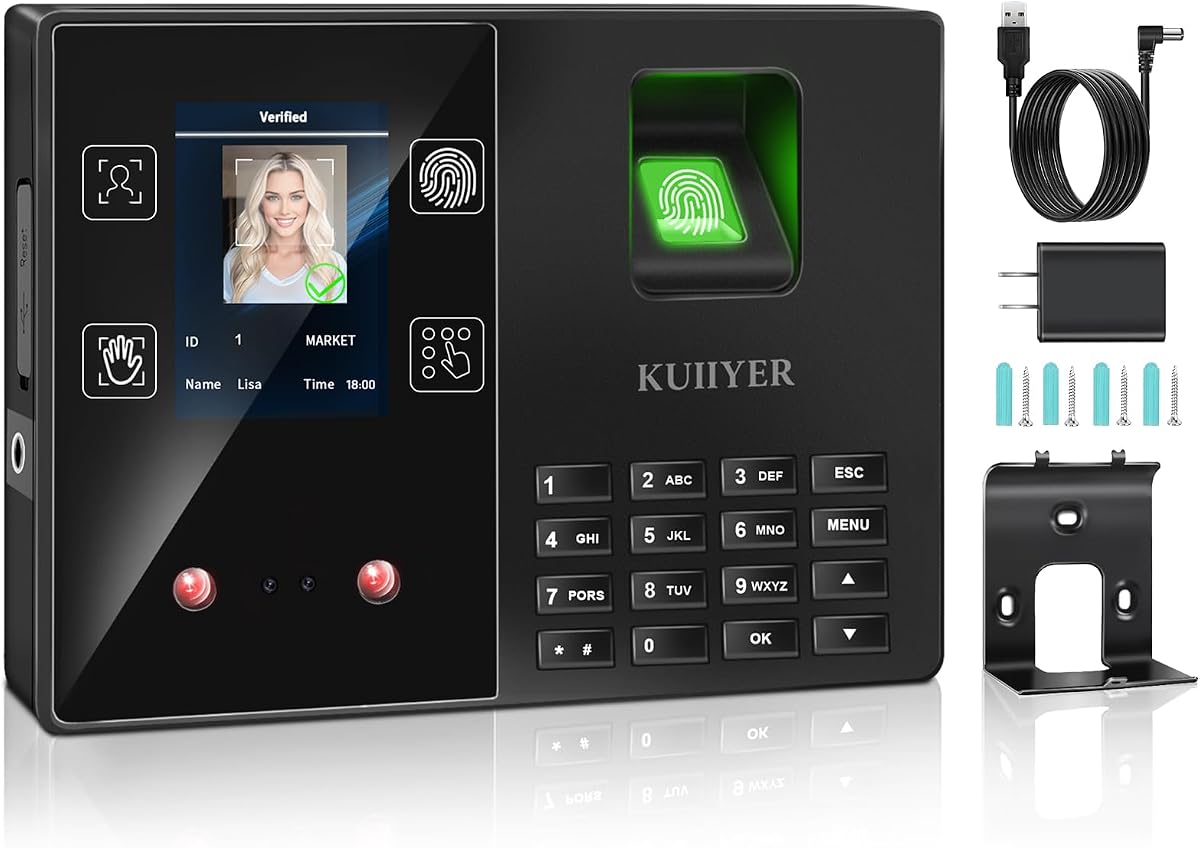
The KUIIYER 4-in-1 system is designed for organizations that want several authentication choices in a single offline clock. Its 3.7 rating is among the lower supplied scores, but the specification list is extensive. It supports face, palm, fingerprint, and PIN identification, making it adaptable to environments where different employees may have distinct scanning needs.
We may earn a commission when you buy through this link, at no additional cost to you.
The system is advertised for up to 1,000 users, 160,000 records, 16 departments, and 24 shifts. A 2.8-inch color LCD provides an intuitive interface, while 12 languages and voice announcements assist users during clock-in. Face and palm recognition reportedly function in dim environments, and fingerprint identification is specified at 0.5 seconds. Reports and scheduling data can be moved using a FAT32-formatted USB drive.
One important practical limitation is that the USB flash drive is not included. Managers must supply compatible storage before moving attendance data or shift arrangements. The 3.7 rating also warrants checking recent customer feedback for recurring concerns, especially because the feature set is broad and multilingual operation can introduce configuration details that affect daily use.
Despite those points, the product is a good candidate for factories, hotels, schools, restaurants, supermarkets, hospitals, and offices seeking offline multi-factor attendance. It suits teams that want large capacity without a required app or network. Buyers should confirm supported languages, desired user and record limits, and whether their workflows need remote access.
Face, palm, fingerprint, and PIN options let administrators accommodate different users without maintaining separate attendance devices. This can also provide a practical fallback when a particular biometric cannot be captured reliably.
The stated capacity for 1,000 users and 160,000 records is useful for organizations with substantial staff or detailed retention needs. Offline operation keeps the core workflow independent of internet availability.
We may earn a commission when you buy through this link, at no additional cost to you.
This product is a USB fingerprint reader rather than a complete stand-alone attendance clock. That distinction makes it relevant to a narrower but potentially useful buying category: offices that already operate attendance or access-control software and need an additional biometric enrollment device. Its lightweight desktop format also makes it easier to position beside a computer than a wall-mounted kiosk.
We may earn a commission when you buy through this link, at no additional cost to you.
The supplied information highlights fast and accurate fingerprint recognition, support for multiple user enrollments, and a stable biometric algorithm. Plug-and-play USB connectivity is intended to simplify setup and connection with a computer. Compatibility with many attendance and access-control software options gives it broader utility, although the exact supported applications should be checked before purchase.
Because this is not a full time-clock system, it does not inherently provide shift scheduling, hour calculations, payroll exports, or cloud management. Those functions must come from compatible software. It also has no supplied customer rating, so buyers cannot use the provided data to compare its satisfaction level with the complete clocks on this list.
The device is best for a business with established attendance software that supports USB biometric readers. It may also suit a portable verification station used alongside another system. It is not the right choice for an organization seeking a self-contained employee punch clock, and software compatibility should be confirmed before ordering.
Because attendance calculations and recordkeeping depend on connected software, this reader is best treated as a peripheral rather than an all-in-one solution. Confirm the required driver and device support with the software provider.
The compact, lightweight enclosure can be used on a reception desk, manager's workstation, or shared office computer. It offers flexibility when a permanent wall-mounted terminal is unnecessary.
We may earn a commission when you buy through this link, at no additional cost to you.
The HapAttend H3 combines standalone biometric timekeeping with automatic working-hour calculations. Its 4.1 rating places it among the stronger general-purpose options, particularly for small businesses that want to avoid both monthly fees and network configuration. The system works without WiFi and transfers data locally through USB.
We may earn a commission when you buy through this link, at no additional cost to you.
Automatic totals eliminate much of the manual work associated with paper cards and ink ribbons. The product supports English, Spanish, German, French, and Italian, and a step-by-step tutorial is available to help administrators get the unit ready. Five RFID cards are included, offering a supplementary clock-in method for employees who may not use a fingerprint scan.
Its limitations are inherent in the offline design. Managers cannot inspect live attendance from a remote app, and the included RFID quantity is modest for a larger team. Setup guidance is largely tutorial-based, so buyers with more complex shift or payroll requirements may need a product with more comprehensive documentation and remote management.
This clock fits a small or mid-sized business that values predictable operating costs, local data control, and uncomplicated setup. Offices, factories, hotels, schools, and restaurants are all named as possible environments. It is less suitable for multi-site managers who need centralized monitoring or rapid remote corrections.
Keeping the system independent of WiFi can simplify installation and make operating costs more predictable. USB transfers provide a direct path from the local device to the manager's reporting workflow.
Support for five languages can make onboarding easier in a multilingual workplace. The available language set should be checked against the workforce before deployment.
We may earn a commission when you buy through this link, at no additional cost to you.
The NGTeco Cloud 4-in-1 is a flexible cloud time clock for businesses that need remote access, varied schedules, and multiple identification methods. Its 3.8 rating is moderate, but the supplied specifications reveal a sophisticated scheduling and reporting platform. Real-time punch data can be accessed from a web browser through NGTeco Office software and an app.
We may earn a commission when you buy through this link, at no additional cost to you.
Fixed, rotating, split, and open shifts accommodate different workforce structures. The system also supports custom weekly overtime rules and dual OT1 and OT2 pay grades, which helps administrators model different compensation policies. It stores up to 30,000 logs, supports 200 users, and captures punches offline before automatically synchronizing them when the network returns. AWS-hosted storage and end-to-end encryption protect the data.
The trade-offs are capacity and optional service levels. A business with more than 200 users may need a different system, while advanced employee-app features such as GPS check-ins and intelligent reminders require a separate TimeEntrix subscription. Core features are described as available without monthly fees, so buyers should distinguish those included tools from the optional expanded service.
This is a strong premium choice for organizations that value schedule flexibility and centralized cloud oversight. It is particularly relevant to part-time teams, multiple departments, and workplaces using fixed, rotating, or split shifts. Confirm user count, required overtime rules, network reliability, and the exact service level before purchasing.
Four shift formats and configurable overtime rules make the system more adaptable than a basic attendance terminal. These options suit organizations with part-time staff or departments that do not follow the same daily schedule.
The clock can retain punches locally and synchronize them when connectivity returns. This reduces the risk of losing attendance events during a temporary network interruption.
We may earn a commission when you buy through this link, at no additional cost to you.
The H1 is a straightforward time clock for small businesses that need automatic employee-hour calculations without a network connection. Its 3.9 rating reflects a balanced but less advanced alternative within the guide. It operates independently, exports attendance through USB, and avoids software installation and recurring fees.
We may earn a commission when you buy through this link, at no additional cost to you.
Automatic hour totals can reduce payroll preparation errors and eliminate paper cards and ink ribbons. The system supports up to 1,000 employees, which provides considerable nominal capacity for a small or mid-sized organization. Its interface can switch among English, Spanish, German, French, and Italian, while a step-by-step video guide helps administrators complete setup without technical experience.
The product is deliberately basic, and that is both its strength and its limitation. There is no described live cloud dashboard, app-based correction system, or advanced shift engine. Managers who want remote access or sophisticated labor rules may need a more advanced platform. Capacity figures should also be considered alongside record-retention requirements, since the supplied details emphasize employees rather than total stored punches.
The H1 is most appropriate for offices, restaurants, retail shops, schools, and other single-location operations that want dependable local time tracking. It is a compelling option when predictable operation and low ongoing complexity matter more than remote oversight. Review the setup materials and current warranty and support details before deployment.
The H1 avoids network setup and software installation, reducing the number of technical steps before use. That simplicity makes it approachable for administrators with limited IT support.
Automatic working-hour totals provide a cleaner foundation for payroll calculations. Exporting the records through USB still requires a regular administrative routine and compatible spreadsheet processing.
We may earn a commission when you buy through this link, at no additional cost to you.
The NGTeco Dual-Band Cloud Clock combines remote attendance management with flexible scheduling and strong connectivity. Its 4.2 rating is among the higher supplied scores. Managers can use an iOS or Android app and a web portal to monitor clock-ins, track attendance, and generate reports without remaining at the physical clock.
We may earn a commission when you buy through this link, at no additional cost to you.
Dual-band WiFi supports both 2.4GHz and 5GHz networks, offering more deployment flexibility than a single-band device. Fixed, rotating, part-time, and department-specific shifts can be configured, while weekly overtime and dual-level OT1 and OT2 rates support different compensation policies. Reports are designed to produce payroll-ready attendance data, and AWS cloud storage with end-to-end encryption protects records.
A 2000mAh backup battery is a notable operational safeguard because the clock can continue operating during a power interruption. The main caveat concerns service packaging: a free management app supports basic operations, while full employee-app access requires a separate TimeEntrix subscription. The supplied details also do not state a maximum user count, so that should be confirmed before the unit is considered for a larger team.
This product fits businesses that want centralized cloud visibility and flexible payroll rules without maintaining a local server. It is well suited to owners or managers responsible for tracking staff remotely. Review subscription requirements, network availability, shift configuration, and support coverage before making a final selection.
Supporting both 2.4GHz and 5GHz WiFi can simplify installation in offices with different wireless configurations. The clock can be placed where the strongest available business network is practical.
The integrated 2000mAh battery helps maintain attendance tracking during outages. This feature reduces lost punches and protects the continuity of shift records when a workplace experiences an unexpected interruption.
We may earn a commission when you buy through this link, at no additional cost to you.
The right biometric time clock depends on workforce size, schedule complexity, network conditions, payroll workflow, and the level of remote control a manager needs. Reviewing these factors before purchasing can prevent an attractive specification sheet from becoming an awkward daily workflow.
Standalone clocks operate without WiFi and usually transfer attendance data through USB. They are attractive where network reliability is uncertain, administrators want records held locally, or predictable operating costs are important. Their main limitation is the absence of live remote monitoring, so a manager must retrieve reports physically and cannot make synchronized corrections from another location.
Cloud-connected systems send punches to an online platform, allowing managers to view attendance, edit records, run reports, and coordinate multiple devices from a browser or mobile app. This is useful for distributed teams and frequent schedule changes. Buyers should confirm whether core features remain available without a subscription and whether the workplace network supports the clock reliably.
Fingerprint scanning should be checked alongside the authentication methods a workplace actually needs. PIN codes provide a universal fallback, RFID badges can speed high-volume entry, and face or palm recognition can help in environments where employees have difficulty with a fingerprint sensor. The stated user limit is also important: some compact systems accommodate a few hundred users, while others list capacity for 1,000 employees.
For growing teams, distinguish employee capacity from punch-record capacity. A clock may support many users but retain only a limited number of punches between exports. Organizations should estimate enrollment numbers, turnover, shift frequency, and how frequently reports will be downloaded before choosing a model.
A reliable time clock must reflect the way employees actually work. Look for support for overnight shifts, split shifts, rotating schedules, fixed shifts, part-time schedules, and department-specific rules. Automatic hour calculation is helpful, but it only reduces manual work if the configured rules match the employer's policies.
Payroll-oriented buyers should also examine weekly overtime thresholds and whether multiple overtime rates or pay grades can be configured. The NGTeco cloud models provide especially detailed rule-setting, while simpler standalone devices may focus primarily on clock-in, clock-out, and total-hour calculation.
Attendance data is only useful when it can be transferred into the payroll process. USB exports with ready-to-use Excel reports suit organizations using spreadsheets, while CSV exports and browser-based reports can feed more automated workflows. Cloud systems may also offer direct payroll integration or automated preparation of time-and-attendance data.
Before buying, check file formats, required date fields, employee identifiers, overtime labels, and the device used to approve corrections. A platform that looks polished on screen may still require careful mapping if the employer uses a specialized accounting or payroll system. A product with established integration may be worth the added setup effort.
Clock-in speed matters most at shift changes, when many employees arrive together. The NGTeco App Control model and KUIIYER system advertise fingerprint recognition in approximately 0.5 seconds, while wet and dry finger support can improve performance in kitchens, warehouses, cleaning roles, or other environments where hands may be moist or dry. The display should also present verification results clearly.
Recognition speed is only one part of a dependable workflow. Fingerprint sensors need appropriate lighting, a clean surface, and consistent employee positioning. A multi-method system can be safer when glove use, physical conditions, or inconsistent prints create repeated failures. Businesses should prioritize a process employees can use without repeated attempts.
Biometric attendance records are sensitive, so backup and data-control features deserve careful attention. Local systems should offer internal power-loss protection and regular USB exports. Cloud systems should explain where data is stored, whether it is encrypted, and whether offline punches are retained and synchronized after an interruption.
For a distributed business, cloud storage can reduce the risk of losing records with a damaged device. For a single-location operation, local control may be preferable. In either case, the organization should establish a backup routine, restrict administrative access, define employee enrollment procedures, and document how records are retained or exported.
The best device is one employees can actually use. Look for an intuitive interface, clear status messages, simple enrollment steps, and a setup guide suited to the employer's technical experience. Compact products can fit a counter or reception desk, while larger units may need wall mounting and a reliable power outlet. Physical placement also affects fingerprint sensor access and queue formation.
US-based support, defined service hours, and a stated warranty can make ownership less uncertain. The supplied product details vary considerably, from lifetime support and limited hardware coverage to one-year warranty terms. Buyers should compare the actual coverage and return policy on the current listing rather than assuming similar protection across brands.
A device advertised without monthly fees may still offer optional subscriptions, while a cloud system may include core tools at no recurring charge but charge for advanced employee-app features. Compare the hardware, required service tier, and features needed by the business over the expected operating period. Do not assume a free management app and a fully featured employee app are equivalent.
Some models use a free trial before a subscription begins. Others provide lifetime access to core functions. Clarify what happens to reports, stored punches, and employee access if a service changes, and whether the time clock continues collecting data locally during a lapse.
Begin by choosing a stable, accessible location where employees can use the scanner without blocking a doorway or creating a bottleneck. Connect the clock to a reliable power source, install any required app or management software, and connect it to the designated network if the model is cloud enabled. If it operates offline, prepare a FAT32-formatted USB drive for regular attendance exports and make a clear schedule for transferring records.
Create employee profiles with consistent names, departments, identifiers, and applicable shift rules. Enroll fingerprints carefully, asking employees to place a clean finger flat and repeat the scan until the device confirms registration. Test every authentication method the workplace intends to use, including PIN or RFID alternatives. Administrators should run a sample shift, inspect calculated hours, and verify that exports contain the fields required by the payroll process before a full rollout.
For daily care, wipe the fingerprint sensor with a soft, dry or lightly damp cloth according to the manufacturer's instructions, and avoid harsh chemicals, abrasive materials, and excessive moisture. Keep the display and card reader free of dust and check cables or mounts regularly. Review attendance records for failed scans, synchronize the device, export data on schedule, and update the system whenever employees, shifts, or payroll rules change.
Several models operate as fully standalone devices and store attendance records locally. Managers then export the data through USB for spreadsheet or payroll processing. Cloud-connected clocks need network access for live remote management, although some also retain punches offline and synchronize them after the connection returns. Buyers who want live reports should choose a networked system, while those prioritizing local control can consider a standalone alternative.
A fingerprint time clock is a complete attendance terminal that can store employee records, capture punches, and calculate hours. A USB fingerprint reader is primarily a peripheral for a computer and relies on compatible attendance or access-control software for its broader functions. The reader is useful when an existing software platform is already in place, but it is not a substitute for a self-contained time clock.
Many models support combinations of fingerprint, PIN, and RFID, while larger systems may also add face or palm recognition. These alternatives let employees use the method that works best for them and can reduce delays when a fingerprint scan is unreliable. Check the supported methods and their separate enrollment capacities, because a headline user total may not apply equally to every biometric option.
Start by confirming the export format, employee identifiers, date format, shift labels, and overtime fields used by the payroll system. Then configure a representative schedule and compare the clock's calculated hours with manually verified examples. Correct any mapping or rounding differences before employees begin using the device for live records, and document a regular export and approval routine.
The employee should usually be able to use a configured fallback such as PIN, RFID badge, face, or palm recognition. If no alternative is available, an administrator can follow the device's correction process to record the attendance event and investigate whether the issue relates to a dirty sensor, finger placement, or incomplete enrollment. Repeated failures should be handled according to company policy rather than through unauthorized shared credentials.
No. Several standalone products operate without recurring fees, and some cloud systems provide lifetime access to core attendance, reporting, and storage features. Other products offer a free trial before subscription, or reserve advanced employee-app functions for a paid tier. Review the current service terms and identify which features the business actually needs before deciding which payment structure is appropriate.
Capacity depends on the number of employees, shifts worked each day, and how often records are exported. A 500-user system may suit many small offices, while systems supporting 1,000 users or more offer more room for growth. For punch records, multiply daily attendance events by the number of days likely to remain stored and add room for corrections, leave, and other entries.
Some systems explicitly support overnight, rotating, split, fixed, and open shifts, along as configurable weekly overtime rules. Simpler models may calculate total hours but offer fewer scheduling options. Businesses with complex schedules should enter the rules carefully, test them with sample start and end times, and verify the resulting totals before using the clock for payroll processing.
The NGTeco Fingerprint App Clock is the leading all-around choice in this guide, combining a 4.7 rating with 0.5-second recognition, mobile punch editing, flexible exports, and outage protection. The NGTeco Standalone Punch Machine is the budget-friendly selection for businesses that want no network setup and Excel-ready USB reports, while the NGTeco Cloud 4-in-1 offers the most adaptable premium combination of remote access, shift configuration, offline synchronization, and encrypted cloud storage.
Prioritize the operating model that matches your workplace rather than selecting on the largest screen or longest feature list. Standalone devices are practical for controlled single locations, while cloud systems are better when managers need remote visibility. Verify schedule support, employee capacity, payroll export fields, authentication fallbacks, security provisions, and the exact support and subscription terms before installation.
Prices and availability change, and the supplied product information may evolve as new models or service plans appear. Review the current Amazon listing, manufacturer documentation, warranty, and return terms before purchasing. Taking time to test a representative schedule and confirm payroll compatibility will help ensure that the chosen fingerprint scanner time clock fits both employees and administrators.

