
JST 1.25mm 6 Pin Micro Connector Wire Kit
5.0Editor score
1.25mm compact pitch
26AWG tinned copper
100mm preattached cables
Ten matched connector pairs
Our 6 Pin Micro Connectors guide compares pitch, wire gauge, cable length, construction, ratings, and common uses to help you choose the right connector for
Six-pin micro connectors provide compact, dependable interconnects for LED assemblies, RC equipment, robots, household electronics, control panels, batteries, and other low-voltage projects. A useful connector must fit the intended device, match the required wire gauge, maintain a secure connection, and offer enough cable length for a clean installation.
We compared the ten featured products using their stated pitch, contact and housing materials, wire gauges, cable lengths, package contents, supported applications, and customer ratings. The guide covers everything from ultra-compact 1.0mm and 1.25mm JST-style connections to larger 2.54mm and dual-row 3.0mm assemblies.
Each review explains the connector's strongest use case, relevant specifications, and practical trade-offs. The top selections represent especially strong options for general wiring, organized harness construction, and flexible 2.0mm connections, although current pricing and availability can change at any time.
5.0Editor score

5.0Editor score

5.0Editor score
The table below places all ten connector kits side by side, emphasizing pitch, wire specification, cable format, and practical construction details. Use it to narrow the field before checking the full reviews for compatibility concerns and intended applications.


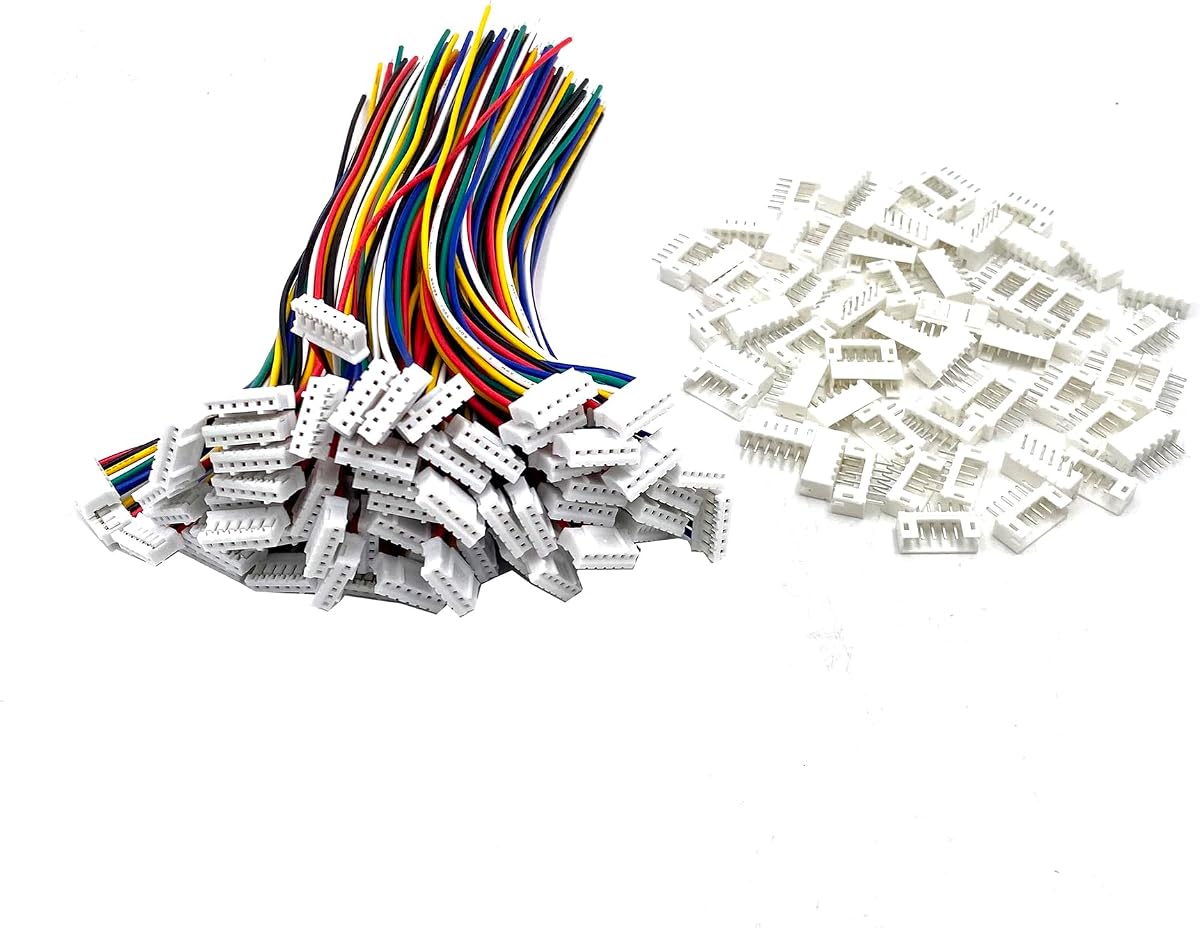

This 1.25mm six-pin connector kit combines ten male plugs and ten female plugs, each supplied with a 100mm wire lead. Its 5.0 rating reflects an especially positive customer response, while the compact dimensions make it appropriate for small RC devices, robots, LED strips, control boards, and internal appliance wiring.
We may earn a commission when you buy through this link, at no additional cost to you.
The standout feature is the ready-to-install format. UL1571 26AWG tinned copper wire provides a practical combination of conductivity and manageable size, and the seven-strand construction is designed for practical installation. The approximately 0.9mm external wire diameter and 2mm tinned tail also make the leads easier to cut, terminate, and solder.
The main limitation is cable length. At roughly 10cm, these leads work best when the two connected sections are close together or can be extended with additional wire. Exact compatibility also matters because 1.25mm pitch connectors are not necessarily interchangeable with 1.0mm, 2.0mm, 2.54mm, or 3.0mm systems.
This is a strong general recommendation for builders who want a large number of compact six-pin connections without assembling separate housings and terminals. Choose it when the target device explicitly accepts 1.25mm pitch, and keep each lead short enough to avoid unnecessary strain.
The 1.25mm pitch preserves valuable room in small RC equipment, robotics, and control-panel layouts. It is especially useful where six conductors must cross a narrow connection point without creating a bulky harness.
Ten matched male and female sets provide enough inventory for multiple repairs or projects. Because the contacts are already attached to wire, builders can focus on polarity checks, trimming, and soldering rather than crimping every termination.
We may earn a commission when you buy through this link, at no additional cost to you.
This JST SH-style kit offers the smallest pitch in the roundup at 1.0mm, giving it a distinct advantage for exceptionally compact devices. The product carries a 4.7 rating and includes twenty male plug assemblies with 150mm wires plus twenty female connector plugs, offering considerable flexibility for mixed wiring approaches.
We may earn a commission when you buy through this link, at no additional cost to you.
Its contacts use tin plating over internal copper, while the attached leads are made from tinned copper wire. The stated construction emphasizes electrical conductivity, heat dissipation, oxidation resistance, and durability. The 26AWG leads are also longer than those in the first-ranked kit, which can simplify routing inside larger housings.
One important package detail is that the female plugs do not include cables. Users who need symmetrical ready-wired leads on both ends must plan additional termination work. The extreme 1.0mm pitch also requires careful alignment and should only be selected when the mating device is explicitly compatible.
This kit is best for miniaturized electronics where every millimeter of connector size matters. It is less convenient for beginners or projects requiring prewired male and female leads in equal quantities, but the generous component count and long male-side wires make it useful for specialized repair work.
A 1.0mm center spacing makes this the most space-efficient option listed. It is well suited to small devices where a larger six-pin housing would interfere with nearby components or restrict cable routing.
Tin-plated copper contacts are designed to support conductivity and resist oxidation. The surface treatment is especially relevant for projects involving repeated mating, serviceable modules, or exposure to variable indoor conditions.
We may earn a commission when you buy through this link, at no additional cost to you.
This is the most complete harness-building kit in the list, providing four pairs of six-pin male and female housings along with 30 pairs of pin and socket terminals. Its 5.0 rating, 3.0mm dual-row format, and support for 20–24AWG wire make it a strong choice for organized custom wiring rather than quick plug-and-play leads.
We may earn a commission when you buy through this link, at no additional cost to you.
The contacts are phosphor copper with tin plating, providing low contact resistance, good conductivity, and corrosion resistance. A rated current of up to 7A distinguishes this kit from the smaller signal-oriented connectors, while the locking mechanism helps prevent accidental separation during operation.
The PA66 housings are specified to resist temperatures from -40°C to 105°C, adding useful tolerance for automotive, motorcycle, printer, and workshop environments. The trade-off is size: a dual-row 3.0mm housing needs more room than a single-row 1.0mm, 1.25mm, 2.0mm, or 2.54mm connector.
This is our top pick for builders who want standard Micro-Fit 3.0 components and the freedom to build custom wire lengths. It is also the best fit for anyone who values current capacity, repeatable locking, and a full collection of housings and terminals rather than preattached short cables.
Separate terminals let each cable be cut to the exact dimensions of the installation. That flexibility is valuable for routing around panels, batteries, controllers, and other components without leaving excess wire inside the finished enclosure.
The precision locking mechanism helps keep paired housings connected in equipment that may vibrate or move. That makes the kit particularly relevant to RC models, motorcycles, automotive projects, and 3D-printer wiring.
We may earn a commission when you buy through this link, at no additional cost to you.
This 1.25mm connector offering is designed around 20cm leads, making it one of the more flexible kits for projects that need additional reach between a controller and a distant module. It earns a 4.7 rating and is intended for LED strips, RC helicopters, control panels, appliances, automotive wiring, robots, speakers, and household electronics.
We may earn a commission when you buy through this link, at no additional cost to you.
The included six-pin configuration uses UL1571 26AWG tinned copper wire with a 1.25mm pitch. A key benefit is that the cables can be cut at any point and soldered, allowing installers to tune the final length instead of committing to the factory lead length.
The listing includes mixed 2-, 3-, 4-, 5-, and 6-pin options, with the pictured configuration listed as ten six-pin sets. Buyers should verify the selected variation carefully because the broader range can otherwise cause confusion. Long leads also need sensible routing so they do not snag or become strained.
This is a compelling option when 1.25mm compatibility is confirmed but the 100mm leads of the top-ranked kit are too short. It gives the user more installation flexibility while retaining the same compact pitch and solder-ready construction.
The approximately 20cm lead length reduces the need for improvised extensions. It can bridge greater distances inside appliances, display housings, robot frames, and control cabinets while retaining a compact connection at each end.
Because the tinned copper leads can be cut and soldered, installers can set the final cable length around the actual project. Trimming only after planning the complete route helps preserve usable strain relief and avoids unnecessarily short conductors.
We may earn a commission when you buy through this link, at no additional cost to you.
This JST PH 2.0mm kit is the most flexible wired option in the roundup, using 22AWG soft silicone tinned copper cable on both male and female sides. It has a 5.0 rating and five matched pairs, making it a refined choice for compact electronics where movement, routing, and neat cable handling matter.
We may earn a commission when you buy through this link, at no additional cost to you.
Soft silicone insulation is easier to bend than stiffer wire and is described as heatproof and resistant to melting. Each six-conductor assembly uses a separate color for each wire, which makes it easier to trace connections and reduce errors during installation.
The connector uses 2.0mm spacing between adjacent pins, so exact device compatibility remains essential. Although the silicone cable is flexible, its stated properties should not be treated as permission for use beyond the device's electrical requirements. The five-pair quantity is also the smallest matched set among the JST-style cable kits listed.
This is a strong recommendation for RC toys, robots, LED strips, portable control panels, and other projects where cable movement and compact routing are priorities. It works particularly well for builders who appreciate identifiable wire colors and a genuinely flexible six-conductor lead.
Silicone insulation tolerates repeated bending better than many rigid cable jackets, making the leads easier to route around moving joints, small chassis, and tightly packed electronics. The softer material also simplifies fine adjustments during installation.
Six individually colored conductors allow each connection to be identified at a glance. This is helpful in LED installations and control panels where reversing or crossing several similar leads can cause troubleshooting delays.
We may earn a commission when you buy through this link, at no additional cost to you.
The JST SM 2.54mm kit includes ten male and ten female connector extension cords, each with a 150mm lead. Its 4.6 rating and serviceable plug-and-socket format make it a practical option for light fixtures, signal wiring, and modules that users may need to disconnect for maintenance.
We may earn a commission when you buy through this link, at no additional cost to you.
The nylon shells provide the main structural housing, while tinned copper contacts support conductivity. The 2.54mm pitch is larger than the other JST-style options here, but that scale can be advantageous when a connection needs to be easier to handle or when the target socket uses the same pitch.
The supplied wire is 22AWG, and the listing identifies the product as suitable for signal and wire-to-wire applications. It is not designed as a high-current power solution, so current requirements should be checked against the connected equipment. The leads may also be more substantial than needed for very small models.
This kit is most appropriate for builders who value easy disconnection and serviceability. It is a sensible middle ground for appliances, control panels, lighting, and moderately sized electronic projects where 2.54mm spacing is acceptable and long, pre-crimped leads are useful.
The male plug and female socket make it possible to remove a connected module without cutting or re-soldering a bundle of wires. That convenience supports prototypes, adjustable lighting, and equipment with serviceable external connections.
The 2.54mm pitch provides a more substantial connection than ultra-compact alternatives. That can be useful in projects where leads must be handled repeatedly or where a very small connector would be difficult to align during assembly.
We may earn a commission when you buy through this link, at no additional cost to you.
This six-pin JST SM cable kit is tailored to supported flexible 5050 RGBWW, RGBCCT, SMD, and FCOB LED strips. It has a 4.0 rating and includes ten male and ten female plugs, with each cable measuring about 140mm.
We may earn a commission when you buy through this link, at no additional cost to you.
The main advantage is specialization. Rather than functioning as a broadly compatible electronics lead, it is presented as a ready connection solution for specific six-pin FCOB RGB PWM strips, including the referenced compatible strip listings. The plug arrangement allows LED sections to be joined without soldering each wire separately.
Compatibility is deliberately limited, and users should verify that the strip uses the supported six-pin arrangement. Wire colors and polarities must also be checked before connection. The 24AWG wire is relatively fine and is better suited to signal and limited-current lighting applications than demanding power distribution.
This is the best fit for installers working with one of the explicitly supported LED strips. For general-purpose robotics, RC, or appliance wiring, one of the wider JST PH or 1.25mm kits will usually offer more flexibility and easier sourcing.
Preassembled male and female ends make it easy to connect compatible strip sections or place a removable link in the lighting path. This can simplify staged installations and reduce the number of individual wire terminations required.
The listing specifically advises checking wire colors and polarity before connecting. Taking that step is especially important with multi-channel RGB, RGBWW, or RGBCCT systems, where a mismatched connection can prevent correct operation.
We may earn a commission when you buy through this link, at no additional cost to you.
This pack presents the Molex Micro-Fit 3.0 dual-row system with six circuits, combining male and female receptacle plugs and terminal sockets. Its 4.2 rating makes it less uniformly endorsed than the highest-rated products, but the well-known 3.0mm format may appeal to builders already working with compatible equipment.
We may earn a commission when you buy through this link, at no additional cost to you.
A dual-row layout provides a practical balance between compactness and handling. Unlike the single-row ultra-micro kits, Micro-Fit 3.0 has enough scale to be easier to grip while still fitting tight wiring areas. Including sockets in the set supports replacement and custom assembly rather than only prewired extensions.
The available product information is limited, so specific wire gauges, current figures, and temperature claims should not be assumed without checking the listing and connector markings. The 4.2 rating also suggests that buyers should pay close attention to fit, pin orientation, and included hardware.
This product is worth considering for replacing an existing Micro-Fit 3.0 connection or completing a harness with a familiar platform. It is less compelling for buyers who need extensive detailed specifications, numerous matched pairs, or a complete collection of loose terminals.
A recognized Micro-Fit 3.0 connection can be useful when replacing a damaged section in equipment that already uses that system. Matching the original housing format and circuit arrangement simplifies the mechanical side of a repair.
The two-row housing arranges six circuits in a compact footprint. This format can be easier to handle than a very small single-row connector while remaining smaller than many general-purpose six-pin alternatives.
We may earn a commission when you buy through this link, at no additional cost to you.
This JST PH 2.0mm kit contains 60 male plugs with pre-crimped cables and 60 female sockets, all supplied with 150mm leads. It carries a 4.3 rating and is designed for bulk wiring involving RC toys, Arduino-style boards, PCB panels, LED systems, micro robotics, 3D printers, appliances, and industrial controls.
We may earn a commission when you buy through this link, at no additional cost to you.
The seven-strand 28AWG tinned copper wire supports conductivity while remaining easy to customize. Zinc-copper contacts and PVC insulation provide a practical construction for solder-ready connections. Its 15cm length gives enough routing flexibility for common board, module, and enclosure layouts.
The stated electrical limit is 24V DC and 1A, so the kit should not be treated as a general high-current connector. It is also explicitly not compatible with LiPo battery balance ports, which use a different arrangement. Those limits are acceptable for the signal and low-current applications the product targets.
This is the most practical option in the list for batch assembly, classroom projects, or builders who expect to consume many matched pairs. Its combination of 2.0mm pitch, uniform lead length, and large quantity can reduce repeated sourcing and make wiring several devices consistent.
Sixty matched pairs are more than enough for multiple prototypes, repairs, or instructional projects. Having matching male and female leads on hand reduces the chance of a project being delayed by a single missing connector.
The stated 24V DC and 1A envelope provides a useful boundary for safe project planning. The exclusion of LiPo balance ports also prevents users from treating it as a universal battery connector when the internal pin arrangement differs.
We may earn a commission when you buy through this link, at no additional cost to you.
This JST MX-style kit provides 20 sets of six-pin connectors with 150mm, 28AWG cables. Its 4.5 rating and combination of compact 1.25mm pitch, moderate lead length, and twenty complete sets make it a versatile option for LED strips, twinkle lights, mini RC helicopters, DIY toys, control panels, and household appliances.
We may earn a commission when you buy through this link, at no additional cost to you.
The wire uses tinned copper with PVC insulation, while the connector head is described as plastic. A 2mm tinned tail is suitable for integration into custom wiring, and the 150mm length provides useful routing freedom without creating excess wire inside a compact assembly.
The stated operating range is -40°C to 80°C, with operation up to 30V. Those figures describe the listed product but do not remove the need to match connector geometry, wire capacity, and application requirements. The 28AWG gauge is finer than the 22AWG or 26AWG alternatives in the roundup.
This is a good pick for bulk projects that need many compact six-pin sets but do not require the 2.0mm bulk kit's larger gauge. Buyers should verify exact MX-style compatibility with the intended device and use the leads within their stated electrical and temperature limits.
The quantity is substantial enough to cover several small devices or repeated maintenance work. Each set offers a matched male and female connection with a useful 150mm lead, reducing the need to buy connectors separately.
The stated -40°C to 80°C operating range is broader than that of many compact hobby connector kits. It can be useful in projects exposed to temperature variation, provided the connected equipment and wire routing are also suitable.
We may earn a commission when you buy through this link, at no additional cost to you.
Choosing a six-pin micro connector starts with the mating device, not the connector family name. Pitch, contact arrangement, current requirements, wire gauge, cable length, and intended movement should all be confirmed before ordering.
Pin pitch is the distance between the centers of adjacent contacts, and it is the most important mechanical compatibility check. The roundup includes 1.0mm, 1.25mm, 2.0mm, 2.54mm, and 3.0mm options, plus a dual-row 3.0mm configuration. A connector can look similar while using a completely different pitch, and forcing an incorrect housing can damage the socket, contacts, or attached device.
The featured leads range from 22AWG to 28AWG. Heavier 22AWG or 26AWG wire generally provides more current capacity and mechanical strength than 28AWG, while finer wire can be easier to route in compact spaces. Pay particular attention to explicit limits such as the PH bulk kit's 24V DC and 1A rating, and do not infer that a connector is suitable for a higher load simply because it has six contacts.
Lead lengths in the list range from approximately 100mm to 200mm, with one LED-focused product measuring about 140mm. Short leads are convenient inside compact modules, while longer leads reduce the need for extensions. Flexible silicone wire, as used in the PH 2.0 premium pick, is especially useful where a connector must bend around moving parts or fit into a crowded enclosure.
Prewired plug-and-socket assemblies save time and simplify repairs, while loose housings and terminals allow exact custom lengths. The Micro-Fit 3.0 kit is the clearest buildable option in the roundup, providing four housing pairs and numerous terminals. If soldering is inconvenient, choose a kit with attached leads and clearly documented male and female cable configurations.
Tinned copper contacts support conductivity and corrosion resistance, while phosphor copper is used in the Micro-Fit 3.0 kit for low contact resistance. Housing materials also influence heat resistance and durability. The featured products use plastics such as nylon, PA66, and PVC, with some specifying broad temperature ranges, but material claims should be evaluated alongside wire insulation, connector geometry, and the intended environment.
Package descriptions contain important differences. The JST SH 1.0mm kit includes male leads but female plugs without attached cables, while the PH 2.0 silicone product includes five prewired male and female plug assemblies. Other kits vary between complete extension sets, mixed pin options, loose components, and specialized LED connectors. Comparing the full contents prevents disappointment over missing wire or mismatched housing types.
General-purpose JST-style kits suit LEDs, RC equipment, robots, batteries, appliances, and PCB control panels, but specialized products may only support particular strip models. The BTF-LIGHTING option is explicitly tied to supported six-pin FCOB RGB PWM strips, and the PH bulk kit excludes LiPo balance ports. Use the most specific manufacturer information available for the target device rather than relying on appearance alone.
Begin by confirming the connector pitch, male or female housing, and the device's pinout. Compare wire colors and continuity before applying power, especially for RGB, RGBWW, RGBCCT, battery, or other polarity-sensitive equipment. Disconnect power whenever changing a connection or working on the wiring.
Cut and solder only after planning the final route. Strip the appropriate amount of insulation, tin each conductor, and avoid bridging adjacent contacts. Keep each solder joint compact because close pin spacing makes accidental bridges more likely. For pre-crimped leads, support the cable near the housing rather than pulling on the conductors.
Route the cable so it does not interfere with moving parts, sharp edges, heat sources, or moisture. Leave a small amount of slack near the connection, inspect the locking fit, and periodically check for discoloration, looseness, damaged insulation, or corrosion. Disconnect the assembly before cleaning, and use electronics-safe methods that do not introduce moisture into the housing.
The main difference is the spacing between adjacent pins. Smaller pitches save space but are harder to handle, while larger pitches are generally easier to align and may support heavier wire. These families are not normally interchangeable, so the target device's specified pitch must be confirmed before purchase.
Only when the connector geometry, pitch, and contact layout genuinely match. Similar-looking housings can have different internal contact positions, locking features, or keying. A JST SM product is described as compatible with PicoBlade, but a general JST-to-Molex assumption should not be made for every product in the roundup.
A six-pin connector should provide six corresponding conductors, but the physical contact arrangement can differ between single-row and dual-row housings. Always inspect the male contacts and the female socket positions, then verify continuity or the manufacturer's pinout before connecting an unfamiliar device.
The best choice depends on current, cable length, and installation temperature. The 22AWG and 26AWG options in this roundup are generally more substantial than 28AWG, but the stated current limit still controls. The PH bulk kit is specifically limited to 24V DC and 1A, so it should not be assumed to handle higher loads.
Most prewired kits are intended to be cut and soldered when used in a permanent installation, although they can also plug into a compatible socket. The Micro-Fit 3.0 harness kit contains separate terminals and housings, so it requires a crimping and assembly process rather than simply attaching the supplied leads.
Check the device documentation, socket orientation, wire colors, and contact layout before insertion. The keying may not provide obvious visual protection in every system, particularly among very small connectors. If continuity is uncertain, use a multimeter to verify the corresponding contacts before powering the device.
The 1.25mm and 1.0mm kits are strongest candidates where space is extremely limited, while the PH 2.0 silicone option offers more flexible wiring for moving assemblies. Compatibility with the existing receiver, battery, ESC, or controller remains the deciding factor, and LiPo balance ports require a different connector format.
Usually, yes, provided the contacts, housing, and solder joints remain undamaged. Repeated mating can wear or contaminate contacts, so inspect them for bent pins, discoloration, and loose fit. A connector that must be forced into place should not be used until the mismatch or deformation is corrected.
The JST 1.25mm wire kit stands out as the best general choice for compact, ready-to-solder projects, while the Micro-Fit 3.0 harness kit leads for custom assemblies, locking reliability, and higher current capacity. The JST PH 2.0 silicone kit completes the top group with flexible leads and clearly color-coded conductors.
Prioritize exact pitch and contact layout above every other feature. From there, match wire gauge and current requirements, choose a cable length that suits the installation, and confirm whether prewired assemblies or separate terminals will make the work easier. Specialized LED or battery exclusions should be checked before ordering.
Current pricing and availability can change, so compare the latest listing details and product images before purchasing. Taking a few minutes to verify dimensions, included parts, polarity, and electrical limits can prevent an incompatible connector from interrupting the project.