
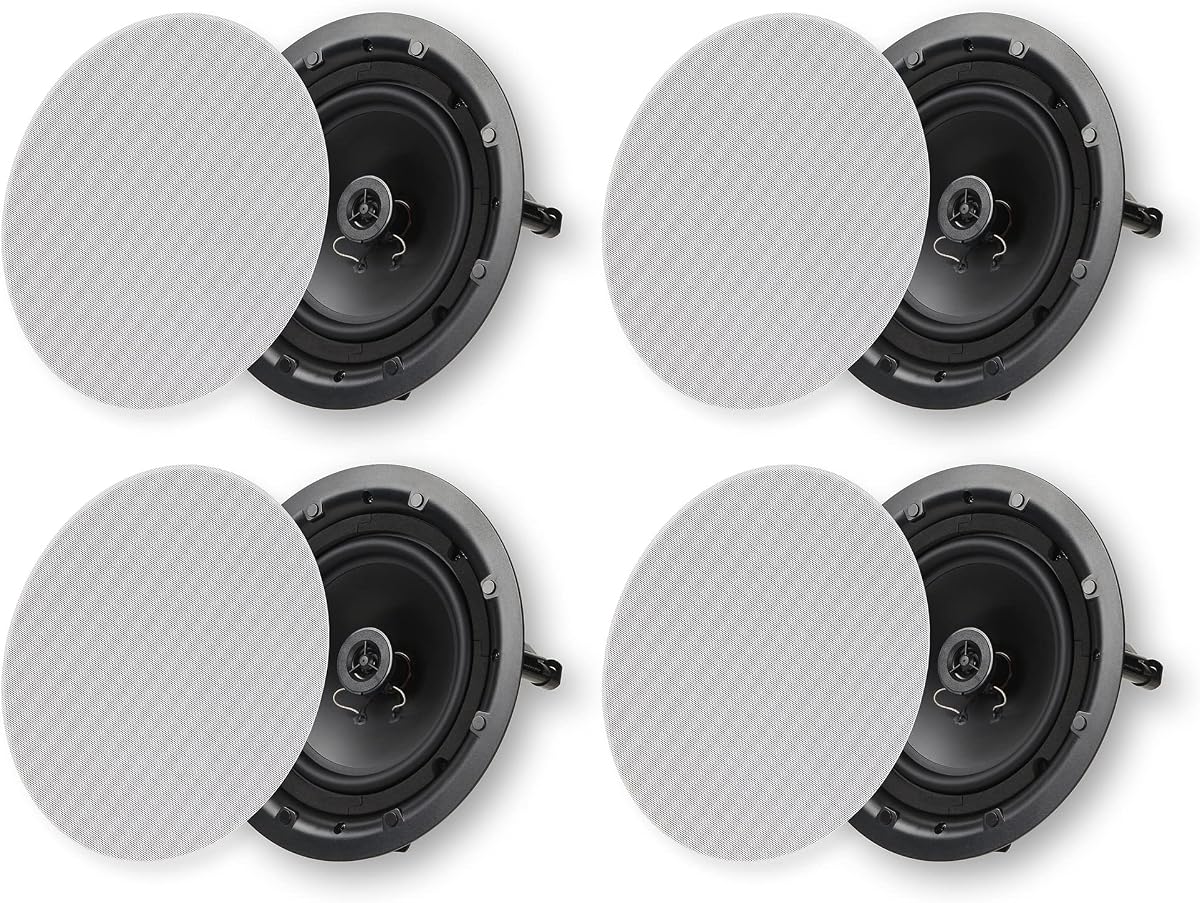
Micca M-8C
4.7Editor score
Pivoting silk dome tweeter
Eight-inch poly woofer
Low-profile rimed grille
Built-in mounting tabs
In-wall and in-ceiling speakers can transform a room by delivering immersive sound without adding visible cabinets to the decor. A good model combines balanced audio, practical mounting hardware, a low-profile grille, and enough power handling for your amplifier while fitting neatly into the planned space.
We compared all ten featured models using the specifications and product information supplied for this guide. The list covers round in-ceiling speakers, in-wall models, multi-speaker packages, compact options, and three-way designs, with attention to drivers, dispersion, installation, grille finish, and intended listening environment.
Each review explains where the speaker stands out and where compromises may exist, helping you match a model to a home theater, whole-home audio system, kitchen, or other space. Product configurations and market conditions can change, so confirm the current specifications and included accessories before purchasing.
4.7Editor score

4.7Editor score

4.8Editor score
As an Amazon Associate we earn from qualifying purchases.
The comparison below organizes all ten models by driver configuration, enclosure type, package contents, installation details, and practical benefits, making it easier to identify the right option for a specific room or system.



The Polk Audio 70-RT is a three-way in-ceiling speaker built for buyers who want more separation between bass, midrange, and treble than a conventional two-way design can provide. It carries a 4.7 rating and combines a 7-inch subwoofer, a 2.5-inch midrange driver, and a 0.75-inch dome tweeter in one flush-mount enclosure. Its stated frequency response extends from 34 Hz to 27,000 Hz, giving it a notably broad operating range.
We may earn a commission when you buy through this link, at no additional cost to you.
The separate drivers are the model’s defining strength. Bass is handled by the larger subwoofer, vocals and important midrange information receive their own driver, and the dome tweeter handles high frequencies. Polk’s Dynamic Balance technology and Power Port design further distinguish this model. The result is a speaker intended to produce room-filling sound without requiring a large freestanding cabinet, making it relevant to home theaters, living areas, and larger distributed-audio installations.
Installation is supported by fit templates, a precision flange, and a patented rotating cam system intended to create a vibration-free, secure fit. The removable grille has a wafer-thin profile and can be painted to blend with the ceiling. The main tradeoff is physical size and the fact that this listing covers one speaker rather than a matched pair, so buyers with two listening positions will need to determine how many units their system requires.
The 70-RT is a strong choice for a dedicated home theater, a spacious media room, or any installation where broad coverage and three-way performance matter more than minimal depth. Its 4.7 rating reflects a strong balance of range, discreet appearance, and installation convenience. For a listener seeking a flexible, high-performance in-ceiling model without a visible cabinet, it is one of the most compelling choices in this guide.
Using separate drivers for bass, midrange, and treble can reduce the burden placed on any single component. In this model, that architecture supports wide coverage and lets the larger subwoofer handle low frequencies while the dedicated midrange driver focuses on voices and instruments.
The low-profile grille can be painted to match the surrounding ceiling, reducing visual distraction in a theater or living area. Secure mounting hardware and included fit templates help keep the installation process organized.
We may earn a commission when you buy through this link, at no additional cost to you.
The Micca M-8C is an eight-inch, two-way in-ceiling speaker that offers a useful balance of performance, installation simplicity, and understated appearance. It earns a 4.7 rating and uses a high-excursion poly woofer paired with a pivoting one-inch silk dome tweeter. Its frequency response is specified from 40 Hz to 20 kHz, while the eight-ohm impedance makes it broadly compatible with conventional home audio amplifiers and receivers.
We may earn a commission when you buy through this link, at no additional cost to you.
The pivoting tweeter is particularly useful in practical installations. Because it can be aimed, the high-frequency section can be directed toward a preferred listening position rather than simply firing straight downward. A six-decibel crossover helps create a coherent transition between the tweeter and woofer in the upper midrange. With 90 dB sensitivity and 100 watts of stated power handling per speaker, the M-8C is also specified for room-filling applications.
Mounting tabs are built into the speaker, allowing it to grip drywall or wood panels without a separate bracket or backing box. The rimed grille protrudes only slightly from the surface and can be painted to match the surrounding décor. The enclosure requires a 9.4-inch cutout, has a 3.5-inch mounting depth, and measures 10.7 inches in outer diameter, so these dimensions should be checked before making an opening.
The M-8C is a compelling choice for background music, living rooms, bedrooms, kitchens, bathrooms, and covered porches, and it can also contribute to a home theater when several units are installed. Its main practical limitation is that the purchase is for one speaker, meaning a stereo pair requires two purchases. Within those terms, it delivers strong specifications and a 4.7 rating at an accessible tier.
The pivoting one-inch silk dome tweeter offers installation flexibility in rooms where the ideal listening position is not directly below the speaker. This makes the M-8C useful where seating, cabinetry, or room geometry limits placement.
Built-in mounting tabs secure the speaker to drywall or wood panels without additional brackets or backing boxes. The grille's shallow rim and paintable finish help the finished installation blend into the ceiling.
We may earn a commission when you buy through this link, at no additional cost to you.
The Polk Audio RC80i is an eight-inch, two-way in-ceiling speaker sold as a white pair, making it a straightforward starting point for a stereo ceiling installation. It has a 4.7 rating and pairs an 8-inch Dynamic Balance woofer with a 1-inch aimable tweeter. A mineral-filled polymer cone is designed to improve damping, while the aimable tweeter offers more directional control than a fixed-position high-frequency driver.
We may earn a commission when you buy through this link, at no additional cost to you.
A rubber seal is intended to prevent moisture from entering the enclosure and is also said to support audio response. That construction makes the RC80i suitable for bathrooms, kitchens, and covered porches in addition to conventional indoor rooms. Its ability to function in a pair simplifies left-and-right placement for music, while multiple pairs could support distributed audio or surround-sound duties depending on the amplifier and room design.
The installation process is described as a simple three-step operation, and the paintable aluminum grilles are designed to blend with an existing interior. That clean visual treatment is valuable when speakers are being added to a finished room rather than incorporated into new construction. The larger 8-inch woofer may also require more ceiling cavity depth than the compact models in this guide, making a pre-installation clearance check essential.
The RC80i is best suited to buyers who want a matched pair of full-size two-way ceiling speakers and appreciate flexible tweeter aiming. Its strengths include balanced room-filling potential, moisture-conscious construction, and a discreet finish. Although a dedicated three-way model may offer even more detailed driver separation, the RC80i provides a versatile and approachable package for many homes.
The enclosure's rubber seal helps keep moisture from leaking into the speaker, making the RC80i a candidate for kitchens, bathrooms, and covered porches. It should still be installed in a location that remains protected from direct weather exposure.
Buying the listed pair reduces the need to source a second matching speaker for conventional stereo placement. The aimable tweeter can then be directed toward the main listening area for better tonal balance.
We may earn a commission when you buy through this link, at no additional cost to you.
The Klipsch CDT-5650-C II stands out with a 4.8 rating, the highest numerical rating among the products in this guide. It is a white in-ceiling speaker sold individually and is particularly relevant to whole-house audio systems, where controlled dispersion can help each unit serve its assigned area without spreading sound indiscriminately. Its 1-inch titanium tweeter is a prominent part of its acoustic design.
We may earn a commission when you buy through this link, at no additional cost to you.
Controlled Dispersion Technology is the model's central concept. Rather than relying only on a conventional wide-dispersion face, this approach focuses sound through a horn-loaded design. That can be advantageous in rooms with several ceiling speakers, hallways, open living areas, and other installations where directional output makes each speaker more useful. The titanium tweeter and horn loading also distinguish it from basic two-way models built around a standard dome tweeter.
The available product information for this particular model is concise, so buyers should not assume specifications that are not listed. It is sold as one speaker, which can be convenient for a larger distributed system because the number of units can be selected according to room layout. The white finish supports a clean installation, and the in-ceiling format preserves wall and floor space.
The CDT-5650-C II is a compelling choice for a multi-room audio plan or any installation where controlled coverage is a priority. Its 4.8 rating, titanium tweeter, and dispersion-focused design make it a strong premium selection, particularly when the system requires multiple individually placed speakers. Confirm current dimensions and cutout requirements before construction.
Controlled dispersion can make ceiling speakers more practical in homes where each unit serves a defined section of a room. The horn-loaded approach concentrates output where it is needed, which is especially useful in multi-speaker installations.
The one-inch titanium tweeter provides the most prominent specification in the supplied information. It works with the model's horn-loaded architecture to support clear, directed high-frequency output.
We may earn a commission when you buy through this link, at no additional cost to you.
The Micca Architecture Series package includes four eight-inch, two-way in-ceiling or in-wall speakers with paintable white grilles. Its 4.5 rating is still solid, and the four-speaker format is highly practical for distributed audio, a multi-zone residence, or a home theater requiring several ceiling units. Each speaker uses a polypropylene cone woofer with a rubber surround and a half-inch PEI dome tweeter.
We may earn a commission when you buy through this link, at no additional cost to you.
The supplied specifications list a frequency response of 50 Hz to 20 kHz, six-ohm impedance, 87 dB sensitivity, and 80 watts of power handling per speaker. The smaller tweeter and higher nominal impedance mean the amplifier and speaker wiring should be considered carefully, particularly when several units share a channel. The stated vocal accuracy and wide dispersion are nevertheless central to the model's design goals.
The rimless grille protrudes less than three-sixteenths of an inch from the wall, offering one of the most discreet appearances in the group. Built-in mounting tabs grip drywall or wood panels without extra brackets or backing boxes. The package is suitable for living rooms, bedrooms, hallways, kitchens, bathrooms, sunrooms, and covered porches, and the instruction sheet provides installation and speaker-wire recommendations.
This is the most useful option for a buyer who needs several matching architectural speakers at once. The extremely low-profile grille is especially attractive in modern interiors, while the four-unit package can simplify project planning. Its trade-offs are the 4.5 rating and a less substantial high-frequency driver specification than some alternatives, but the package remains focused on practical, unobtrusive installation.
The rimless grille sits nearly flush with the mounting surface, creating a cleaner look than a visibly projecting enclosure. Because it can be painted, it can also be matched to the surrounding wall or ceiling finish.
Four matching speakers support distributed-audio planning and larger home theater layouts. Built-in mounting tabs simplify the physical installation, although cable routing and amplifier compatibility still need to be planned.
We may earn a commission when you buy through this link, at no additional cost to you.
The Acoustic Audio by Goldwood CS-IC83 is a five-speaker, three-way in-ceiling system designed primarily for home theater and larger distributed-audio applications. It carries a 4.7 rating and includes five CS-IC83 speakers, removable grilles, cut-out templates, and an instruction manual. Each enclosure combines an 8-inch high-rigidity poly cone woofer, a Poly Mica midrange, and a 13 mm soft dome tweeter.
We may earn a commission when you buy through this link, at no additional cost to you.
Passive three-way crossovers divide the frequency range among the dedicated drivers, supporting greater tonal separation across music and film content. The stated response is 40 Hz to 20 kHz at 95 dB and eight ohms. Five matching units are particularly useful for a surround-sound layout, although the system is passive and must be driven by a compatible receiver or amplifier with suitable outputs and channel handling.
A pressure-lock mounting system clamps against drywall, and the speakers fit a 9.45-inch round opening with a mounting depth of 3.78 inches. Their overall size is 10.83 inches, and spring-loaded raw wire connections support connection to the amplifier. The durable ABS housings and paintable grilles make the package practical for new and existing audio systems as well as commercial or retail installations.
The CS-IC83 is most attractive to a buyer who wants a coordinated five-speaker theater without assembling individual units. Its system-level packaging, templates, and installation hardware simplify project planning. The main commitment is the need for a suitably capable amplifier and enough ceiling space for all five installations, so both should be confirmed before work begins.
Five matched three-way speakers can form the foundation of a ceiling-based surround-sound installation. Including the units together also reduces the difficulty of sourcing a consistent visual and acoustic design for a larger project.
The speakers use a passive design and require raw-wire outputs from a compatible receiver or amplifier. The supplied guidance specifies no less than 10 and no more than 350 watts per channel, so channel capability and wiring should be matched carefully.
We may earn a commission when you buy through this link, at no additional cost to you.
The Klipsch R-1650-C package provides four compact white in-ceiling speakers designed for residential and commercial environments. It has a 4.6 rating and uses a 6.5-inch polymer-cone woofer with a large motor structure alongside a coaxially mounted one-inch polymer-dome tweeter. This is a smaller driver package than the eight-inch options elsewhere in the guide, which can make ceiling clearance easier to manage.
We may earn a commission when you buy through this link, at no additional cost to you.
The coaxial tweeter is mounted at the center of the woofer and distributes high frequencies over a wide area. That configuration can simplify placement because the speaker does not rely on a separate offset tweeter. The large motor structure is designed to support high sensitivity and dynamic acoustic performance, while the compact dimensions make the R-1650-C suitable for rooms where a full-size eight-inch model would be difficult to accommodate.
The mounting system is designed for straightforward installation, and the paintable aluminum grille adds rust protection in moisture-prone areas such as bathrooms, kitchens, and saunas. The speaker measures 9.5 inches, requires an 8.3-inch cutout, and comes as a four-pack with a limited five-year manufacturer warranty. The package format is convenient for a four-zone audio system, a media room, or several rooms with matching installations.
The R-1650-C is best for buyers who prioritize easy placement, coordinated styling, and a four-unit package over maximum low-frequency extension. Its 4.6 rating and wide-dispersion coaxial design make it a versatile architectural speaker, while its compact cutout expands placement flexibility. Check ceiling depth and local moisture conditions as part of the installation plan.
A 6.5-inch woofer and 8.3-inch cutout make this model easier to fit where an 8-inch or larger speaker would be restrictive. The coaxial tweeter simplifies orientation while preserving broad high-frequency coverage.
Four matching units make it easier to build out a media room or several listening zones with consistent grilles and drivers. The paintable aluminum grilles also provide added protection in moisture-prone rooms.
We may earn a commission when you buy through this link, at no additional cost to you.
The Klipsch R-5800-W II is an in-wall speaker distinguished by a 4.8 rating and a detailed driver layout. It combines an 8-inch Cerametallic cone woofer with a 4-inch square Tractrix horn measuring 90 by 60 degrees. A one-inch titanium dome compression driver is mounted to the horn, creating a more specialized acoustic design than a standard two-way ceiling speaker.
We may earn a commission when you buy through this link, at no additional cost to you.
Horn-loaded technology is used to increase acoustic output while reducing distortion. The pivoting horn can be aimed, allowing the high-frequency section to point toward a listening area even when the speaker must be positioned around a wall obstruction or architectural feature. The controlled 90-by-60-degree coverage is useful for a home theater, where a front or surround speaker needs to focus sound toward the correct seating area.
Treble and midbass attenuation switches give the installer another layer of tonal control. An IR receiver knock-out is also listed, which can be relevant when the speaker is used with compatible infrared equipment and the receiver needs to occupy the cavity. As an in-wall model, it needs a suitable opening within the wall rather than a round ceiling cutout, and the cavity depth must accommodate the enclosure and cabling.
The R-5800-W II is a strong option for a dedicated theater or any installation that benefits from adjustable horn direction and larger in-wall output. Its 4.8 rating places it among the strongest-rated choices here, while the attenuation switches and pivoting horn provide practical control. The primary trade-off is that each speaker is purchased separately and the wall construction must be prepared carefully.
The pivoting Tractrix horn can direct high frequencies toward the intended listening position. This is particularly useful in home theaters where speakers are mounted low, beside seating, or behind a wall feature that would otherwise obstruct direct sound.
Treble and midbass attenuation switches allow the output to be adjusted to room conditions. These controls can help manage excessive brightness or midbass buildup in reflective or acoustically lively spaces.
We may earn a commission when you buy through this link, at no additional cost to you.
The Klipsch CDT-5800-C II is a white in-ceiling model intended for outdoor or surround-speaker applications, and it holds a 4.7 rating. Its defining features are Controlled Dispersion Technology, horn-loaded operation, and separate switches for treble and midbass attenuation. Those controls make it interesting for installations in which a ceiling speaker must serve a specific listening zone.
We may earn a commission when you buy through this link, at no additional cost to you.
Controlled dispersion focuses the speaker's output more deliberately than a conventional wide-dispersion model can. That characteristic can help direct sound toward a patio seating area, a home theater audience, or another defined part of a room. Horn loading supports the controlled output, and the attenuation switches allow the installer to refine the balance of high and mid-low frequencies in the final placement.
The product is sold as a set of one, so it should not be mistaken for a complete surround package. A theater would normally require several matching units plus appropriate amplifier channels, while a single speaker may be enough for a supplementary zone. The supplied information is limited, making it especially important to verify the current cutout, mounting depth, enclosure dimensions, and power-handling specifications before construction.
The CDT-5800-C II is a practical candidate for a dedicated surround position or a controlled outdoor listening area. Its 4.7 rating reflects a well-regarded design, while the directional behavior and attenuation controls make it more adaptable than a basic ceiling speaker. It is best chosen after confirming that the current enclosure details suit the intended opening and environment.
Controlled Dispersion Technology is particularly useful when a ceiling speaker needs to serve a patio, seating zone, or home theater position. It provides a more deliberate approach to directing sound than a broadly dispersing model.
Treble and midbass attenuation switches provide control over two important portions of the frequency range. Those adjustments can help the speaker integrate with surrounding finishes, nearby reflective surfaces, and the intended listening position.
We may earn a commission when you buy through this link, at no additional cost to you.
The Yamaha NS-IW480C is a matched pair of eight-inch, three-way in-wall speakers with a 4.6 rating. Each speaker uses a polypropylene mica cone woofer, a midrange section, and dual three-quarter-inch dome tweeters. The inclusion of two speakers makes it a more convenient starting point for a stereo installation than models sold strictly as individual units.
We may earn a commission when you buy through this link, at no additional cost to you.
A three-way architecture separates the main frequency bands more deliberately than a two-way speaker. The dual tweeters can provide broad high-frequency coverage, while the swivel control allows them to be aimed. This is useful in an in-wall installation where structural constraints determine the speaker's position, leaving the high-frequency output to be adjusted toward the room's listening area.
Maximum input capability is listed at 120 watts per speaker. The stated mounting depth is approximately 9 to 7/16 inches, with a width of approximately 4 to 13/32 inches. Because the enclosure is relatively deep, the wall cavity must provide enough clearance for the speaker, wiring, and installation materials. A dedicated back box or appropriate bracing may also be needed depending on the wall construction.
The NS-IW480C is well suited to a two-channel music setup, a front pair in a home theater, or another in-wall installation where matched drivers are desirable. Its 4.6 rating, dedicated three-way layout, and adjustable dispersion offer a strong combination of performance and placement flexibility. The main planning issue is wall depth, which should be confirmed before selecting an opening.
Dual three-quarter-inch dome tweeters give the speaker flexible high-frequency placement. Their swivel feature can direct the output toward a preferred seating area when the wall position cannot be centered perfectly.
The listed mounting depth makes clearance one of the most important installation checks. Inspect the wall cavity, framing, insulation, and wiring path before cutting an opening or choosing the final speaker position.
We may earn a commission when you buy through this link, at no additional cost to you.
The right architectural speaker depends on room size, listening position, amplifier capability, installation depth, and whether the design calls for a single zone, stereo pair, or complete surround system. These factors narrow the choices before you compare driver layouts and finishing details.
In-ceiling speakers use round openings and are normally positioned above a room, while in-wall speakers fit within a wall cavity and may be used for front, side, or surround positions. Consider the architecture, available framing, cable routes, and nearby obstructions before choosing either format. A ceiling installation is often practical above a sofa or media area, whereas an in-wall model can work well when a dedicated theater elevation is available.
Every model requires a specific opening and enough clearance for its enclosure, grille, terminals, and wiring. The Micca M-8C requires a 9.4-inch cutout, the Acoustic Audio CS-IC83 uses a 9.45-inch opening, and the Yamaha NS-IW480C has a notably deep stated mounting requirement. Measure the available space rather than assuming that all eight-inch speakers will fit the same cavity.
A two-way speaker divides the signal between a woofer and a tweeter, making it a straightforward choice for background music and many home systems. A three-way model adds a dedicated midrange driver, which can improve separation between vocals, instruments, dialogue, and bass. The Polk Audio 70-RT, Acoustic Audio CS-IC83, and Yamaha NS-IW480C use three-way designs, while several other featured models use two-way layouts.
Wide dispersion can provide good coverage in a room, while controlled or pivoting output can target a specific listening position. The Micca M-8C includes a pivoting silk dome tweeter, the Klipsch R-5800-W II uses a pivoting Tractrix horn, and the Yamaha NS-IW480C has swivel tweeters. These adjustment options are particularly valuable when speakers must be placed above, below, or beside the ideal seat.
The speaker's impedance, sensitivity, and stated power handling should work with the receiver or amplifier driving it. The Micca M-8C is eight ohms with 100 watts of power handling, while the four-pack Micca Architecture Series uses six-ohm speakers with 80 watts per unit. The Acoustic Audio system also requires a compatible multi-channel amplifier and specifies a channel-power range for safe operation.
A stereo installation normally calls for two units, a home theater may need several surround speakers, and whole-house audio can require one or more speakers in each zone. Some listings include a pair or a multi-speaker package, while the Micca M-8C, Polk Audio 70-RT, and Klipsch CDT models are sold as one speaker. Choose the quantity that matches the room layout before finalizing the installation plan.
Kitchens, bathrooms, covered porches, sunrooms, and outdoor areas require careful attention to environmental exposure. The Polk RC80i includes a rubber moisture seal, the Micca M-8C is listed for covered porches, and the Klipsch R-1650-C grille provides added rust protection in moisture-prone areas. Even with those features, direct weather exposure should be avoided unless the manufacturer specifically approves it.
A paintable grille can blend into the surrounding surface, but the profile also affects how visible the speaker appears. Micca's Architecture Series protrudes less than three-sixteenths of an inch, while the Polk 70-RT uses a wafer-thin grille. Also consider grille removal, terminal access, maintenance access, and whether future service should be possible without opening the wall.
Before cutting any opening, confirm the model, cutout diameter, mounting depth, grille clearance, and cable path. Use the supplied template when one is included, and inspect the area for plumbing, wiring, insulation, structural members, and other obstacles. For a new installation, completing the cable path and wall preparation before mounting the speaker makes future service much easier.
Connect the speaker according to the amplifier or receiver instructions and observe polarity on both conductors. Use appropriate in-wall-certified speaker wire for concealed installations, keep cable runs compliant with local requirements, and avoid leaving a length of cable pinched behind the enclosure. Secure the speaker with its intended clamps, tabs, or rotating cam system, then fit the grille without forcing it.
Set the amplifier output to a moderate level while setting the receiver's room correction, speaker size, and crossover options for the supported configuration. After installation, play familiar music and films at several levels, then make small adjustments to treble, midbass, amplifier trim, and speaker delay where available. Clean the grille with a soft, dry cloth, avoid spraying cleaner into the opening, and inspect the seal and fit periodically.
Both are architectural speakers designed to be hidden within a building, but their mounting locations differ. In-ceiling models install in the ceiling, usually above listening areas, while in-wall models fit between wall studs for front, side, or surround positions. Their cutouts, enclosure depths, and driver arrangements are therefore not interchangeable.
One speaker may be enough for a secondary listening zone, but a stereo pair usually provides more balanced left-and-right imaging. A home theater can require multiple surround units, while whole-home audio may need one or more speakers in every designated room. Plan around seating, room dimensions, amplifier channels, and the coverage pattern of each model.
Many featured models include paintable grilles, including the Polk Audio RC80i and 70-RT, Micca M-8C, Micca Architecture Series, Acoustic Audio CS-IC83, and Klipsch R-1650-C. Use a paint application method that will not clog the grille openings, and follow the manufacturer's preparation and drying guidance before installation.
Most featured models are passive and require a compatible amplifier or receiver with raw speaker-wire outputs. Check impedance, power handling, channel limitations, and crossover settings. The Acoustic Audio CS-IC83 package specifically states a recommended per-channel power range, while four-ohm or six-ohm models may require more care when several speakers share one amplifier channel.
Several models are explicitly listed for bathrooms, kitchens, covered porches, or similar spaces. The Polk RC80i includes a rubber moisture seal, the Micca M-8C is listed for covered outdoor porches, and the Klipsch R-1650-C grille offers rust protection. Keep any installation protected from direct rain and other weather exposure unless specifically permitted by the manufacturer.
The requirement depends on the model, installation, and construction method. Some models use built-in mounting tabs, while others use clamp or rotating-cam systems. A back box can help control the acoustic environment and protect against structural or moisture issues, so check the product instructions and local building requirements before deciding.
Not necessarily. A three-way design can offer better separation because the midrange, bass, and treble each have a dedicated driver, but room size, placement, and system design also matter. A well-positioned two-way model can work very effectively for music and background listening, while a three-way model may suit a more demanding theater installation.
It depends on the model. The Micca M-8C has a pivoting silk dome tweeter, the Yamaha NS-IW480C has swivel tweeters, and the Klipsch R-5800-W II uses a pivoting horn. Models with fixed drivers can still be directed by their overall placement, but they offer less fine control over the high-frequency axis.
The Polk Audio 70-RT is the strongest all-around recommendation for buyers who value a dedicated three-way driver layout, broad frequency response, and a discreet finish. The Micca M-8C offers a compelling two-way alternative for background music and flexible placement, while the Klipsch CDT-5650-C II stands out for controlled dispersion in distributed-audio systems.
Prioritize fit before features. Verify the cutout, enclosure depth, wall or ceiling cavity, cable route, amplifier compatibility, and number of units required. Then choose two-way or three-way drivers, a fixed or adjustable tweeter, and the moisture suitability that best matches the room. A carefully installed model will integrate more effectively than a more advanced speaker forced into an unsuitable space.
Finally, confirm the current product specifications, included accessories, finish details, and manufacturer guidance before ordering. Product configurations and market conditions can change, and the information in this guide reflects the supplied product data. Comparing the dimensions against your room and the amplifier requirements against your system will lead to a more confident installation.
