
Patriot Viper Venom 32GB DDR5
4.6Editor score
6000MHz with CL30
XMP 3.0 and EXPO
32GB matched dual kit
Our DDR5 RAM for Overclocking guide compares ten 32GB kits and one 16GB module across speed, latency, profiles, voltage, stability, RGB, and platform fit.
DDR5 RAM built for overclocking must balance high advertised speeds with tight timings, dependable memory ICs, effective heat spreaders, and profiles that work across modern platforms. The right kit can improve latency, bandwidth, gaming responsiveness, and the headroom available for manual tuning, but a higher number does not automatically mean a better experience.
We compared all ten options by capacity, rated speed, latency, complete timing information when supplied, voltage, EXPO or XMP support, onboard regulation, RGB features, platform compatibility, and the practical caveats attached to reaching advertised performance. The list primarily covers matched 32GB desktop kits, plus one 16GB single-module option for builders who may prefer to add a second matching module later.
Each review explains where the kit stands out, what buyers should verify before purchase, and which type of system it suits best. The recommendations are based on the supplied specifications and customer ratings, not personal testing, while availability, motherboard support, and prices can change as the market moves.
4.6Editor score

4.8Editor score

4.6Editor score
The table below places every kit on a common footing, highlighting the specifications that matter most to overclockers: usable capacity, headline frequency, primary latency, supported profiles, and additional hardware features.




The Crucial Pro 32GB DDR5 RAM Kit is a strong all-around recommendation for an overclocking desktop that needs both everyday responsiveness and extra memory performance. Its advertised 6000MHz speed and CL36 latency offer a useful starting point, while the supplied extended timings of 36-38-38-80 give manual tuners more information than a basic headline specification. It carries a 4.8 customer rating, the highest listed score in the group.
We may earn a commission when you buy through this link, at no additional cost to you.
Support for Intel XMP 3.0 and AMD EXPO makes the kit especially useful when the processor platform is not known at the time of purchase. The 2x16GB arrangement provides 32GB of capacity and dual-channel operation, which is a practical foundation for modern gaming, content creation, and memory-heavy applications. Crucial also describes the modules as rigorously tested at both component and module levels and connects their reliability to more than four decades of Micron memory expertise.
The important caveat is that advertised maximum speed is not automatically a guaranteed everyday setting. As with most enthusiast DDR5 kits, users will generally need to enable the appropriate memory profile in BIOS and may need to adjust voltage, timings, or other parameters for the best result. The listed platform guidance also points buyers toward 13th-generation Intel Core processors or newer AMD Ryzen 9000-series CPUs, making hardware compatibility a priority to verify before purchase.
This kit makes the most sense for a builder who wants 6000MHz, a respectable CL36 rating, and broad AMD and Intel profile support without requiring RGB. It is particularly appropriate for gamers and productivity users who want a credible tuning foundation. For users seeking a flashier appearance or lower primary latency, the other selections in this guide offer alternatives worth comparing.
Intel XMP 3.0 and AMD EXPO support allow the same kit to suit both major desktop ecosystems. After installing the memory, the appropriate profile can be selected in a compatible BIOS, although the final result still depends on the processor, motherboard, and firmware.
The stated 36-38-38-80 timing configuration gives enthusiasts a more precise starting point than a speed and CAS latency alone. It also makes it easier to judge whether a later adjustment improves latency without immediately sacrificing stability.
We may earn a commission when you buy through this link, at no additional cost to you.
Corsair Vengeance RGB RS DDR5 32GB combines a 6000MHz-class performance target with individually addressable RGB lighting and onboard voltage regulation. Its principal appeal is the combination of practical overclocking controls and visual customization. The kit has a 4.3 customer rating, placing it behind several higher-rated alternatives, but the supplied features remain relevant to enthusiast builders.
We may earn a commission when you buy through this link, at no additional cost to you.
The 2x16GB capacity is a sensible configuration for high-performance desktops, while dual EXPO and XMP 3.0 profiles provide a convenient starting point for AMD and Intel systems. Onboard voltage regulation is a notable inclusion because it can make power delivery more consistent and give users finer control than relying solely on motherboard automatic settings. Corsair also describes the memory as optimized for bandwidth and tight response times on current DDR5 platforms.
RGB enthusiasts can manage the individually addressable lighting through a panoramic diffuser, making this kit more visually engaging than the understated Crucial Pro model. That appearance does come with added complexity, however, and users who do not intend to use the lighting may find a simpler heat-spreader design more appropriate. The actual maximum speed also remains dependent on the CPU, motherboard, BIOS, and any manual settings used by the builder.
This Vengeance RGB RS kit is best for a gaming system where appearance and memory tuning matter in roughly equal measure. Its onboard regulation and dual platform profiles make it a particularly solid fit for a builder who wants convenient control alongside coordinated lighting. The lower customer rating should not be ignored, so checking recent owner feedback for the exact module and platform is sensible before finalizing the purchase.
Onboard voltage regulation gives the modules their own control circuitry, allowing more precise voltage management during manual tuning. This can make iterative adjustments easier, although successful overclocking still depends on the rest of the platform.
The individually addressable RGB implementation supports coordinated effects through the panoramic diffuser. It makes the kit a natural fit for a visible system build where lighting is part of the final design rather than an afterthought.
We may earn a commission when you buy through this link, at no additional cost to you.
The Crucial Pro DDR5 32GB 6400MHz kit is the most ambitious speed-focused option in this guide. Its advertised 6400MHz rate and CL32 primary latency make it appealing to enthusiasts who want more bandwidth and lower latency than a conventional 6000MHz kit. A 4.6 customer rating indicates generally positive reception, although the platform demands of a faster memory kit should be considered carefully.
We may earn a commission when you buy through this link, at no additional cost to you.
The kit provides 32GB through a matched 2x16GB configuration and supports Intel XMP 3.0 and AMD EXPO. Its listed extended timings of 32-40-40-103 give manual tuners a detailed foundation. The product information specifically calls out compatibility with Intel Core Ultra Series 2 and Ryzen 9000-series desktop CPUs, suggesting it is aimed at builders using relatively recent platforms where the memory controller and motherboard BIOS are capable of supporting the target profile.
Faster advertised memory is not automatically faster in every application, and achieving 6400MHz may require more motherboard-specific tuning than 6000MHz. CPU memory-controller quality, motherboard trace layout, BIOS maturity, and memory voltage all influence the result. The kit may boot through a JEDEC-compatible profile, but buyers interested in the full rated speed should update the BIOS and test the intended EXPO or XMP setting once the system is assembled.
This is the premium pick for a modern, carefully configured high-end build where maximum advertised frequency and tight CL32 latency are explicit priorities. It is less attractive for a budget platform or a system whose exact motherboard support cannot be confirmed. For a more conservative 6000MHz target, the first Crucial Pro kit provides a more conventional balance.
The 6400MHz headline rate gives compatible systems more theoretical memory bandwidth than the 6000MHz options in the list. Real gains depend on workload, platform behavior, and whether the fastest profile remains stable after tuning.
The CL32 rating and 32-40-40-103 timing set provide a more performance-oriented starting point. Enthusiasts can use those values as a baseline while testing voltage and secondary timing changes against their own hardware.
We may earn a commission when you buy through this link, at no additional cost to you.
This Crucial Pro Overclocking Edition module is the only single-memory option in the lineup, providing 16GB of DDR5 memory in a standard unbuffered 288-pin configuration. Its 6000MT/s data transfer rate and CL36 latency at 1.35V give it the statistical profile of a modern enthusiast module, while the 4.7 customer rating reflects positive user reception.
We may earn a commission when you buy through this link, at no additional cost to you.
The main advantage is deployment flexibility. A builder can begin with one module and add a second later, while a system with four memory slots may eventually use a four-module arrangement. That flexibility can make the module appealing to someone who wants to upgrade gradually. It is important to understand, however, that a single DDR5 module normally operates in a less bandwidth-efficient configuration than a matched pair.
The product is explicitly identified as compatible with systems supporting DDR5-6000 memory. Because it is sold as a single module, buyers who want full dual-channel performance should plan to add a suitably compatible second module. Mixing an independently purchased module with this one may affect the ability to reach the advertised speed or may require more conservative settings, so matched kits remain easier to tune and validate.
Choose this product when a one-at-a-time memory upgrade is the priority and your motherboard layout makes future expansion practical. It is less suitable for a finished gaming system where maximum immediate memory bandwidth is the goal. In that case, one of the matched 32GB kits in the comparison table offers a more straightforward path.
A single module leaves the upgrade path open for owners who do not need 32GB immediately. Adding a suitable second module later can restore dual-channel operation, provided the motherboard and memory controller support the intended configuration.
The stated 6000MT/s rate, CL36 latency, and 1.35V operation give buyers concrete information to compare with their platform requirements. It is a straightforward option for a compatible DDR5-6000 desktop.
We may earn a commission when you buy through this link, at no additional cost to you.
G.SKILL Flare X5 DDR5 32GB is a well-documented option for builders who want a 6000MT/s kit with full timings and broad platform guidance. It is sold as a matched 2x16GB non-ECC U-DIMM set and carries a 4.7 customer rating. The listed profile is CL36-36-36-96 at 1.35V, giving users more information than the headline speed alone.
We may earn a commission when you buy through this link, at no additional cost to you.
Intel XMP 3.0 and AMD EXPO profiles make the kit usable across both major CPU ecosystems, while the included JEDEC default profile provides a conservative fallback when the system first boots with default BIOS settings. G.SKILL provides an extensive list of supported Intel and AMD platforms and directs buyers to its QVL and memory configurator for more detailed validation. This documentation is particularly valuable when the motherboard model is known.
The requirement not to mix memory kits deserves emphasis. G.SKILL sells these modules as matched sets designed to operate together, and combining them with another kit can lead to stability problems or failure. The same caution applies to adding four modules later: a supported platform may boot, but speed and stability will depend on the CPU memory controller, motherboard, and selected configuration. Maximum rated speed likewise requires the appropriate BIOS profile and manual settings.
The Flare X5 is a strong fit for a functional, non-RGB performance build where established platform lists matter. It is less compelling for a showcase system, but that omission is offset by clear specifications, conservative voltage, and 32GB of matched capacity. Buyers should check the QVL for their exact motherboard whenever possible.
Providing 36-36-36-96 timings allows overclockers to understand the intended profile before testing it. That transparency is helpful when comparing stability, voltage needs, and alternative memory settings.
The included JEDEC default profile offers a simpler starting point than immediately forcing maximum performance. Users can then enable EXPO or XMP when the system is ready and stable.
We may earn a commission when you buy through this link, at no additional cost to you.
Patriot Viper Venom DDR5 32GB stands out for pairing 6000MHz with a CL30 primary latency, one of the tighter headline latency ratings in this guide. The 2x16GB kit has a 4.6 customer rating and supplied timings of 30-40-40-76. It is a compelling performance-oriented option for gamers and builders who prioritize latency more than decorative lighting.
We may earn a commission when you buy through this link, at no additional cost to you.
Support for both XMP 3.0 and EXPO means the modules can be configured for AMD or Intel systems without changing the physical kit. Patriot describes the memory as tested across current DDR5 platforms for reliability in high-performance configurations. The relatively tight primary latency also makes this kit appealing for CPU-limited games, in which lower memory delay can help frame pacing and responsiveness when the rest of the system is capable.
The clock rate still needs to be enabled through the proper BIOS profile, and actual stability depends on the CPU, motherboard, and firmware. Overclockers should treat the supplied 6000MHz and 30-40-40-76 values as a performance profile to validate rather than an unconditional guarantee. If the kit does not run at the intended profile on a particular platform, lowering frequency, increasing voltage, or adjusting memory-controller settings may be necessary.
This is the budget recommendation for a builder seeking strong specifications without paying for RGB or premium heat-spreader styling. It works particularly well for a performance-focused desktop where 32GB, 6000MHz, and tight latency are the priorities. It is also a sensible starting point for manual tuning because its complete timing set provides a clear baseline.
The CL30 rating is the main attraction at a 6000MHz speed. Lower primary latency can benefit CPU-sensitive games and other workloads that benefit from quicker memory access.
XMP 3.0 and EXPO support make the Viper Venom adaptable across major CPU brands. The correct profile still needs to be selected in BIOS after installation.
We may earn a commission when you buy through this link, at no additional cost to you.
Corsair Vengeance RGB DDR5 32GB is a well-rounded enthusiast kit combining 6000MHz performance, CL30 primary latency, onboard voltage regulation, and vivid lighting. The 4.7 customer rating reflects positive reception, and the full 30-36-36-76 timing specification gives buyers a clear view of the intended performance profile.
We may earn a commission when you buy through this link, at no additional cost to you.
Ten individually addressable RGB LEDs on each module sit within a panoramic light bar designed to remain visible from multiple angles. This makes the kit especially appropriate for a gaming case with a glass side panel. The visual feature is controlled through the surrounding Corsair ecosystem, while onboard voltage regulation provides more precise power control and easier adjustment through iCUE than older designs without local regulation.
The memory lists AMD EXPO compatibility and is also positioned for current Intel DDR5 motherboards, making it suitable for both platforms when the appropriate BIOS profile is used. The 1.40V figure should be understood as part of the advertised performance configuration rather than a guarantee that every system will run there without adjustment. Maximum speed remains dependent on the CPU, motherboard, and BIOS, and stability tests are still necessary.
This kit is ideal for a gaming build that needs low latency, dual-platform support, and dramatic lighting. Compared with a non-RGB 6000MHz set, it offers more visual integration and more direct voltage-management features. Users who want the same general performance with a simpler appearance may prefer the non-RGB Corsair Vengeance model, while buyers prioritizing the lowest CL rating may compare it with the Patriot kit.
Ten individually addressable LEDs per module offer fine-grained lighting control. The panoramic light bar is intended to create a continuous visual effect from a wide range of viewing angles.
Onboard regulation gives users a more direct way to manage memory voltage through iCUE. It can simplify the early stages of tuning, although profile stability still varies with the rest of the system.
We may earn a commission when you buy through this link, at no additional cost to you.
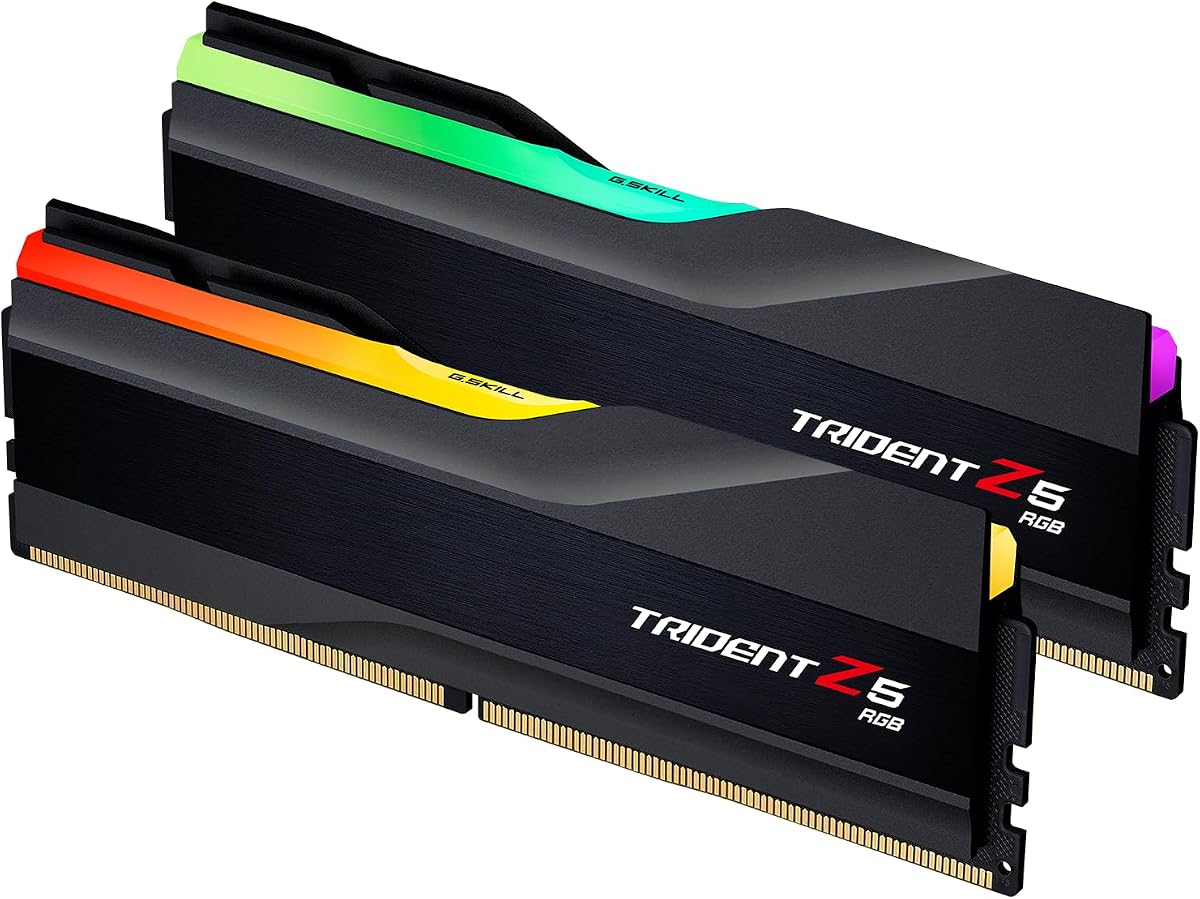
G.SKILL Trident Z5 RGB DDR5 32GB is a polished option for builders who want a matched 6000MT/s set, comprehensive timing information, and integrated lighting. The kit includes 2x16GB modules, carries a 4.7 customer rating, and uses CL36-36-36-96 timings at 1.35V. It belongs to the same general platform-support category as the Flare X5 but adds a more presentation-focused design.
We may earn a commission when you buy through this link, at no additional cost to you.
The package of profiles is useful: buyers receive a JEDEC default along with Intel XMP 3.0 and AMD EXPO overclocking profiles. This allows a conservative initial boot and a more aggressive performance option after the system is configured. G.SKILL provides a broad list of supported Intel Z, B, and X-series boards along with AMD X, B, and A-series platforms, while recommending its QVL for motherboard-specific validation.
As with the other G.SKILL kits, the modules are intended to be used as a matched set. Buyers should not combine them with another memory kit, and adding additional modules can alter speed and stability even when the platform nominally supports more than two DIMMs. The RGB implementation is intended for visual builds, but it does not replace the need to confirm physical clearance, software support, and motherboard compatibility.
The Trident Z5 RGB is a good fit for a showpiece gaming PC where coordinated appearance and a reputable set of memory profiles are both important. It is less compelling for a plain workstation, but the strong specifications, 32GB capacity, and conservative 1.35V profile remain useful. For the exact board, check the QVL before purchase and update the BIOS if the vendor recommends it.
JEDEC, XMP 3.0, and EXPO profiles give the kit flexibility during setup and tuning. The default profile provides a stable baseline, while the enthusiast profiles target higher performance.
The long list of named motherboards makes preliminary compatibility screening straightforward. It should still be treated as guidance rather than a blanket guarantee for every board revision or BIOS version.
We may earn a commission when you buy through this link, at no additional cost to you.
Corsair Vengeance DDR5 32GB is a strong non-RGB choice for an enthusiast desktop that values a 6000MHz target, platform flexibility, and local voltage control. Its 4.8 customer rating is the highest in the lineup, tied with the leading Crucial Pro kit. The 2x16GB arrangement supplies 32GB and a conventional dual-channel layout for demanding applications.
We may earn a commission when you buy through this link, at no additional cost to you.
Both AMD EXPO and Intel XMP 3.0 are supported, allowing the same modules to be used on either major desktop platform. Onboard voltage regulation is designed to make overclocking easier and more stable by giving the memory more direct control over its operating voltage. The result is managed through iCUE according to the product information, which can be particularly convenient for users who want software-assisted adjustment rather than relying only on BIOS controls.
Corsair says the modules are tightly screened to provide extended overclocking potential, but buyers should not treat screening as a guarantee that a specific CPU and motherboard combination will reach the headline speed. The final result depends on the processor's integrated memory controller, motherboard topology, firmware, and voltage settings. The supplied information does not include a complete secondary timing set, so the BIOS and current vendor documentation may need to provide more detail before manual tuning begins.
This kit is well suited to a performance build where low-profile simplicity is preferable to RGB. Its combination of a strong rating, screened components, dual profiles, and onboard regulation makes it a particularly solid all-rounder. It can be considered alongside the Crucial Pro 6000MHz kit, with Corsair appealing more to users who value integrated voltage management and iCUE-based control.
Tightly screened memory chips can improve consistency across a kit and support more predictable overclocking. Individual systems still vary, so buyers should validate the advertised profile with their chosen hardware.
Onboard voltage regulation allows more direct tuning than systems that rely entirely on motherboard automatic control. It simplifies the process of establishing a stable voltage before adjusting frequency and timings.
We may earn a commission when you buy through this link, at no additional cost to you.
G.SKILL Ripjaws S5 DDR5 32GB provides a conventional 6000MT/s target with full CL36-36-36-96 timings and a 1.35V profile. It is sold as a matched 2x16GB set and has a 4.6 customer rating. For a builder who values straightforward specifications over lighting, it offers a useful balance of capacity, latency, and platform support.
We may earn a commission when you buy through this link, at no additional cost to you.
The kit includes JEDEC default, Intel XMP 3.0, and AMD EXPO profiles, so it can serve both major CPU ecosystems. Its listed timings match the Flare X5 specification, providing a clear basis for manual tuning and stability testing. The absence of RGB also reduces visual complexity and avoids the need to configure lighting software, making the Ripjaws S5 especially practical for a restrained workstation or gaming build.
G.SKILL cautions against mixing memory kits because modules sold together are designed to run as a set. It also provides an extensive platform list and directs owners to the QVL and RAM Configurator for more precise checking. As with the other 6000MT/s kits, the maximum speed is not automatic: compatible hardware, a suitable BIOS, and the appropriate profile are required, and manual tuning may be needed if the default voltage does not prove stable.
This is a sensible final recommendation for users who want a documented, non-RGB 32GB kit with recognized overclocking profiles. It may not be the most visually exciting option, and its CL36 rating is not as tight as some 6000MHz alternatives, but the complete timing set, conservative voltage, and broad platform information make it an approachable choice. Verify the exact motherboard and memory-controller combination before ordering.
The matte black, non-RGB design keeps attention on the system rather than lighting effects. It suits workstations and restrained gaming builds where clean cable management and component layout matter more than synchronized illumination.
Using a purpose-matched 2x16GB set simplifies the tuning process. It is generally more predictable than combining memory from separate kits, provided the pair remains together throughout the system's use.
We may earn a commission when you buy through this link, at no additional cost to you.
Choosing overclockable DDR5 memory requires balancing speed, latency, voltage, capacity, and platform support. The most important step is to define the complete system first, because an impressive kit cannot overcome an incompatible motherboard, an older BIOS, or a CPU whose memory controller cannot cooperate with the desired settings.
Advertised speed is usually expressed as 6000MHz or 6000MT/s for these products, but it represents the highest intended performance profile rather than a speed the modules must always use. The faster 6400MHz Crucial Pro kit offers the highest headline ceiling in this guide, while 6000MHz is the dominant target among the alternatives. A higher frequency can improve bandwidth and reduce some memory delays, but it also raises the likelihood that manual voltage, timing, or motherboard adjustments will be required.
CAS latency is expressed as CL36 or CL30 in the headline specifications of the most competitive kits. Lower CAS latency can improve performance, but the secondary and tertiary timings also influence the real behavior of the memory. Kits that publish a full set such as 30-40-40-76 or 36-36-36-96 give manual overclockers a clearer baseline for judging voltage requirements, stability, and possible refinements.
The processor's integrated memory controller, motherboard topology, BIOS maturity, and trace layout all influence the maximum stable memory speed. Some of the products list extensive supported motherboard families, and G.SKILL additionally provides QVL and configurator tools. Those resources are useful, but exact board revision, CPU model, and BIOS version should still be checked. Updating the BIOS before installation can sometimes add support for newer memory profiles or improve stability.
Intel XMP 3.0 and AMD EXPO save users from manually entering every advertised frequency, voltage, and timing value. Nearly all of the matched 32GB kits support both ecosystems, which is useful when the build is upgraded over time. The profile still needs to be enabled in BIOS and validated. If it does not train successfully, the system can fall back to a lower frequency or require adjustments to memory-controller settings and voltage.
Thirty-two gigabytes in a 2x16GB arrangement is the practical sweet spot for most of the listed gaming and enthusiast kits. It provides ample room for current games, background applications, streaming tools, and productivity software while preserving dual-channel operation. The lone 16GB single-module option offers expansion flexibility, but a single DIMM normally has less bandwidth than a matched pair. For a finished performance system, 32GB across two modules is generally the more straightforward choice.
The listed voltages range from 1.35V to 1.40V for the profiled performance configurations, though other kits do not provide a complete voltage figure in the supplied data. Higher frequency and tighter timings can require more voltage for stability, so the profile should not be treated as a promise that every processor will run at the exact specified value. Onboard voltage regulation, found on the Corsair options, can make voltage management more direct and repeatable through software.
DDR5 modules generate heat as frequency and voltage increase, and a well-designed heat spreader helps keep memory ICs within appropriate operating conditions. The Crucial Pro kits emphasize performance and stability, while Corsair's Vengeance options add taller RGB assemblies that may need extra clearance under a large air cooler. Check the case and cooler dimensions, particularly for a four-DIMM board where module height and slot spacing can become important.
RGB is a visual rather than performance feature, but it can be valuable in a gaming build with a glass side panel. Corsair Vengeance RGB and G.SKILL Trident Z5 RGB provide integrated lighting, while the non-RGB kits are better suited to understated systems. Lighting software may add setup complexity and can occasionally conflict with other motherboard utilities. Buyers who value simple operation should consider whether the aesthetic benefit justifies another configuration layer.
Before installing the memory, consult the motherboard manual, identify the recommended DIMM slots, and confirm that the CPU and board support the desired DDR5 generation and memory speed. For a matched two-module kit, use the slots specified by the manufacturer, usually A2 and B2 on a four-slot board. Power off the system, disconnect the power supply, discharge any remaining power, and install the modules with the retention clips fully closed.
Enter the BIOS or UEFI first and save a known-good configuration before changing memory settings. The system may begin with the JEDEC baseline, after which the appropriate XMP 3.0 or EXPO profile can be enabled. After enabling a profile, test the system under realistic workloads and watch for crashes, boot loops, application errors, or corrupted files. If instability appears, update the BIOS, retest at conservative settings, and then adjust voltage and timings gradually rather than making several large changes at once.
Treat memory as part of the complete system rather than an isolated component. Leave room in the cooling and power budgets, avoid unnecessary stress on the memory controller, and use the supplied profile as the primary configuration if manual tuning is not the goal. For ongoing care, keep the interior dust-free, maintain airflow around the DIMM area, avoid frequent power cuts during memory writes, and keep the matched modules together. Do not mix separately purchased kits unless the manufacturer has explicitly validated that combination.
A 6000MHz profile is a common target for modern DDR5 desktop platforms and can provide a strong balance of bandwidth, latency, and attainable stability. The best result depends on the CPU's memory controller, motherboard, BIOS, and selected timings. A well-matched 6000MHz kit can be more useful than a faster kit that requires extensive manual tuning or refuses to boot reliably.
A lower CL rating generally represents tighter primary latency at the advertised profile, but it does not guarantee that the modules will reach a higher frequency or remain stable at lower voltage. Secondary timings, memory-controller quality, motherboard design, and voltage all influence overclocking. A stable CL36 kit can outperform a CL30 kit if the latter requires unstable or excessive settings.
Usually, yes. XMP 3.0 and EXPO store the intended frequency, voltage, and timing configuration so BIOS can apply it with one selection. Without enabling a profile, compatible hardware may boot at a lower JEDEC default speed. Manual configuration can produce similar results, but it takes more knowledge and careful stability testing.
Mixing kits is not recommended, especially when different models, capacities, IC types, or timing profiles are involved. Modules sold as a matched set are tested and configured to work together. Mixing them can reduce the attainable speed, prevent a profile from training, or cause instability. The safer approach is to use one matched kit and add only a manufacturer-validated module later.
It can, particularly in CPU-limited games and other workloads sensitive to memory latency, but the difference is often smaller than the difference between a modern fast CPU and an older one. Games that rely heavily on the graphics processor may see little benefit. Memory capacity, dual-channel operation, CPU choice, and stable settings often have a greater practical effect than a small increase in rated frequency.
Thirty-two gigabytes is a strong capacity for modern gaming, streaming, multitasking, and many enthusiast applications. It also leaves more memory headroom than 16GB while remaining easy to install as a matched 2x16GB kit. Memory-intensive content creation, virtual machines, and large datasets may benefit from 64GB or more, but those users should confirm motherboard support for higher-capacity modules.
Start with the voltage specified by the memory manufacturer for its rated profile and adjust only as stability testing requires. Some listed kits operate around 1.35V, while one supplied Corsair configuration lists 1.40V. Raising voltage can improve stability but also increases heat and electrical load, so it should be done conservatively and within the limits of the modules and motherboard.
Successful BIOS training is only the first step. Run a demanding memory test and realistic applications for an extended period, watching for crashes, freezes, failed calculations, corrupted files, and unexpected restarts. A stable setup should remain error-free under sustained load. If errors appear, reduce the frequency, restore a known-good setting, or increase voltage cautiously before testing again.
The Crucial Pro 32GB 6000MHz kit is the strongest all-around recommendation in this guide, combining a 4.8 customer rating, detailed timings, and both EXPO and XMP 3.0 support. The Patriot Viper Venom 32GB stands out as the budget-focused option with a tight CL30 rating, while the Crucial Pro 32GB 6400MHz kit is the premium choice for builders seeking the highest advertised speed and lowest primary latency.
Prioritize exact platform compatibility, complete timing information, and a stable rated profile before focusing on headline frequency. Onboard voltage regulation and detailed timing sets can make manual tuning more approachable, while RGB is valuable only when appearance is a stated objective. A matched 2x16GB kit remains the most practical configuration for most gaming and enthusiast desktops.
Finally, check current prices, customer feedback, QVL information, and BIOS requirements before purchasing. Availability and pricing change regularly, and the best-performing kit on paper is only the right choice when it can achieve its intended settings on your exact motherboard and processor. Always save a stable BIOS profile before beginning further overclocking experiments.