
Audio-Technica AT6013a
4.6Editor score
Dual-action anti-static cleaning
Carbon-fiber and velvet brushes
Single-pass groove cleaning
Protective metal guard bracket
Record cleaning machines compared by cleaning method, capacity, drying, safety, record compatibility, and ease of use to help you protect your vinyl collection.
Record cleaning machines help remove dust, fingerprints, grease, static, and trapped debris from vinyl without forcing a delicate record into an aggressive household cleaner. The right model depends on your collection size, preferred level of automation, record formats, workspace, and tolerance for manual or powered operation.
We compared all ten featured products by examining their supplied cleaning methods, basin or tank design, brush configuration, drying provisions, record compatibility, safety features, accessories, physical footprint, and customer ratings. The list covers manual washers, sonic and ultrasonic systems, vacuum-style machines, and a compact anti-static cleaning tool.
Each review identifies the product's most useful strengths, practical limitations, and ideal owner, while the comparison table places key specifications side by side. Ratings and product details reflect the supplied listing information, and prices can change, so verify the current listing and included accessories before purchasing.
4.6Editor score

4.6Editor score

4.5Editor score
The comparison covers manual washers, powered ultrasonic and vacuum systems, and a dry anti-static cleaner, with emphasis on cleaning approach, record support, drying, and practical operation.




The HumminGuru EZ Record Washer earns a 4.7 rating and stands out as the most thoughtfully engineered manual washer in this group. Its defining feature is the straight-down clamp, which grips the center spindle area while a soft interior ring creates a watertight seal around the label. That design makes the machine especially appealing for collectors who want to wet-clean records without repeatedly exposing labels or fingers to moisture.
We may earn a commission when you buy through this link, at no additional cost to you.
Operation is refreshingly straightforward. The unique handle supports a back-and-forth motion, with the supplied guidance recommending 12 clockwise turns followed by 12 counter-clockwise turns. Ultra-soft goat-hair brushes contact both surfaces as the record rotates, while the alcohol-free cleaning fluid is intended to lift dust, fingerprints, grease, grime, and static without scratching. The clamp accommodates records from 1mm to 3mm thick, and a 7-inch adapter supports 45rpm records with 38mm center holes.
The trade-off is capacity. It cleans one record at a time, and the wet process still requires separate air-drying before playback. It also does not automate fluid extraction or filtration, so it cannot match the unattended cycle of an ultrasonic unit. Even so, those limitations are reasonable for a manual product whose strongest advantages are label protection, controlled contact, compact storage, and a low-tech cleaning process.
This washer is best for someone with a modest collection who values careful handling, straightforward operation, and a complete manual workflow. It is particularly suitable as a companion to the HumminGuru ultrasonic cleaner, serving as a pre-wash option when a record needs additional attention before its automated cycle. For collectors seeking the strongest combination of manual control, label safety, drying accessories, and overall convenience, it is the leading choice in this roundup.
The clamp is more than a spindle holder. Its waterproof seal is designed to isolate the label while the brushes work across the record surfaces, reducing the chance that cleaning fluid will wick beneath a paper label. The no-touch rotation method also minimizes fingerprints and reduces the need to grip a wet record directly.
Dual water outlets are arranged to make basin emptying easier, while the included rack holds up to eight records for air-drying and stores beneath the washer. The result is a more cohesive setup than a standalone basin with loose accessories, particularly valuable in a dedicated listening area.
We may earn a commission when you buy through this link, at no additional cost to you.
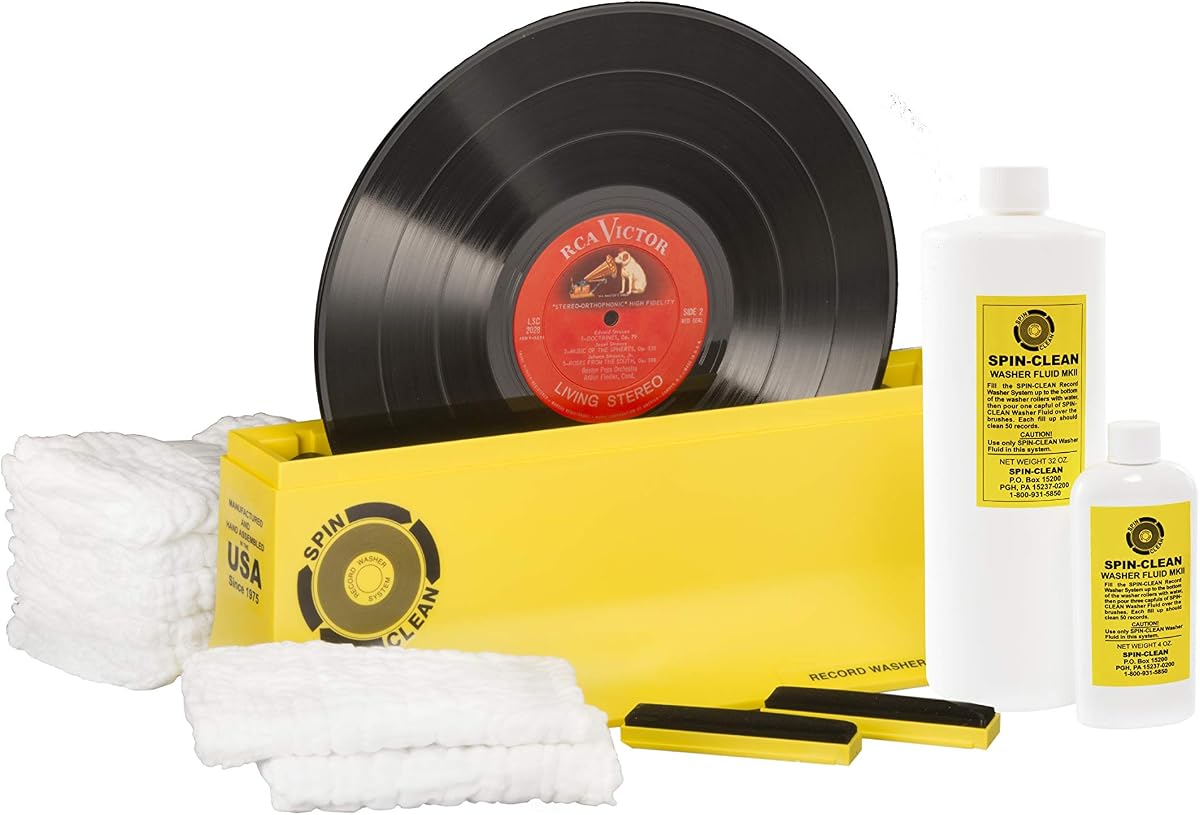
The Spin-Clean Record Washer Kit has a 4.6 rating and offers a proven manual approach with unusually broad format support. It handles 33, 45, and 78rpm records, making it a versatile choice for listeners who own more than standard 12-inch LPs. Cleaning both sides simultaneously reduces the number of separate passes and helps maintain a more consistent result across the collection.
We may earn a commission when you buy through this link, at no additional cost to you.
The washer uses snap-in rollers and wedge-fit brushes intended to remain securely in place during rotation. Its basin includes stability-enhanced feet to limit wobbling, while the simplified shape is designed to be easy to clean. The kit includes an alcohol-free cleaning concentrate, a pair of brushes, a pair of durable rollers, a secure lid, and two lint-free drying cloths, giving buyers most of the essentials needed to begin routine maintenance.
Its main drawback is that the cleaning solution is a concentrate and must be diluted in the basin; first-time users should follow the included guidance rather than adding it directly. As with any wet-cleaning system, records need proper drying before playback. The washer is also entirely manual, so it will not provide the automatic cycle, filtered drying, or compact ultrasonic cleaning found in powered premium models.
The Spin-Clean kit is best for collectors who want a reliable, electricity-free washer without limiting themselves to one record format. It offers a practical compromise between the carefully sealed HumminGuru EZ washer and a large automated ultrasonic system. Choose it when dual-sided cleaning, a complete accessory package, and support for 78rpm records matter most.
The washers and rollers clean both sides of a record during the same manual cycle. Because it draws no electricity, the machine can be used in a listening room without power nearby and operates more quietly than motorized alternatives.
Compatibility with 33, 45, and 78rpm records makes this kit useful for mixed collections. The supplied rollers accommodate different record sizes, while the brushes, fluid, lid, and two lint-free cloths create a fairly complete starting kit.
We may earn a commission when you buy through this link, at no additional cost to you.
The HumminGuru Ultrasonic Vinyl Record Cleaner carries a 4.5 rating and represents the most automated approach in this roundup. It uses dual 40kHz transducers and a closed-loop stainless steel basin to clean without brushes touching the grooves. The ultrasonic process is designed to target deep-groove dirt, microscopic dust, and manufacturing release agents while keeping the record surface physically separated from the cleaning action.
We may earn a commission when you buy through this link, at no additional cost to you.
Its automated two-in-one cycle combines cleaning with filtered-air drying. That airflow is intended to reduce the chance that airborne particles will settle back onto a record before it is played. The compact 350ml basin is another meaningful feature, requiring less distilled water than much larger ultrasonic tanks while allowing repeated use through a built-in filtration system. Compatibility with 7-, 10-, and 12-inch records broadens its appeal for mixed-format collections.
The main caveat is that this is a powered appliance with a more involved setup than a manual washer. It requires distilled water, regular filter care, and an outlet, and it does not provide the same high-volume throughput as a multi-record ultrasonic tank. A temperature sensor also monitors the basin and stops the cycle at 55°C, adding a clear safety layer but not eliminating the need to use the machine as directed.
This cleaner is best for audiophiles who want thorough, contactless cleaning and a largely hands-off workflow, especially if they have space for a dedicated shelf. Its automatic drying, small water requirement, filtration, and thermal monitoring make it the premium pick for buyers who prioritize convenience as much as cleaning performance.
At 40kHz, the dual transducers provide fine ultrasonic activity without brush contact. Keeping the record surface away from physical brushes reduces the risk of scratching, while the calibrated distance and enclosed basin are intended to concentrate energy around the grooves.
The integrated cycle handles cleaning and drying without a separate hand-drying stage. Filtered airflow helps prevent airborne debris from recontaminating the record, while the small basin and reusable filtration system support efficient routine use.
We may earn a commission when you buy through this link, at no additional cost to you.
The HumminGuru HG01 Dark Gray has a 4.5 rating and delivers the same core ultrasonic concept in a compact package. Its dual-transducer, 40kHz system uses a closed-loop stainless steel basin and calibrated proximity to clean records without physical brush contact. That makes it attractive to listeners who want a deep-cleaning process while avoiding abrasion from brushes on delicate vinyl surfaces.
We may earn a commission when you buy through this link, at no additional cost to you.
The machine automates both cleaning and drying. High-efficiency air filtration is designed to keep airborne dust from settling onto the album, allowing the record to be ready for playback after the cycle. Its 350ml basin uses far less water than large industrial-style ultrasonic tanks, and the dual filtration system allows the water to be reused across multiple sessions.
Safety is another strength. A thermal sensor monitors the water continuously and initiates an automatic halt if the temperature reaches 55°C. The listed dimensions of 34.2 by 15.2 by 27.4 centimeters make it suitable for standard record shelving, and hidden cable management under the lid helps keep the setup visually tidy. Compared with the larger-format HumminGuru model in this list, its listing focuses on 12-inch records rather than an explicit three-size range.
The HG01 is best for an audiophile with a 12-inch-heavy collection who values automated, contactless cleaning in a compact footprint. Its disadvantages are the same inherent to ultrasonic appliances: it needs power and distilled water, and filtration components require care. Even so, the combination of automatic drying, low water use, thermal protection, and shelf-conscious design is highly practical for a dedicated listening setup.
The machine's listed dimensions are designed around record-storage shelving rather than bulky workbench dimensions. Hidden cable storage, a lightweight frame, and a restrained dark-gray appearance help it blend into a dedicated audio room.
Real-time temperature monitoring gives the ultrasonic process a defined shutdown point. The 55°C automatic halt is intended to reduce the risk of heat-related record warping during extended cleaning sessions.
We may earn a commission when you buy through this link, at no additional cost to you.
The VEVOR Sonic Cleaner 6L has a 4.4 rating and distinguishes itself through multi-record ultrasonic capacity. Its 304 stainless-steel structure, 6-liter internal tank, and three 180W transducers are designed to clean as many as six records at a time. That makes it a practical option for collectors with larger collections who want to process several albums in a single session.
We may earn a commission when you buy through this link, at no additional cost to you.
Controls add flexibility. The digital panel allows the washing temperature to be adjusted from 20°C to 80°C and the working time to run from zero to 30 minutes. A stainless-steel lid helps keep dust out while the machine is not in use. The supplied package includes the ultrasonic cleaner, cleaning rack, drying rack, screwdriver, cover, power cord, plug, and manual, providing a broad set of components for initial setup.
Its main disadvantages relate to size and thermal responsibility. A 6-liter tank occupies more space than the compact HumminGuru models and requires sufficient room to place a separate drying rack nearby. The wide temperature range is useful for different cleaning needs, but reaching the upper end of that range would demand close attention to the manufacturer's guidance to avoid unnecessary heat exposure.
The VEVOR is best for high-volume listeners who value batch cleaning over a minimal footprint. The ability to clean multiple records together, combined with precise time and temperature controls, makes it a strong choice for a dedicated cleaning area. Buyers seeking a single automated record cycle and shelf-sized design may prefer a smaller ultrasonic model instead.
A six-record capacity can significantly reduce the number of separate cycles required for a collection. The dedicated cleaning rack keeps records organized during ultrasonic treatment, and the separate drying rack supports the next stage of the workflow.
The digital panel exposes both temperature and duration, allowing the user to select a cycle rather than relying on one fixed setting. A 0-30-minute timer range accommodates short cleaning tasks and longer batch sessions.
We may earn a commission when you buy through this link, at no additional cost to you.
The Big Fudge Vinyl Record Cleaning Machine carries a 4.1 rating and focuses on capacity and straightforward manual cleaning. Its dual-wash brush system uses microfiber brushes to clean both sides of a record during the same spin, while an adjustable roller system accommodates records of many sizes. The machine can handle up to 50 records per wash cycle, giving it a clear advantage for high-volume routines.
We may earn a commission when you buy through this link, at no additional cost to you.
The package includes the spinner machine with brushes and rollers, Record Washer Fluid, an all-purpose cleaning cloth, and a microfiber cloth. That combination gives the buyer the tools needed for both washing and drying, while the manual design avoids the need for a nearby outlet. The dual-side action is especially useful when working through a crate of albums that need routine maintenance.
The disadvantages are the lower 4.1 rating and the physical demands of manual spinning. A 50-record cycle is a throughput claim, not a completely hands-off process; records still need to be loaded, washed, dried, and handled carefully. Buyers should also verify how the supplied fluid is mixed and ensure that each record is fully dry before playback.
The Big Fudge machine is best for collectors who clean in batches and want the combination of high cycle capacity, dual-side brushing, and a complete accessory package. It is less compelling for someone who values a compact storage solution, automatic drying, or a sealed clamp. For its intended manual, high-volume role, however, the design remains straightforward and useful.
The microfiber brushes contact both surfaces as the record spins, reducing the need to flip and repeat the process. That efficiency, combined with a stated capacity of up to 50 records per cycle, favors owners who regularly clean many albums.
The roller system can be adjusted to accommodate different record sizes. This flexibility helps prevent the machine from being limited to one common format and makes it more useful for mixed vinyl collections.
We may earn a commission when you buy through this link, at no additional cost to you.
The Spin-Clean Deluxe Kit has a 4.7 rating and shares the well-regarded manual foundation of the standard Spin-Clean system while adding more consumables. It cleans 33, 45, and 78rpm records simultaneously on both sides, using the familiar powered-free basin and brush arrangement. That combination makes it especially attractive for collectors with varied formats who want a deeper cleaning than a dry brush can provide.
We may earn a commission when you buy through this link, at no additional cost to you.
The main upgrade is the amount of cleaning fluid. The kit includes two bottles of alcohol-free concentrate, described as 4 ounces plus an extra 32 ounces, along with extra drying cloths and brushes. The supplied quantity is stated to support cleaning up to 6,300 records, making the bundle better suited to sustained collection maintenance than a smaller starter set.
The fluid remains a concentrate and must be diluted in the basin for proper use, so buyers still need to follow the mixing instructions. Records also need to dry after washing, and the system has none of the automated filtration or airflow found in ultrasonic or vacuum-assisted machines. These limitations keep it firmly in the manual-washer category.
The Deluxe Kit is best for owners of a substantial collection who already understand wet-cleaning basics and want ample supplies on hand. Its 4.7 rating, broad format support, extra cloths, large fluid allowance, and limited lifetime warranty make it a particularly complete manual package. Choose it over the standard kit when ongoing cleaning volume matters more than minimizing accessories.
The expanded fluid quantity and additional drying cloths reduce the likelihood of running out mid-project. For owners cleaning many albums, having consumables available can make the manual workflow more consistent and convenient.
The washer supports 33, 45, and 78rpm records, allowing one basin to serve common LP, single, and older-format discs. Dual-sided cleaning and the alcohol-free concentrate make it a flexible option for diverse vinyl libraries.
We may earn a commission when you buy through this link, at no additional cost to you.
The Pro-Ject VC-E2 has a 3.5 rating and offers a compact vacuum-assisted alternative to larger wet-cleaning systems. Its 0.5-liter tank is intended for vacuumed cleaning liquid, and the listing describes a process that removes cleaning-fluid residue while also reducing static load. The record can become completely dry within two rotations according to the supplied product information.
We may earn a commission when you buy through this link, at no additional cost to you.
Its main strength is efficiency. Rather than describing a long ultrasonic cycle or a manually operated wash basin, the VC-E2 focuses on a short, focused cleaning and drying action. The smaller tank may also be attractive in a listening room where shelf and counter space are limited, although buyers should confirm the full machine dimensions and included accessories before purchase.
The 3.5 rating is the lowest among the featured products and is an important part of an honest evaluation. The supplied information is concise and does not discuss the range of record sizes, included fluid, filtration, or the noise level of the vacuum process. Those unknowns make it harder to compare the VC-E2 confidently with the more fully specified washers and ultrasonic systems.
The VC-E2 is best for a buyer who prioritizes a compact, quick, vacuum-style process and mainly works with standard vinyl records. Its two-rotation drying claim and residue-focused design are compelling, but the lower rating and limited listing details argue for checking current customer feedback and confirming compatibility before committing. It is a specialized choice rather than the safest all-purpose recommendation.
The machine's stated two-rotation drying process is designed to remove residual cleaning liquid quickly. This focus can make the workflow more convenient for listeners who do not want to air-dry every washed record on a separate rack.
A 0.5-liter tank differentiates the VC-E2 from larger vacuum and ultrasonic units. It may suit a compact listening setup, but owners cleaning many records at once should consider whether a larger basin or multi-record system would be more efficient.
We may earn a commission when you buy through this link, at no additional cost to you.
The Pro-Ject VC-S3 has a 3.5 rating and is the larger-capacity counterpart to the VC-E2 in this roundup. Its 2.5-liter tank is built for vacuumed cleaning liquid, making it a better fit for owners who want fewer fluid changes during repeated cleaning sessions. The listing also describes complete drying within two rotations and the removal of cleaning-fluid residue.
We may earn a commission when you buy through this link, at no additional cost to you.
Like the VC-E2, the VC-S3 is intended to reduce static load as part of the cleaning process. That makes static reduction a central benefit rather than a side feature. For collectors who already notice crackles, popping, or dust-related noise, a machine that combines wet cleaning, vacuum-assisted extraction, and fast drying offers a more complete workflow than a basic dry brush.
The disadvantages are the shared 3.5 rating and the limited technical information in the supplied listing. Buyers are not given details about record-size support, included solution, filtration, noise, or the physical dimensions, and those omissions make practical comparison more difficult. A 2.5-liter tank also requires more space than a 0.5-liter model and should be balanced on a suitable surface.
The VC-S3 is best for owners who regularly clean many records and prefer a larger vacuum-style tank. Its capacity is the decisive advantage over the VC-E2, while the same caution applies: review current feedback and confirm the accessory package before purchase. It is a potentially capable system for a dedicated workflow, but the available rating and specification details keep it behind the better-documented choices.
The 2.5-liter tank is substantially larger than the 0.5-liter VC-E2 tank. For routine cleaning of a large collection, that additional volume can reduce interruptions associated with repeatedly managing the cleaning liquid.
The combination of vacuumed cleaning liquid, residue removal, static reduction, and two-rotation drying offers a concise process. This integration can be useful for listeners who want a clear route from washing to playback without adding another drying device.
We may earn a commission when you buy through this link, at no additional cost to you.
The Audio-Technica AT6013a has a 4.6 rating and is the simplest dedicated cleaning option in the guide. Rather than using fluid, a basin, or a powered vacuum, it combines two carbon-fiber brushes with a central velvet pad. The materials collect dust and other contaminants during a single pass, making the device well suited to routine maintenance before playback.
We may earn a commission when you buy through this link, at no additional cost to you.
The carbon fibers are designed to remain straight for deep-groove cleaning, while the central velvet pad adds another cleaning surface. The anti-static construction helps reduce the attraction of airborne debris and can contribute to cleaner playback. A protective metal guard bracket is included, adding structure around the cleaning head and making the tool easier to handle around a turntable.
The important limitation is that this is a dry cleaner, not a wet washer. It can remove loose dust and surface contaminants, but it is not designed to dissolve grease or lift stubborn grime embedded in grooves. It therefore cannot replace a wet or ultrasonic system for neglected records, although it is an excellent first line of defense for records that are handled carefully and cleaned regularly.
The AT6013a is best for new collectors, budget-conscious listeners, and anyone who wants a simple tool for frequent dry cleaning. It is especially helpful before placing a record on the platter because removing loose dust reduces the chance of transferring particles to the stylus. For deeper restoration, pair it with a wet washer rather than expecting it to handle every cleaning task.
Two carbon-fiber brushes work with the central velvet pad to collect contaminants in one pass. The different materials address the record surface and grooves while the anti-static fibers help control the static attraction that can pull more dust onto vinyl.
The listing states that regular use can help preserve sound quality and extend the lives of records and styli. A dry cleaning pass before playback is a quick way to remove particles that might otherwise be dragged across the groove by the stylus.
We may earn a commission when you buy through this link, at no additional cost to you.
The best record cleaning machine depends on how dirty the collection is, how much automation you need, and how much space and time you want to devote to maintenance. Reviewing the cleaning method, compatibility, drying process, and ongoing upkeep will prevent an expensive mismatch.
Wet cleaners use fluid, brushes, ultrasonic energy, or vacuum-assisted extraction to lift dust, fingerprints, grease, and other grime from the record surface. They are the better choice for neglected albums, records that have gone unwashed for a long period, or collections where noise and cleanliness are major concerns. Dry cleaners are faster, simpler, and useful for routine maintenance, but they cannot dissolve oily residue or remove deeply embedded dirt.
Manual washers require you to rotate the record with a handle or spinner, while vacuum systems use extraction during the cleaning cycle. Ultrasonic machines generate high-frequency energy in a water basin and generally require less direct handling. Consider how much attention you actually want to provide: a manual machine may be satisfying for a small collection, whereas an automated cycle is easier to sustain for many records.
A machine may support full-size LPs but not 7-inch singles, or it may work across 33, 45, and 78rpm formats without different attachments. Check both record diameter and center-hole requirements. Some systems include adapters, while others rely on adjustable rollers or a standard spindle. A collection containing several formats benefits from a washer that explicitly supports each size.
Every wet-cleaning method requires a plan for removing or evaporating residual moisture. Manual washers generally need a drying rack and time before playback. Automated ultrasonic systems may include filtered-air drying, while vacuum-style machines can remove fluid rapidly. Records should be fully dry and undamaged by residue before they return to a turntable.
Single-record machines prioritize careful handling and compact storage, while larger ultrasonic tanks can wash several records together. High-capacity options are more useful for active collectors, but they consume more space, water, and energy. A small collection may be better served by a compact washer or dry cleaner, while a large library may justify a batch system with separate cleaning and drying racks.
A waterproof label clamp, stable basin feet, controlled temperature, and automatic shutdown features can all reduce risk. Vinyl should not be exposed to excessive heat, and cleaning fluid should never be applied directly without proper dilution. Brushes should be positioned so they do not place excessive stress on the record, while ultrasonic equipment should follow the supplied operating instructions.
Manual washers are quiet and need only a basin, drying rack, and cleaning surface. Ultrasonic and vacuum machines add power requirements, motors, pumps, or transducers and may be better placed in a utility area than directly beside a turntable. A compact footprint matters if the machine must share a shelf with records, while a larger tank may justify a dedicated cleaning station.
A useful kit should include the correct brushes or racks, an appropriate cleaning solution, and drying tools. Concentrated fluid must be diluted correctly, and ultrasonic systems may require distilled water along with periodic filter care. Compare the quantity of consumables supplied with the number of records you expect to clean, and check what replacement items the manufacturer recommends.
Begin by reading the machine's instructions, confirming the record sizes it supports, and inspecting the brushes, rollers, racks, and basin. Clean the working surfaces before handling records, and use a soft, clean cloth for the outer sleeve. If a record has already been washed, make sure it is completely dry before placing it in any machine.
For a manual washer, dilute the concentrate exactly as directed, secure the record, and rotate it smoothly in the recommended pattern. For ultrasonic or vacuum systems, use the specified water or cleaning liquid, set the appropriate time and temperature, and do not exceed the supplied safety limits. Keep hands and loose objects away from moving rollers, transducers, and powered components.
After cleaning, remove excess fluid without scraping the grooves, place the record on a clean drying rack, and allow it to dry fully. Wipe the machine basin, rollers, brushes, and other reusable parts according to the manual, and allow ultrasonic tanks to cool and drain properly. Replace damaged brushes, clogged filters, or contaminated fluid rather than reusing compromised components.
Regular cleaning can remove dust, fingerprints, grease, and static that may increase playback noise or cause needless stylus wear. A dedicated machine is especially useful for handling many records consistently or restoring albums that have gone unwashed. For a small collection, a dry cleaning tool and occasional wet cleaning by hand may be sufficient.
Ultrasonic record cleaners are designed to clean vinyl without brush contact, using high-frequency activity in a controlled water basin. The records still need to be correctly positioned, and the machine must be operated within its specified temperature and timing limits. The listed HumminGuru models add thermal monitoring, while the VEVOR model allows the user to adjust its cycle.
This roundup emphasizes machines supplied with alcohol-free cleaning solutions, and the manufacturer directions should always take priority. Some common household liquids can damage labels, sleeve materials, or certain plastics, while a record's label may not tolerate prolonged liquid exposure. Use only a solution approved for the machine and the specific record being cleaned.
Yes. Playing a wet record can create a poor listening experience and may draw moisture toward the label edge or leave residue around the grooves. Allow wet-cleaned records to air-dry fully or use a machine with a verified automatic drying cycle. Inspect the record and ensure that no fluid is present before playback.
A wet washer uses fluid to lift dirt and generally includes brushes, rollers, a basin, and a drying process. A dry cleaner relies on conductive or soft materials to collect loose dust and reduce static. Wet cleaning is more thorough for fingerprints and grease, while dry cleaning is faster and ideal for frequent surface maintenance.
Several models in this guide explicitly support 7-, 10-, and 12-inch records, while the Spin-Clean systems list compatibility with 33, 45, and 78rpm formats. Other models focus on 12-inch records or require specific adapters. Check the machine's diameter and RPM specifications, not just the general vinyl compatibility statement.
A light dry cleaning before playback is useful for records handled often, while wet cleaning is better suited to fingerprints, visible grime, or an album that has gone unwashed. The ideal schedule depends on storage, handling, and environment. Keep the record sleeve clean, store albums vertically, and avoid leaving them exposed to dust for long periods.
The listed HumminGuru ultrasonic models specify distilled water for their small basins. Using the correct water helps support reliable ultrasonic activity and reduces unwanted mineral deposits. Other ultrasonic systems may have different fluid requirements, so check the VEVOR manual and the specific product instructions before operating any machine.
The HumminGuru EZ Record Washer is the strongest overall manual choice because its waterproof clamp, one-handed rotation, goat-hair brushes, and integrated drying rack create a careful and cohesive workflow. The Spin-Clean Record Washer Kit offers an excellent alternative for collectors who want dual-sided manual cleaning across 33, 45, and 78rpm formats, while the HumminGuru Ultrasonic Cleaner is the leading premium option for automated deep cleaning and filtered drying.
Prioritize the type of dirt you need to remove, the formats you own, and the maintenance routine you will realistically follow. A dry anti-static cleaner is sufficient for frequent light care, a manual washer provides more thorough cleaning with hands-on control, and an ultrasonic system is best for contactless cleaning and convenient automated drying. Larger-capacity machines make the most sense when regular collection maintenance is the goal.
Product ratings, bundles, included accessories, and prices can change, so review the current listing before making a final decision. Confirm compatibility, fluid requirements, drying provisions, warranty details, and the items included with the machine. That final check helps ensure the selected record cleaning machine fits both your collection and your available space.