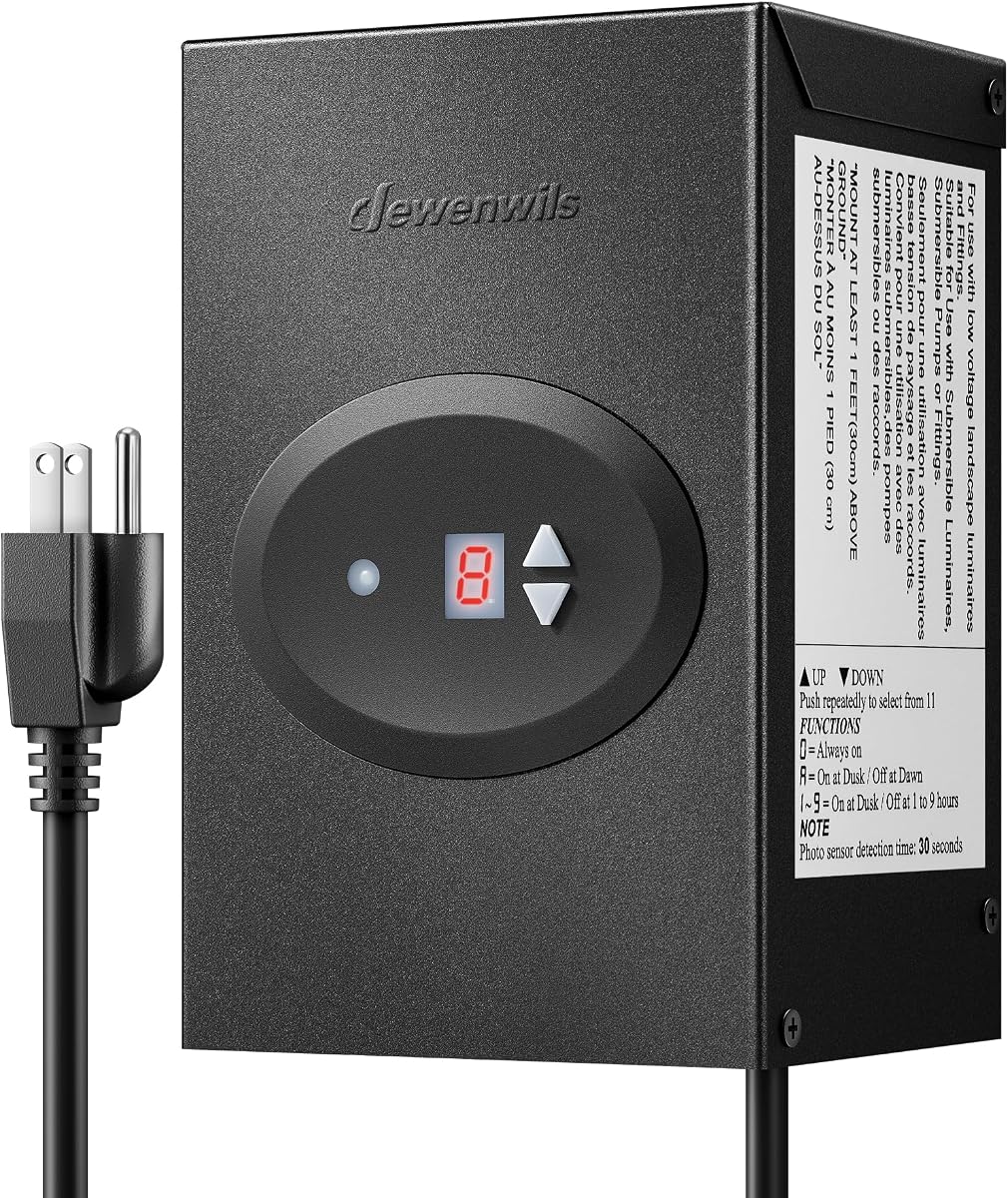
DEWENWILS 120W Low Voltage Landscape Transformer
4.6Editor score
Provides 120 watts of capacity
Includes dusk-to-dawn operation
Supports adjustable countdown timing
Retains settings after power loss
This guide compares the best tools for low voltage lighting, including connectors, transformers, and a voltage tester for safer outdoor installations.
Low voltage lighting projects depend on dependable tools that make wiring, power conversion, and troubleshooting easier. The right equipment helps installers join compatible cables, provide adequate power, and identify electrical issues while reducing the likelihood of installation errors.
This guide compares ten tools selected for low voltage lighting work, including quick-connect fittings, landscaping transformers, and an AC/DC voltage tester. The evaluation considers wire compatibility, installation method, outdoor durability, operating modes, safety features, and suitability for common landscape applications.
Each pick reveals a different practical advantage: rapid connector installation, tool-free wiring, flexible timer controls, high transformer capacity, or dependable voltage detection. Product specifications and ratings can change over time, so readers should confirm current details and compatibility before making a purchase.
4.6Editor score

4.9Editor score

4.5Editor score
The comparison below covers the complete selection, showing each tool's principal purpose, connection method, compatible wiring, and outdoor-focused features. The list includes dedicated landscape-lighting connectors, two transformers, and one voltage tester for diagnostic work.



The 24 Pack Low Voltage Wire Connector is a 4.2-rated connector set built primarily for landscape lighting systems with numerous fixtures. Its standout quality is the pack size, which gives installers enough units to connect an extensive run of path lights, spotlights, or buried fixtures without immediately needing additional fittings.
We may earn a commission when you buy through this link, at no additional cost to you.
The installation process is designed to remove the need for splicing, crimping, or separate tools. A user inserts and locks the fixture conductor, positions the connector around the feed line, compresses it, and locks the housing. Compatibility with 12, 14, 16, and 18 AWG cables, as well as SPT-1W and SPT-2W power cables, makes the set relevant to many common residential landscape systems.
The anti-corrosion PBT body is an important feature because connectors are often placed near soil, grass, mulch, and other damp locations. The listed temperature range extends from -40°F to 140°F. One consideration is that the pack does not accept every possible low-voltage wire size, so installers should confirm the gauge of their fixture leads and feed cable before ordering.
This connector set is best for homeowners or professionals planning a substantial landscape-lighting installation where many individual fixtures need a dedicated connection point. It is less appropriate for a single-lamp repair, but for a larger run it offers a convenient and weather-conscious way to organize connections around gardens, driveways, walkways, trees, walls, and terraces.
With 24 connection units, this set is particularly useful when a project includes many path lights, uplights, or in-ground fixtures. The stated design treats each mounting as a complete connection point, helping installers map the lighting run more directly than a collection of two-piece splice arrangements.
The three-step locking method reduces the number of separate skills required for basic cable joining. Because the product does not require crimping or splicing, it can also simplify repairs and system expansion when a fixture needs to be disconnected or replaced.
We may earn a commission when you buy through this link, at no additional cost to you.
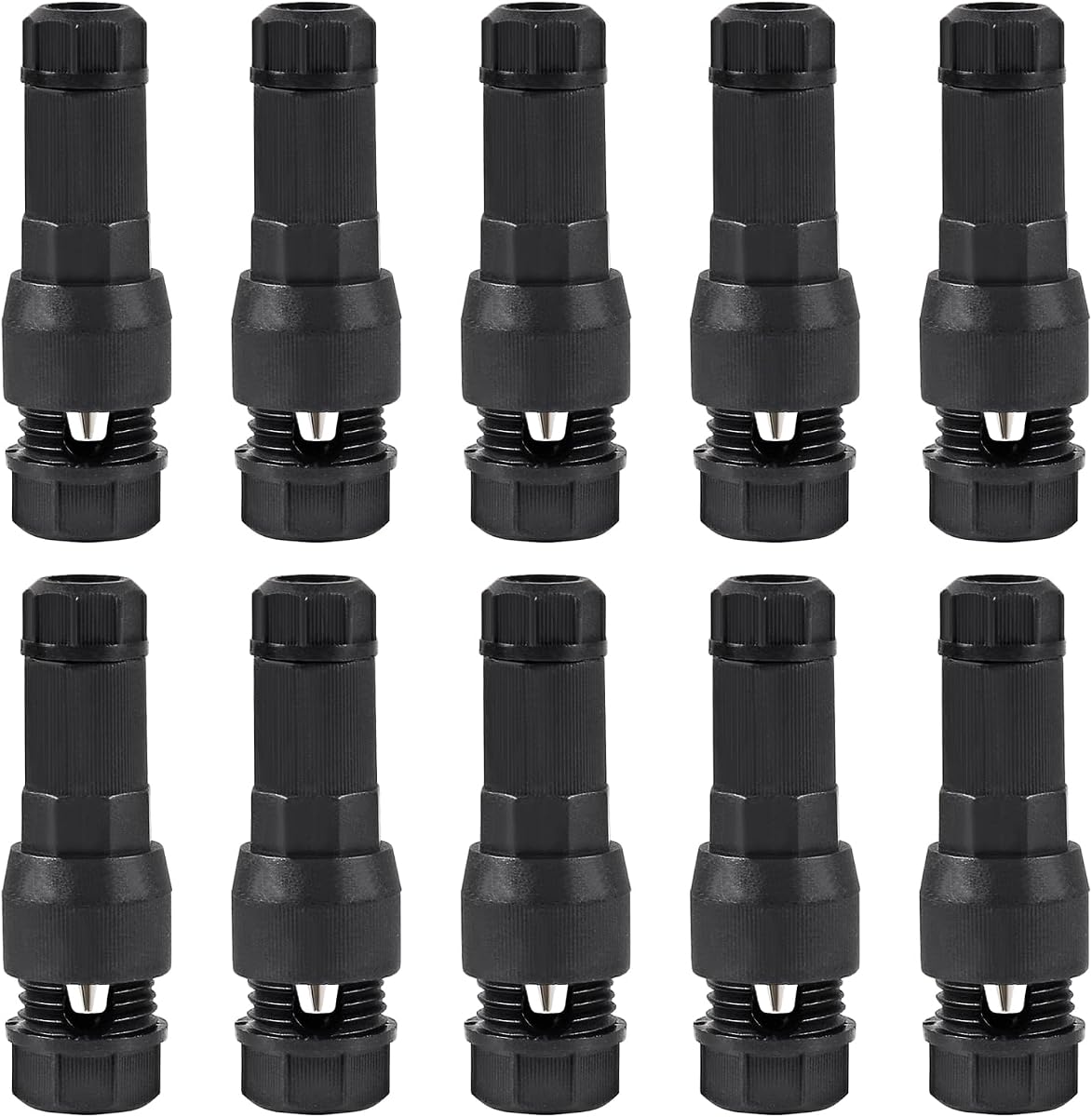
This 10-piece landscape lighting connector set carries a 4.4 rating and distinguishes itself through broad wire-gauge support. It is compatible with 12, 14, 16, 18, and 20 AWG light cords, plus 12 and 14 AWG power cords, giving it useful flexibility for mixed systems and replacement jobs.
We may earn a commission when you buy through this link, at no additional cost to you.
Its installation method uses designated wire slots, a threading mechanism, and a sharp pin that pierces the insulation to contact the conductive core. That design eliminates the need to strip wires, while the fully reusable construction allows a connector to be removed and used again during system changes. Users are instructed to align the conductors fully and gently tug the wires after tightening.
The lack of cutting, crimping, stripping, twisting, and special tools makes this set approachable for DIY projects. The piercing contact still deserves careful attention: wires should be fully seated and aligned before the connector is tightened, because improper positioning could compromise the contact. Its ten-piece quantity is more modest than the larger connector packs in this list.
This is a strong choice for users who need one connector type to handle several cable gauges or who may want to reconfigure a display periodically. It suits path lights, garden spotlights, lawn lamps, deck lighting, and other low-voltage fixtures where a reusable, tool-free connection point is valuable.
Supporting light cords from 12 through 20 AWG makes this set useful when a project combines fixture leads of different sizes. That flexibility can reduce the need to identify and carry several separate connector styles during installation.
The reusable push-style or clip-on design is useful for temporary displays and evolving landscapes. It allows a connection to be released and remade as lighting positions change, provided the wires remain in good condition and the piercing mechanism is operated as directed.
We may earn a commission when you buy through this link, at no additional cost to you.
The NETEHA 8 Pack holds a 4.6 rating and is aimed at users who place priority on connector material and environmental durability. Its housing combines nylon plastic with fiberglass, while its contact pins are CNC-machined from nickel-plated brass. Those materials are intended to withstand rain, snow, and moisture in outdoor lighting applications.
We may earn a commission when you buy through this link, at no additional cost to you.
The connectors support 12, 14, 16, and 18 AWG wires and are suitable for both 12V and 24V low-voltage systems. A twist-on, quick-lock design creates the electrical connection without crimping or soldering. The threaded fastening mechanism is intended to make repeated connections more convenient than a loose wrap-style fitting.
This set is flexible enough for path lights, deck lights, driveway lights, patio lights, garden LEDs, sprinkler-related outdoor wiring, in-ground fixtures, and well lights. The eight-piece count may be insufficient for a broad lighting network, but it is practical for focused repairs, a new walkway, or a small group of spotlights. Users should still match the actual cable gauge to the stated range.
The NETEHA set is best for contractors and homeowners who want a compact assortment of rugged, reusable outdoor connectors without separate tools. It is especially appealing when the installation contains several fixture types but uses one of the supported cable sizes, providing a consistent connection method throughout the project.
The fiberglass-reinforced nylon body and nickel-plated brass pins are meaningful features for connectors installed near landscaping beds, decks, and paths. Their material combination is designed to resist the moisture and temperature changes encountered by outdoor low-voltage systems.
The optimized threaded closure allows users to secure wires with a simple insert-and-twist process. It offers a useful middle ground between permanent soldered joints and connectors that depend on an external clamp or tool.
We may earn a commission when you buy through this link, at no additional cost to you.
The DEWENWILS 120W Low Voltage Landscape Transformer is a 4.6-rated power conversion and control unit. It converts household 120V AC into 12V AC and includes automatic dusk-to-dawn operation, making it well suited to pathway, accent, and ornamental lighting that should activate without manual daily intervention.
We may earn a commission when you buy through this link, at no additional cost to you.
Its controls include Always On, Automatic, and Countdown Timing modes. The countdown offers nine one-hour choices, allowing the lighting to switch off one through nine hours after dusk. The unit also includes a memory function that retains the selected setting after a power interruption, provided it has remained in that mode for at least 24 hours.
Installation support includes built-in mounting holes, a 3.3-foot STJW 18AWG power cord, and direct wall mounting for outdoor walls. The metal housing is described as corrosion resistant and capable of enduring extended outdoor use. The listed guidance is not to operate the transformer with a dimmer, and the combined lighting load should remain at or below 80% of capacity.
This transformer is a strong fit for a moderately sized residential landscape that benefits from automatic scheduling. It is less suitable for a system that needs 12/14V dual output, multiple timer schedules, or a load above its recommended operating range. For those requirements, a more programmable or higher-capacity model may be a better fit.
The built-in dusk-to-dawn sensor allows the connected lights to follow the evening cycle automatically. This is particularly convenient for common path and garden lighting that should remain consistent from nightfall until a selected shutdown time.
Retaining the chosen mode after an outage prevents unnecessary rework. The stated 24-hour condition means the setting must be selected and left in that mode for a full day before the memory function provides that continuity.
We may earn a commission when you buy through this link, at no additional cost to you.
The Gardencoin 12 Pack uses a one-connector-per-fixture approach to simplify landscape-lighting layouts. Its 4.5 rating reflects a product designed around a patented snap-lock mechanism, self-adjusting terminals, and a flame-retardant insulating PBT housing that has passed strict UL tests.
We may earn a commission when you buy through this link, at no additional cost to you.
Installation is intended to be tool-free and fast. A cord enters the connector slot, the snap-lock engages, and the fixture joins the low-voltage run without stripping or shanking the conductor. The anti-loosening design is meant to maintain stable power, while corrosion-resistant terminals are intended to perform in wet outdoor environments.
Wire compatibility spans 10, 12, 14, 16, and 18 gauge, but the product details specifically emphasize thin flat light cords such as SPT-1W and SPT-2W. That distinction matters because broader gauge support does not automatically mean every conductor shape or insulation type will fit. A pack of 12 suits medium-sized installations or planned future expansion.
This connector set is best for installers seeking quick attachment and a compact fixture-centered connection arrangement. It works particularly well for pathway lights, spotlights, in-ground fixtures, driveways, patios, courtyards, and sidewalks, provided the installed cords meet the stated thin-flat-cord requirement.
Using one connector for each fixture makes the overall run easier to organize and troubleshoot. It also avoids the need for multiple pieces at a single junction when comparing different connection layouts.
The tool-free closure eliminates several common preparation steps. Once the compatible cord is fully seated, the locking action completes the connection without the user having to strip, crimp, or cut the conductor.
We may earn a commission when you buy through this link, at no additional cost to you.
The Klein Tools ET45 is a 4.5-rated voltage tester designed to confirm whether a circuit is energized before work begins. Unlike the other products in this guide, it is not a connector or transformer; it is a diagnostic tool for AC and DC voltage checks across several common electrical ranges.
We may earn a commission when you buy through this link, at no additional cost to you.
The tester covers 24V to 240V AC and 32V to 330V DC across four levels. Bright LEDs indicate the voltage type and level, making the result visible in dim work areas. It powers itself from the applied voltage, so users do not need to carry or replace batteries during routine checks.
Built-in holders on the back keep the test leads organized and provide a convenient way to position them for testing tamper-resistant US-style outlets. Its IP44 ingress protection and 9.8-foot drop protection are designed for jobsite demands, while the CAT III 350V, Class 2, double-insulation rating indicates the safety category and protection structure.
This tester is best for installers who want a quick presence-and-type check before servicing a low-voltage lighting system or confirming power at a transformer. It complements rather than replaces a full multimeter: it indicates voltage but does not provide the broader resistance, continuity, and current measurements that some advanced diagnostics require.
A voltage tester helps establish whether a conductor is energized before a connection is opened or adjusted. Clear AC and DC indication helps users identify the type of power present before choosing the next diagnostic or repair step.
Because the tester draws power from the circuit being tested, there is no separate battery to install, recharge, or carry. That makes it convenient for intermittent jobsite checks and reduces one avoidable source of equipment failure.
We may earn a commission when you buy through this link, at no additional cost to you.
The 16 Pack Low Voltage Wire Connector is a 4.2-rated option for medium-sized outdoor-lighting layouts. Its principal advantage is a quantity that sits between the smaller repair packs and the 24-connector set, making it a practical match for a walkway, garden cluster, or partial system expansion.
We may earn a commission when you buy through this link, at no additional cost to you.
The installation process follows a straightforward mechanical sequence: lock the conductor from the landscape light into the connector, place the fitting squarely around the low-voltage feed line, compress the housing, and lock it. No splicing or crimping is required, and the product supports 12, 14, 16, and 18 AWG cables as well as SPT-1W and SPT-2W power cables.
Its anti-corrosion PBT plastic body is designed for exposure around roads, gardens, lawns, and alleyways. The listed operating range is -40°F to 140°F, supporting use through cold and warm seasonal conditions. The connector does not cover 20 AWG wire, so its gauge range should be checked against any thinner fixture leads in the project.
This pack is best for users who need more connection points than a small repair set but do not need to cover a very large landscape. It offers the same tool-free approach as the larger 24-piece option and works across a broad selection of path lights, spotlights, buried lights, wall lights, and tree illumination.
Sixteen connection points cover more fixtures than a compact repair pack while remaining easier to organize than a very large installation set. The result is a versatile quantity for common garden and pathway layouts.
The compress-and-lock arrangement is intended to keep conductors firmly fitted. Correct alignment around the feed cable remains important, because a connector cannot compensate for a conductor inserted at an angle or incompletely seated.
We may earn a commission when you buy through this link, at no additional cost to you.
This six-pack provides a focused set of landscape-lighting connectors and carries a 4.4 rating. Its UL listing and one-connector-per-connection design make it appealing for a small installation, a group of repairs, or a homeowner who wants to replace only a few aged fittings without purchasing a bulk pack.
We may earn a commission when you buy through this link, at no additional cost to you.
The installation process requires inserting and locking the fixture conductors, positioning the connector around the feed line, and securing the housing. It is designed for 12, 14, 16, and 18 gauge wire and avoids splicing or crimping. Because the arrangement treats each unit as a complete connection point, six connectors are presented as support for six fixture connections rather than three paired joints.
The product is intended primarily for SPT-1 and SPT-2 light wire. If a cable is thinner than those types, the instructions recommend stripping and folding it before fastening the clamp, followed by a gentle pressure check with pliers. That extra preparation means the fastest installation path applies to cables that already meet the stated profile.
This set is best for a compact project involving pathways, lawns, patio edges, walls, trees, or yard fixtures. It may be too limited for a large network, but it is a straightforward choice for a handful of compatible fixtures. The UL listing also gives buyers an additional documented feature to consider when selecting a connector for an outdoor installation.
A six-piece quantity is easy to organize and sufficient for several individual fixture connections. It can also serve as a maintenance kit for replacing weather-damaged connectors encountered during routine landscaping work.
The stated UL listing gives shoppers a documented construction detail to evaluate. It does not guarantee compatibility with every cable, so the supported wire types and gauge range should still be confirmed before installation.
We may earn a commission when you buy through this link, at no additional cost to you.
The iCreating 10Pack is a 4.5-rated connector option offering a balanced combination of quick installation and durable construction. Its upgraded screw-tight fast-lock design is intended to secure low-voltage landscape-light connections more quickly and conveniently than conventional multi-piece fittings.
We may earn a commission when you buy through this link, at no additional cost to you.
The connector requires no cutting, crimping, stripping, splicing, or special tools. Users insert the conductors and tighten the housing, creating a secure connection. Its sturdy nylon-plastic shell and electroplated brass pins are designed to remain dependable in outdoor environments that may include storms, heavy snow, and freezing conditions.
Wire support includes 14, 16, 18, and 20 gauge lighting wire, with compatibility listed for 12 and 14 gauge power cords. Potential applications include landscape spotlights, pathway lights, in-ground fixtures, deck step lights, and well lights. The gauge limits are important because a fixture using a heavier or differently configured conductor may require another connector type.
This set is a good value-oriented choice for a new group of path lights or several replacement connections around a yard. It combines tool-free operation with materials intended for prolonged outdoor use. Buyers should verify the actual lead and feed-wire sizes, and anyone working around energized wiring should follow appropriate electrical safety practices.
The screw-tight mechanism provides a visible, controlled way to secure each conductor. Its repeatability is useful when installing multiple fixtures with the same cable configuration and reduces the number of separate preparation tasks.
The nylon shell resists outdoor use while the electroplated brass pins provide a durable contact surface. Together, they address two commonly exposed elements in a connector: environmental wear and repeated mechanical engagement.
We may earn a commission when you buy through this link, at no additional cost to you.
The DEWENWILS 200W Low Voltage Landscape Transformer is the highest-rated product in this guide at 4.9. It converts 120V AC household power into 12/14V AC for outdoor LED and halogen fixtures, giving it the versatility to serve path, spot, deck, and string lighting within one system.
We may earn a commission when you buy through this link, at no additional cost to you.
Five operating modes expand the scheduling options: manual on/off, dusk-to-dawn, dusk-on with a two-, three-, four-, six-, or eight-hour countdown, timer-on with timer-off, and dusk-on with timer-off. A clear LED display and intuitive buttons make it easier to identify and change the active mode without navigating a complicated control panel.
Push-in terminals allow fast wiring without separate tools, while overload protection is designed to shut the unit off when necessary. The memory function restores settings after an outage, and the sealed black-plastic housing is intended to withstand rain, snow, and other harsh outdoor conditions. Because the transformer can power larger lighting loads than many compact units, users should still confirm that their planned load is appropriate.
This is the best overall selection for a new, broader landscape-lighting system or an upgrade seeking multiple timing modes. It combines generous capacity, flexible voltage output, automatic protection, and straightforward wiring in one enclosure. For a very small collection of lights, it may provide more capacity than needed, but its scheduling and installation features make it especially attractive for a complete outdoor installation.
Manual, automatic, countdown, and timed configurations cover the majority of everyday lighting preferences. This flexibility is useful for installations that need dusk activation, a defined nighttime window, or a schedule that can be changed without replacing the transformer.
Overload protection provides a built-in response when the system draws more than intended, while the memory function avoids manual resetting after an outage. The sealed housing completes the package with a focus on continuous outdoor operation.
We may earn a commission when you buy through this link, at no additional cost to you.
Choosing the right tool depends on the role it will perform in the system. Cable compatibility, environmental exposure, installation method, power requirements, timing controls, and diagnostic needs should guide the decision before any products are ordered.
Choose only a connector rated for the wiring in your installation. Confirm both wire sizes before purchasing.
Prioritize a connection method you can install consistently. Proper seating matters more than the simplest claimed method.
For exposed outdoor equipment, prioritize verified weather resistance and durable contacts. Keep electrical connections accessible and protected from standing water.
Match output voltage to the lighting system and keep the total load within the transformer's stated limits. Capacity should cover the planned fixtures without unnecessary excess.
Select controls that match the desired operating pattern. Automatic modes improve convenience, while memory and countdown features simplify long-term operation.
Count fixtures and planned expansion before selecting a pack. Favor straightforward installation methods and enough connection points for the complete layout.
Add a tester when safe troubleshooting is part of the job. Choose a voltage detector for quick presence checks, not as a substitute for a full meter.
Plan for current and future fixtures before purchasing. A written layout helps prevent shortages, incompatible connectors, and an undersized power supply.
Begin with the lighting layout and identify every fixture, cable type, feed point, and power requirement. Disconnect the transformer and other relevant power sources before changing connections. Compare each cable with the connector or transformer's specifications, inspect the conductor for damaged insulation, and confirm that the intended load and output voltage are appropriate for the system.
Install the transformer in a suitable outdoor location using the supplied mounting options, then complete and inspect the low-voltage connections according to the product instructions. Do not force a conductor into a connector that does not match its gauge or type. For piercing or clamping designs, align the wire fully before tightening, and gently check the secured connection. Route cables away from sharp edges, moving parts, and areas likely to collect standing water.
After installation, power the system gradually and observe the behavior of the transformer, controls, and lights. Use an appropriate voltage tester to confirm the presence and type of power when troubleshooting. Periodically inspect connectors for looseness, corrosion, damaged seals, pinched wires, and vegetation interference. Replace any fitting that no longer holds a secure connection, and keep transformer vents and housing openings free of debris.
The core tools are a correctly sized low-voltage transformer, compatible wire connectors, suitable low-voltage cable, and a voltage tester for verification. A connector should match both the gauge and physical type of the cable being joined. Depending on the installation, cable shears, a wire stripper, a nonconductive tool, and protective eye equipment may also be useful.
Many connectors in this guide are specifically designed for outdoor landscape use, with features such as PBT housings, reinforced nylon, plated brass contacts, and stated temperature ranges. Even weather-resistant fittings should be installed according to their instructions and protected from direct immersion or standing water where possible. Periodic inspection helps identify cracked housings, corrosion, or loose connections.
Choose a transformer whose output voltage matches the lights and whose capacity comfortably covers their combined load without exceeding the stated limit. The 120W option is suited to moderate systems, while the 200W option offers greater capacity and dual 12/14V output. Also consider available scheduling modes, mounting requirements, environmental protection, and whether the installation needs automatic dusk operation.
That depends on the connector design. Piercing-pin models may penetrate the insulation and make direct contact with the conductor, while twist-on and screw-fastening connectors may involve different preparation requirements. Some products also provide instructions for thinner-than-specified cables. Follow the included directions rather than assuming every tool-free connector works identically.
A voltage tester is designed primarily to show whether voltage is present and often identify AC or DC and the general level. A multimeter provides a broader set of measurements, such as resistance, continuity, and current, depending on the model. The ET45 is useful for quick voltage presence checks, but it does not replace a full multimeter for comprehensive circuit analysis.
Some connectors accommodate several gauge sizes, but the numerical range does not cover every cable construction. Flat SPT cords, round cords, and other conductor styles may require different fittings even when their AWG measurements overlap. Compare the physical cable profile as well as the gauge, and never force an unsuitable conductor into a connector.
The required number depends on how your connection system is arranged and how many fixtures need a connection point. Products in this guide range from six to 24 units, with several designs assigning one complete connection to each fixture. Count the planned fixture positions, include any extension or repair points, and allow for future expansion when selecting a pack.
Inspect visible connections at least seasonally and more often in areas exposed to heavy rain, irrigation, traffic, or soil movement. Look for looseness, corrosion, damaged insulation, compressed conductors, and water collecting around fittings. If a fixture flickers, operates intermittently, or no longer responds, disconnect power and inspect the affected connection and transformer before replacing components.
The DEWENWILS 200W transformer stands out as the most complete choice because it combines generous capacity, dual low-voltage output, five scheduling modes, overload protection, memory, and tool-free terminals. The DEWENWILS 120W transformer offers a dependable alternative for moderate residential systems that need dusk-to-dawn and countdown control, while the iCreating connector pack is a practical value pick for fast outdoor repairs.
For wiring specifically, begin with gauge and cable type rather than the number of pieces in a pack. The NETEHA set is notable for its reinforced housing and brass pins, the Gardencoin set for its UL-tested snap-lock design, and the UL Listed six-pack for compact repair inventories. A voltage tester should be added when verification and troubleshooting are part of the installation process.
Before purchasing, confirm the current specifications, compatibility, and included components for the exact product listing, and check whether availability or seller details have changed since this guide was prepared. Matching every connector to the real cable type, keeping transformer loads within their limits, and following safe isolation procedures will produce a more dependable low voltage lighting installation.